Torrent Based Content Streaming and Image
Compression in WSN
1 Bhushan Mahajan, 2 Dr. A. R. Mahajan , 3 A. Thomas
1
G.H. Raisoni Collage Of Engineering , Computer Science Department , RTM Nagpur University, Nagpur, Maharashtra 440016, India
2 Govt. Polytechnic Collage Of Engineering , Computer Science Department, RTM Nagpur University,
Nagpur, Maharashtra 440016, India
3
G. H. Raisoni Collage Of Engineering , Computer Science Department , RTM Nagpur University, Nagpur, Maharashtra 440016, India
Abstract - In Wireless sensing element Network era, numerous physical parameters are perceived using sensors. However the readings, that sensors sense is of terribly little numbers in size. Temperature reading or humidity readings are sensed by sensors. These are simply few numerical digits. Is the sensors doing something great besides transporting the reading (string or numeric value) from one hardware device to a different device? However, what if video, images, audio, big string or massive information is to be perceived and transferred using wireless sensing element network. Will sensors work or become unresponsive? Sadly the answer is wsn sensors will become unresponsive due to the large size of information that is troublesome to handle. This paper analysis is concentrated on a way to build the rapid info delivery and that too without using costly devices.
Keywords – Torrent, TDMA, Image Compression, Video Compression
1. Introduction
The World Wide internet is employed to transfer content at consumer aspect from some internet server. The multimedia system content is hold by server that is termed as repository. The content has to be transferred from central repository. The receiver is also one or more than one. The aim is to transfer multimedia content information at receiver from server or repository. Currently question arises if we tend to think about little capability hardware like raspberry pi at consumer end and zigbee rather than cable medium. The audio video information is captured by the supplied hardware devices like web cam or CMOS cam. The images are already in compressed form. However such information cannot be
transferred using zigbee. The question arises why. The answer is limitations of the serial communication device and the buffer size of hardware. [1]
Short introduction of related topics is given below. Design section and system overview section describe the actual experiment and its associated parameters.
2. Related Work
2.1 Serial Communication
stop bits, and parity. For 2 ports to speak, these parameters should match.
The Baud rate may be a speed measuring unit for communication. It indicates the quantity of bit transfers per second. For instance, three hundred information measure is three hundred bits per second travelled.[2] After we consult with a clock cycle, we tend to mean the baud. If the protocol demand a 3700 baud, then the clock is running at 3700Hz. this implies that the port is sampling the info over the line at 3700Hz. Information measure rates must be bigger than these are potential. Data bits are a measure of the particular information bits during the transmission. Once the transmitting node sends a packet of data, the number of actual information might not be a full eight bits. Normal values for the info packets are five, seven, and eight bits. If the info being transferred is normal text then causation seven bits of information per packet is sufficient for communication. A packet refers to one info transfer, together with start/stop bits, data bits, and parity bit. The quantity of actual bits depends on the protocol selected for transmission. Within the packet, where the actual information ends, the stop bits are used. Typical values are one bit or two bits. The info is clocked across the lines and every device has its own clock, it is possible that the 2 devices may become slightly out of adjust. Therefore, the stop bits not solely indicate the end of transmission. It also additionally offer the node some span for error within the clock speeds. The lot of bits that are used for stop bits, the bigger the lenience in synchronizing the various clocks, however the slower the info transmission rate.
Parity may be a easy variety of error checking that's utilized in serial communication. There are four styles of parity: even, odd, marked, and spaced. For even and odd parity, the port can set the check bit i.e. the last bit just after the info. If the info was 011, then for even parity, the check bit would be zero to stay the quantity of logic high bits even. If the parity was odd, then the check bit would be one, leading to three logic high bits. Marked and spaced parity doesn't really check the info bits, however merely sets the check bit high for marked parity or low for spaced parity. This enables the receiving device to understand the state of info .It also enables the device to work out if noise is corrupting the info or if the sending and receiving devices' clocks are out of synchronization and need to be adjusted.RS-232 is that the serial affiliation. It’s used for several functions, like connecting a mouse, printer, or modem. It is used for serial communication up to distances of fifty feet. It uses unbalanced signals documented to ground. The strategy utilized by RS-232 for communication permits for a
straightforward affiliation of 3 lines viz. TX, Rx, and ground. For the info to be transmitted, either side needs to be continuance send and receive the info at identical baud. Baud is bits transferred per second. We tend to use handshake at Software, Hardware and Xmodem level.
2.2 Handshaking
This vogue uses actual information bytes as controlling characters. The Tx, Rx, and ground, these three lines are used. These control characters are sent over the line like regular information. To enable or disable the transmitter, these two characters are used. These characters are XON and XOFF. These two characters are sent by the receiver of the info. It is used to pause the transmitter throughout communication. If the transmitter begins to transmit information at a high baud, then receiver can pause transmitter. Throughout the transmission, the receiver finds that the input buffer is changing into full due to the central processing being busy with alternative tasks.[4] To quickly pause the transmission, the receiver sends XOFF, till the input buffer has been empty. Once the receiver is prepared for a intake information it sends XON, to resume communication.
The biggest disadvantage to the current methodology is currently off limits for information values. Handshaking uses actual hardware lines. The RTS and CTS or DTR and DSR lines work at the side. One becomes the output and also the alternative the input. The first set of lines is Request to send and Clear to send. When a receiver is prepared for information, it will assert the RTS line which indicates that it is able to receive information. This can be then browse by the sender at the CTS input, indicating it's clear to send the info. The next set of lines is Data Terminal Ready and Data Set Ready. [5] They allow the port and also the electronic equipment to speak their standing. When the electronic equipment is prepared for information, it'll assert the DTR line indicating that an affiliation has been created across the subscriber line. When node will begin to send information, it asserts the DSR line. The DTR and DSR lines are accustomed indicate that the system is prepared for communication wherever the RTS and CTS lines are used for individual packets of information.
2.3 Xbee
In wireless environment, their information transfer rates are measured as 250 kbit/s.[2] Two models were introduced — a lower value one 1mW called as XBee and also the higher power a 100 mW called as XBee-PRO. The XBee radios will all be used with the minimum range of connections and minimum power of 3.3 V, ground, information in and information out (UART), with alternative suggested lines being reset and Sleep. In addition, most XBee families have another flow management, input/output (I/O), digitizer (A/D) and indicator lines in-built. A version referred to as the programmable XBee has a further on-board processor for user’s code. The Programmable XBee and a surface-mount version of the XBee radios were each introduced in 2010. Xbee are RF embedded modules that are dominated by the 802.15.4 standard.[4] they uses DSSS (Direct Sequence unfold Spectrum), a technology currently receptive folks. This technology was used just for military functions as a result of the low immunity of electronic countermeasures. This profit comes with a limitation. It takes additional information measure.
XBEE- modules permit extremely reliable and easy wireless serial communication between Microcontrollers, computers, systems with interface. Wireless vary of operation is from 30m to 120m. It’s an occasional power consumption device. It supports ability. It will work with any microcontroller. Some options and advantages are - it supports 802.15.4 / Multi drop network topologies, 2.4 gig cycle for worldwide / 900 rate for long-range preparation. These devices are ideal for communication as a result of handles all the fundamentals configurations. Its speeds are up to 19200 bits per second are unremarkably used. Higher than this noise that's picked up; particularly over long cable runs will introduce information errors.[6]
The XBees will operate either in an exceedingly clear information mode or in an exceedingly packet-based application programming interface (API) mode. within the clear mode, information coming back into the info IN (DIN) pin is directly transmitted over-the-air to the supposed receiving radios with none modification. Incoming packets will either be directly addressed to 1 target (point-to-point) or broadcast to multiple targets (star). This mode is primarily utilized in instances wherever associate existing protocol cannot tolerate changes to the info format. AT commands are accustomed management the radio’s settings. In API mode the info are wrapped in an exceedingly packet structure that enables for addressing, parameter setting and packet delivery feedback,[8] together with remote
sensing and management of digital I/O and analog input pins.[7]
2.4 Raspberry pi
The Raspberry Pi may be small card-sized single-board computers developed within the UK by the Raspberry Pi Foundation with the intent to market the teaching of basic engineering science in colleges and developing countries. The initial Raspberry Pi and Raspberry Pi two are factory-made in many board configurations through accredited producing agreements with urban center element14, RS elements and Egoman. The hardware is that the same across all makers. The microcode is closed-source. Many generations of Raspberry Pi's are discharged. The primary generation (Pi 1) was discharged in February 2012 in basic model A and a better specification model B. A+ and B+ models were discharged a year later. Raspberry Pi two models B was discharged in February 2015 and Raspberry Pi three model B in February 2016. [5]
Secure Digital SD cards are accustomed store the OS and program memory in either the SDHC or MicroSDHC sizes. Most boards have between one and 4 USB slots, HDMI and composite video output, and a 3.5 millimeter jack for audio. Lower level output is provided by variety of GPIO pins that support common protocols like I2C. Some models have associate 8P8C local are network port and therefore the Pi three has on board Wi-Fi 802.11n and Bluetooth.[8]
2.5 The IEEE 802.15.4
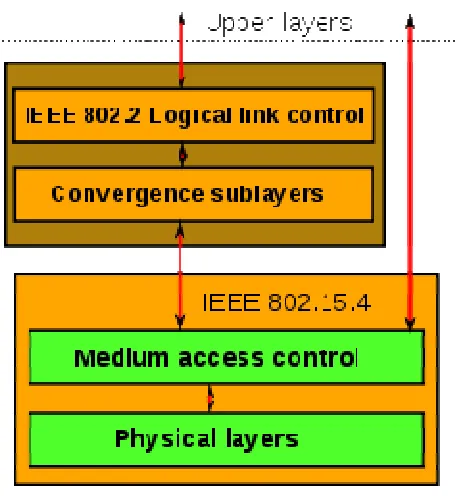
The IEEE 802.15.4 customary defines 2 layers, the Macintosh and therefore the physical layer (PHY) and uses the 3 license-free frequency bands. These license-free bands have a complete of twenty seven channels divided into sixteen channels at two viz. 4GHz with information rates of 250 kbps, ten channels at 902 to 928MHz with information rates of forty kbps, and one channel at 868 to 870MHz with an information rate of twenty kbps. Only the 2.4-GHz band operates worldwide; the others are regional bands.
Fig 1 IEEE 802.15.4 protocol Layers
Technique adopted for beingness is frequency division multiple access (FDMA), that consists of dividing the two.4-GHz band into sixteen non overlapping channels with a distance of 5MHz between them, therefore permitting devices operative in adjacent channels to be effortlessly additionally to the techniques delineated antecedently, Carrier Sense Multiple Access with Collision turning away.
CSMA/CA is additionally necessary in most networks while not beacons as a result of many devices is also operating within the same channel. this method primarily consists of listening, longing for activity, and, if the channel is busy, waiting an exact quantity of your time and checking once more, and then, if the channel isn't busy, using it.[9]
Reliability should be achieved despite time-variable error conditions on the wireless link withal, the cooperative and application-oriented nature of the detector networks and therefore the physical constraints of the nodes, like energy and process limitations, confirm the means during which these responsibilities are consummated.
This layer is divided into Logical Link management (LLC) and Medium Access management (MAC). In WSNs the elemental style issue is that the Macintosh. Macintosh protocols solve a apparently certainty of coordinating once variety of nodes access a shared communication medium.
Fig 2 IEEE 802.15.4 vs ZigBee protocol Layers
2.6 Physical Layer
The physical layer is that the 1st level of the protocol stacks. It implements the services requested by the info link layer. The physical layer is the most simple network layer for transmittal raw bits instead of packets over a physical circuit connecting network nodes. No packet headers or trailers are. The bit stream is also classified into code words or symbols and reborn to a physical signal that's transmitted over a physical transmission medium, that is that the wireless medium in an exceedingly WSN. The physical layer provides associate electrical, mechanical, and procedural interface to the transmission medium. Broadcast frequencies, the modulation theme used, and similar low-level options are laid out in the physical layer. [10]
those reasons, energy-efficient schemes in unfold spectrum systems ought to be investigated for WSNs. [11]
2.7 Data Link Layer
The information link layer is accountable for multiplexing data streams, information frame detection, medium access, and error management. It also ensures reliable point-to-point and point-to-multipoint connections in an exceedingly communication network. The foremost vital tasks of the link layer are the formation and maintenance of direct communication associations between nearby nodes and therefore the reliable and economical transfer of data across these links. [12]
2.8 Medium Access Layer
Medium Access management operation in wireless sensor networks is completely different from ancient wireless operation as a result of the inherent WSN limitation, among them the energy constraint. The MAC protocol in an exceedingly wireless multi-hop, self-organizing sensor network accomplish main goals. These are making network infrastructure. Since thousands of sensor nodes are densely scattered in an exceedingly detector field, the MAC layer ought to establish communication links for information transfer.
This forms the essential infrastructure required for wireless communication and offers the detector network self-organizing ability with efficiency mistreatment and sharing energy and communication resources between detector nodes. Novel protocols and algorithms are required to effectively tackle the distinctive resource constraints and application necessities of detector networks, which imply that MAC schemes in alternative wireless networks cannot be adopted into the detector network eventualities and quality conjointly poses distinctive challenges to MAC protocol style since weak quality implies topology changes, whereas robust quality suggests that new nodes or node failures.[13]
The delay improvement of access/transmission is treated as a difficulty that works against energy conservation, and output isn't a really vital issue for many of the applications. In a WSN, measurability and strength necessities are confronted with the frequent changes within the topology, that are typically made by temporary power decreases in nodes, node quality, new node preparation, or death of existing nodes. The necessity for measurability is clear once considering a really dense WSN with dozens or thousands of nodes.
2.9 Collision Management
Good collision management is additionally vital since it will be helpful for saving energy, each in transmission from the supply node and in reception at the destination node. Collisions ought to be avoided purposely (by giving time slot or fixed assignments of slots or TDMA or assignments beneath demand protocols) or by appropriate collision suppression procedures to offset the hidden-terminal downside in CSMA protocols. Low complexness should be consummated by the MAC protocol for WSNs associated with energy savings as a result of the nodes utilized in WSNs are straightforward. They must not consume associate exceptional quantity of resources like memory, energy, or process power. Complicated programming algorithms ought to be discarded. Most of the MAC protocols are classified in different groups: contention-based or schedule-based. The distinction is that the range of contestants that have the choice of transmittal to a node at a given instant. In contention-based protocols, any node will attempt to transmit with the danger of collisions. As all nodes ought to contend for the channel, collisions are attainable and are one in every of the key causes of energy unskillfulness. Consequently, these protocols have many mechanisms to suppress collisions or to cut back the likelihood of incidence in an exceedingly contention-based wireless detector network, since nodes will directly transmit data to the bottom station at any time, idle listening may also occur. This can be one in every of the most sources of energy waste in these networks since the nodes unremarkably stay inactive for a protracted time while not transmittal. The advantage of these protocols is their simplicity and strength. [14]
2.10 Schedule-Based Protocols
energy in their operation. In hybrid protocols, a mixture of the previous protocol varieties can be employed.
2.11 TDMA
We know that in frequency division multiple accesses, single frequency can be employed for single call making. In CDMA, single frequency can be employed for multiple calls and in TDMA, single frequency can be employed for multiple calls and multiple frequencies are employed for multiple calls. In TDMA the division of calls happens on time basis. The system converts the calls into digital calls, so combines those calls into a digital stream of bytes on one radio channel. So, divide each channel into three time slots. Whenever slot contains three call, 3 time slots get utilized .All of them are on one frequency. Out of those three calls, every call gets a slot. The users transmit information in fast way. Every call uses its own slot. This enables multiple stations to share identical single frequency and same transmission medium. It uses solely a little of its channel capacity. This TDMA technology permits 3 completely different users to use one frequency constantly. Advantage is that, there's no need for three separate frequencies like in FDMA. The TDMA expeditiously carries 3 calls at constant time; this technology is that which is utilized in our GSM system.
2.12 Lossless Compression
It is a compression algorithm type that permits the first information to be utterly reconstructed from the compressed data. Against this, lossy compression permits reconstruction solely of associate approximation of the first information; although this typically improves compression rates (and so reduces file sizes). Lossless information compression is employed in several applications. It is utilized in the file format and within the tool gzip. It is additionally used as an element among lossy information compression technologies (e.g. lossless mid/side joint stereo pre-processing audio encoder and lossy file encoders. Lossless compression is employed in cases wherever it's vital that the first and also the decompressed information be identical, or wherever deviations from the first information might be hurtful. Typical examples are feasible programs, text documents, and ASCII text file. Some image file formats, like PNG or GIF, use solely lossless compression, whereas others like JPG could use either lossless or lossy ways. Lossless audio formats are most frequently used for archiving or production functions, whereas smaller lossy audio files are generally used on transportable players and in different cases wherever cupboard space is restricted or actual replication of the audio is not sensible. [17]
Lossless sound compression algorithms will profit of the continuation patterns shown by the wave-like nature of the information. Basically exploitation autoregressive models to predict the "next" price and secret writing the (hopefully small) distinction between the expectation and also the actual data. It is typically useful to compress solely the variations between two versions of a file. [15]
2.13 A Color-Indexed Image
It is depicted with a color index map every component of that is associate index to pick out a color from a predefined set of colors referred to as palette to represent the color of a component within the image. Two utterly different colors will be of comparable index values in a very palette. Hence, it's perpetually a difficult task to compress a color-indexed image because the compression should be lossless associated prognosticative writing techniques are typically not effective to predict an index supported the spatial correlation of the index map. Palette rearrangement could be a remedial method aiming at finding a permutation of the color palette to form the ensuing color index map additional appropriate for prognosticative writing. [15] Typical palette rearrangement will reorder palette color to make a static palette whose index assignment is common to all or any pixels for creating the rearrangement clear to the decoder. Associate adaptation palette rearrangement methodology is used. This methodology adaptively reorders the palette to form the index assignment pixel-dependent. By thus doing, the rearrangement isn't any longer clear to the decoder. However, the resultant index map of the first color-indexed image will be of abundant lower zero-order entropy, smaller index variance and fewer spatial correlations, that make the index map abundant easier to be encoded expeditiously with a typical lossless codec. Numerous lossless writing algorithms for color-indexed pictures will then be developed.[16]
2.14 Histogram
2.15 A JPEG Compression
JPEG is a lossy image compression method. It employs a Transform coding method using the DCT (Discrete Cosine Transform). Main Steps in JPEG Image Compression
Transform RGB to YIQ or YUV and subsample color.
DCT on image blocks.
Quantization.
Zig-zag ordering and run-length encoding.
Entropy coding.
In jpeg Compression, first step is to divide an image into blocks with each block should have dimensions of 8 x8. The range of the pixels intensities now are from 0 to 255. Intensities are changed and brought to the range from -128 to 127. Then subtract -128 from each pixel value and it yields pixel value from -128 to 127. So now range is reduced. After subtracting 128 from each of the pixel value, we get the results in matrix. Use following formula to compute DCT matrix.
There is a standard Luminance matrix. That is used for computing Quantization matrix.
F(u, v) represents a DCT coefficient, Q(u, v) is a “quantization matrix” entry, and Fˆ(u, v) represents the quantized DCT coefficients which JPEG will use in the succeeding entropy coding.
Pseudo Code –
blockf = np.float32(block) # float conversion dst = dctop(blockf)#cv2.dct(blockf) # dct blockq = np.around(np.divide(dst, std_quant_tbl[channelsel])) blockq = np.multiply(blockq, std_quant_tbl[channelsel]) blockz = zigzag(blockq)
zeros = Extractzero ( blockz ,channel)
Pseudo Code of Quantization –
ffk=np.zeros(shape=(8, 8),dtype=int) i=0
for xx in f_j: n = len(xx)
F_k = np.zeros(n , dtype=float) for k in range(n):
F_k[k] = 0.5 * ( xx[0] + (-1)**k * xx[n-1] ) for j in range( 1 , n - 1):
F_k[k] += xx[j] * np.cos(np.pi * j * k / (n-1))
ffk[i] = F_k i=i+1
3. Design
To set up Torrent based environment, sender and receiver node is set up. Among these two nodes, multiple forwarding nodes act as forwarder. Encoding process is done by image capturing device. While sending packet , multiple paths are used by the sender. At multiple intermediate nodes, the decompression takes place. Final result is accumulated at receiver node. For example a Client C1, Neighbor N1 and Neighbor N2 are wirelessly connected to V1 Video Server network. All 3 nodes are near to each other. C1 raise a Video request. Neighbors N1 and N2 have spare information and, being willing to join, each connect with C1 employing a wireless ad-hoc network. C1 informs the Video Server regarding its active Neighbors and also the video server V1 streams the video through all the obtainable nodes close to it. The V1 server sends frames information in a very file. Information is in variety of code characters. Ex- [240,-11, 12,'r61'] it's a quantization matrix when zigzag travel complete, ac value is stored as 240. DC value is -11 and 12 . r61 represent sixty one zeros in 8 x 8 matrix. So the total elements are sixty four. It’s a block of 8x8 pixels and similar info for all rest of the blocks has to be convey to another node through intermediate nodes. This is to be done with R channel , G Chanel and B Chanel. Then every color channel is split into 8x8 blocks. Each 8x8 block are reduced to 3-4 values tuple exploitation jpeg compression process. These tuples are hold on in file. Exploitation these dictionaries are recreated at receiver aspect and image is recreated.
code and it's continual FF times (255 times). So similar color if continued then it will be logged. It is temporal redundancy recording in a file using Color code and color index. Color Index file contain following entries within the variety of dictionaries. 2: (FF, 87, 2A) Here 2 could be a code and FF is R intensity 87 is G intensity and 2A is B intensity.
Now just in case of two adjacent pictures, one will determine the distinction between pictures. Whereas examination two pictures , the logic scan pixels row by row. Logic may travel column by column additionally supported bound criteria. Then rule finds that at sixteenth position say, the component in second image isn't like component in 1st image. It logs the entry in distinction file. 1F: '(FF, FF, FF)', this entry represent at position index 1F. It found a component having completely different combination of RGB. Instead of RGB value, RGB code can be also used. 1F: '(3B)', It indicate at position 1F, color code 3B is found which is different than the color code of reference image.
The video server sends frame one to the requesting node C1, sends frame two through Neighbor N1 and frame three through Neighbor N2. While streaming, the system totally utilizes the obtainable information measure all the 3 links and adapts dynamically to any amendment in information measure. These N1 and N2 act as seeds for consumer C1. C1 is mere accumulate decompressed information from N1 and N2 and merge final combined media content. System performance is to be evaluated exploitation metrics like combination output and video quality. To assess the video quality, we tend to live the play out time, start-up delay and re-buffer events throughout streaming.
4. System Overview
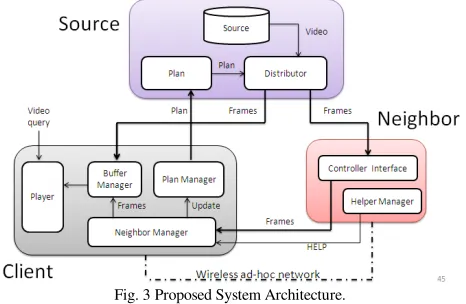
When a user requests a video, the Neighbor Manager creates ad-hoc network and waits for Neighbors to hitch the ad-hoc network. The Neighbor Manager sporadically broadcasts REQUEST messages to seek out new Neighbors within the ad-hoc network that are willing to contribute information measure. The Neighbor Manager keeps associate updated information of active Neighbors willing to assist within the system. The Neighbor Manager monitors for periodic heartbeat messages (I-CAN-HELP messages) from the Neighbors and perpetually keeps track of Neighbors connexion and deed the Neighborhood. The Neighbor Manager sporadically informs the Video arrange Manager regarding the active Neighbors and changes in Neighborhood (new Neighbors
connexion and Neighbors leaving). The Neighbor Manager receives video frames from the active Neighbors and forwards it to the Buffer Manager. It keeps track of the frames received from every of the Neighbors and informs the Video arrange Manager. The Video arrange Module could be a core element of the consumer that perpetually informs the Video Server regarding the streaming arrange. The role of the Video arranges Manager is summarized below: The Video Manager constructs the streaming Meta data with Neighbor details and sporadically updates the arrange Handler within the Video Server. The streaming consists of knowledge regarding the consumer and Neighbor links (IP address and Port) that the Video Server will use to stream video to the consumer two. Once a brand new Neighbor, able to contribute information measure, joins the ad-hoc network, the Video arrange Manager informs the Video Server regarding the Neighbor in order that the Video Server will quickly use extra information measure to stream. Once a Neighbor leaves the network, the Video arrange Manager informs the Video Server in order that the Video Server will recover lost frames and stream through different active links.
Fig. 3 Proposed System Architecture.
5. Result
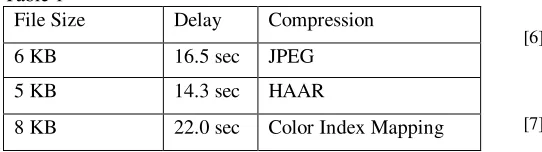
have totally different information measure, then the frame distribution formula might assign the frames additional showing intelligence. An answer is to stay track of the frame requests by the consumer and Neighbor threads and assign frames supported their frequency compared to others. The information measure of the links might be calculable and frames appointed supported their ratios. To form positive frames arrive so as, the frame assignment theme might assign frames to threads in such the way that by the time they reach the consumer, they're virtually so as. as an example, within the on top of situation, if the Video Server estimates that the information measure of the Neighbor is 10 times slower than that of consumer, it might look ahead and assign frame eleven to the Neighbor rather than the frame at the top of the queue (frame 1). in this method, frame eleven can hit the consumer at a similar time it had finished streaming frames one to ten through the consumer link. Below is the delay chart using compression algorithm and API mode of Xbee.
Table 1
File Size Delay Compression
6 KB 16.5 sec JPEG
5 KB 14.3 sec HAAR
8 KB 22.0 sec Color Index Mapping
Below is the delay chart using compression algorithm and Serial mode of XBee.
Table 2
File Size Delay Compression
6 KB 8.5 sec JPEG
5 KB 6.3 sec HAAR
8 KB 12.0 sec Color Index Mapping
In order to reduce the data to be transported, some encoding tools can be used.
6. Future Scope
A color-indexed image can be represented with a color index map each element of which serves as an index to select a color from a predefined set of colors called palette to represent the color of a pixel in the image. Jpeg Compression can provide image metadata smaller in size. API mode of XBEE is not sufficient since data cannot be delivered fast. Serial mode of Xbee can be used to implement Torrent based architecture. Audio and Video can be transported from one hardware to another.
References
[1] “Video Summary Delivery Over Cooperative Wireless Networks”, Song Ci, Dalei Wu, Yun Ye, Zhu Han, Guan-Ming Su,Haohong Wang, Hui Tang , Ieee Wireless Communications , April 2012 .
[2] “Cloud Enhanced Smart Home Technologies”, Ivan Kastelan, Mihajlo Katona, Goran Miljkovic, Tomislav Maruna, Mirko Vucelja, 2012 Ieee International Conference On Consumer Electronics (Icce), 2012. [3] “Operator Controlled Device-To-Device
Communications In Lte-Advanced Networks”, Lei Lei And Zhangdui Zhong, Chuang Lin, Xuemin (Sherman) Shen, Wireless Communications, April 2012.
[4] “Interference Management With Relay Cooperation In Two-Hop Interference Channels”, Jun Zhang And Khaled B. Letaief, Ieee Wireless Communications Letters, Vol. 1, No. 3, June 2012.
[5] “Effective Video Multicast Using Svc With Heterogeneous User Demands Over Tdma Based Wireless Mesh Networks”, Jin-Bum Hwang And Chae Y. Lee, Member, Ieee, Ieee Transactions On Mobile Computing, 2012.
[6] “Energy-Performance Trade-Offs In Multiuser Scheduling: Large System Analysis”, M. Majid Butt, Ieee Wireless Communications Letters, Vol. 1, No. 3, June 2012.
[7] “Optimal Relay Selection And Power Allocation For Cognitive Two-Way Relaying Networks” , P. Ubaidulla , And Sonia A¨Issa, Senior Member, Ieee,Ieee Wireless Communications Letters, Vol. 1, No. 3, June 2012.
[8] “Energy Efficiency Of Cooperative Relaying Over A Wireless Link”, Nof Abuzainab, Anthony Ephremides, Ieee Transactions On Wireless Communications, Vol. 11, No. 6, June 2012.
[9] “A Smart Job Scheduling System For Cloud Computing Service Providers And Users: Modeling And Simulation”, Kushal Dutta,, 1st Int’l Conf. On Recent Advances In Information Technology Rait- 2012 .
[10] Cooperative Layered Video Multicast Using Randomized Distributed Space Time Codes Özgü Alay, Student Member, Ieee, Pei Liu, Member, Ieee, Yao Wang, Fellow, Ieee, Elza Erkip, Fellow, Ieee, And Shivendra S. Panwar, Fellow, Ieee Ieee Transactions On Multimedia, Vol. 13, No. 5, October 2011
[11] Time-Diffusion Synchronization Protocols In Wireless Sensor Networks , Mantian Xiang, Lihua Sun, Lihong Li , Nanchang, China
[12] On The Effect Of Cooperative Relaying On The Performance Of Video Streaming Applications In Cognitive Radio Networks , Zhangyu Guan†‡, Lei Ding‡ , Tommaso Melodia‡, And Dongfeng Yuan† , Ieee Icc 2011 Proceedings
[14] End-To-End Statistical Delay Bound Amin Abdel Khalek And Zaher Dawy
[15] Study On Monitoring Systems With Video Capture Cards And Wireless Sensors, Gong Xiugang , Li Yang M, Ieee 2011.
[16] An Adaptable Mobility-Aware Clustering Algorithm In Vehicular Networks, Mildred M. Caballeros Morales, Choong Seon Hong, Ieee 2011.
[17] Time Sync Protocol For Sensor Network,Ganeriwal, S.; Kumar, R. & Srivastava, M. . The First Acm Conference On Embedded Networked Sensor System (Sensys), Los Angeles, Nov., Pp. 138–149, 2005
Bhushan N. Mahajan received Master of Engineering degree [M.E.]
in WCC in Computer Science department at GHRCE , Nagpur university , India in 2010. He is now working on Video streaming energy and power management topics and various schedule development strategies in WSN . He has a special interest in topology modeling of ad-hoc network i.e. wireless sensor network , wireless mesh network and MANET . He has simulated various network scenario using ns2 network simulator software and other programming languages.
Dr. A. R mahajan is working as Head of Information Technology
Department, GP, Nagpur. She is BE and ME in Computer Science and Engineering She has completed her PhD in Computer Science and Engineering. She has presented twenty four papers in International Journal and one paper in national Journal She has published Fourty three papers in International conferences and five papers in national conferences .She has more than twenty years of experience. Her area of specialization is compiler optimization, Artificial Intelligence, Parallel algorithms. She is a member of IEEE, ISTE, CSI.
A. Thomas received M.E. in 2012. She is Head of Computer