R E S E A R C H A R T I C L E
Open Access
Using eye tracking and gaze pattern
analysis to test a
“
dirty bomb
”
decision aid
in a pilot RCT in urban adults with limited
literacy
Sarah Bauerle Bass
1*, Thomas F. Gordon
2, Ryan Gordon
1and Claudia Parvanta
3Abstract
Background:Eye tracking is commonly used in marketing to understand complex responses to materials, but has
not been used to understand how low-literacy adults access health information or its relationship to decision making.
Methods:This study assessed how participants use a literacy appropriate“dirty bomb”decision aid. Participants were randomized to receive a CDC“factsheet”(n= 21) or literacy-appropriate aid (n= 29) shown on a computer screen. Using 7 content similar slides, gaze patterns, mean pupil fixation time and mean overall time reading and looking at slides were compared. Groups were also compared by literacy level and effect on 'confidence of knowledge' and intended behavior.
Results:Results revealed differing abilities to read densely written material. Intervention participants more precisely followed text on 4 of 7 content-similar slides compared to control participants whose gaze patterns indicated unread text, or repeated attempts at reading the same text, suggesting difficulty in understanding key preparedness messages. Controls had significantly longer pupil fixations on 5 of 7 slides and spent more overall time on every slide. In those with very low literacy, intervention participants were more likely than controls to say they understood what a
“dirty bomb”is and how to respond if one should occur.
Conclusions:Results indicate limited- literacy adults, especially those with very low literacy, may not be able to understand how to respond during a“dirty bomb”using available materials, making them vulnerable to negative health events. This study provides insights into how individuals perceive and process risk communication messages, illustrating a rich and nuanced understanding of the qualitative experience of a limited literacy population with written materials. It also demonstrates the feasibility of using these methods on a wider scale to develop more effective health and risk communication messages designed to increase knowledge of and compliance with general health guidelines, and enhance decision making. This has application for those with learning disabilities, those with limited media-literacy skills, and those needing to access the diverse array of assistive technologies now available. Eye tracking is thus a practical approach to understanding these diverse needs to ensure the development of cogent and salient communication.
Keywords:Eye tracking, Low literacy, Risk communication, Emergency preparedness,“dirty bomb”, Decision-making
* Correspondence:[email protected]
1Department of Social and Behavioral Sciences, Risk Communication
Laboratory, Temple University, College of Public Health, 1301 Cecil B. Moore Ave., Philadelphia, PA 19122, USA
Full list of author information is available at the end of the article
Background
Eye tracking technology assesses how individuals view visual content by monitoring and recording eye move-ments as a subject processes the stimulus in real time. All systems use cameras, with some mounted to a flat stable surface and others embedded in a computer screen or mounted on lightweight glasses. Eye tracking is commonly used in marketing research [1], training systems involving hand-eye coordination (e.g., pilot flight training, surgery training) [2, 3], academic applications such as reading instruction or studies of cognition and information processing [4], and digital design work (e.g., websites, smart phones and tablet applications) [5, 6]. Eye movements, and the time spent on any one passage or image, indicate an individual’s interest or attention and provide an index of the input of information to more complex processing and/or reasoning [7, 8]. Eye tracking output can also clearly differentiate whether an individual is reading text as expected [9–12] or if a sub-ject runs their eyes repeatedly over the same passages, suggesting difficulty in processing. The relationship be-tween eye-tracking and comprehension has been studied since the early 1990’s, throughout which eye-tracking methodologies have made valuable contributions to our understanding of how to integrate information from texts, graphics and images to maximize comprehension. Current studies indicate brain structural correlates to text and sentence construction with comprehension can be validated with eye tracking methods [13]. Eye track-ing can also be used to pinpoint specific pieces of content that pose comprehension difficulties, and these measures can be related to other outcome measures, such as knowledge gained, decision making, and intended or actual behavior. As such, eye movement measures can provide valuable information for the de-sign or refinement of health communication materials, particularly when these combine language and visual information processing [14, 15], to enhance decision-making.
While eye tracking has been used in a number of health-related studies [15–19] few have used it to under-stand the needs of low-literacy groups [9, 20], and none have used eye tracking to test a decision aid for readabil-ity and comprehension by intended users with low liter-acy, comparing text that is written in an accessible format to text that is typical of the type of health infor-mation available to the public on the Internet. The present study fills this gap by testing a decision aid de-signed to provide information about what to do in the event of a“dirty bomb”explosion in an urban area.
The importance of examining low-literacy populations’ perceptions of and responses to Radiological Terror Events (RTEs) such as a “dirty bomb” is evident. The 2003 National Assessment of Adult Literacy, the most
recent national-level assessment of literacy, revealed that 14 % of adults in the United States have below basic lit-eracy, 22 % have basic litlit-eracy, 53 % have intermediate literacy, while only 12 % are proficient [21]. Overall, the United States ranks 17thof 24 developed nations in liter-acy ability [22]. The National Center for Education Statistics(NCES) found that having only basic health lit-eracy was greater in urban areas (16.3 %) compared to non-urban areas (13.1 %), with minorities and those over age 65 being most at risk of having literacy issues [23]. This prevalence has significant implications for commu-nicating threats about terror, especially terror events that may be difficult to conceptualize, such as an explosion that includes radiation exposure.
The needs of low-literacy populations in the event of a terror or bioterror event are not well understood. This is especially critical because as we move farther away from the September 11, 2001 attacks, a decrease in resources directed toward emergency preparedness has occurred. RTEs, such as the explosion of a“dirty bomb”, present a threat that requires national, state, and local prepared-ness [24], but little research has been conducted on the public’s likely response. Studies that have been done in-dicate that potential threats from nuclear technologies and radiation contamination are increasing exponentially [25, 26], while at the same time these types of terror attacks are not well understood, and thus trigger ex-ceptional feelings of helplessness, confusion, fear, and distress [27, 28].
dirty bombs. A study conducted by Wray et al. found that participants preferred messaging that provided clear and accurate information and concrete action steps that were simple and consistently presented; since individuals were often confused by terms and messages utilized in current governmental communication efforts (e.g.,“shelter in place”) [31]. Additionally, non-English speakers had difficulty understanding messages and feared they would miss critical information [31]. Currently, however, no studies have developed or tested literacy appropriate health communication materials or interventions for urban adults with limited literacy, but there is evidence from other domains, such as healthcare, that designing materials for literacy has effects not only on understand-ing of materials but on behavior as well [34–36].
The present study sought to address this gap by using eye tracking to assess how a systematically-developed, literacy appropriate decision aid, designed to foster un-derstanding about how to respond to a “dirty bomb” event, addressed the needs of adults with limited literacy compared to a higher-literacy sample. The content of the decision aid was based on “Frequently Asked Ques-tions” information developed by the Centers for Disease Control and Prevention (CDC), one of the few materials on RTEs publically available. Results showed clear pat-terns of differential text use in a small randomized pilot and demonstrated that eye tracking is a viable and useful tool in the quest to design materials for low-literacy groups to enhance decision-making.
Methods
This study included a multi-phase protocol. Phase I in-cluded qualitative focus groups and quantitative surveys. Results of this phase were used in Phase II to develop a low-literacy risk communication decision aid about “dirty bomb” RTEs. Phase III involved testing the devel-oped decision aid in a pilot randomized controlled trial. This paper discusses the results of Phase III, and focuses on the eye-tracking results.
Study phases
Phase I included both qualitative and quantitative data collection. This involved three focus groups with thirty-seven urban 18 to 65-year-olds, representing both men and women recruited from areas with low income and education levels in Philadelphia, PA [37]. From existing lit-erature on perceptions of radiation and radiological terror, a moderator’s guide was developed and tailored for the target sample [38]. These questions helped to identify the range of cognitive and affective issues thought to be important for understanding perceptions of dirty bombs, including: (1) perceptions of emergency situations, (2) knowledge of a dirty bomb, (3) reaction to dirty bomb sce-narios, and (4) comprehension of information provided.
Results were analyzed using the Krueger method of ana-lyzing narrative text, including familiarization, identifying a thematic framework, indexing, charting, mapping, and interpretation [39, 40].
Focus group results were then used to develop a com-prehensive survey administered to 50 low-literacy adults, which assessed perception and understanding of a“dirty bomb,” trust of information sources, and intention to comply with government directives about “sheltering in place.” Implemented as a cross-sectional intercept sur-vey, recruitment of respondents occurred in a variety of community-based sites in North Philadelphia, including local hospitals, neighborhood youth and senior commu-nity centers, and supermarkets. Four groupings of conceptually-related statements were included in the survey, including: 1. Statements on knowledge of a dirty bomb, trust of information sources if a dirty bomb oc-curred, and need for information about who was respon-sible for the event; 2. Statements on action intentions (staying home vs. leaving; getting children/family), belief in general preparedness, and preparedness activities such as having an emergency plan, food, and water; 3. State-ments on what respondents would be worried about in the event of a dirty bomb, such as safety of food and water, risk of illness, breathing radiation, and its effects and risks to children and pets; and, 4. Statements that assessed participants’ perspectives of how likely a dirty bomb is to occur; likelihood of this event occurring compared to other threats (such as violence, flooding, or a car accident); beliefs about the trustworthiness of local, state, and federal authorities; and, whether their neighborhood would be treated fairly in response/re-covery efforts.
mapping display (i.e. changing the perceptions or atti-tudes of the target segment). After the perceptual map is produced to display the relationships among concepts and between the concepts and “self”, vector modeling is used to determine which concept or concepts should be emphasized in a message or intervention to “move” the group toward the desired behavior, in this case to “shelter in place” in the event of a “dirty bomb”. This desired behavior establishes the target vector. (For more information on perceptual mapping and message vector modeling techniques, see http:// sites.temple.edu/turiskcommlab/).
Based on these results, we developed a literacy-appropriate decision aid, optimizing the fit between the subjects’perceptual maps and the content and format of literacy-appropriate information about a “dirty bomb”. The resulting decision aid included overall information about what a“dirty bomb”is and how to respond should an explosion occur, as well as specific message concepts determined to be important through the perceptual mapping. These concepts included: (1) Emphasizing trust in the information and recommended responses of authorities/experts, (2) Complying with recommended actions, and (3) Getting prepared for an emergency be-fore one occurs. We also emphasized that in such a cri-sis, it is less important to dwell on who was responsible for the attack (a common need felt by victims of attacks that can impede taking immediate action) than it is to determine how to immediately protect yourself and your family. As well, the decision aid presented straight-forward information about what a dirty bomb is and how to respond if one occurred.
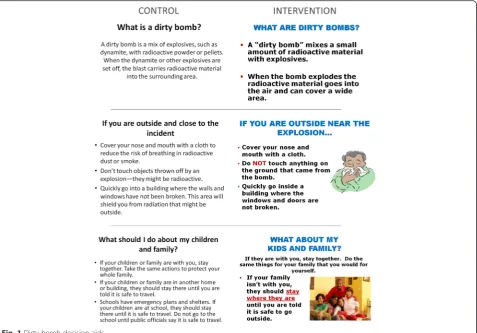
The control material was the CDC’s printed docu-ment, “Frequently Asked Questions” for a “dirty bomb”, which is available to the public on the CDC website (http://emergency.cdc.gov/radiation/dirtybombs.asp) and presented in a question/answer format. The reading level of this material, assessed using the Flesch-Kincaid test [46], was at an 8.2 grade level. Since the text on CDC’s website involved scrolling down a page and we wanted to be able to compare how participants read unique text and compare it across groups, both control and inter-vention materials were presented through a PowerPoint slide format, with each “question and answer” on a dif-ferent slide. To focus on literacy relevant variables, the layout, graphics, and basic format of the low-literacy de-cision aid was made consistent, but text was written at a 5thgrade reading level and utilized graphics to represent words. The CDC FAQs decision aid was 19 slides, com-pared to the intervention (low-literacy) decision aid, which was 35 slides. Many slides were content similar, but the intervention decision aid was longer to account for special message content derived from the perceptual mapping but not addressed in the CDC's FAQs. Figure 1
illustrates differences between the Control decision aid (CDC's content) and the Intervention decision aid (de-signed for low-literacy individuals) on three content-similar slides.
DuringPhase IIIof the study, a randomized pilot-test comparing the developed literacy appropriate “dirty bomb” decision aid (intervention) and the existing CDC “dirty bomb” FAQs (control) was conducted with a con-venience sample of 50 adults (29 in the intervention group, 21 in the control group) in the Risk Communica-tion Laboratory at Temple University in Philadelphia. The testing occurred over six months, between January and June, 2012. We conducted this pilot study to assess the feasibility of conducting a fully powered randomized trial on whether a systematically developed, literacy ap-propriate decision aid would help urban residents under-stand the risks of a “dirty bomb” and how to respond if one occurred, as well as to determine if eye tracking was a useful and valid method of determining how those with low-literacy can or cannot access text.
Participants were recruited for the pilot through community-based methods, including placing flyers in the Temple University Hospital’s General Internal Medicine Clinic, community organizations surrounding Temple University, as well as local pharmacies and su-permarkets. Flyers included a “tear tab” with a phone number so those interested could call about participat-ing in the study. We also focused on users of a neighbor-hood food bank, a senior services organization, and a federal services office. In these cases, research assistants visited the sites, talked with people about the study and screened them for eligibility. The goal was to have par-ticipants who closely represented people who matched the socio-demographic groups represented in the focus group and survey analysis.
dyslexia or other learning problems that interfere with reading/tracking text. If eligible, appointments to come into the Risk Communication Laboratory were made and participants were randomized to the control and intervention groups using a random numbers table. Par-ticipants were provided incentives to take part in the study, including a $20 gift card and two transit tokens. The university's Institutional Review Board approved all procedures and consent materials.
When participants arrived at the Risk Communication Laboratory a trained research assistant orally adminis-tered all consent forms and instruments, which were tailored for people with low literacy. The eye tracking data collection procedures were explained to participants using pictures of the equipment and samples. Partici-pants were then escorted to the testing lab, which is a small private room, and they were connected to the eye tracking system in preparation for viewing their assigned decision aid. The input from the physiological monitors was fed directly into a computer database for storage and analysis. Eye tracking was performed using an Applied Science Laboratory stationary eye tracker (Eye Trac 6000). This equipment requires a participant to sit in front of a screen with a Velcro band around his/her head, which
automatically corrects for any head movement during eye tracking data collection. The control and intervention messages were presented on a computer monitor for each participant to view. Once the system acquired a pupil lock and calibrated the subject’s eye tracking, he/she was told to look at the screen and read the slide presented, and then indicate to the technician when he/she was done. The technician then advanced the slide for the participant until he/she was done looking at all slides. Once the participant was finished, he/she was directed back to an-other room where the post-education survey protocol was conducted. The full study took approximately 45 min to administer. Results of eye tracking analyses are discussed here.
Analysis
trouble filling out medical forms on the SILS), compared to those with low literacy (defined as those who scored a 3–6 on the REALM-R or said they “sometimes” have trouble filling out medical forms of the SILS). Demo-graphic characteristics of these groups are provided in Table 2. For continuous variables (Tables 3, 4 and 5), means, sample sizes and standard deviations are pro-vided. Using SPSS Version 23, T-Tests were computed to examine differences between groups as well as sub-groups by literacy level. Four sub-groups were used: 1. Inter-vention, Very Low Literacy; 2. InterInter-vention, Low literacy; 3. Control, Very Low Literacy; and, 4. Control, Low
Literacy. Group differences were examined on mean qualitative ratings of ability to track text, average pupil fixation, and average time to complete reading a slide, a composite average of these ratings, as well as outcome measures of confidence in knowledge of what a “dirty bomb” is and intended behavior in the likelihood of a “dirty bomb”exploding.
To extract pupil fixation and average time to complete a slide, as well as extracting the gaze patterns, the Eyenal software program (designed for analysis of eye-tracking data) was used (Applied Science Labs). In addition, a 5-point subjective rating scale was developed and tested by
Table 1Demographic Characteristics and Literacy Test Means, RCT Intervention and Control Groups
Number Percent
Control Intervention Control Intervention
Age
23–35 4 3 19.05 11.11
36–50 9 18 42.86 66.67
51–59 7 5 33.33 18.52
60–67 1 1 4.76 3.70
Total 21 27 100.00 100.00
Race
African American 20 24 95.24 82.76
Mixed 0 1 0.00 3.45
White 1 2 4.76 6.89
Asian 0 1 0.00 3.45
Native American 0 1 0.00 3.45
Total 21 29 100.00 100.00
Hispanic Origin
Yes 0 2 0.00 7.14
No 20 26 100.00 92.86
Total 20 28 100.00 100.00
Gender
Male 10 16 47.62 55.17
Female 11 13 52.38 44.83
Total 21 29 100.00 100.00
Education
Grade School 0 2 0.00 7.14
Some High School 7 7 35.00 25.00
Graduated High School 11 15 55.00 53.57
GED 1 2 5.00 7.14
Some College 1 1 5.00 3.57
Graduated from College 0 1 0.00 3.57
Total 20 28 100.00 100.00
Literacy Scores
REALM-R (mean) 3.00 (N= 11) 2.35 (N= 20)
the authors to rate the consistency of a participant's gaze patterns, including the ease with which the participant appeared to follow the text. To establish inter-coder reliability in the use of this scale, three study coders first came to agreement about what each scale point meant. The five-point tracking consistency scale was defined as follows:
1. =“Very chaotic tracking with very limited ability to
follow text”,
2. = "Mostly chaotic tracking and quite limited ability to follow text,"
3. =“Mixed tracking, where tracking of some areas of the text/slide were precise, and the rest chaotic and inconsistent,"
4. = "Mostly precise tracking and relatively consistent following of text,"
5. = "Very precise tracking and highly consistent following of text."
Coder training involved practicing use of the scale to rate eye-tracking consistency until a high level of inter-coder reliability was achieved (Pearson r = .898, Spearman R = .989). After training, coders independ-ently rated each participant's eye-tracking patterns on each slide. In the few cases where rater discrepancies occurred, the coders reviewed the gaze pattern in question together, and discussed their ratings to arrive at a consensus scale value.
Eye-tracking comparisons were only performed on seven content-similar slides to control for content. These seven slides included similar questions and re-sponses and allowed us to compare eye tracking patterns across similar content. The slides included:
1. What is a dirty bomb?
2. Dirty bomb is not the same as an atomic bomb. 3. What to do if you are inside and close to the
explosion?
4. What to do if you are outside and close to the explosion?
5. What should I do about my kids and family? 6. Will my food and water be safe?
7. How do I know if I’ve been exposed to radiation?
Results
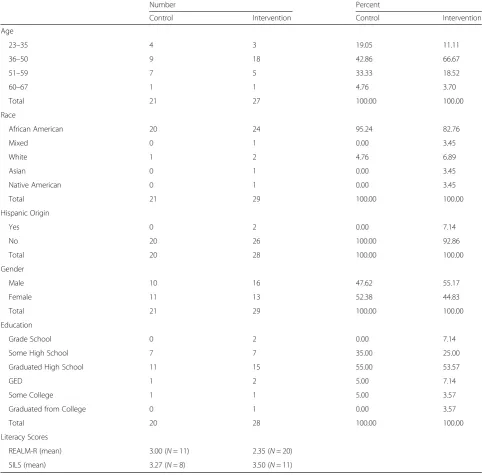
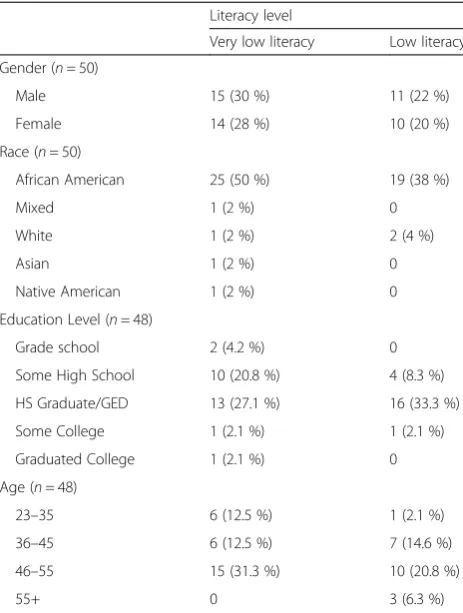
As illustrated in Table 1, there were 29 participants in the intervention group and 21 in the control group. No significant differences between the groups were found
Table 2Participant Demographic Characteristics by Literacy Level
Literacy level
Very low literacy Low literacy
Gender (n= 50)
Male 15 (30 %) 11 (22 %)
Female 14 (28 %) 10 (20 %)
Race (n= 50)
African American 25 (50 %) 19 (38 %)
Mixed 1 (2 %) 0
White 1 (2 %) 2 (4 %)
Asian 1 (2 %) 0
Native American 1 (2 %) 0
Education Level (n= 48)
Grade school 2 (4.2 %) 0
Some High School 10 (20.8 %) 4 (8.3 %)
HS Graduate/GED 13 (27.1 %) 16 (33.3 %)
Some College 1 (2.1 %) 1 (2.1 %)
Graduated College 1 (2.1 %) 0
Age (n= 48)
23–35 6 (12.5 %) 1 (2.1 %)
36–45 6 (12.5 %) 7 (14.6 %)
46–55 15 (31.3 %) 10 (20.8 %)
55+ 0 3 (6.3 %)
Table 3Independent Samples t-Tests: Eye Tracking Ratings on Seven Selected Slides
Intervention Group 95 % CI for Mean Difference
Intervention Control
Slide M SD n M SD n t df
1. What is a dirty bomb? 3.53 1.13 17 4.00 1.00 11 −.387,1.33 1.13 26
2. A dirty bomb is not an atomic bomb. 3.65 1.49 17 2.50 1.29 14 −2.19,−.11 2.26* 29
3. What to do if you’re outside 3.81 1.17 16 2.75 1.06 12 −1.94,−.18 2.48* 26
4. What to do if you’re inside. 3.88 .96 16 2.31 1.38 13 −2.46,−.68 3.61** 27
5. What should I do about my children and family? 3.53 1.06 15 2.38 1.19 13 −2.02.−.27 2.70* 26
6. What to do about food and water? 3.41 1.29 17 2.60 1.18 15 −1.71,.08 1.86 30
7. How do I know about radiation exposure? 3.41 1.33 17 2.64 1.22 14 −1.71,.17 1.67 29
Scale = 5 points. Larger means more consistency/precision of eye-tracking
on demographic variables and literacy levels, indicating randomization was successful. Sub-analysis of the group by literacy level (Table 2) showed similar characteristics in those who had very low literacy compared with those with low literacy. No significant differences by literacy group were found. For all groups, the dominant age cat-egory was 36 to 59 and they were primarily African American. The majority also reported graduating from high school. Literacy statistics indicated a very low level of literacy. For the 31 participants who did the REALM-R screening, the mean score was 2.58, with a range of 0 to 5 (SD 1.42) indicating very low literacy. Of the 19 par-ticipants screened over the phone with the SILS, the mean score was a 3.37 (range 3 to 5, SD = .684).
Table 3 summarizes independent- samples t-Tests, comparing the intervention and control groups across the seven content similar slides on gaze pattern and consistency of eye tracking. The intervention group was rated significantly higher in ability track on four of the seven slides, including the “A dirty bomb is not an atomic bomb”(M = 3.65, SD = 1.49; t(29) = 2.26,p= .032), “what to do if you are outside and close to the explosion” (M = 3.81, SD = 1.17; t(26) = 2.48, p= .02), “what to do if you are inside and close to the explosion” (M = 3.88,
SD = .96; t(27) = 3.61, p= .001), and “what should I do about my children and family” (M = 3.53, SD = 1.06; t(26) = 2.70, p= .012) slides. Intervention participants had higher means on all but one of the slides (“What is a dirty bomb”), which in both groups was very sim-ple and contained only one statement describing what a dirty bomb is.
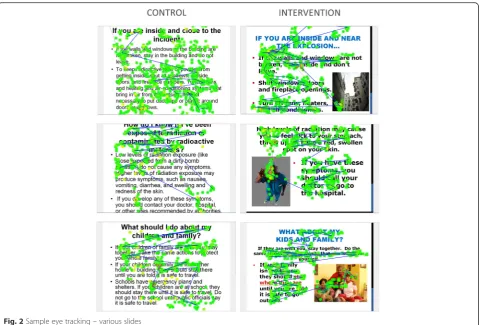
Figure 2 shows summary slides of selected participant eye tracking to illustrate the differences evident in track-ing patterns; each represents a different participant. The blue line indicates the actual pattern of tracking and the green dots indicate pupil fixation (the larger the dot, the longer the participant spent looking at that location). These patterns illustrate the differences observed be-tween participants presented with higher vs. lower liter-acy information. For example, in Slide 1 – Control, the participant looked all over the page but did not have a specific gaze pattern that indicated he/she was actually reading the text. Slide 2– Intervention, however, shows a clear gaze pattern indicating the participant was fol-lowing the text as would be expected if he/she was read-ing the text. It is also clear that he/she looked at the photograph on the slide after reading the text. Similarly, in slides 3 and 5 – control, it appears that the
Table 4Independent Samples T-Tests: Number of Pupil Fixations by Seven Selected Slides
Intervention Group 95 % CI for Mean Difference
Intervention Control
Slide M SD n M SD n t df
1. What is a dirty bomb? 24.00 20.69 24 23.67 22.29 21 −13.26,12.59 .05 43
2. A dirty bomb is not an atomic bomb. 15.33 15.02 24 38.14 30.05 21 8.80,36.82 3.28** 43
3. What to do if you’re outside 32.46 32.62 24 35.95 36.67 21 −17.33,24.32 .34 43
4. What to do if you’re inside. 28.13 28.13 24 47.14 38.22 21 .15,37.89 2.03* 43
5. What should I do about my children and family? 32.04 32.04 23 50.00 36.46 21 −1.48,37,40 1.86 42
6. What to do about food and water? 36.71 36.91 23 50.52 37.54 21 −6.58,33.79 1.36 42
7. How do I know about radiation exposure? 24.96 24.96 23 54.20 43.89 20 4.71,47.60 2.46* 42
*p≤.05, **p≤.005
Table 5Independent Samples T-Tests: Time Spent Reading the Seven Selected Slides
Intervention Group 95 % CI for Mean Difference
Intervention Control
Slide M SD n M SD n t df
1. What is a dirty bomb? 12.66 4.53 24 21.94 17.32 21 1.89,16.68 2.54* 43
2. A dirty bomb is not an atomic bomb. 9.54 8.90 24 32.35 16.81 21 14.87,30.76 5.79*** 43
3. What to do if you’re outside 17.37 9.22 24 27.29 17.16 21 1.79,18.06 2.46** 43
4. What to do if you’re inside. 16.70 6.88 24 31.61 24.02 21 4.58,25.23 2.91** 43
5. What should I do about my children and family? 17.28 7.35 23 35.72. 24.06 21 7.83,29.06 3.51** 42
6. What to do about food and water? 17.92 7.27 23 34.85 14.30 21 10.12,23.75 5.02*** 42
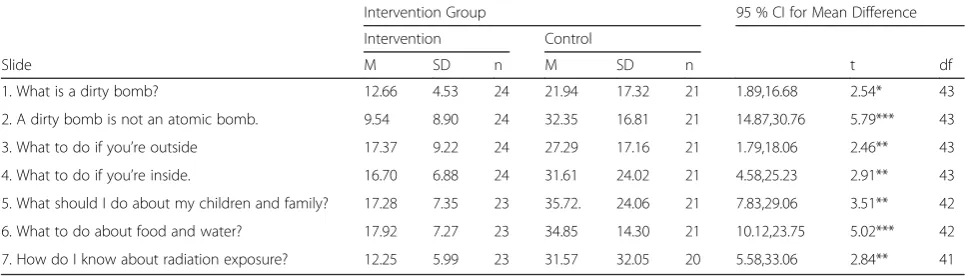
7. How do I know about radiation exposure? 12.25 5.99 23 31.57 32.05 20 5.58,33.06 2.84** 41
participants made an attempt to read the title and the first sentence of text but then did not finish, not looking at the rest of the text. Slides 4 and 6 – intervention, however, clearly show the participants not only followed the text, but also spent time looking at the photographs. (Additional files 1 and 2: Videos to Fig. 2 are provided, which show real-time eye tracking for selected interven-tion and control participants.)
Mean number of pupil fixations on the seven selected slides indicated that the control group spent signifi-cantly longer looking at specific words or phrases on three of the slides (Table 4). These include “A dirty bomb is not an atomic bomb” (M = 38.14, SD = 30.05; t(43) = 3.28,p= .002),“What to do if you’re inside”(M = 47.14, SD = 38.22; t(43) = 2.03, p= .048),“How do I know about radiation exposure” (M = 54.20, SD = 43.89; t(42) = 2.46,p= .02). A fourth slide,“What should I do about my children and family” approaches significance, with the control group having more mean fixations (M = 50, SD = 36.46; t(42) = 1.86,p= .069). This is indicative of the more densely worded material in the control slides and their low-literacy level. In some cases, control participants had twice the number of pupil fixations compared to the inter-vention participants, most likely because of the density of the text. This correlates with the observations of real time
tracking, where control participants can be seen repeating lines of text or skipping back and forth on the slide.
analysis and strengthens the argument that the control participants had a difficult time reading and processing the text-heavy control slides.
In addition to looking at individual slides, composite scores for overall ability to track slides, fixations and time were calculated and then correlated to the dichoto-mized literacy variable. Pearson Correlations indicates that literacy level was associated with four of the 7 slides on the eye tracking rating (Dirty Bomb is not an Atomic Bomb, .404,p= .024; What do with family, .409,p= .031; What to do about food/water, .473, p= .006; Radiation Exposure, .406,p= .024). In addition, comparing average time, fixation and tracking ratings by intervention group, the Intervention, Very Low Literacy group had lower time and fixation composite scores (time = 32.08 s vs. 40.20 for Control, Very Low Literacy; fixation = 39.97 vs.49.37) and higher tracking scores (3.32 vs. 2.79). These differences, however, were not significant.
Finally, Independent Samples T-Tests were run com-paring effects of the intervention on those with the lowest literacy levels on outcome measures, specifically confidence in knowledge of what a“dirty bomb” is, and intended behavior (i.e. sheltering in place) if one oc-curred (participants indicated how much they agreed or disagreed with a statement on a 0-10 scale). Table 6 il-lustrates that significant differences were seen in three post-intervention knowledge or behavior survey ques-tions: Know what a dirty bomb is (M = 8.76, SD = 2.64; t(28) = 2.78,p= .01); Know what to do if a bomb blows up (M = 8.95, SD = 1.50; t(28) = 2.49,p= .02); My ability to follow instructions if a “dirty bomb” happens (M = 8.80, SD = .62; t(27) = 2.87,p= .008). These differences were not seen in the Low Literacy by intervention groups.
Discussion
Monitoring of eye tracking in real time and watching video of each participant’s session clearly revealed that in this pilot study the control group participants had a difficult time getting through the dense text. For many of the low-literacy participants, it was obvious that they either chose to randomly glance around the slide text and not systematically work through it, or they began to work through the text, often re-reading given lines
several times before giving up and resorting to random looking patterns. In some instances, it seemed that con-trol participants would look off the slide for a period of time before deciding enough time had passed to tell the technician to advance to the next slide. Observing these patterns could be difficult to watch, as the apparent frustration many participants had with the text was evi-dent. These observations were supported by the data, which indicated significant differences in not only the gaze patterns tracked across time, but was also in the measures of time spent at each fixation point, and the total number of fixation points per slide. These differ-ences also remained once tracking fixations and time were combined as a composite score and compared, and when the sample was compared by their literacy level and intervention group. It was clear that the dense text provided in the control condition caused partici-pants to spend more time with trying to get through the text and attempting to read lines more than once. Despite the small sample size of this study, the differ-ences we found in tracking and outcome measures (confidence in knowledge and ability to follow instruc-tions) indicate a large effect size (cohen’s d = .94). How-ever, future studies using eye tracking measures will have to take into account the intent of the trial (eye tracking as outcomes vs. changes in knowledge and be-havior) and whether larger sample sizes are required to test the effect of these types of materials are larger audiences.
Clearly, having access to literacy appropriate materials is important. In this study, significant effects on confi-dence in knowing what a dirty bomb was, how to re-spond if one occurred and ability to carry out instructions was seen in those with the very lowest liter-acy. This is a significant finding, indicating that even those with very low literacy can benefit from having in-formation presented in a manner that addresses their needs. Because of the serious consequences of exposure to a “dirty bomb’, it is important that disaster planning and management teams address the accessibility of risk communication materials designed for limited-literacy groups, so that everyone can have equal access to potentially lifesaving information and make informed
Table 6T-Tests, Very Low literacy by Intervention Group on Knowledge and Behavior Post-Intervention Survey Questions
Intervention Group 95 % CI for Mean Difference
Intervention Control
Question M SD n M SD n t df
1. I know what a dirty bomb is. 8.76 2.64 21 5.44 3.75 9 .87, 5.77 2.78* 28
2. I know what to do if a bomb blows up. 8.95 1.50 21 6.67 3.61 9 .40, 4.17 2.49* 28
3. How do you feel about your ability to follow instructions after a dirty bomb? 8.80 .62 20 7.44 1.94 9 .386, 2.3 2.87* 27
Scale was 0–10, with zero = totally disagree and 10 = totally agree
decisions for themselves and their families. Health lit-eracy studies suggest that a third-to-a-half of the US population has some difficulty using written materials [49], such as those available on the CDC website – materials that have been measured at an 8th grade reading level or higher [50, 51]. If large numbers of US adults cannot use complex prose, it is important public health communication specialists develop ma-terials that are accessible and presented in a develop-mentally appropriate form. If these materials are not available, people with limited-literacy will be unable to adequately prepare for or respond to an emergency such as a “dirty bomb”, thus decreasing their ability to make informed decisions.
Public trust and confidence can help mitigate and im-prove the ability to manage a terror threat [52], but this is severely compromised if a large group is unable to ac-cess or proac-cess emergency communications. Risk com-munication is essential to containing the public’s fear and fatalism, and for ensuring public cooperation during crisis events [53]. However, risk communication is espe-cially challenging when applying the messages to high risk, high outrage situations [54] such as a“dirty bomb” due to their capacity to produce widespread fear, which reduces complexity of information processing and inhibits memory abilities [26]. These limitations are fur-ther accentuated in low literacy populations, as distrust may be exacerbated by use of complicated terminology that assumes the public has more information and understanding than they do and making them most at risk for negative outcomes.
On a conceptual level, the goal of effectively commu-nicating a health/risk message to a particular target audi-ence must take into account not only their literacy skills, but also their level of education and experience with the topic being addressed. As such, the design of effective messages strategies requires attention to the task of informing and educating the receiver of the message, and the task of creating an information processing experience that effectively and efficiently optimizes the formatting, graphics, and visual/auditory aspects of message structure. These latter structural elements are critical to optimizing overall processing, learning, motiv-ation, decision making, and behavior. Eye tracking ana-lyses are particularly well suited to understand both the content/educational aspects of message design and the structural information processing aspects, and to under-stand how difficult it may be to access material that is not developed for those with low literacy. In this pilot study it was clear that low-literacy participants were more comfortable with the decision aid written at their literacy level and were more receptive to its messages; this is especially true in those with the lowest literacy. Eye tracking was thus a viable and useful method for
understanding how low literacy adults may respond to and understand emergency communications, informing the development of better, more accessible materials.
Limitations and future research
The limitations of this research include the fact that as a pilot study the sample size is, by design, small. Although this is the case, care was taken to accurately assess the participant's literacy level and to randomly assign partic-ipants to the control and intervention test-groups. Fu-ture studies should expand the sample size and also expand the geographic scope of the study to explore urban v. suburban differences as well as potential re-gional differences across the country.
There are also other types of eye tracking data that could have been used in the analysis of this study, in-cluding saccades and smooth pursuits. These could be useful in larger studies to assess ease of tracking and reading material, especially when video or other inter-active activities are incorporated into learning materials. These were not used here. In addition, the subjective eye tracking rating, despite rigorous training of raters and good reliability, is still a source of bias. Perhaps in a larger study this could be compared through a more objective mathematical evaluation of areas of interest and/or machine learning techniques. These measures were not available for this study. In addition, screen-ing participants for visual acuity and vision quality would be advised.
Another limitation involves the current focus on the topic of radiological terror events (Dirty Bomb). Individ-ual responses, in terms of information processing, physiological reactions, and knowledge gain will likely vary with different types of content (e.g., what to do in natural v. man-made disasters; active-shooter v. kid-napping/ransom events; bombs at a public event v. bombing a building, etc.). Public Health officials will have to develop "preparedness" materials for these types of differences as the frequency of such events continues to increase. This may also affect eye track-ing results, as information more familiar to an audi-ence may hinder the ability to differentiate as easily between tested materials.
Conclusion
The use of eye tracking is an effective approach to understand how health communication materials are accessed and processed by individuals with limited-literacy skills. We believe that this pilot work clearly demonstrates the feasibility of using these methods on a wider scale to develop more effective health and risk communication messages designed to increase know-ledge of and compliance with general health guidelines on the one hand and specific health-based emergency di-rectives on the other. It is also clear that the message de-sign and testing approach has application not only for those with low-literacy, but for those with learning dis-abilities, those with limited media-literacy skills, and those needing to access the diverse array of assistive technologies now available. The long-term goal is to evolve and refine powerful message design tools that will contribute to effective decision making and the elimin-ation of health disparities evident in educelimin-ational, social, and personal contexts.
Additional files
Additional file 1:a. Eye tracking video of Intervention condition–what about my kids and family. b. Eye tracking video of Control condition– what about my kids and family. (ZIP 32338 kb)
Additional file 2:a. Eye tracking video of Intervention condition–what about my food. b. Eye tracking video of Control condition–what about my food. (ZIP 48292 kb)
Abbreviations
CDC, Centers for Disease Control and Prevention; REALM-R, Rapid Estimate of Adult Literacy in Medicine-Revised; RTE, Radiological Terror Event; SILS, Single Item Literacy Screener
Acknowledgements
The authors would like to thank Kaitlin Kordusky, MPH, who contributed to the study by recruiting participants and collecting data.
Funding
This study was funded by the National Institute of Biomedical Imaging and Bioengineering, 5RO3EB9561-2 (Health Literacy mechanism):“Developing Radiological Risk Communication Materials for Low-Literacy Populations,” Bass, SB–Principal Investigator
Availability of data and materials
Educational materials are available at http://sites.temple.edu/turiskcommlab/. Those interested in data files can contact the lead author, Sarah Bauerle Bass, Ph.D., MPH at [email protected]
Authors’contributions
SBB was Principal Investigator for the study and conceived the study and all protocol. She also was primary author of the manuscript. TFG was a co-investigator of the study and contributed by analyzing eye tracking data and conceiving of the developed eye tracking scale reported in this manuscript. He also contributed to the writing of the discussion section of the manu-script. RG collected all eye tracking data and assisted with data analysis, including gaze pattern analysis. CP was a co-investigator of the study and contributed to the writing of the manuscript. All authors read and approved the final manuscript.
Competing interests
The authors declare that they have no competing interests.
Consent for publication
Not applicable.
Ethics approval and consent to participate
All study materials and protocols were approved by the Temple University Institutional Review Board, study number 12434.
Author details
1Department of Social and Behavioral Sciences, Risk Communication
Laboratory, Temple University, College of Public Health, 1301 Cecil B. Moore Ave., Philadelphia, PA 19122, USA.2Department of Psychology, University of Massachusetts-Lowell, Health and Social Sciences Bldg., Suite 300, 113 Wilder St., Lowell, MA 01854, USA.3Department of Behavioral and Social Sciences, University of the Sciences, 600 S. 43rd St., Philadelphia, PA 19104, USA.
Received: 12 February 2016 Accepted: 1 June 2016
References
1. Shi SW, Wedel M, Pieters FGM. Information acquisition during online decision making: A model-based exploration using eye-tracking data. Manage Sci. 2013;59:1009–26.
2. Sarter NB, Mumaw RJ, Wickens CD. Pilots’monitoring strategies and performance on automated flight decks: An empirical study combining behavioral and eye-tracking data. J Hum Fac Erg Soc. 2007;49:347–57. 3. Chetwood AS, Kwok K, Sun L, Mylonas GP, Clark J, Darzi A, Yang G.
Collaborative eye tracking: A potential training tool in laparoscopic surgery. Surg Endosc. 2012;26:2003–9.
4. Mason L, Pluchino P, Tornatora MC. Using eye-tracking technology as an indirect instruction tool to improve text and picture processing and learning. Brit J Educ Technol. 2015. doi:10.1111/bjet.12271. 5. Wang Q, Yang S, Liu M, Cao Z, Ma Q. An eye-tracking study of
website complexity from cognitive load perspective. Decis Support Syst. 2014;62:1–10.
6. Molina AI, Redondo MA, Lacave C, Ortega M. Assessing the effectiveness of new devices for accessing learning materials: An empirical analysis based on eye tracking and learner subjective perception. Comput Hum Behav. 2014;31:475–90.
7. Beatty J. Pupillometric signs of selective attention in man. In: Galbraith GC, Kietzman ML, Donchin E, editors. Neurophysiology and psychophysiology: Experimental and clinical applications. Hillsdaly: Lawrence Erlbaum Associates, Inc.; 1988. p. 138–43.
8. Steinhauer S. Pupillary Responses, Cognitive Psychophysiology and Psychopathology. 2006. http://www.wpic.pitt.edu/research/biometrics/ Publications/PupilWeb.htm. Accessed 4 Feb 2016.
9. Mackert M, Champlin SE, Pasch KE, Weiss BD. Understanding health literacy measurement through eye tracking. J Health Commun. 2013;18:185–96. 10. Miller B, O’Donnell C. Opening a window into reading development: eye
movements’role within a broader literacy research framework. School Psychol Rev. 2013;42:123–39.
11. Sereno SC, Rayner K. Measuring word recognition in reading: eye movements and event-related potentials. Trends Cogn Sci. 2003;7:489–93. 12. Smith AC, Monaghan P, Huettig F. Literacy effects on language and vision:
emergent effects from an amodal shared resources (ASR) computational model. Cogn Psychol. 2014;75:28–54.
13. Fengler A, Meyer L, Friederici AD. Brain structural correlates of complex sentence comprehension in children. Dev Cog Neuro. 2015;15:48–57. 14. Krugman DM, Fox RJ, Fletcher JE, Fischer PM, Rojas TH. Do adolescents
attend to warnings in cigarette advertising? An eye-tracking approach. J Advertising Res. 1994;34:39–52.
15. Thomsen SR, Fulton K. Adolescents’attention to responsibility messages in magazine alcohol advertisements: an eye-tracking approach. J Adolesc Health. 2007;41:27–34.
16. Turner MM, Skubisz C, Pandya SP, Silverman M, Austin L. Predicting visual attention to nutrition information on food products: the influence of motivation and ability. J Health Commun. 2014;19:1017–29. 17. Berenbaum E, Latimer-Cheung AE. Examining the link between framed
physical activity ads and behavior among women. J Sport Exercise Psy. 2014;36:271–80.
consumers’choice. Evidence from a choice experiment involving eye-tracking. Appetite. 2014;76:66–75.
19. Brown SL, Richardson M. The effect of distressing imagery on attention to and persuasiveness of an anti-alcohol message: a gaze-tracking approach. Health Educ Behav. 2012;39:8–17.
20. Summers K, Langford J, Wu J, Abela C, Souza R. Designing web-based forms for users with lower literacy skills. P Am Soc Inform Sci Tech. 2007;43:1–12. 21. Rudd R. Health literacy skills of U.S. Adults. Am J Health Behav. 2007;31:S8–S18. 22. Goodman M, Finnegan R, Mohadjer L, Krenzke T, Hogan, J. Literacy,
numeracy, and problem solving in technology-risk environments among U. S. adults: Results from the program for international assessment of adult competencies 2012: First Look (NCES 2014-008). 2013. Washington, DC. 23. Mohadjer L, Kalton G, Krenzke T, Liu B, de Kerckhove W, Li L, et al. National
assessment of adult literacy: Indirect county and state estimates of the percentage of adults at the lowest literacy level for 1992 and 2003. Research and Development Report. NCES 2009-482. 2009. Washington, D.C. 24. Centers for Disease Control and Prevention. Strengthening CDC’s
emergency response. 2009. http://www.cdc.gov/phpr/publications/2009/ phprep_report_2009.pdf. Accessed 4 Feb 2016.
25. Slovic P. Perception of risk from radiation. In: Slovic P, editor. The perception of risk. London: Earthscan Publications Limited; 2001. p. 264–74.
26. Acton JM, Brooke Rogers M, Zimmerman PD. Beyond the Dirty Bomb: Re-thinking Radiological Terror. Survival: Global Politics and Strategy. 2007;49(3): 151–68.
27. Rosa EA, Freudenberg WR. The historical development of public reactions in nuclear power: implications for nuclear waste policy. In: Dunlap RE, Kraft ME, Rosa EA, editors. Public reactions to nuclear waste: Citizen’s views of repository sitting. Durham: Duke University Press; 1993. p. 32–63. 28. Nutbeam D. Health literacy as a public health goal: a challenge for
contemporary health education and communication strategies into the 21st
century. Health Promot Int. 2006;15:259–67.
29. Meredith LS, Eisenman DP, Rhodes H, Ryan G, Long A. Trust influences response to public health messages during a bioterrorist event. J Health Commun. 2007;12:217–32.
30. Wray R, Rivers J, Whitworth A, Jupka K, Clements B. Public perceptions about trust in emergency risk communication: qualitative research findings. Int J Mass Emerg Disasters. 2006;24:45–75.
31. Wray RJ, Becker SM, Henderson N, Gilk D, Jupka K, Middleton S, et al. Communicating with the public about emerging health threats: lessons from the Pre-Event Message Development Project. Am J Public Health. 2008;98:2214–22.
32. Marist College Institute for Public Opinion. How Americans feel about terrorism and security two years after 9/11. Survey conducted on behalf of the National Center for Disaster Preparedness and the Children’s Health Fund. 2003. http://maristpoll.marist.edu/tag/terrorism/. Accessed 4 Feb 2016. 33. Lasker RD. Redefining readiness: Terrorism planning through the eyes of the
public. New York: New York Academy of Medicine; 2004.
34. Pignone M, DeWalt D, Sheridan S, Berkman N, Lohr K. Interventions to improve health outcomes for patients with low literacy. J Gen Int Med. 2005;20:185–92.
35. Sheridan S, Halpern D, Viera A, Berkman N, Donahue K, Crotty K. Interventions for individuals with low health literacy: a systematic review. J Health Comm. 2011;16(Supp 3):30–54.
36. Taggart J, Williams A, Dennis S, Newall A, Shortus T, Zwar N, Denney-Wilson E, Harris M. A systematic review of interventions in primary care to improve health literacy for chronic disease behavioral risk factors. BMC Fam Pract. 2012; Doi:10.1186/1471-2296-13-49.
37. Bass SB, Greener JR, Ruggieri D, Parvanta C, Mora G, Wolak C, et al. Attitudes and perceptions of urban African Americans of a "dirty bomb" radiological terror event: Results of a qualitative study and implications for effective risk communication. Disaster Med Public Health Prep. 2015;9:9–18. doi:10.1017/ dmp.2014.158.
38. Becker S. Emergency communication and information issues in terrorist events involving radioactive materials. Biosecur Bioterror. 2004;2(3):195–207. 39. Krueger RA. Focus Groups: A Practical Guide for Applied Research. CA: Sage
Publications; 1994.
40. Rabiee F. Focus-group interview and data analysis. Proc Nutr Soc. 2004;63:655–60. 41. Bass SB, Mora G, Ruggieri D, Wolak C, Gordon TF, Rovito MJ, et al.
Understanding of and willingness to comply with recommendations in the event of a‘dirty bomb’: Demographic differences in low-literacy urban residents. Washington, DC: American Public Health Association; 2001.
42. Bass SB, Gordon TF, Ruzek SB, Hausman AJ. Mapping perceptions related to acceptance of smallpox vaccination by hospital emergency room personnel. Biosecur Bioterror. 2008;6(2):179–90.
43. Ruggieri DG, Bass SB, Rovito MJ, Ward S, Gordon TF, Paranjape A, et al. Perceived colonoscopy barriers and facilitators among urban African American patients and their medical residents. J Health Comm. 2013;18(4):372–90. 44. Bass SB, Gordon TF, Ruzek SB, Wolak C, Ruggieri D, Mora G, et al.
Developing a computer touch-screen interactive colorectal screening decision aid for a low-literacy African American population: lessons learned. Health Promot Pract. 2013;14(4):589–98.
45. Bass SB, Wolak C, Greener J, Tedaldi E, Nanavati A, Ruppert K, et al. Using perceptual mapping methods to understand gender differences in perceived barriers and benefits of clinical research participation in urban minority HIV+ patients. AIDS Care. 2016;28(4):528–36.
46. Kincaid JP, Fishburne RP, Rogers RL, Chissom BS. Derivation of new readability formulas (Automated Readability Index, Fog Count, and Flesch Reading Ease Formula) for Navy enlisted personnel. Research Branch Report 8-75. Millington, TN. 1975.
47. Bass PF, Wilson JF, Griffith CH. A shortened instrument for literacy screening. J Gen Intern Med. 2003;18:1036–8.
48. Morris NS, MacLean CD, Chew LD, Littenberg B. The single item literacy screener: evaluation of a brief instrument to identify limited reading ability. BMC Fam Pract. 2006;7:21. doi:10.1186/1471-2296-7-2.
49. Kutner M, Greenberg E, Jin Y, Paulsen C. The health literacy of America’s adults: Results from the 2003 National Assessment of Adult Literacy (NCES 2006–483). U.S. Department of Education, National Center for Education Statistics: Washington, DC. 2006. http://nces.ed.gov/pubsearch/pubsinfo. asp?pubid=2006483 2006. Accessed 1 Apr 2015.
50. Vanderford M, Nastoff T, Telfer J, Bonzo SE. Emergency communication challenges in response to Hurricane Katrina: Lessons from the Centers for Disease Control and Prevention. J Appl Commun Res. 2007;35:9–25. 51. Lagassé L, Rimal R, Smith K, Storey D, Rhoades E, Barnett D, et al. How
accessible was information about H1N1flu? Literacy assessments of CDC guidance documents for different audiences. PLoS One. 2011;6:11. doi:10. 1371.journal.pone.0023583
52. Eisenman DP, Wold C, Setodji C, Hickey S, Lee B, Stein B, Long A. Will public health’s response to terrorism be fair? Racial/ethnic variations in perceived fairness during a bioterrorist event. Biosecur Bioterror. 2004;2:146–56. 53. National Research Council. Improving risk communication. Washington, DC:
National Academy Press. 1989.
54. Sandman PM. Hazard versus outrage in the public perception of risk. In: Covello VT, McCallum DB, Pavlova MT, editors. Effective Risk
Communication: The Role and Responsibility of Government and Nongovernment Organizations. New York: Plenum Press; 1989. p. 45–9.
• We accept pre-submission inquiries
• Our selector tool helps you to find the most relevant journal
• We provide round the clock customer support
• Convenient online submission
• Thorough peer review
• Inclusion in PubMed and all major indexing services
• Maximum visibility for your research Submit your manuscript at
www.biomedcentral.com/submit