R E S E A R C H
Open Access
Integrating shortest dependency path and
sentence sequence into a deep learning
framework for relation extraction in clinical
text
Zhiheng Li
1, Zhihao Yang
1, Chen Shen
1, Jun Xu
2, Yaoyun Zhang
2and Hua Xu
2*FromThe International Conference on Intelligent Biology and Medicine (ICIBM) 2018 Los Angeles, CA, USA. 10-12 June 2018
Abstract
Background:Extracting relations between important clinical entities is critical but very challenging for natural language processing (NLP) in the medical domain. Researchers have applied deep learning-based approaches to clinical relation extraction; but most of them consider sentence sequence only, without modeling syntactic structures. The aim of this study was to utilize a deep neural network to capture the syntactic features and further improve the performances of relation extraction in clinical notes.
Methods:We propose a novel neural approach to model shortest dependency path (SDP) between target entities together with the sentence sequence for clinical relation extraction. Our neural network architecture consists of three modules: (1) sentence sequence representation module using bidirectional long short-term memory network (Bi-LSTM) to capture the features in the sentence sequence; (2) SDP representation module implementing the convolutional neural network (CNN) and Bi-LSTM network to capture the syntactic context for target entities using SDP information; and (3) classification module utilizing a fully-connected layer with Softmax function to classify the relation type between target entities.
Results:Using the 2010 i2b2/VA relation extraction dataset, we compared our approach with other baseline methods. Our experimental results show that the proposed approach achieved significant improvements over comparable existing methods, demonstrating the effectiveness of utilizing syntactic structures in deep learning-based relation extraction. The F-measure of our method reaches 74.34% which is 2.5% higher than the method without using syntactic features.
Conclusions:We propose a new neural network architecture by modeling SDP along with sentence sequence to extract multi-relations from clinical text. Our experimental results show that the proposed approach significantly improve the performances on clinical notes, demonstrating the effectiveness of syntactic structures in deep learning-based relation extraction.
Keywords:Relation extraction - deep learning, Shortest dependency path
* Correspondence:[email protected]
2School of Biomedical Informatics, The University of Texas Health Science Center at Houston, Houston, TX 77030, USA
Full list of author information is available at the end of the article
Background
Clinical texts such as discharge summaries and progress reports contain rich information of patients and are valuable data sources for many computerized clinical ap-plications such as decision support systems. Although manual review can accurately transform unstructured
narratives into structured data, it is costly and
time-consuming, and thus, not feasible for applications that require extracting information from a large number of clinical documents. Therefore, natural language pro-cessing (NLP), which can automatically extract informa-tion of interest from narratives, becomes an enabling technology to support clinical researches and applica-tions. One of the fundamental tasks of clinical NLP is to automatically extract relations between important clin-ical entities such as diseases, drugs, and lab tests. For ex-ample, in the sentence“likelypenicillinand sulfadrugs leading to a rash”, recognizing that “rash” is an adverse event caused by the drugs“penicillin”and “sulfa” is very important to understand how the patient responded to the treatment.
Many approaches have been proposed for relation ex-traction tasks in the open domain [1], as well as for bio-medical literature mining [2–5]. For clinical text, early systems primarily relied on rule-based approaches for re-lation extraction [6]. For example, Chen et al. [7] applied
the MedLEE system [8] to extract relations between
drugs and diseases, in order to facilitate building know-ledge bases. Recently, with the development of anno-tated clinical corpora, increasing numbers of machine learning-based approaches have been developed for clin-ical relation extraction tasks [9–11]. Many of them have looked at identifying modifiers related to important clin-ical entities, e.g., signature of medications [12] and mod-ifiers of diseases including negation, severity, temporal information etc. [13,14]
An interesting relation extraction task was proposed in the 2010 i2b2/VA challenge, in which participating systems were asked to extract relations between im-portant clinical entities (e.g., relations between diseases and drugs), rather than modifiers of these entities. Extracting such relations is critical for understanding patients’ disease, diagnosis and prognosis, as well as their treatments and outcomes. All the top-ranked sys-tems used machine learning-based methods with exten-sive feature engineering. For example, Grouin et al. proposed a Support Vector Machine (SVM)based sys-tem with additional rules to capture linguistic patterns of relations [15]. Bruijn et al. investigated machine learning approaches with a focus on feature engineer-ing, assessing large-dimensional features derived from both the text itself and other external sources [9]. They also performed a follow-up study by proposing a kernel-based model that consists of concept kernels,
connection kernels, and tree kernels in order to capture lexical, semantic and syntactic features [16].
To avoid labor-intensive feature engineering and the
high-dimensionality issue of features [17], deep
learning-based architectures, which can automatically learn representations of data at multiple levels of ab-straction, have been proposed and have demonstrated successes in multiple domains including medicine [18]. For the 2010 i2b2/VA relation extraction task, several deep learning-based approaches were also investigated.
Sahu et al. [19] used convolutional neural networks
(CNN) to learn features automatically. The model took a complete sentence with mentioned entities as input and each word in the sentence was represented with discrete features such as part of speech (POS) tag, chunk tag, etc. The system achieved an F-measure of 71.16% on a sub-set from the 2010 i2b2/VA challenge, which removed all the notes from the University of Pittsburg Medical Cen-ter and instances of 3 relation classes (TrWP, TrIP and TrNAP) from the whole dataset. Furthermore, Raj et al. [20] proposed a convolutional recurrent neural network (CRNN) model, which combines recurrent neural net-works (RNNs) and CNNs to learn global and local con-text features. The model achieved a lower F-measure of 64.38% without using manual features. More recently, Luo et al. proposed the Seg-CNNs approach that splits the sentence into five parts: preceding, concept-1, mid-dle, concept-2 and succeeding, and generates the repre-sentations for these five parts for relation classification, resulting in an F-measure of 74.2% on the original 2010 i2b2/VA challenge dataset [21].
sentence sequence in a deep learning framework for clinical relation extraction.
Methods
Dataset and preprocessing
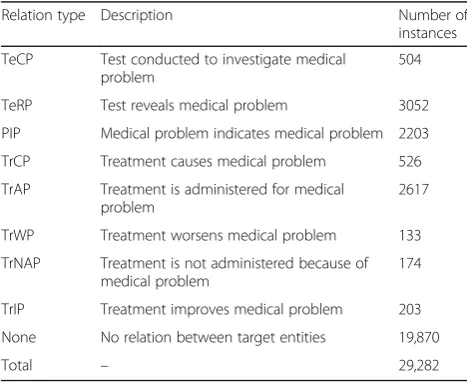
We used a dataset from the 2010 i2b2/VA relation ex-traction challenge to develop and evaluate our models. The statistics of the dataset are shown in Table 1. The dataset contains 426 discharge summaries collected from 2 hospitals, with 8 relation types in total [10]. Please note that this dataset is a subset of the original dataset used in the challenge, since the University of Pittsburg Medical Center’s data were not available to the public and were removed from the original dataset after the challenge.
As this is a relatively small corpus, individual words in clinical entities may have low frequency and may not have appropriate representation for training. Therefore, we replaced all entities with their entity types and used the updated sentences for training. We also added“tar-” and “ent-” to denote target entities and non-target en-tities in the sentence, respectively. For example, the
in-stance “She was maintained on [an epidural]treatment
and [pca]treatment for [pain control]problem” was
con-verted to “She was maintained on tar_treatment and
ent_treatment for tar_problem”, where “tar_treatment” and “tar_problem”are the target entities and “ ent_treat-ment” is a non-target entity that we did not take into consideration in this instance. The replacement also in-troduced the semantic information about entity types into the model.
Our approach
As shown in Fig. 1, our neural network architecture
consists of three modules: (1) sentence sequence
representation module, which takes the entire sen-tence along with position features as the input and generates the representation of the sentence by using a Bi-LSTM network; (2) SDP representation module, which implements the CNN and Bi-LSTM network to capture the syntactic context for target entities using SDP information; and (3) classification module, which concatenates outputs of both of the previous modules into a context vector with a fully-connected layer and feeds it into the output layer with the Softmax func-tion for classificafunc-tion.
Sentence sequence representation module
We used S = {w1, w2 …, wn} to denote the word
se-quence of a sentence. Each word wi is represented by both word embedding and position embedding. Word embedding maps words into a low-dimensional space
to capture semantic information among words [17] .
It has been widely used as the input of the neural networks in NLP tasks. In this study, we employed
the word2vec [22] to pre-train word embeddings
using the Medical Information Mart for Intensive
Care (MIMIC)-III clinical corpus [23]. Besides the
words, the positions of the target entities in the sen-tence also play an important role in relation extrac-tion. Therefore, we used position embeddings to represent the position information of target entities, which is adapted from Zeng et al. [14]. For example, in the sentence “She was maintained on [an epidural]-treatment and [pca]epidural]-treatment for [pain
control]pro-blem”, the relative distances of “She” to “[an
epidural]treatment” and “[pain control]problem” are
−4 and−8, respectively. In our model, we mapped
the relative distances to vectors and initialized them randomly. The sentence representation was further fed to the Bi-LSTM network, which consists of a for-ward LSTM and a backfor-ward one. The output hðftÞ and
hðbtÞ of the forward and backward LSTMs were then
concatenated into hðtÞ¼ ½hðftÞ;hðbtÞ which is the output vector of Bi-LSTM.
SDP representation module
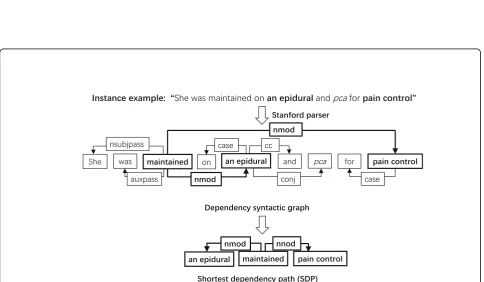
Several recent studies have shown that the SDP can boost the performance of the relation extraction [24– 27]. In clinical relation extraction, we also observed that the SDP between entities provides strong hints for determining the relationship. For example, in Fig. 2
the dependency syntactic structure of a sentence can be represented as a graph and there is always a short-est path between two words in the graph. The SDP between the target entities ‘an epidural’ and ‘pain control’ is:
Table 1–Statistics of the relation extraction dataset (a subset from the 2010 i2b2/VA challenge)
Relation type Description Number of
instances
TeCP Test conducted to investigate medical problem
504
TeRP Test reveals medical problem 3052
PIP Medical problem indicates medical problem 2203
TrCP Treatment causes medical problem 526
TrAP Treatment is administered for medical problem
2617
TrWP Treatment worsens medical problem 133
TrNAP Treatment is not administered because of medical problem
174
TrIP Treatment improves medical problem 203
None No relation between target entities 19,870
Fig. 1- Architecture of our model. Our neural network architecture consists of three modules: (1) sentence sequence representation module; (2) SDP representation module; and (3) classification module
[an epidural]treatment– nmod→maintained––nmod →[pain control]problem.
The words“maintained”in the SDP provide critical in-formation for classifying the relations between the target entities of “an epidural” and “pain control”. Besides the words on the path themselves, the type of dependency relation between the two neighboring words is also use-ful. In the example, the dependency relation‘nmod’
indi-cates that the word “pain control” is the noun
compound modifier of the word‘maintained’, which pro-vides supplemental information for relation classifica-tion. Thus, the relation extraction benefits from the semantic information contained in the representation of the words in SDP, as well as syntactic information in SDP, especially for the long and complex sentences. In this study, we used the Stanford parser to parse the sen-tences and generate dependencies.
Following the above intuition, we also designed a
neural network to model SDP. We used P = {p1, p2, …,
pm} to denote the word sequence of the SDP. Each word pi in the SDP is represented by its word embedding. We utilized the convolutional approach [28,29] as expressed by Eq. (1) to merge the two neighboring words that con-tain a cercon-tain dependency relation:
ConPi¼ PPi iþ1
∙M ð1Þ
where Pi is the embedding of word pi (i= 1, 2, …, m), andMn1n2 is the transformation matrix that is the same
across all local features in the SDP. ConPi∈R2n2 is the
transforming result of the two neighboring words using M, where n1is the dimension of word embeddings and n2is a hyper-parameter that denotes the output
dimen-sion after convolutional transformation. After the trans-formation, the representation of SDP is ConP = {ConP1, ConP2,…,ConPm−1}. We used {d1, d2,…, dm-1} to
de-note the dependency relation types between all neigh-boring words and each dependency relation type was randomly initialized into a vector. The output of the convolutional layer and the embeddings of dependency relation types were concatenated and fed to a Bi-LSTM network to generate the SDP representations.
Classification module
In the classification module, we first concatenated the outputs of the sentence sequence representation module and the SDP representation module, and then fed it to a fully-connected layer to generate the context vector. Fi-nally, the context vector was fed to an output layer with the Softmax function to classify the relation between the candidate entities. The probability of a candidate pair belonging to a relation type was calculated as follow:
p ið Þ ¼js softmax Wð o∙sþboÞ ð2Þ
where Wo and bo are the weight parameters, and s is the feature representation of the candidate pair. In our method, we used the cross-entropy cost function as the training objective function. Adaptive moment estimation (Adam) [30] was used to optimize the pa-rameters in our model with respect to the objective function.
Experiments and evaluation
We performed a 5-fold cross-validation using the data-set from the challenge and reported micro-average pre-cision, recall, and F-measure from the 5-fold cross validation results. In our experiments, we used the Pytorch library [31] to implement our proposed model. The dimensionality of the word embeddings and pos-ition embeddings were set to 100 and 50, respectively. The hidden unit number of Bi-LSTMs and the SDP-based convolutional layer was 200. The learning rate of Adam was 0.00001 and the mini-batch size was set to 32. To alleviate overfitting of the model, we also
used dropout [32] to randomly drop units and their
connections from the fully-connected layer in the model during training.
Results
As shown in Table 2, our method achieved an
F-measure of 71.84% when only the sentence sequence module (with both word embedding and position
em-bedding) was used. When we added the SDP
Table 2–Performance of our proposed methods on the 2010 i2b2/VA subset (5-fold cross validation)
Features Precision (%) Recall (%) F-measure (%) Δ(%)
Sentence Sequence only
74.01 69.79 71.84 –
+SDP (Word Sequence) 74.20 72.84 73.51 1.67
+SDP (Word Sequence + Relation Type)
75.69 73.03 74.34 2.50
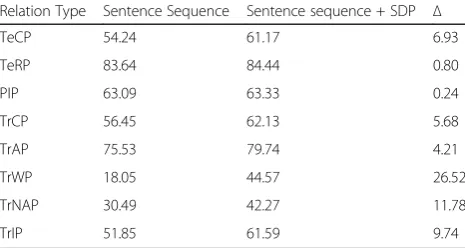
Table 3–Improvements in F-measure by adding SDP module for each relation type
Relation Type Sentence Sequence Sentence sequence + SDP Δ
TeCP 54.24 61.17 6.93
TeRP 83.64 84.44 0.80
PIP 63.09 63.33 0.24
TrCP 56.45 62.13 5.68
TrAP 75.53 79.74 4.21
TrWP 18.05 44.57 26.52
TrNAP 30.49 42.27 11.78
representation module (both word sequences and rela-tion type), the system achieved the best F-measure of 74.34%, with an increase of 2.50%. Our results also showed that both word sequences and the dependency relation types of SDP contributed to the increase of performance.
To further evaluate the effectiveness of SDP features, we looked at the F-measures achieved before and after adding SDP features for each relation type in Table3. It is clear that SDP features improved performance for every type of relations. For some relation types such as TrWP, TrNAP and TrIP, the improvements were dra-matic (e.g., 26.52% increase for TrWP).
Discussion
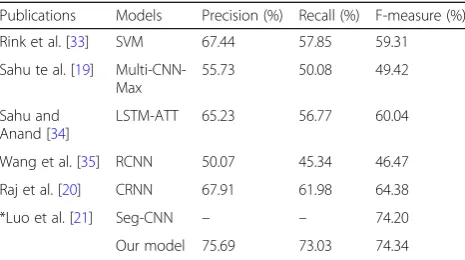
In this study, we propose a novel neural network archi-tecture to model syntactic structures (SDP) along with sentence sequences for clinical relation extraction. Ex-perimental results show that our proposed method out-performed the baseline method that used sentence sequence only, demonstrating the value of incorporating SDP features into deep learning-based approaches for clinical relation extraction. In Table 4, we compare our approach with the previously published systems in terms of performance on the same 2010 i2b2/VA challenge
dataset. The first five studies used exactly the same data-set as ours and our approach apparently achieved a much higher performance than those reported previ-ously. The last study by Luo et al. [21]was published re-cently, in which they achieved an F-measure of 74.2% by using the original dataset from the challenge (871 notes in total). Although our dataset is much smaller than what they used (426 vs. 871 notes), our approach actu-ally achieved slightly better performance as theirs (F-measure 74.34% vs. 74.2%respectively).
We also conducted an analysis to further illustrate why SDP could help clinical relation extraction.
Table 5 shows several examples that were classified
into wrong relations when only sentence sequences were used. After integrating the SDP features, these relations were correctly recognized. We summarize possible reasons that lead to the success of the pro-posed model as follows: 1) The length of SDP is much shorter than the length of the whole sentence sequence, which may reduce noise caused by many other entities; 2) SDP emphasizes more on syntactic structures, which are critical to the relation extraction task; and 3) The dependency relation type represents valuable syntactic relation information between the two neighboring words in the SDP.
Although our method achieved the state-of-the-art performance on the 2010 i2b2/VA dataset, we believe that there are many ways to further improve deep learning-based relation extraction in clinical text and we plan to investigate the other aspects in our future work. One of the directions is to leverage existing knowledge bases to improve the accuracy of deep learning models. For example, we plan to study distant supervision methods under the context of deep learning architec-tures for relation extraction in the medical domain. By automatically generating training data via aligning know-ledge bases and texts, we can assume two entities that have a relation in the knowledge bases will express the same relation in a sentence. The knowledge of clinical relations can be used to automatically annotate the
Table 4–Comparison of performance of different systems reported on the same i2b2–2010 corpus
Publications Models Precision (%) Recall (%) F-measure (%)
Rink et al. [33] SVM 67.44 57.85 59.31
Sahu te al. [19] Multi-CNN-Max
55.73 50.08 49.42
Sahu and Anand [34]
LSTM-ATT 65.23 56.77 60.04
Wang et al. [35] RCNN 50.07 45.34 46.47
Raj et al. [20] CRNN 67.91 61.98 64.38
*Luo et al. [21] Seg-CNN – – 74.20
Our model 75.69 73.03 74.34
*Luo et al. used the original dataset from the challenge (871 documents in total)
Table 5–Instances Corrected by Adding SDP-based Module Relation
Type
Sentence Sequence SDP
TrWP Subsequent discontinuance of [azithromycin]treatment,[trial_of_5-fc]treatment, with[increasing neutropenia]problemrequiring discontinuance, change if [itraconazole]treatmentto [voriconazole]treatment, given [continued neutropenia]treatment, and trial of [sulfadiazine]treatment, discontinued for [increasing ars]treatment
[trial_of_5-fc]treatment–appos→[azithromycin]treatment–nmod →discontinuance–nmod→[increasing neutropenia]problem
TrNAP [His cast]treatmentwas removed by the orthopedic service in anticipation of [this edema]problemand to avoid[compartment syndrome]problem
[His cast]treatment–nsubjpass→removed–nmod→service– acl→avoid–dobj→[compartment syndrome]problem
TrIP [His hypertension]problem;[his high blood pressure]problemwas controlled with [intravenous nitroglycerine]treatmentin the early going and then he was switched to [an oral regimen]treatmentfor better control after he was removed from the intensive care unit
[his high blood pressure]problem–nsubjpass→controlled–nmod →[intravenous nitroglycerine]treatment
dataset, in order to reduce the cost of manual curation [36,37].
Conclusion
In this study, we propose a new neural network architec-ture to extract multi-relations from clinical text by
mod-eling SDP along with sentence sequence. Our
experimental results show that the proposed approach achieved significant improvements over comparable existing methods on the 2010 i2b2/VA relation extrac-tion task, demonstrating the effectiveness of syntactic structures in deep learning-based relation extraction.
Abbreviations
Adam:Adaptive moment estimation; Bi-LSTM: Bidirectional long short-term memory; CNN: Convolutional neural network; CRNN: Convolutional recurrent neural network; MIMIC: Medical Information Mart for Intensive Care; NLP: Natural language processing; POS: Part of speech; RNN: Recurrent neural network; SDP: Shortest dependency path
Acknowledgements
This project was supported by Advancing Cancer Pharmacoepidemiology Research through EHRs and Informatics (NCI U24 CA194215 01A1). The support provided by China Scholarship Council (CSC) during a visit of Zhiheng Li to the University of Texas Health Science Center at Houston is acknowledged. And the authors also gratefully acknowledge the support of NVIDIA Corporation with the donation of the Titan XP GPU used for this research.
Funding
The publication costs for this article were funded by the corresponding author.
Availability of data and materials
The datasets analyzed during the current study are available in the 2010 i2b2/VA relation extraction dataset repository,https://www.i2b2.org/NLP/ DataSets/Main.php.
About this supplement
This article has been published as part of BMC Medical Informatics and Decision Making Volume 19 Supplement 1, 2019: Selected articles from the International Conference on Intelligent Biology and Medicine (ICIBM) 2018: medical informatics and decision making. The full contents of the supplement are available online athttps://bmcmedinformdecismak.biomedcentral.com/articles/ supplements/volume-19-supplement-1.
Authors’contributions
ZL, JX, CS, ZY and HX conceived the study and designed the model. ZL, JX and CS were responsible for the overall design, development and evaluation of this study. JX collected the data and preprocessed it. ZL trained the model and completed the whole experiment. HX, CS and ZY analyzed the results of the experiments. ZL drafted the article, YZ edited the manuscript and all authors contributed substantially to its revision. ZL take responsibility for the paper as a whole. All of the authors have read and approved the final manuscript.
Ethics approval and consent to participate Not applicable.
Consent for publication Not applicable.
Competing interests
The authors declare no competing financial interests.
Publisher’s Note
Springer Nature remains neutral with regard to jurisdictional claims in published maps and institutional affiliations.
Author details
1School of Computer Science and Technology, Dalian University of Technology, Dalian 116024, China.2School of Biomedical Informatics, The University of Texas Health Science Center at Houston, Houston, TX 77030, USA.
Published: 31 January 2019
References
1. Zelenko D, Aone C, Richardella A. Kernel methods for relation extraction. J Mach Learn Res. 2003;3:1083–106.
2. Rindflesch TC, Fiszman M. The interaction of domain knowledge and linguistic structure in natural language processing: interpreting hypernymic propositions in biomedical text. J Biomed Inform. 2003;36:462–77. 3. Bunescu R, Mooney R, Ramani A, Marcotte E. Integrating co-occurrence
statistics with information extraction for robust retrieval of protein interactions from Medline. Proceedings of the BioNLP Workshop on Linking Natural Language Processing and Biology at HLT-NAACL. 2006:49–56. 4. Song Q, Watanabe Y and Yokota H. Relationship extraction methods based
on co-occurrence in web pages and files. Proceedings of the 13th International Conference on Information Integration and Web-based Applications and Services. ACM. 2011:82–89.
5. Leroy G, Chen H, Martinez JD. A shallow parser based on closed-class words to capture relations in biomedical text. J Biomed Inform. 2003;36:145–58. 6. Harkema H, Dowling JN. Context: an algorithm for determining negation,
experiencer, and temporal status from clinical reports. J Biomed Inform. 2009;42:839–51.
7. Chen ES, Hripcsak G, Xu H, Markatou M, Friedman C. Automated acquisition of disease–drug knowledge from biomedical and clinical documents: an initial study. J Am Med Inform Assoc. 2008;15:87–98.
8. Friedman C, Alderson PO, Austin JH, Cimino JJ, Johnson SB. A general natural-language text processor for clinical radiology. J Am Med Inform Assoc. 1994;1:161–74.
9. De Bruijn B, Cherry C, Kiritchenko S, Martin J, Zhu X. Machine-learned solutions for three stages of clinical information extraction: the state of the art at i2b2 2010. J Am Med Inform Assoc. 2011;18:557–62.
10. Uzuner Ö, South BR, Shen S, DuVall SL. 2010 i2b2/VA challenge on concepts, assertions, and relations in clinical text. J Am Med Inform Assoc. 2011;18:552–6.
11. Aramaki E, Miura Y, Tonoike M, Ohkuma T, Masuichi H, Waki K, Ohe K. Extraction of adverse drug effects from clinical records. MedInfo. 2010: 739–43.
12. Patrick J, Li M. High accuracy information extraction of medication information from clinical notes: 2009 i2b2 medication extraction challenge. J Am Med Inform Assoc. 2010;17:524–7.
13. Pathak P, Patel P, Panchal V, Soni S, Dani K. Patel a and Choudhary. N ezDI: a Supervised NLP System for clinical narrative analysis Proceedings of the 9th International Workshop on Semantic Evaluation (SemEval. 2015;2015: 412–6.
14. Dligach D, Bethard S, Becker L, Miller T, Savova GK. Discovering body site and severity modifiers in clinical texts. J Am Med Inform Assoc. 2013;21: 448–54.
15. Grouin C, Abacha AB, Bernhard D, Cartoni B, Deleger L, Grau B and Zweigenbaum P, et al. CARAMBA: concept, assertion, and relation annotation using machine-learning based approaches. i2b2 Medication Extraction Challenge Workshop. 2010: Boston.
16. Zhu X, Cherry C, Kiritchenko S, Martin J, De Bruijn B. Detecting concept relations in clinical text: insights from a state-of-the-art model. J Biomed Inform. 2013;46(2):275–85.
17. Bengio Y, Ducharme R, Vincent P. Jauvin C. A neural probabilistic language model. J Mach Learn Res. 2003;3(Feb):1137–55.
18. LeCun Y, Bengio Y, Hinton G. Deep learning. Nature. 2015;521(7553):436. 19. Sahu SK, Anand A. Oruganty K and Gattu M. relation extraction from clinical
texts using domain invariant convolutional neural network. arXiv preprint. 2016; arXiv. 1606:09370.
biomedical text. In: Proceedings of the 21st conference on computational natural language learning (CoNLL 2017); 2017. p. 311–21.
21. Luo Y, Cheng Y, Uzuner Ö, Szolovits P, Starren J. Segment convolutional neural networks (Seg-CNNs) for classifying relations in clinical notes. J Am Med Inform Assoc. 2017;25(1):93–8.
22. Mikolov T, Chen K, Corrado G and Dean, J. Efficient estimation of word representations in vector space. arXiv preprint. 2013; arXiv:1301.3781. 23. Johnson AE, Pollard TJ, Shen L, Li-wei HL, Feng M, Ghassemi M, Mark RG,
et al. MIMIC-III, a freely accessible critical care database. Scientific data. 2016. 2016;160035:3.
24. Liu Y, Wei F, Li S, Ji H. Zhou M and Wang H. a dependency-based neural network for relation classification. arXiv preprint. 2015; arXiv. 1507:04646. 25. Yan X, Mou L, Li G, Chen Y, Peng H and Jin, Z. Classifying relations via long
short term memory networks along shortest dependency path. arXiv preprint. 2015; arXiv:1508.03720.
26. Miwa M and Bansal M. End-to-end relation extraction using lstms on sequences and tree structures.arXiv preprint 2016; arXiv:1601.00770. 27. Zhang Y, Zheng W, Lin H, Wang J, Yang Z, Dumontier M. Drug–drug interaction extraction via hierarchical RNNs on sequence and shortest dependency paths. Bioinformatics. 2018;34(5):828–35.
28. Collobert R, Weston J, Bottou L, Karlen M, Kavukcuoglu K, Kuksa P. Natural language processing (almost) from scratch. J Mach Learn Res. 2001:2493–537.
29. Zeng D, Liu K, Lai S, Zhou G, Zhao J. Relation classification via convolutional deep neural network. In: Proceedings of COLING 2014, the 25th
international conference on computational linguistics: technical papers; 2014. p. 2335–44.
30. Kingma DP and Ba J. Adam: A method for stochastic optimization. arXiv preprint. 2014; arXiv:1412.6980.
31. Baydin AG, Pearlmutter BA. Radul AA and Siskind JM. Automatic differentiation in machine learning: a survey. arXiv preprint. 2015 arXiv. 1502:05767.
32. Srivastava N, Hinton G, Krizhevsky A, Sutskever I, Salakhutdinov R. Dropout: a simple way to prevent neural networks from overfitting. The Journal of Machine Learning Research. 2014;15(1):1929–58.
33. Rink B, Harabagiu S, Roberts K. Automatic extraction of relations between medical concepts in clinical texts. J Am Med Inform Assoc. 2011;18(5):594–600.
34. Björne J, Airola A, Pahikkala T, Salakoski T. Drug-drug interaction extraction from biomedical texts with svm and rls classifiers. Proceedings of DDIExtraction-2011 Challenge Task. 2011:35–42.
35. Wang X, Jiang W and Luo Z. Combination of convolutional and recurrent neural network for sentiment analysis of short texts. Proceedings of COLING 2016, the 26th International Conference on Computational Linguistics: Technical Papers. 2016:2428–2437.
36. Zeng D, Liu K, Chen Y, Zhao J. Distant supervision for relation extraction via piecewise convolutional neural networks. Proceedings of the 2015 Conference on Empirical Methods in Natural Language Processing. 2015: 1753–62.