S T U D Y P R O T O C O L
Open Access
Effectiveness of a multicomponent exercise
program in the attenuation of frailty in
long-term nursing home residents: study
protocol for a randomized clinical
controlled trial
Ana Rodriguez-Larrad
1*, Haritz Arrieta
1, Chloe Rezola
1, Maider Kortajarena
2, Jose Javier Yanguas
3, Miren Iturburu
3,
María Gil Susana
1and Jon Irazusta
1Abstract
Background:There is increasing evidence suggesting that cognition and physical frailty interact within a cycle of decline associated with aging which has been called cognitive frailty. Exercise programs have demonstrated to be an effective tool to prevent functional and cognitive decline during aging, but little is known about their potential to restore or maintain functionality in individuals that require long-term nursing care. Besides, WHO has recently highlighted the importance of introducing systematic musculoskeletal health programs for older people living in residential care, as they represent a particularly vulnerable group for the development of noncommunicable diseases.
Methods:This is a multicentre randomized controlled trial. 114 participants will be randomly allocated to a usual care group or to an intervention group. Inclusion criteria are as follows:≥70 years,≥50 on the Barthel Index,≥20 on MEC-35 who are capable to stand up and walk independently for 10 m. Subjects in the intervention group will add to the activities scheduled for the control group the participation in a 6 months long multicomponent exercise program designed to improve strength, balance and walking retraining. Study assessments will be conducted at baseline and at 3 and 6 months. The primary outcome is change in function assessed by Short Physical
Performance Battery and secondary outcomes include other measurements to assess all together the condition of frailty, which includes functionality, sedentary behaviors, cognitive and emotional status and biological markers. The present study has been approved by the Committee on Ethics in Research of the University of the Basque Country (Humans Committee Code M10/2016/105; Biological Samples Committee Code M30/2016/106).
Discussion:Results from this research will show if ageing related functional and cognitive deterioration can be effectively prevented by physical exercise in institutionalized elders. It is expected that the results of this research will guide clinical practice in nursing home settings, so that clinicians and policymakers can provide more evidence-based practice for the management of institutionalized elder people.
Trial registration:The protocol has been registered under the Australian and New Zealand Clinical Trials Registry (ANZCTR) with the identifier: ACTRN12616001044415.
Keywords:Physical activity, Exercise, Older adults, Aging, Frailty, Cognitive frailty, Nursing-home
* Correspondence:[email protected]
1Department of Physiology, Faculty of Medicine and Nursing, University of the Basque Country (UPV/EHU), Barrio Sarriena s/n, E-48940 Leioa, Bizkaia, Spain
Full list of author information is available at the end of the article
Background
Globally, older adult population is estimated to reach approximately 22% of the world’s population by 2050 [1, 2] due to the increase in life expectancy. Those older people are characterized by a particularly higher risk of developing negative health-related events be-cause of an age-associated decline in physical and cognitive functions, leading to a progressive disability status. This condition of risk (generally indicated as
“frailty”) may support the differentiation of “ chrono-logically” from “biologically” aged individuals in the heterogeneous group of elders [3], and consequently, has emerged as a major clinical and public health pri-ority providing a challenge for health and social care resources development [4].
Otherwise, age-associated frailty is a major concern in geriatrics because of its high prevalence in older per-sons [5–7] and because it is associated with a greater incidence of disability, hospitalization and death [8]. Al-though frailty references focus usually on its physical side, there is increasing evidence suggesting that cogni-tion and physical frailty interact within a cycle of decline associated with aging [9]. Actually, affective psychological aspects such as anxiety [10] and depres-sion [11], subjective well-being [12] and quality of life [13, 14] of people are also closely related to frailty.
In this regard, researchers from the International Academy of Nutrition and Aging (IANA) and the Inter-national Association of Gerontology and Geriatrics (IAGG) have recently established a definition for“ cogni-tive frailty” in older adults [15]:“an heterogeneous clin-ical manifestation characterized by the simultaneous presence of physical frailty and cognitive impairment. In particular, the key factors that define such conditions in-clude: 1) the presence of physical frailty and cognitive impairment; and 2) the exclusion of a concurrent clinical diagnosis of Alzheimer disease or other dementias”.
Exercise programs have demonstrated to prevent func-tional and cognitive decline during aging [16–18]. In the last decade, the study of exercise programs exploring its benefits has been mainly focused on community-dwelling older adults [19], when frailty is identified at an early stage. When compared with control interventions, phys-ical exercise programs have shown to reverse frailty and improve cognition, emotional, and social networking in controlled populations of community-dwelling frail older adults [20, 21]. Otherwise, while it is widely accepted that frailty can be considered reversible at early stages, mild to moderate disability has proven to be hardly reversible by interventions at old age [22], when individuals require long-term nursing care.
In spite of the widely known health benefits associated with physical activity, older adults represent a very seden-tary behavior cohort [23, 24]. Sedenseden-tary behavior refers to
any waking activity characterized by low energy ex-penditure (1.0 to 1.5 basal metabolic rate) and a sitting or reclining posture [25]. There is a new body of evi-dence centered on the negative impact of sedentary be-haviors for health, which links it with a higher risk of cardiovascular disease, metabolic syndrome, obesity, and other negative health outcomes, independent of phys-ical activity levels, among older adults [26, 27]. Further-more, several studies have demonstrated the association between the sedentary behaviors and the development of functional limitations in older adults [28–35]. Neverthe-less, little is known about the associations of sedentary be-havior with variables that are important for successful aging including mental [36, 37], cognitive [38], biological markers [39] and quality of life indicators [40–42].
Finally, about 60 different potential biomarkers of frailty have been postulated, most of them involved in inflammation, oxidative stress and metabolism which affect different organ systems [43, 44]. Inflammation ap-pears to play a major role in the pathophysiology of frailty; in fact, a positive relationship between frailty-related indexes and markers of inflammation has been observed [45]. Several studies have also detected higher serum levels of interleukin 6 (IL-6), CRP and IL-1Ra in fragile patients, which have been associated with lower muscle strength and a slower gait [46–48]. On the other hand, brain-derived neural factor (BDNF) which is re-lated to brain plasticity and function, has demonstrated to be influenced by physical exercise [49]. Despite this evidence, nowadays there is no clear consensus about the validity of such biomarkers in primary and hospital care and they are not commonly used for identifying frailty in clinical settings.
Objective
To the knowledge of the authors, no studies have explored the effects of a supervised multicomponent exercise pro-gram carried out in long-term nursing care centers from a broad perspective of the condition of frailty, assessing all together functionality, sedentary behaviors, cognitive and emotional status and biological markers. Thus, it has been designed a randomized multicenter study to test the hy-pothesis that the addition of a multicomponent exercise program to the usual care in institutionalized elders can improve their functionality in 1 point in the Short Physical Performance Battery (SPPB).
The present study is based on a previous pilot study [50] in which we successfully collected preliminary data to accurately demonstrate the feasibility of recruitment, esti-mate the required sample size for the current trial, con-firm the adherence and safety of the intervention, refine the outcome assessments, and optimize the organizational infrastructure.
Methods
Study design and participants
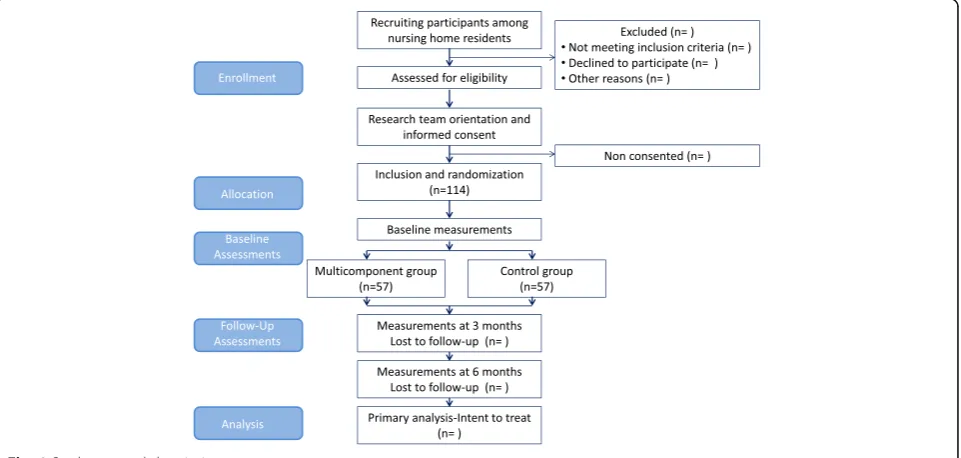
With the above mentioned objective in mind, it has been designed an experimental multicentre simple ran-domized study, with random allocation to a usual care group or to an intervention group. Each site will enroll on average 15 subjects. Researchers responsible for data gath-ering will be blinded for this study. Participants will be re-cruited from Matia and Caser Residential Care Facilities in 7 long-term nursing homes (San Sebastian, Basque Country, Spain). It is expected that the intervention will take place between October 2016 and June 2017. Study assessments will be conducted by blinded research staff during clinic visits at baseline, as well as at 3 and 6 months from the beginning of the intervention. The CONSORT Statement extension for trials of non-pharmacological interventions and pragmatic interven-tion trials has been used to design the study and will be used to report it (Fig. 1).
Inclusion and exclusion criteria
Subjects will be considered eligible for the study if they fulfill all of the following criteria: aged≥70 years, scored≥50 on the Barthel Index [51], scored≥20 on
MEC-35 [52] Test (an adapted and validated version of Mini Mental State Examination (MMSE) in Spanish) who are all capable to stand up and walk independently for at least 10 m.
Participants will not be eligible for the study if they are clinically unstable under the clinical judgment of the medical professionals of the reference center, or in any other condition that means that entering the study would not be in the subject’s best interests.
Recruitment and randomization
The listing of individuals that meet inclusion criteria will be obtained from the database of Matia and Caser Residential Care Facilities. The primary recruitment strategy will be information provided to the potential participants by the medical and nursing professionals from each nursing home. All the volunteers will receive detailed study information in their reference sites through the research team: objectives, measurement variables and other details about the interventions will be explained orally and in writing, to both potential partic-ipants and their families. Informed consent will be ob-tained from each participant who will sign it after fully understanding the procedures. Afterwards they will be randomly assigned (1:1 ratio) by center through sealed opaque envelopes to either the control or the intervention group by coin-tossing sequence generation.
Control group
Subjects in the control group will participate in the rou-tine activities that all nursing homes usually offer to the
attendees: memory workshops, reading, singing, etc. Ac-tivities will be low intensity in any case.
Multicomponent exercise program
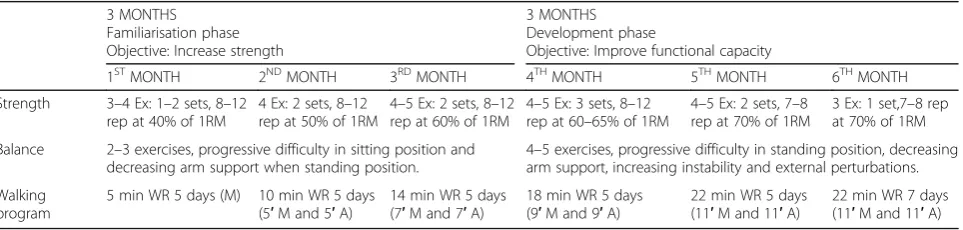
Subjects in the intervention group will add to the ac-tivities scheduled for the control group, the participa-tion in a multicomponent exercise program designed to improve strength, balance and walking retraining conducted by an experienced physical trainer. Strength and balance training will be performed through super-vised sessions, while walking retraining will be carried out through individualized recommendations that par-ticipants will fulfill on their own. The technical con-tent of the program is based on a specific literature review [17, 53, 54] including authors’ expertise and field experience, and it is divided into two sections of 3 months long (Table 1). Each section has specific ob-jectives and a standardized framework (combination and sequence of exercises), but the goals are individu-alized based on each participants’level of physical fit-ness. Goals will be adapted in response to illness, injury or physical symptoms. The intervention has been designed to meet the exercise and physical activ-ity guidelines for older adults established by the American College of Sport Medicine (ACSM) and American Heart Association (AHA) [55, 56]. Training attendance will be recorded every session.
Forty-five min supervised sessions directed to im-prove strength and balance will be conducted twice a week. An interval of at least 48 h between training ses-sions will be respected (Table 2). All sesses-sions will begin with a brief warm-up of 5 min (range-of-motion exer-cises for the neck, wrists, shoulders, hip, knees and an-kles). Strength training (25 min) will comprise upper and lower body exercises performed with external weights, which will be tailored to the individual’s func-tional capacity through Brzycki equation for the estima-tion of 1-RM (repetiestima-tion maximum) at baseline and at the end of every month, to ensure an appropriate train-ing stimulus. In all strength tests subjects will be en-couraged verbally to perform each exercise as forcefully
as possible in a standardized form. In the three first months exercises will be performed with light loads (40–60% 1-RM) to ensure an appropriate adaption to resistance exercise and thereafter loads, if they are well tolerated, will be increased to 65–70% 1-RM for add-itional benefits.
Balance training (10 min) will include exercises in pro-gressing difficulty starting by decreasing arm support (with 2 arms at first, with one hand, and finally none if possible) along with decreasing base of support (both feet together, semi-tandem and tandem positions) and increasing complexity of movements as to challenge participants’ balance as they progress. Exercises will be varied through the period: weight transfer from one leg to another, walking with small obstacles, proprioceptive exercises and stepping practice. Sessions will finish with 5 min of cooling down by stretching, breathing and relaxing exercises.
Walking retraining will also be implemented through individualized recommendations regarding distance and intensity to perform on their own in addition to the supervised sessions. According to ACSM/AHA guide-lines [56], exercise intensity will be monitored using a category-ratio 0–10 scale for physical exertion and breathlessness (Borg CR10 scale) [57]. Participants will be instructed to walk at a moderate intensity, equiva-lent to a 5–6 on the CR10 scale, with a target goal of achieving at least 22 min/day at the end of the 6 months period. Walking retraining will initially begin with light intensity activity for short periods of time, which grad-ually will be increased in intensity and duration over the 6 months period.
Finally, attendance to the program may be suspended due to a hospitalization, injury, or any other health events. Evaluation for re-engaging the exercitation will depend on the functional impact of the illness and on any activity limitation prescriptions that may provide the participant’s health care team. Irrespective of the week of the intervention that a suspension may occur, all restarts will be conducted in a supervised and pro-gressive way.
Table 1Multicomponent exercise program’s technical content
3 MONTHS 3 MONTHS
Familiarisation phase Development phase
Objective: Increase strength Objective: Improve functional capacity
1STMONTH 2NDMONTH 3RDMONTH 4THMONTH 5THMONTH 6THMONTH
Strength 3–4 Ex: 1–2 sets, 8–12 rep at 40% of 1RM
4 Ex: 2 sets, 8–12 rep at 50% of 1RM
4–5 Ex: 2 sets, 8–12 rep at 60% of 1RM
4–5 Ex: 3 sets, 8–12 rep at 60–65% of 1RM
4–5 Ex: 2 sets, 7–8 rep at 70% of 1RM
3 Ex: 1 set,7–8 rep at 70% of 1RM
Balance 2–3 exercises, progressive difficulty in sitting position and decreasing arm support when standing position.
4–5 exercises, progressive difficulty in standing position, decreasing arm support, increasing instability and external perturbations.
Walking program
5 min WR 5 days (M) 10 min WR 5 days (5′M and 5′A)
14 min WR 5 days (7′M and 7′A)
18 min WR 5 days (9′M and 9′A)
22 min WR 5 days (11′M and 11′A)
22 min WR 7 days (11′M and 11′A)
Outcome measures
The primary outcome measure will be the difference in function between intervention and control group assessed by changes in summary ordinal score on the Short Phys-ical Performance Battery [58] (SPPB). SPPB consists of three tests: balance, gait ability and leg strength. The score for each test is given in categorical modality (0–4) based on run time intervals, and the total score will range from 0 (worst) to 12 points (best). The SPPB has been shown to be a valid instrument for screening frailty and predicting disability, institutionalization and mortality. A total score of less than 10 points indicates frailty and a high risk of disability and falls. 1 point change in the total score has demonstrated to be of clinical relevance [59, 60].
The following parameters will be also recorded: age, gender, socioeconomic situation, marital status, Barthel index [51], MEC-35 [52], Lubben Social Network Scale (LSNS-6) [61], Tilburg Frail index [62], Frailty index [63], and Charlson [64] index. Anthropometric data will include body mass index (BMI) and waist-hip ratio; fat mass percentage will be measured using a portable bio-electrical impedance analyzer (Bodystat BIA Quadscan 4000) [65].
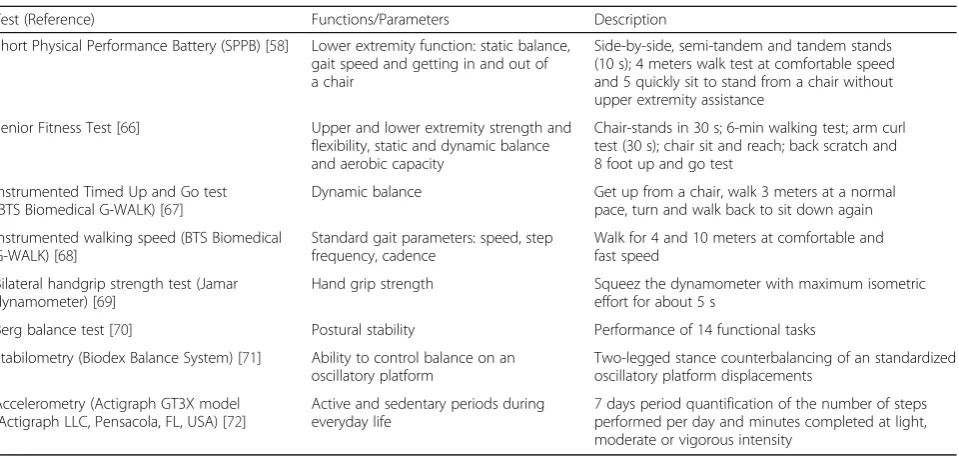
Functional examination will include the following (Table 3): Senior Fitness Test [66], instrumented Timed Up and Go test [67] (iTUG; BTS Biomedical G-WALK triaxial accelerometer and gyroscope), comfortable and fast walking speed [68], bilateral handgrip strength test [69] (Jamar dynamometer), Berg balance test [70], static balance and fall-risk by stabilometer [71] (Biodex Balance System SD), as well as active and sedentary periods during everyday life recorded with an accelerometer (Actigraph GT3X model (Actigraph LLC, Pensacola, FL, USA)) that will be worn on the hip with a belt for a 7 day period. The device will be set to quantify the number of steps taken per day. In line with that, active-period intensities will be classified following the criteria developed by Freedson et al. [72] as light, moderate or vigorous intensity and mea-sured in minutes performed in each intensity.
Cognitive and emotional assessment will be determined by the following (Table 4): Clinical Dementia Rating [73] (CDR), Montreal Cognitive Assessment (MoCA) [74], Symbol Digit Modalities Test (SDMT) [75] and Anxiety and Depression Goldberg Scale [76]. Health related quality of life will be assessed by the questionnaire EQ-5D-5 L [77].
Table 2Programation of the intervention for the 13th week
Objective Monday Tuesday Wednesday Thursday Friday Saturday Sunday
Multicomponent exercise program
Warm-Up 5 min Range of motion for
different joints
Range of motion for different joints
Strength training 25 min - Arm curl 60% 3 sets 8-12rep
- Arm curl 60% 3 sets 8-12rep
- -
-- Chair stand 60% 3 sets 8-12rep
- Chair stand 60% 3 sets 8-12rep
- -
-- Leg flexion 60% 3 sets 8-12rep
- Leg flexion 60% 3 sets 8-12rep
- -
-- Leg abduction 60% 3 sets 8-12rep
- - - -
-- - - Hip extensión 60% 3
sets 8-12rep
- -
-- Standing on tips and heels 3 sets 10 rep
- Standing on tips and heels 3 sets 10 rep
- -
-Balance training 10 min - One legged stand 2 sets 10 s
- One legged stand 2 sets 10 s
- -
-- Semi-tandem/Tandem exercises 2 sets 10 s
- Semi-tandem/Tandem
exercises 2 sets 10 s
- -
-- Circuit training 2 sets - Circuit training 2 sets - -
-- Stepping 2 sets 10 rep - Stepping 2 sets 10rep - -
-- Ball reaching 2 sets - - - -
-Cooling-Down 5 min Stretching, breathing, relaxing exercises.
Stretching, breathing, relaxing exercises.
Walking retraining
9 min WR M & A
- 9 min WR
M & A
- 9 min WR
M & A
9 min WR M & A
9 min WR M & A
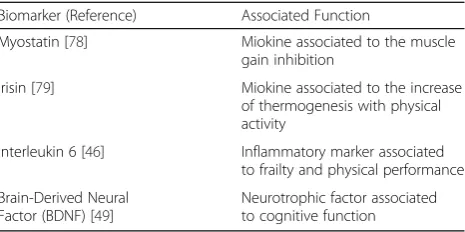
Blood samples will be obtained and stored at−80 °C. Biomarkers will be measured according to standard la-boratory protocols at the Physiology lala-boratory in the University of the Basque Country using an ELISA kit (ChemiKine TM; Millipore, Temecula, CA) following the manufacturer’s instructions. Thus, myostatin [78], irisin [79], interleukin 6 [46] and BDNF [49] will be measured (Table 5).
Finally, we will also record the number of falls, visits to the emergency service, hospital admissions and length of hospital stay.
Safety assessments
All co-existing diseases or conditions related with the intervention will be treated in accordance with prevail-ing medical practice and will be reported as an adverse event.
Power and sample size
Sample size has been calculated to detect minimal sig-nificant effects on the variable of physical performance (SPPB) [80, 81]: accepting an alpha risk of 0.05 and a beta risk of 0.20 in a bilateral contrast, 86 individuals are required in order to detect a difference equal to or greater than 1 unit in the SPPB (SD = 2.34). It has been increased the sample size in an additional 20% (loses during follow-up) and 5% (mortality). The resultant sample size is determinate in 114 individuals, therefore 57 individuals per group (intervention and control group).
Statistical considerations
The IBM SPSS Statistics 23 statistical software package (SPSS, Inc., Chicago, IL) will be used to analyse the data. Intention to treat analyses will be performed. The Table 3Functional assessment tests
Test (Reference) Functions/Parameters Description
Short Physical Performance Battery (SPPB) [58] Lower extremity function: static balance, gait speed and getting in and out of a chair
Side-by-side, semi-tandem and tandem stands (10 s); 4 meters walk test at comfortable speed and 5 quickly sit to stand from a chair without upper extremity assistance
Senior Fitness Test [66] Upper and lower extremity strength and flexibility, static and dynamic balance and aerobic capacity
Chair-stands in 30 s; 6-min walking test; arm curl test (30 s); chair sit and reach; back scratch and 8 foot up and go test
Instrumented Timed Up and Go test (BTS Biomedical G-WALK) [67]
Dynamic balance Get up from a chair, walk 3 meters at a normal pace, turn and walk back to sit down again
Instrumented walking speed (BTS Biomedical G-WALK) [68]
Standard gait parameters: speed, step frequency, cadence
Walk for 4 and 10 meters at comfortable and fast speed
Bilateral handgrip strength test (Jamar dynamometer) [69]
Hand grip strength Squeez the dynamometer with maximum isometric effort for about 5 s
Berg balance test [70] Postural stability Performance of 14 functional tasks
Stabilometry (Biodex Balance System) [71] Ability to control balance on an oscillatory platform
Two-legged stance counterbalancing of an standardized oscillatory platform displacements
Accelerometry (Actigraph GT3X model (Actigraph LLC, Pensacola, FL, USA) [72]
Active and sedentary periods during everyday life
7 days period quantification of the number of steps performed per day and minutes completed at light, moderate or vigorous intensity
Table 4Cognitive and Functional assessment tests
Test (Reference) Functions Description
Clinical Dementia Rating (CDR) [73] Cognitive and functional performance Covered domains: Memory, Orientation, Judgment and Problem Solving, Community Affairs, Home and Hobbies, Personal Care
Montreal Cognitive Assessment (MoCA) [74]
Mild Cognitive Impairment, Early Alzheimer’s disease Covered domains: Attention and Concentration, Executive Functions, Memory, Language, Visuoconstructional Skills, Conceptual Thinking, Calculations, Orientation
Symbol Digit Modalities Test (SDMT) [75] Cognitive impairment Covered domains: Attention, Visual Scanning, Motor Speed
Anxiety and Depression Goldberg Scale [76]
Affective state Includes nine depression and nine anxiety items from the past month
normal distribution of the data will be evaluated using the Kolmogorov-Smirnov test. Continuous variables will be expressed as mean (SD) when normally distributed and as median with interquartile range (IQR) when not. Categor-ical variables will be expressed as frequency counts and percentages. Statistical comparisons at baseline will be performed using appropriate statistical tests according to the type and distribution of the data: t test or Mann– WhitneyU-test for continuous variables and Chi-squared test for categorical variables. The intervention-related ef-fects will be performed using appropriate statistical tests according to the type and distribution of the data: an ana-lysis of variance (ANOVA) or Friedman test with repeated measures (0, 3 and 6 months). When a significant F value is obtained, LSD post hoc procedures will be used to evaluate pairwise differences. p< 0.05 will be considered to be statistically significant. Furthermore, an analysis of covariance (ANCOVA) will be done to compare the data between intervention and control groups, considering as co-variables baseline measurements, as well as other vari-ables as age or gender.
Trial status
The trial is currently being set up with participant re-cruitment. Recruitment will cease when 114 participants have been randomized; it is expected this target will be reached by June 2017.
Discussion
This is a multicenter study designed to ascertain if a su-pervised multicomponent exercise program carried out in long-term nursing care centers improves or maintains functionality, sedentary behaviors, cognitive and emo-tional status and biological markers related to frailty when compared with a control population that receives usual care. To our knowledge, an exercise program car-ried out in nursing home elderly population has not been studied before from a so broad perspective, taking into account all together functional, cognitive, emotional and biochemical conditions. The current lack of defini-tive evidence on whether ageing related functional deterioration can be effectively prevented by physical
exercise in institutionalized elders represents a potential obstacle to the development of guidelines for geriatric clinicians and policymakers that would also report in in-creasing health-related quality of life for a prevalent and clinically-relevant population. Furthermore, the World Health Organization (WHO) has recently published an Action Plan for the Prevention and Control of Noncom-municable Diseases in the WHO European Region 2016–2025, where it is highlighted the importance of introducing systematic musculoskeletal health programs for older people, including those living in residential care [82]. Moreover, long-term nursing home residents have been identified as a particularly vulnerable group where the above mentioned plan should direct its actions through an early intervention to restore and maintain functionality.
The exercise program that is described in this proto-col has been designed to be feasible, easy to implement and potentially delivered in any nursing home settings, which may have direct clinical applications. We previ-ous reported [83] that a similar multicomponent exer-cise program is feasible, well tolerated and pleasantly welcomed by individuals living in long-term care facil-ities. Furthermore, improvements in functional status were observed in those participants that took part in the program, particularly in gait ability, balance and aerobic capacity. These findings are in line with other studies carried out in nursing homes, indicating that the exercise programs can benefit functional perform-ance, well being and cognition of the residents [84–88]. Nevertheless, to date few randomized clinical trials have been conducted in institutionalized elders, and normally these trials study heterogeneous interventions (sometimes poorly explained), while our study allows the extrapolation of results and the implementation of the program to any other nursing home through a well-defined methodology.
Finally, if the described multicomponent exercise pro-gram proves to report benefits in terms of functional, sedentary behavior, cognitive and emotional status, as well as knowledge on the response of biological markers to physical activity, the findings could provide evidence suggesting the need to augment the standard physical practice prescribed at nursing homes in the elder population. Otherwise, failure to reject the null hypothesis would suggest that the progression of the decline associated with the aging process in at-risk per-sons continues on to disability, despite any potential benefits from physical activity. This would be an im-portant study outcome as well and implies that efforts to hold back the process of disablement in this popula-tion should be directed elsewhere.
The study of whether multicomponent exercise pro-gram can improve or maintain functionality, sedentary Table 5Biomarkers that will be analysed in the study
Biomarker (Reference) Associated Function
Myostatin [78] Miokine associated to the muscle gain inhibition
Irisin [79] Miokine associated to the increase of thermogenesis with physical activity
Interleukin 6 [46] Inflammatory marker associated to frailty and physical performance
Brain-Derived Neural Factor (BDNF) [49]
behaviors, cognitive and emotional status and biological markers related with frailty in nursing home elders is nowadays an unanswered question that is of major importance to public health and social policy. It is expected that the results of this research will guide clinical practice in nursing home settings, so that clini-cians and policymakers can provide more evidence-based practice for the management of institutionalized elder people.
Abbreviations
ACSM:American College of sport medicine; AHA: American heart association; ANZCTR: Australian and New Zealand clinical trials registry; BDNF: Brain-derived neural factor; BMI: Body mass index; CDR: Clinical dementia rating; CONSORT: Consolidated Standards of reporting trials; CRP: C-Reactive protein; EQ-5D-5 L: EuroQol five-dimensional questionnaire; IAGG: International association of gerontology and geriatrics; IANA: International academy of nutrition and aging; 1Ra: Interleukin 1 reception antagonist;
IL-6: Interleukin 6; IQR: InterQuartile range; iTUG: Instrumented timed up and go test; LSNS: Lubben social network scale; MEC-35: Cognition mini-exam of lobo; MoCA: Montreal cognitive assessment; RM: Repetition maximum; SDMT: Symbol digit modalities test; SPPB: Short physical performance battery; WHO: World health organisation
Acknowledgements
We would like to thank all study participants and their families for their cooperation and their confidence in the research team.
Funding
This research is supported by a grant from the Basque Government (ELKARTEK15/39; N°. EXPT.: KK-2015/00106).
Availability of data and materials Not applicable.
Authors’contributions
The protocol was developed by AR, JI, SG, HA, CR, MK, JY and MI. AR, JI, SG, HA and CR prepared the initial manuscript. All authors contributed to and reviewed the final manuscript prior to submission. All authors read and approved the final manuscript.
Competing interests
The authors declare that they have no competing interests.
Consent for publication Not applicable.
Ethics approval and consent to participate
The present study has been approved by the Committee on Ethics in Research of the University of the Basque Country (Humans Committee Code M10/2016/105; Biological Samples Committee Code M30/2016/106) and has also received a letter of support from the senior administrator of Matia and Caser Residential Care Facilities. Furthermore, the study protocol has been registered under the Australian and New Zealand Clinical Trials Registry (ANZCTR) with the identifier: ACTRN12616001044415 and all participants will provide written informed consent based on documents approved by a university Institutional Review Board. The study will be carried out in accordance with Good Clinical Practice, applicable local regulatory requirements, and the guiding principles of the Declaration of Helsinki. Universal Trial Number U1111-1185-6368.
Author details
1Department of Physiology, Faculty of Medicine and Nursing, University of the Basque Country (UPV/EHU), Barrio Sarriena s/n, E-48940 Leioa, Bizkaia, Spain.2Department of Nursing II, Faculty of Medicine and Nursing, University of the Basque Country (UPV/EHU), J. Begiristain Doktorearen pasealekua 105, E-20014 Donostia-San Sebastian, Gipuzkoa, Spain.3Matia Instituto
Gerontológico, Camino de los Pinos 35, E-20018 Donostia-San Sebastian, Gipuzkoa, Spain.
Received: 4 October 2016 Accepted: 18 February 2017
References
1. Scully T. Demography: to the limit. Nature. 2012;492:2. doi:10.1038/492S2a. 2. World Health Organization. Global Age-friendly Cities: A Guide. Geneva:
WHO press; 2007.
3. Cesari M, Vellas B, Gambassi G. The stress of aging. Exp Gerontol. 2013;48: 451–6. doi:10.1016/j.exger.2012.10.004.
4. World Health Organization. Good Health Adds Life to Years: Global Brief for World Health Day 2012. Geneva: WHO press; 2012.
5. Rodriguez-Manas L, Fried LP. Frailty in the clinical scenario. Lancet. 2015; 385(9968):e7–9. http://www.thelancet.com/journals/lancet/article/PIIS0140-6736(14)61595-6/abstract.
6. Collard RM, Boter H, Schoevers RA, et al. Prevalence of frailty in community-dwelling older persons: a systematic review. J Am Geriatr Soc. 2012;60(8): 1487–92. doi:10.1111/j.1532-5415.2012.04054.x.
7. Santos-Eggimann B, Cuénoud P, Spagnoli J, et al. Prevalence of frailty in middle-aged and older community-dwelling Europeans living in 10 countries. J Gerontol A Biol Sci Med Sci. 2009;64(6):675–81. doi:10.1093/ gerona/glp012.
8. Rodriguez-Manas L, Feart C, Mann G, et al. Searching for an operational definition of frailty: A Delphi method based consensus statement: The frailty operative definition-consensus conference project. J Gerontol A Biol Sci Med Sci. 2013;68(1):62–7. doi:10.1093/gerona/gls119.
9. Robertson DA, Savva GM, Kenny RA. Frailty and cognitive impairment–a review of the evidence and causal mechanisms. Ageing Res Rev. 2013;12(4): 840–51. doi:10.1016/j.arr.2013.06.004.
10. Bernal-Lopez C, Potvin O, Avila-Funes JA. Frailty is associated with anxiety in community-dwelling elderly adults. J Am Geriatr Soc. 2012;60(12):2373–4. doi:10.1111/jgs.12014.
11. St. John PD, Tyas SL, Montgomery PR. Depressive symptoms and frailty. Int J Geriatr Psychiatry. 2013;28(6):607–14. doi:10.1002/gps.3866.
12. Gale CR, Cooper C, Deary IJ, et al. Psychological well-being and incident frailty in men and women: the English Longitudinal Study of Ageing. Psychol Med. 2014;44(4):697–706. doi:10.1017/S0033291713001384. 13. Mhaolain AM, Gallagher D, Crosby L, et al. Frailty and quality of life for people
with Alzheimer’s dementia and mild cognitive impairment. Am J Alzheimers Dis Other Demen. 2012;27(1):48–54. doi:10.1177/1533317511435661. 14. Rizzoli R, Reginster JY, Arnal JF, et al. Quality of life in sarcopenia and frailty.
Calcif Tissue Int. 2013;93(2):101–20. doi:10.1007/s00223-013-9758-y. 15. Kelaiditi E, Cesari M, Canevelli M, et al. Cognitive frailty: rational and
definition from an (I.A.N.A./I.A.G.G.) international consensus group. J Nutr Health Aging. 2013;17(9):726–34. doi:10.1007/s12603-013-0367-2. 16. Theou O, Stathokostas L, Roland KP, et al. The effectiveness of exercise
interventions for the management of frailty: a systematic review. J Aging Res. 2011;2011:569194. doi:10.4061/2011/569194.
17. Cadore EL, Rodriguez-Manas L, Sinclair A, et al. Effects of different exercise interventions on risk of falls, gait ability, and balance in physically frail older adults: A systematic review. Rejuvenation Res. 2013;16(2):105–14. doi:10. 1089/rej.2012.1397.
18. Buford TW, Anton SD, Clark DJ, et al. Optimizing the benefits of exercise on physical function in older adults. PM R. 2014;6(6):528–43. doi:10.1016/j.pmrj. 2013.11.009.
19. Gine-Garriga M, Roque-Figuls M, Coll-Planas L, et al. Physical exercise interventions for improving performance-based measures of physical function in community-dwelling, frail older adults: A systematic review and meta-analysis. Arch Phys Med Rehabil. 2014;95(4):753–69. doi:10.1016/j.apmr.2013.11.007.
20. Tarazona-Santabalbina FJ, Gómez-Cabrera MC, Pérez-Ros P, et al. A multicomponent exercise intervention that reverses frailty and improves cognition, emotion, and social networking in the community-dwelling frail elderly: a randomized clinical trial. J Am Med Dir Assoc. 2016;17(5):426–33. doi:10.1016/j.jamda.2016.01.019.
21. Pahor M, Guralnik JM, Ambrosius WT, et al. Effect of structured physical activity on prevention of major mobility disability in older adults: the LIFE study randomized clinical trial. Jama. 2014;311(23):2387–96. doi:10.1001/ jama.2014.5616.
23. Colley RC, Garriguet D, Janssen I, et al. Physical activity of Canadian adults: accelerometer results from the 2007–2009 Canadian Health Measures Survey. Health Reports, Statistics Canada. 2011;Catalogue 82-003-XPE. http://www.statcan.gc.ca/pub/82-003-x/2011001/article/11396-eng.pdf. Accessed 21 Feb 2017.
24. Sardinha LB, Santos DA, Silva AM, et al. Breaking-up sedentary time is associated with physical function in older adults. J Gerontol A Biol Sci Med Sci. 2015;70(1):119–24. doi:10.1093/gerona/glu193.
25. Cart LRSM. Letter to the editor: standardized use of the terms“sedentary” and“sedentary behaviours”. Appl Physiol Nutr Metab. 2012;37(3):540–2. doi:10.1139/h2012-024.
26. Shiroma EJ, Freedson PS, Trost SG, et al. Patterns of accelerometer-assessed sedentary behavior in older women. JAMA. 2013;310(23):2562–3. doi:10. 1001/jama.2013.278896.
27. De Rezende LFM, Rey-Lopez JP, Matsudo VK, et al. Sedentary behavior and health outcomes among older adults: a systematic review. BMC Public Health. 2014;14(1):333. doi:10.1186/1471-2458-14-333.
28. Davis MG, Fox KR, Stathi A, et al. Objectively measured sedentary time and lower extremity function in older adults. J Aging Phys Act. 2014;22(4):474– 81. http://dx.doi.Org/10.1123/JAPA.2013-0042.
29. Santos DA, Silva AM, Baptista F, et al. Sedentary behavior and physical activity are independently related to functional fitness in older adults. Exp Gerontol. 2012;47:908–12. doi:10.1016/j.exger.2012.07.011.
30. Chastin SFM, Ferriolli E, Stephens NA, et al. Relationship between sedentary behaviour, physical activity, muscle quality and body composition in healthy older adults. Age Ageing. 2012;41:111–4. doi:10.1093/ageing/afr075.
31. McDermott MM, Liu K, Ferrucci L, et al. Greater sedentary hours and slower walking speed outside the home predict faster declines in functioning and adverse calf muscle changes in peripheral arterial disease. J Am Coll Cardiol. 2011;57(23):2356–64. doi:10.1016/j.jacc.2010.12.038.
32. Cawthon PM, Blackwell TL, Cauley JA, et al. Objective assessment of activity, energy expenditure, and functional limitations in older men: the Osteoporotic Fractures in Men study. J Gerontol A Biol Sci Med Sci. 2013; 68(12):1518–24. doi:10.1093/gerona/glt054.
33. Rosenberg DE, Bellettiere J, Gardiner PA, et al. Independent Associations Between Sedentary Behaviors and Mental, Cognitive, Physical, and Functional Health Among Older Adults in Retirement Communities. J Gerontol A Biol Sci Med Sci. 2016;71(1):78–83. doi:10.1093/gerona/glv103. 34. Dunlop DD, Song J, Arntson EK, et al. Sedentary time in U.S. older adults
associated with disability in activities of daily living independent of physical activity. J Phys Act Health. 2015;12(1):93–101. doi:10.1123/jpah.2013-0311. 35. Davis MG, Fox KR, Stathi A, et al. Objectively measured sedentary time and
its association with physical function in older adults. J Aging Phys Act. 2014; 22(4):474–81. doi:10.1123/japa.2013-0042.
36. Lucas M, Mekary R, Pan A, et al. Relation between clinical depression risk and physical activity and time spent watching television in older women: a 10-year prospective follow-up study. Am J Epidemiol. 2011;174(9):1017–27. doi:10.1093/aje/kwr218.
37. Hamer M, Stamatakis E. Prospective study of sedentary behavior, risk of depression, and cognitive impairment. Med Sci Sports Exerc. 2014;46(4):718–23. doi:10.1249/MSS.0000000000000156.
38. Kesse-Guyot E, Charreire H, Andreeva VA, et al. Cross-sectional and longitudinal associations of different sedentary behaviors with cognitive performance in older adults. PLoS One. 2012;7(10), e47831. doi:10.1371/journal.pone.0047831. 39. Fraile-Bermúdez AB, Kortajarena M, Zarrazquin I, et al. Relationship between
physical activity and markers of oxidative stress in independent community-living elderly individuals. Exp Gerontol. 2015;70:26–31. doi:10.1016/j.exger.2015.07.005. 40. Vallance JK, Boyle T, Courneya KS, et al. Associations of objectively assessed
physical activity and sedentary time with health-related quality of life among colon cancer survivors. Cancer. 2014;120(18):2919–26. doi:10.1002/cncr.28779. 41. George SM, Alfano CM, Groves J, et al. Objectively measured sedentary time
is related to quality of life among cancer survivors. PLoS One. 2014;9(2), e87937. doi:10.1371/journal.pone.0087937.
42. Balboa-Castillo T, Leon-Munoz LM, Graciani A, et al. Longitudinal association of physical activity and sedentary behavior during leisure time with health-related quality of life in community-dwelling older adults. Health Qual Life Outcomes. 2011;9(1):47. doi:10.1186/1477-7525-9-47.
43. Berrut G, Andrieu S, De Carvalho IA, et al. Promoting access to innovation for frail old persons. J Nutr Health Aging. 2013;17(8):688–93. doi:10.1007/ s12603-013-0039-2.
44. Erusalimsky JD, Grillari J, Grune T, et al. In Search of‘Omics’-Based Biomarkers to Predict Risk of Frailty and Its Consequences in Older Individuals: The FRAILOMIC Initiative. Gerontology. 2015;62(2):182–90. doi:10.1159/000435853. 45. Walston J, McBurnie MA, Newman A, et al. Frailty and activation of the
inflammation and coagulation systems with and without clinical comorbidities: results from the Cardiovascular Health Study. Arch Intern Med. 2002;162(20):2333–41. doi:10.1001/archinte.162.20.2333.
46. Cesari M, Penninx BW, Pahor M, et al. Inflammatory markers and physical performance in older persons: the InCHIANTI study. J Gerontol A Biol Sci Med Sci. 2004;59(3):M242–8. doi:10.1093/gerona/59.3.M242.
47. Ferrucci L, Penninx BW, Volpato S, et al. Change in Muscle Strength Explains Accelerated Decline of Physical Function in Older Women With High Interleukin‐6 Serum Levels. J Am Geriatr Soc. 2002;50(12):1947–54. doi:10. 1046/j.1532-5415.2002.50605.x.
48. Puts MTE, Lips PTAM, Deeg DJH. Static and dynamic measures of frailty predicted decline in performance-based and self-reported physical functioning. J Clin Epidemiol. 2005;58(11):1188–98. doi:10.1016/j.jclinepi. 2005.03.008.
49. De Melo Coelho FG, Gobbi S, Andreatto CAA, et al. Physical exercise modulates peripheral levels of brain-derived neurotrophic factor (BDNF): a systematic review of experimental studies in the elderly. Arch Gerontol Geriatr. 2013;56(1):10–5. doi:10.1016/j.archger.2012.06.003.
50. Rodriguez-Larrad A, Arrieta H, Yanguas J, Markotegi M, Irazusta A, Gil SM. Multi-component exercise training in elderly day care centers: a pilot study. 21st Annual Congress of the European College of Sport Science. Book of Abstracts. ISBN 978-3-00-053383-9. 2016. p. 204.
51. Wade DT, Collin C. The Barthel ADL Index: a standard measure of physical disability? Int Disabil Stud. 1988;10(2):64–7. doi:10.3109/09638288809164105. 52. Lobo A, Saz P, Marcos G, et al. Revalidación y normalización del
Mini-Examen Cognoscitivo (primera versión en castellano del Mini-Mental Status Examination) en la población general geriátrica. Med Clin (Barc). 1999; 112(20):767–74.
53. Binder EF, Schechtman KB, Ehsani AA, et al. Effects of exercise training on frailty in community‐dwelling older adults: results of a randomized, controlled trial. J Am Geriatr Soc. 2002;50(12):1921–8. doi:10.1046/j.1532-5415.2002.50601.x.
54. McPhate L, Simek EM, Haines TP. Program-related factors are associated with adherence to group exercise interventions for the prevention of falls: a systematic review. J Physiother. 2013;59(2):81–92. doi:10.1016/S1836-9553(13)70160-7.
55. Chodzko-Zajko WJ, Proctor DN, Fiatarone-Singh MA, for the American College of Sports Medicine Position Stand, et al. Exercise and physical activity for older adults. Med Sci Sports Exerc. 2009;41:1510–30. doi:10.1249/ MSS.0b013e3181a0c95c.
56. Nelson ME, Rejeski WJ, Blair SN, et al. Physical activity and public health in older adults: recommendation from the American College of Sports Medicine and the American Heart Association. Circulation. 2007;116(9):1094– 105. doi:10.1161/CIRCULATIONAHA.107.185650.
57. Guralnik JM, Simonsick EM, Ferrucci L, et al. A short physical performance battery assessing lower extremity function: association with self-reported disability and prediction of mortality and nursing home admission. J Gerontol. 1994;49(2):M85–94. doi:10.1093/geronj/49.2.M85.
58. Borg G. Perceived exertion and pain scales. Champaign: Human Kinetics; 1988. 59. Guralnik JM, Ferrucci L, Simonsick EM, et al. Lower-extremity function in
persons over the age of 70 years as a predictor of subsequent disability. N Engl J Med. 1995;332(9):556–61. doi:10.1056/NEJM199503023320902. 60. Guralnik JM, Ferrucci L, Pieper CF, Leveille SG, et al. Lower extremity
function and subsequent disability: consistency across studies, predictive models, and value of gait speed alone compared with the short physical performance battery. J Gerontol A Biol Sci Med Sci. 2000;55(4):M221–31. doi:10.1093/gerona/55.4.M221.
61. Lubben J, Blozik E, Gillmann G, et al. Performance of an abbreviated version of the Lubben Social Network Scale among three European community-dwelling older adult populations. Gerontologist. 2006;46:503–13. doi:10. 1093/geront/46.4.503.
62. Gobbens RJ, Van Assen MA, Luijkx KG, et al. The Tilburg Frailty Indicator: psychometric properties. J Am Med Dir Assoc. 2010;11(5):344–55. doi:10. 1016/j.jamda.2009.11.003.
64. Charlson M, Szatrowski TP, Peterson J, et al. Validation of a combined comorbidity index. J Clin Epidemiol. 1994;47(11):1245–51. doi:10.1016/0895-4356(94)90129-5.
65. Scafoglieri A., Predicting appendicular lean and fat mass with bioelectrical impedance analysis in older adults with physical function decline e The PROVIDE study. Clin Nutrition. 2016;Article in press. doi: http://dx.doi.org/10. 1016/j.clnu.2016.04.026.
66. Rikli RE, Jones CJ. Senior fitness test. Champaign: Human Kinetics; 2001. ISBN 0-7360-3356-4.
67. Mathias S, Nayak US, Isaacs B. Balance in elderly patients: the“get-up and go”test. Arch Phys Med Rehabil. 1986;67(6):387–9.
68. Bohannon RW, Andrews AW, Thomas MW. Walking speed: reference values and correlates for older adults. J Orthop Sports Phys Ther. 1996;24(2):86–90. doi:10.2519/jospt.1996.24.2.86.
69. Fess EE. In: Casanova JS, editor. Clinical assessment recommendations. Chicago: American Society of Hand Therapists; 1992. p. 41–5. Grip strength. 70. Berg KO, Wood-Dauphinée SL, Williams JI, et al. Measuring balance in the
elderly: validation of an instrument. Can J Publ Health. 1992;83:S7–S11. 71. Gusi N, Adsuar JC, Corzo H, et al. Balance training reduces fear of falling and
improves dynamic balance and isometric strength in institutionalised older people: a randomised trial. J Physiother. 2012;58(2):97–104. doi:10.1016/ S1836-9553(12)70089-9.
72. Freedson PS, Melanson E, Sirard J. Calibration of the Computer Science and Applications, Inc. accelerometer. Med Sci Sports Exerc. 1998;30(5):777–81. doi:10.1097/00005768-199805000-00021.
73. Morris JC. The clinical dementia rating (CDR): current version and scoring rules. Neurology. 1993;43(11):2412–4.
74. Coen RF, Robertson DA, Kenny RA, et al. Strengths and Limitations of the MoCA for Assessing Cognitive Functioning Findings From a Large Representative Sample of Irish Older Adults. J Geriatr Psychiatry Neurol. 2016;29(1):18–24. doi:10.1177/0891988715598236.
75. Sheridan LK, Fitzgerald HE, Adams KM, et al. Normative Symbol Digit Modalities Test performance in a community-based sample. Arch Clin Neuropsychol. 2006;21(1):23–8. doi:10.1016/j.acn.2005.07.003. 76. Goldberg D, Bridges K, Duncan-Jones P, et al. Detecting anxiety and
depression in general medical settings. Br Med J. 1988;297(6653):897–9. doi:10.1136/bmj.297.6653.897.
77. Janssen MF, Pickard AS, Golicki D, et al. Measurement properties of the EQ-5D-5 L compared to the EQ-EQ-5D-5D-3 L across eight patient groups: a multi-country study. Qual Life Res. 2013;22(7):1717–27. doi:10.1007/s11136-012-0322-4. 78. Kalinkovich A, Livshits G. Sarcopenia–The search for emerging biomarkers.
Ageing Res Rev. 2015;22:58–71.
79. Boström P, Wu J, Jedrychowski MP, et al. A PGC1-[agr]-dependent myokine that drives brown-fat-like development of white fat and thermogenesis. Nature. 2012;481(7382):463–8.
80. Perera S, Mody SH, Woodman RC, et al. Meaningful change and responsiveness in common physical performance measures in older adults. J Am Geriatr Soc. 2006;54(5):743–9. doi:10.1111/j.1532-5415.2006.00701.x. 81. Kwon S, Perera S, Pahor M, et al. What is a meaningful change in physical
performance? Findings from a clinical trial in older adults (the LIFE-P study). J Nutr Health Aging. 2009;13:538–44. doi:10.1007/s12603-009-0104-z. 82. World Health Organization. Regional Committee for Europe 66th Session.
Action plan for the prevention and control of noncommunicable diseases in the WHO European Region. Copenhagen, Denmark, 12–15 September 2016. http://www.euro.who.int/__data/assets/pdf_file/0011/315398/ 66wd11e_NCDActionPlan_160522.pdf?ua=1. Accesed 21 Feb 2017. 83. Arrieta H., Rodriguez-Larrad A., Iturburu M., Kortajarena M., Irazusta J.
A pilot trial of multi-component exercise training in older residents in long-term residential care facilities. 21st Annual Congress of the European College of Sport Science. Book of Abstracts. ISBN 978-3-00-053383-9. 2016. p. 204.
84. Brett L, Traynor V, Stapley P. Effects of physical exercise on health and well-being of individuals living with a dementia in nursing homes: A systematic review. J Am Med Dir Assoc. 2016;17(2):104–16. doi:10.1016/j. jamda.2015.08.016.
85. De Souto Barreto P, Morley JE, Chodzko-Zajko W, et al. Recommendations on physical activity and exercise for older adults living in long-term care facilities: a taskforce report. J Am Med Dir Assoc. 2016;17(5):381–92. doi:10. 1016/j.jamda.2016.01.021.
86. Frändin K., Grönstedt H., Helbostad J.L. et al. Long-Term Effects of Individually Tailored Physical Training and Activity on Physical Function,
Well-Being and Cognition in Scandinavian Nursing Home Residents: A Randomized Controlled Trial. Gerontology. 2016. doi:10.1159/000443611. 87. Franzke B, Halper B, Hofmann M, et al. The effect of 6 months of elastic
band resistance training, nutritional supplementation or cognitive training on chromosomal damage in institutionalized elderly. Exp Gerontol. 2015;65:16–22. doi:10.1016/j.exger.2015.03.001.
88. Casilda-López J, Torres-Sánchez I, Garzón-Moreno VM, et al. Results of a physical therapy program in nursing home residents: A randomized clinical trial. Rev Esp Geriatr Gerontol. 2014;50(4):174–8. doi:10.1016/j. regg.2014.09.007.
• We accept pre-submission inquiries
• Our selector tool helps you to find the most relevant journal
• We provide round the clock customer support
• Convenient online submission
• Thorough peer review
• Inclusion in PubMed and all major indexing services
• Maximum visibility for your research
Submit your manuscript at www.biomedcentral.com/submit