Bosn J Basic Med Sci 2012; 12 (3): 177-181
Abstract
Crataegus species have been widely used in herbal medicine, especially for the hearth diseases. In the present study, the eff ect of Crataegus aronia var. dentata Browicz extract on partially hepatectomized rats was investigated with biochemical and TUNEL apoptosis assays. Th e extracts of the plant at the concentrations of . and ml/ g body weight/day were administered orally to the two experimental groups
including partially hepatectomized rats for days. At the end of the experimental period, animals were sacrifi ced, blood was collected for the assessment of serum levels of alanine aminotransferase (ALT), aspartate aminotransferase (AST) and gamma-glutamyltransferase (GGT), and the liver tissue was used for TUNEL assay.
In biochemical assay, it was found a signifi cant decrease in the levels of serum ALT and AST in the experimental groups. On the other hand, the plant extract did not cause any signifi cant changes in the level of GGT in these groups. In apoptosis assay, TUNEL positive hepatocytes could not be detected in both experimental groups.
Th e present fi ndings can suggest that Crataegus aronia var. dentata Browicz extract can decrease the levels of serum ALT and AST and play a role in apoptosis of hepatocytes in the liver of partially hepatectomized rats. However, further studies are required to confi rm the eff ects of the plant extract on hepatoprotection and apoptosis in the regenerating liver after partial hepatectomy in animal models.
© Association of Basic Medical Sciences of FBIH. All rights reserved
KEY WORDS: Crataegus aronia var. dentata Browicz, liver, hepatectomy, apoptosis
extract on biochemical indices and apoptosis
in partially hepatectomized liver in rats
Nazan Keskin1*, Ramazan Mammadov2, Pinar Ili2
1 Department of Histology and Embryology, Faculty of Medicine, University of Pamukkale, Kinikli 20070, Denizli, Turkey. 2 Department of
Biology, Faculty of Science and Arts, University of Pamukkale, Kinikli 20070, Denizli, Turkey.
INTRODUCTION
Liver can rapidly regenerate itself after acute liver injury, chronic hepatic diseases, liver transplantation and partial hepatectomy. Hepatectomy, characterized by increased apoptosis, induces oxidative injury in hepatocytes. Apopto-sis (programmed cell death) is an important process during normal development and regeneration of the liver. Due to the signifi cant roles in development, regeneration and tissue homeostasis, it plays a critical role in the balance between regeneration and cell death. Recently, many researches have received a great deal of attention about evaluating apoptotic cell death and the corresponding intracellular signaling path-ways [, , , , ]. Besides, the importance of cell apoptosis in normal liver development, regeneration and also in hepato-pathology is exclusively investigated [, , , , , , , ].
Apoptosis is morphologically characterized by some cel-lular changes including DNA fragmentation and the ap-pearance of cytoplasmic apoptotic bodies. As an important method for the demonstration of apoptotic cells, the TU-NEL (deoxynucleotdyltransferase-mediated dUDP nick end labeling) method is based on the specifi c detection of DNA fragmentation in the nuclei of apoptotic cells []. In the past decade, there has been a great deal of inter-est in the use of medicinal plants for the treatment of diseases. Many researches have focused on the thera-peutic properties of medicinal plants such as hepato-protective, antioxidative, antimicrobial and gastric ef-fects [, , , , , , , ]. Furthermore, many scientific studies have been extensively carried out by us-ing medicinal plants in liver damages [, , , , , ].
Crataegus species, also known as Hawthorn, are medicinal plants, which have fl avonoids, triterpene acids, proanthocy-anidins, and organic acids as main components. Several stud-ies demonstrated the cardioprotective eff ect of Crataegus spp [, , , , ]. Additionally, some studies have reported on diff erent eff ectiveness of Crataegus spp such as antioxidant, antiinfl ammatory and anticarcinogenic eff ects [, , , ]. * Corresponding author: Nazan Keskin, Department of
Histology and Embryology, Faculty of Medicine, University of Pamukkale, Kinikli 20070, Denizli, Turkey.
Tel: +90 258 2961755 Fax: +90 258 2961765 e-mail: [email protected]
Bosn J Basic Med Sci 2012; 12 (3): 178-181 The aim of the present study was to investigate thehepa-toprotective and apoptotic effects of C. aronia var. den-tata Browicz extracts in the liver of partially hepatec-tomized rats using biochemical and TUNEL methods.
MATERIALS AND METHODS
Preparation of plant extract
C. aronia var. dentata Browicz grows along forest edges in Güzelpinar village, Denizli/Turkey. The flowers of the plants were collected and dried at shady places. Dried fl ow-ers were pulverized and put in the fl ask with ethyl alco-hol to let them dissolve until the concentration at . Th e fl ask mouth was closed with a rubber stopper to protect the extract from contacting with air. Th e fl ask was covered with aluminum foil to protect the extract from light. Th en, it was placed in the water bath at °C for six hours. Th e extract fi ltered and remaining sediment was dissolved with ethyl al-cohol and placed in the water bath at °C for another six hours. Th e extract was refi ltered and the sum of the al-cohol was evaporated using a rotary evaporator (Laborata ; Heidolph Instruments GmbH & Co. KG, Germany). Residual part of the extract was dissolved with ultrapure wa-ter and the wawa-ter in the extract was lyophilized. Two diff er-ent concer-entrations of the extract were prepared: . and .
Treatment of animals
Male albino rats, weighing approximately - g, were ob-tained from the Pamukkale University, Faculty of Medicine, Experimental Research Center, Denizli, Turkey. Th e animals (Ethical approval was obtained from the Pamukkale Univer-sity Animal Ethics Committee) were allocated into three groups with fi ve rats in each group. Before the experimental period, partial hepatectomy was performed under an-aesthesia by removing the left lateral lobe from all the groups.
Group I: Control animals received normal rat diet and wa-ter, ad libitum.
Group II: Th e plant extract at concentration of . was given orally for weeks.
Group III: Th e plant extract at concentration of was giv-en orally for weeks.
After the experimental period, the animals were sacri-ficed under anesthesia, and blood samples were collected for the biochemical assays. For apoptosis assay, the liv-ers were excised immediately from the animals, sliced thinly and embedded within optimal cutting tempera-ture (OCT) compound. They were snap frozen in liq-uid nitrogen and stored at - °C for cryostat technique.
Biochemical assays
Blood samples were taken by cardiac venipuncture
on the nd, th and th weeks after the initial treatment.
Then, they were centrifuged at rpm for min-utes to collect serum and were stored at -oC.
As-partate aminotransferase (AST), alanine aminotrans-ferase (ALT) and gamma-glutamyltransaminotrans-ferase (GGT) were measured for the determination of liver function.
Apoptosis assay
In order to detect the apoptotic cells, TUNEL assay on fro-zen tissue sections ( μm) were performed using In Situ Cell Death Detection Kit (POD, ROCHE, cat: ).
Controls of TUNEL: TUNEL controls were performed by in-cubating slides with μl label solution.
Photography
Olympus BX light microscope and Olympus DP-BSW microscope digital camera system were used for photography.
Statistical analysis
Th e biochemical results were evaluated using Kruskal-Wallis test in SPSS . program. Th e level of signifi cance was set at
p<..
RESULTS
Biochemical fi ndings
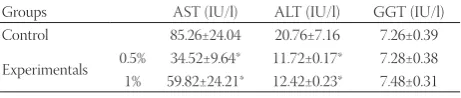
Tables , , and give the mean serum AST, ALT and GGT levels for , , and weeks in all groups. Th ere was a signifi -cant diff erence in serum AST and ALT levels of the experi-mental groups when compared to controls (p<.). C. aronia
var. dentata Browicz extract given to the hepatectomized rats signifi cantly reduced the serum AST and ALT levels when compared to controls at the end of treatment. However, AST levels at the concentration of . were less than those of the levels of . Th is eff ect appeared to be dose dependent. On the other hand, the extract did not aff ect the level of GGT.
Groups AST (IU/l) ALT (IU/l) GGT (IU/l)
Control 85.26±24.04 20.76±7.16 7.26±0.39
Experimentals 0.5% 34.52±9.64* 11.72±0.17* 7.28±0.38
1% 59.82±24.21* 12.42±0.23* 7.48±0.31 TABLE 1. Serum AST, ALT and GGT levels of 2 weeks in partially hepatectomized rats
Groups AST (IU/l) ALT (IU/l) GGT (IU/l)
Control 85.42±24.80* 21.56±7.77* 7.18±0.47
Experimentals 0.5% 32.60±8.79* 11.68±0.42* 7.10±0.52
1% 59.48±24.66* 12.32±0.28* 7.44±0.49 TABLE 2. Serum AST, ALT and GGT levels of 4 weeks in partially hepatectomized rats
*p<0.05 compared to control
Bosn J Basic Med Sci 2012; 12 (3): 179-181
Apoptosis assay fi ndings
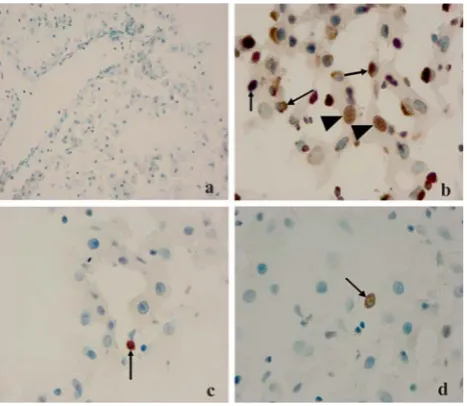
The plant extracts at concentrations of . ml and ml were administered to the hepatectomized rats and the presence of apoptotic cells were investigated in liver tis-sue by TUNEL assay. Apoptotic cells were distinguished by distinct nuclear staining. In controls, positively stained nuclei were observed not only in hepatocytes, but also in sinusoidal cells (Figure b). However, TUNEL-positive he-patocytes could not be distinguished in the liver from . and plant extract administered groups, whereas TU-NEL-positive sinusoidal cells were observed (Figures c, d).
DISCUSSION
Crataegus species have received extensive attention in many scientifi c researches particularly on the treatment of cardio-vascular diseases. In recent years, the effectiveness of the plant has been investigated on various disorders [, ]. Many researches have shown its antioxidant,
cardioprotec-tive, anticarcinogenic eff ects [, , , , , , ]. Th e major activity of the plant is thought to be provided by its fl avonoid content. Flavonoids are biochemically active com-pounds with antiinfl ammatory and anticarcinogenic proper-ties []. Th ey have extensive biological properties that pro-mote human health and help reduce the risk of disease []. As it is known, the values of ALT and AST are used as bio-chemical markers of liver damage []. From the biobio-chemical analyses, C. aronia var. dentata Browicz extract in diff erent concentrations administration lowered ALT and AST lev-els in partially hepatectomized rats. Particularly, there was a signifi cant decrease of AST level at the concentration of . compared to that of . Th is fi nding showed that the extract of C. aronia var. dentata Browicz may have protec-tive eff ect against partial hepatectomy-induced liver injury. It has been concluded that fatal hepatic failure after exces-sive hepatectomy was characterized by increased apoptosis and diminished liver regeneration []. It has been reported that carvacrol obtained from Origanum onites L. (Lamia-ceae) plant oil increases the liver regeneration rate follow-ing hepatectomy in rats []. In this study, the extracts of
C. aronia var. dentata Browicz may increase the regenera-tion rate in hepatocytes in comparison to control group in the liver of partially hepatectomized rats. Furthermore, Swaminathan et al. [] reported that C. oxycantha extract may reduce the oxidative stress in the reperfused myocar-dium, and play a significant role in the inhibition of apop-totic pathways leading to cardioprotection. Taken together, it is speculated that C. aronia var. dentata Browicz extract may play a role in the process of hepatocyte apoptosis and subsequent regeneration in hepatectomy-related injury.
CONCLUSION
In conclusion, C. aronia var. dentata Browicz extract may have potent antioxidant activity, refl ected by reduced serum AST and ALT levels in partially hepatectomized rats. The mechanism of antioxidant activity may be explained by the fl avanoids present in the extract. Moreover, the plant extract may enhance regenerative capacity of hepatocytes in experi-mental groups. Th erefore, it can be suggested that C. aronia
var. dentata Browicz extract may play a role in the apoptotic process of regenerating hepatocytes as well as in the antioxi-dant process after partial hepatectomy in rats. However, fur-ther studies are required to confi rm the eff ects of the plant ex-tract on hepatoprotection and the mechanisms of apoptosis and regeneration after partial hepatectomy in animal models.
DECLARATION OF INTEREST
Th e authors declare no confl ict of interest. FIGURE 1. Tunel assay of hepatectomized liver in control (Group
I) and experimental groups (Group II and III). a: negative control. b: TUNEL-positive hepatocytes (arrowheads), sinusoidal cells (ar-rows) were visualized in the Group I. c, d: It could not be distin-guished apoptotic hepatocytes in the hepatectomized liver of ex-perimental groups, but apoptotic sinusoidal cells were observed (arrows) (c: sections from the liver of Group II, d: sections from the liver of Group III), x1000
Groups AST (IU/l) ALT (IU/l) GGT (IU/l)
Control 84.94±24.72* 20.08±6.92* 7.04±0.54
Experimentals 0.5% 34.36±9.56* 11.56±0.30* 7.22±0.13
1% 59.70±24.29* 12.28±0.23* 7.48±0.17 TABLE 3. Serum AST, ALT and GGT levels of 6 weeks in partially hepatectomized rats
Bosn J Basic Med Sci 2012; 12 (3): 180-181REFERENCES
[] Cho SG, Choi EJ. Apoptotic signaling pathways: Caspases and stress-activated protein kinases. J Biochem Mol Biol ; (): -.
[] Jaeschke H, Gujral JS, Bajt ML. Apoptosis and necrosis in liver dis-ease. Liver Int ; : -.
[] Liu J, Lin A. Role of JNK activation in apoptosis: A double-edged sword. Cell Res ; (): -.
[] Elmore S. Apoptosis: A review of programmed cell death. Toxicol Pathol ; : -.
[] Arican GO. Apoptosis signalling: A life or death decision. Advanc-es in Molecular Biology ; : -.
[] Schulte-Hermann R, Bursch W, Low-Baselli A, Wagner A, Grasl-Kraupp B. Apoptosis in the liver and its role in hepatocarcinogen-esis. Cell Biol Toxicol ; : -.
[] Blankson H, Grotterod EM, Seglen PO. Prevention of toxin-in-duced cytoskeletal disruption and apoptotic liver cell death by the grapefruit fl avonoid naringin. Cell Death Diff er ; : -. [] Moon WS, Kim JH, Kang MJ, Lee DG. Early ultrastructural
chang-es of apoptosis induced by fumonisin B in rat liver. Yonsei Med J ; (): -.
[] Schmilovitz-Weiss H, Belinki A, Pappo O, Sulkes J, Melzer E, Ka-ganovski E, Kfi r B, Tur-Kaspa R, Klein T, Ben-Ari Z. Role of circu-lating soluble CD as an apoptotic marker in liver disease. Apop-tosis ; : -.
[] Jiang H, Meng F, Li J, Sun X. Anti-apoptosis eff ects of oxymatrine protect the liver from warm ischemia reperfusion injury in rats. World J Surg ; : -.
[] Leifeld L, Fink K, Debska G, Fielenbach M, Schmitz V, Sauerbruch T et al. Anti-apoptotic function of gelsolin in fas antibody-induced liver failure in vivo. Am J Pathol ; (): -.
[] Renna MS, Correa SG, Porporatto C, Figueredo CM, Aoki MP, Pa-raje MG et al. Hepatocellular apoptosis during Candida albicans
colonization: involvement of TNF-alpha and infi ltrating Fas-L posi-tive lymphocytes. Int Immunol ; (): -.
[] Liu LM, Zhang JX, Luo J, Guo HX, Deng H, Chen JY, Sun SL. A role of cell apoptosis in lipopolysaccharide (LPS)-induced nonle-thal liver injury in D-galactosamine (D-GalN)-sensitized rats. Dig Dis Sci ; : -
[] Gavrieli Y, Sherman Y, Ben-Sasson SA. Identification of pro-grammed cell death in situ via specifi c labeling of nuclear DNA fragmentation. J Cell Biol ; : -.
[] Rusu MA, Tamas M, Puica C, Roman I, Sabadas M. Th e hepato-protective action of ten herbal extracts in CCl intoxicated liver. Phytother Res ; : -.
[] Mazzanti G, Di Sotto A, Franchitto A, Mastrangelo S, Pezzella M, Vitalone A et al. Eff ects of Cimicifuga racemosa extract on liver morphology and hepatic function indices. Phytomedicine ; ():-
[] Jan S, Khan MA, Siraj-ud-din, Murad W, Hussain M, Ghani A. Herbal recipes used for gastrointestinal disorder in Kaghan valley, NWFP, Pakistan. Pak J Weed Sci Res ; (-): -. [] Janovská D, Kubíková K, Kokoška L. Screening for antimicrobial
activity of some medicinal plants species of traditional Chinese medicine. Czech J Food Sci ; : -.
[] Moselhy SS, Ali HKH. Hepatoprotective eff ect of Cinnamon ex-tracts against carbon tetrachloride induced oxidative stress and liver injury in rats. Biol Res ; : -.
[] Hussain A, Wahab S, Zarin I, Hussain MDS. Antibacterial activity of the leaves of Coccinia indica (W. A.) of India. Advan Biol Res ; (): -.
[] Uboh FE, Okon IE, Ekong MB. Eff ect of aqueous extract of Psidium guajava leaves on liver enzymes, histological integrity and hemato-logical indices in rats. Gastroenterolgy Res ; (): -. [] Can A, Akev N, Ozsoy N, Bolkent S, Arda BP, Yanardag R. et al.
Eff ect of Aloe vera leaf gel and pulp extracts on the liver in Type-II diabetic rat models. Biol Pharm Bull ; (): -. [] Hewawasam RP, Jayatilaka KAPW, Pathirana C, Mudduwa LKB.
Hepatoprotective eff ect of Epaltes divaricata extract on carbon tet-rachloride induced hepatotoxicity in mice. Indian J Med Res ; (): -.
[] Dahiru D, William ET, Nadro MS. Protective eff ect of Ziziphus mauritiana leaf extract on carbon tetrachloride-induced liver in-jury. Afr J Biotechnol ; (): -.
[] Garba SH, Prasad J, Sandabe UK. Histomorphological eff ect of the aqueous root-bark extract of Ficus sycomorus (Linn) on the liver and kidney of albino rats. International Journal of Pharmacology: IJP ; : -.
[] Aliyu R, Gatsing D, Jaryum KH. Th e eff ects of Boswellia dalzielii
(Burseraceae) aqueous bark extract on rat liver function. Asian J Biochem ; (): -.
[] Al Makdessi S, Sweidan H, Dietz K, Jacob R. Protective eff ect of
Crataegus oxyacantha against reperfusion arrhythmias after global no-fl ow ischemia in the rat heart. Basic Res Cardiol ; (): -.
[] Holubarsch CJF, Colucci WS, Meinertz T, Gaus W, Tendera M. Th e effi cacy and safety of Crataegus extract WS® in patients with heart failure: Th e SPICE trial, Eur J Heart Fail ; : -.
[] Brixius K, Willms S, Napp A, Tossios P, Ladage D, Bloch W, Mehl-horn U, Schwinger RHG Crataegus special extract WS in-duces an endothelium-dependent, NO-mediated vasorelaxation via eNOS-phosphorylation at serine . Cardiovasc Drugs Th er ; (): -
[] Salehi S, Long SR, Proteau PJ, Filtz TM. Hawthorn (Crataegus mo-nogyna Jacq.) extract exhibits atropine-sensitive activity in a cul-tured cardiomyocyte assay. J Nat Med ; (): -.
[] Verma SK, Jain V, Verma D, Khamesra R. Crataegus oxyacantha-A cardioprotective herb. J Herbal Med Toxicol ; (): -. [] Bahri-Sahloul R, Ammar S, Fredj RB, Saguem S, Grec S, Trotin F,
Skhiri FH. Polyphenol contents and antioxidant activities of ex-tracts from fl owers of two Crataegus azarolus L. varieties. Pak J Biol Sci ; (): -.
[] Ahumada, C, Saenz T, Garcia D, De La Puerta R, Fernandez A, Martinez E. Th e eff ects of a triterpene fraction isolated from Cra-taegus monogyna Jacq. on diff erent acute infl ammation models in rats and mice. Leucocyte migration and phospholipase A inhibi-tion. J Pharm Pharmacol ; (): -.
[] Kao ES, Wang CJ, Lin WL, Yin YF, Wang CP, Tseng TH. Anti-infl ammatory potential of fl avonoid contents from dried fruit of
Crataegus pinnatifi da in vitro and in vivo. J Agric Food Chem ; : -.
[] Kao ES, Wang CJ, Lin WL, Chu CY, Tseng TH. Eff ects of polyphe-nols derived from fruit of Crataegus pinnatifi da on cell transforma-tion, dermal edema and skin tumor formation by phorbol ester ap-plication. Food Chem Toxicol ; (): -.
[] Zhang DL, Zhang YT, Yin JJ, Zhao BL. Oral administration of Cra-taegus fl avonoids protects against ischemia/reperfusion brain dam-age in gerbils. J Neurochem ; (): -.
[] Arslan R, Bor Z, Bektas N, Mericli AH, Ozturk Y. Antithrombotic eff ects of ethanol extract of Crataegus orientalis in the carrageenan-induced mice tail thrombosis model. Th romb Res ; (): -.
[] Th irupurasundari CJ, Jayalakshmi R, Niranjali DS. Liver architec-ture maintenance by tincarchitec-ture of Crataegus against isoproterenol-induced myocardially infarcted rats. J Med Food ; (): -.
[] Ljubuncic P, Portnaya I, Cogan U, Azaizeh H, Bomzon A. Anti-oxidant activity of Crataegus aronia aqueous extract used in tra-ditional Arab medicine in Israel. J Ethnopharmacol ; (-): -.
[] Jayalakshmi R, Th irupurasundari CJ, Niranjali Devaraj S. Pretreat-ment with alcoholic extract of Crataegus oxycantha (AEC) ac-tivates mitochondrial protection during isoproterenol-induced myocardial infarction in rats. Mol Cell Biochem ; : -. [] Khalil R, Abuharfeil N, Shabsoug B. Th e eff ect of crataegus aronica
Bosn J Basic Med Sci 2012; 12 (3): 181-181
[] Li C, Han W, Wang MH. Antioxidant activity of hawthorn fruit in vitro. J Appl Biol Chem ; (): -.
[] Liang YC, Huang YT, Tsai SH, Lin-Shiau SY, Chen CF, Lin JK. Suppression of inducible cyclooxygenase and inducible nitrite ox-ide synthase by apigenin and related fl avonoids in mouse macro-phages. Carcinogenesis ; : -.
[] Craig WJ. Health-promoting properties of common herbs. Am J Clin Nutr ; ( Suppl): S-S.
[] Sturgill MG, Lambert GH. Xenobiotic-induced hepatotoxicity: Mechanisms of liver injury and methods of monitoring hepatic function. Clin Chem ; : -.
[] Morita T, Togo S, Kubota T, Kamimukai N, Nishizuka I, Kobayashi T, Ichikawa Y, Ishikawa T, Takahashi S, Matsuo K, Tomaru Y,
Oka-zaki Y, HayashiOka-zaki Y, Shimada H. Mechanism of postoperative liver failure after excessive hepatectomy investigated using a cDNA microarray. J Hepatobiliary Pancreat Surg ; : -. [] Uyanoglu M, Canbek M, Aral E, Baser KHC. Eff ects of carvacrol
upon the liver of rats under going partial hepatectomy. Phytomedi-cine ; : -.