Iran J Public Health, Vol. 46, No.4, Apr 2017, pp.485-490
Original Article
Analysis of Risk Factors of Peripherally Inserted Central Catheter
Induced Catheter-related Infection in Patients with Leukemia
Lanlan ZHOU
1, Mingjun WANG
2, *Aping LI
31. Dept. of Hematology and Oncology, The Second People’s Hospital of Hefei, Hefei, Anhui, China 2. Dept. of Hematology, Liaocheng People’s Hospital, Liaocheng, Shandong , China 3. Dept. of Neurosurgery, People’s Hospital of Haiyang City, Haiyang, Shandong, China
*Corresponding Author: Email: [email protected]
(Received 10 Nov 2016; accepted 15 Feb 2017)
Introduction
Leukemia is a heterogeneous group of hemato-poietic malignancies that include many diverse and biologically distinct subgroups, including acute lymphoblastic leukemia (ALL), chronic lymphoblastic leukemia (CLL), acute myeloid leukemia (AML), and chronic myeloid leukemia (CML) (1). For different types and different ages, the incidence of leukemia ranges. American Can-cer Society (ACS) showed that nearly 30,800 in-dividuals per year were diagnosed with leukemia
in the United States. Among, 21,700 of them are deadly cases (2). With the use of risk-directed treatment and developed supportive care, treat-ment outcomes for leukemia have improved sub-stantially. During the past decade, epidemiologi-cal analysis has revealed a significant increase of the 5-year-survival rates (3). Especially for child-ren with ALL receiving protocol-based therapy, the 5-year-survival rate has been increased to nearly 80% (4).
Abstract
Background: Peripherally inserted central catheter (PICC) is commonly used in nursing for patients with leukemia.
The purpose of this study was to investigate the risk factors of Catheter-related infection (CRI) in patients with leu-kemia and to provide some nursing strategies based on the results.
Methods:Clinical data from 140 patients with leukemia between May 2014 and July 2016 in Haiyang People's
Hospit-al, China were retrospectively analyzed. We employed univariate analysis to explore the relationship of various factors, including leukemia types, puncture times, underlying diseases, Catheter indwelling time, hormones use, chemotherapy use, immune functions and seasons, with the incidence of CRI. Further, multivariate logistic regression analysis was conducted to identify the potential independent risk factors of CRI. Bacterial culture was performed for etiological detection.
Results:Among the 140 patients with leukemia, 25 cases were diagnosed as CRI, with the incidence of 17.9%.
Univa-riate analysis showed that puncture times, underlying diseases, catheter indwelling time, hormones use, chemotherapy use, immune functions and seasons were significantly correlated with the incidence of CRI. Multivariate logistic re-gression analysis revealed that immune functions, puncture times and seasons were independent risk factors for CRI. Etiological bacterial culture detected 20 strains of bacteria (Staphylococcus aureus: n=10, Klebsiella pneumonia: n=4, Coryne-bacterium: n=2 and other species: n=4) in 25 cases diagnosed with CRI.
Conclusion:Based on risk factors of CRI and its etiological distribution, appropriate nursing measures can be taken
to reduce the incidence of CRI in patients with leukemia.
Keywords: Leukemia, Peripherally inserted central catheter (PICC), Catheter-related infection (CRI), Nursing,
Leukemia patients often need to be infused with a large number of strongly stimulating chemothe-rapeutic agents during the course of treatment, while the transfusion extravasation, repeated ve-nepuncture and other factors in the chemothera-py process provoke the occurrences of phlebitis and other complications easily, which cause a strong impact on the therapeutic effect and prognosis (5-7). Although peripherally inserted central catheter (PICC) brings a lot of conveni-ence for patients and clinical nursing, there are still some corresponding complications, such as long-term indwelling can cause mechanical or thrombophlebitis, catheter misplacement, fall-off of catheter, catheter blockage and so forth, if handled improperly, it will bring physical and mental suffering and economic losses to patients, and may even lead to disputes between doctors and patients (8-11).
Leukemia patients often require intravenous infu-sion of a large number of chemotherapy drugs with stronger irritation. Given that the patients with low platelet count, decreased granulocyte, low autoimmune function and high blood viscos-ity often need to be treated with intravenous in-fusion of high concentration of nutrient liquid
and blood products, the complications after in-dwelling catheter, such as puncture point bleed-ing, catheter-related infection, catheter blockage, non-infective phlebitis and others often occur (5,11). Therein, catheter-related infection (CRI) is one of the common complications of long time indwelling operation of PICC. The incidence of PICC catheter-related infection of leukemia is higher than that of other diseases (12).
This study aimed to investigate the risk factors of PICC catheter-related infection of patients with leukemia, and to put forward some nursing strate-gies in accordance with the related research results.
Methods
Patients
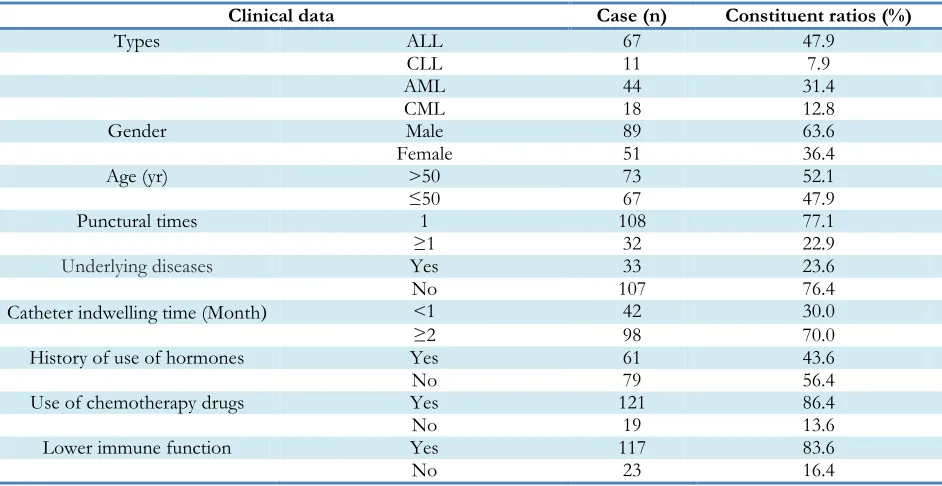
We retrospectively collected clinical data from 140 patients with leukemia between May 2014 and July 2016.Among there were 89 males and 51 females, aged 14-86 yr (58.91±12.09). Other information, including leukemia types, puncture times, underly-ing diseases, Catheter indwellunderly-ing time, hormones use, chemotherapy use, immune functions and sea-sons, were also recorded (Table 1).
Table 1: Clinical data of patients with leukemia (%)
Clinical data Case (n) Constituent ratios (%)
Types ALL 67 47.9
CLL 11 7.9
AML 44 31.4
CML 18 12.8
Gender Male 89 63.6
Female 51 36.4
Age (yr) >50 73 52.1
≤50 67 47.9
Punctural times 1 108 77.1
≥1 32 22.9
Underlying diseases Yes 33 23.6
No 107 76.4
Catheter indwelling time (Month) <1 42 30.0
≥2 98 70.0
History of use of hormones Yes 61 43.6
No 79 56.4
Use of chemotherapy drugs Yes 121 86.4
No 19 13.6
Lower immune function Yes 117 83.6
This study was approved by the Ethics Commit-tee of Haiyang People's Hospital. Signed written informed consents were obtained from all partic-ipants before the study.
Samples collection and bacterial culture
For those confirmed cases with CRI, purulent secretion nearby the puncture position was col-lected for bacterial culture etiologic examination. CRI diagnosis criteria were according to a pre-vious report: Purulent secretion and diffuse ery-thema appeared nearby the puncture site, accom-panied by pain, tenderness, elevated body tem-perature and positive bacterial culture results.
Statistical analysis
Quantitative Data were expressed as mean ± standard deviation. Percentage (%) was used to express the enumeration data and chi-square test was used for data analysis. Univariate analysis or multi-factor logistic regression analysis was
con-ducted using SPSS software (Version 19.0IBM, Armonk, NY, USA). P values < 0.05 were consi-dered statistically significant.
Results
Total infection rate of CRI
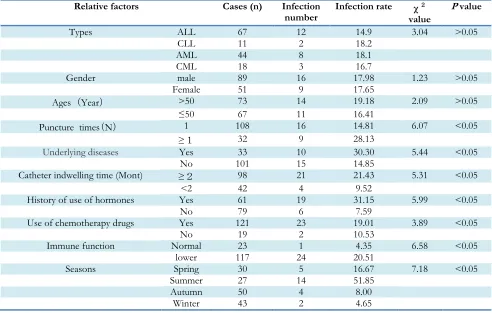
Among a total of 140 patients with leukemia, 25 cases were diagnosed as CRI. The total incidence was 17.9%. The incidence for subgroups, such as different leukemia types, genders and ages, were detailed shown in Table 2.
Univariate analysis
Univariate analysis results showed that puncture times, factors of underlying diseases, catheter in-dwelling time, hormones use, chemotherapy use, immune functions and seasons were all signifi-cantly correlated with the incidence of CRI (P<0.05).
Table 2: Univariate analysis of the related factors of COI in the patients with leukemia and the infection rates (%)
Relative factors Cases (n) Infection
number Infection rate χ
2
value
P value
Types ALL 67 12 14.9 3.04 >0.05
CLL 11 2 18.2
AML 44 8 18.1
CML 18 3 16.7
Gender male 89 16 17.98 1.23 >0.05
Female 51 9 17.65
Ages (Year) >50 73 14 19.18 2.09 >0.05
≤50 67 11 16.41
Puncture times(N) 1 108 16 14.81 6.07 <0.05
≥1 32 9 28.13
Underlying diseases Yes 33 10 30.30 5.44 <0.05
No 101 15 14.85
Catheter indwelling time (Mont) ≥2 98 21 21.43 5.31 <0.05
<2 42 4 9.52
History of use of hormones Yes 61 19 31.15 5.99 <0.05
No 79 6 7.59
Use of chemotherapy drugs Yes 121 23 19.01 3.89 <0.05
No 19 2 10.53
Immune function Normal 23 1 4.35 6.58 <0.05
lower 117 24 20.51
Seasons Spring 30 5 16.67 7.18 <0.05
Summer 27 14 51.85
Autumn 50 4 8.00
For those who received puncture for over 2 times, combined with underlying diseases, used hormones, treated with chemotherapy, and cases with impaired immune functions and received PICC in summer, the incidence of CRI signifi-cantly increased. Detailed information was shown in Table 2.
Multivariate logistic regression analysis
To further identify independent risk factors of CRI for leukemia patients, we conducted multi-variate logistic regression analysis. Results
indi-cated that immune functions, puncture times and seasons were independent risk factors of CRI (Table 3).
Etiological analysis of CRI
We next collected samples of purulent secretion from puncture sites to explore the etiological dis-tribution. Bacterial culture obtained 20 strains of bacteria in 25 cases diagnosed with CRI. Among, there were 10 Staphylococcus aureus, 4 Klebsiella pneumonia, 2 Corynebacterium and 4 other species (Table 4).
Table 3: Multivariate logistic regression analysis of the clinical factors for the PICC-related infections in the patients
with leukemia
Clinical factors β sx OR 95% CI Χ2 p value
Puncture time 0.512 0.090 1.533 1.274~1.785 6.72 0.090 Seasons 0.616 0.035 1.636 1.154~1.573 7.09 0.008 Immune function 0.549 0.043 1.584 1.657~1.918 6.88 0.009
Table 4: Constituent ratio of the pathogens causing the PICC-related infections (%)
Pathogens Strains number Constituent ratio (%)
Staphylococcus aureus 10 50.00
Klebsiella pneumonia 4 20.00
Corynebacterium 2 10.00
Other species 4 20.00
Total 20 100.00
Discussion
Catheter-related infection is a common complica-tion of long-term indwelling catheter of PICC, and for some severe cases, it can lead to hemato-sepsis or systemic infectious disease (8, 11). Therefore, to explore the main influencing fac-tors of catheter-related infection and put forward some reasonable nursing strategies according to the risk factors of infection has an important clinical significance in controlling and preventing the occurrence of infection.
Reasonable nursing strategy is of great signific-ance in the prevention and control of PICC ca-theter-related infection (13). According to the influencing factors of the catheter-related infec-tion, the nursing strategies are proposed as fol-lows (14-16):
which is easy to be digested and has high nutri-tion, thereby improving the immune function of patients.
b) In summer, the risk of catheter-related infec-tion and other hospital infecinfec-tions is significantly increased. The significant increase of growth and reproduction of pathogenic microorganisms caused by hot weather will easily cause the occur-rence of skin sweating and skin adverse reactions, causing the fall-off of catheter, and then bacteria are more likely to invade the mouth of the cathe-ter. Therefore, to keep the ventilation of ward, increase the frequency of changing dressing in hot summer or at the time of sweating, and per-form the local changing dressing using chlorote-tracycline ointment or bactroban ointment are conducive to decrease the occurrence of bacterial infection.
c) The non-standard operation of changing dress-ing, the incomplete or non-standard disinfection of hands before the operation of puncture and indwelling catheter, the non-standard aseptic dis-infection and other factors increase the incidence of PICC catheter-related infection.
Conclusion
We need to perform the aseptic operation strictly, keep the clean sticking, strengthen the propagan-da and education of health knowledge, pay atten-tion to the prevenatten-tion and control of catheter-related infection strictly, maintain the cleanliness of the surrounding environment or personal hy-giene, reduce PICC catheter indwelling time and avoid the use of hormone drugs.
Ethical considerations
Ethical issues (Including plagiarism, informed consent, misconduct, data fabrication and/or fal-sification, double publication and/or submission, redundancy, etc.) have been completely observed by the authors.
Acknowledgements
This study received no funding support. The au-thors declare that there is no conflict of interest.
References
1. Porter DL, Hwang WT, Frey NV et al (2015). Chimeric antigen receptor T cells persist and induce sustained remissions in relapsed re-fractory chronic lymphocytic leukemia. Sci Transl Med, 7(303):303ra139.
2. Siegel RL, Miller KD, Jemal A (2016). Cancer statistics, 2016. CA Cancer J Clin, 66(1): 7-30. 3. Shimoni A, Labopin M, Savani B et al (2016).
Long-term survival and late events after allo-geneic stem cell transplantation from HLA-matched siblings for acute myeloid leukemia with myeloablative compared to reduced-intensity conditioning: A report on behalf of the acute leukemia working party of Euro-pean group for blood and marrow transplan-tation. J Hematol Oncol, 9: 118.
4. Barrington-Trimis JL, Cockburn M, Metayer C, Gauderman WJ, Wiemels J, McKean-Cowdin R (2016). Trends in Childhood Leukemia In-cidence Over Two Decades from 1992-2013.
Int J Cancer, 140(5):1000-1008.
5. Funakoshi T, Latif A, Galsky MD (2013). Risk of hematologic toxicities in patients with solid tumors treated with everolimus: A systematic review and meta-analysis. Crit Rev Oncol Hema-tol, 88(1): 30-41.
6. Hershman DL, Lacchetti C, Dworkin RH et al (2014). Prevention and management of che-motherapy-induced peripheral neuropathy in survivors of adult cancers: American Society of Clinical Oncology clinical practice guide-line. J Clin Oncol, 32: 1941-1967.
7. Seto WK, Chan TS, Hwang YY et al (2014). He-patitis B reactivation in patients with previous hepatitis B virus exposure undergoing ritux-imab-containing chemotherapy for lympho-ma: A prospective study. J Clin Oncol, 32(33): 3736-3743.
8. Chopra V, Ratz D, Kuhn L, Lopus T, Lee A, Krein S (2014). Peripherally inserted central catheter-related deep vein thrombosis: Con-temporary patterns and predictors. J Thromb Haemost, 12(6):847-54.
10. Patel GS, Jain K, Kumar R et al (2014). Compar-ison of peripherally inserted central venous catheters (PICC) versus subcutaneously im-planted port-chamber catheters by complica-tion and cost for patients receiving chemothe-rapy for non-haematological malignancies.
Support Care Cancer, 22 (1): 121-128.
11. Casner M, Hoesli SJ, Slaughter JC, Hill M, Weitkamp JH (2014). Incidence of catheter-related bloodstream infections in neonates following removal of peripherally inserted central venous catheters. Pediatr Crit Care Med, 15: 42-48.
12. Zhou J, Li M, Tang Z (2014). Peripherally in-serted central catheter: How safe is it for acute myeloid leukemia patients? Med Princ Pract, 23(6): 586.
13. Chopra V, Montoya A, Joshi D et al (2015). Pe-ripherally inserted central catheter use in skilled nursing facilities: A pilot study. J Am Geriatr Soc, 63(9): 1894-1899.
14. Morano SG, Latagliata R, Girmenia C et al (2015). Catheter-associated bloodstream in-fections and thrombotic risk in hematologic patients with peripherally inserted central ca-theters (PICC). Support Care Cancer, 23(11): 3289-3295.
15. Li J, Fan YY, Xin MZ, Yan J, Hu W, Huang WH, Lin XL, Qin HY (2014). A randomised, controlled trial comparing the long-term ef-fects of peripherally inserted central catheter placement in chemotherapy patients using B-mode ultrasound with modified Seldinger technique versus blind puncture. Eur J Oncol Nurs, 18(1): 94-103.
16. Kim-Saechao SJ, Almario E, Rubin ZA (2016). A novel infection prevention approach: Leve-raging a mandatory electronic communication tool to decrease peripherally inserted central catheter infections, complications, and cost.