DOI: 10.30954/2249-6637.10.2018.5
©2018 New Delhi Publishers. All rights reserved
Activity Based Learning System in Higher Education: A
Student Centred Approach
Sonal Sharma*
1and Rakesh Kumar
2 1Ramjas College, University of Delhi, New Delhi, India 2Lakshmibai College, University of Delhi, New Delhi, India*Corresponding author: [email protected]
ABSTRACT
Higher education is considered to be the apex in all educational endeavors. It is imparted by universities and other institutions of higher education & research. It embraces teaching and learning for the promotion of faculties and research attitude among students. It mainly focuses on knowledge creation and its dissemination. Apparently, teaching, learning and research are considered to be the core activities in higher education. Besides, there are some associated activities which seem to augment the outcomes and effectiveness of higher education. Such activities include instruction and instructional mechanism, learning activities, campus environment and infrastructure, innovations and interventions etc. Therefore, a university teacher should involve students in learning process through activities aiming to inculcate academic & social skills among them.
Keywords: Activity Based Learning, Project Based Learning, Learning Methods,Higher Education, Information & Communication Technology
Historical Background of Higher Education System in India
The higher education system in India has evolved from different time periods such as: ancient, mediaeval, colonial, post-independence and contemporary. In ancient system of education, in the Vedic period in which two types of educational system were exists, the Brahminical and the Buddhist systems of education. The Brahminical system of education was regulated by religious values, while the Buddhist form of education was secular by nature. The nature of higher education in Ancient India was considered as religious. The basic religions were Hinduism, Buddhism and Jainism. Religion-based education in Ancient India had an outstanding role in creating, transforming and transmitting knowledge to the people in society. In Ancient India, there were two broad trends in educational systems - Brahminical education and Buddhist education. (Ghosh S.C. 2001). The universities
of Nalanda, Vikramshila and Vallabhi were perhaps the most important universities of ancient India. Nalanda University was an institution of higher studies situated in Bihar and was known for Buddhist studies, attracting students from China, Nepal, Tibet, and Korea, who went there to study valuable Buddhist manuscripts. The University curriculum included a wide range of subjects such as Brahminical and Buddhist, Sacred and Secular, Philosophical and Practical.
Genesis of Activity Based Learning
the emphasis on activity based learning in recent years suggests that educators are increasingly reluctant to leave this important aspect of learning entirely under the control of the student. The educator attempts to breakdown the learning process into a set of guided activities carried out by the student in order to achieve the desired learning outcome.
Teaching Method: Student Centered Approaches Teaching methods that are described as “student centred” are aligned with the constructivist theory of learning. Although some of these methods were in operation long before constructivism emerged as a coherent theory.
Student centred approaches have been given specific titles by their creators (examples:
Activity Based Learning Guided Discovery Inquiry Approach Problem Based Learning Project Based Learning Situated Learning)
But the principles and practices associated with the methods are very similar. The subtle differences among the methods described below are usually associated with the amount of guidance and structure provided by the teacher during the learning process and with the degree of autonomy demanded of the learners.
The underlying principles for most of the methods are that:
1. Students should be actively involved in the learning process and intrinsically motivated. 2. Topics, issues, or subject matter should be
interesting relevant and intrinsically motivating. 3. Whenever possible learning experiences should
take place in real life situations where the relevant knowledge and skills will really be needed and used (Situated Learning).
Student centred approaches and the contexts in which they can be used can be addressed under the general
categories of inquiry based methods, project based or resourced based learning and computer assisted learning.
Theoretical Issues in Activity Based Learning
Educational technologists and researchers have continually lamented the great divide between theory and practice in teaching and have constantly tried to bring together current thinking in psychology of learning with everyday practice in facilitating learning in the class-room (Atkin, 1968; Cronbach, 1975).
Sometimes the attempt at unification takes the form of developing a new method according to theoretical principles as in the case of PSI. Sometimes it involves a synthesis of new theories and old techniques, as in the case of applying information processing to problem solving.
Increasingly, it is achieved by observing and carrying out research studies within the reality of the class-room itself a trend that is developing in both the United States and Europe (Lesgold et al. 1978; Marton et al. 1984). This latter development means that educational methods can now be analyzed in terms of both psychologically-based theories and empirically generated descriptions of student learning.
Constructivist approach corresponds to learning by doing assuming that the more repeatedly one does something, the more efficient they become at it. It consists on different forms and activities including cooperative learning, experiential learning, problem-based learning and inquiry learning (Hussain & Sultan, 2010). However, it is based on active involvement of learners and their interactions for creation of new knowledge. Critical thinking, problem solving approach and analytical skills are assumed to be the essential constructs of higher education graduates. Equipped with such faculties and skills they construct new knowledge based on their previous experiences and involvement in learning process (Li, 2001).
environment such as their peers, teachers or technology”. It is based on strategies of effective learning and leads them to construct new knowledge by interpreting it in a particular situation. In a constructivist classroom the teacher becomes facilitator (Alesandrini & Larson 2002; Ornstein & Hunkins, 1998) to help students in acquiring knowledge through activities. Students’ involvement results in their effective learning. Johnson and Johnson (1999) stated that effective learning takes place through one’s personal involvement in learning experience. It requires them to work in groups and interact in social settings based on the principle of Vygotsky’s social constructivism.
Vygotsky (1994) believed in social constructivism and asserted that social interaction among learners spurred the construction of new ideas and enhanced their intellectual development. Nonetheless to say that intellectual development and creation of ideas is associated with Bruners’ (1960) pedagogies. Bruners’ pedagogies included activity-based and hands-on instruction in which students were expected to use their own direct experiences and observations to acquire information and to solve problems scientifically.
A teacher is considered to be the academic leader and facilitator of students. They recognizes their potential and helps them in right direction at right time. A constructivist approach is oriented on construction of knowledge putting students in practical situations under the guidance and tutelage of teachers. It seems to be based on the belief that learners construct their own knowledge through interaction, and the assumption that “knowledge is physically constructed by learners who are involved actively in learning process” (Gagnon & Colley, 2001: p. 1) appears to be substantiating it. Knowledge is constructed in social environments where interaction is considered to be a fundamental factor for effective teaching learning process (Sims, Dobbs, & Hand, 2001). Under such circumstances the role of a teacher cannot be neglected rather it becomes more significant in terms of coaching students to selecting appropriate activities for learning.
Traditionally, a teacher has been playing an active role in transferring knowledge to passive students. In new
settings the stage is set for students to play an active role in learning process through activities. They feel pleasure and confidence in becoming active participant. The study of Lord, Travis, Magill & King (2005) revealed greater effects of constructivist learning (learner-centered) approach on weekly test scores of students as compared to students’ scores in traditional or teacher centered environment. The study further elaborated that constructivist learning helped them in enhancing their participation, level of satisfaction, enthusiasm for raising a question or responding to it, and an inclination towards scientific attitude.
Constructivism makes teachers design activities and projects to be offered to the students. These may consist on service-learning and community-based projects and activities to involve students. Use of constructivist approach in education has direct effects on students learning. They are active stake holders in the process of knowledge construction and its dissemination. They participate in teaching learning process and assume responsibility of their learning by giving it their own meaning in their respective contexts. Constructivism offers students opportunities of cooperative and collaborative learning. A study was conducted by Santmire, Giraud, & Grosskopf (1999) and compared learning achievement of two groups of elementary school students. The researchers found that the students who learned through social-constructivist approach to education and took a standardized test secured higher grades than their counterparts who were instructed traditionally in the classroom.
students (constructivism) was affirmed to be an efficient instructional approach for creating & sustaining motivation and passion for knowledge construction.
Concept of Student Centred Learning
Student Centred Learning is broadly based on constructivism as a theory of learning, which is built on the idea that learners must construct and reconstruct knowledge in order to learn effectively, with learning being most effective when, as part of an activity, the learner experiences constructing a meaningful product. SCL is also akin to transformative learning which contemplates a process of qualitative change in the learner as an ongoing process of transformation which focuses on enhancing and empowering the learner, developing their critical ability.
Active Learning Pedagogies
Active learning is a process whereby students engage in activities, such as reading, writing, discussion, or problem solving that promote analysis, synthesis and evaluation of class content. Cooperative learning, problem based learning and the use of case methods and simulations are some approaches that promote active learning. Active learning is commonly defined as activities that students do to construct knowledge and understanding. The activities vary but require students to do higher order thinking. Although not always explicitly noted, metacognition students’ thinking about their own learning is an important element, providing the link between activity and learning.
Active learning is a key aspect of the flipped classroom1 and can be applied to any learning environment from online to standard lectures or as a blend of these. The aim of active learning is to provide opportunities for learners to think critically about content through a range of activities that help prepare learners for the challenges of professional situations that may involve evaluative, problem solving or clinical reasoning skills.
1Flipped classroom is an instructional strategy and a type of blended learning that reverses the traditional learning environment by delivering instructional content, often online, outside of the classroom.
Forms of Activity Based Learning
There are many different teaching and learning methods which are capable of generating activity based learning. The following examples are covering some of the most important methods used in higher education. It is considered in terms of:
1. How they are meant to help the students
2. And what kind of learning activities are involved.
Laboratory Practical Work
Laboratory Practical Work is one of the traditional and widely used method of activity based learning technique. Laboratory work is considered to be an important way of giving students hands-on experience with their subject but many of the activities involved are too prescriptive and give the students too little freedom to direct his own learning.
Teachers would like to give students more opportunity to act like scientists and some have therefore attempted to move away from the guided practical work to open ended project work (Goodlad, 1975; Graetzer, 1972)
Problem Solving Method
Problem solving is also a very traditional method, designed to give students practice in applying principles, using knowledge, and carrying out standard procedures. The form of the problem set is vary from one subject to another. It engaged students in a goal oriented task.
Personalized system of Instruction (PSI) is a more recent development. It is based on two fundamental principles:
1. Mastery- the student must demonstrate mastery at stage of instruction before moving on to the next stage.
Reading Assignment Worked Problems
Self-Assessment Questions
PSI Courses have been run successfully at several institutions in Britain and the United States (Bridge, 1976; Green, 1971; Swartz and Zipfel, 1972).
Simulations and Games
Simulations and Games activities are designed to help a student to grasp a concept and understand a system or process.
For example: a management game in which students role-play a group of decision-makers.
Simulations and games are highly structured activities that requires careful design and frequently involve quite complex rules and procedures (Taylor and Carter, 1970).
Computer Assisted Learning
It includes a number of radically different types of activity based learning, each offering a different type of learning experience to a student with the use of interactive and data processing features of the computer. Computer assisted learning is the most rapidly expanding form of activity based learning. The aim is to provide the experimental environment to the student.
Audio Vision Tutorials
Audio-vision tutorials use a human voice to guide students through visually presented material on an individual basis. The material may be text, diagrams, pictures, models, or equipment. The students are directed to do something with the material for example: sketching a diagram.
Methods of Active Learning
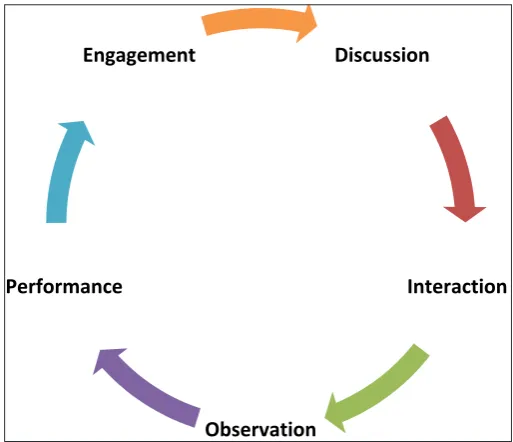
The method of active learning has recently become one of the promising areas of modern education, as it provides the organization of self-learning environments. This teaching method allows students to effectively solve problems of practice-focused training.
This method is implemented in group work among students. During the joint work on the problem (which is practice focused), students develop their own way to a comprehensive solution, justify that solution and conduct a presentation of their proposals.
Discussion
Interaction
Observation Performance
Engagement
Fig. 1: Active Learning Cycle
A group of teachers discusses the results of the public defense and names the winner, which makes evaluation more objective. If this method is used by students during the period of work experience, the problems to be solved may be taken from a particular practice, which enhances the teaching potential of the method and the results obtained in the course of its implementation. Thus, learning by doing has a positive influence on the components of professional competence through practical skills which develop the organization of joint activities and taking responsibility for one’s work.
CONCLUDING REMARKS
learning. Lack of concern on the part of the teachers to make attempts to assess the competency level of students and design their teaching lesson plan accordingly. There is an academic learning divide among students because of students coming from diverse backgrounds. There is a difficulty in academic integration among students. In Nutshell, Higher Education Institutions role is very significant in the teaching learning process in Higher education among diverse learners and it prepares students who are coming from rural and lower socio-economic backgrounds areas for adaptation into academic arena.
REFERENCES
Angelo, T.A. & Cross, K.P. 1993. “Classroom Assessment Techniques: A Handbook for College Teachers”, (2nd ed),
Jossey-Bass, San Francisco.
Bonwell, C.C. & Eison, J.A. 1991. “Active Learning: Creating Excitement in the Classroom”, ASHE–ERIC Higher Education Rep. No. 1, School of Education and Human Development, The George Washington University, Washington, DC.
Buchanan, R.W. and Rogers, M. 1990. “Innovative Assessment in Large Classes”, College Teaching, 38(2): 69-73.
Davis, B.G. 2009. “Tools for Teaching”, (2nd ed), Jossey-Bass
Publishers, San Francisco.
Deslauriers, L., Schelew, E. and Wieman, C. 2011. “Improved Learning in a Large-Enrollment Physics Class”, Science, 332:
862-864.
Doyle, T. 2008. “Helping Students Learn in a Learner-Centered Environment: A Guide to Facilitating Learning in Higher Education”, Stylus Publishing, Sterling, VA, USA.
Dunne, D. and Brooks, K. 2004. “Teaching with Cases”, Society for Teaching and Learning in Higher Education, 82 pages, ISBN 0-7703-8924-4
Eison, J.A. & Bonwell, C.C. 1993. “Recent Works on Using Active Learning Strategies across the Disciplines”, Unpublished Manuscript, ERIC Document Reproduction Service No. ED 364 135.
Felder, R.M. & Brent, R. 1996. “Navigating the Bumpy Road to Student-Centered Instruction”, College Teaching, 44(2): 43-47.
Felder, R.M. & Brent, R. 2009. “Active Learning: An Introduction”,
ASQ Higher Education Brief, 2(4): 1-5.
Gibbs, G. 1992. “Improving the Quality of Student Learning”, Technical and Educational Services Ltd, Bristol.
Hake, R.R. 1998. “Interactive-Engagement vs. Traditional Methods: A Six-Thousand-Student Survey of Mechanics Test Data for Introductory Physics Courses”, American Journal of Physics, 66(1): 64-74.
Hotchkiss, C. 2002. “Website Creation as an Active Learning Strategy in Business Law Classes”, Journal of Legal Studies Education, 20(2): 235-247.
Hussain, I. & Mahmood, S.T. 2010. “Practice Teaching or Internship: Professional Development of Prospective Teachers through their Pre-Service Training Programmes”, Journal of Educational Research, 13: 105-122.
Hussain, I. & Sultan, S. 2010. “Learning by Doing: Outcomes of Teaching a Research Course through Group Activities”, Proceedings of the Annual International Conference on Computer Science Education: Innovation & Technology (CSEIT) 2010, Global Science and Technology Forum, Singapore City.
Hyman, R.T. 1979. “Strategic Questioning”, Englewood Cliffs, Prentice-Hall, New Jersey, US.
Hyman, R.T. 1980. “Improving Discussion Leadership”, Teachers College Press, New York, USA.
Jacobson, A.R., Militello, R. & Baveye, P.C. 2009. “Development of Computer-Assisted Virtual Field Trips to Support Multidisciplinary Learning”, Computers and Education, 52(3): 571–580.
Johnstone, A.H. & Percival, F. 1976 “Attention Breaks in Lectures”,
Education in Chemistry, 13(2): 49-50.
Klemm, E.B. & Tuthill, G. 2003. “Virtual Field Trips: Best Practices”, International Journal of Instructional Media, 30(2): 177-193.
Lewis, K.G. 1987. “Taming the Pedagogical Monster: A Handbook for Large Class Instructors” (2nd ed.). Austin, TX: The University
of Texas at Austin, Center for Teaching Effectiveness.