http://www.gjaets.com © Global Journal of Advance Engineering Technology and Sciences 64
Global Journal of Advanced Engineering Technologies and Sciences
PROCESS EXECUTION AS A SOURCE OF KNOWLEDGE
Dr Marek Szelągowski
*1*1Vistula University Warsaw, Poland.
Abstract
Knowledge is the most important asset that companies have in the knowledge economy. Intellectual capital is becoming more important than financial capital. The problem that companies face in the modern hypercompetitive environment is not just how to maintain efficiency on an ongoing basis, but also how to adapt to the ever-changing needs of their clients on an ongoing basis. The article demonstrates how expanding traditional business process management (BPM) in accordance with the concept of dynamic BPM empowers companies with the capabilities of creating new knowledge on an ongoing basis, as well as provides the mechanisms of verifying present knowledge. Enabling limited experimentation and the creation of knowledge in the course of performing business processes allows for the constant creation of practical knowledge. Furthermore, such knowledge is immediately verified by the clients in an objective and impartial manner.
Keywords:business process management (BPM), unstructured processes, dynamic BPM (dBPM), Business Process Model and Notation (BPMN), process pattern, adaptive case management (ACM), automated business process discovery (ABPD), process mining, social BPM, communities of practice (CoP), process-driven application, business process management system (BPMS), adaptive case management system (ACMS), knowledge management (KM), organizational learning, knowledge acquisition, active knowledge modeling (AKM), process-oriented knowledge management (pKM), process-related knowledge, knowledge-intensive BPM (kiBPM), experimenting.
Introduction
The modern economy is undergoing accelerating, multidimensional changes, which are the result of the growing demand of clients for easier access to individualized products and services. The pace, the qualitative character, and the unforeseeable nature of such changes results in traditional management solutions becoming obsolete and insufficient (Płoszajski, 2004). In this hypercompetitive environment, the key to success is not just to put trust in an optimized business process, but the dynamic adaptation of business process to the needs of the client. Success is premised upon the ability to manage the knowledge inscribed in processes, understood as the constant acquisition and the rapid (faster than the competition) use of knowledge. Companies face the challenge of how to avoid storing and pseudo-managing outdated knowledge, as well as how to raise the speed at which knowledge is derived and applied in a widespread, practical manner.
According to the concept of "creative destruction" (D'Aveni, 1994), knowledge management should combine two complementary mechanisms:
The creation or acquisition of new knowledge,
The verification or rejection of obsolete knowledge.
Due to the rapid pace of changes, such mechanisms cannot be based on compartmentalized research and
development departments, periodical certification audits, or the occasional update of strategies. Such mechanisms should allow for the creation and verification of knowledge within the fundamental processes of the organization in order to eliminate the risk of fragmentation or an excessive theoretical approach detached from actual practical realities. Such mechanisms should support both rapid and controlled accommodation of the process work-flow to the individual needs of the clients, as well as allow for the fastest possible, widespread implementation of those changes, which offer positive results.
http://www.gjaets.com © Global Journal of Advance Engineering Technology and Sciences 65
Related Work
The standard division of processes is to divide them into main processes, supporting processes, and management processes (Rummler and Brache, 1995). This division is a good illustration of the significance that the particular process groups have in business. It enables us to create a clear, explicit, and well-organized process map. It also allows us to define the relations between the processes themselves, as well as relations between processes and the teams performing them. However, this division does not enable us to choose the manners of describing processes or the methodologies of implementing or automating processes within the organization. Should we wish to do so, we would need to resort to a classification dealing with the method of performing business processes within the organization.
Static and dynamic processes
Static processes are those processes which are unchangeable, as well as those processes which change over a long period of time. In effect, it is possible to improve such processes with the use of standard business process improvement mechanisms, which are usually derived from the concepts of W. Edwards Deming and based on modifications to his Deming's wheel (PDAC) method (Pande, Neuman, and Cavanagh, 2000). Their performance is based on the initiatives of the management and the employees of the organization, either evaluated, accepted, rejected, or even dismissed in silence by the management. Employees cannot introduce changes to static processes during the execution. In a considerable number of organizations, actions which go against accepted business processes (or regulations or procedures) are treated as transgressions against discipline and penalized as such. Because the structure of static processes is known beforehand, such processes can be described in the form of a complete algorithm; or a "program" on how to operate a business (Belaychuk, 2011). In principle, the execution of static processes which do not require the participation of individuals or decision-making can be delegated to industrial robots or computers.
Traditional, static implementations of business process management provide companies with certain benefits, which include:
exposure and unification of organizational knowledge, usually on a one-time basis in the process identification phase,
transparency and accessibility of published and up-to-date process maps and models,
lower costs of process execution due to automation,
full control over real-time and ex-post process performance (instant identification of deviations and errors arising in the course of process execution).
However, such implementations are also subject to risks and hazards, the most important of which include:
misalignment with the changing market conditions,
being incapable of individualization process,
generating losses when performing the process in the standard manner, which does not conform to the conditions of process execution,
creating or strengthening a culture of unaccountability.
It is estimated that only 20% to 40% of processes are static (Kemsley, 2009a; Handy Soft, 2012). Most often these are the organizations' normal internal processes, the structure of which is not dependent on changing client needs (e.g. administrative or technological processes), as well as processes which must be standardized due to legal constraints (i.e. Accounting processes, tax processes, some HR processes, etc.). (Belaychuk, 2011; Ukelson, 2010)
http://www.gjaets.com © Global Journal of Advance Engineering Technology and Sciences 66
eliminates the risk of slowing down the process of adapting to the needs of the clients and the market due to being unable to make rapid decisions, or even due to the phenomenon of "analysis paralysis" (Jennings and Haughton, 2002; Ultimus, 2004; Pucher, 2010b). Anchoring adaptations or individualizations of processes (in more general terms: innovations) in actual activities prevents the need of performing thorough analyses. In the words of Theodore Lewitt from his article "Creativity is not Enough," which was published in HBR as far back as 1963, "The fact that you can put a dozen inexperienced people in a room and conduct a brainstorming session that produces exciting new ideas shows how little relative importance ideas themselves actually have" (Levitt, 1963). Using dynamic BPM allows us to eliminate this problem, because:
ideas originate from a wide range of practitioners with specific skills and privileges,
each idea is instantly verified in terms of being implementable and in terms of its effects via changes to indicators for processes, in which the idea has been implemented.
Mutual relations between knowledge management and process management
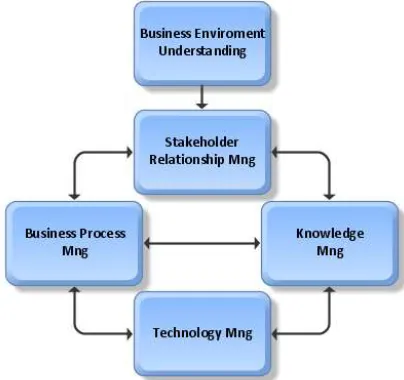
Since the '90s, the development of business process management and knowledge management has accelerated, using, but also stimulating the development of ICT technologies. Their mutual relation has been acknowledged from the onset and some early exponents of knowledge management (KM) were also enthusiastic about BPM. However, the rapid development of BPM toward business process reengineering (BPR), its thoughtless abandonment of present business models, as well as restructurization aimed for all practical purposes at workforce reduction, often meant losing knowledge on a wide scale and the active implementation of practices which went against the premise of a learning organization (Davenport, 1995). However, following a decided shift away from business process reengineering, caused by multiple failures connected primarily with not taking into account the cultural aspect of an organization and knowledge loss, the mutual relation between process management and knowledge management once again became a topic of research and praxis. As shown on Figure 1, in 2001 Burlton perceived BPM and KM as competences critical for raising business efficiency (Burlton, 2001). He also pointed to the need of securing a strong, bilateral relation between the two.
Figure 1. Interplay between critical competences for performance improvement (Burlton, 2001)
http://www.gjaets.com © Global Journal of Advance Engineering Technology and Sciences 67
improvement cycle. In turn, the performance of processes within traditional BPM provided knowledge on the efficiency or effectiveness or processes alone, as traditional BPM does not empower process performers to shape their processes. Nevertheless, in response to user needs, the first years of the next decade witnessed the appearance of extended BPMS systems, which allowed for on-the-go modeling of processes (Ultimus, 2004; Business Wire, 2005). At almost the same time, concepts and tools appeared which allowed for the identification of information and knowledge generated in the course of process execution, first related to automated business process discovery (ABPD), and then to process mining (Kemsley, 2009b; Di Ciccio, Marrella, and Russo, 2012). In the year of the Process Mining Manifesto, the scholarship of e.g. Marjanovic and Freeze includes the strong pronouncement that knowledge is an integral part of business process management (Process Mining Manifesto, 2012; Marjanovic and Freeze, 2012). This requires the subordination of the process-based "component" to the human component, and not, as before, vice versa. Under such a condition, "BPs can then be considered as knowledge-in-action or actionable knowledge thus reinforcing the need for better integration of KM and BPM, especially in the context of knowledge-intensive BPs" (Marjanovic and Freeze, 2012, p. 183).
The concept of dynamic BPM
In response to a strong pressure from business, numerous attempts were made at developing concepts which expand the flexible nature of traditional business process management. The most well-known concepts include Agile Process Management, Adaptive Process Management, Human-Centric BPM, Unstructured Processes, Knowledge Worker Processes, and Adaptive Case Management (Belaychuk, 2010; Pucher, 2010a; Earls, 2011; Stutz, 2014). Such concepts attempt to combine static process management with the option of performing tasks in a sequence specified by the process performer, as well as the option of performing tasks which were not specified in the modeling phase. Such concepts like ACM might also concentrate on data accumulated in the course of performing a specific action (Verlaenen, 2010; Swenson, 2010b).
This article is based on the concept of dynamic business process management (dynamic BPM), which is receiving increasing recognition. This concept is an extension of traditional (static) business process management, which fully incorporates the need to empower process performers. It also takes into account the need of combining business process management (BPM) with knowledge management (KM). It requires the implementation of the following three rules:
principle 1: The ability to change the process in the performance.
Employees performing a given process are authorized to adapt it dynamically to particular executive requirements. Processes should be defined and implemented in such a manner, as to enable their accommodation to the specific requirements of their direct process performers (e.g. Contract Managers, Project Coordinators, Line Workers, etc.) The authority to introduce changes to the performed processes on an ongoing basis should not be limited, as it had been thus far, to the management of the organization or process leaders. Instead, it should also be given to the authorized employees. Direct process performers should also be allowed access to a process-driven application (business process management system – BPMS) in order to execute tasks, actions, and even whole processes, which are not included in the standard process (Diaz, 2013; Gartner, 2014; Knudson, 2014b; Wikipedia, 2014).
principle 2: Processes are considered completed only after having been documented
Processes are considered completed only after having been documented, no longer being burdened with additional reports or other ex-post actions. The documentation of the process must include i.a. Information crucial to understanding the entire process performance context in the event log (Aalst, 2012). Of course, the documentation of the process must also include elements of knowledge created or acquired in the course of performing the process, as well as the results of the verification of such knowledge. (Pucher, 2010b)
principle 3: Comprehensiveness and continuity
http://www.gjaets.com © Global Journal of Advance Engineering Technology and Sciences 68
Because process performers are authorized to change processes on a dynamic basis, the entire system of managing an organization is able to embrace the creative initiatives of a wide range of employees, without running the risk of chaos resulting from unrestricted alterations to operational standards. Furthermore, the ability to trace the effects of the introduced changes enables users to enrich the shared knowledge of the organization with information on which practices and solutions generate the best results (good practices), and which generate the worst (wrong practices). This approach centers on making actual, ongoing improvements to business processes on the basis of the client-verified knowledge of a wide range of employees.
The fundamental benefits of taking into account the dynamic character of adapting business processes to client needs include:
ongoing verification and creation of new knowledge in actual business conditions (and not in some detached research and development facilities),
rapid, broad use of new knowledge with the aim of raising the efficiency of performed processes (Jennings and Haughton, 2002),
actual empowerment of process performers, creation of a culture of accountability (Kemsley, 2013; Pucher, 2010b)
However, the introduction of dynamic process management is also tied to certain risks and hazards, including:
the risk of the failure of the process performers' limited experiments (although some knowledge is also gained in return due to trial and error),
the risk of chaos as the result of too many uncontrolled experiments (which can be mitigated thanks to the strict oversight of privilege levels and limited experiments).
Process Modeling
When implementing business process management, organizations must meet much larger requirements than in the case of implementing ERP, MRP, or CRM systems. Dynamic business process management requires the introduction of a specific management philosophy, which will govern all of the actions of the organization within the fundamental process accounting for the core products or services of the organization (Knudson, 2013). Such an implementation requires first and foremost the comprehensive identification of processes. The introduction of the 2.0 version of Business Process Model and Notation (BPMN) managed to standardize the rules of describing process maps and models. This notation enables the modeling of static processes, as well as the modeling of dynamic processes to a considerable extent.
Static process modeling
http://www.gjaets.com © Global Journal of Advance Engineering Technology and Sciences 69
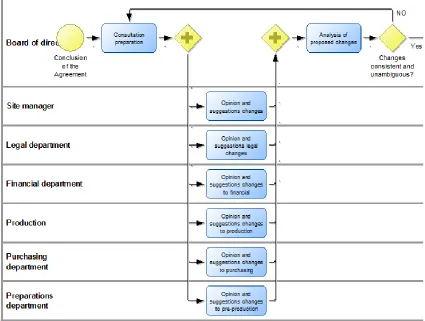
Figure 2. Example of static decision-making process modeling
The process pictured in Figure 2 is bound not to foresee all of the possible needs and possibilities, which means that it will no doubt require continued modifications in the process modification phase. The management will be sure to find out about such needed alteration as far along as in the process of evaluating the effects of sub-optimal or even flawed decisions. The process will become less and less transparent and will begin to include "just in case" provisions, as well as call upon disinterested individuals for no good reason to oversee decisions in specific situations. The model can be improved upon by substituting the first AND gate with a XOR gate. This enables the head consultant to chose the participants of the consultations. However, it does not enable the consultant to chose the sequence of consultations (this is quite a different process with an even more complicated structure) or expand the group of consultants. This would require a change of the process itself. In conclusion, perhaps it would be wiser to model decision-making processes in reaction to specific events?
Event context modeling
http://www.gjaets.com © Global Journal of Advance Engineering Technology and Sciences 70
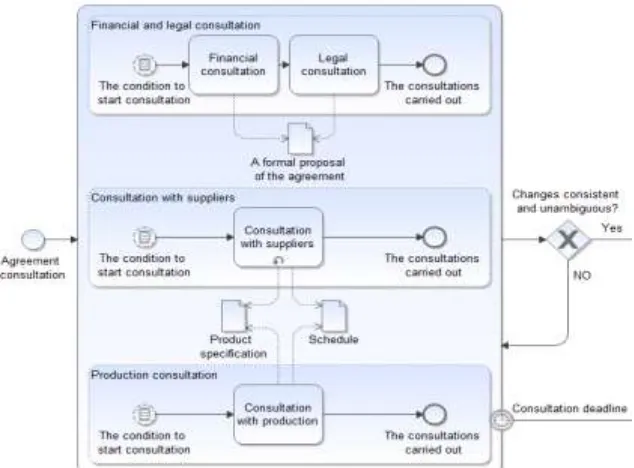
Figure 3. An example of the static modeling of decision-making processes based on the specific event context.
The first gate, regardless of whether it is a XOR, an OR, or an event-based gate, is used to distinguish between different kinds of agreements / contexts of signing an agreement. Just a single process gate (or several specific process gates) is activated – one which represents the specific agreement in consultation. Regardless of which gate we chose, we are presented with a process which depicts a list of all the possible variants of a given decision. Even when all of the variants are modeled in an optimal manner, the number of potential variants will increase with time like in the previous example, end this increase will result in wrong decisions being made (and having to face their actual results). Of course, all of the variants are just optimal for the time being. With time, all of them will accumulate the risks and drawbacks from the previous example.
The BPMN standard enables us to model the decision-making process in such a manner, as to be able to extract the management of specific kinds / contexts from the main decision-making process and depict it in the form of sub-processes triggered by business events.
http://www.gjaets.com © Global Journal of Advance Engineering Technology and Sciences 71
As before, such a solution requires us to define all of the variants / contexts of signing an agreement in the course of the modeling phase. And as in the previous examples, this solution also runs the risk of being incomplete or too complex. However, it leaves us with a more transparent graphic diagram and enables us to make use of predefined process patterns with ease. In a practical implementation, the sequence of executing subsequent processes depends on the time of their appearance and the priorities assigned to them in BPMS.
Risks involved with the static modeling of processes which are dynamic in nature
All of the above-mentioned examples involve similar risks, which are characteristic of the static modeling of processes which are in fact dynamic in nature. Due to such attempts projects take longer (larger costs, larger risks) to finish and the efficiency of the organization does not rise, but falls instead. Whenever processes are connected with the client or the market environment, it is even more crucial to establish whether dividing the process into individual "indivisible" actions, which the process performers then performs, would not lead to higher losses due to the over-complication of the process with multiple "just in case" variants, as well as its lacking the option of reacting to unforeseen scenarios, than the lack of a detailed description. The main risks connected with modeling dynamic processes as complete algorithms are:
losing the explicit and flexible character of processes as the result of their over-specification.
This results in the "creeping" over-complication of processes due to adding different special exceptions, "contingency plans," and conditions which should be taken into account despite the fact that they only arise in special circumstances!
strengthening a culture of unaccountability
The strict imposition of an unchanging method of performing a process, which does not factor in changing circumstances, rids employees of their initiative and takes away their responsibility for the results of the processes. Not only that, it even encourages them to accept a situation which causes a loss, but which follows the statute/procedures/processes! After all, if the process/procedure/regulation owner is responsible for the outcome, the employees think it wise to stay close to the process, even knowing that such action is senseless.
Dynamic process modeling
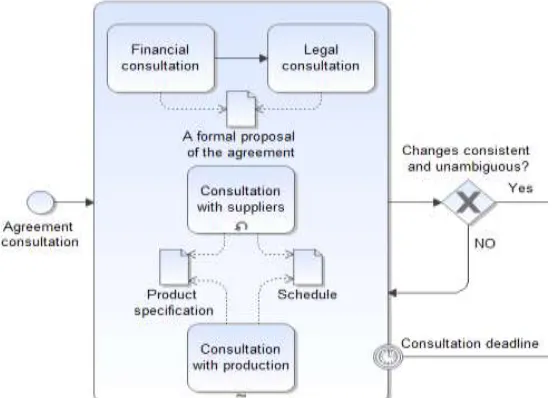
BPMN 2.0 offers us the option to model a dynamic (ad-hoc, unstructured...) sub-process which allows us to perform multiple non-organized, non-prioritized, but predefined actions. Such actions can take the form of tasks (the equivalent of a checklist) or short sub-processes (the equivalent of business scenarios). As before, BPMN 2.0 also offers the option of using predefined, reusable process patterns. The actions can involve the ad-hoc sub-process performer, as well as other individuals (roles) (OMG, 2011, p. 431). In most implementations in BPMS systems (e.g. BizFlow, Fujitsu), the process performer can also perform actions which were not taken into account in the initial process modeling phase. (Knudson, 2014a) In regard to each action, performers of ad-hoc processes can make use of documents, data objects, or virtually any other objects which fit within the predefined attributes.
http://www.gjaets.com © Global Journal of Advance Engineering Technology and Sciences 72
The diagram from Figure 5 enables the process performer to perform selected consultations (one consultation, a selected number of consultations, or all of them) on a one time-basis or on a repeated basis as required. Assuming that "||" designates parallel consultations, and "→" designates sequential consultations, an example scenario of a consultation chain for the process from the diagram in Figure 5 can be depicted as:
financial -> production -> suppliers -> financial -> production or
suppliers || production -> financial -> production -> financial -> suppliers || production
The process model assumes that each financial consultation will be followed by a mandatory legal consultation (financial = financial → legal). Of course, each of the actions can also be presented as separate actions or in multiple combinations according with the actual sequence of business or the requirements of e.g. risk analysis. Each time, the tasks themselves are logged in an event log, and the results of particular actions are notified in appropriate data objects. By reading the timestamps associated with performing specific actions in the BPMS system log, we are able to determine the performer, the sequence, and the results of each action. With such data readily available at hand, building a knowledge base on the subsequent performances of a given process, their course, data, results, and the individual process performers, is just one simple step away.
Instead of supplementing (over-complicating) the static "Sign an agreement" process with additional consultations, the logic conditions for performing a process and process priorities were described in the form of a single, much more transparent diagram, empowering the process performer to perform the process in accordance with the requirements of a specific business process case. Such a solution supports normal, natural work-flow, which draws from the engagement, creativeness, and the knowledge of the employees. Furthermore, it reduces the risks associated with performance thanks to full transparency and the ongoing oversight of actions, preventing the so-called "hidden factory" effect (BusinessDictionary, Miller and Vollman, 1985). dynamic BPM changes the fundamental aim of the modeling process. It departs from the traditional aim of defining the sequence and the details of all possible actions. Instead, in dynamic BPM the aim of the modeling process is to define a standard sequence for the performed actions according to the knowledge of the organization, define the method of performing the process in non-standard conditions, as well as the data required in the analysis of the full context of dynamic process performance. The term "method of performing the process in non-standard conditions" should be understood as defining:
privileges to choose tasks specified in ad-hoc sub-processes (maybe all tasks should not be available to all individuals),
privileges to perform tasks not specified in ad-hoc sub-processes (the freedom to perform limited experiments in the form of performing unforeseen tasks should not be available to all individuals),
limitations of particular tasks (e.g. parallel/serial performance of ad-hoc tasks, time constraints, or resource limits (a process cannot have an indefinite time and engage all possible resources)).
In effect, dynamic BPMN makes the concept of business process management (BPM) similar to adaptive case management (ACM) to a considerable extent by allowing the substitution of static "algorithms" describing the structure of processes with lists of the possible tasks and the specifications of input data and output data used in the course of these tasks. In the case of most implementations in BPMS systems, tasks can be nested and it is possible to generate a task that was not predefined in a specification prepared beforehand (Belaychuk, 2011; Swenson, 2010a).
Knowledge-intensive business processes
The performance of processes in accordance with the concept of dynamic BPM enables process performers to tailor the structure of the processes to the conditions of a given situation. The automatic logging of such data in the BPMS system log on the 4th or at the minimum 3rd maturity level for event logs enables us to fully recreate the performance
of a given process (Process Mining Manifesto, 2012). By assessing multiple process performances, it is possible to define:
contextual scenarios for process performance (e.g. sales processes dependent on the type of goods, the character of the client, the time of day; or investment processes dependent on whether the investment pertains to housing or infrastructure...) (Chain, Yongsiriwit, Gaaloul, and Mending, 2014),
http://www.gjaets.com © Global Journal of Advance Engineering Technology and Sciences 73
process patterns for the performance of elementary sub-processes (e.g. decision-making), which might be used in numerous processes, (Belaychuk, 2011)
benchmarks which exceed simple statistics,
new elements/criteria affecting the efficiency of processes which need to be considered or codified.
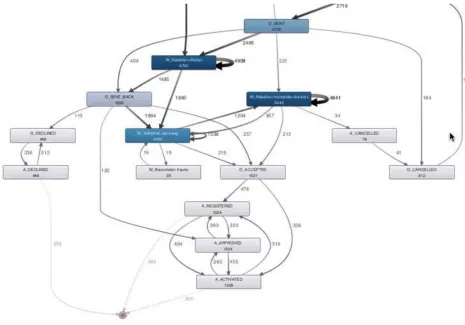
Figure 6 depicts part of a sample process map created with the use of process mining tools. It depicts multiple performances of a process on a single diagram. Line thickness and the number alongside each line indicate the number of passes for a given path (Rozinat, 2014).
Figure 6. Part of the sample process map from DISCO 1.6.0
At the same time, it is possible to acquire valuable knowledge by including in the process modeling phase:
data objects containing knowledge available to the process performer during the performance of a task, e.g. tips on a particular subject, control lists, process patterns, best practices, the option to consult with communities of practice (the equivalent of "phone-a-friend" or another such "lifeline"), etc.,
attributes and data objects representing the knowledge collected in the course of performing a task, e.g. selections from control lists, information on experts, tasks performed outside of the standard process and their fundamental parameters, etc.
http://www.gjaets.com © Global Journal of Advance Engineering Technology and Sciences 74
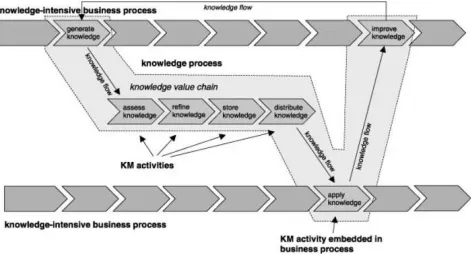
Figure 7. The relationships between knowledge-intensive business processes, knowledge processes, KM activities, and knowledge flows (Remus and Schub, 2003).
In the course of standard knowledge management processes, knowledge is first identified and evaluated, and then generalized, improved upon, stored, and distributed with the aim of its widespread application in the processes used throughout the organization. This sequence pertains both to knowledge used in the course of performing processes, as well as to new knowledge created or acquired in the course of process performance. This enables us to close the knowledge life-cycle thanks to the most objective evaluation of its usefulness – that of the client, the recipient of the results of a given process. Without dynamic BPM, the entire concept of KM is often detached from the daily life of the organization. Without the concurrent implementation of process-oriented KM (pKM), the implementation of dynamic BPM alone often turns out to be an unnecessary burden, because its effects, and so are wasted. The aim of such a combination is the ongoing, constant acquisition of knowledge on process performance and its rapid implementation with the aim of process improvement.
In conclusion, dynamic business process management can serve as an ongoing, virtually free source of knowledge. Perhaps even one more crucial than tacit and explicit knowledge obtained from outside the organizat ion.
Conclusion And Reflection
Including knowledge management in processes is a fundamental factor in the success of an organization. Such a solution provides:
1. ongoing, institutional readiness to change thanks to the ongoing search for new solutions by a wide number of employees,
2. the option of reducing costs thanks to the organization's openness toward integrating its processes with its clients, suppliers, and partners,
3. ongoing application of generated knowledge and efficiency indicators to invigorate the organization's strategy and gain a competitive advantage.
Because work is considered completed only after having been documented, virtually all of the knowledge generated within the organization is explicit, available for analysis and the rapid dissemination throughout the organization.
http://www.gjaets.com © Global Journal of Advance Engineering Technology and Sciences 75
to date raises the hope that by genuinely using the dynamism of a wide range of employees, this concept will allow us to combine the effectiveness and efficiency of process management with the flexibility and openness to change.
References
1. van der Aalst, W.M.P. and Dustdar, S. (2012). Process Mining Put Into Context. Internet Computing, IEEE, 16 (1), pp. 82 – 83. Retrived from http://wwwis.win.tue.nl/~wvdaalst/publications/p662.pdf.
2. Belaychuk, A. (2010). BPM Frontier: Dynamic Processes. Retrived from http://mainthing.ru/?s=BPM+Frontier%3A+Dynamic+Processes
3. Belaychuk, A. (2011). ACM: Paradigm Or Feature? Retrived from http://www.microsofttranslator.com/bv.aspx?&lo=SP&from=&to=pl&a=http%3A%2F%2Fmainthing.ru%2 Ftag%2Facm%2F
4. Burlton, R.T. (2001). Business Process Management: Profiting From Process. p.34. Indianapolis: Sams Publishing.
5. BusinessDictionary, Hidden Factory. Retrieved from http://www.businessdictionary.com/definition/hidden-factory.html
6. (“Activities that reduce the quality or efficiency of a manufacturing operation or business process, but are not initially known to managers or others seeking to improve the process. ….”)
7. Business Wire, (2005). Ultimus Receives Industry Accolades for Excellence in BPM; The Leader in Business Process Management Acknowledged By Top Publications and Industry Organizations. Retrieved from http://www.businesswire.com/news/home/20051107005235/en/Ultimus-Receives-Industry-Accolades-Excellence-BPM-Leader#.VCpbwBaZFA4
8. Champy, J.A. (2003). X-Engineering the Corporation. Reinventing Your Business in the Digital Age. New
York: Warner Books.
(polish edition: X-engineering przedsiębiorstwa. Przemyśl swój biznes w erze cyfrowej. (p. 152). Warszawa: Placet.)
9. Chan, N.N. Yongsiriwit, K. Gaaloul, W. and Mendling, J. (2014). Mining Event Logs to Assist the Development of Executable Process Variants. pp.548–563, CAiSE 2014, LNCS 8484, Springer International Publishing Switzerland.
10. CSIOZ, (2014). Elektroniczna Platforma Gromadzenia, Analizy i Udostępniania zasobów cyfrowych o Zdarzeniach Medycznych. Retrieved from https://p1.csioz.gov.pl/11
11. D’Aveni, R.A. (1994). Hypercompetition. Managing the dynamics of strategic maneuvering. New York: The Free Press.
12. Diaz, J. (2013). BPM Labels. Retrieved from http://bpmjourney.com/2013/08/bpm-labels/?goback=.gde_161666_member_264677107
13. Di Ciccio, C., Marrella, A. and Russo, A. (2012). Knowledge-intensive Processes: An Overview of Contemporary Approaches? Retrieved from http://ceur-ws.org/Vol-861/KiBP2012_paper_2.pdf
14. Drucker, P. (1999). Managements Challenges for the 21st Century. New York: HarperCollins Publishers, Inc. (polish edition: Zarządzanie w XXI wieku. (p. 117). Warszawa: Muza S.A.)
15. Earls, A. (2011). The evolution of human-centric BPM. Retrieved from http://www.ebizq.net/topics/bpm_technology_implementation/features/13277.html
16. Encyklopedia Zarządzania (2008). Koszty jakości - ukryta fabryka. Retrieved from http://mfiles.pl/pl/index.php/Koszty_jako%C5%9Bci_-_ukryta_fabryka
17. Gartner (2014). Retrieved from http://www.gartner.com/it-glossary/bpms-business-process-management-suite/
18. Hammer, M. (1996). Beyond Reengineering. How the Process-Centered Organization is Changing our Work and our Lives. New York: HarperCollins Publishers. (polish edition: Reinżynieria i jej następstwa – jak organizacje skoncentrowane na procesach zmieniają naszą pracę i nasze życie. Warszawa: Wydawnictwo Naukowe PWN.
19. Handy Soft (2012). Dynamic BPM – The Value of Embedding Process into Dynamic Work Activities: A Comparison Between BPM and Email. Retrieved from: http://bpm.asia/dynamic-bpm-the-value-of-embedding-process-into-dynamic-work-activities-a-comparison-between-bpm-and-email.html
20. Jennings J. and Haughton L. (2002). Its not the big that eat the small ... Its the fast that eat the slow. How to use speed as a competitive tool in business. New York: Harper Paperbacks
http://www.gjaets.com © Global Journal of Advance Engineering Technology and Sciences 76
22. Kemsley, S. (2009b). Fujitsu process discovery case study #GartnerBPM. Retrieved from http://www.column2.com/2009/10/fujitsu-process-discovery-case-study-gartnerbpm/
23. Kemsley, S. (2013). Empowering Business Roles For Dynamic BPM. Retrieved from http://column2.com/2013/04/empowering-business-roles-for-dynamic-bpm/
24. Knudson, G. (2013). What is BPM? Retrieved from http://www.bpmleader.com/2013/07/29/what-is-bpm/ 25. Knudson, G. (2014a).BPM-based Case Management Frameworks. Retrieved from
http://www.bizflow.com/bpm-software/blog/BPM-based-case-management-frameworks-CMF
26. Knudson, G. (2014b). The Difference between BPM and Case Management. Retrieved from http://www.bizflow.com/bpm-software/blog/bpm-suite-and-case-management-applications
27. Levit, T. (1963).Creativity Is Not Enough, Harvard Business Review.
28. Maier, R. and Remus, U. (2002). Defining Process-oriented Knowledge Management Strategies. pp 103– 118. Knowledge and Process Management Volume 9 Number 2.
29. Maier, R. and Remus, U. (2006). Implementing process-oriented knowledge management strategies. Retrieved from http://www.emeraldinsight.com/journals.htm?articleid=883826
30. Marjanovic, O. and Freeze, R. (2012). Knowledge-Intensive Business Process: Deriving a Sustainable Competitive Advantage through Business Process Management and Knowledge Management Integration. pp 180–188. Knowledge and Process Management Volume 19 Number 4.
31. Miller J.G. and Vollmann, T.E. (1985). The Hidden Factory. Retrieved from http://hbr.org/1985/09/the-hidden-factory/ar/1
32. Nonaka, I. and Takeuchi, H.,(1995) The Knowledge-Creating Company. How Japanese Companies Create the Dynamics of Innovation. New York: Oxford University Press.
33. OMG (2011). Business Process Model and Notation (BPMN). Retrieved from standard document URL
http://www.omg.org/spec/BPMN/2.0
34. Optima (2014) http://xoverit.blogspot.com/2014/07/post-war-optimas-1949-1961.html
35. Pande, P.S. and Neuman, R.P. and Cavanagh R.R. (2000). The Six Sigma Way. The McGraw-Hill Companiec, Inc.
36. Płoszajski, P. (2004). Organizacja przyszłości: przerażony kameleon. Retrieved from http://www.allternet.most.org.pl/SOD/Heterarchia%20prof._Ploszajski_-_Organizacja_przyszlosci.pdf. 37. Process Mining Manifesto, (2012). Retrieved from
http://www.win.tue.nl/ieeetfpm/doku.php?id=shared:process_mining_manifesto.
38. Pucher, M.J. (2010a). Agile-, AdHoc-, Dynamic-, Social-, or Adaptive BPM. Retrieved from http://isismjpucher.wordpress.com/2010/03/30/dynamic-vs-adaptive-bpm/
39. Pucher, M.J. (2010b). Gartner Group 2020: The De-routinization of Work. Retrieved from http://isismjpucher.wordpress.com/2010/11/12/the-future-of-work/
40. Remus, U. and Schub, S. (2003). A Blueprint for the Implementation of Process-oriented Knowledge Management. Knowledge and Process Management Volume 10 Number 4 pp 237–253.
41. Rozinat, A. (2014). Disco 1.6.0 Tour — Process Mining TV. Retrieved from http://www.youtube.com/watch?v=o9hNnLnCHfM
42. Rummler, G.A. and Brache, A.P. (1995). Improving performance. How to manage the white space on the organization chart. pp. 75-78. Jossey-Bass Inc.
43. Russell Records, L., (2005).The Fusion of Process and Knowledge Management. Retrieved from
http://www.bptrends.com/publicationfiles/09-05%20WP%20Fusion%20Process%20KM%20-%20Records.pdf
44. Salik, H. (2004) Google zadebiutowało na giełdzie. Retrieved from http://serwisy.gazeta.pl/wyborcza/1,34513,2238826.html. („The search engines so that with one click, to use another. But people choose us. Because they want”)
45. Stutz, E. (2014). The Future of BPM: 7 Predictions. Retrieved from http://www.bpm.com/Blogs/the-future-of-bpm.html
46. Kim, S., Hwang, H. and Suh, E. (2003). A Process-based Approach to Knowledge-Flow Analysis: A Case Study of a Manufacturing Firm. pp 260–276. Knowledge and Process Management Volume 10 Number 4. 47. Swenson, K.D. (2010a). Mastering the Unpredictable: How Adaptive Case Management Will Revolutionize
the Way That Knowledge Workers Get Things Done. Tampa (USA): Meghan-Kiffer Press
http://www.gjaets.com © Global Journal of Advance Engineering Technology and Sciences 77
49. Ukelson, J. (2010). Adaptive Case Management over Business Process Management. Retrieved from
http://it.toolbox.com/blogs/lessons-process-management/adaptive-case-management-over-business-process-management-40002
50. Ultimus, (2004). Adaptive Discovery. Accelerating the Deployment and Adaptation of Automated Business Processes.