@Mayas Publication Page 10 PROBLEMS AND PROSPECTS OF SELF HELP GROUPS IN THOOTHUKUDI
DISTRICT
Dr. A. S. MANIKANDESWARAN
Assistant Professor of Commerce
Asan Memorial College of Arts & Science College, Jaladampet, Chennai-100
Mrs. A. M. SUMATHY
Assistant Professor of Commerce
A. M. Jain College, Meenambakkam, Chennai-114
Abstract
One has to believe that the progress of any
nation is inevitably linked with the social
and economic plight of women in a
particular country. Participation in SHGs
can bring enviable changes and
enhancement in the standard of living of
women which could be their empowerment
in poor and developing nations. Self Help
Group (SHG) is a process by which a group
of 10-20 women with common objectives
are facilitated to come together voluntarily
to participate in the development activities
like savings, credit and income generation
and thereby ensure economic independence.
The basic principle which underlies the
SHGs is to finance the poor to achieve
holistic empowerment. SHG phenomenon
brings the following qualities: group
consciousness among women, sense of
belongingness, confidence and
self-reliance. When a woman becomes a member
of SHG, her sense of public participation,
enlarged horizon of social activities, high
self-esteem, self-respect and fulfillment in
life become expanding and enhance the
status of women. Thus, the SHGs can be an
effective instrument to empower women
socially and economically.4 a sizable
portion of India s rural population lives
Below Poverty Line (BPL). They are doing
their traditional work and they are not able
to come up because of their financial crises.
Even after Independence, there has been no
proper banking system to meet the credit
needs of the poor. Cooperative banks,
nationalized banks and other commercial
banks offer credit to the institutions but not
to the poor persons. But in recent years, Self
Help Groups are emerging as an alternative
mechanism to meet the urgent credit needs
@Mayas Publication Page 11 Introduction
In recent years, empowerment of women has
become a subject of great concern for the
nations all over the world especially in poor
and developing countries. Empowerment
means emancipation of women in
harmonious co-existence with men in the
society. Power provides social recognition,
dignity, prosperity, property, value and
security. Hence empowerment has acquired
considerable importance. Empowerment is a
way of acquiring the ability and opportunity
to participate in decision making and
implementation of decisions with proper
knowledge of self-dignity and
self-confidence.1 The concept „empowerment‟
was introduced at the International
Women‟s Conference at Nairobi in 1985, where it was defined as “a redistribution of
social power and control of resources in
favor of women. Empowerment is not only
essential in political field; but also in
personal, economical, social, and political
dimensions with personal empowerment”.
Self Help Groups (SHGs) have emerged as
the most successful strategy in the process
of participatory development and
empowerment of women. Women
SHGs in India have become successful in
bringing the women in the main stream of
decision making. SHGs are also a viable
organized setup to disburse micro credit to
the rural women and encourage them to
enter into entrepreneurial ventures.
Significance of the Study
Generally, women are as efficient as men
and contribute much to the economic
development. In particular, Self Help
Groups contribute to social and economic
development. SHGs are facilitated to
achieve independence in the lives of its
members. Further, SHGs are formed to
improve their mental caliber through proper
awareness. Thus, SHGs play a major role in
women empowerment to channelize
micro-finance through bank linkages in
collaboration with NGOs and contribute for
the upliftment of the rural economy. Self
Help Groups should function as
non-political and non-controversial groups.
Political and religious neutrality pave the
way for its healthy growth. The Self Help
Group helps the people to improve their
economic conditions. There is a sign of
relief and cheer in the faces of the members
of the Self Help Group which would spread
all the people in all the villages. Self Help
Group concept gains momentum now-a-days
because of its many folded effects on the
economic empowerment of women. Though
there are several exhaustive studies have
@Mayas Publication Page 12
empowerment and economic status of Self
Help Group members at the state and district
levels, no attempts have been made on the
problems and prospects of Self Help Group
members. This is a pioneering attempt to
know the problems and prospects of Self
Help Groups in district level.
Statement of the Problem
Micro finance has been emerging as a
significant instrument to address the
problems of lack of access to credit, faced
by the poor and also indirectly attacking
poverty and unemployment. Self Help
Groups have been proved as an effective
tool or instrument in India particularly in
Tamil Nadu to address the problems of
poverty alleviation and empower the
women.
SHGs play a major role in transforming
rural economy. Micro-finance helps the rural
poor to improve their living standard and
fulfill their credit needs. SHGs are a new
innovation in the field of rural economic
development, to finance the rural people and
also to satisfy their credit needs. This in turn
will help to transform the rural economy to
improve the economic status of each and
every individual member of the SHG in the
rural areas apart from providing scope for
women empowerment. The Government of
Tamil Nadu has been facilitating the
formation of SHGs through NGOs. Tamil
Nadu Women Development Project
(Mahalir Thittam) is a State Government
sponsored poverty eradication project that
targets the poor women by assisting them to
promote their income generation activities.
The effect of SHGs is often seen in the
economic independence of the rural poor
and especially among the rural women also.
This economic independence is an effective
tool for the rural poor to escape from the
clutches of poverty. This is possible by
setting up of sustainable income generating
operation like micro finance,
agricultural-labour, artisan, food processing,
petty-traders, trade, service sector, production and
financial service. Though, the above said
modalities of remuneration help the poor to
get some income, they do not support the
poor to complete the fulfillment of their
need.
The most important social objective of the
SHGs is to help the poor. In recent years it
has been the success of thrift and credit
based SHG. The question often asked is,
whether all the poor are benefitted? What
are the practical problems of unemployment
in rural area? Have the financial position of
the members been improved? What are the
attempts made to study the problems and to
@Mayas Publication Page 13
strengthen the SHGs? In this study, the
researcher has identified the various
problems regarding the availability of group
loans and other loans as well as problems
regarding bank procedure. The researcher
also identifies the prospects, savings, group
activities and problems faced. The
researcher observes that there are many
studies undertaken about micro finance,
women empowerment and women
entrepreneurs of the state and district. This
study enjoys theoretical validity, analytical
feasibility and practical utility also. Hence,
the researcher has undertaken this study on
the prospects and problems of Self Help
Groups in Thoothukudi district.
Objectives of the Study
The main objective of the study is to analyze
the problems and prospects of the SHG
members. This can be achieved through the
following specific objectives:
1. To find out the demographic features of
the sample Self Help Group members in
Southern Taluks of Thoothukudi district.
2. To examine the impact of SHG members
on income, expenditure, saving, asset
and housing conditions before and after
joining the group.
3. To evaluate the prospects of the SHG
members on personal, economic, social
and political developments before and
after joining the group and
4. To offer viable suggestions on the basis
of the findings of the study.
Area of the Study
Thoothukudi district of Tamil Nadu has
been chosen as the area of study, which
comprises of three revenue divisions
namely, Thoothukudi, Kovilpatti and
Tiruchendur. There are eight taluks in this
district. Out of the eight taluks, southern
three taluks have been selected for this
study. They are Srivaikuntam, Tiruchendur
and Sathankulam. These taluks comprises of
six blocks namely Srivaikuntam,
Karunkulam, Alwarthirunagari,
Tiruchendur, Udangudi and Sathankulam.
Study Period
This study covers a period from 2016 to
2017. The data are confined to the financial
year commencing from April to March.
Methodology
Specific objectives of the study as stated
earlier require use of both primary and
secondary data. Methods used for the
collection and analysis of data are provided
in this section. Specific tools of analysis and
empirical models are also presented
Collection of Data
This study is based on both primary and
@Mayas Publication Page 14
from the Census Report of 2011.The other
secondary data are made available from the
Directorate of Economics and Statistics,
DRDA, District Collector Office and various
journals, books and websites. The required
primary data are collected from the selected
respondents with the help of a
comprehensive, pre-tested enquiry schedule,
(vide Appendix-I) through personal
interview method. The data are collected
over a period of six months. Care has been
taken to avoid bias and necessary cross
checks that are applied to ensure the
accuracy of data.
Sampling Design
This district has been selected as the
universe for this study for two reasons. First,
the district has a large number of Self Help
Groups. Secondly, the researcher is familiar
with the area and so it is possible to get the
co-operation of the officials and also
respondents. There are three taluks namely
Srivaikuntam, Tiruchendur and Sathankulam
were selected for this study. According to
the official records, there are 5,853 Self
Help Groups and 98,572 members in these
three taluks. Since the census study of such
a large number of members is very difficult
and time consuming, the investigator
proposed to resort to the sampling
technique. As far as the present study is
concerned, the investigator has proposed to
collect the data required from the sample
population by adopting percentage sampling
technique. The researcher has targeted 600
sample respondents from which the
percentage of the total in proportion to the
number of members and the total targeted
respondents from three taluks. However,
respondents have been selected randomly
from the groups
Data Collection
The present study is an empirical one.
Survey method is employed to collect the
data from the SHG members. The data used
for the present study are primary in nature.
So an interview schedule is prepared and
applied on the basis of the objectives of the
study.
The interaction technique is applied to
collect certain relevant data in order to
facilitate the study. Through observation the
researcher can understand the economic
status of the members, their financial
conditions, and the problems faced by them
in availing the benefits. The researcher
being an inhabitant of the study area his first
hand knowledge of the SHG members and
his observations of several activities of these
members in the area are also helpful in the
@Mayas Publication Page 15 Pilot Study
To find the validity of questions, the
interview schedule is pre-tested with 40
respondents. The main objective of
pre-testing is to find out the respondents‟
opinions, the language used and to rule out
ambiguities and doubts. During this exercise
several suggestions are received from the
relevant respondents. In the light of those
suggestions, several questions have been
revised and some new questions are added
in the final draft. Necessary Tamil version of
schedule was also provided to the
respondents.
Uses of the Study
The present study attempts to investigate the
existing conditions of the members of SHGs
and to offer policy suggestions for further
improvements. Efforts are made to suggest
an efficient functioning and to advise helpful
methods in increasing their standard of
living. This study will be helpful to the
policy makers, bankers and PLF officials on
subsidy policies. Since the study is
concerned with the local problems, it is
realistic. Hence, this project will lead to the
growth and development of the Self Help
Groups in Tamil Nadu, which in turn will
help the financial development of the nation.
Limitations of the Study
This study has some limitations. The area of
the study is limited to the population of one
district. Regarding primary data the
respondents do not maintain any records.
They have to recall facts from their memory
and sometimes the respondents may infer
from their experiences which may not be a
reliable one. So there may be an element of
bias and prejudice in the results of the
analysis. Therefore, the conclusion of this
study is indicative rather than imperative.
Review of literature
Jitendra Ahirrao (2009) in his article rural
women empowerment through micro
finance stated that Self Help Group is a
suitable means for the empowerment of
women. The impacts of SHGs on
socio-economic status of women were found
significant. Micro finance programmes are
currently being promoted as a key strategy
for simultaneously addressing both poverty
alleviation and women empowerment.
Micro credits are enough for innovative and
hard working micro entrepreneurs to start
small business such as making handicraft
items. From the income of this small
business the borrowers of micro credit can
enjoy better life, food, shelter, health care
@Mayas Publication Page 16
all these small earnings will provide a hope
for better future.
Shunmugam (2011) in his article entitled
women‟s empowerment–a powerful strategy for women‟s liberty and emancipation,
pointed out that, empowerment is control
over material assets, intellectual resources
and ideology. Empowerment is
redistribution of power. Empowerment has
become the key solution to many social
problems. Power may be personal and
social. It is a sense of gaining control, sense
of participating and sense of decision
making. The components of women
empowerment are awareness building,
capacity building, decision making,
administering equality between men and
women and so on.
Saving Function
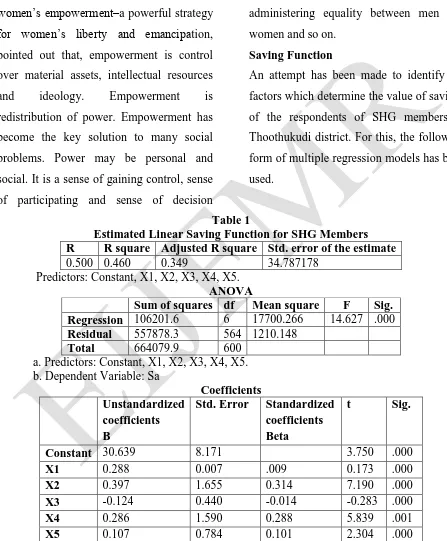
An attempt has been made to identify the
factors which determine the value of savings
of the respondents of SHG members in
Thoothukudi district. For this, the following
form of multiple regression models has been
used.
Table 1
Estimated Linear Saving Function for SHG Members R R square Adjusted R square Std. error of the estimate
0.500 0.460 0.349 34.787178 Predictors: Constant, X1, X2, X3, X4, X5.
ANOVA
Sum of squares df Mean square F Sig. Regression 106201.6 6 17700.266 14.627 .000
Residual 557878.3 564 1210.148
Total 664079.9 600
a. Predictors: Constant, X1, X2, X3, X4, X5. b. Dependent Variable: Sa
Coefficients Unstandardized
coefficients B
Std. Error Standardized coefficients Beta
t Sig.
Constant 30.639 8.171 3.750 .000
X1 0.288 0.007 .009 0.173 .000
X2 0.397 1.655 0.314 7.190 .000
X3 -0.124 0.440 -0.014 -0.283 .000
X4 0.286 1.590 0.288 5.839 .001
X5 0.107 0.784 0.101 2.304 .000
@Mayas Publication Page 17
It is found from the Table 1 that all the
independent variables in the regression
model are jointly responsible for 46 per cent
(R2) variation in the volume of savings in
the study area. Out of the five variables, four
variables namely income in post SHG,
occupation of the respondent, family size
and borrowing in post SHGs are statistically
significant at 5 per cent level. Among these
significant variables, four are positively
related to the volume of savings in the study
area. It means that an additional unit is made
in these variables, may lead to the increase
of 0.288 unit, 0.397 unit, 0.286 unit and
0.107 unit respectively with volume of
savings. It is inferred from the analysis that
the variables such as occupation of the
respondent (t=7.190) and education status
(t=5.839) have a greater influence on the
volume of savings. The F value shows that
the model fitted is statistically significant at
5 per cent level.
Suggestions
Considering the findings of the study, the
following suggestions are recommended.
1. It is necessary that, government may
form a Regulatory Authority to
monitor the functions of the SHGs
especially in income generation and
in social activities in all areas.
2. Most of the SHGs members believe
that they have not been properly
informed and trained by the NGOs
regarding the government‟s latest
schemes to avail benefits. The
researcher suggests that, the NGO has
to organize the awareness training
programme to the members regularly
with a stipulated time interval.
3. The members of the SHGs should be
more active, enthusiastic and
dynamic to mobilize their savings by
group actions. In this process NGOs /
PLF should act as facilitators and
motivators.
4. Meetings and seminars may be
organized where the members will
get a chance to exchange their views
and be able to develop their group
strength by interactions.
5. Literacy and numeric training are
needed for the poor women to benefit
from the micro-credit schemes.
6. Training in legal literacy, rights and
gender awareness are important
complements to micro-credit for the
empowerment of women. The
@Mayas Publication Page 18
training and guidance for the
successful operation of the group.
7. Women may be given vocational
training under women‟s
entrepreneurship development
programme.
8. The bank should advance adequate
credit to the SHGs according to their
needs.
9. The procedure of the banks in
sanctioning credit to SHGs should be
simple and quick.
10.Uniformity should be maintained in
formation and extension of financial
assistance to them by banks in all
blocks.
11.Delay in sanctioning of loan by the
bank or government official should
be avoided by relaxing the stringent
rules and regulations. The
government may insist the bank to
disburse the loan immediately.
12.Government through the panchayat
could provide training of the group
member in producing consumable
goods. The products of the group
could be marketed in the town area
by providing rent-free government
buildings.
13.The SHGs entrepreneurs face the
problems of marketing the product
produced by them. The government
may take necessary steps to market
the SHGs products through public
distribution system.
Conclusion
In this twenty-first century, any one
could adopt an active, people-centered
and growth-oriented poverty alleviation
strategy - a strategy which seems to
incorporate women‟s aspirations,
dynamism and involvement. It is
envisaged that Self Help Group will play
a vital role in such strategy. But there is a
need for structural orientation of the
groups to suit the requirements of new
business. Micro-credit movement has to
be viewed from a long-term perspective
under SHG framework, which underlines
the need for deliberate policy
implications in favor of assurance in
terms of technology back-up, product
market and human resource
development. Hence, there is need for
@Mayas Publication Page 19 diversified micro-finance sector, which
will make a real contribution to women
empowerment. The researcher has a
sense of joy and satisfaction as he has
studied a significant local and so real
problem. These suggestions if
implemented are bound to pave the way
for greater success.
References
Books
1. Acharya Madnani, Applied
Econometrics for Agricultural
Economics, Vdaipur: Himalaya
Publication, 1988.
2. Dhiren Vandra, Micro Finance and
Rural Development, Micro Finance
and Rural Development- A Critical
Review, Delhi: Abhijeet Publications,
1995.
3. Gupta S.P., Statistical Methods, New
Delhi: Sultan Chand & Sons, 1987.
4. Kalirajan, K.P., and Sanker, U., (eds),
Economic Reforms and the
Liberalisation of the Indian
Economy, Elgar: Cheltenham
Edward, 2002.
Journals
5. Abdul Raheem, Women‟s Self-Help
Group for Alleviating Poverty, Kisan
World, 32(7): 2005.
6. Aliyar, Decision making
Empowerment –The needy change,
2006.
7. Amal Mandal, Swarnajayanti Gram
Swarozgar Yojana and Self Help
Groups: An Assessment,
Kurukshetra, 53(3): January 2003.
8. Anil Chuhan and N.K.Verma,
Comparative Performance of Major
Micro Financing Agencies for
Dairying in Haryana, Indian Journal
of Agricultural Economics, 56(3):
July-September 2001.
9. Anjugam, M and Alagumani, T.,
Impact of Micro Finance through Self
Help Groups - A Case Study, Indian
Journal of Agricultural Economics,
56(3): July-September 2001. Anu
Muhammad, Grameen and Micro
Credit: A Tale of Corporate Success,
“Economic and Political Weekly,