R E S E A R C H
Open Access
Adaptive error protection coding for
wireless transmission of motion JPEG 2000
video
Giuseppe Baruffa
*and Fabrizio Frescura
Abstract
The delivery of video over wireless, error-prone transmission channels requires careful allocation of channel and source code rates, given the available bandwidth. In this paper, we present a theoretical framework to find an optimal joint channel and source code rate allocation, by considering an intra-coded video compression standard such as Motion JPEG 2000 and an error-prone wireless transmission channel. Lagrangian optimization is used to find the optimal code rate allocation, from a PSNR perspective, starting from commonly available source coding outputs, such as intermediate rate-distortion traces. The algorithm is simple and adaptive both on the available bandwidth and on the transmission channel conditions, and it has a low computational complexity. Simulation results, using
Reed-Solomon (R-S) coding, show that the achieved performance, in terms of PSNR and MSSIM, is comparable with that of other methods reported in literature. In addition, a simplified and sub-optimal expression for determining the channel code assignment is also provided.
Keywords: Motion JPEG 2000, Wireless video transmission, Lagrangian optimization, Unequal error protection, Forward error correction
1 Introduction
Many multimedia devices are being turned into com-plete entertainment centers, also by taking profit of wire-less transmission. There exist several industry-backed liaisons aimed at transmitting wireless audio/video con-tents between multimedia home appliances using either the 60-GHz band [1–3] or the 2.4–5.0-GHz unlicensed spectrum [4, 5], using for this purpose techniques such as UltraWideBand, orthogonal frequency division multiplex-ing, and multi-antenna links.
Moreover, JPEG 2000 [6] is rapidly spreading as a valu-able intra-coding scheme for video contribution applica-tions [7] due to the high compression efficiency, wide coverage of encoding profiles from lossless to lossy, and the low latency. Recently the International Organization for Standardization (ISO), jointly with the International Electrotechnical Commission (IEC) and the International Telecommunications Union (ITU), added new profiles, to the JPEG 2000 standard, for broadcast video contribution
*Correspondence: [email protected]
Department of Engineering, University of Perugia, via G. Duranti 93, I-06125 Perugia, Italy
and distribution with an amendment to the JPEG 2000 core coding system [8]. This amendment defines three new profiles, aimed at studio contribution links, specify-ing encodspecify-ing parameters and rate limits over seven oper-ating levels for video encoded with JPEG 2000. Even JPEG 2000 over MPEG-2 Transport Stream is a recently stan-dardized method suited to this scenario [9]. In this kind of application, wireless cameras may produce a video con-tribution that has to adapt, in real time, to time-varying transmission channel profiles. In such case, both the avail-able bandwidth and the wireless link bit error rate (BER) may be considered slowly variable with respect to the video frame rate [10].
The streaming of video either directly over the physi-cal layer or using IP packets, is subject to transmission errors. Retransmission of lost/corrupted data or packets is viable, but decreases interactivity and real-time require-ments. Thus, forward error correction (FEC) is generally adopted, and the channel code rate may be matched to compressed data error sensitivity, performing unequal error protection (UEP) [11–13].
Many researchers have investigated optimal methods for the protection of intra-coded video streams. For instance, JPEG 2000 for wireless (JPWL) [14] has been standardized for this purpose, and several works have shown its good performance either when used on IP networks [15–17] or directly over the physical layer [18–23].
In [24, 25], the authors addressed similar prob-lems showing how rate-distortion optimized (RaDiO) audio/video streaming over packetized networks can be achieved, and they solved this problem using Lagrangian optimization. Cataldi et al. proposed a technique based on raptor codes and sliding windows, where different H.264 [26] code rates are associated to each quality layer [27]. In [28], the authors proposed Wyner-Ziv coding for the protection of a coarse version of the video, where side information is provided by a primary H.26x decoder. Ahmad et al. proposed a UEP system using fountain codes [29]. In general, many of the solutions reported in lit-erature for searching optimal UEP strategies are based on heuristic methods or use optimization algorithms [30–33]. It should be noted, however, that such solutions are based on search strategies characterized by a variable amount of computational complexity, which could pre-vent their use in real-time and bandwidth-adaptive video transmission.
1.1 Review of recent works
In recent years, several researchers have investigated techniques capable to apply differentiated FEC levels to wavelet-based image/video compressors, when the mul-timedia stream is delivered over unreliable or wireless channels.
In [34], a motion-compensated temporal filtering dis-crete wavelet transform (DWT) video coder is coupled with double binary turbo codes: the joint source-channel coding strategy is based on distortion profiling and code statistics. Also, Ho and Tsai [35] used 3D-wavelets, data interleaving, and Reed-Solomon (R-S) codes for their UEP streaming system. In [36], the authors investigate the performance of MJPEG 2000 and rate-compatible punc-tured convolutional codes for streaming over a time-varying binary symmetric channel (BSC); in their work, rate-distortion tradeoff of the coding units adapts the error correction code to the bandwidth and error char-acteristics. Schwartz et al. [37] adopted the DWT-based compression and convolutional coding FEC of CCSDS 122.0-B-1 and 131.0-B-1 satellite standards. Their results show that wavelet coefficient UEP outperforms the equal error protection (EEP) method over the simulated AWGN channel.
In [15, 38], the authors focus on JPEG 2000, R-S cod-ing, and interleaving over wireless channels, simulated by a time-varying BSC with Gilbert-Elliot (GE) model.
UEP is performed by variable FEC rates defined by solv-ing a convex optimization problem. Based on interleavsolv-ing effects, they derive a lower bound for successful image decoding rate in wireless environments. In [39], several UEP schemes are compared and layered JPWL stream-ing with RTP packetization on wireless channels is stud-ied; the FEC allocation method is comparably faster and less complex than others, although yielding comparable quality.
JPWL has been shown to be both flexible and reactive to variable channel status. In [21, 40], streaming perfor-mance is simulated over realistic wireless channels, such as multiple-input multiple-output or Rayleigh fading ones. In [17], the authors conjugate JPWL with a dynamic band-width estimation scheme in order to provide the best layering, scaling, and protection of video streams. Even if source distortion is coarsely estimated, it has been shown that it can be effectively used to find an optimal rate allocation that outperforms EEP [23].
In our previous papers [16, 41], we used JPWL and inter-leaving over lossy packet networks. The UEP solution, found by means of a recursive, dichotomic search algo-rithm, was shown to always outperform EEP, and a low complexity interleaving strategy was devised for JPWL implementation on a DSP device. Iqbal et al. [42, 43] devised a family of dynamic programming code alloca-tion methods for FEC protected wireless video streaming. Their protection assignment can provide variable trade-off between performance and implementation complexity. A different view was adopted by Bahmani et al. [44]. The method devised by the authors operates mainly at the decoder side, leaving the particular UEP imple-mentation open. By leveraging the error resilience fea-tures of JPEG 2000, their method guesses the erased received symbols and improves the error correction capability.
1.2 Proposed contributions
In this paper, we present a simple mathematical and algo-rithmic solution for finding an optimal UEP channel code rate allocation strategy. The method used for solving the problem is based on Lagrangian optimization, which is known in the literature and has been applied in several works of other authors [25, 34, 36]. Our proposed solution can be calculated with a closed-form expression, directly from the knowledge of the data units rate-distortion and of the transmission channel characteristics.
Differently from other existing strategies, such as those reviewed in Sec. 1.1, our method has a closed-form rep-resentation for the solution to the UEP problem, and it does not require iterative or dynamic programming-based strategies. Moreover, the presence of data interleaving enables optimal video quality when channel conditions are time-varying, and data- and channel-adaptivity can be fulfilled.
The devised method does not rely on a particular chan-nel coding technique, since it can be applied universally to all block-based FEC schemes. The algorithm itself is also lightweight, as it gives a closed-form expression of the optimal channel code allocation strategy, which can be computed in real time and adaptively respond to changes in the available transmission bandwidth and experienced channel BER. This makes the technique suit-able for channels with unknown and slowly changing error rate and, even, available bandwidth; the video stream receiver should communicate the experienced error rate to the sender side, which in turn would change the UEP solution accordingly. We also show how the algorithm can be practically applied, using JPEG 2000 source coding and R-S channel coding, and present some performance results expressed in terms of either PSNR (peak signal-to-noise ratio) or MSSIM (mean structural similarity index metric).
Some mathematical derivations and performance results shown in this paper have already been partially presented in [49]. However, in this paper, we present additional derivations and novel simulation results. First, we describe in detail a method for assigning codewords of a channel code and implementing the designed protection profile. Furthermore, we work out a formula that allows approximating the optimal protection profile without knowledge of the image content, but only by means of a statistical entropy approach. Finally, we also present some results on the simulated transmission of a complete video sequence.
The paper is structured as follows. First, the theoreti-cal framework for optimized unequal error protection is presented in Sec. 2 and a Lagrangian optimization strat-egy is shown to be able to find a UEP solution, both for particular and general cases. Then, a practical UEP code rate assignment using R-S codes is presented in Sec. 3. In
Sec. 4, the Monte Carlo simulation setup is described, and the results of several simulated scenarios are presented and discussed. Eventually, conclusions are drawn, fol-lowed by an Appendix that contains proofs to assumptions and lemmas.
2 Optimized unequal error protection
In this paper, we model the distortion as a function of the combined channel characteristics/channel code perfor-mance in terms of probability of data loss. This approach is commonly used in the reference literature [16, 30]. We use Motion JPEG 2000 as source coding algorithm and R-S as channel coding algorithm, but the same optimization technique can be applied to other source/channel coding combinations as well. Table 1 summarizes the mathemat-ical notation that will be used throughout the following sections and in the appendices.
Since we are considering an intra-video coding method, the video stream is regarded as a sequence of frames that are compressed independently of each other [50]. Each frame is compressed using JPEG 2000, and the size of the compressed bitstream is ofBbits or, equivalently, the source code rate isrsbits/pixel. The compressed bitstream
is then divided inNk pieces, each one of(k−16)bits; a
two-byte cyclic redundancy check (CRC) codeword, used to test for the error-free condition, is appended at the end of each piece (see Fig. 1). The CRC codeword is consid-ered in our method, even if it is not necessary when R-S codes are used, since they are able to detect the presence of residual errors. However, for different types of chan-nel codes (e.g., convolutional codes), the CRC codeword is required. In this work, the detection of eventual erasures is not managed differently than the detection of errors. The message words of thek-bit long pieces are then R-S encoded, and the codewords are assembled inni-bit long
pieces, 0 ≤ i < Nk . If the average channel code rate is
¯
r, the combined source/channel code rate for the whole codestream will beR=rs/r¯.
The packetized codestream is then transmitted over a Q-ary symmetric transmission channel, whereQ is the number of available different transmission symbols, that is, the pieces are assembled in symbols of log2Qbits. We define pi as the probability that no errors occur up to
piecei, andMias the mean-square error (MSE) distortion
of the decompressed image using all pieces up to piece i. The combined transmission channel performance and channel coding correction capability results in the proba-bilityh(nl)that a piece ofnlbits (after channel decoding)
is received with errors (residual error rate); many other researchers, in the past, have already used this model (e.g., [30]). In this paper, we assume that this probability is approximated by a log-linear model [51], such as
Table 1Summary of mathematical notation
Symbol Meaning Symbol Meaning
B Size of the compressed bitstream, in bits mi mi = Nj=ik−1Mj, complementary cumulative distortion (CCD)
Nk Number of pieces the bitstream is split into mˆ mˆ =(i=0Nk−1mi)1/Nk, geometric mean of the CCD
k Size of each piece (with 2-byte CRC) before channel coding, in bits
¯
rmin,
¯
nmin
Minimum average channel code rate and piece length after channel coding, in bits or bytes
ni Size of thei-th piece after channel coding, in bits σ2 Variance of the compressed frame coefficients
pi pi(n0,n1,. . .,ni), probability that no transmission errors
occur up to piecei ρ
MSE profile sampling step width, in bits/pixel
Mi MSE distortion of reconstructed frame using the firstipieces H Differential entropy of the frame
Q Number of available transmission alphabet symbols in the symmetric channel
˜
N Number ofmotherR-S codes
PS Symbol error rate of theQ-ary symmetric channel ˜rl k˜l/n˜l, channel code rate of thel-th R-S code
˜
PS Q-ary symbol error rate estimated at the receiver wi Index of the R-S code used in thei-th piece
Pb Effective bit error rate of theQ-ary symmetric channel αi,βi Fractional number of codewords, in piece i, with R-S channel code rate˜rwiand˜rwi+1, respectively
γb Average signal-to-noise ratio of the AWGN or Rayleigh
fad-ing channels α
i,βi Integer number of codewords, in piecei, with R-S channel code rate˜rwiand˜rwi+1, respectively
h(nl) Probability that a piece ofnlbits is channel-decoded
with-out residual errors δα
i Amount of rate ˜rwi codewords normalized to the total
number of codewords
C,s,d Amplitude, decay, and offset constants of the log-linear model for the combined transmission channel/channel code performance
Nrow,
Ncol
Dimensions (rows and columns) of the block interleaver
fD Doppler spread of the Rayleigh fading channel λ Lagrange multiplier used for the optimization step
rs Source code rate, in bits/pixel ¯r Channel code rate
R Combined source and channel rate, in bits/pixel NF Number of frames in the YUV video sequence
Rb Transmitted bit rate, after source and channel coding i,¯ Per-frame and average MSE of the received video sequence
¯
n Average piece length after channel coding, in bits or bytes i,¯ Per-frame and average PSNR (in dB) of the received video sequence
ιi,¯ι Per-frame and average MSSIM of the received video sequence
FE() a posteriori cumulative distribution function of the per-frame MSEi
where C, s, and d represent the combined transmis-sion channel/channel code performance characteristics. In particular, the parametersis a decay connected to the correcting performance of the code, dis an offset to nl
used to improve the validity of this model, and C is an amplitude normalization constant. Further details on this approximation are given in Appendix A.1. This approx-imation is correct when the channel error probability is lower than 10−1, as for higher values, the log-linear
rela-tionship does not prove to be valid; however, in such cases, any practical rate allocation/FEC method is hardly operational without increasing the channel coding redun-dancy to a limit beyond which the video quality is severely impaired by the high decoding latency and the low source code rate. In particular, for the model presented in (1), it is found that a unique parameter,s, can be used to repre-sent the transmission scenario, and its value increases as the combined transmission channel/channel code perfor-mance improves (see Appendix A.1). At the receiving side,
the probability of having no errors up to pieceidepends on the chosen sequence of code word lengths (up to piece i) aspi = pi(n0,n1,. . .,ni). The optimization objective
is that of minimizing the average MSE distortion, given that a constant amount of combined source and channel coding bits is sent on the channel, i.e.,
min {ni}
Nk−1
i=0
Mipi s.t. Nk−1
i=0 ni=
B ¯
r . (2)
Lemma 1.The optimal UEP profile, i.e., the set of code-word lengths{ni}to be used for the pieces, which minimizes the overall distortion on the received image, is given by
ni= ¯n+
1 s ln
mi
ˆ
m, 0≤i<Nk, (3)
Fig. 1Organization of the protected bitstream after division inNkpieces
mi = Nkj=i−1Mj, and m is the CCD geometric meanˆ
ˆ m=
Nk−1
i=0 mi 1/Nk
.
Appendix A.2 shows how the closed-form expression (3), mathematical solution of (2), can be obtained. The relationship in (3) can be commented as follows:
• The protection rate for piecei depends on the average protection raten¯plus a modification term. • The modification term logarithmically weights the
CCD at piecei, normalized by the geometric mean of the CCD.
• If the channel code has high-error correction performance and/or the channel conditions are good, the parameters is large, which gives a small
modification term.
• The protection profile depends on the equivalent transmission channel conditions only by means of the parameters, not C and d.
• Sincemiis monotonically not increasing andln(·)is
a monotonic function, the modification term is monotonically not increasing, i.e., pieces at the beginning of the bitstream are more protected than those at the end.
• The protection level at piecei depends on the cumulative amount of distortion of all following pieces.
• The shape of the protection profile is determined by the CCD. Ordinate extrema are defined only by the channel/code combined performance.
With respect to other similar solutions presented in the literature, and described in Sec. 1.1, the main advantage of our method is that a closed-form solution to the UEP problem is readily available, without needing iterative or dynamic programming-based solving strategies. The pro-posed solution is data and channel adaptive; regular, low
bit rate feedback from the receiver lets the transmitter modify the UEP strategy, which, considering also the pres-ence of data interleaving, enables optimal decompressed video quality when channel conditions change with time. Moreover, the side information produced at no cost dur-ing the compression process allows implementdur-ing a well-crafted protection profile, which minimizes the expected amount of distortion due to missing or corrupted data at the receiver. Eventually, we also want to outline that when stringent real-time requirements are needed, and the wireless channel is time-varying, deep interleaving matrices are necessary to intersperse the symbol losses occurring in the channel far away (for high Doppler spread fD), and the decoding delay increases correspondingly.
Upon looking carefully at the solution (3) proposed in Lemma 1, it can be noticed that an additional condition to be satisfied is thatni ≥k, 0 ≤ i < Nk, meaning that we
cannot overprotect the pieces at the beginning, since there would be not enough bits to allocate for the last pieces, not even the source coding bits; especially at high sym-bol error probabilities, the protection profile, given the total bit budget, could be extremely unbalanced and might provide values lower thank.
Lemma 2.The minimum average channel code rate ¯
rmin, expressed in terms of minimum average piece size after channel coding, is approximated by
¯
nmin=max i<Nk
k+ln
ˆ m/mi
s
, (4)
for a given equivalent channel error performance s.
Lemma 2 can be proved after some work on (3) and supposing that lnmi/mˆ<0, for largeiclose toNk.
exactly, an approximation of (3) can be done, if the source coding process is expected to generate an ideal progressive codestream with a typical rate-distortion curve.
Lemma 3.The approximated protection profile for pro-gressively source encoded codestreams is given by
ni∼= ¯n+ ρln 2
s (Nk−1−2i), 0≤iNk, (5)
for Nklarge, whereρis the bit rate sampling step of the MSE profile.
Proof of this lemma is given in Appendix A.3.
Our proposed UEP method has been devised in order to be as general as possible, with application scenarios that can extend also to other source and channel coding meth-ods. For instance, considerations on the distortion reduc-tion carried by data packets may be similarly done also for the network abstraction layer (NAL) units used in H.264 or H.265. In this case, NAL units naturally segment the video stream in pieces for which there is a correspondence with the pieces used in Fig. 1. The computation of the dis-tortion profile can be achieved in several ways, if temporal and spatial frames intra/inter-dependency is maintained or not; layering methods for post-compression reorder-ing of NAL units, similar to those adopted by the scalable video coding (SVC) extension of H.264 are then possible [52].
3 UEP profile generation using R-S coding
In the scenario adopted in this paper, when R-S coding is used, a strategy must be devised for the practical imple-mentation of the optimal UEP profile found with (3). First, we consider a list ofN mother˜ code rates{˜rl} = {(k˜l/n˜l)}, l = 0, 1,. . .,N˜ − 1, ordered by decreasing code rate and not containing repeated code values, i.e.,r˜l > ˜rl+1, j=0, 1,. . .,N˜ −2.
Given the actual code rate for a generic piecei,ri=ki/ni
(it was previously assumed that pieces are of fixed length, i.e.,ki = k, thus this is a generalization), an indexwican
be determined, such thatr˜wi+1≤ri≤ ˜rwi. The numberαi
of R-S codewords with rater˜wi, andβiof codewords with
rater˜wi+1is chosen in such way to achieve the target code
raterifor the piecei. Due to the constraints
αik˜wi+βik˜wi+1=ki and αin˜wi+βin˜wi+1=ni,
the number of codewords for each code is
αi= kin˜wi+1−nik˜wi+1
˜
kwin˜wi+1− ˜nwik˜wi+1
,
βi= k˜wini− ˜nwiki
˜
kwin˜wi+1− ˜nwik˜wi+1
. (6)
Positive-valued solutions always exists for (6), since the constraint˜rwi+1≤ri≤ ˜rwigives
˜
kwini−kin˜wi >0, kin˜wi+1−nik˜wi+1>0
and the constraint˜rwi>˜rwi+1gives
˜
kwin˜wi+1− ˜kwi+1n˜wi>0 .
The values ofαiandβiobtained from (6) are fractional numbers. In order to best approximate them with integer numbers, we first computeαiwith rounding, and then use this result to computeβi, as
α
i = 1/2+
kin˜wi+1−nik˜wi+1
˜
kwin˜wi+1− ˜nwik˜wi+1
,
β i =
ki−αik˜wi
˜ kwi+1
. (7)
4 System simulation and performance 4.1 Simulation setup
For purposes of assessing the performance of the tech-nique presented in this paper, we have prepared a 512-frame video composed by the first 32 512-frames of each of the following 16 clips with CIF resolution (352×288, 30 frames/s) and YUV 4:2:0 format, combined in sequence: akiyo,bus,coastguard,crew,flower,football,foreman, har-bor, husky, ice, news, soccer, stefan, tempete, tennis, and waterfall[53]. Only the luminance (Y) component of the video frames has been used to perform the optimiza-tion strategy and the transmission and recepoptimiza-tion over a simulated channel.
First, the partial distortions Mi for each frame in
the video sequence have been calculated. To this pur-pose, JPEG 2000 compression has been performed using Kakadu 6.0 [54], with default parameters, no visual weighting, and the ‘-rate’ option on every frame. The portion of each JPEG 2000 codestream located after the start-of-data (SOD) marker has been split into multi-ple pieces, each one with a size of (k − 2) bytes (after CRC insertion, the piece will be of k bytes). Then, a new codestream has been constructed using the original header data, with an amended start-of-tile (SOT) marker to account for the new codestream length, a number i of codestream pieces, and the end-of-codestream (EOC) marker. The obtained codestream has been decompressed using Kakadu 6.0, andMi has been calculated as the
dis-tortion of the reconstructed frame. Although this process of determiningMi is cumbersome, it should be said that
coefficients with embedded block coding optimized trun-cation (EBCOT) of the bit-stream [55]. In this work, we have favored a direct calculation of the distortion values, in order to achieve more precise results.
When the piece boundaries are not coincident with the codestream interruption points decided by the JPEG 2000 compressor, we adopt a continuum hypothesis, i.e., we assume that the intermediate distortions at the piece boundaries can be calculated using linear inter-polation from the nearest known, available distortions. This assumption is generally valid, since JPEG 2000 is a position-progressive encoder, and distortions are related to the way wavelet coefficients are truncated by EBCOT, in order to best satisfy the quality-rate con-straints imposed on the compression process.
Moreover, in order to make a fair comparison among different channel code rates, we have kept fixed the total amount of data sent on the channel, i.e., the combined source and channel code rateR.
The transmission of the compressed stream has been simulated, using MATLAB, on three different types of channels. The first type is a Q-ary symmetric channel (Q=256), characterized by symbol error ratesPSranging
from 10−3to 10−1. In this type of channel, errors occur at a symbol-level; since the bit errors are equiprobable and uniformly distributed over the symbol bits (log2Q = 8 bits/symbol), there is a simple relationship between bit and symbol error rates when the number of bits per symbol is large, i.e.,Pb∼=PS/2 ([56] Section 4.4-1).
The second type of channel uses binary phase shift key-ing (BPSK) and additive white Gaussian noise (AWGN), in order to represent a transmission condition akin to physical level signaling on an actual, but ideal, channel. In this case, the performance depends on the signal-to-noise ratio (SNR) expressed by γb. Finally, the last type of simulated channel uses BPSK, AWGN, and Rayleigh-distributed flat fading, which represents a condition similar to that experienced on actual, wireless, non-line-of-sight (NLOS) channels. In this case, the performance depends on the SNR γb and on the correlation degree among fades, expressed by the Doppler spread fD. For
channels using BPSK, the expressions used to determine the average BER (and the corresponding channel parame-ters), given a certain value ofγb, are
Pb,AWGN=Q
2γb , (8)
Pb,Rayleigh=
1 2
1−
γb
1+γb
, (9)
whereQ(·)is the Gaussian tail function, and the Rayleigh channel BER is calculated for the maximum uncorrelated Doppler spread [56].
The UEP profile has been generated using (3), given the distortion profile Mi and the channel parameter s.
Then, the codestream has been split into pieces that have been protected according to the determined UEP pro-file, using R-S coding with N˜ = 24 mother code rates {˜rl} = {32/36, 32/38, 32/40,. . ., 32/80}, and adopting the
codeword allocation strategy given by (7). The effect of the channel is simulated by randomly changing the trans-mitted bytes according to the simulation symbol error ratePS. The error-affected codestream has been
recom-posed by terminating it at the last error-free received piece (thanks to the CRC codeword). In this way, any image reconstruction artifact due to wrong/erased codestream bytes has been eliminated, and the reconstructed image MSE is that used by the UEP allocation strategy. The JPEG 2000 header (about 300 bytes) has been considered as transmitted on a reliable channel, since it represents the most critical section of the codestream. At the receiv-ing side, the JPEG 2000 header has been pre-pended to the JPEG 2000 bitstream bytes, and only the portion of the header carrying information on the bitstream size (Psotfield of the SOT marker) has been changed accord-ingly. Performance has been evaluated as objective visual quality, and Y-PSNR has been used as objective quality indicator. In addition, we used MSSIM to faithfully repre-sent the subjective evaluation by a human observer. The overall performance has been calculated by averaging the PSNR and MSSIM values calculated at each frame of the video sequence. The performance of the UEP method has been directly compared with that of an EEP method.
Additionally, comparisons with existing techniques in literature have been done using a static reference image, the 512×512 pixel grayscale version oflena, compressed at a total bit rate (joint source and channel code rate) of R=0.5 bits/pixel. For each simulated channel error rate, at least 100 independent transmissions of the image have been repeated, and the results averaged. Since both the video sequence and the static image cases cover a standard definition application scenario, we have also used a static image frame from the high-definition 1920× 1080 pix-elscrowdrunRGB sequence [53], in order to show some properties of the calculated UEP profiles.
4.2 Simulated performance results 4.2.1 Performance for static images on BSC
We first report the performance obtained with static images. Both images (lena and crowdrun) were com-pressed to a total rate ofR = 2.5 bits/pixel, comprising both the source and the channel code bits.
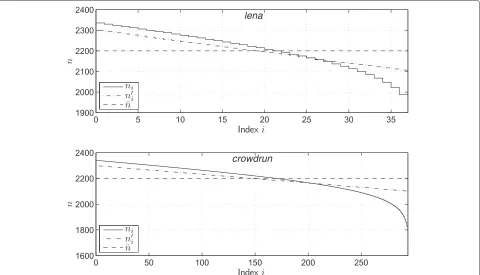
Figure 2 (top) presents the UEP profile forlena, calcu-lated with (3) at an average channel code rate of¯r=32/44, and a channel symbol error probabilityPS = 5×10⁻².
The UEP profile, represented by the solid line, is shown in terms of the protected piece lengthniversus the piece
Fig. 2UEP profiles forlena(top) andcrowdrun(bottom), with code rate of¯r=32/44, fork=1 600 bytes and equivalent channel characterized by
s=0.0127 (PS=5×10⁻²). The values ofkandnare expressed in bytes
Figure 2 (bottom) shows the equivalent case forcrowdrun. In both cases, the piece length is k = 1 600 bytes, and the channel parameter iss = 0.0127 (see Appendix A.1 and Table 3). The dot-dashed line in Fig. 2 represents the protection profile obtained using (5), at rate steps cor-responding to the situation illustrated so far. The UEP profiles begin with a high protection level (low code rate), which then gradually decreases as the index of the piece increases, as expected.
Figure 3 shows how the UEP profile is practically gen-erated, for lena, using a proper combination of the{˜rl}
mother codes and with a number of codewordsαiandβi, for each pair of codes, as given by (7). The top subplot shows the mother code rates ˜rwi and˜rwi+1used in each i-th piece, expressed in terms of codeword sizen˜wi. The
bottom subplot describes the normalized amount δα i of
codewords with rate˜rwiwith respect to the total number
of codewords used in theith piece,
δα i =
α i α
i+βi
. (10)
Clearly,(1−δα,i)is the normalized amount of codewords with rater˜wi+1.
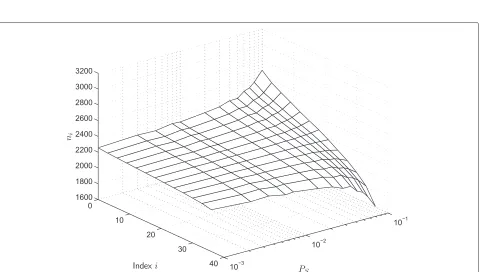
Figure 4 shows the UEP profile ni obtained for
sev-eral values of the channel symbol error rate PS (from
10−3to 10−1) and an average code rater¯ = 32/46, for
lena. The used message word size is k = 1 600 bytes, which corresponds to the floor of the plot. For low val-ues of error rates, the protection profile is almost linear, meaning that an EEP solution is optimal. On the other side, at higher error rates, the profile climbs over, at the beginning, and submerge below, toward the ending, the average protection level. At even higher error rates, the average protection is not sufficient for keeping the profile above the message size floor, and an increased protection rate is requested for correct operation of the algorithm.
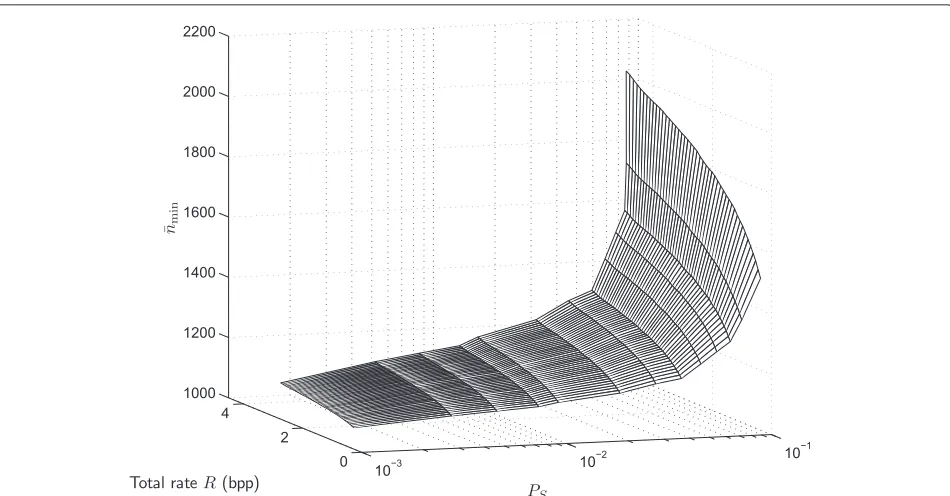
Figure 5 shows the minimum required protected piece average sizen¯min given by (4), plotted versus the
chan-nel symbol error ratePSand the total bit rateR, using a
message word size ofk = 1 024 bytes and thecrowdrun image. The plot has been generated considering also the channel code rate in the total bit rate. We outline that, using this relationship, the system can adaptively respond to variations of the conditions of the transmission chan-nel and of the available bandwidth, by keeping in all cases the received video quality at the optimal level. Given a channel error rate, the minimum average protection slightly increases as the available bandwidth increases, thus meaning that higher protection is required to achieve the optimal UEP profile for an error rate PS. It is also
Fig. 3Generation of the UEP profile forlenawith an average channel code rate of¯r=32/44,k=1 600 and equivalent channels=0.0127 (PS=5×10⁻²). The used mother code rates are˜rl= {32/36, 32/38, 32/40,. . ., 32/80}. The values ofkandnare expressed in bytes
Fig. 5Minimum average protection required forcrowdrun, plotted versus the channel symbol error rate and the total bit rate, in case ofk=1 024. The values ofkandnare expressed in bytes
algorithm selects progressively higher levels of protection to maximize image quality. Clearly, in order to achieve the optimal profile for a given error rate, there must be some knowledge of the channel status even at the transmitter. Thus, the receiver must be able to calculate an estimate
˜
PS of the current channel symbol error rate and feed
this information back to the transmission side. If channel conditions are slowly varying with respect to the infor-mation exchange rate, then this feedback may happen with minimum signaling requirements. Since our method employs the secure delivery of the JPEG 2000 header part (using a reliable transmission technique), these data can be repeated periodically (e.g., 1–2 times per second) on the same channel and used as pilot information for estimatingP˜S.
The performance of our method has been measured using the PSNR and MSSIM quality metrics. In order to compare the results with similar methods referenced in [16, 57, 58], Monte Carlo simulations have been done at a total bit rate (joint source and channel code rate) of R = 0.5 bits/pixel, and the metrics have been aver-aged. Figure 6 shows the achieved performance plotted versus the actual bit error probability Pb before
chan-nel decoding at the receiver side. The simulations have been done with a total of nine different configurations: three possible piece length valuesk(512, 1 024, and 1 600 bytes) and three different average channel code rates r¯ (32/40, 32/44, and 32/48). In all the presented cases, it can be seen that shorter values of k allow achieving slightly
higher PSNR/MSSIM values, for the same error rate on the channel.
The results summarized in Table 2, for the case ¯r = 32/40 and k = 512, show that the achieved PSNR is comparable or better than that obtained in [16, 57, 58]. There is an exception in the comparison with [58], which presents a higher PSNR. In that work, the authors used turbo codes with codewords longer than those used in our work, resulting in improved error correction capa-bility. However, we want to outline that our algorithm is designed to find optimal UEP profiles, and using differ-ent error-correcting codes would result in differdiffer-ent final PSNR values.
4.2.2 Performance for video sequence on BSC
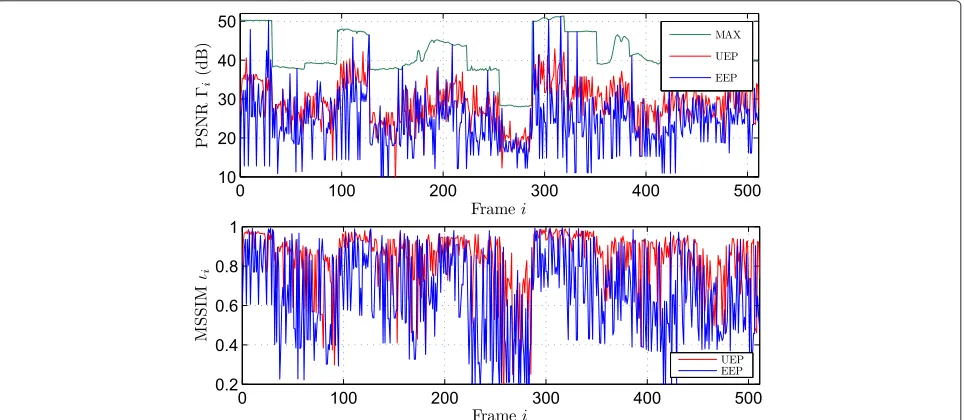
As for the performance obtained on the video sequence, Fig. 7 shows the quality metric indicators history along theNF = 512 frames of the test video. The piece length
isk = 1 024 bytes, the average code rate isr¯ = 32/48, and the total rate is R = 2.5 bits/pixel. Given the video frame rate (30 frames/s) and resolution (352×288), this corresponds to a transmitted bit rate of nearlyRb = 7.6
a
b
Fig. 6Performance plotted in terms of PSNR (a) and MSSIM (b) versus channel bit error rate, for¯r=32/40 (solid lines),¯r=32/44 (dashed lines),
¯
r=32/48 (dotted lines), respectively, andk=512 (diamond),k=1 024 (plus),k=1 600 (asterisk). The image islena, compressed at 0.5 bpp 10 log10(1/i) and plotted versus the frame number i.
Then, the average MSE has been calculated using the arithmetic mean of all MSEs, ¯ = (1/NF)NFi=0−1i. Finally, the average PSNR is calculated from the aver-age MSE as ¯ = 10 log10(1/)¯ . For the MSSIM, the
valuesιi obtained at each frame have been plotted ver-sus the frame number i and arithmetically averaged as ¯
ι=(1/NF) NF−1
i=0 ιi. Also in this case, the actual BERPb,
Table 2PSNR (dB) forlenaat 0.5 bpp,¯r=32/40, andk=512 bytes
Pb 1E-1 8E-2 3E-2 1E-2 1E-3 1E-4
[16] 16.5 16.5 20.0 23.0 33.0 37.0
[57] – – – 16.04 22.11 29.02
[58] 32.76 33.20 35.15 35.67 – –
Fig. 6 – – 18.1 31.2 35.6 –
The PSNR and MSSIM histories i andιi plotted in Fig. 7 are obtained on a simulated channel with an error rate of PS = 7 × 10⁻², equivalent to a bit error rate
ofPb = 3.5×10⁻². The red line depicts the quality of
the received UEP frames after decompression, with addi-tional artifacts due to the errors introduced by the loss of pieces during transmission on the channel. For com-parison purposes, we have also reported the quality of an EEP profile (blue line), having the same total rate R. The average performance of the UEP method results in a PSNR of ¯ = 25.3 dB, while the PSNR of the EEP method is of¯ = 19.6 dB. Similarly, we have an MSSIM of¯ι = 0.84 and¯ι = 0.66, for the UEP and EEP methods, respectively.
Figure 8 shows the obtained average PSNR ¯ and MSSIM¯ιfor different values of channel SERPS, varying
from 2×10⁻²to 10−1(Pbvarying from 10−2to 5×10⁻²).
The results are plotted both for the UEP and EEP cases. The curves show that the proposed UEP method outper-forms the EEP method, in terms of PSNR, up to nearly 7 dB for PS = 10−1 (Pb = 5 × 10⁻²). It is also
evi-dent that the UEP method begins to provide better results
than EEP starting from a SER ofPS = 3×10⁻² (Pb =
1.5 × 10⁻²), while for values of SER lower than PS =
2×10⁻²(Pb = 10−2) the two methods are equivalent.
Similar considerations can be declared for the MSSIM. In this case, the quality index of UEP begins to improve over the EEP one for SER higher than PS = 4 ×10⁻²
(Pb = 2×10⁻²); the protection advantage given by UEP
over EEP is thus only slightly reduced when considering this more subjective-quality related metric.
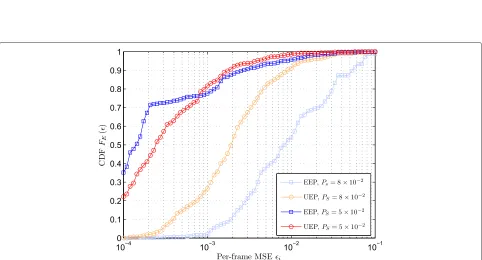
Figure 9 shows thea posterioricumulative distribution function (CDF) of the per-frame MSE,FE(), defined as the computed probability that the MSE of a decompressed frame is lower than. The figure plots the CDFs for UEP and EEP cases, and for two different values of channel SER,PS=5×10⁻²(Pb=2.5×10⁻²) andPS=8×10⁻²
(Pb=4×10⁻²). By setting, for instance, a threshold
prob-ability of 0.9, we find that, for the higher SER, the UEP MSEs are lower than 0.009 whereas for EEP they are lower than 0.05. Moreover, for every threshold probability, the UEP curves always give lower MSEs than the UEP curve. Similarly, at the lower SER, the 90 % threshold values are 0.0017 and 0.0025 for UEP and EEP, respectively. However, in this case, for a probability of 79 % and MSE of 0.0008, the two curves cross each other. This peculiar fact can be explained in the following way: in the EEP case, there are few values ofi that are much worse than the worst val-ues obtained in the UEP case. On the contrary, UEP gives a lot ofi values that are somewhat lower than those of EEP ones, but never get much worse than that. This fact is mainly responsible for the improved average PSNR¯ exhibited by the UEP method over the EEP method in Fig. 8.
Fig. 7PSNR and MSSIM history for the test video sequence onQ-ary channel. The piece length isk=1 024 bytes, the average code rate is
Fig. 8Average PSNR and MSSIM for the test video sequence at different values ofQ-ary channel BER. The piece length isk=1 024 bytes, the average code rate is¯r=32/48, and the total rate isR=2.5 bits/pixel
Fig. 9CDF of MSE for the test video sequence at different values ofQ-ary channel BER. The piece length isk=1 024 bytes, the average code rate is
¯
Fig. 10Probability of failed decoding for the test video sequence at different values ofQ-ary channel BER. The piece length isk=1 024 bytes, the average code rate is¯r=32/48, and the total rate isR=2.5 bits/pixel
A proof that this phenomenon affects the decoded video quality is also given by Fig. 10. The figure shows the mea-sured probability that no decoding happens at all in the received compressed video frame, due to the presence of uncorrectable errors in the first piece (i = 0). Both methods can successfully decode at least the first packet
up to a SER ofPS=4×10⁻²(Pb=2×10⁻²). For larger
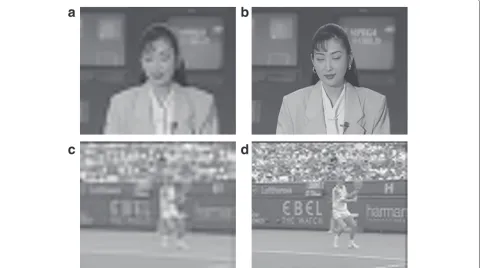
BERs, the UEP method attains a maximum of about 5 % probability of no decoding, whereas the EEP method fail-ure probability is an order of magnitude higher and grows up to 80 %. Figure 11 shows two decompressed frames (frames no. 6 and 360) obtained during the transmission
Fig. 11Comparison between decompressed frames using the EEP (a–c) and UEP (b–d) methods, for aQ-ary channel simulated error rate of
on a channel with an error rate of PS = 7 × 10⁻²
(Pb = 3.5×10⁻²). In this case, the error sequence has
been exactly the same for the UEP and the EEP methods. Figure 11a and c display the frames obtained with EEP, while Fig. 11b and d present the frames obtained with UEP. Simulation results and samples of the original and decompressed video clips are available for download [59].
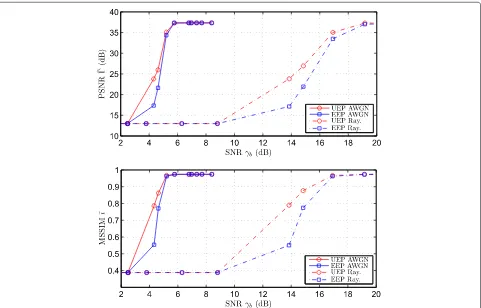
4.2.3 Performance on AWGN and Rayleigh channels The performance of the proposed system has been also verified using the AWGN and uncorrelated (fD ≈ Rb)
Rayleigh flat fading channels, for the video sequence only (without loss of generality, the results apply also to the static images case). Figure 12 shows the average PSNR and MSSIM versus the average channel SNRγb. For both types of channels, UEP outperforms EEP. This is not sur-prising, as the proper combination of interleaving depth and channel coding results in a equivalent BSC channel, which we have already simulated. In case of correlated Rayleigh fading (fD < Rb), the bit interleaver size has
to be chosen to span over an amount of bits such that, after deinterleaving, the fades are practically uncorre-lated. If transmission on a channel with Doppler spread fD adopts an Nrow × Ncol block interleaver, then, after
deinterleaving, the equivalent Doppler spread becomes Nrowtimes higher,NrowfD[60]. Thus, by properly
choos-ing the interleaver dimensionNrow, one can revert to the
condition of uncorrelated Rayleigh fading, for which the performance is plotted in the right-side curves of Fig. 12. If, on the other side, the Doppler spread is so low (such as it happens on nearly static NLOS channels,fDRb) that
the interleaver size should exceed the available memory or the decoding delay bounds, then the periodic feedback from the receiver would allow the transmitter to adapt the protection profile and coding rate at the measured channel conditions. In this case, in the short term, the per-formance will be practically that of the AWGN case, for which the curves on the left side of Fig. 12 apply.
4.3 Computational complexity
The optimization problem requires the knowledge of the distortion profile of the image. Using JPEG 2000 compres-sion, the partial distortionsMi (and the CCDmi) can be
easily obtained during the rate allocation step of the JPEG 2000 bitstream preparation [55]; thus, these values can be obtained virtually at no cost.
For the calculation of the C, s, and d coefficients, a look-up table (LUT) can be used to store the parameters,
for different values of the packet size Nk, of the
chan-nel bit/symbol error rate Pb/PS, and possibly even for
different channel coding algorithms (e.g., convolutional, binary R-S, low-density parity check codes). The LUT can then be accessed to provide the parameters that will be used in the protection profile generation, with a large sav-ing with respect to storsav-ing the entire UEP profile, for each combination of the three variables. As for generating the coefficients stored in the LUT, they can be calcu-lated off-line and smoothly interpocalcu-lated to provide all the intermediate values that could be requested by the system. The calculation of the optimal protection profile in (3) depends on the geometric mean of the CCD func-tion. In order to avoid overflow or underflow problems due to floating point operations rounding during the computation, the geometric mean should be calculated logarithmically as
ˆ m=eNk1
Nk−1
i=0 lnmi, (11)
in which case it takesNklogarithms,(Nk−1)additions, 1
division, and 1 exponentiation to be computed. Then, we need(Nk−1)additions for the computation of the CCD
function, Nk multiplications for the logarithm operand
(one division to obtain the inverse of the geometric mean), Nklogarithm operations,Nkmultiplications for logarithm result scaling (one division to obtain the inverse of s, if not already saved in this form in the LUT), andNk
addi-tions. In summary, to implement (3), a total of(3Nk−2)
additions, 2Nk multiplications, 2Nk logarithms, 3
divi-sions, 1 exponentiation is needed. Assuming that natu-ral logarithms and powers of e can be implemented by means of another LUT, with a sufficient precision once the dynamic ranges of the operands have been characterized, the asymptotic complexity becomes O(Nk). Differently, the solutions presented in [16] or in [58] require mul-tiple evaluations of expressions similar to (2), which are more cumbersome to calculate from the computational viewpoint.
5 Conclusions
The transmission of video over error-prone wireless chan-nels is a problem that can be solved by using an adequate error protection layer added to the streams, once the char-acteristics of the channel are known. In this work, we have presented a UEP strategy devised to allocate chan-nel code bits, using an optimization algorithm that is computationally light during the search of the UEP pro-file. The general formulation of the problem has been solved using a Lagrangian minimization method. The discovered closed-form UEP expression requires already available data, such as the image rate-distortion curve, the average error protection code rate, the typical allowed packet size for transmission, and the channel error model
(represented by one parameter). In addition, we have also presented a practical method for implementing the discovered UEP profile using R-S codes. The simulated performance of the proposed UEP strategy shows that the results outperform those obtained using an EEP strat-egy, that they are comparable with the UEP performance results of other methods presented in similar works, yet having a lower computational complexity, and that this UEP method can be used to effectively counteract the impairments introduced by an error-prone transmission channel.
Appendix A
A.1 Loglinear approximation of residual BER curves The expression (1), derived from a more general expres-sion found in [51], approximates the functionsh(nl)with exponentials, at least in definite regions where h(·) is lower than 10−1, which is a common requirement. In
order to show the validity of this approximation, we have simulated the performance of R-S error coding applied to the devised packetization scheme. Each piece of kbytes has been split in message words ofk˜ = 32 bytes and a R-S code with rate n˜/k˜ has been applied to each word. Then, the resulting codewords have been concatenated, producing a piece ofnbytes. Multiple pieces have been transmitted over an Q-ary channel (Q = 256) with a defined symbol error ratePS, and the residual error
proba-bility after decoding,h(n), has been measured. For a fixed PS, the value ofn has been increased and the
measure-ment on the residual error rate performed again. This procedure has been repeated for several different values ofPS. Figure 13 shows the set of residual error
probabil-ity curves obtained adopting a piece length k = 1 600 bytes, for channel symbol error rates from PS = 10−3
(Pb = 5 × 10⁻⁴) to PS = 10−1 (Pb = 5 × 10⁻²).
Similar sets of error rate curves have been obtained for different lengths of the pieces. The resulting curves have been fit using a nonlinear least-squares method in the logarithmic domain, thus providing the relevant model parameters; Table 3 lists the parametersC,s, and d for several piece lengths and channel symbol error probabilitiesPS.
In Fig. 13, solid lines represent the results of simulations, whereas the dashed lines are obtained by evaluating (1) with the best-fit model parameters of Table 3, for every channel symbol error rate.
The following can be said onC,s, anddparameters:
• The amplitudeC is generally much lower than 1. • The decays increases as the channel/channel code
performance improves.
• The offsetd is the point where the error rate curve becomes linear, and is higher than10−2.
Fig. 13Simulated (solid line) and modeled (dashed line) piece error rate performance for R-S coding, using a mother code from˜rland a piece size ofk=1 600 (nandkare expressed in bytes). The channel symbol error ratePSvaries from 10−3to 10−1(curve stylesare in theleft-side legend)
For other types of transmission methods, such as, for instance, BPSK on AWGN or Rayleigh fading channels, if a bit/byte interleaver interspersing consecutive errors is present, then the results and comments discussed above are still valid.
A.2 Proof of Lemma 1
Proof.The constrained minimization problem expressed by (2) can be solved using the Lagrange multipliers method, as
∂ ∂ni
Nk−1
j=0
Mjpj
n0,n1,. . .,nj
−λnj
=0 ,
0≤i<Nk. (12)
First, we simplify the probability of having no received errors up to piecei,pi = pi(n0,n1,. . .,ni). We suppose
that this probability is expressed by the product of cor-rect reception probabilities for each piece, since they are independently decoded of each other, as
pj
n0,n1,. . .,nj
=
j
l=0
(1−h(nl)), (13)
where h(nl) is the probability that a piece of k bits (nl
bits after channel encoding) is received with errors. Under such conditions, products in (13) are approximated as
j
l=0
(1−h(nl))∼=1−
j
l=0
h(nl), (14)
Table 3Fitting parametersC,s, anddfound for the curves in Fig. 13
k
512 1024 1600
PS C s d C s d C s d
1E-3 0.0085 0.1893 544 0.0180 0.0783 1088 0.0282 0.0461 1700
3E-3 0.0000 0.0984 623 0.0009 0.0512 1186 0.0074 0.0314 1806
5E-3 0.0000 0.0886 660 0.0008 0.0453 1228 0.2666 0.0345 1747
1E-2 0.0000 0.0801 684 0.0008 0.0364 1298 0.0761 0.0255 1854
3E-2 0.0002 0.0451 772 0.0026 0.0248 1451 0.0237 0.0163 2148
5E-2 0.0003 0.0404 849 0.0027 0.0178 1628 0.1258 0.0127 2281
since products ofh(nl)terms can be neglected. Supposing
that all h(nl) have the same value, it can be found that whenh(nl) < 2×10⁻², the approximation (14) is valid with an error lower than 10 %.
After substituting (14) in (13) and differentiating, we obtain
∂pj ∂ni = −
∂h(ni) ∂ni
⎛ ⎜ ⎜ ⎝1−
j
l=0 l=i
h(nl)
⎞ ⎟ ⎟
⎠. (15)
With the approximations (1) and (15), and neglectingC2 (sinceC1), (12) becomes
e−sni = λ sCesdNk−1
j=i Mj
, 0≤i<Nk. (16)
The summation at the denominator of (16) is the CCD mi = jNk=i−1Mj, which is a nonincreasing function in the ivariable (asiincreases, there are lessMj’s to sum). Then, niis found to be
ni=d+
1 s ln sCmi λ
, 0≤i<Nk. (17)
In order to find the Lagrange multiplier λ, we use the constraint in (2). After some work, the constraint becomes
λ=sCe− s(T−D)
Nk mˆ , (18)
wheremˆ = (iNk=0−1mi)1/Nk is the geometric mean of the CCD,T =B(n¯−k)/k, andD= Nk(d−k). We can
sub-stitute (18) into (17), and find the closed form solution to the minimization problem
ni= k ¯ r+ 1 sNk ln ⎛ ⎜ ⎜ ⎜ ⎜ ⎜ ⎜ ⎝
Nk−1
j=i Mj
Nk−1
Nk−1
l=0 l=i
Nk−1
j=l Mj ⎞ ⎟ ⎟ ⎟ ⎟ ⎟ ⎟ ⎠ (19)
= ¯n+ 1 sln
mi
ˆ
m, 0≤i<Nk.
A.3 Proof of Lemma 3
Proof. If the exact R-D curve of the image is not known, it is still possible to calculate an approximate UEP profile considering the MSE profile, sampled atρ bit/symbol steps, using the bounds
1 2πe2
−2(iρ−H)<M
i< σ22−2iρ, (20)
0≤i<Nk, where the lower bound expresses the differen-tial entropyHof the actual source, and the upper bound is calculated considering the hypothesis of Gaussian source
(with encoded image coefficients that are Gaussian dis-tributed with varianceσ2), respectively.
We start by expressing the CCD, for both bounds in (20), as
mi=K Nk−1
j=i
2−2ρj=K2
−2ρi−2−2ρNk
1−2−2ρ , (21)
where either K = 22H−1/πe or K = σ2. Consider-ing i Nk andNk large, (21) can be approximated by mi ∼= K2−2ρi/(1 − 2−2ρ). The geometric mean is
expressed and approximated by
ˆ
m∼= K 1−2−2ρ2
−2ρ Nk
Nk−1
i=0
i
=K2
−ρ(Nk−1)
1−2−2ρ ,
whenNkis large. Eventually, the approximated protection profileniis given by
ni∼= ¯n+ 1 s ln
K2−2ρi
ˆ
m1−2−2ρ
= ¯n+ ρln 2
s (Nk−1−2i) , 0≤iNk, Nk large .
Competing interests
The authors declare that they have no competing interests.
Authors’ contributions
GB and FF worked jointly on the development of the theoretical model. GB performed the simulations and drafted the manuscript, FF carried out the statistical analysis of video and helped to draft the manuscript. All authors read and approved the final manuscript.
Acknowledgements
The authors thank Paolo Micanti and Barbara Villarini for the help on theoretical aspects and simulations carried out for this paper.
Received: 9 July 2015 Accepted: 25 February 2016
References
1. H Singh, J Oh, C Kweon, X Qin, H-R Shao, CY Ngo, A 60 GHz wireless network for enabling uncompressed video communication. IEEE Commun. Mag.46(12), 71–78 (2008). doi:10.1109/MCOM.2008.4689210 2. CJ Hansen, WiGiG: Multi-gigabit wireless communications in the 60 GHz
band. IEEE Wireless Commun.18(6), 6–7 (2011). doi:10.1109/MWC.2011.6108325
3. S Yong, C-C Chong, An overview of multigigabit wireless through millimeter wave technology: potentials and technical challenges. EURASIP J. Wirel. Commun. Netw.2007(078907) (2007). doi:10.1155/2007/78907 4. G Lawton, Wireless HD video heats up. IEEE Computer.41(12), 18–20
(2008). doi:10.1109/MC.2008.509
5. S Srinivasan, inProc. of 20th Int. Conf. on Computer Commun. and Networks (ICCCN). An assessment of technologies for in-home entertainment (IEEE, Maui, Hawaii, 2011), pp. 1–6. doi:10.1109/ICCCN.2011.6005803
6. ISO/IEC,JPEG 2000 image coding system – part 1: core coding system. ISO/IEC ISO/IEC 15444-1. (Int. Standards Org./Int. Electrotech. Comm., Geneva, Switzerland, 2004)
8. ISO/IEC,JPEG 2000 profiles for broadcast applications. (ISO/IEC 15444-1:2004/Amd 3:2010, Int. Standards Org./Int. Electrotech. Comm., Geneva, Switzerland, 2010)
9. ISO/IEC,ISO/IEC 13818-1:2007/FPDAM 5, Int. Standards Org./Int. Electrotech. Comm., (Geneva, Switzerland, 2010)
10. S Pejoski, V Kafedziski, inProc. of 5th European Conf. on Circuits and Sys. for Commun. (ECCSC). Causal video transmission over fading channels with full channel state information (IEEE, Belgrade, Serbia, 2010), pp. 294–297 11. M Etoh, T Yoshimura, Advances in wireless video delivery. Proc. IEEE.
93(1), 111–122 (2005). doi:10.1109/JPROC.2004.839605
12. A Albanese, J Blomer, J Edmonds, M Luby, M Sudan, Priority encoding transmission. IEEE Trans. Inf. Theory.42(6), 1737–1744 (1996). doi:10.1109/18.556670
13. R de Albuquerque, D Cunha, C Pimentel, On the complexity-performance trade-off in soft-decision decoding for unequal error protection block codes. EURASIP J. Adv. Signal Process.2013(1), 28 (2013).
doi:10.1186/1687-6180-2013-28
14. ISO/IEC,JPEG 2000 image coding system-part 11: wireless. (ISO/IEC WD2.0 15444-11, Int. Standards Org./Int. Electrotech. Comm., Geneva, Switzerland, 2003)
15. M Agueh, J-F Diouris, M Diop, F-O Devaux, C De Vleeschouwer, B Macq, Optimal JPWL forward error correction rate allocation for robust JPEG 2000 images and video streaming over mobile ad hoc networks. EURASIP J. Adv. Signal Process.2008(1), 192984 (2008). doi:10.1155/2008/192984 16. G Baruffa, P Micanti, F Frescura, Error protection and interleaving for
wireless transmission of JPEG 2000 images and video. IEEE Trans. Image Process.18(2), 346–356 (2009). doi:10.1109/TIP.2008.2008421 17. C Mairal, M Agueh, inProc. of 2nd Int. Conf. on Advan. in Multimedia
(MMEDIA). Smooth and scalable wireless JPEG 2000 images and video streaming with dynamic bandwidth estimation (IARIA, Athens, Greece, 2010), pp. 174–179. doi:10.1109/MMEDIA.2010.40
18. M Murroni, A power-based unequal error protection system for digital cinema broadcasting over wireless channels. Signal Process. Image Commun.22(3), 331–339 (2007). doi:10.1016/j.image.2006.12.006 19. MI Iqbal, H-J Zepernick, U Engelke, inProc. of 2nd Int. Conf. on Signal
Process. and Commun. Sys. (ICSPCS 2008). Error sensitivity analysis for wireless JPEG 2000 using perceptual quality metrics (IEEE, Gold Coast, Australia, 2008), pp. 1–9. doi:10.1109/ICSPCS.2008.4813665 20. MI Iqbal, H-J Zepernick, U Engelke, inProc. of 6th Int. Symp. on Wireless
Commun. Sys. (ISWCS 2009). Perceptual-based quality assessment of error protection schemes for wireless JPEG 2000 (IEEE, Siena, Italy, 2009), pp. 348–352. doi:10.1109/ISWCS.2009.5285217
21. W Xiang, A Clemence, J Leis, Y Wang, inProc. of 7th Int. Conf. on Inf., Commun. and Signal Process. (ICICS 2009). Error resilience analysis of wireless image transmission using JPEG, JPEG 2000 and JPWL (IEEE, Macau, China, 2009), pp. 1–6. doi:10.1109/ICICS.2009.5397742 22. KM Alajel, W Xiang, J Leis, inProc. of 4th Int. Conf. on Signal Proc. and
Commun. Sys. (ICSPCS). Error resilience performance evaluation of H.264 I-frame and JPWL for wireless image transmission (IEEE, Gold Coast, Australia, 2010), pp. 1–7. doi:10.1109/ICSPCS.2010.5709766
23. C Bergeron, B Gadat, C Poulliat, D Nicholson, inProc. of 17th IEEE Int. Conf. on Image Process. (ICIP). Extrinsic distortion based source-channel allocation for wireless JPEG2000 transcoding systems (IEEE, Hong Kong, China, 2010), pp. 4469–4472. doi:10.1109/ICIP.2010.5651228
24. J Chakareski, PA Chou, Application layer error-correction coding for rate-distortion optimized streaming to wireless clients. IEEE Trans. Commun.52(10), 1675–1687 (2004). doi:10.1109/TCOMM.2004.836436 25. PA Chou, Z Miao, Rate-distortion optimized streaming of packetized
media. IEEE Trans. Multimedia.8(2), 390–404 (2006). doi:10.1109/TMM.2005.864313
26. ISO/IEC,Coding of audio-visual objects-part 10: Advanced video coding. (ISO/IEC 14496-10, Int. Standards Org./Int. Electrotech. Comm., Geneva, Switzerland, 2010)
27. P Cataldi, M Grangetto, T Tillo, E Magli, G Olmo, Sliding-window raptor codes for efficient scalable wireless video broadcasting with unequal loss protection. IEEE Trans. Image Process.19(6), 1491–1503 (2010). doi:10.1109/TIP.2010.2042985
28. L Liang, P Salama, E Delp, Unequal error protection techniques based on Wyner-Ziv coding. EURASIP J. Image Video Process.2009(1), 474689 (2009). doi:10.1155/2009/474689
29. S Ahmad, R Hamzaoui, MM Al-Akaidi, Unequal error protection using fountain codes with applications to video communication. IEEE Trans. Multimedia.13(1), 92–101 (2011). doi:10.1109/TMM.2010.2093511 30. J Lu, A Nosratinia, B Aazhang, inProc. of Int. Conf. on Image Process. (ICIP
98). Progressive source-channel coding of images over bursty error channels, vol. 2 (IEEE, Chicago, Illinois, 1998), pp. 127–131. doi:10.1109/ICIP.1998.723331
31. VM Stankovic, R Hamzaoui, Z Xiong, Real-time error protection of embedded codes for packet erasure and fading channels. IEEE Trans. Circuits Syst. Video Technol.14(8), 1064–1072 (2004).
doi:10.1109/TCSVT.2004.831964
32. N Thomos, NV Boulgouris, MG Strintzis, Optimized transmission of JPEG2000 streams over wireless channels. IEEE Trans. Image Process.
15(1), 54–67 (2006). doi:10.1109/TIP.2005.860338
33. Y Zhang, S Qin, B Li, Z He, Rate-distortion optimized unequal loss protection for video transmission over packet erasure channels. Signal Process. Image Commun.28(10), 1390–1404 (2013).
doi:10.1016/j.image.2013.05.009
34. N Ramzan, S Wan, E Izquierdo, Joint source-channel coding for wavelet-based scalable video transmission using an adaptive Turbo code. EURASIP J. Image Video Process.2007(1), 047517 (2007). doi:10.1155/2007/47517 35. C-P Ho, C-J Tsai, Content-adaptive packetization and streaming of
wavelet video over IP networks. EURASIP J. Image Video Process.2007(1), 045201 (2007). doi:10.1155/2007/45201
36. S Bezan, S Shirani, RD optimized, adaptive, error-resilient transmission of MJPEG2000-coded video over multiple time-varying channels. EURASIP J. Adv. Signal Process.2006(1), 079769 (2006). doi:10.1155/ASP/2006/79769 37. C Schwartz, F da Silva Marques, M da Silva Pinho, inInternational
Telecommunications Symposium (ITS). An unequal coding scheme for remote sensing systems based on CCSDS recommendations (IEEE, Sao Paulo, Brazil, 2014), pp. 1–5. doi:10.1109/ITS.2014.6947971
38. D Pascual Biosca, M Agueh, inMobile Multimedia Communications. Lecture Notes of the Institute for Computer Sciences, Social Informatics and Telecommunications Engineering, ed. by L Atzori, J Delgado, and Giusto D. Optimal interleaving for robust wireless JPEG 2000 images and video transmission, vol. 79 (Springer, Berlin Heidelberg, 2012), pp. 217–226. doi:10.1007/978-3-642-30419-4-19
39. M Agueh, S Ataman, H Soude, inFourth International Conference on Communications and Networking in China (ChinaCOM 2009). A low time-consuming smart FEC rate allocation scheme for robust wireless JPEG 2000 images and video transmission (IEEE, Xi’an, China, 2009), pp. 1–5. doi:10.1109/CHINACOM.2009.5339854
40. J Abot, C Olivier, C Perrine, Y Pousset, A link adaptation scheme optimized for wireless JPEG 2000 transmission over realistic MIMO systems. Signal Process. Image Commun.27(10), 1066–1078 (2012).
doi:10.1016/j.image.2012.08.003
41. F Fiorucci, G Baruffa, P Micanti, F Frescura, inIEEE International Conference on Multimedia and Expo (ICME). A real-time, DSP-based JPWL
implementation for wireless High Definition video transmission (IEEE, Barcelona, Spain, 2011), pp. 1–4. doi:10.1109/ICME.2011.6012054 42. MI Iqbal, H-J Zepernick, inInternational Symposium on Communications
and Information Technologies (ISCIT). Error protection for wireless imaging: providing a trade-off between performance and complexity (IEEE, Tokyo, Japan, 2010), pp. 249–254. doi:10.1109/ISCIT.2010.5664847
43. MI Iqbal, H-J Zepernick, A framework for error protection of region of interest coded images and videos. Signal Process. Image Commun.
26(4–5), 236–249 (2011). doi:10.1016/j.image.2011.03.001
44. S Bahmani, IV Bajic, A HajShirmohammadi, Joint decoding of unequally protected JPEG2000 bitstreams and Reed-Solomon codes. IEEE Trans. Image Process.19(10), 2693–2704 (2010). doi:10.1109/TIP.2010.2049529 45. M Ouaret, F Dufaux, T Ebrahimi, Error-resilient scalable compression
based on distributed video coding. Signal Process. Image Commun.
24(6), 437–451 (2009). doi:10.1016/j.image.2009.02.011
46. E Baccaglini, T Tillo, G Olmo, Image and video transmission: a comparison study of using unequal loss protection and multiple description coding. Multimedia Tools Appl.55(2), 247–259 (2011).
doi:10.1007/s11042-010-0574-3