ISSN: 2231-5381
http://www.internationaljournalssrg.org
Page 397
Abstract - In the present work we have tried to optimize the
cross sectional area of curved beam, by properly selecting the parameters with the help of computer. Flexural formula is reasonably held good for this calculation [1]. This study forces on both bending stresses either tensile or compressive along with displacement censorial axis with respect to neutral axis called eccentricity. Software’s developed in the present work have been run successfully; trapezoidal section is the most suitable for curved beam among circular, rectangular, triangular trapezoidal T and I - sections. Trapezoidal section takes maximum total stresses with minimum shift in eccentricity.
Keywords: Curved beam, flexural equation, eccentricity, bending stresses, trapezoidal cross-section.
I. INTRODUCTION
Machine members and structures subjected to bending are not always straight as in the case of crane hooks, chain links etc., before a bending moment is applied to them. For initially straight beams the simple bending formula is applicable and the neutral axis coincides with the centroidal axis [4]. A simple flexural formula may be used for curved beams for which the radius of curvature is more than five times the beam depth. For deeply curved beams, the neutral and centroidal axes are no longer coincide and the simple bending formula is not applicable.
The total deformations of the fibers in curved beams are proportional to the distances of the fibers from the neutral surfaces, the strains of the fibers are not proportional to these distances because the fibers are not of equal length; where as in straight beam the fibers are of equal length and fibers are of equal length and hence the strains in a straight beam, as well as total deformations are proportional to the distances of fibers from neutral axis [2]. But for bending stresses that do not exceed the elastic strength of the material the stress on any fiber in the beam is proportional to the strain of the fiber, and hence the elastic stresses in the fibers of curved beam are not proportional to the distances from the neutral surface it follows, then that the
resisting moment in a curved beam is not given the expression I/C. Since this expression is obtained on the assumption that stress varies directly as the distance from the neutral axis. For the same reason, neutral axis in a curved beam does not pass through the centroid of section [2].
II. ANALYSIS
During Analysis of various types of cross-section the following assumptions are used (e.g. [2], [3]):
Material of the beam is homogeneous and isotropic.
The material of the bar is stressed within the elastic limit and thus Obeys Hook’s law.
The values of the Young’s modulus are the same for beam material in tension as well as compression.
A transverse section of the beam, which is plane before bending, will remain plane after bending.
The resultant pull or thrust on a transverse section of beam is zero.
The transverse cross-section has at least one axis of symmetry, and bending moment lies on this plane.
The distribution of stresses in a curved beam is
)
(
R
y
Ae
My
(1)An optimum section of a curved beam can be designed by relating the inner and outer fiber stresses in the same ratio as the tensile and compressive strength of beam material is steel, the and compressive strength are nearly equal. Expressions of ‘e’ from above equation are different for different sections. In most of the engineering problems, the magnitude of e is very small and it should be calculated precisely to avoid large percentage error in the final results [1].
A. Stress Distribution Expression For Curved Beams
Simulation of Geometrical Cross-Section for
Practical Purposes
Bhasker R.S.1, Prasad R. K.2, Kumar V.3, Prasad P.4 123
Department of Mechanical Engineering, R.D. Engineering College, Ghaziabad, UP, 201206 (INDIA)
4
ISSN: 2231-5381
http://www.internationaljournalssrg.org
Page 398
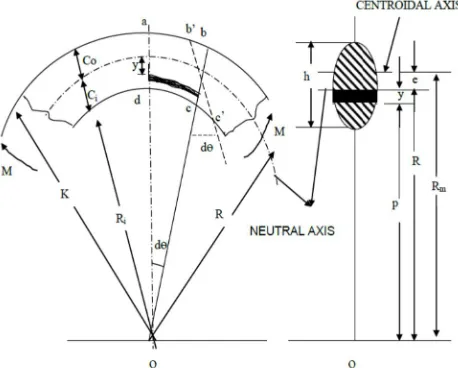
A curved beam subjected to bending moment, M is shownin fig (1). An element a, b, c, d is defined by the angle ϴ. Bending moment M causes section b, c to rotate through dϴ to b’c’.
According to [5] the strain on any fiber at a distance p from center O is:
Fig (1): Curve beam subjected to bending moment
p
d
p
R
)
(
(2)The moment stresses corresponding to this strain is
p
d
p
R
E
E
(
)
(3)
Since there are no axial external forces acting on the beam, the sum of the normal forces acting on the section must be zero [5]. Therefore
0
)
(
dA
Ed
R
p
p
dA
(4)
We arranging equation (3) in the from
dA
p
dA
R
Ed
Solving the expression in parenthesis. This gives
0
A
A
dA
R
p
dA
A
R
/
(5)This important equation is used to find the location of neutral axis with respect to center of the curvature o of the cross-section [5, 9] .The equation indicates neutral axis and centroidal are not coincident and the neutral axis shifted towards center of curvature, it is located between the centroidal axis and center of curvature.
Now balancing the external applied moment against the internal resisting moment
M
dA
p
p
R
Ed
dA
p
R
2)
(
)
)(
(
(6)
2 2 22
Rp
p
R
p
R
Equation 6 can be written as
dA
R
dA
pdA
p
dA
R
Ed
M
2
(7)Now that R is a constant, comparing the first two terms in parentheses with equation (4). These terms vanish and we have left with
Ed
R
dA
pdA
M
(8)
The first integral in this expression is the area A and second integral is area Rm A.
Therefore,
A
R
R
Ed
M
(
m
)
(9)
Since
e
R
m
R
eA
Ed
M
(10)Now using equation (2) once more and arranging finally
we obtain.
)
(
R
y
Ae
my
(11)ISSN: 2231-5381
http://www.internationaljournalssrg.org
Page 399
I
KMh
in which,
I
Mh
r
e
h
Ae
M
K
i i i
i
2
2
)
(
I
Mh
r
e
h
Ae
M
K
o i
o
2
2
)
(
values of the correction factors Ki for the inside fiber and
Ko for outside fiber for some of the common sections with
different degrees of curvature. Value of K can also be read from graph from [6].
III. FLOW CHART AND COMPUTER
PROGRAMS:
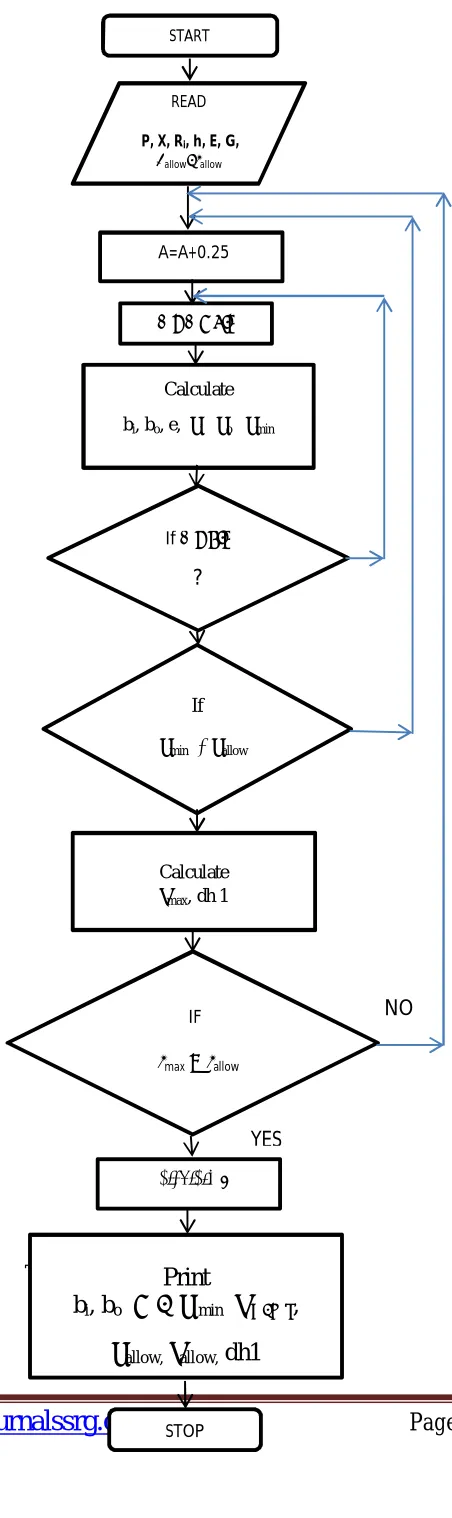
The flow chart for software for design optimization of curved beam with trapezoidal the program developed is shown in figure, [8].
A. Post Processor
The eccentricity is obtained with the help of graph between total tensile and compressive stresses using software. The program for stress distribution analysis of curved beam used in crane hook will give total stress at the desired fiber (top and bottom fiber).
Fig. (2): Developed Flow Chart
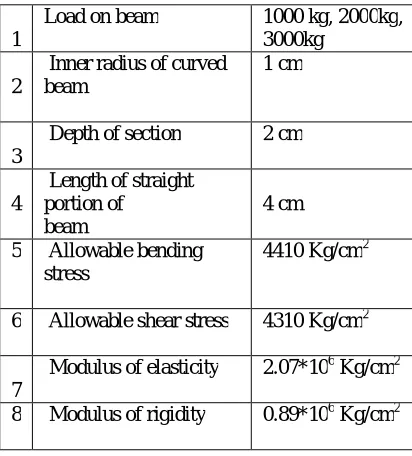
TABLE 1: For Input Data
START
READ P, X, Ri, h, E, G,
σallow, τallow
A=A+0.25
α = α + 0.1
If
σmin < σallow
If α = 1.1 ?
Calculate τmax, dh 1
IF
τmax< τallow
Calculate δ
b
i, b
o, e, a, σ
min, τ
max, δ,
σ
allow,τ
allow,dh1
STOP
Calculate
bi, bo, e, σi, σo, σmin
YES
ISSN: 2231-5381
http://www.internationaljournalssrg.org
Page 400
1Load on beam 1000 kg, 2000kg,
3000kg
2
Inner radius of curved beam
1 cm
3
Depth of section 2 cm
4
Length of straight portion of beam
4 cm
5 Allowable bending stress
4410 Kg/cm2
6 Allowable shear stress 4310 Kg/cm2
7
Modulus of elasticity 2.07*106 Kg/cm2
8 Modulus of rigidity 0.89*106 Kg/cm2
Following output parameters will be obtained for optimal design of curved beam with trapezoidal section.
(i) Area of cross section
(ii) Inner and outer width of the trapezoidal section
(iii) Distance between neutral and centroidal axis
(iv) Maximum bending stress
(v) Maximum shear stress
(vi) Distance of fiber at which shear stress is maximum from top fiber.
B. Case Study:
For eccentricity of curved beam and stress distribution analysis of curved beam used in crane hook are given with results obtained by the computation. Input data for calculation is shown in table (1) for alloy steel.
IV. RESULTS AND DISCUSSION
Results obtained from the software for stress distribution analysis of curved beam show that stress can be easily calculated on any fiber of beam section if all the dimensions of section, load and distance from centroidal axis on it are known to us.
Eccentricity is obtained with the help of graph of curved beam using load P.
P = 1000, 2000, 3000 kg.
A = 19.64, 30, 15, 22.5, 18, 15 cm2 respectively.
Ixx = 30.68, 62.5, 20.83, 45.1, 53.50, 51.52 cm4
respectively.
Y = distance top and bottom fiber form centroidal axis is different for different sections.
Eccentricity has been calculated with the help of graph of circular, rectangular, triangular, trapezoidal, T and I – sections with maximum possible load is
I - 0.65, -0.8, +0.5, -0.25, +0.5, -1.3 cm
II - 0.60, -0.80, +0.6, -0.3, +0.4, -1.4. cm
Fig. (3): Minimum eccentricity for Trapezoidal Section
Total stress has been calculated from table (2) at the outermost fibers of circular, rectangular, trapezoidal T and I - sections is
I – 504.56, 257.88, 322.60, 181.11, 272.46, 368.98 kg/cm2 respectively.
II – 1009.12, 515.76, 645.20, 362.22, 544.92, 737.96
kg/cm2 respectively.
It can be concluded from above results that trapezoidal section
9
is the most suitable section for the curved beamCompression 126.92
215.80
Tension
ISSN: 2231-5381
http://www.internationaljournalssrg.org
Page 401
is considered because minimum eccentricity shown infigure (3) and maximum stress is shown table (2) is the lowest with this section.
Same conclusions are made on changing the magnitudes P, A, and Ixx, as it is evident from the results.
Software for design optimization or curved beam with trapezoidal section has been run for sample problem.
Results obtained are;
A =1.75 cm2
bi = 1.46 cm
bo = 0.29 cm
Maximum bending stress = 3898.51 kg/cm2
Maximum shear stress = 236.97 kg/cm2
Maximum deflection = 0.016 cm
Thus beam is safe in both bending and shear.
IV. CONCLUSIONS
Following general conclusions can be made from the results obtained.
(i) The range of the stress distribution analysis from top to bottom and vice versa of curved beam can be done easily by the software developed by us. Thereby saving human labour and the time of the designer.
(ii) Trapezoidal section is the most suitable section for curved beam used in crane hooks, clamps etc., Among circular, rectangular, triangular trapezoidal T and I - sections because neutral axis minimum shifted towards centroidal axis.
(iii) Trapezoidal section will take maximum bending Stress. So, best optimum section is trapezoidal section for design criteria.
Nomenclature:
A= Area of Cross-Section, cm2
C = Inner radius of Crane Hook, cm
E = Modulus of Elasticity, kg/cm2 G =Modulus of Rigidity, kg/cm2
I = Moment of Inertia, cm4
M = Bending Moment, kg-cm
N = Normal Force, N
P = Applied Force, N
R = Radius of Neutral Axis, cm
Ri = Radius of Inner Fiber, cm
Rm = Radius of Centroidal Axis, cm
Ro = Radius of Outer Fiber, cm
bi = Width of Inner Fiber, cm
bo = Width of outer Fiber, cm
d = Diameter of Circular Section, cm
α = Ratio of Inner Width to Outer Width
∂ = Deflection, cm
σ = Bending Stress, kg/cm2
σt = Total Stress, kg/cm2
τ = Shear Stress, kg/cm2
REFRENCES
[1] Hutson, Ronald and Joseph Herald “practical stress analysis in Engineering Design” third edition CRC Press 2009 page, 199-209. [2] Bhandari, V.B., “Design of Machine Elements” Tata McGraw-Hill Publishing, Company Limited New Delhi 2010, page 130-132. [3] Gere, James M. and Timoshenko, Stephen P. “Mechanics of Materials” C.B.S.Publishers and Distributors Delhi 1986 p- 702-727. [4] Ronald Richards Jr. “Principles of solid mechanics” CRC Press 2010 page 162-164.
[5] Sadd Martin H. “Elasicity: Theory, Applications and Numerics” Academic press 2009, page 528-529.
[6] Lindeburg Michael R. “Core Engineering concepts for students and professionals” PPI 2010, eqn 52.54.
[7] Holland and Liverpool, M.,” Pure Bending of Beams having Initial Curvature“, Engl., Aeronet, Dec 1974, p 570- 573.
[8] Summers and Steven, C., “Evolution, Growth of Computer Aided Design”, U.S.A., Aug 1986, p167-170.
[9] E. Narvydas, N. Puodziuniene, “Circumferential stress concentration factor at the asymmetric shallow notches of the lifting hooks of trapezoidal cross-section” Journal of Mechanika 2012 volume 18(12), page 152-153.
ISSN: 2231-5381
http://www.internationaljournalssrg.org
Page 402
SECTION LOAD
(Kg)
Area (cm2)
Distance from neutral axis (R) (cm)
Distance from Centroidal Axis
(cm)
Bending Moment (kg-cm)
Bending Stress (kg/cm2)
Total Stress (kg/cm2)
Top Fiber
Y1
Bottom Fiber
Y2
Horizontal Vertical Tensile Compressive Tensile Compressive
CIRCULAR
1000 2000 3000
19.64 6.77 +2.5 -2.5 6062.18 12124.36 18186.54
3500 7000 10500
453.64 907.28 1360.92
208.96 417.92 626.88
504.56 1009.12 1513.68
158.04 316.08 474.12 RECTANGULAR 1000
2000 3000
30 6.69 +2.5 -2.5 6062.18 12124.36 18186.54
3500 7000 10500
224.55 449.10 673.65
102.38 204.76 307.14
257.88 515.76 773.64
69.05 138.10 207.15 TRIANGULAR
1000 2000 3000
15 3.55 +3.33 -1.67 6062.18 12124.36 18186.54
3500 7000 10500
255.93 511.86 767.79
128.35 256.70 385.05
322.60 605.45 967.80
61.68 123.36 185.04 TRAPEZOIDAL
1000 2000 3000
22.5 2.17 +2.78 -2.22 6062.18 12124.36 18186.54
3500 7000 10500
136.67 273.34 410.01
787.89 1575.78 2363.67
181.11 362.22 543.33
743.45 1486.90 2230.35 T-SECTION
1000 2000 3000
18 2.76 +3.50 -1.50 6062.18 12124.36 18186.54
3500 7000 10500
216.90 433.80 650.70
16.15 32.30 48.45
272.46 544.92 817.38
39.41 78.96 118.23 I-SECTION
1000 2000 3000
15 6.52 +2.50 -2.50 6062.18 12124.36 18186.54
3500 7000 10500
302.31 604.63 906.93
134.73 269.46 404.19
368.98 737.96 1106.94