Trypanosoma bruceievades the host immune response by sequential expression of a large family of variant
surface glycoproteins (VSG) from one of ⬃20 subtelomeric expression sites (ES). VSG transcription is
monoallelic, and little is known about the regulation of antigenic switching. To explore whether telomere length could affect antigenic switching, we created a telomerase-deficient cell line, in which telomeres shortened at a rate of 3 to 6 bp at each cell division. Upon reaching a critical length, short silent ES telomeres were stabilized by a telomerase-independent mechanism. The active ES telomere progressively shortened and frequently
broke. Upon reaching a critical length, the short active ES telomere stabilized, but the transcribedVSGwas
gradually lost from the population and replaced by a newVSG through duplicative gene conversion. We
propose a model in which subtelomeric-break-induced replication-mediated repair at a short ES telomere leads
to duplicative gene conversion and expression of a newVSG.
A variety of pathogens evade the host immune response by sequential expression of variant surface glycoproteins (VSG) (1, 4, 17, 32). InTrypanosoma brucei, the causative agent of sleeping sickness, the parasite surface consists of a homoge-neous dense layer of⬃107VSG. A large repertoire of VSG
genes is dispersed among many subtelomeric regions, but the single transcribed copy is located in a telomeric expression site (ES) (6).T. bruceicontains⬃20 similar ESs, and transcription occurs in a strictly monoallelic fashion (27, 37). An antigenic switch can be achieved by shifting transcription from one ES to another (in situ switch) (13), by a reciprocal translocation between two ESs (31), or when a previously silent VSG is copied into the active ES through duplicative gene conversion (24, 36). In pleomorphic wild-type strains, gene conversion-mediated switching predominates and occurs at a dramatically higher rate than in laboratory-adapted strains (29, 33, 34). Although we know a little about the molecular mechanisms underlyingVSGswitching, we do not know what precipitates switching events.
In this study, we tried to determine whether telomere length could influenceVSGswitching. Human andT. bruceitelomeres consist of long tracts of TTAGGG repeats and, together with their associated factors, they protect chromosome ends from nucleolytic degradation and illegitimate DNA repair activities (3, 5, 21, 38). In contrast to any other known organism, T.
bruceitelomeres grow at a steady rate of 7 to 9 bp per
popu-lation doubling (PD), and the telomere adjacent to the single transcribedVSGgene inT. bruceiundergoes frequent trunca-tions (2, 13, 23, 28, 35), which are rapidly elongated by the telomerase (8, 10, 15). It remains unclear whether telomere truncations play a role in antigenic variation. Deletion of
telomerase reverse transcriptase (TERT) fromT. bruceicauses progressive telomere shortening at a rate of 3 to 6 bp/PD, loss of minichromosomes, and genomic rearrangements among in-termediate chromosomes (8, 9). At essential megabase chro-mosomes, silent ES telomeres stabilized within a discreet size range by a potentially novel telomerase-independent mecha-nism (8).
Here we report the consequences of telomere shortening at the actively transcribedVSGES and propose a model for how this could precipitate aVSGswitch.
MATERIALS AND METHODS
Trypanosome cell lines.The cell line used in these experiments, Lister 427 antigenic type MITat 1.2, designated single marker, expresses T7 RNA polymer-ase, a Tet repressor, and neomycin phosphotransferase and stably expresses VSG 221 (39). Generation of telomerase-deficient clones has been described previ-ously (9). Parental single marker and mutant cells were cultured in HMI-9 containing 2.5g/ml G418 (Sigma) at 37°C (7, 11).
DNA isolation, Southern blotting, and telomere size distribution analysis.
Genomic DNA was isolated as previously described (22). Terminal restriction fragments containing specificVSGwere detected by genomic blotting, hybrid-ization, and phosphorimaging (14). By use of ImageQuant software, each lane in Fig. 1A was partitioned into 30 equally sized rectangles. The signal intensity in each rectangle was measured as a percentage of the total signal in the entire lane and graphically represented as a function of telomere length.
Rotating agarose gel electrophoresis (RAGE).DNA agarose plugs were pre-pared as described previously by Navarro and Cross (26). Briefly, 2⫻108cells
were harvested, washed in TDB (5 mM KCl, 80 mM NaCl, 1 mM MgSO4, 20 mM
Na2HPO4, 20 mM glucose, pH 7.7) resuspended in 0.5 ml L buffer (0.1 M EDTA,
pH 8.0, 10 mM Tris-HCl, pH 7.6, 20 mM NaCl), and incubated for 10 min at 42°C. Five-tenths milliliters of 1.6% low gelling agarose (Sigma) in L buffer was added to 0.5 ml cells, mixed, and poured into plug molds (Bio-Rad Laborato-ries). Plugs were treated in 3 ml L buffer for 2 days with 1 mg/ml proteinase K at 50°C. After two washes for 15 min with L buffer, proteinase K treatment and washing were repeated. Plugs were stored at 4°C until used. Plugs were embed-ded in 0.8% agarose in 0.5⫻Tris-borate-EDTA (TBE) gels. To separate mega-base chromosomes, a two-window program was used, consisting of a 100- to 300-s linear ramp pulse time at 120 V for 10 h followed by a 1,000- to 2,500-s linear ramp pulse time at 50 V for 80 h. The rotation angle was 106° at a temperature of 12°C (26). Gels were stained for 45 min in TBE plus 0.02g/ml ethidium bromide and destained in TBE for 30 min prior to being photographed under UV light. Southern blotting and hybridization were performed as described above.
* Corresponding author. Mailing address: Laboratory of Molecular Parasitology, The Rockefeller University, 1230 York Avenue, New York, NY 10021-6307. Phone: (212) 327-7571. Fax: (212) 327-7845. E-mail: [email protected].
† Supplemental material for this article may be found at http://ec .asm.org/.
䌤Published ahead of print on 27 October 2006.
2114
on September 8, 2020 by guest
http://ec.asm.org/
Long-range Southern blotting.Digestion of DNA in genomic plugs was per-formed as recommended by the enzyme manufacturer (New England Biolabs). Sixty units of ApaI was incubated in New England Biolabs buffer 4 plus bovine serum albumin at 25°C overnight. Plugs were subsequently washed in 0.1 M EDTA, pH 8.0, and 10 mM Tris-HCl, pH 7.6. Restriction fragments were sep-arated on a 0.8% agarose gel in 0.5⫻TBE. We used a program consisting of a 1- to 12-s linear ramp at a constant 150 V for 15 h at 12°C. The rotation angle was 120°.
Northern blotting and RT-PCR.T. bruceimRNA was isolated by using RNAstat60 according to the manufacturer’s protocol. The dominantVSG ex-pressed by the population was cloned by reverse transcriptase PCR (RT-PCR) using oligonucleotides corresponding to theT. bruceispliced leader sequence (5⬘-GACTAGTTTCTGTACTATAT-3⬘) and aVSGC-terminal conserved re-gion (5⬘-GACTAGTGTTAAAATATATCA-3⬘). PCR was carried out for 30 cycles of 1 min at 94°C, 1 min at 40°C, and 1 min at 72°C.
RESULTS
Telomere breakage and shortening at the active VSG 221
expression site. Telomere length changes at the active VSG
221 ES can be visualized by digestion with EcoRI and hybrid-ization with a VSG 221 probe (Fig. 1A). The actively tran-scribed ES telomere is subject to frequent terminal deletions (2, 13, 23, 28, 35). These truncations and their subsequent repair by telomerase account for the telomere length hetero-geneity we and others have observed at the active ES in wild-type cells (Fig. 2A, WT lane) (15). In telomerase-deficient cells, breakage and progressive telomere shortening occur. In a newly cloned population, the active ESVSG221 terminal re-striction fragment is a sharp band (Fig. 1A, upper panel, week 0). During subsequent culturing, as a result of telomere break-age in the absence of telomerase, the signal starts to smear towards the bottom of the gel. In contrast, wild-typeVSG221 signal is heterogeneous but remains within a high-molecular-size range throughout the time course (data not shown). To verify equal loading and to confirm the progressive moderate shortening at a silent ES, the blot was rehybridized with a probe against a silentVSG bR2 (Fig. 1A, lower panel). We quantified the extent of telomere loss at the active ES over 8 weeks by measuring signal intensity in each lane as a function of telomere length (Fig. 1B). In several independent experi-ments, the distribution of telomere signal changed reproduc-ibly over time. We confirmed that loss ofVSG 221 and de-crease of its transcript levels (Fig. 1C, upper panel) coincided with a gradual increase inVSG1.8 transcript levels (Fig. 1C, middle panel). By the end of the time course, the population expressed roughly equal amounts ofVSG1.8 andVSG221, as judged by phosphorimager quantification (see Fig. S1 in the supplemental material), RT-PCR, and sequencing of 30 clones FIG. 1. Telomere length at the activeVSG221 ES in
telomerase-deficientT. brucei. (A) (Upper panel) EcoRI telomere terminal re-striction fragment hybridized with VSG 221. Progressive telomere shortening and breakage lead to loss of telomeric DNA at the active ES and smearing of theVSG221 signal towards the bottom of the gel. (Lower panel) Reprobing with silent ESVSGbR2 verifies equal load-ing and progressive shortenload-ing of silent ES telomeres. (B) Signal in-tensity distribution in each lane of panel A is graphically represented as a function of telomere length. Smearing of the signal is apparent as peaks become broader and move towards lower molecular mass. (C) Northern blotting ofVSG221 (upper panel) andVSG1.8 (middle panel) over 13 weeks. Positive controls forVSG1.8 are in the right three lanes. Equal loading was verified by reprobing with a tubulin probe and ethidium bromide staining of the gel (lower panel). Phos-phorimager quantification of the signal is shown in Fig. S1 in the supplemental material.
FIG. 2. Selection of clones with a short active ES telomere. (A) TERT-deficient (TERT⫺/⫺) clones cannot repair telomere
trun-cations, and successive rounds of cloning yield clones with very short active ES terminal restriction fragments (lanes 1, 3, and 5). In wild-type populations, telomere breakage and telomerase elongation lead to heterogeneity of theVSG221 terminal restriction fragment (WT lane). (B) (Upper panel) Northern blotting of the cells from panel A confirms that they still expressVSG221. (Lower panel) Equal loading was verified by ethidium bromide staining.
on September 8, 2020 by guest
http://ec.asm.org/
(data not shown), although cells expressingVSG221 appeared to have a slight growth advantage. In these cells,VSG1.8 and
VSG221 appeared to be on opposite arms of chromosome VI. The fact thatVSG221 was lost asVSG1.8 became transcribed suggests that the latter was activated through duplicative gene conversion (see Fig. S2 in the supplemental material). This result led us to investigate the consequences of a short telo-mere at an active ES in more detail by selecting clones that had lost large amounts of telomeric DNA from the active ES. Six telomerase-deficient clones are shown in Fig. 2A. Clones with very short telomeres, notably, clones 1, 2, 3, and 5, were ob-tained only after several rounds of continuous propagation and cloning. The sequence betweenVSG221 and its telomere is known and indicates that an⬃3-kb terminal restriction frag-ment contains⬃200 to 400 bp of telomeric repeats (15). As judged by Northern blotting, telomere lengths in this range did not affectVSG221 mRNA levels at this time (Fig. 2B).
Gradual loss of VSG 221 over time.Next, we determined
whether further shortening of the active ES telomere would occur and whether it would affect the transcriptional status of
VSG221. We addressed these questions by keeping three
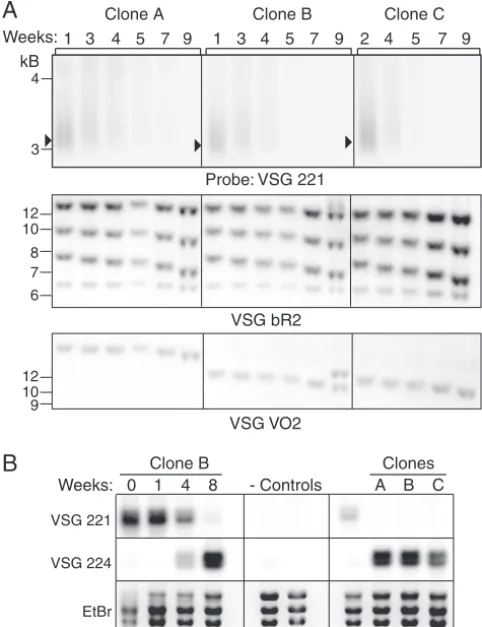
in-dependent clones (clones A to C), which already had a very short telomere at the active ES, in continuous culture for 15 weeks, during which we monitored population growth and iso-lated DNA and RNA every week. We also analyzed the status of VSG 221 at weeks 1, 2, 4, and 6 in an additional eight individual subclones of clone A. The results for weeks 2 and 4 are shown in Fig. S3 in the supplemental material. The short activeVSG221 ES terminal restriction fragment was hetero-geneous and ended in⬃200 to 400 bp of telomeric DNA (Fig. 3A, upper panel) but did not shorten further. In contrast to silent ES telomeres harboringVSGbR2 andVSGV02, which continue to shorten at a rate of 3 to 6 bp/PD (Fig. 3A, middle and lower panels) and which also act as equal-loading controls, theVSG221 signal in the active ES almost disappeared by 5 weeks (Fig. 3A, upper panel). Analysis of individual subclones FIG. 3. A short telomere at the active ES leads to loss of the
transcribedVSG. (A)VSG221 loss in three individual TERT-deficient short active ES telomere clones (clones A, B, and C) during 9 weeks of continuous propagation. The size of the predominantVSG221 band did not change over time, but signal intensity decreased, reflecting loss of the gene. Probes for silent ESVSGbR2 andVSGV02 (arrowheads) confirmed their stability and shortening and verified equal loading. (B) RT-PCR and Northern blotting show thatVSG 224 transcripts replaceVSG221. EtBr, ethidium bromide.
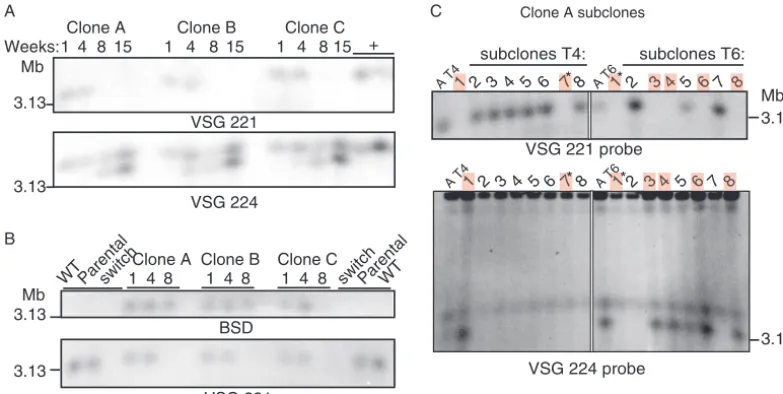
FIG. 4. Southern blotting with a unique upstream pseudogene (schematic representation on the right) demonstrates thatVSG224 replacedVSG221 in the same active ES. (A) (Left panel) As shown in Fig. 3, the population lostVSG221 by 8 weeks. (Middle panel) Re-probing of the blot with an ES-specific pseudogene probe. AfterVSG 221 loss, the size of the predominant terminal restriction fragment increases to⬃23 kb (asterisk). (Right panel) Reprobing with the newly expressedVSG224 probe.VSG224 signal appeared afterVSG221 loss and colocalized precisely with the pseudogene signal (asterisk), indi-cating thatVSG224 translocated into the ES, previously occupied by VSG221. An arrowhead marks the silent copy ofVSG224. The arrow and the asterisk indicate different means ofVSG224 activation within the population (see the text). (B and C) In two other clones, the pseudogene, the SmaI site, andVSG221 were lost (left and middle panels). The duplicated copy ofVSG224 is indicated by an arrow (right panel).
on September 8, 2020 by guest
http://ec.asm.org/
revealed that some short active ES telomeres became elon-gated (see Fig S3A and C in the supplemental material), pre-sumably due to repair by break-induced replication (BIR) us-ing another telomere as a template.
The loss ofVSG221 poses two threats to the cell. First, the parasite needs a protective surface coat for survival. Second, loss of VSG 221 and its telomere results in an unprotected chromosome end that requires repair. Since we did not detect any growth retardation, we were interested to learn how the cell addressed these problems. RNA analysis of clone B con-firmed thatVSG 224 became dominant in the population as
VSG221 transcript levels diminished (Fig. 3B, left four lanes). Two independent clones (clones A and C) also lostVSG221 over a period of 4 to 5 weeks and also activatedVSG224 (Fig. 3B, right three lanes). In other experiments, VSG 221 was replaced by a differentVSG(Fig. 1C).
VSG224 replacedVSG221 in the active expression site.To
clarify the events that led toVSG224 expression, we generated an⬃9-kb SmaI terminal restriction fragment that hybridized with bothVSG221 and an upstreamVSGpseudogene (Fig. 4). After 4 weeks of continuous culture,VSG221 was again lost from the population. By week 8, the size of the predominant restriction fragments containing the pseudogene increased to
⬃23 kb (Fig. 4A, middle panel) and colocalized with a new copy ofVSG224 (Fig. 4A, right panel), suggesting thatVSG
224 and part or all of its associated telomere replacedVSG221 at the previously transcribed ES. In addition to the⬃23-kb bands, a higher molecular band that does not colocalize with the pseudogene appeared (Fig. 4A). We attribute this band to individual breaks in which the SmaI site and the pseudogene marker were deleted. Deletion of the pseudogene occurred
after 8 weeks in two analyzed clones, as the duplicated copy of
VSG 224 appeared (Fig. 4B and C). To determine whether
VSG224 was activated by gene conversion or reciprocal trans-location, we separated whole chromosomal DNA. In all three clones,VSG221 was lost after⬃4 weeks andVSG224, initially present as a single-copy gene, was duplicated into the ES that previously carriedVSG221 (Fig. 5A and C).
We independently confirmed that the same ES remained active by using a blasticidin resistance gene that we had inte-grated immediately downstream of the active promoter (25) whileVSG 221 was being expressed. No drug selection was applied during propagation and switching, but the population and individual subclones retained the marker and were highly resistant to blasticidin, indicating that the same ES was in use (Fig. 5B). This result was further confirmed by analyzing indi-vidual subclones from each time point. Subclones derived from clone A after 4 or 6 weeks are shown in Fig. 5C. By week 4 subclones 1 and 7 and by week 6 subclones 1, 3, 4, 6, and 8 had all lostVSG221 (Fig. 5C, upper panel). Most subclones that lostVSG221 had duplicatedVSG224 (Fig. 5C, lower panel). Subclone 7 from week 4 and subclone 1 from week 6 had lost theVSG221 gene but did not duplicateVSG224: these sub-clones must have undergone independent switch events that activated a differentVSG.
Could a short telomere trigger an antigenic switch?Due to
the low switching frequency and apparent growth advantage of VSG 221-expressing cells in vitro, our cell lines rarely loseVSG
221 or otherwise result in another VSG becoming dominant in the population, even after extensive propagation. Hence, the appearance of a new VSGat the active ES locus was unex-pected and could be explained in two ways. As telomere length FIG. 5. Chromosomal DNA separation by RAGE confirms thatVSG224 replaced VSG221 at the active ES through a duplicative gene conversion event. (A) (Upper panel)VSG221 is lost by week 8. (Lower panel) Reprobing withVSG224 shows thatVSG224 replacesVSG221 on the same chromosome. Under the conditions used, the⬃3.2-Mb chromosome VI band, harboring the 221 ES, is well separated from other chromosomes (20, 25). The entire gel is shown in Fig. S4 in the supplemental material.⫹,VSG221 positive controls. (B) (Upper panel) ES integrity was verified by the retention of the blasticidin resistance marker (BSD) that was inserted immediately downstream from the ES promoter. All three clones retained BSD and were highly resistant to blasticidin. Lanes: switch, a switched clone from a previous experiment; parental, the telomerase-deficient cell line withoutBSDat the active ES; WT, wild type. (Lower panel) Similarly to results shown in panel A,VSG221 is lost after 4 weeks of continuous culture. (C) RAGE of clone A subclones after 4 and 6 weeks. Red-shaded numbers indicate subclones that lostVSG 221. Asterisks indicate subclones that lostVSG221 but did not duplicateVSG224. AT4 and AT6 are the 4- and 6-week populations prior to subcloning. Hybridization probes are indicated below each panel.
on September 8, 2020 by guest
http://ec.asm.org/
mere by using immune selection in mice. However, due to extensive propagation in laboratory culture or unforeseen con-sequences of short telomeres in an animal infection that were not evident in culture, these clones did not grow well in mice. Readaptation to mice, during 3 weeks of sequential transfer, appeared to select for recombination-based elongation of the active ES telomere (data not shown).
We also made a mathematical model to predict the growth dynamics of a culture if a short telomere leads to gradual lethality and switchers arise at various frequencies (10⫺3 to
10⫺6). Gradual death of cells with a short active ES telomere
and concomitant appearance of switchers (at a rate of 10⫺6,
but with a growth advantage) would affect population growth dynamics only subtly over 4 to 5 weeks. In conclusion, unless the switching frequency is dramatically higher at short telo-meres, switchers must have a clear growth advantage in order to outgrow the population within 4 weeks. However, we had to assume parameters, such as relative fitness of short telomere strains and growth advantage of switched parasites, for which we had no experimental data. Thus, we cannot ex-clude the possibility that switchers, at a frequency of 10⫺6,
could have outgrown dying parasites without giving rise to a significant decline in population fitness, which would mean that telomere break-induced repair did not necessarily increase the switching rate.
DISCUSSION
To investigate whether telomere length and telomere dys-function could regulate antigenic switching, we created telo-merase-deficientT. bruceimutant strains (9). As reported else-where, short telomeres at silent ESs were stabilized by a telomerase-independent lengthening mechanism and re-mained at a stable length over several months (8). Further-more, dramatic telomere shortening at silent ESs did not affect
VSGexpression. In this report, we addressed the consequences of a short telomere at the actively transcribed ES. As with shortening at silent ES telomeres, the length of a short active ES telomere could be maintained. However, in sharp contrast to stabilized silent ES telomeres, the actively transcribedVSG
221 was gradually lost from the population and replaced by another VSG through a duplicative gene conversion event. What could account for the difference between silent and ac-tive ESs? One conspicuous difference is that the acac-tive ES undergoes frequent terminal truncations, which were observed many years ago (2, 13, 23, 28). Although the nature of these breaks remains unclear, they could be a consequence of tran-scription bubble destabilization and/or nucleolytic degradation as transcription reaches a DNA terminus. At long telomeres, terminal truncations delete telomeric repeats that can be
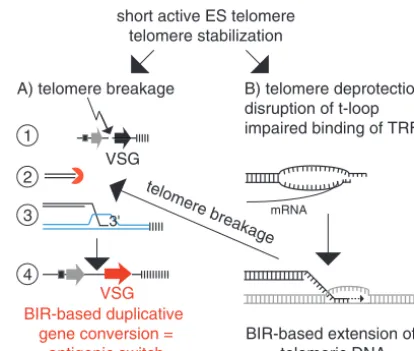
elon-gated rapidly by telomerase (8, 10, 15). At short telomeres, we hypothesize that a truncation might frequently fall within the subtelomeric region, resulting in a double-stranded break. The double-stranded break could be repaired through BIR (Fig. 6A), a mechanism that has been well studied for
Saccharomy-ces cerevisiae(16). During BIR, the centromere-proximal end
of a break is processed into a 3⬘overhang, which can invade the sister chromatid and use it as a template for repair. DNA polymerase-mediated synthesis completes the repair (12). InT.
brucei, the repair template could be any ES or possibly just a
VSG-containing telomere, depending on the location of the break (Fig. 6A) (12), and BIR could extend into the telomere, resulting in duplicative expression of a newVSGand seeding of a new telomere. Depending upon the circumstances, BIR might not effectively repair every active ES break: sometimes an entire ES might be deleted, resulting in an in situ ES switch or death (30). Additionally, transcription of a shortened active ES telomere could lead to telomere deprotection, possibly due to displacement of the T. brucei telomere binding factor (TbTRF) (19). Telomere deprotection could result in BIR-based elongation of the active ES telomere and contribute to the signal heterogeneity observed at the active ES (Fig. 6B).
In conclusion, within a few weeks of continuous culture, the
VSGat a short active ES telomere in telomerase-deficientT.
brucei is replaced by a new VSG through duplicative gene
conversion. Analysis of individual subclones suggested that multiple switch events occurred within the population. We speculate that breakage of short telomeres at an active ES, followed by BIR, could accelerateVSGswitching. Due to tech-nical difficulties, we were unable to reliably measure the VSG switching rates in clones with short telomeres at the active ES, and mathematical modeling (data not shown) could not ex-clude the possibility that, when short active ES telomeres broke,VSGexpression was compromised and these cells died. We could not determine the telomere breakage frequency in the population, and if it were low, VSG switches arising at the normal (for this strain) low frequency of ⬃10⫺6/PD could
dominate the population within a period of 4 to 5 weeks with-out an observable pause in population growth (13, 18). It FIG. 6. (A) Model for telomere breakage and duplicative gene conversion through BIR. (B) BIR-based elongation of deprotected short active ES telomeres.
on September 8, 2020 by guest
http://ec.asm.org/
therefore remains to be determined whether short telomeres and preferential breakage at the active ES are at least partly responsible for the high rate of gene conversion-mediated an-tigenic variation in rapid-switching trypanosome isolates (29).
ACKNOWLEDGMENTS
We thank the reviewers of the manuscript for valuable experimental suggestions and comments. We are grateful to Doeke Hekstra for mathematical modeling and to Heinrich zu Dohna, Pradeep Patnaik, Titia de Lange, Albert Libchaber, Stanislas Leibler, and members of the Cross lab for inspiring discussions. Veena Mandava and Luisa Figueiredo are thanked for suggestions on the manuscript.
This work was supported by NIH grants AI 21729 and AI 50614.
REFERENCES
1.Barry, J. D., M. L. Ginger, P. Burton, and R. McCulloch.2003. Why are parasite contingency genes often associated with telomeres? Int. J. Parasitol.
33:29–45.
2.Bernards, A., P. A. Michels, C. R. Lincke, and P. Borst.1983. Growth of chromosome ends in multiplying trypanosomes. Nature303:592–597. 3.Blackburn, E. H., and P. B. Challoner.1984. Identification of a telomeric
DNA sequence inTrypanosoma brucei. Cell36:447–457.
4.Cross, G. A. M.1975. Identification, purification and properties of clone-specific glycoprotein antigens constituting the surface coat ofTrypanosoma brucei. Parasitology71:393–417.
5.de Lange, T.2002. Protection of mammalian telomeres. Oncogene21:532– 540.
6.de Lange, T., and P. Borst.1982. Genomic environment of the expression-linked extra copies of genes for surface antigens ofTrypanosoma brucei
resembles the end of a chromosome. Nature299:451–453.
7.Doyle, J. J., H. Hirumi, K. Hirumi, E. N. Lupton, and G. A. M. Cross.1980. Antigenic variation in clones of animal-infectiveTrypanosoma bruceiderived and maintained in vitro. Parasitology80:359–369.
8.Dreesen, O., and G. A. M. Cross.2006. Telomerase-independent stabiliza-tion of short telomeres inTrypanosoma brucei. Mol. Cell. Biol.26:4911–4919. 9.Dreesen, O., B. Li, and G. A. M. Cross. 2005. Telomere structure and shortening in telomerase-deficientTrypanosoma brucei. Nucleic Acids Res.
33:4536–4543.
10.Glover, L., and D. Horn.2006. Repression of polymerase I-mediated gene expression atTrypanosoma bruceitelomeres. EMBO Rep.7:93–99. 11.Hirumi, H., and K. Hirumi.1989. Continuous cultivation ofTrypanosoma
bruceiblood stream forms in a medium containing a low concentration of serum protein without feeder cell layers. J. Parasitol.75:985–989. 12.Holmes, A. M., and J. E. Haber.1999. Double-strand break repair in yeast
requires both leading and lagging strand DNA polymerases. Cell96:415–424. 13.Horn, D., and G. A. M. Cross.1997. Analysis ofTrypanosoma brucei VSG
expression site switchingin vitro. Mol. Biochem. Parasitol.84:189–201. 14.Horn, D., and G. A. M. Cross.1997. Position-dependent and
promoter-specific regulation of gene expression inTrypanosoma brucei. EMBO J.
16:7422–7431.
15.Horn, D., C. Spence, and A. K. Ingram.2000. Telomere maintenance and length regulation inTrypanosoma brucei. EMBO J.19:2332–2339. 16.Kraus, E., W. Y. Leung, and J. E. Haber.2001. Break-induced replication: a
review and an example in budding yeast. Proc. Natl. Acad. Sci. USA98:
8255–8262.
17.Kutty, G., L. Ma, and J. A. Kovacs.2001. Characterization of the expression site of the major surface glycoprotein of human-derivedPneumocystis carinii. Mol. Microbiol.42:183–193.
18.Lamont, G. S., R. S. Tucker, and G. A. M. Cross.1986. Analysis of antigen switching rates inTrypanosoma brucei. Parasitology92:355–367.
19.Li, B., A. Espinal, and G. A. M. Cross.2005. Trypanosome telomeres are protected by a homologue of mammalian TRF2. Mol. Cell. Biol.25:5011– 5021.
20.Melville, S. E., V. Leech, C. S. Gerrard, A. Tait, and J. M. Blackwell.1998. The molecular karyotype of the megabase chromosomes ofTrypanosoma bruceiand the assignment of chromosome markers. Mol. Biochem. Parasitol.
94:155–173.
21.Moyzis, R. K., J. M. Buckingham, L. S. Cram, M. Dani, L. L. Deaven, M. D. Jones, J. Meyne, R. L. Ratliff, and J. R. Wu.1988. A highly conserved repetitive DNA sequence, (TTAGGG)n, present at the telomeres of human chromosomes. Proc. Natl. Acad. Sci. USA85:6622–6626.
22.Munoz-Jordan, J. L., G. A. M. Cross, T. de Lange, and J. D. Griffith.2001. t-loops at trypanosome telomeres. EMBO J.20:579–588.
23.Myler, P. J., R. F. Aline, Jr., J. K. Scholler, and K. D. Stuart.1988. Changes in telomere length associated with antigenic variation inTrypanosoma brucei. Mol. Biochem. Parasitol.29:243–250.
24.Myler, P. J., J. Allison, N. Agabian, and K. Stuart.1984. Antigenic variation in African trypanosomes by gene replacement or activation of alternate telomeres. Cell39:203–211.
25.Navarro, M., and G. A. M. Cross.1996. DNA rearrangements associated with multiple consecutive directed antigenic switches inTrypanosoma brucei. Mol. Cell. Biol.16:3615–3625.
26.Navarro, M., and G. A. M. Cross.1998. In situ analysis of a variant surface glycoprotein expression-site promoter region inTrypanosoma brucei. Mol. Biochem. Parasitol.94:53–66.
27.Navarro, M., and K. Gull.2001. A pol I transcriptional body associated with VSG mono-allelic expression inTrypanosoma brucei. Nature414:759–763. 28.Pays, E., M. Laurent, K. Delinte, N. Van Meirvenne, and M. Steinert.1983.
Differential size variations between transcriptionally active and inactive telo-meres ofTrypanosoma brucei. Nucleic Acids Res.11:8137–8147. 29.Robinson, N. P., N. Burman, S. E. Melville, and J. D. Barry.1999.
Predom-inance of duplicativeVSGgene conversion in antigenic variation in African trypanosomes. Mol. Cell. Biol.19:5839–5846.
30.Rudenko, G., I. Chaves, A. Dirks-Mulder, and P. Borst.1998. Selection for activation of a new variant surface glycoprotein gene expression site in
Trypanosoma bruceican result in deletion of the old one. Mol. Biochem. Parasitol.95:97–109.
31.Rudenko, G., R. McCulloch, A. Dirks-Mulder, and P. Borst.1996. Telomere exchange can be an important mechanism of variant surface glycoprotein gene switching inTrypanosoma brucei. Mol. Biochem. Parasitol.80:65–75. 32.Singh, S. K., and H. J. Girschick.2004. Molecular survival strategies of the
Lyme disease spirocheteBorrelia burgdorferi. Lancet Infect. Dis.4:575–583. 33.Turner, C. M.1997. The rate of antigenic variation in fly-transmitted and syringe-passaged infections ofTrypanosoma brucei. FEMS Microbiol. Lett.
153:227–231.
34.Turner, C. M., and J. D. Barry.1989. High frequency of antigenic variation inTrypanosoma brucei rhodesienseinfections. Parasitology99:67–75. 35.van der Ploeg, L. H., A. Y. Liu, and P. Borst.1984. Structure of the growing
telomeres of trypanosomes. Cell36:459–468.
36.van der Ploeg, L. H., D. C. Schwartz, C. R. Cantor, and P. Borst.1984. Antigenic variation inTrypanosoma bruceianalyzed by electrophoretic sep-aration of chromosome-sized DNA molecules. Cell37:77–84.
37.Vanhamme, L., P. Poelvoorde, A. Pays, P. Tebabi, H. Van Xong, and E. Pays.
2000. Differential RNA elongation controls the variant surface glycoprotein gene expression sites ofTrypanosoma brucei. Mol. Microbiol.36:328–340. 38.van Steensel, B., A. Smogorzewska, and T. de Lange.1998. TRF2 protects
human telomeres from end-to-end fusions. Cell92:401–413.
39.Wirtz, E., S. Leal, C. Ochatt, and G. A. M. Cross.1999. A tightly regulated inducible expression system for conditional gene knock-outs and dominant-negative genetics inTrypanosoma brucei. Mol. Biochem. Parasitol.99:89– 101.