IJSRR, 7(4) Oct. – Dec., 2018 Page 1906
Research article
Available online www.ijsrr.org
ISSN: 2279–0543
International Journal of Scientific Research and Reviews
Effectiveness of Progressive Muscle Relaxation Technique On Pain
Among Mothers Underwent The Caesarean Section
A. Rajarajeswari
(Meenakshi University) HOD in OBD Department, Vinayaka Mission’s College of Nursing, Puducherry
ABSTRACT:
A Quasi experimental study to assess the effectiveness of progressive muscle relaxation technique on pain among mothers underwent the caesarean section in New life Hospital at Cuddalore. The aim of the study was to assess the pretest level of pain among mothers underwent caesarean section in control and experimental group, to find the effectiveness of progressive muscle relaxation technique on pain among mothers underwent the caesarean section and to associate the pretest level of pain with selected demographic variables. Methods:A Quasi experimental research design was adopted for the study. Thirty mothers selected based on the convenient sampling techniques. The pretest was conducted for both the groups and intervention on progressive muscle relaxation technique was taught to the experimental group. The collected data were analyzed by using descriptive and inferential statistics. Results:In control group the uncomfortable pain was noticed on 1st day was 66.77% and it was decreases in to 6.67%. Regarding mild pain was noticed the mothers on 1st day 33.3% to increases in to increases in to 93.3%. In Experimental group the uncomfortable pain was noticed on 1st day was 60% and it was gradually decreases on 2nd day and 3rd day it was none. The unpaired “t” test to assess the effectiveness of progressive muscle relaxation technique on post test level of pain among mothers underwent the caesarean section on 1st day the “t” value is 9.2 and p value is p < 0.000. Comparatively on the 3rd day the “t” value is 11.3 and p value is p < 0.000. Hence it is interpreted the p value is highly significant and the progressive muscle relaxation technique was more effective. Conclusion: The study found the progressive muscle relaxation technique is more significant in the caesarean section mothers.
KEY WORDS:
Progressive muscle relaxation, Caesarean section, Pain scale*Corresponding author
A. Rajarajeswari
M.sc (N) ,
PhD Scholar (Meenakshi University) HOD in OBD Department,
IJSRR, 7(4) Oct. – Dec., 2018 Page 1907
INTRODUCTION
Childbearing is a natural physiological event and is the most unforgettable experience in a woman’s life and labour is the most critical period. For several decades the childbirth educators have
focused on the alleviation or reduction of pain and suffering during the childbirth.
Relaxation is thought to increase pain tolerance through a number of mechanisms including
reduction of anxiety, decreased catecholamine response, increased uterine blood flow and decreased
muscle tension. In the last few decades the caesarean rates have increased dramatically in the
developed countries. Progressive muscle relaxation is a deeply relaxing technique that was
developed by Dr.Edmund Jacobson back in 1929. Studies shown that the progressive muscle
relaxation technique given for 3 days of postoperative period just 5-20 minutes alone helps
toimproved pain tolerance for Caesarean mothers.
STATEMENT OF THE PROBLEM
A study to assess the effectiveness of progressive muscle relaxation technique on pain among
mothers underwent the caesarean section in New life Hospital at Cuddalore.
OBJECTIVES
To assess the pretest level of pain among mothers underwent Caesarean section in control and experimental group.
To find the effectiveness of progressive muscle relaxation technique on pain among mothers underwent the caesarean section.
To associate the pretest level of pain with selected demographic variables.
HYPOTHESIS
H1: There is a statistically significance difference between pretest and posttest level of pain among
mothers(P<0.000)
H2: There is a significance association between the pre test level of pain with selected demographic
variables.
METHODOLOGY
RESEARCH APPROACH
A Quantitative research approach was used for this study.
RESEARCH DESIGN
IJSRR, 7(4) Oct. – Dec., 2018 Page 1908
POPULATION
The Population of study was Antenatal mothers who admitted for labour, in New Life Hospital
at Cuddalore.
SETTING
The study was conducted in New Life Hospital at Cuddalore.
SAMPLE TECHNIQUE
Study samples for the present study were selected by convenient sampling techniques
SAMPLE SIZE
Sample size for the present study is 30 mothers. 15 mothers were selected for experimental
group and 15 mothers were selected for control group.
CRITERIA FOR SAMPLE SELECTION:
INCLUSION CRITERIA
Mothers who are subjected for caesarean section.
Mothers who are willing to participate.
Mothers who know English and Tamil.
EXCLUSIVE CRITERIA
Mothers who developed post-operative complications.
High risk mothers.
DEVELOPMENT OF TOOL
The research tool was developed by doing extensive literature review. The primary and
secondary source of literature were reviewed to develops and appropriate tool. Five expects from
various fields like medical surgical Nursing and Obstetrics and Gynecological Nursing and Medicine
provided their opinions and their valuable suggestions to develop the research tool.
INSTURMENT
Visual analogue pain scale.
DESCRIPTION OF THE TOOL
It consist of two section
Section-A: Demographic data.
Section-B: Visuals analogue Pain scale
Section - A
It consisted of Age, Educational status, Religion, Occupation. Marital status, Income, Dietary
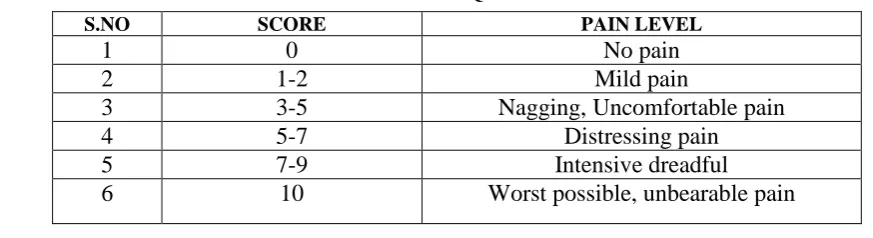
IJSRR, 7(4) Oct. – Dec., 2018 Page 1909 TABLE -1 – SCORING TECHNIQUE FOR THE PAIN SCALE
RESULTS:
FINDINGS RELATED TO DEMOGRAPHIC VARIABLES:-
Most of the mothers were between the age group of 25-30 years both control 7(46.7%) and
experimental 7(46.7%). The highest percentage of mothers were graduates in control group 8(53.3%)
and experimental group 8(53.3%). Majority of the mothers were belongs to Hindus religion in
control (40%) and experimental group (60%). In occupation status experimental group 100% of
mothers were Home maker whereas in control groups 20% of mothers belong to private employee.
The highest percentage of income above 10,000 in control 80% and in experimental group (53.3%).
Regarding the dietary pattern of both experimental & control group whereas in non
vegetarian (93.3%). In menstrual pattern 100% of mothers belong to both groups has been regular
menstrual pattern. Regarding source of information in control group most of mothers got information
through Television 46.7% and experimental group (60%).
FINDING RELATED TO PRETEST LEVEL OF PAIN AMONG CONTROL AND
EXPERIMENTAL GROUP:
Figure -1 Distribution of pretest level of pain regarding Progressive Muscle Relaxation Technique among mothers
Underwent Caesarean Section in control group.
Figure -1 shows that in control group the uncomfortable pain was noticed on 1st day was
66.77% and it was decreases in to 6.67% on 3rd day. Regarding mild pain was noticed the mothers on
1st day 33.3% to increases in to increases in to 93.3% on 3rdday. 33.33
53.33
93.33
66.67
46.67
6.67
0 20 40 60 80 100
1st day 2nd day 3rd day
Per
ce
n
tage
Control group - Level of pain
Pretest level of pain
Mild pain
Uncomfortable pain
S.NO SCORE PAIN LEVEL
1 0 No pain
2 1-2 Mild pain
3 3-5 Nagging, Uncomfortable pain
4 5-7 Distressing pain
5 7-9 Intensive dreadful
IJSRR, 7(4) Oct. – Dec., 2018 Page 1910 Figure -2 Distribution of pretest level of pain regarding Progressive Muscle Relaxation Technique among mothers
Underwent Caesarean Section in experimental group.
Figure -2 shows that in Experimental group the uncomfortable pain was noticed on 1st day
was 60% and it was gradually decreases on 2nd day and 3rd day it was none. Regarding mild pain was
noticed the mothers on 1st day 40% to increases into 100% on 3rd day.
EFFECTIVENESS OF PROGRESSIVE MUSCLE RELAXATION TECHNIQUE
ON PAIN AMONG MOTHERS UNDERGONE CAESAREAN SECTION :
The unpaired “t” test to assess the effectiveness of progressive muscle relaxation technique
on post test level of pain among mothers undergone the caesarean section on 1st day the “t” value is
9.2 and p value is p < 0.000. Comparatively on the 3rd day the “t” value is 11.3 and p value is p <
0.000. Hence it is interpreted the p value is highly significant and the progressive muscle relaxation
technique was more effective.
ASSOCIATION BETWEEN THE PRETEST LEVEL OF PAIN WITH
SELECTED DEMOGRAPHIC VARIABLES:
There is no association found between the pretest level of pain with selected demographic
variables. Hence H2 Hypothesis is not accepted.
CONCLUSION
Majority of mothers had increased level of pain due to caesarean section.Progressive
muscle relaxation technique among caesarean section to be very effective method in terms of
reducing the pain level mothers underwent caesarean section. 40
93.33 100
60
6.67
0 0
20 40 60 80 100 120
1st day 2nd day 3rd day
Per
ce
n
tage
Experimental group - Level of pain
Pretest level of pain
Mild pain
IJSRR, 7(4) Oct. – Dec., 2018 Page 1911
RECOMMENDATIONS:
A study can be replicated on large sample there by findings can be generalized to a large population.
Experimental study can be conducted to find out the similarities or difference in effectiveness of progressive muscle relaxation among the intranatal mothers in new life hospital at
Cuddalore.
A descriptive study can be conducted to find out the knowledge, attitude and practice regarding progressive muscle relaxation on caesarean section mothers.
An experimental study can be conducted to find out progressive muscle relaxation pain with other complementary therapies among caesarean section mothers on new life hospital.
REFERENCE
1. Carolgn Kinger. Therapeutic Exercise. 4th Edition. Jaypee Brothers Medical Publication. New
Delhi; 2002.
2. Piliter.A.Maternal and Child Health Nursing. 6th Edition. Lippincott Williams and
Wikins.Philadelphia; 2010.
3. Delia Chaiaromonte, Brain Morrison. Practical Management of pain. 5th Edition. Elsevier
Publication. New Delhi; 2014.
4. Raman AV. Maternity Nursing. 19th Edition. Lippincott Williams and Wilkins. New Delhi;
2014.
5. Denise F.Polit, Cheryl Tatano Beck, Nursing Research Generating and Assessing Evidence
for Nursing Practice.8th Edition. Williams and Wilkins. New Delhi; 2010
6. Suresh. K.Sharma. Nursing Research & Statistics. Elsevier publication. New Delhi; 2011.
7. Sharma.J.B. Midwifery and Gynecological Nursing. 1st Edition. Avichal Publishing
Company. New Delhi; 2015.
8. Dutta DC. Textbook of Obstetrics. 8th Edition. The Health Sciences Publisher. New Delhi;
2015.
9. Barbara Cherry, Susan R.Jacob. Contemporary Nursing. 6th edition. Elsevier Publication.
Missouri; 2015.
10. Burns and Gravew. Understanding Nursing Research. 11th edition. Elsevier Publication. New
Delhi; 2007.
11. Gita Ganguly. Current of Obstetrics of Gynecology. 1st edition. Jaypee Publication. New
IJSRR, 7(4) Oct. – Dec., 2018 Page 1912
12. Roger.P.Smith. Netter’s Obstetrics Gynecology and Women’s Health. 1st Edition. ICON
learning system Publications. Candada; 2002.
13. Shaws. Textbook of Gynecology. 12th Edition. Churchill Livingstone Publication. New
Delhi; 1999.
14. Micartely A Bonnie. Progressive Muscle Relaxation and Pain Perception. 6th Edition.
Lippincott publication. Philadelphia. 2010.
15. Marth Davis. Elizabeth Robbins Eshelman etal. Progressive Muscle Relaxation: The
relaxation and stress Reduction Workbook. 6th Edition. Harbinger Publications. Mumbai;
2008.
16. Freeman L. Relaxation Therapy in Mosby’s complementary and alternative medicine: A
Research – Based Approach. 3rd Edition. Mosby Elsevier Publication. Louis;
17. Jacobson E. Progressive relaxation: a Physiological Clinical Investigation of muscular states
and their significance in psychological and Medical practice. 3rd Edition. University of
Chicago Press. Chicago; 1974.
18. Payne. RA. Relaxation Techniques: a practica: l Handbook for the health care professionals.
Churchill Livingstone: New York; 1985.
19. Adriana Aparecida Delloiagono De Paula etal. The use of the progressive Muscle Relaxation
Technique for pain relief in gynecology and Obstetrics. 2002; 10(5)
20. Palak Patel. A study to assess the effectiveness of progressive muscle relaxation therapy on
stress among staff nurses working in selected hospitals at Vadodara city. IOSR Journal of
Nursing and Health sciences. 2014;3(3):34-59.
21. Conard A, Roth, WT. Muscle relaxation therapy for anxiety disorders. It works but how?.
Journal of Anxiety disorders. 2006; 21 (2): 243- 264.
22. Dhyani D,Sen S, Raghmahanti R. Effect of progressive muscular relaxation on stress and
disability in subjects with chronic low back pain. IOSR Journal of Nursing and Health
Sciences. 2015;4(1): 40-45.
23. Paula A, Caralho E , Santos. The use of the progressive muscle relaxation technique for pain
relief in gynecology and obstetrics. Rev Lat Am Enfermagem. 2002; 10(5): 654- 659.
24. Manjuri A & Latheef F. Effectiveness of foot reflexology and back massage in improving the
quality of sleep among post caesarean mothers. International journal of research in Ayurveda
Pharmacy. 2016.7 (5). 103-108.
25. Gitanjali N & Sreehari.R. Progressive Muscular Relaxation as a Multi – pronged
IJSRR, 7(4) Oct. – Dec., 2018 Page 1913
26. Gupta B Kumari M, Karur T. Effectiveness of Progressive muscle relaxation technique on
physical symptoms among patients receiving chemotherapy. Nursing and Midwifery
Research Journal. 2016; 12(1):33-40.
27. Chin E, Vincent C & Wilkie D. A comprehensive description of postpartum pain after
cesarean delivery. Journal of Obstetric Gynecologic & Neonatal Nursing. 2014; 43(6):
729-741.
28. Topcu S & Findik U. Effect of relaxation exercises on controlling postoperative pain. Pain
management Nursing.2012; 13(1): 11-17.
29. Susan M etal. Major concerns of women after cesarean Delivery. Journal Gynecology and
Neonatal Nursing. 2013. 4(1).53-59.
30. Shobeiri F etal. Effects of progressive muscle relaxation counseling on anxiety among
primigravida women referred to Health care Centers in Hamadan. Journal of Education
Community Health. 2015; 2(2): 1-9.
31. Mirbagher- Ajorpaz N, Ranjbar N. Effects of recitation of holy Quran on anxiety of women
before casarean section: A randomize clinical trail. Journal of Qom University Medical
Science. 2012; 4(1): 15-19.
32. Sam ML. Effectiveness of progressive muscle relaxation technique on anxiety. Sinhgad e-
Journal of Nursing. 2014; 17 (1): 23-5.
33. Nahid Golmakani etal. Comparing the Effects of progressive muscle relaxation and sleep
quality in primigravida women referring to Mashhad health care centers. 2015; 3(2):335-342.
34. Wenzel.W.R.Jennifer.Anxiety symptoms and disorders at eight weeks post – partum. Journal
of anxiety disorders. 2005; 19(3): 295-311.
35. Khorsandi M, Ghorfranipour.The effect of childbirth preparation class on childbirth fear
among primiparous woman. Journal of Arab University of Medical science. 2008; 11(3): 29 – 36.
36. Clements S. Psychological aspects of caesarean section. Best Practice and research clinical
obstetrics and gynecology. 2001; 15 (2): 109 – 126.
37. Nancy Jallo, Cheryl Bourguignon. Biobehavioural Effects of Relaxation Guided Imagery on
Mental stress. Advances in mind body medicine. 2009; 1(4): 7-9.
38. Karlstroma A etal. Post operative pain after casarean birth affects breastfeeding and infant