IJSRR, 2(4) October - December 2013 Page 98
Research article
Available online
www.ijsrr.org
ISSN: 2279–0543
International Journal of Scientific Research and Review
Vertical
Sub Surface Flow Constructed Vermifilter
Prasad Amit Kumar
1and Kumar Sumit
21
Shri Balaji College of Engineering and Technology, Jaipur, Rajasthan
2
TirhutCollege of Agriculture, Dholi, Bihar.
ABSTRACT
Cost effective and eco friendly water treatment process is need of this modern age. The earthworm species like Eisenia fetida (Tiger worm), Perionyx excavatus (Indian blue worm) and Eudrilus euginae (African night crawler) are very efficient in bioremediation and purification of waste water. The gut microbes of earthworm, play an important role in breakdown and detoxification of complex organic materials. Earthworm vermicast is hydrophilic in nature which adsorbs heavy metals and other chemical pollutants from waste water. Earthworm can bio-accumulates, biodegrade or biotransform any toxic chemicals like organic compounds, pesticides, herbicides and heavy metals. Earthworm species like Eisenia fetida, Eisenia terrestris, Lumbricus rubellus and Allobophora chlorotica have also been recorded to remove heavy metals (Cd, Pb, Cu, Hg etc), pesticides and lipophilic organic micro pollutants from the wastewater. Several factors which affect the vermifiltration process like hydraulic retention time, bed thickness, number of earthworm individuals, species of earthworm and developmental stages of earthworm etc. Constructed wetlands are the newer concept efficient in removal of BOD, TDS, Nitrogen etc from waste water. Vertical Subsurface flow constructed vermifilter is the combined form of vertical sub surface flow constructed wetland and Vermifilteration system which is much more efficient in removal of pollutant, so there is need of study in this field.
KEYWORDS:
Constructed wetland, vermifilteration, Oligochaeta, sludge reduction, biofilterationCorresponding Author
-
Prasad Amit Kumar
IJSRR, 2(4) October - December 2013 Page 99
INTRODUCTION
More than 70% of our fresh water bodies are polluted. Nearly 80% of our water supply returns
as municipal wastewater in the sewer system as sewage1,2. Our country generates nearly 38000 million
liter of sewage per day out of which we can treat only about 12000 million liters per day3. Sewage
carries hazardous chemicals and very high loadings of organic matter referred as BOD (biological
oxygen demand) and COD (chemical oxygen demand) and solids (both dissolved and suspended)
solids4. The urban runoff in general, carries organic load along with several hazardous chemicals
which not only spoils the aesthetic sense of the river but at the same time also degrades the aquatic
ecosystem.
Due to high establishment and running cost of a sewage treatment plant (STP) the majority of
urban centers in developing world dispose urban runoff and sewerage water directly into urban river
without any treatments or with partial treatments2. Developing countries cannot afford to construct
sewage treatment plants in their cities. Conventional effluent treatment systems, such as, mechanical
aeration systems, tank digestion and anaerobic facultative ponds, physico-chemical and biological
treatment system are very costly and demand space1.
A large amount of excess activated sludge produced in wastewater purification, if not properly
disposed, may cause a potential threat to both the environment and human health 5. In conventional
waste water treatment process sludge management is very challenging. It accounts for up to 60% of
total operating cost of waste water treatment plant 6.
In such a scenario, alternatives are needed urgently for treating wastewaters which are low cost,
without any significant negative impacts on the environment. There is tremendous need to develop
reliable technologies for the treatment of waste water in developing countries. Such treatment systems
must fulfill many requirements, such as simple design, use of non–sophisticated Equipment, high
treatment efficiency, low excess sludge production and low operating and capital cost7.
Vermifilter (VF) was widely used to treat the wastewater, and appeared to have high treatment
efficiencies, including synchronous stabilization of wastewater and sludge8. It can effectively remove
BOD, COD, TSS, TDS, Heavy Metals and other organic pollutant from waste water. Vermifiltration
may be a competitive method for wastewater treatment in rural area due to cost saving and ecological
IJSRR, 2(4) October - December 2013 Page 100 pollutant of waste water. The combination of both Vertical Subsurface flow Constructed Wetland and
Vermifilter is named here as “Vertical Subsurface flow Constructed Vermifilter”.
REVIEW OF LITERATURE
Constructed wetlands are defined as those wetlands which are specifically constructed for
treating wastewater and are effective in the removal
of BOD, TSS, and nitrogen8. Typically there are
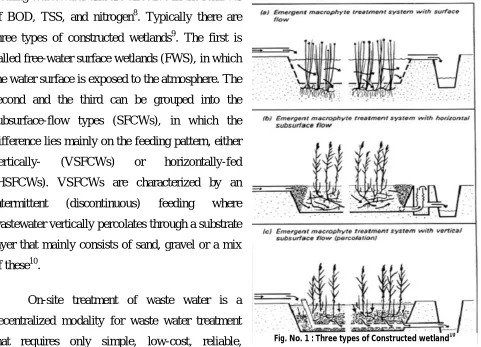
three types of constructed wetlands9. The first is
called free-water surface wetlands (FWS), in which
the water surface is exposed to the atmosphere. The
second and the third can be grouped into the
subsurface-flow types (SFCWs), in which the
difference lies mainly on the feeding pattern, either
vertically- (VSFCWs) or horizontally-fed
(HSFCWs). VSFCWs are characterized by an
intermittent (discontinuous) feeding where
wastewater vertically percolates through a substrate
layer that mainly consists of sand, gravel or a mix
of these10.
On-site treatment of waste water is a
decentralized modality for waste water treatment
that requires only simple, low-cost, reliable,
energy-efficient technology. As such It can be conducted by private home owners without special
skills or training. Vermifiltration is the process which can handle this problem9. Vermifiltration
technology possesses the capacity to process organically polluted water, It break down a wide range of
organic materials11 Eisenia fetida (tiger worm), Eisenia andrei (red tiger worm), Perionyx excavatus
(indian blue), Eudrilus eugeniae (African nightcrawler) and Eisenia veneta (European nightcrawler)
are the species widely used in vermifiltration process
IJSRR, 2(4) October - December 2013 Page 101 The treatment efficiency was not influenced only by earthworm abundance but also the
earthworm growth state9. In ensuring an efficient treatment system, sufficient density of earthworms
and good vermifilter conditions are necessary for earthworm growth in suitable hydraulic loading rates.
There are various studies are available on vermifiltration, vermi-biofiltration or only
constructed wetland filtration system for removal of pollutant/nutrients from waste water2. Very few
reports are available on combined vermi-biofiltration and constructed wetland system, for waste water
treatment. In 2010 Chiarwatchi has worked on combined vertical sub-surface flow constructed wetland
(VSFCWS) with earthworms10. Again in 2011 P.Tomar and S.Suthar worked on an integrated
vermi-biofiltration system with VSFCWS2. These combined system is cost effective and sustainable option
for waste water treatment.
Priyanka Tomar and Surindra Suthar (2011) constructed wetland (VSFCWS) with earthworms
by using a wetland weed Cyprus rotundus and live biomass of a local earthworm P. sansibaricus) in
treatment of urban wastewater. This design is a cost effective and sustainable option for onsite
wastewater treatment. Results clearly suggested that integrated vermi-biofiltration reactor was more
efficient than traditional biofiltration system in terms of removal of key chemical pollutant from
wastewater (Fig. 9). Although, results clearly indicates the efficacy of vermibiofiltration system in
wastewater treatment but further detailed studies are still required to answer few key issues of this
system, e.g. hydrolic load, retention time impact, microbial ecology in vermibeds,
earthworm-microbial interaction etc.
POLLUTANT REMOVAL MECHANISM
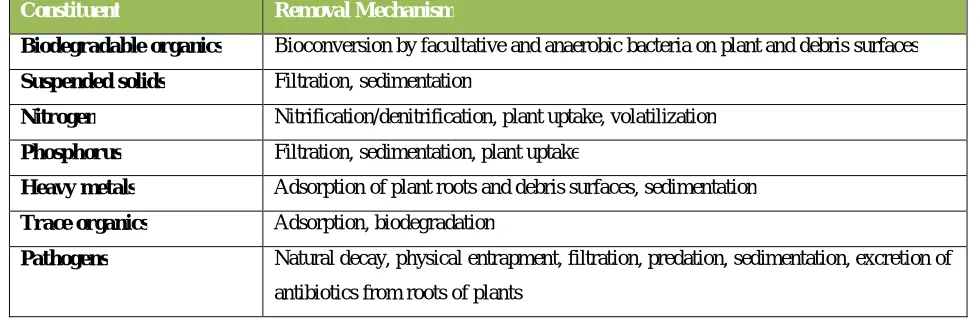
Table No. 1: Pollutant Removal Mechanism10
Constituent Removal Mechanism
Biodegradable organics Bioconversion by facultative and anaerobic bacteria on plant and debris surfaces
Suspended solids Filtration, sedimentation
Nitrogen Nitrification/denitrification, plant uptake, volatilization
Phosphorus Filtration, sedimentation, plant uptake
Heavy metals Adsorption of plant roots and debris surfaces, sedimentation
Trace organics Adsorption, biodegradation
Pathogens Natural decay, physical entrapment, filtration, predation, sedimentation, excretion of
IJSRR, 2(4) October - December 2013 Page 102
FUTURE PROSPECTUS
This work can be implemented in Industrial waste water treatment in the coming future in large
scale. Industries like food, tannery, textile etc produce waste water with biodegradable waste which
can be consumed by earthworm easily. These Industries invest a huge amount of money for waste
management that can be saved by this method.
This method of waste water treatment is cost effective, eco friendly and is sufficient enough to
satisfy the water quality parameter set by government of India; hence there is need of study in large
scale so that it can be easily implemented in other industries.
ACKNOWLEDGEMENTS
My duties stand incomplete without mentioning the following names whose support and concern has helped me
Mr Suraj Kumar Bhagat, Shri Bajaji College of Engineering and Technology.
Mr Prabhu Dayal, founder of Dayal Wormy Compost, Delhi.
REFERENCE
1. Tengku Erina Binti, U A. Malek, S. A Ismail and M. H. Ibrahim. A study on hydraulic loading
rate and worm density in vermifiltration of Palm Oil Mill Effluent. Journal of Industrial
Research and Technology,2013; 3(1): 1-5.
2. Priyanka Tomar, Surindra Suthar. Urban Waste water treatment using vermin-biofiltration
system. Desalination. October 2011; 282: 95-103.
3. CPCB. Status of water supply, wastewater generation and treatment in class-I cities & class-II
towns of India. Central Pollution Control Board. 2009.
4. Sharma S. K., Gupta Pankaj, Borauh Monalisa and Usmani Nisar Khan, A Hydro Biochemical
studies of fluoride concentration on human beings. International Journal of Scientific Research
and Reviews June 2012 ; 1 (1): 67-72.
5. Y.S. Wei, H. Zhu, Y.W. Wang, J.F. Li, P.X. Zhang, J. Hu, J.X. Liu. Nutrients release and
phosphorus distribution during oligochaetes predation on activated sludge. Biochem. Eng.
IJSRR, 2(4) October - December 2013 Page 103 6. Wei, Y.S., VanHouten, R.T., Borger, A.R., Eikelboom, D.H., Fan, Y.B. Minimization of excess
sludge production for biological wastewater treatment. Water Res. 2003; 37: 4453–4467.
7. Su Wang, Jian Yang, Shan-Jie Lou, Jian Yang. Wastewater treatment performance of a
vermifilter enhancement by a converter slag–coal cinder filter. Ecological Engineering. 2010;
36: 489-494.
8. Meiyan Xing, Xiaowei Li, Jian Yang, Baoyi Lv, Yongsen Lu Performance and mechanism of
vermifiltration system for liquid-state sewage sludge treatment using molecular and stable
isotopic techniques. Chemical Engineering Journal. 2012; 197; 143-150.
9. XING Meiyan, Yu Fen, LIU Jing, YANG Jian. Vermifiltration as a final-stage process for rural
sewage purification in China. State Key Laboratory of Pollution Control and Resources Reuse.
College of Environmental Science and Engineering. Tongji University Shanghai ISBN IEEE.
2010; 978-1-4244-4713-8/10/25.
10.N. Chiarawatchai. Implementation of earthworm-assisted constructed wetlands to treat
wastewater and possibility of using alternative plants in constructed wetlands. Ph.D. Thesis.
Hamburg University of Technology. 21073 Hamburg, Germany 2010; 105.
11.Kwon, Y.T., Lee, C.W., Yun, J.H. Development of vermicast from sludge and powdered oyster
shell. J. Clean Prod. 2009; 17: 708-711.
12.Rajiv K. Sinha, G. Bharambe, U. Chaudhari. Sewage treatment by vermifiltration with
synchronous treatment of sludge by earthworms: a low-cost sustainable technology over
conventional systems with potential for decentralization. Environmentalist. April 2008; 28: