Licensed under Creative Common Page 120
http://ijecm.co.uk/
ISSN 2348 0386
THE EVOLUTION GAME ANALYSIS OF CUSTOMER
WORD-OF-MOUTH REFERRALS UNDER ON-NET AND OFF-NET
DIFFERENT PRICING-BASED ON THE PERSPECTIVE
OF RECIPROCITY PREFERENCE
Huang Yan-ping
School of Management, Guangdong University of Technology, Guangzhou, China
Xie Fang
School of Management, Guangdong University of Technology, Guangzhou, China
Abstract
Enterprises implement reward referral program. The customer’s recommendation motivation is
often easy to be questioned, which makes the reward of enterprises fail to effectively simulate
customer’s recommended behavior. This paper describes a model by planting the reciprocity
motivation hypothesis to study customer word-of-mouth referral behavior under on-Net and
off-Net different pricing. The research reveals that customer word-of-mouth referral subjects are
often inclined to become the reciprocal subjects under on-Net and off-Net different pricing.
Reciprocal word-of-mouth referral subjects account for the proportion of the overall number is S
.By adjusting the various benefit payments in the process of customer referrals, there is a
threshold which makes the efficiency of referrals monotone increasing before it is decreasing
when S(θ,1). And reciprocal customers in the overall referral subjects will be into dominant
stable equilibrium state. When S(0, θ),customers return to rational state and evolve into stable
equilibrium state which is entirely contrary to reciprocal subjects. Then reciprocal word-of-mouth
referrals completely fail.
Keywords: Word-of-Mouth Referrals; On-Net and Off-Net Different Pricing; Reciprocity
Licensed under Creative Common Page 121 INTRODUCTION
In the recent years, marketing managers have increasingly focused on word-of-mouth (WOM)
as effective source of new customer acquisition (Godes et al., 2005; Smith et al.2007; Hartmann
et al., 2008). In order to promote referrals from existing customers, some Enterprises begin to
actively design and develop all kinds of Customer referrals Program. Enterprises encourage
customers to recommend products or services to their family or friends, and reward
every successful presenter. For example, when customers recommend a new shampoo to
others, Procter & Gamble Company rewards them a safari suit small shampoo. Finally, the plan
wins 2 million presentees (Kelly, 2000).
Biyalogorsky (2001), Chen & Shi (2003), Kornish and Li (2010), Lobler & Welk (2004) study the incentive mechanism of customers’ successful recommendation; Xiao etc.
(2011) use the game theory method to determine enterprise's best reward policy. Although the
scholars at home and abroad for referrals for exploration, most studies focus on the combination
of the low price and rewards, illustrating the impact of direct economic returns for
referrals. However, in a certain sense, direct economic returns will make the customer the sales
staff of the enterprise, and make the customer with the customer-marketing personnel's double identity. Presenter's double identity determines the customers’ ambivalent attitude when they
recommend. The reason is that some people think the motivation of recommendation is just in
order to obtain self-interest behavior of reward. Therefore, direct reward incentive mechanism can’t effectively simulate customer’s recommended behavior.
Under the inside and outside of network differential pricing, customers recommend
others to join the network which is the altruistic behavior on the basis of going after return. In the
mutual benefit environment, the ambivalence will be weakened; customers will have more
power to recommend products or services to their friends. Based on the above discussion, the
article will study customer referrals, be based on the reciprocal preference perspective and use
evolutionary game method to explore customer referrals under on-Net and off-Net different.
LITERATURE REVIEW
How to develop the optimal customers recommend incentive mechanism, scholars have been a
lot of work. Biyalogorsky (2001) mainly studies the incentive mechanism of customer’s
successful recommendation that the combination of price and reward is the optimal strategy.
Chen & Shi (2003) introduce the future discount as reward strategies, the recommended
successful customers can buy the product at a low price in the future; Lobler & Welk (2004)
suggest the optimal combination of the mechanism about the price and reward. They point out
Licensed under Creative Common Page 122 spontaneously recommend in the case of no reward. For these spontaneous recommended
customers, the bonus that the enterprise gives is actually a free-rider behavior; Xiao (2011)
uses the game theory method to determine the optimal incentive policy of the enterprise, finding
that the optimal combination mainly depends on the price and the recommended efficiency of
presenters.
Based on the above review of literature, most studies focus on the combination of low
price and rewards, showing the impact of direct economic returns for referrals. In a sense, direct
economic returns make customers become sales personnel of the enterprise, and let customers
have the customer - marketing personnel's double identity. Kozinets & De Valck (2010)
think reward referral program (RRP) has broken the established social norms. The tension
of market norms and social norms results in the customer diversification reaction on RRP. The
source of conflict is the double identity of the presenter. Li Hui-fan & Fan Xiu-cheng (2015)
present the mind of customers who have the dual identity often arise two arguments in the fight:
the idea is that they share the experience about product or service under the social norms;
Another view is that they recommend to others for rewarding under the market norms
themselves, which make incentives of the enterprise fail to effectively stimulate customer’s
recommended behavior. The contradiction of two arguments makes the customer difficult to
decide. The reason is that some people think the motivation of recommendation is just in order
to obtain self-interest behavior of reward. Wirtz (2013) showes "if the customer thinks the
motivation of their recommended behavior might be questioned by others, customers may be
more cautious when recommend, especially for those who pay more attention to others views ". Presenter's double identity (customer - marketers) determines customers’ ambivalent attitude for referrals. Direct reward incentive mechanism can’t effectively induce customers to
recommend the products or services of enterprises. So, some scholars argue that incentive
mechanism is not confined to direct reward. Ryu & Feick (2007) suggest that it not only
considers the direct influence of reward, but also the study should be extended to other
marketing. Williams & Buttle (2011) think that price could significantly influence the evaluation
and communication of the customer about service (Sundaram, etc., 1998; Mangold and Miller,
1999). Biyalogorsky (2001) make the price as a kind of reward strategy. Through exploring the
diffusion of innovation, they conclude that charges mode is interaction with customers’ recommended behavior. In the management practice, enterprises try to take
advantage of cost model to stimulate the recommended rate. For example, Mobile operators
offer a low rate for customers in the same network (e.g., cornet cluster network package). Laffont (1998) presents mobile network operators can produce “tariff-mediated network effects”
Licensed under Creative Common Page 123 Butle & Lilien (2001) raise that the network effect will induce existing customers to increase
recommend strength. Christian Barrot (2013) makes empirical study for the German mobile
network operators .The results show that service pricing (network inside 5 cents/min VS network
outside 15 cents/min; do not distinguish between inside and outside, 10 cents/min) can affect customers’ recommended behavior. It is on-Net and off-Net different pricing that triggers
word-of-mouth referrals, improving the overall recommended behavior. Unfortunately, the existing
research does not delve into on-Net and off-Net different pricing which is how to influence
customers with increasing chances of referrals and successful probability,
On-net and off-net different pricing is different price for the same service or product
inside and outside the network. Gabrielsen & Vagstad (2008) explore on-net and off-net
different pricing in the point of customer switching cost. They think that on-net and off-net
different pricing will increase customer switching cost, make the customer more loyal to the
enterprise, and make the enterprise gain more profits. Under on-net and off-net different pricing,
customers are more willing to recommend the product or service of enterprises. Customers join
into the same networks operators, and the costs will be lower. In the mutual benefit
environment, the ambivalence will be weakened, customers will have more power to
recommend products or services to their friends and share experience with them. In addition,
from the perspective of utility theory, it depends on individual utility and social interests if
customers would be willing to recommend word-of-mouth, such as whether the recommended
information is recognized by the presentees. Customer is not only driven by personal interest
motivation, but strongly influenced by much social preference, including mutual motivation.
However, most existing studies have mainly focused on incentive mechanism of direct
economic returns. Few scholar puts reciprocal preference into customer referrals. Pu Yong-jian
(2009) argues that reciprocal preference as a kind of cooperative behavior under certain
conditions will induce reciprocity behaviors by producing mutual motivation. Reciprocity
behavior tends to maximize each other’s interests in the form of reward. The way usually
reduces or damages the interests of them, but will eventually increase the overall welfare. The
only sole purpose of rational behavior is in the pursuit of self-interest maximization.
In essence, the mutual benefit is a kind of altruism behavior based on returns, rather
than purely unilateral dedication. Reciprocity theory indicates that rational individuals must be restricted by others’ interests in pursuit of their own interests. Only in this way can we realize the
harmony of personal interests, others’ interests and group interests. Under on-Net and off-Net
different pricing, customers recommend others to join the network which is a kind of altruism
behavior based on returns, so do presentees. The interests are mutual restriction, which
Licensed under Creative Common Page 124 customer referrals introduce reciprocal preference theory and use evolutionary game method to
explore customer referrals under on-Net and off-Net different.
Based on Reciprocal Preference Customer Referrals Evolution Model Analysis
In biological game we often use replication dynamic model (Replicator Dynamics), namely RD
model, to study the evolution of the different groups when they separately select a strategy
game at some point. According to RD model, assuming that the adaptability of a group exceeds
the average population, the number of individuals in a population will increase. If the pay of a
certain group is less than the average level, the proportion of the number of individuals in the
whole population would be reduced. In RD model, when customers recommend word-of mouth,
game partners (presenter and the presentee) are limited to two types: reciprocity and
self-interest.
Under on-net and off-net different pricing, according to different individual attribute, the
presenter and presentee can be divided into four kinds of transfer state:(1) the presenter and
presentee are self-interested individual. If in game, the presentee gets the difference of n unit,
presenter obtains n units compensation; (2) the presenter and presentee are mutually beneficial
economic individuals. Both sides get the difference of m unit. Pu Yong-jian etc.(2007) show that
economic effect under reciprocal preference will be bigger than economic effect under the
self-interest motive, so m > n;(3) presenter for self-self-interest, the presentee for mutual benefit.
Presenter gets the difference of n + k unit. The presentee will pay for k unit to the presenter as
reciprocity transfer and obtain the compensation value of n - k unit. It is less than fully rational
interest payments; (4) the presenter for reciprocal, the presentee is self-interest. The presenter
gets the difference of n-k unit and the presentee obtain n + k unit payments.
Based on the above analysis, the paper establishes a game model of customer
word-of-mouth referral behavior under the perspective of reciprocal preference, as figure 1 (m> n > k >
0):
Figure 1: Reciprocity Game Matrix
Presenter
Reciprocity Self-Interest
M ,M N-K, N+K
N+K, N-K N, N
Presentee
Reciprocity
Licensed under Creative Common Page 125 Under on-net and off-net different pricing, if customers recommend successfully, presentees
buy the product or service. Based on the principle of reciprocity, presentees will recommend the
product or service to others. Presenter and presentee are of symmetry. A certain economic
individual is not only presenter but also presenter. Whether it is a presenter or presentee, the
payment value is the same. That is to say, in the perspective of reciprocal preference, the
payment value of word-of-mouth referral individual is just related to the type. It only depends on
individual self-interest or reciprocity. Therefore, under on-net and off-net different pricing, based
on mutual benefit perspective, customer word-of-mouth referral game model is in line with the
premise of symmetry evolutionary game analysis.
If u1, u2 respectively presents the reciprocity and self-interest individual payment, u is
average payment of economic individual, s and 1-s respectively presents the proportion of
the reciprocity and self-interested individuals in the overall group. We make use of differential
equation F (s) to describe RD model.
u1=ms+(1-s)(n-k)=ms+n-k-ns+ks
u2=(n+k)s+n(1-s)=ns+ks+n-ns=ks+n
u=u1s+u2(1-s)=ms2-ns2+ks2+ns-ks+(ks+n)(1-s)=ms2-ns2+n
F(s)=s(u1-u )=s(ms+n-k-ns+ks-ms2+ns2-n)=s[(m-n)s-k](1-s)
If F(s)=0, get s1=0,s2=
k
m−n,s3=1
If F(s)=0, get 3(m-n)s2-2(m-n+k)s+k=0, =4k-1
2m − n 2+3
4m − n 20
Two different solution are s1=
2m−n−√4m−n+k2−12m−nk
6m−n ,s2=
2m−n+√4m−n+k2−12m−nk
6m−n
If F(s)=-3ms2+3ns2+2ms-2ns+2ks-k,get F(0)0,F( k
m−n)0, F(1)=n+k-m
If n+k-m<0,By the zero-point theorem ,we can know F(s) at least has a point in 0, k
m−n make
F(s)=0,so is k
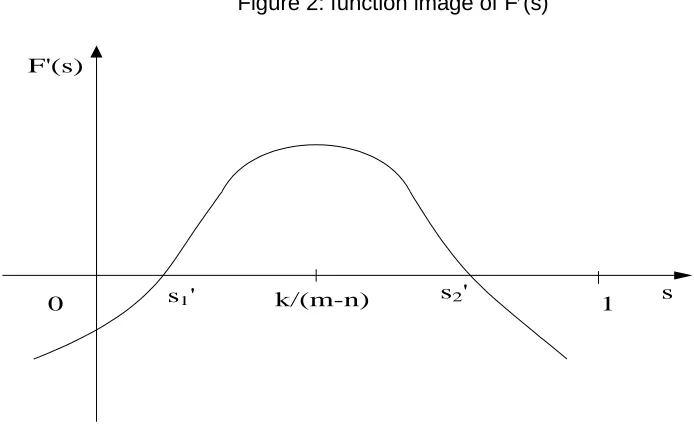
m−n, 1. But F(s)=0 has two different solution. So we can indicate F(s) image as figure 2, and F (s) image as figure 3。
If 1 2
0
1
k
s
m n
k
s
m n
get 2 2 2 2(m n)
(m n)k
k
2
2
2
(m n)
(m n)k
k
m n
k
n
m k
,get n+k-m 0,Licensed under Creative Common Page 126 Figure 2: function image of F(s)
Figure 3: function image of evolution differential equation F (s)
1 F(s)
0 s1' k/(m-n) s2' s
From function image of F(s), we can know F(0)< 0,F( k
m−n) > 0,F(1)=n+k-m<0,so s1=0 is a stable equilibrium;s2=
k
m−n is unstable equilibrium;when n+k-m>0,s3=1is unstable equilibrium,when n+k-m<0,s3=1 is a stable equilibrium. We have verified n+k-m<0,so
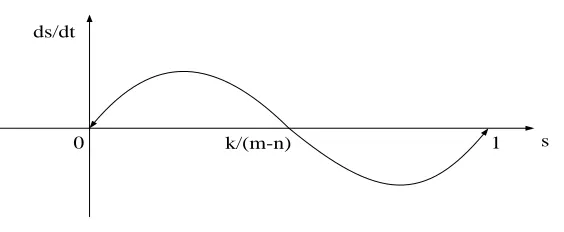
s3=1is also a stable equilibrium. The phase diagram of dynamic equations as shown in the
figure 4.
s F'(s)
Licensed under Creative Common Page 127 Figure 4: The phase diagram of dynamic equations
1 ds/dt
0 k/(m-n) s
Reciprocal word-of-mouth referral subjects account for the proportion of the overall number is S
.When s> k
m−n, by F (s) - figure 4 ,we can know that the expected revenue of reciprocal referrals subjects will exceed the average. By the phase diagram figure 5 of dynamic equations, we can
know that the results of the evolution will be into s3=1 stable state. At this time, all
word-of-mouth referral subjects are entirely reciprocal subjects, the efficiency of customer referrals is
improved fundamentally; When s< k
m−n , by F (s) - figure 3, we can know that the expected revenue of reciprocal referrals subjects will be less than the average. By the phase diagram
figure 4 of dynamic equations, we can know that the results of the evolution will be into s1=0
stable state. At this time, all word-of-mouth referral subjects return to rational state and the
traditional economic theory has absolute advantage. Then reciprocal word-of-mouth referrals
completely fail.
Based on the above analysis, under on-net and off-net different pricing, the evolution
mechanism of customer referrals game model shows that customer referrals will not only be into
steady state with the maximum efficiency, but also with the minimum efficiency under the mutual
environment. Therefore, the enterprise should adjust the various benefit payments in the
process of customer referrals (e.g.: m, n, k) to make S( k
m−n, 1) . Then the enterprise can realize the maximum efficiency of customer word-of-mouth referrals. When
s=s2'=
2m−n+√4m−n+k2−12m−nk
6m−n ,the efficiency of customer referrals will reach the maximum.
CONCLUSION AND OUTLOOK
Direct reward incentive mechanism can’t effectively simulate customer referrals under the
complete contract. It has failed to effectively solve the contradiction about their attitude when
customer recommends the product or service. The reason is that some people think the
Licensed under Creative Common Page 128 sharing the product or service from the heart. Under on-net and off-net different pricing, customers with reciprocal preference motivation can weaken “economic person hypothesis” to a large extent. It is customer’s ambivalence of self-interest behavior that is also weaken. It can
improve the efficiency of customer referrals.
According to the basic ideas of evolutionary game, on-net and off-net different pricing
can realize the positive evolution of customer referrals under the mutual environment.
Reciprocal customers in the overall referral subjects will be gradually into dominant advantage
eventually evolve into stable equilibrium state and realize the maximum efficiency of customer
referrals. In mutual evolution process, if reciprocal word-of-mouth referral subject account for
the proportion of the overall number is less than a certain threshold, customers return to rational
state and evolve into stable equilibrium state which is entirely contrary to reciprocal subjects. At
the moment, the traditional economic theory has absolute advantage and reciprocal
word-of-mouth referrals completely fail. Therefore, in order to guarantee reciprocal word-of-word-of-mouth
referral subjects finally occupy the dominance equilibrium state of positive evolution, the
enterprise needs to adjust the various benefit payments (e.g.: m, n, k) in the evolution of the
initial state to make S( k
m−n, 1) . Only in this way can the enterprise realize the maximum efficiency of customer word-of-mouth referrals.
However, the paper also has some limitation. Firstly, researches about customer
referrals behavior under on-net and off-net different pricing are mainly experiential products
(e.g.: telecommunication service or fitness club membership) and if applicable in other
industries needs to study further. Secondly, if the second price difference (the nonlinear pricing)
can more effectively induce customer referrals, the paper is not involved. In the future we can
do empirical comparative study about customer referrals from the nonlinear pricing and on-net
and off-net different pricing and further explore the impact of pricing model on the other
industries.
REFERENCES
Biyalogorsky, Eyal, Eitan Gerstner and Barak libai. Customer Referral Management: Optimal Reward Program. Marketing Science, 2001, 20(4):82-95.
Christian Barrot, Jan U. Becker and Jannik Meyners. Impact of service pricing on referral behavior. European Journal of Marketing, 2013, 47(7):1052-1066.
Chervonnaya. Customer Role and Skill Trajectories in Services. International Journal of Service Industry Management, 2003, 14:347-363.
Gabrielsen T S, Vagstad S. Why is on-net traffic cheaper than off-net traffic?. European Economic Review, 2008, 52(1):99-115.
Licensed under Creative Common Page 129 Kornish, L.J. and Li,Q. Optimal referral bonuses with asymmetric information: firm-offered and interpersonal incentives. Marketing Science, 2010, 29(1):108-121.
Kozinets, R.V., De Valck, K.,Wojnicki, A.C., & Wilner,S.J. Networked narratives: Understanding word-of-mouth marketing in online communities. Journal of Marketing, 2010, 74:71-89.
Kumar, V., Petersen, J.A. and Leone, R.P. Driving profitability by encouraging customer referrals: who, when, and how. Journal of Marketing, 2010,74(5):1-17.
Lobler H. and Welk M. Optimal Prices and Rewards When Customers Generate Autonomous Referrals and When Free Riding Occurs. Working Paper, 2004.
Li Hui-fan, Fan Xiu-cheng. The influencing mechanism of referral reward program on referral behavior: from the perspective of conflicts between social norm and market norm. Advances in Psychological Science, 2015, 23(1):11-21.
Laffont,J.J., Rey,P. and Tirole,J. Network competition: price discrimination. Rand Journal of Economics, 1998, 29(1):38-56.
Lin Zhao-wen, Zhang Tong-jian, Pu Yong-jian. The study on the tacit knowledge transition of person-to-person based on reciprocity motivation. Science Research Management, 2009, 29(4):28-33.
Liu Liang-can, Zhang Tong-jian. The evolution game analysis on organization tactic knowledge transferring-based on the reciprocal enterprise environments. Technoeconomics & Management Research, 2011(2):38-41.
Pu Yong-jian. A principal-agent model based on the behavioral economics theory: the material utility and motivation fair alternative. China Economic, 2007, 7(1):96-110.
Ryu,G. and Feick,L. A penny for your thoughts: referral reward programs and referral likelihood. Journal of Marketing, 2007, 71(1):84-94.
Schmitt, P., Skiera, B. and Van Den Bulte, C. Referral programs and customer value. Journal of Marketing, 2011, 75(1):46-59.
Tan Xiao-quan. Analysis of on-Net-and-off-Net different pricing based on Hotelling model. Industrial Engineering, 2010, 13(1):31-35.
Van Den Bulte,C. and Lilien, G.L. Medical innovation revisited: social contagion versus marketing effort. American Journal of Sociology, 2001,106(5):1409-1435.
Wirtz, J., Orsingher, C., Chew, P. and Tambyah, S.K..The role of metaperception on the effectiveness of referral reward. Journal of Service Research, 2013,16(1):82-98.
Williams,M. and Buttle, F. The eight pillars of WOM management: lessons from a multiple case study. Australasian Marketing Journal, 2011, 19(2):85-92.