S T U D Y P R O T O C O L
Open Access
Improving GHB withdrawal with baclofen:
study protocol for a feasibility study for a
randomised controlled trial
Anne Lingford-Hughes
1,2*, Yash Patel
1, Owen Bowden-Jones
1, Mike J. Crawford
1,2, Paul I. Dargan
3,4,
Fabiana Gordon
5, Steve Parrott
6, Tim Weaver
7and David M. Wood
3,4Abstract
Background:GHB (gamma-hydroxybutyrate) and its pro-drugs GBL (gamma-butyrolactone) and 1,4-butanediol
(1,4-BD) are central nervous system depressants whose street names include‘G’and‘liquid ecstasy’. They are used recreationally predominately for their stimulant and pro-sexual effects or for sedation to help with sleep and/or to‘come down’after using stimulant recreational drugs. Although overall population prevalence is low (0.1 %), in some groups such as men who have sex with men, GHB/GBL use may reach 20 %. GHB/GBL dependence may be associated with severe withdrawal with individuals presenting either acutely to emergency departments or to addiction services for support. Benzodiazepines are currently prescribed for GHB/GBL detoxification but do not prevent all complications, such as behavioural disinhibition, that may require hospitalisation or admission to a high dependency/intensive care unit. The GABABreceptor mediates most effects of GHB/GBL and the GABABagonist, baclofen, has shown promise as an adjunct
to benzodiazepines in reducing withdrawal severity when prescribed both during withdrawal and as a 2-day‘preload’ prior to detoxification. The key aim of this feasibility study is provide information about recruitment and characteristics of the proposed outcome measure (symptom severity, complications including delirium and treatment escalation) to inform an application for a definitive randomised placebo controlled trial to determine the role of baclofen in the management of GHB/GBL withdrawal and whether starting baclofen 2 days earlier improves outcomes further.
Methods/design:This is a prospective, randomised, double-blind, placebo-controlled feasibility study that will recruit participants (aged over 18 years) who are GHB/GBL-dependent and wish to undergo planned GHB/GBL detoxification or are at risk of acute withdrawal and are inpatients requiring unplanned withdrawal. We aim to recruit 88 participants: 28 unplanned inpatients and 60 planned outpatients.
During detoxification we will compare baclofen 10 mg three times a day with placebo as an adjunct to the usual benzodiazepine regimen. In the planned outpatient arm, we will also compare a 2-day preload of baclofen 10 mg three times a day with placebo. Ratings of GHB/GBL withdrawal, sleep, depression, anxiety as well as GHB/GBL use will be collected. The main data analyses will be descriptive about recruitment and characterising the impact of adding
baclofen to the usual benzodiazepine regimen on measures and outcomes of GHB/GBL withdrawal to provide estimates of variability and effect size. A qualitative approach will evaluate research participant and clinician acceptability and data collected to inform cost-effectiveness.
(Continued on next page)
* Correspondence:
[email protected];[email protected] 1Central North West London NHS Foundation Trust’s Club Drug Clinic, 69 Warwick Rd, London SW5 9HB, UK
2Centre for Psychiatry, Division of Brain Sciences, Imperial College London,
Burlington Danes Building, Hammersmith Hospital site, Du Cane Rd, London W12 0NN, UK
Full list of author information is available at the end of the article
(Continued from previous page)
Discussion:This feasibility study will inform a randomised controlled trial to establish whether adding baclofen to a benzodiazepine regimen reduces the severity and complications of GHB/GBL withdrawal.
Trial registration:ISRCTN59911189. Registered 14 October 2015. Protocol: v3.1, 1 February 2016
Keywords:GHB, Gamma-hydroxybutyrate, GBL, Gamma-butyrolactone, GHB/GBL withdrawal, Baclofen, Benzodiazepine,
GABAB, GHB/GBL dependence
Background
GHB/GBL use and dependence
GHB (gamma-hydroxybutyrate) and its related analogues GBL (gamma-butyrolactone) and 1,4-butanediol (1,4-BD) are central nervous system depressants and their street names include‘G’and‘liquid ecstasy’[1, 2]. GBL and 1,4-BD are converted to GHB after ingestion and, therefore, all three drugs have similar pharmacological actions and profiles [1, 2]. There is limited use of 1,4-BD in the UK and, therefore, hereafter we will use the term GHB/GBL to refer to these compounds. They are used recreationally predominately for their stimulant and pro-sexual effects, although some individuals use them for their sedative effects and/or to help ‘come down’after using stimulant recreational drugs [3–5]. Although overall population prevalence of use is low, the Crime Survey for England and Wales reported that use significantly rose from 0.0 % in 2010/11 to 0.1 % in 2011/12; subsequent surveys did not collect GHB/GBL data [6]. However, the use of these drugs is more common in a number of subpopulation groups. In particular, in populations such as clubbers and men who have sex with men (MSM), lifetime prevalence of GHB/GBL use ranges from 3.9 to 14.3 %, with last-month prevalence of use of up to 4.6 % [7]. Almost a quarter of those surveyed in ‘gay-friendly’ South London dance clubs in July 2011 reported GHB/GBL use that night, second to mephedrone at 41 % [8]. Similarly, attendees at two London sexual health clinics (December 2013 to March 2104) reported lifetime prevalence of use of GHB at 19 % and GBL at 13 % [9].
Reports from the UK’s Advisory Council on Misuse of Drugs [10] and European Monitoring Centre for Drugs and Drug Addiction (EMCDDA) [7] have highlighted the potential for both significant acute toxicity and also dependence associated with GHB/GBL. The latest data from Public Health England reports that the numbers of people presenting to treatment services with problems with GHB/GBL continue to rise from 18 (2 % of new presentations involving ‘club drugs’ (methamphetamine, mephedrone, ketamine, ecstasy, and GHB/GBL)) of those seeking treatment in 2005–2006 to 249 (5 %) in 2013–2014 [11] and the number of deaths implicating GHB are also rising from none in 1993 to 12–20/year in 2008–2012 [12]. Our clinical experience is consistent with this. Presentations with acute GHB/GBL toxicity to
GHB/GBL withdrawal and its treatment
GHB/GBL withdrawal has many similar features to alcohol withdrawal, including tremor, sweating, anxiety, agitation and confusion; however, it is generally more severe, has a more rapid onset and more prominent neuropsychiatric features such as delirium and psychosis [2, 15, 18]. In common with alcohol withdrawal, benzo-diazepines have been the pharmacotherapeutic mainstay for GHB/GBL withdrawal [18]. However, our clinical experience suggests that using benzodiazepines alone may be insufficient, with up to 50 % of individuals presenting to our ED and initially 4 % of those in our outpatient clinic requiring acute medical care [21, 22]. This latter group had either developed significant delirium and/or worsening of their initial acute delirium on presentation that required escalation of treatment, in-cluding admission to intensive care and use of additional sedatives (e.g. barbiturates or propofol) with the associ-ated intubation and mechanical ventilation for airway support as described [15]. Acute delirium, agitation and/ or psychosis results in further risks to the individual, as well as to the staff treating them due to the severity of their agitation and violent behaviour. There has been one death reported as a ‘complication of GHB/GBL withdrawal’. The individual in this case was treated with benzodiazepines for 12 days, developed pneumonia and suffered a cardiac arrest and we feel that the significance of the GHB dependency/withdrawal in the death is un-clear and it is likely that the death is not directly related to dependence/withdrawal [23]. Despite the severity of GHB/GBL withdrawal and concerns about how to best manage unplanned and planned detoxification, at this time there is no systematic evidence base on which to base a nationally or internationally agreed treatment protocol. One review produced an algorithm based on the amount of use and the presence of delirium [24]. For those with severe dependence (more than three doses of GHB/GBL per 24 h or over 30 g GHB or/over 15 g GBL) and‘medical complications’, admission for de-toxification and supportive medical care with high-dose diazepam (150–200 mg/24 h) was suggested. Pentobar-bital (barbiturate) in the intensive care unit (ICU) was suggested for treating those presenting with delirium. However, it was not clear how long to use pentobarbital for or what to do in those who do not respond to this treatment escalation. For those without delirium, diaze-pam reducing from 80 to 150 mg per day over 7 days whilst an inpatient was proposed. For those using less GHB/GBL, outpatient management with diazepam redu-cing from 20 to 40 mg per day over 7 days was sug-gested. Given the complexity, rapidity of onset of symptoms and complications of withdrawal, such as acute severe delirium, it is important that daily out-patient supervision of GHB/GBL withdrawal occurs in a
setting in which admission to an acute hospital is pos-sible should complications arise [25].
Various other pharmacological approaches have been investigated. One trial compared lorazepam and pen-tobarbital in inpatients for GHB/GBL withdrawal; however, this was not completed due to the inability to recruit sufficient GHB-dependent individuals [26]. Whilst pentobarbital is safe to use in hospital, due to the potential risk of coma and lethal toxicity it is not appropriate for use in community/outpatient detoxifi-cation. A Dutch pilot uncontrolled study reported that a reducing regimen of GHB/GBL successfully treated withdrawal and prevented complications, such as delirium, in 23 GHB/GBL-dependent inpatients [27]. GHB in the pharmaceutical preparation sodium oxy-bate is licensed in the UK for the treatment of nar-colepsy associated with cataplexy in specialist sleep services. Current UK prescribing, storage and adminis-tration controls (due to the legal status of GHB under the UK Misuse of Drugs Act, 1971) are likely to be practical considerations that limit its usefulness in managing GHB/GBL withdrawal (due to delays in treatment administration). Antipsychotic agents may lower the seizure threshold increasing the risk of GHB withdrawal-related seizures. However, they may also interact with GHB’s effects on the dopaminergic system increasing the risk of neuroleptic malignant syndrome [17, 28].
In summary, a reducing regimen of benzodiazepines alone for GHB/GBL withdrawal is currently considered
‘standard’ treatment and as such is the current ‘best practice’; although in a significant proportion of indi-viduals benzodiazepines alone may be insufficient. The limited research almost always suggests benzodi-azepines as the core treatment, with a range of other options having been suggested as helpful of which baclofen has strong pharmacological validity (see next section).
GHB/GBL withdrawal and the GABABsystem
In addition to its activity at endogenous GHB receptors GHB acts at GABABreceptors, which play a key role in withdrawal since GABAB antagonists precipitate with-drawal in GHB-dependent nonhuman primates [1, 29] and can block GHB-induced respiratory depression [30]. Benzodiazepines work through GABAA receptors; how-ever, GHB has limited activity at these receptors, likely explaining their apparently incomplete clinical
effective-ness in acute GHB withdrawal. The GABAB agonist
for the management of muscle spasticity in multiple sclerosis and other conditions.
An uncontrolled case series in 19
GHB/GBL-dependent patients, all of whom except for 2 underwent outpatient treatment, reported that baclofen (10 mg three times a day) in addition to high-dose diazepam during the initial 4–5 days of GHB/GBL detoxification, resulted in no transfers to ICU and several patients commented that baclofen was helpful [18]. Furthermore, the experience of clinical toxicologists and addiction specialists in the UK, including those involved in this study, has been that baclofen is helpful in reducing the complications from GHB/GBL withdrawal. Consequently, the recent update of the British Association for Psycho-pharmacology’s addiction guidelines [25] suggested using baclofen (10 mg three times a day) as an adjunct to benzo-diazepines for GHB/GBL withdrawal.
Furthermore, our clinical experience of GHB/GBL withdrawal in outpatient settings has been that patients who slowly reduce their GHB/GBL use describe signifi-cant anxiety and cravings during the few days before commencing medically assisted detoxification. For some, this acted as a deterrent to attending for treatment and a trigger for using higher doses of GHB/GBL. Conse-quently, we have initially used baclofen 2 days prior to stopping GHB/GBL in a small number of patients. There was very positive feedback from patients regarding the benefit, particularly in terms of reduced cravings and helping to stabilise pre-detoxification GHB use. The use of baclofen in our outpatient clinical service prior to ini-tiating medically assisted detoxification has now become more widespread. The 2 days of pre-detoxification
‘preloading’ of baclofen at a standard dose of 10 mg three times a day has not resulted in any clinical incidents in relation to baclofen. This preloading with baclofen has previously not been formally studied to determine the usefulness of baclofen itself, neither has whether some of the reported benefits relate more to
engagement with drug treatment services
pre-detoxification than to baclofen itself.
Baclofen has been licensed in the UK for many years for the treatment of spasticity (maximum, 100 mg per day) and can be safely prescribed to a wide range of pa-tients (see Summary of Product Characteristics (SPC), https://www.medicines.org.uk/emc/medicine/23850). Our clinical experience is that it is associated with few side effects. Whilst a withdrawal state is recognised for baclofen, this is unlikely to occur with its use in acute GHB withdrawal due to the short duration (7 to 10 days) of baclofen use in this indication. We suggest that the risk of complications from baclofen withdrawal is con-siderably less than that of inadequately managed GHB/ GBL withdrawal [15, 18]. Nevertheless, whilst the use of baclofen holds promise, there are potential adverse
effects on cardiovascular, neurological and respiratory systems so controlled data is urgently required to deter-mine its efficacy and safety in GHB/GBL withdrawal. Optimising outpatient treatment to reduce the risk of complications and hospital admission is important since many individuals decline admission [17, 25]. Despite this complexity and its impact on, and cost to, the individual and the NHS, there is limited knowledge about how to best treat people in planned or unplanned GHB/GBL withdrawal.
Primary and secondary objectives
The primary objective of this study is to investigate the feasibility of recruiting GHB/GBL-dependent patients and to characterise the impact of adding baclofen to a standard benzodiazepine regimen for the management of GHB/GBL withdrawal in both outpatient (community) and inpatient general hospital settings.
There are several other secondary objectives. These are to examine:
Withdrawal symptoms and complications, such as delirium and the requirement for treatment escalation, during detoxification in two populations: those presenting to an ED requiring immediate acute withdrawal management (unplanned) and those presenting to a specialist outpatient Club Drug Clinic requiring GHB/GBL detoxification (planned)
Whether, as part of a planned detoxification, starting baclofen 2 days prior to stopping GHB/GBL confers additional benefits in our proposed primary outcome measures (symptom severity, complications such as delirium and requirement for treatment escalation)
Recruitment rate monitoring and manage any difficulties
The impact of GHB/GBL withdrawal on secondary outcome measures (anxiety, depression, sleep, quality of life)
The impact of study participation on GHB/GBL use up to 1 month post randomisation and other alcohol/drug use
The views of the research participants and staff about the acceptability of the study design
Preliminary information gathered regarding costs of GHB/GBL withdrawal and its management to develop a full economic analysis in a definitive trial
Methods/design
strategies and characteristics of the proposed primary outcome measures (symptom severity, complications, and requirement for treatment escalation) will be assessed. Ethical approval has been obtained from National Research Ethics Service Committee London – Dulwich and the EUDRACT number is 2013-005319-28.
Research settings
The study will recruit from two services where individuals present for treatment of GHB/GBL withdrawal. The CNWL Club Drug Clinic, based in Central London, UK is an outpatient clinic where individuals are referred or self-present for treatment for GHB/GBL dependence and may undergo planned detoxification as part of their treatment package, and secondly, to a specialist Clinical Toxicology Service at Guy’s and St. Thomas’NHS Foundation Trust, London, UK for those who present with unplanned with-drawal requiring immediate management. For planned detoxification group recruitment, we have produced a trial poster and short information sheet for use at our linked clinical services to ensure an adequate appropriate recruit-ment rate. We will display this poster at such clinical services and staff will be encouraged to provide a copy of the short information sheet for planned withdrawal.
Participants
Inclusion criteria
Any individual who is over 18 years old, is either in ac-tive GHB/GBL withdrawal or has underlying GHB/GBL dependence and wishes to undergo GHB/GBL detoxifi-cation or is thought to have underlying GHB/GBL dependence and is at risk of acute withdrawal and, for the outpatient arm only, who is registered with a drug treatment service, will be eligible for the study.
Exclusion criteria
An individual will not be eligible for inclusion in this study if they are unable to provide written informed consent and any of the following criteria apply: the clinician decides that medication is not required for the management of GHB/GBL withdrawal; if medication is indicated but the patient lacks capacity to consent, is unable to take oral medication or is unable to take baclofen according to SPC due to known hypersensitivity to baclofen or any of the excipients, hereditary problems of galactose intolerance, the Lapp lactase deficiency or glucose-galactose malabsorption, active peptic ulceration or porphyria. In addition, for those with epilepsy that is not well-controlled, either with or without medication, or those with end-stage renal failure (Chronic Kidney Disease (CKD) stage 5, GFR below 15 mL/min) (which have special warnings and precautions for use, according to the SPC) will not be entered since the risk versus benefit ratio for prescribing is not in favour of
prescribing baclofen. In addition, participants who are unable to follow the study protocol due to serious mental health disorder, e.g. enduring psychotic illness or suicidal intent will not be eligible. Further, any partici-pant who has taken any investigational drug within 30 days prior to drug administration or any woman refusing a pregnancy test will not be eligible.
Randomisation
An assessment of eligibility will be made by a phys-ician following discussion with the potential partici-pant and review of the accessible medical records. For some participants wishing to participate in the study but where there is limited or no access to medical records, the individual will be included in the trial unless one or more of the eligibility criteria are known not to be met. Informed consent will be ob-tained by a member of the study team.
To be able to respond to the urgent needs of people who are at high risk of withdrawing from GHB/GBL in a timely manner, the study medication will be pre-packed and pre-randomised and stored at both study sites. Randomisation codes in blocks of 4 (for the planned withdrawal group) and blocks of 15 (for the unplanned withdrawal group) will be generated by the trial statisti-cian. Those eligible for inclusion will be randomised to baclofen or placebo by taking the next lowest consecu-tively numbered pack from storage cupboards in the respective treatment centre.
Assessment and outcome measures
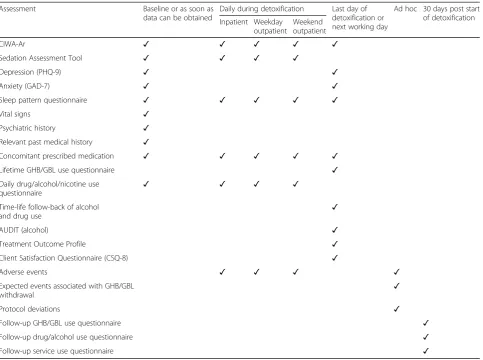
Data will be collected to inform the primary and second-ary outcome measures in the definitive trial (see Table 1). The proposed primary outcome measures include symp-tom severity, complications and requirement for treat-ment escalation, and the proposed secondary outcomes include change in anxiety, depression, sleep and quality of life as well as relapse to GHB/GBL use or change in other illicit drug or alcohol use 30 days after the start of detoxification.
On the first day of GHB/GBL detoxification, ratings will be obtained from each participant of their symp-toms of GHB/GBL withdrawal using a scale widely used for alcohol withdrawal – the Clinical Institute Withdrawal Assessment for Alcohol (CIWA-Ar) which is currently used clinically by teams to monitor GHB/
GBL withdrawal [32–35]. The CIWA-Ar may not
adequately capture all neuropsychiatric symptoms/ signs [32, 33] and the Sedation Assessment Tool (SAT) will assess behavioural disturbance [36]. Depressive (Patient Health Questionnaire-9 (PHQ-9); [37]) and anxiety (Generalized Anxiety Disorder-7 (GAD-7); [38]) symptoms will be assessed using scales that are already in routine clinical use. We will also re-cord sleep pattern using a questionnaire [39]. Any
medication taken by the time of the ratings will be recorded. Blood pressure, respiratory rate, oxygen saturation and pulse will also be recorded when the CIWA-Ar is completed. Since this is a pragmatic trial, we aim to minimise any extra tests or investigations and research participants will receive standard medical care as usual. If, as part of this standard medical care, blood and/or urine will be collected for toxicological screening for recreational drugs/novel psychoactive substances, the results will be recorded but not sought solely for the purposes of this study.
During detoxification, daily assessments will record the withdrawal assessment scale (CIWA-Ar; [29]), be-havioural disturbance (SAT; [36]), sleep pattern, any use of other drugs/novel psychoactive substances/ alcohol and nicotine (including substitution), as well as when they took any medication. On the last day of taking detoxification medication (or the next working day for outpatients where this falls on a weekend/ public holiday), withdrawal, depressive and anxiety symptoms (PHQ-9: [37]; GAD-7: [38]) and sleep pattern will be recorded for all participants. Research participant satisfaction will be measured with the Client Satisfaction Questionnaire-8 (CSQ-8; [40, 41]). Any information not already obtained or previously available will also be completed and will include the following: using a semistructured questionnaire: years of GHB/GBL use, the amount of GHB/GBL used in the week prior to detoxification and the amount in a typical day/week, pattern of use, whether they are self-reported ‘dependent’ on any of these medication(s) that have been used to help self-treat or prevent previ-ous withdrawal. Previprevi-ous psychiatric and medical his-tory, other drug or alcohol use including nicotine and determination of any dependence will be similarly established as well as using time-life follow-back, the alcohol screening questionnaire (Alcohol Use Disor-ders Identification Test (AUDIT); [42]) and appropri-ate parts of the mandatory Treatment Outcomes Profile (TOP; [43]) used in substance misuse services will be completed.
Regarding medication, the total amount of benzodi-azepine prescribed, its dosing regimen and quantity taken will be recorded. Use of any other medication during the detoxification will also be recorded.
Any complications arising during preload or detoxifi-cation will be recorded. These will be classified as adverse events if they are not one of the following prede-termined events which are known to occur in acute GHB/GBL withdrawal or detoxification: agitation or aggression, hallucinations (visual, auditory and/or tact-ile), tachycardia, seizures, ataxia, sedation, tremor and/or sweating. All adverse events occurring from the time a participant signs the Consent Form until completion
A
B
Fig. 1aCNWL Club Drug Clinic–Planned (outpatient) withdrawal,
[image:6.595.56.291.86.339.2]of the last study-related procedure will be recorded in the Case Report Form. Any serious adverse event which occurs in a participant will be reported imme-diately to the chief investigator (CI) and sponsor and, if stated orally, will be followed by a detailed written report.
On day 30 after the start of detoxification (benzodi-azepine detoxification, not preload), the researcher will contact the research participant to obtain information about any subsequent use of GHB/GBL, other recre-ational drugs/novel psychoactive substances/alcohol as
well as any medication (prescribed or otherwise
obtained) taken and psychosocial treatment/support received for their GHB/GBL dependence. In addition, any issues or events that could be related to their detoxi-fication will be recorded.
Patients will be asked to return any remaining study medication to the clinic so that a pill count can be performed to assess compliance.
Study medication discontinuation and withdrawal from the study
[image:7.595.58.542.97.457.2]In accordance with the current revision of the Declaration of Helsinki (amended October 2000, with additional foot-notes added in 2002 and 2004), a participant has the right to stop trial treatment and to withdraw from the trial at any time and for any reason, without prejudice to his or her future medical care by the physician or at the institu-tion, and is not obliged to give his or her reasons for doing so. The principal investigator’s clinical judgement will de-termine whether or not an adverse event is of sufficient severity to require discontinuation of the study treatment. A participant who discontinues the study medication be-fore the end of their detoxification will not be withdrawn from the study. Provided they have not withdrawn their consent, they would continue to be followed up to enable an intention-to-treat analysis. In addition, as this is a feasibility study, they may be approached for the qualitative study.
Table 1Assessment schedule of quantitative measures
Assessment Baseline or as soon as
data can be obtained
Daily during detoxification Last day of detoxification or next working day
Ad hoc 30 days post start of detoxification Inpatient Weekday
outpatient
Weekend outpatient
CIWA-Ar ✓ ✓ ✓ ✓ ✓
Sedation Assessment Tool ✓ ✓ ✓ ✓
Depression (PHQ-9) ✓ ✓
Anxiety (GAD-7) ✓ ✓
Sleep pattern questionnaire ✓ ✓ ✓ ✓ ✓
Vital signs ✓
Psychiatric history ✓
Relevant past medical history ✓
Concomitant prescribed medication ✓ ✓ ✓ ✓ ✓
Lifetime GHB/GBL use questionnaire ✓
Daily drug/alcohol/nicotine use
questionnaire ✓ ✓ ✓ ✓
Time-life follow-back of alcohol and drug use
✓
AUDIT (alcohol) ✓
Treatment Outcome Profile ✓
Client Satisfaction Questionnaire (CSQ-8) ✓
Adverse events ✓ ✓ ✓ ✓
Expected events associated with GHB/GBL
withdrawal ✓
Protocol deviations ✓
Follow-up GHB/GBL use questionnaire ✓
Follow-up drug/alcohol use questionnaire ✓
Follow-up service use questionnaire ✓
AUDITAlcohol Use Disorders Identification Test,CIWA-ArClinical Institute Withdrawal Assessment for Alcohol,GAD-7Generalised Anxiety Disorder-7,
Study unblinding
Masking of treatment allocation will be maintained dur-ing an individual’s participation in the trial unless any of the following occur: a serious adverse event arises that clinically requires disclosure or another clinical reason to need to know the allocation such as to start the par-ticipant on medication which has a risk of interaction. The 24-h emergency unblinding service will allow a med-ical request for unblinding in the event of a medmed-ical emer-gency. Procedures will be put in place to verify the identity of the participant and caller, and the decision on whether to reveal the study medication allocation will be based on a set of criteria for judging clinical need. All re-quests for unblinding will be recorded.
Sample size
The aim is to recruit 88 research participants who are undergoing GHB/GBL detoxification: 60 planned outpa-tients and 28 unplanned inpaoutpa-tients.
Qualitative process evaluation: research participant and clinician acceptability
We will undertake qualitative, semistructured, one-to-one interviews with 12 research participants, 6 from each site. Informed consent will be separately sought for this aspect of the study. Participants will be sampled purposively to represent key case-mix variables and treatment allocation. These interviews will investigate (1) participants’ experi-ence and acceptance of the study procedures (notably recruitment, randomisation and outcome assessment procedures) and (2) their treatment experience. The inter-views will be conducted using a topic guide. This will be drafted on the basis of the study aims, relevant scientific literature and clinical experience, but there will be scope for iterative development of the guide as data collection and analysis progress. Participants who have undergone a previous detoxification will be asked to reflect on how the trial detoxification compared with previous ones.
In addition, two focus groups involving the clinical teams from each site will also be conducted. These will explore clinician experience of the trial and the accept-ability of trial procedures. Key senior members of staff will also be offered a one-to-one semistructured interview. All interviews and focus groups will be audio-recorded, transcribed and analysed using a thematic framework approach and managed using NVivo (Scolari/Sage) com-puter software. Initial coding frameworks for both partici-pant and staff datasets will be based on the study aims of how feasible and acceptable it is to undertake a definitive trial, but subthemes will be further developed through analytic induction and grounded in the data. This will be revised iteratively as data collection and analysis progress.
Cost-effectiveness
Data will be collected to inform the undertaking of a full economic evaluation in the definitive randomised con-trolled trial (RCT) by piloting the data collection methods that would be used in such a full trial. Piloting data collection instruments will show the feasibility of recording service use information from the population and identify the services and other costs to participants that would need to be included in a full economic evalu-ation of a phase III trial.
Safety monitoring plan
An Independent Data Monitoring and Ethics Committee (IDMEC) will be established to provide overall supervi-sion of the trial and ensure that it is being conducted in accordance with the principles of Good Clinical Practice (GCP) and the relevant regulations. It will report to the Trial Steering Committee which provides overall super-vision for the GHB trial on behalf of the trial sponsor and the trial funder, ensures that the trial is appropri-ately conducted, and provides advice, through its chair, to the Trial Management Group.
The end of the trial is defined as completion of follow-up of, or three attempts to contact, the last participant randomised to the study medication. The trial may terminate before all (n= 88) participants have been recruited if we have obtained sufficient information about recruitment, engagement and/or evaluation of outcome measures.
The NHS Indemnity Scheme applies and provides un-limited cover for NHS staff, medical academic staff with honorary contracts and those conducting research, for negligent harm. Non-negligent harm (i.e. harm that has been caused through no fault of those conducting re-search) is not covered by this scheme; however, ex gratia payments may be considered by the trust in limited circumstances.
Trial monitoring
Each site in the trial will receive two on-site monitor visits, firstly when five participants have been rando-mised to the trial and a second site visit 6–9 months from the time of site activation. Additional monitor visits will be conducted if required. These will be conducted by the sponsor, CI and trial manager.
Data
and Medicine and Healthcare products Regulatory Agency (MHRA) review (as applicable) and provide dir-ect access to source data and documents as appropriate.
Data analysis
The primary focus of this study is to assess the feasibility of undertaking a definitive trial. In particular, we will char-acterise the optimal recruitment rate and strategies and characteristics of the proposed primary outcome measures (symptom severity, complications, and requirement for treatment escalation). The main analyses will be descrip-tive and provide estimates of variability and effect size with 95 % confidence intervals. This will include the rate of recruitment, the proportion of people approached who consent to randomisation, the proportion who complete detoxification and the proportion who will complete the follow-up assessment. We will also describe the distribu-tion of scores on the primary outcomes and estimate the variance of the measure in this population. Data for our proposed secondary outcomes in the definitive trial will include change in anxiety, depression, sleep and quality of life as well as relapse to GHB/GBL use or change in other illicit drug or alcohol use 30 days after the start of detoxifi-cation. We will also identify appropriate criteria, e.g. benzodiazepine requirement or withdrawal score for mini-misation or stratification in the full RCT.
We will use ANCOVA adjusting for patients’ character-istics and relevant clinical data. Where there is follow-up, methods applied to longitudinal data will be appropriate since they are able to detect significant differences between arms but they can also detect changes of the outcome measure(s) over time. We will also conduct an interim analysis to characterise the number of adverse events in each arm as described above.
An interim analysis to characterise the number of ad-verse events in each arm will also be conducted. Treat-ment escalation (i.e. admission to ICU for those presenting to the ED (unplanned) and admission to the general hospital for those in the Club Drug Clinic (planned)) will be closely monitored. From our clinical experience of complications from GHB/GBL withdrawal, if five individuals in any one group require treatment escalation, the sponsor and IDMEC will be immediately informed and recruitment suspended until there has been a discussion and consideration of the protocol and trial continuing. Stopping rules will also be agreed which specify the point at which interim results will be judged to be sufficiently conclusive for it to be appropriate for the IDMEC to recommend that they consider early termination of the trial.
Trial dissemination
The outcome of the trial will be communicated to the clinical and academic communities through presentations
at conferences and meetings including those attended by users, and publications in peer-reviewed journals and general media if appropriate. These will be completed by members of the study team. These will be in line with NIHR publication procedures.
Discussion
Whilst GHB/GBL may not be widely used by the general population, there is greater use in certain subpopulations such as gay and bisexual males (GBM). Regular use of GHB and its related analogues can lead to the development of physical dependency and an associated withdrawal syndrome on stopping use [1, 2]. This typically is rapid in onset after last dose and may mimic other conditions (e.g. acute stimulant toxicity, acute alcohol withdrawal) making its diagnosis and management challenging for clinicians [2, 11, 14]. This is particularly of concern in areas where GHB and related analogue use is low, so there may be a lack of awareness of the potential for dependency and withdrawal. A proportion of individuals with GHB-related withdrawal may require more intensive sedation and sub-sequent admission to HDU/ICU to ensure not only their safety, but also that of the staff caring for them. This incurs significant costs to the individual through length of stay and potential for ICU-related complications, as well as to the NHS and wider society due to the required resource utilisation.
There is much anecdotal evidence that the current clin-ical practice of using benzodiazepines alone as initial treat-ment may be insufficient to adequately manage GHB/GBL withdrawal and prevent the requirement for treatment es-calation. Since GHB/GBL acts as a GABABreceptor agon-ist, using another GABAB agonist, baclofen, to attenuate withdrawal has pharmacological validity. Our clinical ex-perience, and that of others, is that the addition of baclo-fen (10 mg three times a day) to benzodiazepines does indeed reduce GHB/GBL withdrawal symptoms and its associated complications [11, 14]. Furthermore, preloading with baclofen for 2 days prior to detoxification appears to provide additional benefits. When designing this trial, we were not aware that this is undertaken routinely outside our specialist clinic and it is important to understand its role in improving and managing GHB/GBL withdrawal. A similar approach may be used by some clinicians for par-ticular patients to help them to prepare for their alcohol detoxification by reducing cravings and excessive con-sumption prior to starting their detoxification proper.
the local needs. They are, therefore, well-placed to con-duct this study due to their experience and the regular presentations of those with GHB/GBL withdrawal. There is local support and much user interest in this study.
In order to determine whether baclofen is a useful adjunct and to meet thresholds required by national guidelines, e.g. NICE, a trial is still required; without such a trial the use of baclofen will remain based on anecdotal evidence. We are not aware of any other trial using baclofen in GHB withdrawal nor has any other pharmacological approach been shown to be robustly effective or appropriate for community-based detoxifica-tion. Importantly this trial also seeks to establish whether the use of baclofen prior to starting detoxification, i.e. a preload improves symptom control and reduces complica-tions during GHB detoxification. This is a novel aspect of the study and addresses a critical question.
Trial status
The study has received favourable opinions from the MHRA and the REC. The aim is to start recruitment by Spring 2016.
Abbreviations
AUDIT:Alcohol Use Disorders Identification Test; CIWA-Ar: Clinical Institute Withdrawal Assessment for Alcohol; CNWL: Central North West London NHS Foundation Trust; ED: Emergency department; EMCDDA: European Monitoring Centre for Drugs and Drug Addiction; GBL: Gamma-butyrolactone; GCP: Good Clinical Practice; GHB: Gamma-hydroxybutyrate; GSTT: Guy’and St. Thomas’s NHS Foundation Trust, London; ICU: Intensive care unit; IDMEC: Independent Data Monitoring and Ethics Committee; RCT: Randomised controlled trial; SPC: Summary of Product Characteristics
Acknowledgements
Thank you to Gemma Loebenberg who has succeeded Yash Patel as project manager.
Funding
The‘Improving GHB withdrawal with baclofen’is funded by the National Institute for Health Research’s Research for Patient Funding programme: PB-PG-0212-27068.
Availability of data and materials Not applicable.
Authors’contributions
ALH is Professor of Addiction Biology at Imperial College London and a consultant psychiatrist at Central North West London NHS Foundation Trust (CNWL). YP is the project manager for the trial. OBJ is a consultant psychiatrist at CNWL and lead at its Club Drug Clinic and is an honorary senior lecturer at Imperial College London. MJC is Professor of Psychiatry at Imperial College London. FG is a senior statistical consultant at the Statistical Advisory Service, School of Public Health, Imperial College London and leads on statistical advice. SP is a reader in health economics at the Department of Health Sciences, The University of York and leads on economic evaluation. TW is Associate Professor of Mental Health Research at Middlesex University and leads on qualitative process. PID and DMW are consultant physicians and clinical toxicologists at Guy’s and St. Thomas NHS Foundation Trust (GSTT): PID is the Director for Clinical Toxicology at GSTT and Professor of Clinical Toxicology at the Faculty of Life Sciences and Medicine, King’s College, London; DMW is the service (clinical) lead for medicine at GSTT and an honorary senior lecturer at the Faculty of Life Sciences and Medicine, King’s College, London. All authors read and approved the final manuscript.
Authors’information Not applicable.
Competing interests
The authors declare that they have no competing interests.
Consent for publication Not applicable.
Ethics approval and consent to participate
Ethical approval has been obtained from National Research Ethics Service Committee London (14/LO/0233). Informed consent will be obtained by an investigator.
Sponsor
CNWL: contact: Dr. Lynis Lewis, Noclor, 1st Floor, Bloomsbury Building, St. Pancras Hospital, 4 St. Pancras Way, London, NW1 0PE; Tel: +44 20 3317 3763; Email: [email protected].
DMEC: chair: Dr. Louise Sell with Dr. Sally Bradberry, Dr. Jennifer Hellier and members of the study team. The DMEC is independent and will review the progress and accruing data of this trial and provide advice on the conduct of the trial to the Trial Steering Committee. The IDMEC will inform the chair of the Steering Committee if, in their view, the results are likely to convince a broad range of clinicians, including those supporting the trial and the general clinical community, that on balance one trial arm is clearly indicated or contraindicated for all participants or a particular category of participants, and that there was a reasonable expectation that this new evidence would materially influence patient management; or it becomes evident that no clear outcome would be obtained.
Trials Steering Committee: chair: Dr. Stephen Waring, Dr. Sarah Welch and members of the study team This committee will provide overall supervision for the GHB trial on behalf of the trial sponsor and the trial funder and to ensure that the trial is conducted according to the guidelines for Good Clinical Practice (GCP), the Research Governance Framework for Health and Social Care and all relevant regulations and local policies.
Trials Management Group: Anne Lingford-Hughes, Paul Dargan, David Wood, Fabiana Gordon, Owen Bowden-Jones, Steve Parrott and Tim Weaver; Yash Patel (project manager) and other staff as required/appropriate.
Author details
1Central North West London NHS Foundation Trust’s Club Drug Clinic, 69 Warwick Rd, London SW5 9HB, UK.2Centre for Psychiatry, Division of Brain Sciences, Imperial College London, Burlington Danes Building, Hammersmith Hospital site, Du Cane Rd, London W12 0NN, UK.3Guy’s and St. Thomas NHS Foundation Trust, London, UK.4Faculty of Life Sciences and Medicine, King’s College, London, UK.5Statistical Advisory Service, School Of Public Health, Imperial College London, London, UK.6Department of Health Sciences, The University of York, York, UK.7Department of Mental Health, Social Work and Integrative Medicine, Middlesex University, London, UK.
Received: 5 April 2016 Accepted: 27 July 2016
References
1. Wong CG, Gibson KM, Snead 3rd OC. From the street to the brain: neurobiology of the recreational drug gamma-hydroxybutyric acid. Trends Pharmacol Sci. 2004;25(1):29–34.
2. Busardò FP, Jones AW. GHB Pharmacology and toxicology: acute intoxication, concentrations in blood and urine in forensic cases and treatment of the withdrawal syndrome. Curr Neuropharmacol. 2015;13(1):47–70.
3. Degenhardt L, Darke S, Dillon P. GHB use among Australians: characteristics, use patterns and associated harm. Drug Alcohol Depend. 2002;67:89–94. 4. Nicholson KL, Balster RL. GHB: a new and novel drug of abuse. Drug
Alcohol Depend. 2001;63:1–22.
5. McCall H, Adams N, Mason D, Willis J. What is chemsex and why does it matter? BMJ. 2015;351:h5790.
7. European Monitoring Centre for Drugs and Drug Addiction, 2008. http:// www.emcdda.europa.eu/attachements.cfm/att_58668_EN_TP_ GHB%20and%20GBL.pdf.
8. Wood DM, Measham F, Dargan PI.‘Our favourite drug’: prevalence of use and preference for mephedrone in the London night-time economy 1 year after control. J Subst Use. 2012;17(2):91–7.
9. Thurtle N, Dargan PI, Hunter LJ, Lovett C, White JA, Wood DM. A comparison of recreational drug use amongst sexual health clinic users in London with existing prevalence data. Int J STD AIDS. 2015.
[Epub ahead of print].
10. Advisory Council on Misuse of Drugs, 2008. http://www.homeoffice.gov.uk/ acmd1/report-on-gbl1?view=Binary.
11. Public Health England. Adult drug statistics from the National Drug Treatment Monitoring System (NDTMS). 2014. http://www.nta.nhs.uk/ uploads/adult-drug-statistics-from-the-national-drug-treatment-monitoring-system-2013-14.pdf.
12. Office for National Statistics. Deaths related to drug poisoning in England and Wales, 2012. 2012. http://www.ons.gov.uk/ons/dcp171778_320841.pdf. 13. Wood DM, Greene SL, Dargan PI. Five-year trends in self-reported
recreational drugs associated with presentation to a UK emergency department with suspected drug-related toxicity. Eur J Emerg Med. 2013;20(4):263–7.
14. Novel Psychoactive Treatment UK Network. Guidance on the clinical management of acute and chronic harms of club drugs and novel psychoactive substances. 2015. http://neptune-clinical-guidance.co.uk/wp-content/uploads/2015/03/NEPTUNE-Guidance-March-2015.pdf. 15. Wood DM, Brailsford AD, Dargan PI. Acute toxicity and withdrawal
syndromes related to gamma-hydroxybutyrate (GHB) and its analogues gamma-butyrolactone (GBL) and 1,4-butanediol (1,4-BD). Drug Test Anal. 2011;3(7-8):417–25.
16. Galloway GP, Frederick SL, Staggers Jr FE, Gonzales M, Stalcup SA, Smith DE. Gammahydroxybutyrate: an emerging drug of abuse that causes physical dependence. Addiction. 1997;92(1):89–96.
17. Gonzalez A, Nutt DJ. Gamma hydroxy butyrate abuse and dependency. J Psychopharmacol. 2005;19(2):195–204.
18. Bell J, Collins R. Gamma-butyrolactone (GBL) dependence and withdrawal. Addiction. 2011;106(2):442–7.
19. Wojtowicz JM, Yarema MC, Wax PM. Withdrawal from gamma-hydroxybutyrate, 1,4- butanediol and gamma-butyrolactone: a case report and systematic review. Can J Emerg Med. 2008;10(1):69–74.
20. van Noorden MS, van Dongen LC, Zitman FG, Vergouwen TA. Gamma-hydroxybutyrate withdrawal syndrome: dangerous but not well-known. Gen Hosp Psychiatry. 2009;31(4):394–6.
21. Choudhuri D, Cross S, Dargan PI, Wood DM, Ranjith G. Psychiatric aspects of acute withdrawal from gamma-hydroxybutyrate (GHB) and its analogue gamma-butyrolactone (GBL): implications for psychiatry services in the general hospital. Int J Psychiatry Clin Pract. 2013;17:154–6.
22. Polledri L, Bowden-Jones O, Abdulrahim D, Prideaux-Brune N, Whitelock C, Dunn M. 2015. http://www.addiction-ssa.org/symposium/poster/treatment-completion-and-complications-in-80-patients-receiving-an-outpatie. 23. Dyer JE, Roth B, Hyma BA. Gamma-hydroxybutyrate withdrawal syndrome.
Ann Emerg Med. 2001;37:147–53.
24. McDonough M, Kennedy N, Glasper A, Bearn J. Clinical features and management of gamma-hydroxybutyrate (GHB) withdrawal: a review. Drug Alcohol Depend. 2004;75:3–9.
25. Lingford-Hughes A, Welch SW, Peters L, Nutt. Club Drug Clinic, Central North West London NHS Foundation Trust. British Association for Psychopharmacology updated guidelines: evidence-based guidelines for the pharmacological management of substance abuse, harmful use, addiction and comorbidity: recommendations from the BAP. Psychopharmacol. 2012;26:899–952. 26. Miotto K. NCT00123578; https://clinicaltrials.gov/ct2/show/results/
NCT00123578.
27. de Jong CA, Kamal R, Dijkstra BA, de Haan HA. Gamma-hydroxybutyrate detoxification by titration and tapering. Eur Addict Res. 2012;18(1):40–5. 28. Eiden C, Capdevielle D, Deddouche C, Boulenger JP, Blayac JP, Peyrière H.
Neuroleptic malignant syndrome-like reaction precipitated by antipsychotics in a patient with gamma-butyrolactone withdrawal. J Addict Med. 2011;5(4):302–3. 29. Weerts EM, Goodwin AK, Griffiths RR, Brown PR, Froestl W, Jakobs C, Gibson
KM. Spontaneous and precipitated withdrawal after chronic intragastric administration of gamma-hydroxybutyrate (GHB) in baboons. Psychopharmacology (Berl). 2005;179(3):678–87.
30. Morse BL, Vijay N, Morris ME.γ-Hydroxybutyrate (GHB)-induced respiratory depression: combined receptor-transporter inhibition therapy for treatment in GHB overdose. Mol Pharmacol. 2012;82(2):226–35.
31. LeTourneau JL, Hagg DS, Smith SM. Baclofen and gamma-hydroxybutyrate withdrawal. Neurocrit Care. 2008;8(3):430–3.
32. Bowden-Jones O, Dargan PI, Lingford-Hughes A, Reed L, Wood DM. Development of a risk assessment tool to determine whether patents with GHB/GBL toxicity can be managed in an out-patient or in-patient setting. Presented Society for Study of Addiction Annual Meeting. 2011. 33. Wood DM, Bowden-Jones O, Lingford-Hughes A, Dargan PI. Management
of acute gamma-hydroxybutyrate (GHB) and gamma-butyrolactone (GBL) withdrawal: use of CIWA-Ar scoring is not sufficient in determining need for benzodiazepine treatment. Br J Clin Pharmacol. 2012;73:1001–2.
34. Sullivan JT, Sykora K, Schneiderman J, Naranjo CA, Sellers EM. Assessment of alcohol withdrawal: the revised Clinical Institute Withdrawal Assessment for Alcohol scale (CIWA-Ar). Br J Addict. 1989;84:1353–7.
35. Stein LA, Lebeau R, Clair M, Martin R, Bryant M, Storti S. Preliminary web-based measures development for GHB: expectancies, functions, and withdrawal. Am J Drug Alcohol Abuse. 2012;38(2):121–9.
36. Calver LA, Stokes B, Isbister GK. Sedation assessment tool to score acute behavioural disturbance in the emergency department. Emerg Med Australas. 2011;23(6):732–40.
37. Kroenke K, Spitzer RL, Williams JB. The PHQ-9: validity of a brief depression severity measure. J Gen Intern Med. 2001;16(9):606–13.
38. Spitzer R, Kroenke K, Williams J, Lowe B. A brief measure for assessing generalized anxiety disorder. Arch Intern Med. 2006;166(10):1092–7. 39. Parrot AC, Hindmarch I. A factor analysis of a sleep evaluation questionnaire.
Psychol Med. 1978;8:325–9.
40. Larsen DL, Attkisson CC, Hargreaves WA, Nguyen TD. Assessment of client/ patient satisfaction: development of a general scale. Eval Program Plann. 1979;2(3):197–207.
41. Marsden J, Stewart D, Gossop M, Rolfe A, Bacchus L, Griffiths P, Clarke K, Strang J. Assessing client satisfaction with treatment for substance use problems and the development of the Treatment Perceptions Questionnaire. Addict Res Theory. 2000;8:455–70.
42. Saunders JB, Aasland OG, Babor TF, de la Fuente JR, Grant M. Development of the Alcohol Use Disorders Identification Test (AUDIT): WHO Collaborative Project on Early Detection of Persons with Harmful Alcohol
Consumption—II. Addiction. 1993;88(6):791–804.
43. Marsden J, Farrell M, Bradbury C, Dale-Perera A, Eastwood B, Roxburgh M, Taylor S. Development of the Treatment Outcomes Profile. Addiction. 2008;103(9):1450–60.
• We accept pre-submission inquiries
• Our selector tool helps you to find the most relevant journal
• We provide round the clock customer support
• Convenient online submission
• Thorough peer review
• Inclusion in PubMed and all major indexing services
• Maximum visibility for your research
Submit your manuscript at www.biomedcentral.com/submit