855
Volume 64 98 Number 3, 2016
http://dx.doi.org/10.11118/actaun201664030855
IMPROVING THE MACHINING PROCESS
BY ANALYSING THE RELATIONSHIP BETWEEN
CUTTING FORCE AND TEMPERATURE
IN DRILLING OF ENGINEERING STEELS
Pavel Polák
1, Zuzana Poláková
2, Ján Žitňanský
1, Petr Dostál
3, Katarína Kollárová
41 Department of Quality and Engineering Technologies, Faculty of Engineering, Slovak University of Agriculture
in Nitra, Tr. A. Hlinku 2, 949 76 Nitra, Slovak Republic
2 Department of Statistics, Faculty of Economics and Management, Slovak University of Agriculture in Nitra,
Tr. A. Hlinku 2, 949 76 Nitra, Slovak Republic
3 Department of Technology and Automobile Transport, Faculty of AgriSciences, Mendel University in Brno,
Zemědělská 1, 613 00 Brno, Czech Republic
4 Department of Science and Research, Faculty of Engineering, Slovak University of Agriculture in Nitra,
Tr. A. Hlinku 2, 949 76 Nitra, Slovak Republic
Abstract
POLÁK PAVEL, POLÁKOVÁ ZUZANA, ŽITŇANSKÝ JÁN, DOSTÁL PETR, KOLLÁROVÁ KATARÍNA. 2016. Improving the Machining Process by Analysing the Relationship Between Cutting Force and Temperature in Drilling of Engineering Steels. Acta Universitatis Agriculturae et Silviculturae Mendelianae Brunensis, 64(3): 855–861.
This paper describes the experiment of measuring the temperature and cutting force during the drilling of short holes without using cutting lubricants, at constant cutting speed, and at increasing shi . Measurement was performed on steel samples of grade 11 523. During drilling, temperature was monitored by a thermocouple, using the method of two foreign metals. Cutting force was measured by a strain-gauge sensor. The experiment provides a quick orientation in the given issue and points out to the optimisation of cutting conditions. Based on results, it can be stated that the range of temperatures and the size of cutting forces depends on technological conditions, cutting parameters, and mechanical and physical properties of tool and workpiece’s material.
Keywords: metal working, hole boring, cutting conditions, tool shi
INTRODUCTION
The machining technology and production process optimisation signifi cantly contribute to mechanical production. Machining is a working process where raw product obtains the required shape and size of machine component by removing material particles from the surface layer. Removing can be performed by various means, whereby the most widespread is cutting where chips are separated from base material. Working conditions include all the factors determining the given machining process (Zdravecká and Kráľ, 2004), i.e. tool’s material and geometry, the quality of material, condition of cutting edge when replacing the tool, cutting conditions, time of machining by the given tip, and cutting environment. Holes can be created
Ra = 1.6 μm. cast iron, sintered steel, aluminium alloy with short chip. The drill is manufactured from high-speed steel highly alloyed by wolfram with carbon content up to 1.45% C. Hardness reaches up to 64 HRC. This hardness is maintained up to temperatures of about 600 °C.
Experimental Method
The experimental part was performed at the Department of Quality and Engineering Technologies, in the laboratory of machining at the Faculty of Engineering of the Slovak University of Agriculture in Nitra (Fig. 4). Individual sensors of temperature and cutting force were calibrated to maximum possible values that the said sensors 1: Test sample
I: Material sheet of steel 11 523
MATERIAL SHEET OF STEEL 11 523
Standard: STN 41 1523
Material identifi cation: 11 523
Material number: 411523
Colour identifi cation:
-Waste category: 002
Specifi c weight (kg/dm3): 7.850
CHEMICAL COMPOSITION (wt%)
C Mn N P S Si
Max.: 0.200 1.600 0.009 0.040 0.040 0.550
MECHANICAL PROPERTIES
Re(MPa) Rm (MPa) Dt (MPa)
static volatile alternating
320–360 520–640 140–210 90–135 65–95
THERMAL TREATMENT
Method Temperature (°C)
Normalising 870–900
So annealing 680–710
Tempering 670–700
Weldability Guaranteed
USAGE
Bridge and other welded structures, strips and bands for bent profi les and tubes, machine parts, welded spiral cases of water wheels, seamless and welded tubes, tubular welded structures of machines, automobiles, motorcycles (loaded statically and dynamically) and bicycles.
enable sensing. A clamping device was fi xed to the simple drilling machine KAZANLIK BS 30 by using screws. The samples were gripped in the clamping device, which ensured a fi rm clamping of the workpiece and reliable sensing of measured quantities during drilling. Measured values were recorded in a PC using the Visi DAQ Task Designer so ware by Advantech. Each measurement
was performed with three samples. In the fi rst measurement, the speed for sample 1 was set to n = 85 rpm, and shi was fn = 0.1 mm. In the second measurement, the speed for sample 2 was n = 85 rpm, and shi was fn = 0.16 mm. In
the third measurement, the speed for sample 3 was n = 85 rpm, and shi was fn = 0.25 mm. In all
experiments, cutting speed was kept constant, 2: Simple stand drilling machine KAZANLIK BS 30
Source: own photo
3: Screw drill with taper shank
Source: Stimzet, 2009
RESULTS
The strain-gauge sensor of force – Utilcell-M120 (Utilcell, Tecnicas de Electronica y Automatismos, S.A., Spain) was used for recording cutting forces in the drilling process. It is a sensor with a deformation
withdrawable spindle of the drilling machine using a socket. Recorded contact was always at the level of cutting edges of the drill.
The graphs of cutting forces and temperatures in time series were constructed from measured values and were analysed.
5: Course of cutting forces and temperatures depending on time at spindle shift fn = 0.1 mm
7: Course of cutting forces and temperatures depending on time at spindle shift fn = 0.16 mm
8: Effect of cutting force on temperature at shift 0.16 mm
Fig. 5 illustrates the course of relationships between cutting forces and temperatures at spindle shi fn = 0.1 mm.
It is evident that cutting force begins increasing at the moment when the drill got completely into engagement with the whole cutting edge and decreasing at the moment when the drill went out of engagement.
We have used the correlation and regression analysis to determine the eff ect of cutting force on temperature at diff erent shi s. Fig. 6 illustrates the relationship at the spindle shi fn = 0.1 mm.
At the shi 0.1 mm, there was used the second degree polynomial function in the form y = 53.472 – 0.0838.x + 5.10−5.x2 (Fig. 6). There is
a strong statistical relationship between analysed attributes (R = 0.884). The temperature variation is explained to 78.17% by the selected regression model.
Fig. 7 illustrates the course of relationships between cutting forces and temperatures at the spindle shi fn = 0.16 mm.
The second degree polynomial model was similarly used at the shi 0.16 mm (Fig. 8). This model explained 79.3% of the temperature variation. The equation is expressed as y = 42.817 – 0.0367.x + 2.10−5.x2.
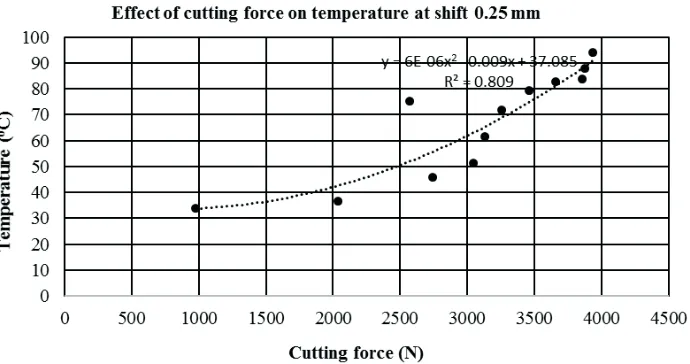
Fig. 9 illustrates the course of relationships between cutting forces and temperatures at the spindle shi fn = 0.25 mm.
The eff ect of cutting force on temperature at the shi 0.25 mm (Fig. 10) was also analysed. The parabolic function was used again to explain the relationship; it is expressed as y = 37.085 – 0.009.x + 6.10−6.x2. The temperature
variation is explained to 80.9% (R2) by the selected
regression model. 10: Effect of cutting force on temperature at shift 0.25 mm
CONCLUSION
From measured values it is evident that cutting force begins increasing at the moment when the drill got into engagement with the whole cutting edge and decreasing at the moment when the drill went out of engagement. The time to drill the sample declines by changing the speed of spindle shi . The courses of cutting forces and temperatures depending on time are illustrated in Fig. 5, at fn = 0.1 mm. The maximum value of cutting force was 2,144.73 N, and the value of maximum temperature of the workpiece reached 116.99 °C. At the shi fn = 0.16 mm, we have measured the maximum cutting force
2,476.38 N. At the shi fn = 0.25 mm, cutting force was at the value 3,934.66 N. This measured value
of cutting force reached the maximum value from all measurements. Based on measured results, by increasing the spindle shi the machining time declines and generated heat is removed mostly by chip out of the workpiece. Only heat generated by friction on the tool’s back is getting into the workpiece. The amount of heat transferred into the workpiece is relatively small in relation to the total amount of removed heat generated during machining; therefore, in all measurements, the lowest value of mean temperature of the workpiece was reached with the shi fn = 0.25 mm. High temperature causes rapid
wear of the main cutting edge on the drill, thus causing annealing of the edge and sticking of formed chip upon the drill. As a consequence of that, the drill may be damaged or hacked, cracks may be formed, or it may even be broken.
The use of cutting conditions corresponding to the work on standard machine tools aff ects negatively the economy of machining. The high price of numerically controlled machines requires an increase in cutting conditions. Optimal cutting conditions are aff ected by appropriately chosen machining technique. The choice of machining technology depends on numerous production factors. Machining centers must meet technological and customer requirements as well as those related to the safety and protection of health (Matisková et al., 2004; Kotus, et al., 2014).
Acknowledgement
The work described in this paper was supported by the KEGA project No. 035SPU-4/2014 ‘Integration of innovative trends of metal cutting, metrology and quality management into university study’. The research has been supported by the project TP 4/2014 “Analysis of degradation processes of modern materials used in agricultural technology“ fi nanced by IGA AF MENDELU.
REFERENCES
DOSTÁL, P., ČERNÝ, M., LEV, J., VARNER, D. 2011. Proportional monitoring of the acoustic emission in crypto-conditions. Acta Universitatis Agriculturae et Silviculturae Mendelianae Brunensis, 59(5): 31–38. KOTUS, M., PAULIČEK, T., JANKAJ, D.,
SPIŠÁKOVÁ, Ž., HOLOTA, T., INGALDI, M. 2014. Audit bezpečnosti obrábacieho centra vo výrobnej organizácii. In: Kvalita, technológie, diagnostika v technických systémoch. Nitra: SPU, 51–56. MATISKOVÁ, D., KOTUS, M. 2014. Methodology
for determining the cutting conditions in drilling of automated manufacturing. Acta Universitatis Agriculturae et Silviculturae Mendelianae Brunensis, 62(5): 1033–1040.
MATISKOVÁ, D., PAVLENKO, S. 2004. Stratégia výberu technológii rezania materiálov. In: Management of manufacturing systems. Prešov: FVT TU, 151–155.
PAULIČEK, T., ČIČO, P., ORŠULA, V., JANKAJOVÁ, E., HOLOTA, T., KOTUS, M. 2014. Hodnotenie poruchovosti obrábacieho centra metódou FMEA. In: Kvalita, technológie, diagnostika v technických systémoch. Nitra: SPU, 74–79.
POLÁK, P., ŽITŇANSKÝ, J., FERANCOVÁ, M. 2014. Eff ect of type of cutting tips on cutting forces in turning. Acta Technologica Agriculturae, 17(3): 57–60. POLÁK, P., ŽITŇANSKÝ, J., POLÁKOVÁ, Z.
2014. Planning of experiments in the process
of machining materials [in Slovak: Plánovanie experimentov v procese obrábania materiálov]. In: Collection of scientifi c papers ‘Kvalita, technológie, diagnostika v technických systémoch’. Nitra: Slovak University of Agriculture in Nitra, 284–291. POLÁKOVÁ, Z. 2011. Statistical methods, instructions
for practical lessons [in Slovak: Štatistické metódy, návody na cvičenia]. 1st ed. Nitra: Slovenská
poľnohospodárska univerzita v Nitre.
STIMZET. 2009. Catalogue 2009. Available at: http://www.autostyl.net/UploadFiles/katalogy/ Prumyslove_obrabeni/Obrabeni_otvoru/Katalog-STIM-ZET-obrabeni-otvoru.pdf.
VÁVRA, P. et al. 2009. Engineering tables for secondary industrial schools of mechanical engineering [in Slovak: Strojnícke tabuľky pre SPŠ strojnícke]. 5th ed. Bratislava:
ALFA-PRESS.
ZDRAVECKÁ, E., KRÁĽ, J. 2004. Basics of engineering production [in Slovak: Základy strojárskej výroby]. Košice: Elfa.
ŽITŇANSKÝ, J., POLÁK, P., BERNÁT, R., ZÁLEŽÁK, Z. 2014. Eff ect of cutting conditions on size accuracy, shape and roughness of machined parts [in Slovak: Vplyv rezných podmienok na rozmerovú presnosť, tvar a drsnosť obrábaných dielcov]. In: Collection of scientifi c papers ‘Kvalita, technológie, diagnostika v technických systémoch’. Nitra: Slovak University of Agriculture in Nitra, 173–180.
Contact information Pavel Polák: [email protected]