Supplementary material
Table SA: Data concerning the suitability of suppressed mite reproduction as a trait for resistance selection
Suppressed mite reproduction (SMR)
Measurement methods: the reproduction rate of V. destructor foundresses is measured in brood cells containing pupae at 8–11 (Harbo and Harris, 2005) or 7–12 days post-capping (Büchler et al, 2017). The evaluator opens the brood cells and the presence of foundresses and male and female offspring is recorded. SMR is diagnosed when the foundress produced no offspring, only a male offspring or a non-viable male offspring resulting in unmated daughters, or when a delay in oviposition prevented the production of adult mated daughter mites prior to host emergence (Kustermann, 1990; Martin et al, 1997).
Suitability as a resistance selection trait
Pros Cons
- Brazil: low mite reproduction in naturally surviving Africanised honey bees possibly contributing to colony survival (Camazine, 1986; Rosenkranz, 1990).
- Canada: colonies selected for low infestation growth rates for 16 weeks show a lower proportion of reproductive mites (Emsen et al, 2012): host-influenced mite reproduction could have an effect on the infestation level.
- Central Europe: in an A. m. carnica population, SMR significantly correlates with infestation levels in adult worker and brood samples (Buchegger et al, 2018).
- France: non-reproducing mites identified in the naturally surviving Avignon population (Locke, 2016b) and in the surviving population from the Toulouse region: in the latter, the trait is linked to host genes from the ecdysone–synthesis pathway (Conlon et al, 2019).
- Sweden: reciprocal crosses between a Gotland
- Europe: no significant correlation between the V. destructor reproduction rate and the infestation levels of colonies from different European origins (Büchler, 1990a).
- Germany: the fertility and fecundity of adult (German) mites infesting Gotland colonies, colonies headed by daughters from USA SMR queens and local A. m. carnica colonies did not differ (Weller, 2008). Mites infesting colonies headed by F2 Gotland, A. m. mellifera, A. m. carnica or A. m. ligustica queens did not differ in terms of fertility or fecundity (Odemer, 2019). Between 2013 and 2017, an increase in SMR in a local A. m. carnica population selected for low mite reproduction (Büchler, 2019), but high variation in colony values for each year. The genetic contribution through selection to this evolution was not published so far, neither were survival data.
- Italy: No relation between infestation and the rate of non-reproducing mites in an Italian A. m. 1
population with low mite reproduction and local susceptible lines resulted in a decrease in the rate of successful mite reproduction (at least one viable offspring produced) in all the crosses where at least one parent was of Gotland origin: low reproduction is a highly heritable trait (Locke, 2016a).
- USA: in a population of colonies with low V. destructor population growth rates, the V. destructor reproduction rate correlated with an infestation increase (Harbo and Hoopingarner, 1997). SMR was thus chosen for the USDA selection programme. Colonies from this programme showed lower infestation rates when compared to other lines, including colonies of surviving ‘Russian’ stock (Ward et al, 2008). Colonies headed by SMR and hybrid queens mated with unselected drones had lower infestation levels when compared to the controls (Harbo and Harris, 2001; Harbo and Harris, 2003).
ligustica population subjected to diverging selection for high and low infestation levels (Lodesani et al, 2002).
USA: only a third of the variation in the growth rate could be attributed to the proportion of fertile mites together with the ratio of mites infesting brood versus adults (Harris et al, 2003). In another study, environmental factors rather than the genetic effects of the host explained the variations in mite reproduction, leading to the conclusion that SMR cannot be improved by selection (DeGrandi-Hoffman et al, 2002). Crosses between lines selected for SMR and lines selected for hygienic behaviour towards freeze-killed brood resulted in lower infestation rates in the hybrids when compared to the colonies selected for hygienic behaviour (Ibrahim et al, 2004; Ibrahim et al, 2007). Surprisingly, no differences in mite fertility or the number of viable offspring produced found between the lines (Ibrahim et al, 2007): it cannot be excluded that other traits than the reproduction rate contributed to the differences in infestation rates.
5
Table SB: Data concerning the suitability of Varroa sensitive hygiene as a trait for resistance selection
Varroa sensitive hygiene (VSH)
Measurement methods: VSH has been measured in various ways. The most precise yet also time-consuming method involves measuring the removal of cells manually infested with V. destructor (Bienefeld, 1996b; Boecking et al, 2000; Panziera et al, 2017). Less effort-intensive methods measure the changes in the infestation rate of the brood frame transitorily inserted into a highly infested colony before being returned to the test colony (Danka et al, 2016; Danka et al, 2011; Harbo and Harris, 2009; Jungels, 2014; Villa et al, 2009; Villa et al, 2017). With this method, however, it is impossible to know whether the infested pupae has been removed (VSH) or whether only the mite escaped from the cells opened by the worker (uncapping–recapping, see section 1.1.1.3). A more precise method involving the use of photographs of the inserted brood frame before and after introduction to the test colony to record removed pupae has also been used (de Guzman et al, 2015; Oddie et al, 2017). It allows for the determination of whether the reduction in infestation measured following the opening of remaining brood cells correlates with brood removal or not. However, this approach does not indicate whether the removed brood was infested or not. For research purposes, the time-consuming analysis of video recordings can help to identify the workers performing the task (Bienefeld et al, 2002; Boecking, 1994). This can be useful when later genotyping the individuals involved in removal or using workers to produce drones in experimental selection programmes (Bienefeld et al, 2002). A comparison of the different VSH protocols, as was performed for the hygienic tests (see section 1.1.1.4), is currently unavailable to help choose the best protocol, minimise costs and maximise precision.
Suitability as a resistance selection trait
Pros Cons
- France: in colonies with low infestations, honey bees tended to have a lower sensitivity threshold to recognise single-infested cells than honey bees from highly infested colonies (Martin et al, 2001).
- Germany: the removal of infested brood occurred (Boecking and Drescher, 1992) and possibly depended on the viral load of the mites (Boecking, 1994; Schoning et al, 2012): VSH may be a defence mechanism against both V. destructor and its associated viruses.
USA: colonies selected for VSH reduced the infestation
- Germany: the removal reaction of colonies with high VSH ability towards infested brood is stronger in the case of multiple infestations than single infestation (Boecking and Drescher, 1992), which suggests limited efficiency at low infestation levels. The results of repeated tests on the same colonies correlated with about r = 0.6 (Boecking, 1994); measuring the removal rates after feeding the colonies with sugar water doubled the values when compared to conditions without feeding (Boecking, 7
levels of foreign brood (-80%) significantly more when compared to F1 colonies (about -30%) and controls (about -0%) (Danka et al, 2011). It is not known whether the reduction of the brood infestation rate is due to brood removal or to mites leaving cells opened by workers. In colonies of Russian line, the removal of infested brood is suggested as the main reason for reduced infestation levels when compared to controls (de Guzman et al, 2015). In this line, negative correlation (r = -0.25) was measured between the removal of infested brood and the colony infestation level (Kirrane et al, 2015): VSH could directly contribute to limiting the infestation level.
1994): values obtained in beekeeping conditions, when many environmental factors are not under control, may result in high variations between evaluation dates.
10 11
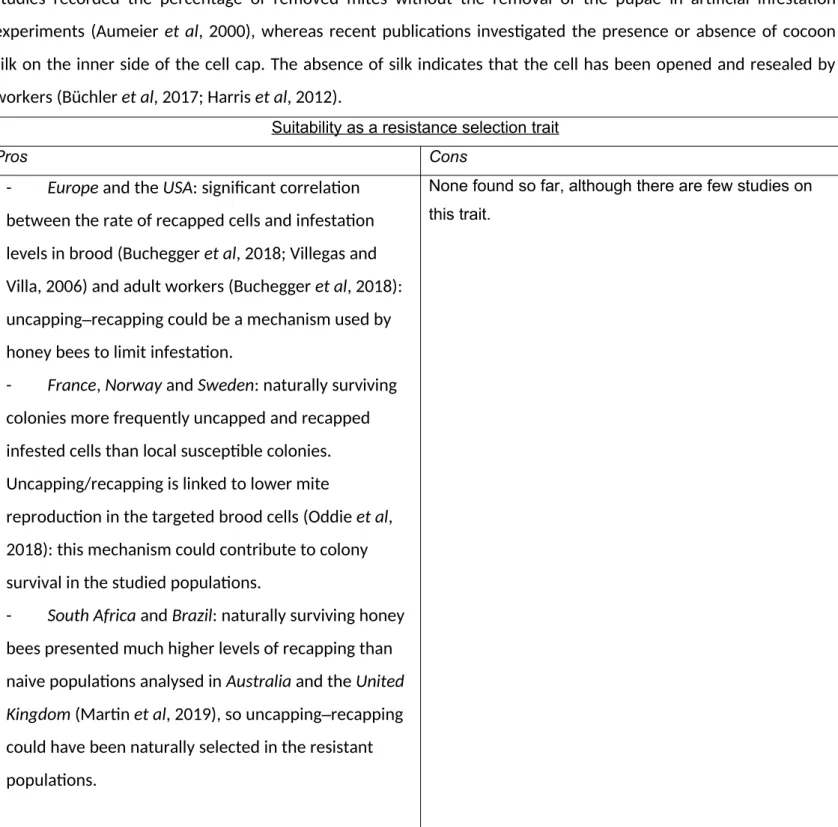
Table SC: Data concerning the suitability of uncapping–recapping as a trait for resistance selection
Uncapping–recapping
Measurement methods: several methods were used to measure the frequency of uncapping–recapping. Some
studies recorded the percentage of removed mites without the removal of the pupae in artificial infestation experiments (Aumeier et al, 2000), whereas recent publications investigated the presence or absence of cocoon silk on the inner side of the cell cap. The absence of silk indicates that the cell has been opened and resealed by workers (Büchler et al, 2017; Harris et al, 2012).
Suitability as a resistance selection trait
Pros Cons
- Europe and the USA: significant correlation between the rate of recapped cells and infestation levels in brood (Buchegger et al, 2018; Villegas and Villa, 2006) and adult workers (Buchegger et al, 2018): uncapping–recapping could be a mechanism used by honey bees to limit infestation.
- France, Norway and Sweden: naturally surviving colonies more frequently uncapped and recapped infested cells than local susceptible colonies. Uncapping/recapping is linked to lower mite
reproduction in the targeted brood cells (Oddie et al, 2018): this mechanism could contribute to colony survival in the studied populations.
- South Africa and Brazil: naturally surviving honey bees presented much higher levels of recapping than naive populations analysed in Australia and the United Kingdom (Martin et al, 2019), so uncapping–recapping could have been naturally selected in the resistant populations.
None found so far, although there are few studies on this trait.
13 14 15
Table SD: Data concerning the suitability of hygienic behaviour towards dead brood as a trait for resistance selection
Hygienic behaviour towards dead brood
Measurement methods: the degree of hygienic behaviour of a colony is measured as the removal rate of dead worker pupae by adult workers after a certain amount of time. Brood killing occurs either by freezing a piece of brood comb in a freezer (Kefuss et al, 1996; Newton et al, 1975) with liquid nitrogen (Spivak and Downey, 1998) or by pinning individual brood cells with a needle (Büchler, 1996; Newton and Ostasiewski, 1986), the latter being less demanding in terms of material and time. These methods appear similar with regards to their ability to quantify hygienic behaviour since significant positive correlations, ranging between 0.54 and 0.96, were obtained (Büchler, 1994; Espinosa-Montano et al, 2008; Newton and Ostasiewski, 1986). Thus, the selection output should be independent of the method used, and the ease of implementation can guide the method chosen to assess the phenotype. In Central Europe, however, the pin-test method was recommended to local beekeepers (Hoffmann, 1996a) as it was found to give more repeatable and accurate results (Hoffmann, 1996b).
Suitability as a resistance selection trait
Pros Cons
- Argentina: significant correlation between the removal of experimentally V. destructor-infested brood and the removal of pin-killed brood in cells infested by two mites (Del Hoyo et al, 2001)).
- Brazil, Africanised honey bees: strong negative genetic correlation between the removal of freeze-killed brood and the infestation rate of adult honey bees (r=-0.82) (Padilha et al, 2013) and between the removal of pin-killed brood and infestation (-0.96) (Pinto et al, 2012) and moderate correlation between the removal of freeze-killed brood and the reproduction rate of V. destructor (r = -0.48)(Wielewski et al, 2012).
- Canada: untreated colonies selected for hygienic behaviour towards freeze-killed brood better survived in the presence of V. destructor when compared to unselected colonies (Guarna et al, 2017). Negative
- Argentina: colonies of European origin were selected for hygienic behaviour via the pin-test method (Palacio et al, 2001). Slight differences were found between the selected and non-selected groups in terms of the infestation levels, although no significant differences were visible concerning the survival of the untreated colonies (Merke, 2016). No relation between the removal of pin-killed brood and brood removal in cells experimentally infested with a single mite (Del Hoyo et al, 2001).
- Belgium: no correlation between the removal of freeze-killed brood and the infestation rates of both worker brood and adult workers, the ratio of these infestations or the reproduction rate of mites (Leclercq et al, 2018).
- Chile: no correlation between hygienic behaviour and the infestation level of V. destructor 19
correlation (r = -0.13 to r = -0.54) between the removal of freeze-killed brood and infestation rates in brood or on adult workers had previously been identified (Parker et al, 2012).
- Ethiopia: negative correlation between the removal of pin-killed brood and the infestation level on adult bees (r = -0.79) and in brood (r = -0.46) in naturally surviving A. m. simensis (Gebremedhn et al, 2019)
- Germany, A. m. carnica: negative correlation between hygienic behaviour and the population growth of V. destructor (Ehrhardt et al, 2010). Arbeitsgemeinschaft Toleranzzucht (AGT, www.toleranzzucht.de) population: between 2004 and
2007, negative correlation (r=-0.57) between the infestation growth rate and hygienic behaviour (Büchler et al, 2008). Bee Research Institute Kirchhain population (Büchler, 1993a): lower infestation rates in colonies selected for hygienic behaviour and grooming when compared to the controls (Büchler, 1997; Büchler, 2000). Positive genetic (r = 0.61 ± 0.51) and phenotypic (r = 0.11) correlation between the removal of pin-killed brood and the removal of V. destructor -infested pupae (Boecking et al, 2000). Moderate correlation between the removal of pin-killed brood and V. destructor infestation, fluctuating depending on the honey bee lines considered (Hoffmann, 1996b). High correlation between mite removal and the removal of pinned (r = 0.65) or freeze-killed brood (r = 0.79) (Büchler, 1994). Significant correlation between the removal of experimentally V. destructor-infested cells and the removal of freeze-killed brood infested by
(Araneda et al, 2008).
- Germany: no relation between the removal of freeze-killed brood and the removal of cells experimentally infested with a single mite (Boecking and Drescher, 1992). Colonies from the AGT and Kirchhain populations selected for hygienic behaviour did not show better survival when tested in different environmental conditions on the European scale in the absence of mite control when compared with colonies of various origins, most of them not selected for resistance (Meixner et al, 2014). In A. m. carnica, poor correlation between pin-killed brood removal and the infestation of adult honey bees (Buchegger et al, 2018).
- Italy, A. m. ligustica: no correlation between the removal of pin-killed brood and the infestation level of the colony (Lodesani et al, 2002).
- Mexico, naturally surviving Africanised honey bees: no correlation between hygienic behaviour and the infestation level of V. destructor (Medina-Flores et al, 2014; Mondragon et al, 2005).
- The Netherlands: In two naturally surviving populations, no high hygienic behaviour towards dead brood (Blacquière et al, 2019; Locke and Fries, 2011; Mondragon et al, 2005).
- Turkey, A. m. anatoliaca: a survival experiment involving hygienic and non-hygienic colonies with initially equalised mite loads did not show the better survival of hygienic colonies according to freeze-killed brood removal assays (Cakmak, 2010).
two mites (Boecking and Drescher, 1992).
- Kenya, naturally surviving honey bees: significant correlation found between the infestation level and hygienic behaviour in naturally resistant populations (Muli et al, 2014).
- United Kingdom, England: some highly hygienic colonies had lower infestation rates (Al Toufailia et al, 2014).
- USA, ‘Russian’ stock: colonies showed higher hygienic behaviour than control colonies (de Guzman et al, 2002).
in colonies with low or medium hygiene levels (Al Toufailia et al, 2014).
USA: colonies bred for hygienic behaviour against dead brood were not very effective in cleaning infested cells (Danka et al, 2013; Ibrahim and Spivak, 2006). In Minnesota, colonies bred for hygienic behaviour showed lower infestation than controls (Spivak and Reuter, 1998), although they still needed varroacide treatments during the late season to prevent winter losses (Ibrahim et al, 2007; Spivak and Reuter, 2001). Similarly, a negative relation between hygienic behaviour and infestation (natural mite fall) was found in another US population selected for hygienic behaviour; however, no significant difference was found for the time of year at which the treatment threshold was reached (Delaplane et al, 2005). Another study found no correlation between hygienic behaviour and the infestation level of V. destructor (Harbo and Hoopingarner, 1997).
Table SE: Data concerning the suitability of a reduced post-capping stage duration as a trait for resistance selection
Reduced post-capping stage duration
Measurement methods: after the sealing of individual worker cells, the duration of the post-capping stage is monitored at short time intervals either in the hive (Büchler, 1990b; Büchler and Drescher, 1990; Rosenkranz, 1990) or by placing the test comb in an incubator (Bienefeld, 1996a; Oddie et al, 2018). The frequency of these observations determines the precision of the assessment of the post-capping duration. The hive method offers the advantage of including colony effects in the analysis; however, the repeated opening of the colony may induce disturbances in the in-hive conditions and so affect brood development. To the best of our knowledge, the two methods have not been compared to date, so their respective impact on the evaluation of the post-capping stage duration is not known.
Suitability as a resistance selection trait
Pros Cons
- Germany: positive correlation (r = 0.48) between the post-capping stage duration and the infestation rate (Büchler, 1990b; Büchler and Drescher, 1990).
- Germany: variations in the post-capping stage duration between 270 and 300 hours unlikely to have an effect on the infestation level (Hoffmann, 1996b). - Norway: a reduced post-capping stage duration has been identified in a naturally surviving population, although it is unlikely that this trait effectively contributes to the observed survival (Oddie et al, 2018).
- Poland: colonies with A. m. capensis ancestry selected for the reduced post-capping stage duration had significantly lower (1.75 versus 1.98) V. destructor reproduction rates than the unselected controls (Wilde and Siuda, 1997), although this difference was not significant in the following generation. The differences in colony infestation rates when compared to the controls were not significant either (Siuda and Wilde, 1998). This absence of a visible effect on the infestation rate resulted in the end of the selection programme.
- USA: in contrast to SMR, the post-capping stage duration was only marginally correlated with the infestation rate (Harbo and Hoopingarner, 1997). 27
Table SF: Data concerning the suitability of grooming as a trait for resistance selection
Grooming
Measurement methods: in the field, grooming is evaluated by sampling the mites falling from the colony onto a board set under a hive with a meshed floor bottom. Mites are collected and body damage, for instance, missing legs or an injured shield, is recorded (Ruttner and Hänel, 1992). The percentage of damaged mites is used as an indicator of the grooming capacity of the colony.
Suitability as a resistance selection trait
Pros Cons
- Austria: significant negative correlation was found between the rate of damaged mites collected under colonies and the infestation levels of brood and adult workers (Moosbeckhofer, 1992), indicating that selecting for colonies showing injured mites could help to limit infestation levels among local A. m. carnica. - Canada: a higher proportion of damaged mites in colonies selected for low V. destructor infestation growth rates when compared to lines selected for high infestation growth rates (Guzman-Novoa et al, 2012). Higher daily mite mortality in overwintering colonies whose workers expressed high grooming behaviour in experimental cages when compared to a colony with low grooming workers (Currie and Tahmasbi, 2008). - Germany: colonies with a high percentage of damaged mites (above 40%) had a lower increase in their mite population than colonies with less than 30% damaged mites as well as significant negative correlation (r = -0.42) between the proportion of injured mites and the relative infestation increase in spring (Büchler, 1993b). This finding was confirmed by later studies in the Kirchhainer population (Hoffmann, 1996b). Colonies originating from the same selection
- Austria, A. m. carnica: grooming was identified as a defence mechanism in a line selected for low infestation growth rates (Ruttner and Hänel, 1992). The beekeeper selecting this population mentioned empirical selection progress for high rates of mite injury accompanied by a reduction in the treatment frequency (Markthaler, 2004; Wallner, 1997; Wallner, 2002). However, in a comparison test performed elsewhere in Germany, colonies originating from the lineage selected for grooming showed far higher infestation rates and less damaged mites than the other A. m. carnica strains, which were not selected for their proportion of injured mites (Büchler, 1998). This suggests high environmental effects for the grooming trait.
- Canada: no relation was found between infestation as estimated by natural mite fall and the rate of injured mites in ‘Russian’ stock evaluated in Canada or in Africanised honey bees studied in Mexico (Guzman-Novoa et al, 2012).
- Italy: in a population selected for either low or high V. destructor population growth rates, no correlation was found between grooming behaviour 30
programme using artificial insemination still had significantly lower infestations than controls in the subsequent generations (Büchler, 2000).
- Mexico, Africanised honey bees: the proportion of injured mites was one of two variables that correlated best (negatively) with the colony infestation level (Mondragon et al, 2005). Other studies highlighted negative correlation between the percentage of injured mites and the mite population growth (Arechavaleta-Velasco and Guzman-Novoa, 2001).
- Tunisia, A. m. intermissa: grooming was interpreted as contributing to the survival of colonies (Boecking and Ritter, 1993).
- USA: colonies selected according to the damaged mite rate and tested in different beekeeping conditions showed lower mite populations than controls in some of the test locations (Hunt et al, 2016). A preliminary study showed significant positive correlation between the number of injured mites found beneath colonies and the number of mites removed by grooming in caged groups of workers from the same colonies (Andino and Hunt, 2011), indicating than laboratory assays could help to identify colonies with high grooming behaviour. Lower V. destructor infestation combined with increased colony survival and the increased expression of a grooming-related gene were later identified in the same selected population when compared to a susceptible control population (Morfin et al, 2019).
and the infestation level (Lodesani et al, 2002).
- The Netherlands: in two naturally surviving populations, no noticeable grooming behaviour was recorded (Kruitwagen et al, 2017)
- USA: no correlation was found between grooming and V. destructor population growth (Harbo and Hoopingarner, 1997).
Table SG: Data concerning the suitability of the mite infestation level as a trait for resistance selection
Mite infestation level
Measurement methods: several methods can be used to measure infestation levels. The most precise method involves killing the entire colony (Dietemann et al, 2013). In practice, even if the queen could be spared for selection purposes, this method is too costly to be applied. Alternatively, varroacide treatments can be used, although they are destructive towards mites and, therefore, prevent reliable repeated measurements. Mite counts in worker or brood samples and the recording of the natural mite fall beneath the colony are thus preferred for estimating the mite load of the colony (Dietemann et al, 2013), and they are employed as selection traits in beekeeping conditions (Erickson et al, 2000; Oliver, 2018; Oliver, 2019). The mite population growth rate, for instance, between spring and late summer, may also be used as a selection trait. In research programmes, lineages with either low or high infestation growth rates were selected (Harbo and Hoopingarner, 1997; Kulincevic et al, 1992; Lodesani et al, 2002), for example, to determine the mechanisms linked to the observed infestation differences (Harbo and Hoopingarner, 1997; Lodesani et al, 2002). Similar approaches could also be employed in beekeeping conditions to select for lineages with lower infestation.
Suitability as a resistance selection trait
Pros Cons
- Austria: in the 1990s, a commercial beekeeper selected colonies with low brood infestation growth rates and high natural mite fall. Initially, 12 colonies out of 700 were able to overwinter without treatment in local conditions and to produce similar honey quantities when compared to treated colonies (Ruttner and Hänel, 1992). Some 30–50% of the mites found on the bottom boards of the colony showed signs of injuries, which was interpreted as the result of the active defense behaviour of the worker honey bees (Ruttner and Hänel, 1992). Selection was continued considering the high proportion of injured mites as the breeding goal, with controversial results (Table SF). Another study concluded that selection for late season mite infestation could be feasible, although it would
- Turkey: colonies with infestation levels under 1 mite per 100 honey bee workers in summer were left untreated and used as a source to requeen more heavily infested and treated colonies (Cakmak and Fuchs, 2013). The proportion of colonies requiring no treatment increased after two years. However, no controls were used to exclude environmental and yearly effects, so genetic progress could not be proven. In addition, collaboration problems with the beekeepers on the island resulted in the relaxing of the selection effort, which led to an increase in infestation rates after the first two years (Fuchs, personal communication).
- USA: lines with low infestation rates selected in Yugoslavia were tested in the USA and showed barely 35
require large tested and selected populations (Boigenzahn and Willam, 1999).
- The Netherlands: the De Duurzame Bij association (www.duurzamebij.nl) selects colonies for low cumulative infestation growth rate coefficients based on continuous measurements of the natural mite fall. The programme involves approximately 90 untreated colonies, with mortality rates ranging between 10% and 15% per year (Kok, personal communication). Such a rate is within the range of national colony losses (Brodschneider et al, 2016; Van Der Zee et al, 2014).
any difference in infestation levels when compared to susceptible controls (Rinderer et al, 1993), despite an estimated heritability for infestation level of 0.3 in the original population (Kulincevic et al, 1992). Changes in environmental conditions may have affected the host–parasite interaction.
38
Table SH: V. destructor-infested honey bee populations surviving without acaricide treatments
- Avignon and Sarthe, France: see section 1.2.1. - Gotland, Sweden: see section 1.2.1.
- Toulouse, France: see section 1.2.1. - The Netherlands: see section 1.2.1.
- Norway: since 1997, untreated and surviving commercial population of Buckfast origin. After high initial losses, significantly lower infestation rates when compared to neighbouring susceptible control colonies (Oddie et al, 2017).
- Switzerland: two groups of non-isolated colonies untreated since 2006 and 2010, respectively, survive despite mite infestations (Dettli, 2018b). Some colonies reduce the infestation of V. destructor after peaks in spring or autumn by unknown mechanisms (Dettli, 2018a).
- Ireland: colonies in North County Dublin untreated since 2010; infestation rates occasionally rose during the beekeeping season, but few colonies were lost. DWV symptoms rarely seen. Signs of resistance or tolerance build-up (McMullan, 2018).
- United Kingdom: 40 untreated colonies in the Swindon region survive for 20 years despite V. destructor infestation and high DWV loads (Gfeller et al, 2019; Mordecai et al, 2016). In Wales, untreated colonies have been reported to survive for up to 20 years (Gfeller et al, 2020). In addition, among the owners of a total of 1573 colonies, the majority of beekeepers do not treat their colonies: between 2010 and 2015, their colony losses were lower than those of beekeepers who treat their colonies (Hudson and Hudson, 2016). In Northern England, in a population kept by a beekeeper, very low infestation rates despite the colonies being untreated since 2002 (Pritchard, 2018).
- Dominica Island: untreated and infested colonies of A. m. mellifera ancestry survive (Rangel et al, 2018). No data on colony mortality, on the haplotype of V. destructor or on virus infections are available, so the cause of survival is unknown.
42 43
44
References
Al Toufailia HM, Amiri E, Scandian L, Kryger P, Ratnieks FLW (2014). Towards integrated control of Varroa: Effect of variation in hygienic behaviour among honey bee colonies on mite population increase and deformed wing virus incidence. Journal of Apicultural Research 53(5): 555-562.
Andino GK, Hunt GJ (2011). A scientific note on a new assay to measure honeybee mite-grooming behavior. Apidologie42(4): 481-484.
Araneda X, Pérez R, Castillo C, Medina L (2008). Evaluation of the hygienic behavior of Apis mellifera L. related to the level of infestation of Varroa destructor Anderson & Trueman.
IDESIA (Chile)26(2): 59-67.
Arechavaleta-Velasco ME, Guzman-Novoa E (2001). Relative effect of four characteristics that restrain the population growth of the mite Varroa destructor in honey bee (Apis mellifera) colonies. Apidologie32(2): 157-174.
Aumeier P, Rosenkranz P, Goncalves LS (2000). A comparison of the hygienic response of Africanized and European (Apis mellifera carnica) honey bees to Varroa-infested brood in tropical Brazil. Genetics and molecular biology23(4): 787-791.
Bienefeld K (1996a). Factors affecting duration of the postcapping period in brood of the honey bee (Apis mellifera carnica). J Apic Res35(1): 11-17.
Bienefeld K (1996b). Züchterische Aspekte bei der Selektion auf Varroatoleranz. Deutsches Bienen Journal4(2): 18-23.
Bienefeld K, Reinsch N, Thakur R (2002). Selection for uncapping of Varroa infested brood cells in the honeybee (Apis mellifera). Proceedings of the 37th International Apicultural Congress, 28 October – 1 November 2001, Durban, South Africa.
Blacquière T, Boot WJ, Calis J, Van Stratum P (2019). Darwinian Black Box selection leads to Varroa resistance in honey bees. Proceedings of the Fifth International Organic
Beekeeping ConferenceHohenheim, 01-03 march 2019: 232-233.
Boecking O (1994). Das Ausräumverhalten von Apis mellifera L. gegenüber Milben-infizierter Brut als ein Abwehrverhalten gegen die ektoparasitische Milbe Varroa jacobsoni Oud. Dr. sc.nat. thesis, Rheinische Friedrich Wilhelms-Universität zu Bonn, Bonn.
Boecking O, Bienefeld K, Drescher W (2000). Heritability of the Varroa-specific hygienic behaviour in honey bees (Hymenoptera: Apidae). Journal of Animal Breeding and Genetics 117(6): 417-424.
Boecking O, Drescher W (1992). The removal response of Apis mellifera L. colonies to brood in wax and plastic cells after artificial and natural infestation with Varroa jacobsoni Oud. and to freeze-killed brood. Experimental & Applied Acarology16(4): 321-329.
Boecking O, Ritter W (1993). Grooming and removal behaviour of Apis mellifera intermissa in Tunisia against Varroa jacobsoni. Journal of Apicultural Research32(3-4): 127-134.
Boigenzahn C, Willam A (1999). Estimation of population parameters for tolerance of the honey bee (Apis mellifera carnica) for Varroa jacobsoni Oudemans. Apidologie30(6): 485-490.
Brodschneider R, Gray A, van der Zee R, Adjlane N, Brusbardis V, Charrière JD et al (2016). Preliminary analysis of loss rates of honey bee colonies during winter 2015/16 from the COLOSS survey. Journal of Apicultural Research55(5): 375-378.
Buchegger M, Buechler R, Fuerst-Waltl B, Kovacic M, Willam A (2018). Relationships between resistance characteristics of honey bees (Apis mellifera) against Varroa mites (Varroa destructor). Journal of Central European Agriculture19(4): 954-958.
Büchler R (1990a). Genetically caused differences in Varroa susceptibility of European honeybee colonies as a basis for breeding for increased resistance. Ph.D. thesis, Rheinische Friedrich-Wilhelms-Universistat, Bonn, German Federal Republic.
Büchler R (1990b). Genetisch bedingte Unterschiede in der Anfälligkeit von Bienenvölkern (Apis mellifera L.) gegenüber der Varroa-Milbe (Varroa jacobsoni Oud.) als Grundlage einer Zucht auf erhöhte Widerstandsfähigkeit. Ph.D. thesis, Bonn Rheinische Friedrich-Wilhelm-Universität zu Bonn.
Büchler R (1993a). Aufbau, Leistungsprüfung und Auslese der Kirchhainer Population. Die Biene129(1): 11-17.
Büchler R (1993b). Der Anteil beschädigter Varroamilben im natürlichen Totenfall im Hinblick auf Saisoneinflüsse und Befallsentwicklung. Apidologie24: 492-493.
Büchler R (1994). Varroa tolerance in honey bees - occurrence, characters and breeding.
Bee World75(2): 54-70.
Büchler R (1996). Selektion auf Bruthygiene in der Kirchhainer Population. Apidologie27(4):
280-281.
Büchler R (1997). Feldversuch zur Varroatoleranz der Kirchhainer Population. Apidologie 28(3/4): 191-193.
Büchler R (1998). Varroatoleranz, Leistung und Verhalten verschiedener Carnica-Linien.
Allgemeine Deutsche Imkerzeitung32(6): 11-13.
Büchler R (2000). Design and success of a German breeding program for Varroa tolerance.
American Bee Journal140(8): 662-665.
Büchler R (2019). Strategische Impulse für eine ökologische Varroabekämpfung.
Proceedings of the 5th International Organic Beekeeping Conference Hohenheim, Germany, 01-03 March 2019.
Büchler R, Costa C, Mondet F, Kezic N, Kovacic M. (2017). RNSBB research network for sustainable beekeeping [online] Available at:
https://www.beebreeding.net/index.php/2017/09/01/new-smr-protocol/ [Accessed 27 February 2019].
Büchler R, Drescher W (1990). Variance and heritability of the capped developmental stage in European Apis mellifera L. and its correlation with increased Varroa jacobsoni Oud. infestation. J Apic Res29(3): 172-176.
Büchler R, Garrido C, Bienefeld K, Ehrhardt K (2008). Selection for Varroa tolerance: concept and results of a long-term selection project. Apidologie5(39): 598.
Cakmak I (2010). The over wintering survival of highly Varroa destructor infested honey bee colonies determined to be hygienic using the liquid nitrogen freeze killed brood assay.
Journal of Apicultural Research49(2): 197-201.
Cakmak I, Fuchs S (2013). Exploring a treatment strategy for long-term increase of varroa tolerance on Marmara Island, Turkey. Journal of Apicultural Research52(5).
Camazine S (1986). Differential reproduction of the mite, Varroa jacobsoni (Mesostigmata: Varroidae), on Africanized and European honey bees (Hymenoptera: Apidae). Annals of the Entomological Society of America79(5): 801-803.
Conlon BH, Aurori A, A. G, Kefuss J, Dezmirean DS, Moritz RFA et al (2019). A gene for resistance to the Varroa mite (Acari) in honey bee (Apis mellifera) pupae. Molecular Ecology 00: 1-9.
Currie RW, Tahmasbi GH (2008). The ability of high- and low-grooming lines of honey bees to remove the parasitic mite Varroa destructor is affected by environmental conditions.
Canadian Journal of Zoology-Revue Canadienne de Zoologie86(9): 1059-1067.
Danka RG, Harris JW, Dodds GE (2016). Selection of VSH-derived “Pol-line” honey bees and evaluation of their Varroa-resistance characteristics. Apidologie47(3): 483-490.
Danka RG, Harris JW, Villa JD (2011). Expression of Varroa Sensitive Hygiene (VSH) in Commercial VSH Honey Bees (Hymenoptera: Apidae). Journal of Economic Entomology 104(3): 745-749.
Danka RG, Harris JW, Villa JD, Dodds GE (2013). Varying congruence of hygienic
responses to Varroa destructor and freeze-killed brood among different types of honeybees.
Apidologie44(4): 447-457.
de Guzman LI, Rinderer TE, Frake AM, Kirrane MJ (2015). Brood removal influences fall of
Varroa destructor in honey bee colonies. Journal of Apicultural Research54(3): 216-225.
de Guzman LI, Rinderer TE, Stelzer JA, Beaman L, Delatte GT, Harper C (2002). Hygienic behavior by honey bees from far-eastern Russia. American Bee Journal142(1): 58-60.
DeGrandi-Hoffman G, Page RE, Martin JH, Fondrk MK (2002). Can the frequency of reduced
Varroa destructor fecundity in honey bee (Apis mellifera) pupae be increased by selection?
Apidologie33(6): 563-570.
Del Hoyo M, Goncalves L, Palacio A, Bedascarrasbure E (2001). Apis mellifera hygienic behaviors in relation to Varroa destructor tolerance in two honey bee populations in Argentina. Proceedings of the 37th International Apicultural Congress, 28 October – 1 November 2001, Durban, South Africa.
Delaplane KS, Berry JA, Skinner JA, Parkman JP, Hood WM (2005). Integrated pest management against Varroa destructor reduces colony mite levels and delays treatment threshold. Journal of Apicultural Research44(4): 157-162.
Dettli M (2018a). Varroatolerante Bienenvölker. (1.Teil). Schweizerische Bienenzeitung(1):
Dettli M (2018b). Varroatolerante Bienenvölker. (2. Teil). Schweizerische Bienenzeitung(2):
15-17.
Dietemann V, Nazzi F, Martin SJ, Anderson DL, Locke B, Delaplane KS et al (2013). Standard methods for varroa research. Journal of Apicultural Research52(1).
Ehrhardt K, Büchler R, Bienefeld K (2010). Genetic parameters of new traits to improve the tolerance of honeybees to Varroa mites. Proceedings of the 9th World Congress on Genetics Applied to Livestock Production (9th WCGALP)1–6 August 2010, Leipzig.
Emsen B, Petukhova T, Guzman-Novoa E (2012). Factors Limiting the Growth of Varroa destructor Populations in Selected Honey Bee (Apis mellifera L.) Colonies. Journal of Animal and Veterinary Advances11(24): 4519-4525.
Erickson EH, Hines LH, Atmowidjojo AH (2000). Producing Varroa-tolerant honey bees from locally adapted stock: A recipe. American Bee Journal140(8): 659-661.
Espinosa-Montano LG, Guzman-Novoa E, Sanchez-Albarran A, Montaldo HH, Correa-Benitez A (2008). Comparative study of three assays to evaluate hygienic behavior in honey bee (Apis mellifera L.) colonies. Veterinaria Mexico39(1): 39-54.
Gebremedhn H, Amssalu B, De Smet L, De Graaf DC (2019). Factors restraining the population growth of Varroa destructor in Ethiopian honey bees (Apis mellifera simensis).
PLoS ONE14(9).
Gfeller T, Bandi I, Ritter R, Dietemann V (2019). Une apiculture comme avant Varroa. revue Suisse d'Apiculture(11-12): 43-50.
Gfeller T, Bandi I, Ritter R, Dietemann V (2020). Une apiculture comme avant Varroa. Revue Suisse d'Apiculture141(1-2): 45-54.
Guarna M, Hoover S, Huxter E, Higo H, Moon K, Domanski D et al (2017). Peptide biomarkers used for the selective breeding of a complex polygenic trait in honey bees.
Scientific Reports7(8381): 1-10.
Guzman-Novoa E, Emsen B, Unger P, Espinosa-Montano LG, Petukhova T (2012). Genotypic variability and relationships between mite infestation levels, mite damage, grooming intensity, and removal of Varroa destructor mites in selected strains of worker honey bees (Apis mellifera L.). Journal of Invertebrate Pathology110(3): 314-320.
Harbo JR, Harris JW (2001). Resistance to Varroa destructor (Mesostigmata: Varroidae) when mite-resistant queen honey bees (Hymenoptera: Apidae) were free-mated with unselected drones. Journal of Economic Entomology94(6): 1319-1323.
Harbo JR, Harris JW (2003). An evaluation of commercially-produced queens that have the SMR trait. American Bee Journal143(3): 213-216.
Harbo JR, Harris JW (2005). Suppressed mite reproduction explained by the behavior of adult bees. Journal of Apicultural Research44: 21-23.
Harbo JR, Harris JW (2009). Responses to Varroa by honey bees with different levels of Varroa Sensitive Hygiene. Journal of Apicultural Research48(3): 156-161.
Harbo JR, Hoopingarner RA (1997). Honey bees (Hymenoptera: Apidae) in the United States that express resistance to Varroa jacobsoni (Mesostigmata: Varroidae). Journal of Economic Entomology90(4): 893-898.
Harris JW, Danka RG, Villa JD (2012). Changes in infestation, cell cap condition, and reproductive status of Varroa destructor (Mesostigmata: Varroidae) in brood exposed to honey bees with Varroa sensitive hygiene. Annals of the Entomological Society of America 105(3): 512-518.
Harris JW, Harbo JR, Villa JD, Danka RG (2003). Variable population growth of Varroa destructor (Mesostigmata : Varroidae) in colonies of honey bees (Hymenoptera : Apidae) during a 10-year period. Environmental entomology32(6): 1305-1312.
Hoffmann S (1996a). Beurteilung von Körperputz- und Bruthygieneverhalten der Bienen - unter Versuchs- und Praxisbedingungen. Deutsches Bienen Journal(7): 306-309.
Hoffmann S (1996b). Untersuchungsmethoden und Analyse der quantitativ genetischen Basis unterschiedlicher Varroatose-Anfälligkeit von Bienenvölkern der Carnica-Rasse (Apis mellifera carnica, Pollmann). Dr. thesis, Bonn Rheinische Frierich-Wilhelm Universität Bonn.
Hudson C, Hudson S (2016). Varroa has lost its sting. BBKA News(December 2016): 429-439.
Hunt G, Given K, Tsuruda J, Andino G (2016). Breeding mite-biting bees to control Varroa.
Bee Culture8: 41-47.
Ibrahim A, Reuter GS, Spivak M (2004). Progress in breeding honey bees for resistance to
Varroa destructor. American Bee Journal144(5): 405-406.
Ibrahim A, Reuter GS, Spivak M (2007). Field trial of honey bee colonies bred for mechanisms of resistance against Varroa destructor. Apidologie38(1): 67-76.
Ibrahim A, Spivak M (2006). The relationship between hygienic behavior and suppression of mite reproduction as honey bee (Apis mellifera) mechanisms of resistance to Varroa
destructor. Apidologie37(1): 31-40.
Jungels P (2014). Bruthygiene und Varroa Sensitiv Hygiene in der praktischen Zuchtauslese.
Der Buckfastimker4: 6-15.
Kefuss J, Taber S, Vanpoucke J (1996). A practical methode to test for disease resistance in honey bees. American Bee Journal136(1): 31-32.
Kirrane MJ, De Guzman LI, Holloway B, Frake AM, Rinderer TE, Whelan PM (2015).
Phenotypic and genetic analyses of the Varroa sensitive hygienic trait in Russian honey bee (Hymenoptera: Apidae) colonies. PLoS ONE10(4).
Kruitwagen A, van Langevelde F, van Dooremalen C, Blacquière T (2017). Naturally selected honey bee (Apis mellifera) colonies resistant to Varroa destructor do not groom more
intensively. Journal of Apicultural Research: 1-12.
Kulincevic JM, Rinderer TE, Mladjan VJ, Buco SM (1992). Five years of bi-directional genetic selection for honey bees resistant and susceptible to Varroa jacobsoni. Apidologie23(5):
443-452.
Kustermann T (1990). Untersuchungen zur Populationsstruktur der Milbe Varroa jacobsoni
Leclercq G, Blacquière T, Gengler N, Francis F (2018). Hygienic removal of freeze-killed brood does not predict Varroa-resistance traits in unselected stocks. Journal of Apicultural Research: 1-8.
Locke B (2016a). Inheritance of reduced Varroa mite reproductive success in reciprocal crosses of mite-resistant and mite-susceptible honey bees (Apis mellifera). Apidologie47(4):
583-588.
Locke B (2016b). Natural Varroa mite-surviving Apis mellifera honeybee populations.
Apidologie47(3): 467-482.
Locke B, Fries I (2011). Characteristics of honey bee colonies (Apis mellifera) in Sweden surviving Varroa destructor infestation. Apidologie42(4): 533-542.
Lodesani M, Crailsheim K, Moritz RFA (2002). Effect of some characters on the population growth of mite Varroa jacobsoni in Apis mellifera L. colonies and results of a bi-directional selection. J Appl Ent126(2-3): 130-137.
Markthaler G (2004). A safe method of detecting varroa-resistant colonies. American Bee Journal144(10): 755-756.
Martin C, Provost E, Roux M, Bruchou C, Crauser D, Clément JL et al (2001). Resistance of the honey bee, Apis mellifera, to the acarian parasite Varroa destructor: behavioural and electroantennographic data. Physiological Entomology26(4): 362-370.
Martin S, Holland K, Murray M (1997). Non-reproduction in the honeybee mite Varroa jacobsoni. Experimental & Applied Acarology21(8): 539-549.
Martin SJ, Hawkins G, Brettell L, Reece N, Correia-Oliveira ME, Allsopp MH (2019). Varroa destructor reproduction and cell re-capping in mite-resistant Apis mellifera populations.
Apidologie.
McMullan J (2018). Adaptation in Honey Bee (Apis mellifera) Colonies Exhibiting Tolerance to Varroa destructor in Ireland. Bee World95(2): 39-43.
Medina-Flores CA, Guzman-Novoa E, Flores CFA, Banuelos HG, Soto JIA (2014). Honey production and Varroa destructor infestation of Africanized honey bee (Apis mellifera) colonies with high and low hygienic behavior. Revista Mexicana de Ciencias Pecuarias5(2):
157-170.
Meixner MD, Francis RM, Gajda A, Kryger P, Andonov S, Uzunov A et al (2014). Occurrence of parasites and pathogens in honey bee colonies used in a European genotype-environment interactions experiment. Journal of Apicultural Research53(2): 215-229.
Merke J (2016). Dinámica poblacional de Varroa destructor y Apis mellifera L. como
herramienta para la selección de abejas tolerantes. Tesis doctoral - Universidad Nacional de Mar del Plata.
Mondragon L, Spivak M, Vandame R (2005). A multifactorial study of the resistance of honeybees Apis mellifera to the mite Varroa destructor over one year in Mexico. Apidologie 36: 345-358.
Moosbeckhofer R (1992). Beobachtungen zum Auftreten beschädigter Varroamilben im natürlichen Totenfall bei Völkern von Apis mellifera carnica. Apidologie23(6): 523-531.
Mordecai GJ, Brettell LE, Martin SJ, Dixon D, Jones IM, Schroeder DC (2016). Superinfection exclusion and the long-term survival of honey bees in Varroa-infested colonies. ISME Journal10(5): 1182-1191.
Morfin N, Given K, Evans M, Guzman-Novoa E, Hunt GJ (2019). Grooming behavior and gene expression of the Indiana “mite-biter” honey bee stock. Apidologie.
Muli E, Patch H, Frazier M, Frazier J, Torto B, Baumgarten T et al (2014). Evaluation of the distribution and impacts of parasites, pathogens, and pesticides on honey bee (Apis
mellifera) populations in East Africa. Plos One9(4): 1-11.
Newton DC, Cantwell GC, Bourquin EP (1975). Removal of freeze killed brood as an index of nest cleaning behavior in honey bee colonies (Apis mellifera L.). American Bee Journal 115(10): 388-406.
Newton DC, Ostasiewski NJJ (1986). A simplified bioassay for behavioral resistance to American foulbrood in honey bees (Apis mellifera L.). American Bee Journal126(4): 278-281.
Oddie MAY, Dahle B, Neumann P (2017). Norwegian honey bees surviving Varroa destructor mite infestations by means of natural selection. PeerJ5: e3956.
Oddie MAY, Dahle B, Neumann P (2018). Reduced postcapping period in honey bees surviving Varroa destructor by means of natural selection. Insects9(4).
Odemer R (2019). Reproductive capacity of Varroa destructor in four different honey bee subspecies. bioRxiv preprint: 1-11.
Oliver R (2018). Selective breeding for mite resistance: 1,000 hives 100 hours. American Bee Journal158(3): 297-302.
Oliver R (2019). Selective Breeding for Mite-Resistance: Walking the Walk Progress Report 2019. American Bee Journal159(6): 653-660.
Padilha A, Sattler A, Cobuci JA, McManus C (2013). Genetic parameters for five traits in Africanized honeybees using Bayesian inference. Genet Mol Biol36(2): 207-213.
Palacio MA, Figini E, Andere C, Del Hoyo M, Ruffinengo S, Rodriguez G et al (2001). Improving honey bee stocks in Argentina. Proceedings of the 37th International Apicultural Congress, 28 October – 1 November 2001, Durban, South Africa.
Panziera D, van Langevelde F, Blacquière T (2017). Varroa sensitive hygiene contributes to naturally selected varroa resistance in honey bees. Journal of Apicultural Research56(5):
635-642.
Parker R, Guama MM, Melathopoulos AP, Moon KM, White R, Huxter E et al (2012). Correlation of proteome-wide changes with social immunity behaviors provides insight into resistance to the parasitic mite, Varroa destructor, in the honey bee (Apis mellifera). Genome biology13: 1-15.
Pinto F, Puker A, Barreto L, Message D (2012). The ectoparasite mite Varroa destructor
Anderson and Trueman in southeastern Brazil apiaries: effects of the hygienic behavior of Africanized honey bees on infestation rates. Arquivo Brasileiro de Medicina Veterinaria e Zootecnia64(5): 1194-1199.
Pritchard DJ (2018). Just look what happens if you don't treat against varroa -"All beekeepers must manage varroa in their stocks". Bee Improvement and Conservation51: 6-13.
Rangel J, Gonzalez A, Stoner M, Hatter A, Traver BE (2018). Genetic diversity and
prevalence of Varroa destructor, Nosema apis, and N. ceranae in managed honey bee (Apis mellifera) colonies in the Caribbean island of Dominica, West Indies. Journal of Apicultural Research.
Rinderer TE, de Guzman LI, Kulincevic JM, Delatte GT, Beaman LD, Buco SM (1993). The breeding, importing, testing and general characteristics of Yugoslavian honey bees bred for resistance to Varroa jacobsoni. American Bee Journal133(3): 197-200.
Rosenkranz P (1990). Wirtsfaktoren in der Steuerung der Reproduktion der parasitischen Bienenmilbe Varroa jacobsoni in Völkern von Apis mellifera. Ph.D. thesis, Eberhard-Karls-Universität Tübingen, Germany.
Ruttner F, Hänel H (1992). Active defense against Varroa mites in a carniolan strain of honeybee Apis mellifera carnica Pollmann. Apidologie23(2): 173-187.
Schoning C, Gisder S, Geiselhardt S, Kretschmann I, Bienefeld K, Hilker M et al (2012). Evidence for damage-dependent hygienic behaviour towards Varroa destructor-parasitised brood in the western honey bee, Apis mellifera. Journal of Experimental Biology215(2): 264-271.
Siuda M, Wilde J (1998). Varroa resistance of honeybees with a shorter postcapping stage duration. Pszczelnicze Zeszyty Naukowe42(2): 75-76.
Spivak M, Downey DL (1998). Field assays for hygienic behavior in honey bees (Hymenoptera: Apidae). Journal of Economic Entomology91(1): 64-70.
Spivak M, Reuter GS (1998). Performance of hygienic honey bee colonies in a commercial apiary. Apidologie29(3): 291-302.
Spivak M, Reuter GS (2001). Varroa destructor infestation in untreated honey bee (Hymenoptera: Apidae) colonies selected for hygienic behavior. Journal of Economic Entomology94(2): 326-331.
Van Der Zee R, Brodschneider R, Brusbardis V, Charrière JD, Chlebo R, Coffey MF et al
(2014). Results of international standardised beekeeper surveys of colony losses for winter 2012-2013: analysis of winter loss rates and mixed effects modelling of risk factors for winter loss. Journal of Apicultural Research53(1): 19-34.
Villa JD, Danka RG, Harris JW (2009). Simplified methods of evaluating colonies for levels of Varroa Sensitive Hygiene (VSH). Journal of Apicultural Research48(3): 162-167.
Villa JD, Danka RG, Harris JW (2017). Repeatability of measurements of removal of mite-infested brood to assess Varroa Sensitive Hygiene. Journal of Apicultural Research56(5):
631-634.
Villegas AJ, Villa JD (2006). Uncapping of pupal cells by European bees in the United States as responses to Varroa destructor and Galleria metionella. Journal of Apicultural Research 45(4): 203-206.
Wallner A (2002). Züchtung auf natürliche Varroaabwehr - war es eine Utopie? Bienenwelt 44(1): 35-36.
Ward K, Danka RG, Ward R (2008). Comparative performance of two mite-resistant stocks of honey bees (Hymenoptera : apidae) in Alabama beekeeping operations. Journal of Economic Entomology101(3): 654-659.
Weller S (2008). Populationsdynamik der parasitischen Bienenmilbe Varroa destructor in vorselektierten Bienenvölkern (Apis mellifera L.) unter besonderer Berücksichtigung der Reproduktion. Landesanstalt für Bienenkunde. Universität Hohenheim Stuttgart, Stuttgart, D.
Wielewski P, Arnaut de Toledo VA, Martins E, Costa-Maia FM, Faquinello P, Lino-Lourenco DA et al (2012). Relationship Between Hygienic Behavior and Varroa destructor Mites in Colonies Producing Honey or Royal Jelly. Sociobiology59(1): 251-274.
Wilde J, Siuda M (1997). Einfluss von verkürzter Entwicklungsdauer der verdeckelten Bienenbrut auf die Vermehrung von Varroa jacobsoni Oud. und die Leistungsfähigkeit der Bienenvölker. Apidologie28(3-4): 195-196.