The International Journal of the First Year in Higher
Education
ISSN: 1838-2959
Volume 2, Issue 2, pp. 35-48
July 2011
MAPs to Success: Improving the First
Year Experience of alternative entry
mature age students
Liana Christensen and Sarah Evamy University of Western Australia
Abstract
Successfully supporting wider participation in higher education requires a coherent blend of administrative, social and academic support. Access is a necessary but insufficient element of equitable participation. This is a vital distinction given the outcomes of the Bradley Report and the expectation that higher education institutions will significantly increase the enrolment and participation of equity target groups. Our project, MAPs to Success, was designed to achieve the best possible outcomes for underprepared mature age students who have been granted alternative entry to the University of Western Australia through the Mature age Access Pathway (MAP). This alternative entry pathway was first offered in July 2008. In late 2009 we secured a Learning Teaching Performance Fund Grant to provide support for the original and subsequent cohorts. This paper outlines the theoretical perspectives underpinning this project’s social and academic components, and evaluates the impact this project has achieved after its first year of operation.
Please cite this article as:
Christensen, L., & Evamy, S. (2011). MAPs to Success: Improving the First Year Experience of alternative entry mature age students. The International Journal of the First Year in Higher Education, 2(2), 35-48. doi: 10.5204/intjfyhe.v2i2.83
This article has been peer reviewed and accepted for publication in Int J FYHE. Please see the Editorial Policies under the ‘About’ section of the Journal website for further information.
Introduction
Since the landmark report A Fair Chance for All (Department of Education, Employment and Training [DEET], 1990) was released in February 1990, there has been increasingly sophisticated analyses of effective policies to increase the participation of underrepresented groups in higher education (Atweh & Bland, 2007; Gale & Tranter, 2011; James, Baldwin, Coates, Krause, & McInnis, 2004). Given the recent recommendations of the Bradley Review (Bradley, Noonan, Nugent, & Scales, 2008), the sector is poised for further expansion in this direction. Over the same period, major long-term studies of the first year experience (Krause, Hartley, James, & McInnis, 2005) clearly document a significant rise in the number of undergraduate students of any age who are—through necessity—employed for more than sixteen hours a week. The students reveal that this level of working hours has a detrimental effect on both their statistical chances of success (retention, passing units) as well as their subjective enjoyment of the study experience. It is quite clear that all Australian universities are facing the challenge of creating workable solutions for higher numbers of under-prepared students who are also even more likely to be obliged to work long hours to meet essential needs. It is a similar story in most OECD countries (Schuetze & Slowey, 2002).
One response to the challenge of widening participation in higher education is to focus on encouraging more school students to consider the option of university. This has resulted in several successful programs designed to increase school leaver enrolments from underrepresented schools and regions (e.g. the ASPIRE
program at the University of Western
Australia [see
http://www.transition.uwa.edu.au/welco me/aspire_uwa] and the Compass - find your way to higher education program at
the University of Sydney
[http://sydney.edu.au/compass/]).
Another kind of outreach is addressed to those who for a wide variety of reasons did not pursue higher education as school leavers. There is a corresponding rise in the number of mature age students who see, often for the first time, the opportunity to study at university level. Schuetze and Slowey (2002) conceptualise this as paradigm shift from an elitist educational model to a more equitable one that is characterised by an emphasis on “lifelong learning.”
standard pathways. Although in broad brush terms, mature-age students have been found to have several key advantages (McKenzie & Gow, 2004), nonetheless they also face unique and specific challenges, particularly when entering a Group of Eight University such as UWA. Most of these challenges are exacerbated when entrants are underprepared for university studies by any previous education experience, come from low socio-economic status (LSES) backgrounds (Tones, Fraser, Elder, & White, 2009) or are a person with a disability (Aird, Miller, van Megen, & Buys, 2010). Needless to say, none of these descriptors are mutually exclusive, so the barriers not only can be complex, but also can compound one another (Willems, 2010).
Skene et al. (2009) investigated the barriers faced by the mature age students enrolled in the Faculty of Arts, Humanities and Social Sciences at UWA. This was timely, given that in mid-2008, the university initiated a non-traditional pathway—the Mature age Access Pathway (MAP)—that would allow students with no formal entry requirements the opportunity to qualify for entry through the process of studying in one of a restricted selection of degree courses and passing four undergraduate units. The first MAP entrants were given provisional entry to the university a simple orientation and information about existing student support services. Some of the original cohort thrived but from a Student Support Services’ perspective it was no surprise that there was a high attrition and failure rate.
Consequently, the MAPs to Success Project
was devised to make more explicit links to existing services as well as developing
MAP-specific activities to ensure that the academic and support needs of these—and subsequent MAP students—were adequately met. The project is designed to enable MAP students to adapt to the culture and academic requirements of UWA, to make the move from provisional to full enrolment, and ultimately to graduate in their chosen field. Its specific aims are twofold: to enhance student retention by providing ongoing academic and social support in a flexible and personalised manner; and to reduce the potential harm of underprepared students incurring a personal and or financial cost through over-enrolling or failing to withdraw before the HECS Census Date.
MAPs to Success offers a comprehensive suite of activities and advice both pre- and post-enrolment. This paper examines what Student Support Services and Admissions staff have learned from the MAPs to Success
Project at the end of its first year.
Project outline
During the second semester of 2009, a project submission was developed seeking the funds to provide formal, targeted support for current and future MAP entrants. In December, the MAPs to Success
academic needs. It is common knowledge that the first encounter with university culture can be bewildering even for the most well prepared (Evans, 2000; Lawrence, 2002), and this is often exacerbated in a cohort of students of variable and unpredictable levels of preparedness for university. A detailed description of the various elements of
MAPs to Success is given below.
Pre-semester
Twice a year—in May and October—calls for applications are advertised across Australia. People aged 20 years and over who have no formal qualifications for university entry or less than one semester’s prior experience of university are eligible to apply. Applications are processed in Admissions and invitations are sent to those who meet these criteria, an average of around 100 eligible applicants each semester. Everyone who meets the requirements for this scheme has thus far received an offer, as the maximum Equivalent Full Time Students (EFTS) limit has not been reached. Inevitably, some people misread the information and just assume that because they are 20 or older they have to apply via MAP. However, the applications are well screened, and if there are any people who are eligible through the standard pathway, their MAP applications are removed.
Initially MAP entrants were simply invited to attend an Information Session in order to be given details of how to move through the enrolment process and to undertake a small assessment task which is detailed below. In December 2010, attending the Information Session became a formal requirement in order for a letter of offer to be issued. The Information Session, which
runs for one and a half hours, is held twice, once in the evening to provide for those who are working during the day, and once in the late morning to provide for those who have children in school or day care. This may seem a small point, but it marks a significant shift in a university more accustomed to providing for full time students who have enrolled straight from school. The first twenty minutes is a welcome and presentation from the Manager of Admissions detailing the steps necessary to accept an offer online, and the dates and requirements for the on-campus faculty advice and enrolment sessions. The second twenty minutes is a welcome and presentation from the Coordinator of UniSkills, UWA’s first year transition program, outlining some of the challenges facing mature age students and giving a brief overview of the many support services available to help students successfully navigate these challenges.
The remaining part of the information session is given by a member of the STUDYSmarter Team, Student Support Services’ Learning Skills Advisers. It comprises a mini lecture of 20 minutes and a short assessment task. The content of the lecture is based on the ten year study of the
After the diagnostics have been assessed, the students are issued with a Learning Action Plan comprising a list of recommended and optional actions and activities. The entire list is identical, but the division between recommended and optional activities varies according to the whether the student requires low, medium or high levels of support. The Learning Action Plans serve two purposes: they provide the students with a particular program of support; and at the same time, they also provide faculty advisers with some guidelines to use when advising students about subject choice and level of enrolment. For instance, a student requiring a high level of support would be strongly encouraged to enrol in only one or at most two units in first semester. One exception to this is when the student must enrol full time in order to be eligible for Centrelink benefits, but even then they would be advised to take a qualifying three, rather than four units. Another rare exception occurs when the results of the diagnostic indicate that the potential student is likely to face multiple challenges in achieving study success. Every semester there is a MAP intake of around 80-100 students. Of these, only two or three students per year may be offered admission only into a single unit in their first semester of study on the basis of the diagnostic.
One of the primary pre-semester activities recommended to all students is a full day
MAPs to Success Study Essentials, which is run twice. This workshop is taught by two members of the STUDYSmarter Team of Learning Skills Advisers, and is designed to meet several needs. It provides a forum for students to begin networking with their peers, which is known to be a factor contributing to success and retention
(Eggens, van der Werf, & Bosker, 2007; Krause et al., 2005). It addresses issues of time and study management, reinforcing the idea initially tabled in the Information Session that it is preferable if possible to enrol less than full time. Some introductory learning skills and knowledge of university culture are covered. There are sessions on library skills and an introduction to the university’s IT Systems. Student Support Services staff members from Careers, Housing, Chaplaincy, UniAccess (Disability Services) and Counselling are briefly introduced, and they subsequently stay for lunch and engage informally with any students who wish to ask questions. Evaluation of the
Study Essentials both immediately and at the end of the semester indicated that the students considered the workshop worthwhile. Feedback on the first sessions was used to make minor modifications for the next iteration. Details are given in the section on evaluation below.
An optional pre-semester activity that many MAP students take advantage of is the Mature Age Welcome session—a longstanding orientation that pre-dates the MAP alternative entry pathway. It is a welcome day for all mature age students, regardless of their mode of entry. From the perspective of supporting MAP entrants, it is useful both for its intrinsic content, and also for broadening the networks and connections with other mature age students beyond the MAP cohort.
During semester
consultation with all new MAP students, and any who fail one or more units in subsequent semesters. All other MAP students are offered the option of a one-on-one interview in their second semester if they wish to have one. Social activities are run through the UniSkills program, as are Study Groups for specific units. Six MAP-specific Getting Started study skills workshops are complemented by the availability of individual consultations with a MAP-dedicated Learning Skills Adviser, and access to the generic workshops run each semester by the STUDYSmarter Team. Each of these elements is elaborated on below.
It is recommended on all Learning Action Plans that the individual attend an interview that takes place in the first five weeks of semester, prior to the HECS Census Date. Early individual intervention has already proved very effective in existing UniSkills support programs offered to all students who have come into the university through flexible entry pathways. Drawing from this experience, and the first round of the MAPs to Success
Project, it has now become an established protocol to schedule the earliest interviews with new students whose Learning Action Plan indicates a need for the highest level of support, as well as existing students who have failed one or more units in the previous semester. During this 30 minute interview, students are taken through a checklist to make sure they are aware of all the services that are available to them. It is also the opportunity to discuss an individual’s particular situation and any other factors that have the potential to negatively impact on their study success. These may range from financial or family issues to disabilities or medical conditions.
Clearly, this is an intensive use of staff resources during those five weeks, with three members of Student Support Services team conducting the interviews and a fourth fully engaged with scheduling them. Nonetheless, it is a highly effective investment that can pick up small problems—and sometimes large ones— and minimise the chance of them escalating at considerable personal and financial cost for individual students, and concomitant costs to the university. For example, it may be that a student has a diagnosis of ADHD but is unaware that UniAccess has a set of protocols and strategies that can assist students with learning disabilities. If a student has an unrealistically low estimate of the amount of out of class study required to successfully complete a unit, this can be addressed at a time when the maximum benefit is possible. It is early enough in the semester for a student to revise that estimate upwards, or alternatively do a “reality audit” of the competing demands on their time and decide to withdraw from a unit or two without attracting a financial penalty.
for the program. In addition, there are two social catch ups per semester specifically for mature age students. Students may choose to attend just one or two or all of these events, but either way, most find them a highly effective way of networking in a low-stakes situation. This is evident in the feedback provided in the outcomes section of this paper.
In terms of academic support, the students have access to all of the STUDYSmarter
Learning Skills Advisers, but know that one of the team has a particular responsibility for MAP students. Students have access to individual consultations and can sign up for GET Smart, STUDYSmarter’s e-newsletter which provides time-relevant study tips and notifications of current workshops. Many MAP students take full advantage of the generic workshops run by STUDYSmarter, but the MAPs to Success
Project has a series of six study skills workshops that have been developed specifically for the MAP students. Although the traditional model of teaching hours from 9.00am-5.00pm still largely prevails at UWA, the MAPs Getting Started Workshops are offered on a Saturday morning in order to provide a better chance for mature age students to attend, as we are aware that ”[m]ost important for lifelong learners is a greater degree of flexibility of higher education learning opportunities designed to meet the needs of adult and other non-traditional learners” (Schuetze & Slowey, 2002, p. 323).
Outcomes at one year
Since the introduction of MAP in mid-2008, there has been a steady and marked increase in the number of students admitted each semester through this alternative entry method. After the
introduction of the MAPs to Success Project
in 2010, there was a small but definite improvement in the outcomes for these students. Admittedly, with only three years of operation the statistics for this group of students are particularly difficult to analyse as these students tend to change from full time to part time and back again depending on their other commitments. The general trend, however, has been towards not only a higher number of MAP students taking up their offers and remaining enrolled, but also a higher number who are passing all of the units they have attempted.
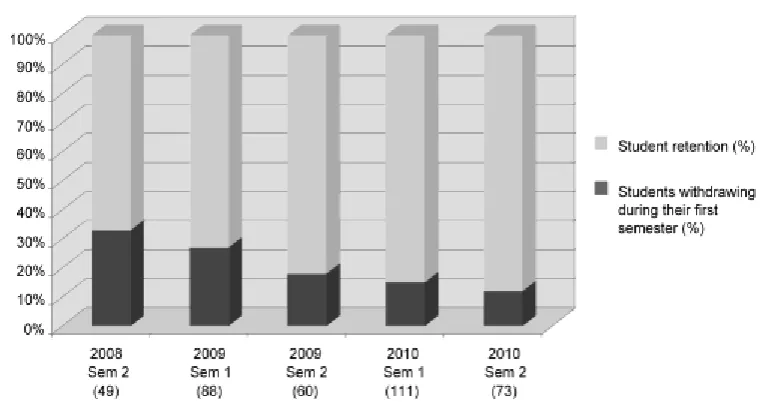
For example, Figure 1 shows that fewer students are withdrawing during their first semester, which is an indication that the support offered is making a difference.
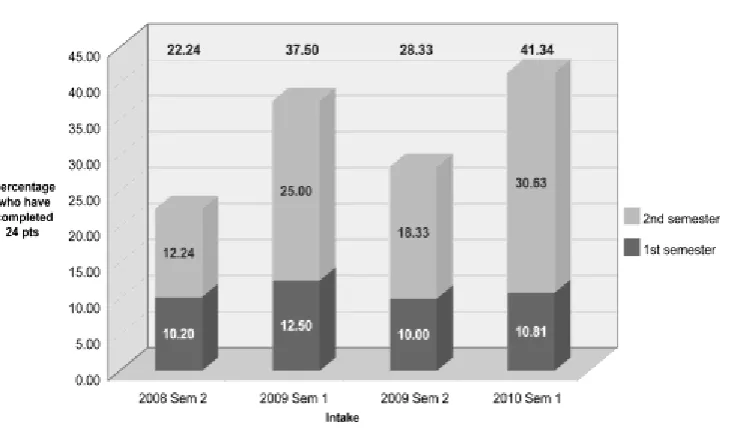
promising indicator. Over the next 5-10 years, we hope to see this upward trend continue, although the increase is likely to be more incremental than dramatic.
We will continue to compile quantitative feedback to gauge our progress and guide our future development as part of a robust evaluation cycle that also includes qualitative data. Qualitative evidence in the form of student feedback, both formal and informal, is also a valid form of evidence, and one that provides a depth and richness that is often unavailable in more standardised evaluative surveys (Spark & Trimble, 2001). Therefore, we contend that the positive trend in retention and passing in enrolled units—taken together with some qualitative data from ongoing evaluations—means that it is reasonable to
assume that the evolving MAPs to Success Project is itself successful in its dual aims of a) Enhancing student retention by providing ongoing academic and social support in a flexible and personalised manner and b) Reducing the potential harm of underprepared students incurring a personal and/or financial cost through over-enrolling or failing to withdraw before the HECS Census Date.
We will continue to compile quantitative feedback to gauge our progress and guide our future development as part of a robust evaluation cycle that also includes qualitative data. Qualitative evidence in the form of student feedback, both formal and informal, is also a valid form of evidence, and one that provides a depth and richness that is often unavailable in more
standardised evaluative surveys (Spark & Trimble, 2001). Therefore, we contend that the positive trend in retention and passing in enrolled units—taken together with some qualitative data from ongoing evaluations—means that it is reasonable to assume that the evolving MAPs to Success Project is itself successful in its dual aims of a) Enhancing student retention by providing ongoing academic and social support in a flexible and personalised manner and b) Reducing the potential harm of underprepared students incurring a personal and/or financial cost through over-enrolling or failing to withdraw before the HECS Census Date.
Of the 91 students enrolled in MAP in Semester 1 2010, 30 (33%) responded to the on-line evaluation. Overall, 87%
(26/30) of the respondents were either “very satisfied” or “mostly satisfied” with the level of support offered in their first semester, and 77% (23/30) were either “very satisfied” or “mostly satisfied” with respect to their study experience. Typical comments include:
Good to touch base with people who care about your progress. Working full time means you don't hang around between or after lectures to socialize and experience “Uni life.” The early contact with people who appear interested in your well being was reassuring.
Everyone I approached was very helpful and made me feel special in spite of their need of having to deal with hundreds of students.
It was everything and more I had ever hoped it would be. I am especially grateful for the very first information evening when Dr Christensen explained about the “invisible” unit of getting used to the whole new culture. I often reflected on that when I felt I was getting overwhelmed and felt a bit better telling myself it was just the ”invisible” unit.
There were 52 MAP students in total who signed up for a study group in 2010 across a range of 37 different study groups. Around 25-30 attended one of a series of six Getting Started Workshops, covering some basic learning skills, that were held on Saturday mornings and repeated during the week, although the second session was less well attended and has subsequently been dropped in favour of podcasting. Also, many of the MAP students who attend classes during the week take advantage of STUDYSmarter’s generic workshop program. Those who did attend the workshops commented on their usefulness:
I find the conversational aspect of the units beneficial. I find this a better way to learn than to have someone in a “teaching” role.
I attended as many as I could timetable allowing. They were very beneficial as they allowed me an opportunity to ask some questions as well as receive info, also to meet up with other mature students.
Fantastic workshop. I wish I had more free time to come to more!
Another small positive outcome of the ongoing information and support supplied by the MAPs to Success Team is that the Admissions Office staff have observed that a larger percentage of students enrolled
through the MAP project withdraw on time if needed (before Census date) when compared with the standard entry students. Whether or not these withdrawing MAP students are LSES, it seems that the ongoing advice and regular reminders about key dates have enabled them to make a decision that limits both financial and personal cost of withdrawing from studies. In turn, of course, this means that re-entry at a later date is not unnecessarily compromised, either administratively or through the student feeling a sense of failure or shame.
Finally, on a very positive note, a major milestone was reached this year when two students from the original cohort (Semester 1 2008) completed their degrees in July 2011, both within the standard three year period.
Conclusion
Schuetze & Slowey (2002) reviewed how educational policy either inhibited or contributed to equitable participation in 10 countries. They make a strong argument that the key is not simply increasing numbers, but rather a shift of culture to a lifelong learning model. One of their strongest recommendations is that policy and institutions should provide “the opportunity for individuals to be able to gain access to higher education over the entire life-course” (p. 325). By providing support over and above a specific entry pathway, the MAPs to Success project contributes to this goal. One example of the specific provisions is the Saturday morning study skills workshop series. This
Atweh & Bland (2007) detail a series of barriers to equitable participation in higher education. Some of these barriers, such as poverty, are large and systemic. As they acknowledge, having a major impact on such systemic issues is beyond the scope of individual institutions and programs. In a small way, however, the UniSkills component of the MAPs to Success
project tackles the problem by alerting students to the existence of various scholarships, bursaries and financial aid, and encouraging them to apply for relevant sources of funding. As previously mentioned, great care is also taken to ensure students are aware of the how to avoid incurring an unnecessary HECs debt. From the very first pre-enrolment information session, the MAPs to Success
project openly challenges another of the barriers mentioned by Atweh and Bland: “myths about university”—specifically, in this case that real students are full time students. Incoming MAP students are strongly encouraged to study part time, at least initially, and reassured that this is a legitimate as well as strategic approach to study success.
The work of Krause, et al. (2005) is the most comprehensive longitudinal study of the First Year Experience in Australian Universities. Their data is explicitly incorporated into the pre-enrolment MAP Study Essentials session as part of the diagnostic. By drawing on Krause as the basis for the mini-lecture, the MAP students are triply exposed to the culture of University. Firstly, they are specifically told at the beginning: “This is a lecture theatre, if you come to University this is where you will be spending a significant portion of your time as it is a classic university activity.” Secondly, they are informed that the basis of the mini-lecture
they are about to hear is from a longitudinal study, and this concept is decoded. Again it is explicitly pointed out that this is what academics do—academic judgement is based on research. Finally, they are told that the data is derived from the experiences of many Australian students and therefore is deeply relevant for successfully navigating their own first year experience. As well as answering five multiple choice questions, students are then asked to write 250 words or more in response to the question: “Identify one or more of your motivations for studying at University. Discuss the potential strengths and challenges you face as a mature age student and indicate any strategies you may use to overcome the challenges.” This both tests their ability to listen, comprehend and write, while simultaneously reinforcing the research-based best practice strategies.
The imperative to demystify the nature of University culture also underlies the provision of the pre-enrolment MAP Study Essentials one day seminar. During this seminar students are encouraged to form networks with each other, and at the same time they are exposed to a wide range of University systems and terminology. As Davig & Spain (2004) discovered: “If a student did not have exposure to study skills, advising information, curriculum planning, group activities, and campus tours, they were less likely to re-enroll” (p. 305).
follows many of the recommendations of Skene et al. (2009) who assessed ways to overcome the barriers faced by mature age students in the Arts Faculty at UWA. These included providing information sessions, building community and social networks, peer mentoring and flexible options.
Of course, clarifying the nature of the existing culture is only a part of the necessary work. In the concluding words of their paper, Gale and Tranter (2011) provide a succinct statement of the more difficult part of creating equitable participation:
In a context of higher education for the masses, recognitive justice requires a
deeper understanding of the
knowledges, values and understandings that all students bring to university. And this necessarily implies creating spaces for them, not simply creating more places. (p. 43)
MAPs to Success is designed to make such spaces available. Every aspect from the “open door” policy to the provision of relaxed informal social events creates an opportunity for students from diverse backgrounds not only to take their place in the institution but also to contribute to changing the culture in multiple, diverse and intellectually rich ways.
Clearly, the MAPs to Success projectis in its infancy. The actual entry route via MAP has only been available since mid-2008. Given that many are enrolled part time and the cohort is relatively small, any statistics can only be regarded as indicative. However, even at this early stage, the MAPs to Success project is consistent with the research that indicates early investment in key academic skills and building social networks are crucial to a positive first year
experience. Widening participation in higher education is not simply a matter of increasing the numbers of students enrolled. The satisfactory experience of studying and completing a university degree, particularly when students are diverse in their identities, their level of preparation for higher studies, and their entry pathways, requires a level of support that is both timely and individualised as much as possible. This is what the MAPs to Success Project has been able to achieve.
References
Aird, R., Miller, E., van Megen, K., & Buys, L. (2010).
Issues for students navigating alternative pathways to higher education: Barriers, access and equity. A literature review prepared for the Adult Learner Social Inclusion Project. Queensland University of Technology, Brisbane, Australia.
Atweh, B., & Bland, D. C. (2007). Social disadvantage and access to higher education: What potential students don’t know and how to address their needs. In P. L. Jeffery (Ed.),
Proceedings of the Australian Association for Research in Education Annual Conference 2007. Fremantle, Australia. PDF available from QUT ePrints, http://eprints.qut.edu.au/13526/ Bradley, D., Noonan, P., Nugent, H., & Scales, B. (2008).
Review of Australian higher education. Final report. Canberra, Australia: Commonwealth of Australia. Available at http://www.deewr.gov.au/HigherEducatio n/Review/Pages/ReviewofAustralianHighe rEducationFinalReport.aspx
Davig, W. B., & Spain, J. W. (2004). Impact on freshmen retention of Orientation course content: Proposed persistence. Journal of College Student Retention,5(3), 305-323.
Eggens, L., van der Werf, M. P. C., & Bosker, R. J. (2007) The influence of personal networks and social support on study attainment of students in university education. Higher Education, 55(5), 553-573.
Evans, M. (2000). Research papers planning for the transition to tertiary study: A literature review. Retrieved January 20, 2011, from http://www.ulster.ac.uk/star/resources/li terature_transition.pdf
Gale, T. & Tranter, D. (2011). Social justice in Australian higher education policy: An historical and conceptual account of student participation. Critical Studies in Education, 52(1), 29-46.
James, R., Baldwin, G., Coates, H., Krause, K-L., & McInnis, C. (2004). An analysis of equity groups in higher education 1991-2002. Department of Education, Science and Training. Canberra, Australia: Commonwealth of Australia.
Krause, K., Hartley, R., James R., & McInnis, C. (2005).
The first year experience in Australian universities: Findings from a decade of national studies. Canberra, Australia: AGPS.
Available at
http://www.cshe.unimelb.edu.au Lawrence, J. (2002, July). The “deficit-discourse” shift:
University teachers and their role in helping first year students persevere and succeed in the new university culture. Paper presented at the 6th Pacific Rim First Year in Higher Education Conference, “Changing Agendas - Te Ao Hurihuri.” Christchurch, New Zealand.
McKenzie, K., & Gow, K. (2004). Exploring the first year academic achievement of school leavers and mature-age students through structural equation modelling. Learning and Individual Differences, 14, 107-123. Retrieved February 9, 2011, from http://www.sciencedirect
Schuetze, H. G., & Slowey, M. (2002). Participation and exclusion: A comparative analysis of non-traditional students and lifelong learners in higher education. Higher Education, 44,
309–327. Retrieved January 15, 2011, from http://www.springerlink.com/ Skene, J., Broomhall S., Ludewig, A., & Allen, D. (2009).
Examining barriers for mature-age students in the Faculty of Arts, Humanities and Social Sciences. Retrieved December 8, 2010,
from
http://www.transition.uwa.edu.au/__data /page/17614/Mature_Age_Report_2009.p df
Spark, M., & Trimble, K. (2001, December). Innovation in education – towards a qualitative approach to higher education stakeholder feedback. A working paper. (AARE paper code SPA01256). Prepared for presentation at the AARE Conference, held at the University of Notre Dame, Fremantle, Australia.
Tones, M., Fraser, J., Elder, R., & White, K. M. (2009). Supporting mature-aged students from a low socioeconomic background. Higher Education, 58(4), 505-529.