(Student Teacher Perspectives), 4 (4). pp. 30-41.
Downloaded from: http://insight.cumbria.ac.uk/id/eprint/3401/
Usage of any items from the University of Cumbria’s institutional repository ‘Insight’ must conform to the following fair usage guidelines.
Any item and its associated metadata held in the University of Cumbria’s institutional repository Insight (unless stated otherwise on the metadata record) may becopied, displayed or performed, and stored in line with the JISC fair dealing guidelines (available here) for educational and not-for-profit activities
provided that
• the authors, title and full bibliographic details of the item are cited clearly when any part of the work is referred to verbally or in the written form
• a hyperlink/URL to the original Insight record of that item is included in any citations of the work • the content is not changed in any way
• all files required for usage of the item are kept together with the main item file. You may not
• sell any part of an item
• refer to any part of an item without citation
• amend any item or contextualise it in a way that will impugn the creator’s reputation • remove or alter the copyright statement on an item.
The full policy can be found here.
Citation
How can tinkering activities support the teaching of iterative design at key stage three in design and technology?
The STeP Journal Student Teacher Perspectives
Copyright © 2017 University of Cumbria Vol 4 (4) pages 30-41 Harry Gowlett
Nottingham Trent University
Abstract
The importance of adopting the iterative design process when teaching design and technology (D&T) in secondary schools has grown. Resulting from new GCSE D&T specifications, the way practitioners teach D&T is rapidly changing to prepare learners studying the subject. Successful practitioners of the subject strive to find ways to adopt engaging pedagogical techniques to support the teaching of iterative design. This research study aims to explore the ways that tinkering activities can enhance existing schemes of work at key stage three in line with National Curriculum requirements, preparing learners ready for the new GCSE D&T specifications.
This research study has used a range of research methodology producing both qualitative and quantitative data, allowing for cross-referencing of findings to make links and distinctions. The focus of the study has been on two key stage three classes, allowing the study to find out whether the tinkering activities created aided learning whilst supporting the introduction of the iterative design process. Observations of these activities by experienced D&T teachers supported the research, as well as learner centred questionnaire data collected before and after tinkering.
The results from this study show that tinkering activities have a positive effect on supporting the teaching of iterative design at key stage three. The study also provides activities that are suitable for embedding into existing schemes of work, which are suited to most D&T departments in the process of making gradual changes to the way in which they approach D&T at key stage three.
Introduction
The way design and technology (D&T) is taught in secondary schools is constantly evolving to meet the needs of the technological society that we live in. This presents the problem that D&T practitioners need to continue using modern pedagogical techniques that meet the needs of the National Curriculum (NC) for D&T (DfE 2014), whilst meeting the needs of a diverse range of learners with varying learning styles studying the subject. This research study aims to examine the concepts of iterative design and tinkering, and how these can be applied effectively when teaching D&T. Throughout this study links between tinkering and iterative design to aid learning progress within D&T are shown.
The choice of the topic studied is resulting from teaching in two contrasting secondary schools during my initial teacher training professional practice year. This made me realise the need to explore and develop exciting opportunities to teach D&T in an engaging way by using modern concepts such as tinkering.
Literature Review
This literature review has four key sections: 1. Iterative Design
2. Tinkering
4. Using literature to inform practice
Each section will analyse and explore literature relevant to the topic. Throughout this research study, there are links between research and design relevant to the study. Research is concerned with u de sta di g hat is… a d design questions hat if… eati g e ideas ased o fi di gs (Kimbell and Stables 2009).
Iterative Design
In the early stages of D&T education, there was an expectation that learners would all follow a design process guided by one common prescription. This included three linear stages: analysis, synthesis and evaluation (Vries 2005). As time went on the realisation that this linear process was too simplistic became apparent, with learners not being allowed to experiment with new ideas. This identified the need to modernise how we perceive the design process and teach it in D&T.
The Design and Technology Association (DATA) have advocated that secondary school D&T teachers should be adopting the iterative design process. Research by the technology education unit at Goldsmiths College for schools informed the development of the iterative design process in a school context. Their research has helped to develop a clear definition of iterative design:
Iterative design is a design methodology based on a cyclic process of prototyping, testing, analysing, and refining a product or process. Based on the results of testing the most recent iteration of a design, changes and refinements are made
(DATA 2016).
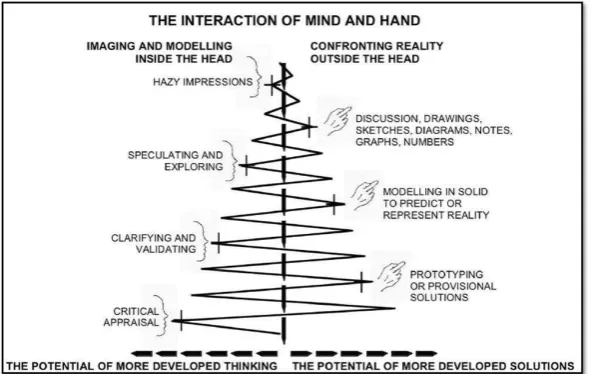
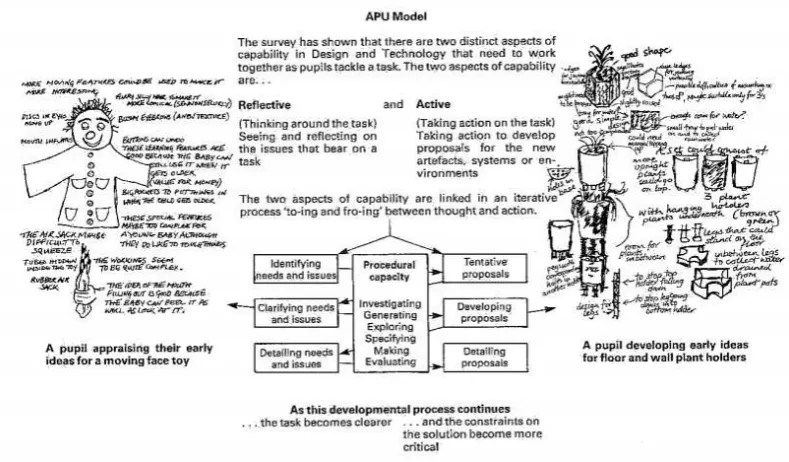
The iterative design process rejects the more formulaic, linear models of the design process presented within D&T. Kimbell and Stables (2009) presented the Assessment of Performance Unit (APU) model (shown below), which is now commonly known as the iterative design process.
Figure 1. APU model of the design and technology process (Kimbell and Stables 2009, p.601).
Figure 2. APU model example (Eggleston 2001, p.59).
A more modern and simplistic representation of the iterative design process is shown below. This shows how the process of D&T is not a set journey. Learners may take a different and more personalised journey in order to reach their goals. Robson (2016) highlights how the iterative process is much nearer to how professional designers approach their work, rather than the previous linear model used.
Figure 3. Design process as iteration (Robson 2016, p.64).
out the knowledge, understanding and skills required to undertake the iterative design process of e plo i g, eati g a d e aluati g (AQA 2017, p.9). This shows that it is essential to teach the iterative design process at GCSE level, and perhaps just as importantly during KS3.
Tinkering
Tinkering is a growing concept referring to o ki g-and learning- ith ou ha ds (Wilkinson 2013, p.4). This allows learners in a D&T context to explore materials and tools to realise solutions to problems. Spendlove (2008) supports this by describing that D&T has the unique feature that learners learn by doing, through taking action. Doorley (2012) expands on this, offering a more suitable definition of tinkering in an educational context. Doorley states that a tinkerer is someone “who experiments with materials and ideas to fully understand their capacities, and who further iterates on thei lea i g to fi d ette solutio s to u e t p o le s. To be a successful tinkerer it is important to gain a hands-on experience, learning from failures and having an unstructured time to explore and invent, allowing for innovation.
There are many examples of how tinkering has been used within society, however, sadly, within education tinkering is currently less commonly used. This provides an opportunity to create ways to embed the principles of tinkering within the D&T curriculum. To do this, I have researched examples of where and how tinkering is currently used to fully understand the concept. Tulley (2009), the founder of the Tinkering School describes how he would allow learners to be trusted with tools and ould ake all ate ials a aila le fo use. He o eptualises the pu pose of ti ke i g stati g that nothing ever turns out as planned, therefore by allowing learners to be creative and hands on with materials and tools/equipment they will realise solutions to problems independently.
Using tinkering as a pedagogical tool within D&T is very effective in responding to a differentiated classroom where learners focus on learning by doing through a constructivist method. Critics of the tinkering concept within schools state that tinkering is good for one type of learner and not others. It is important to understand that tinkering is not just for the lea e s ho a t do egula o k. Teaching in a way that nurtures a tinkering mind-set in the classroom allows all learners to learn in their own style (Martinez and Stager 2013). This is required to be a successful teacher and to meet the teaching standards, relating to meeting the needs of all learners (DfE 2013).
After researching about tinkering, it is now important to think about whether there is a place for tinkering within both the NC and the new GCSE D&T specifications. The NC states that lea e s lea ho to take isks, e o i g esou eful, i o ati e, e te p isi g a d apa le itize s (DfE 2014, p.1). This sentence summarises tinkering according to the literature studied. Tinkering can fit into many parts of the NC, for example under the design section, where learners identify and solve their own design problems. Tinkering lends itself to this by being a learner centred experience allowing for creative ideas. The Department for Education guidelines for the subject content of GCSE D&T further iterates on the skills learnt at KS3. It describes how learners are required to explore design and make opportunities (DfE 2015), tinkering supports this by being a useful tool for exploration if utilised appropriately.
Similarities and Differences
learning –the ou ha e e el a s eatshop e talit of aki g thi gs . This shows that tinkering is o e o e ed ith taki g a tio a d ite ati e desig ith lea i g , hilst oth aspe ts also demonstrate pa ts of the doi g a d the lea i g . If small scale tinkering activities are embedded within iterative design tasks, then learners are enabled to access high quality learner centred D&T.
A key similarity between iterative design and tinkering is that both concepts link to discovery based constructivist learning. This is e ause ti ke i g a ti ities d a upo the lea e s p io k o ledge of materials and equipment, which interacts with new knowledge offered through the curriculum in the case of iterative design (Burton 2016). Both tinkering and iterative design also allow learners to realise that they can learn by making mistakes, creating a fail-forward mind-set. This allows learners to take more risks with their work without the fear of being wrong and avoiding fixation on one single idea, this is an area that I have reflected on during professional practice.
Using literature to inform practice
From my professional practice in two contrasting schools and from engaging with the D&T community more widely, it has become clear that currently there is an ambiguity about the teaching of iterative design. For example, during my professional practice, I created a classroom display introducing iterative design which prompted learners to comment that they were unclear on the concept. This provides an exciting opportunity to research modern teaching strategies to support the iterative process of D&T; this is where tinkering offers such opportunity. The research focus chosen also allowed me to develop my teaching practice by producing engaging lessons, which was a key development target during my professional practice. It also allowed me to develop my subject knowledge by further exploring tinkering and iterative design whilst applying this understanding to my practice.
After researching and analysing literature relevant to the study, it is now important to choose an appropriate methodology to collect meaningful data about the topic. Due to the amount of time available to carry out the research, the methodology will focus on using the principles of iterative design and tinkering within existing schemes of work at KS3, following the NC for D&T. The activities designed are small-scale activities available to use immediately to aid the development of schemes of work. The study will also have heavy links to learner centred teaching strategies based on the constructivist learning style.
Methodology
As this research study focusses on iterative design and tinkering as being hands on concepts, it is important that the methodology chosen must relate closely to this. The main feature of this study is using tinkering activities informed by literature to make learners aware of iterative design across the D&T curriculum to help integrate technologies. I have designed a range of tinkering activities using literature and my pedagogical knowledge. Outlined in this section of the study are the two activities focussed on when collecting research data.
The first tinkering activity involves making all materials/equipment available when introducing a new project (Doorley 2012, Tulley 2009). Creating a tinkering station allowed learners the chance to interact with materials whilst completing introductory activities to a new project. To accompany the materials/equipment was a tinkering help sheet to support the learners as they explore the materials. For the research study the focus for this activity has been resistant materials at KS3, however this activity lends itself to use across the whole D&T curriculum.
The teacher will demonstrate the concepts of a practical activity and will prepare examples at different stages of development for the learners to tinker with during the lesson. The learners will then be able to become hands on with the practical task (Eggleston 2001), identifying that there is more than one way to complete the activity, making the link to iterative design. For this research study, the focus for this activity has been textiles at KS3.
To test the effectiveness of using the tinkering activities to make learners aware of iterative design I decided to use a range of research methods including observation, unstructured interviews and questionnaires, alongside conducting a pilot study. These methods are most suited to the time scale available to complete the research study. If the study had a longer time scale, I may have chosen different research methods to reflect the longitudinal potential of the research.
To obtain a learner perspective on the effectiveness of my research I designed a questionnaire, which the learners would complete at the start and end of the lesson. Due to the size of the classes in the study, structured questions were utilised to produce quantitative data that can be analysed more effectively showing a comparison before and after tinkering. Sharp (2012) supported this by stating that structured questionnaires using closed questions are easier to analyse and more suited to large sample sizes.
Initially, I produced two questionnaires with differing questions, specifically for the start and end of the lesson. However, as a result of completing a pilot study I found that the questions I had produced were leading questions, which suggested to the learner the response that I wanted to see, resulting in data with low validity. Therefore, both the start and end of lesson questionnaire presented the same questions, for standardisation. This reduces the scope for interpersonal factors to affect the data collected (Denscombe 2014). A t ap uestio as i luded to e su e the alidit of results and that the learners read the questions properly before answering.
The second method of data collection used was observation of my teaching using a checklist informed by literature. The main purpose of using observation is to validate the data collected from the learners by collecting qualitative data that is rich in detail. The method of observation chosen was structured observation; Bell (2010) suggests that this method was suitable, as the objectives of the research study are decided. The use of a structured checklist to record observations on helps to focus the observer, rather than making observations that are not relevant to the study.
To ensure that the observations carried out are in line with the research study, the observer received a briefing before the lesson about the aims of the study. The observer is also the normal class teacher, so the risk of the Hawthorne effect (where lea e s behaviours have the potential to change because an outside observer being present in the lesson) are removed (McCambridge, Witton and Elbourne 2014). Thomas (2013) iterates this by stating that if an outside observer shows an interest in a learner, it is likely to spark enthusiasm, and add extra energy to the research situation.
Participants
As the study aims to support the teaching of iterative design through tinkering activities, I decided to focus on two different material areas of D&T, to distinguish similarities and differences. Another criterion for the classes studied is that they would have to be in KS3. The classes chosen to take part in the study are a year seven textiles and a resistant materials class. I was the main teacher for both classes, which supported the development of my professional practice against the teaching standards. In each class, there were twenty-four mixed ability learners, some of which are gifted and talented, pupil premium and special educational needs learners.
Another factor considered when choosing the participants of the study links to the ethics of data collection. Walliman (2011) suggests that when researching vulnerable participants (children) it is important to speak to an experienced practitioner about how to approach the research collection. Therefore, I had a discussion with the head of department at my professional practice school to discuss how was best to approach collecting data from the classes being studied, in line with both school and university ethics policy. A letter sent to the parents/guardians of each learner explained the research collection process and provided contact details if they had any questions. The data collected is anonymous, so there is no need for a formal consent form from each learner.
Findings
This section of the research study will highlight a range of findings resulting from conducting primary research. As outlined earlier the research methods selected included; questionnaires (quantitative data), observations (qualitative data) and a pilot study all informed by relevant literature.
Questionnaire Findings
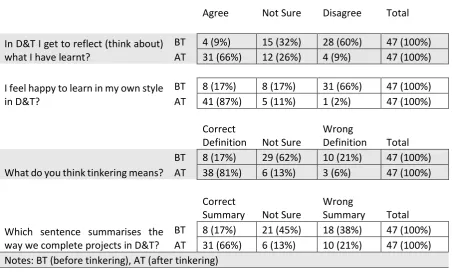
Learners in each class completed a start and end of lesson questionnaire, using closed questions (that also linked to the observation points). Below is a table of the results, providing a comparison of before and after completing the tinkering activity. These results combine both the year seven textiles and resistant materials classes showing an overall effectiveness of tinkering activities:
Table 1. Questionnaire Findings.
Agree Not Sure Disagree Total
In D&T I get to be hands on with my learning?
BT 4 (9%) 11 (23%) 32 (68%) 47 (100%) AT 39 (83%) 7 (15%) 1 (2%) 47 (100%)
I can make mistake in D&T?
BT 0 (0%) 9 (19%) 38 (81%) 47 (100%) AT 40 (85%) 6 (13%) 1 (2%) 47 (100%
I can be creative with materials and equipment in D&T?
BT 5 (11%) 7 (15%) 35 (74%) 47 (100%) AT 41 (87%) 6 (13%) 0 (0%) 47 (100%)
Everyone in the class follows the same process in D&T?
BT 26 (55%) 11 (24%) 10 (21%) 47 (100%) AT 6 (13%) 11 (23%) 30 (64%) 47 (100%)
In D&T there is more than one starting point for a project?
BT 4 (8%) 22 (47%) 21 (45%) 47 (100%) AT 32 (68%) 12 (26%) 3 (6%) 47 (100%)
I am feeling positive about this lesson?
Agree Not Sure Disagree Total
In D&T I get to reflect (think about) what I have learnt?
BT 4 (9%) 15 (32%) 28 (60%) 47 (100%) AT 31 (66%) 12 (26%) 4 (9%) 47 (100%)
I feel happy to learn in my own style in D&T?
BT 8 (17%) 8 (17%) 31 (66%) 47 (100%) AT 41 (87%) 5 (11%) 1 (2%) 47 (100%)
Correct
Definition Not Sure
Wrong
Definition Total
What do you think tinkering means?
BT 8 (17%) 29 (62%) 10 (21%) 47 (100%) AT 38 (81%) 6 (13%) 3 (6%) 47 (100%)
Correct
Summary Not Sure
Wrong
Summary Total
Which sentence summarises the way we complete projects in D&T?
BT 8 (17%) 21 (45%) 18 (38%) 47 (100%) AT 31 (66%) 6 (13%) 10 (21%) 47 (100%) Notes: BT (before tinkering), AT (after tinkering)
Observation Findings
To support the findings of the questionnaire completed by the learners, observations were made of lessons including the tinkering activities. This allowed me to find common themes between both tinkering activities studied. Shown below are some of the similarities between tinkering activities:
Table 2: Observation Findings.
Point Explanation During the lesson…
1 Has the design/make process been demonstrated as being cyclic (iterative)? (DATA 2016)
Obs. Projects at KS3 have limitations as learners produce the same outcome. The way the tinkering activities taught made learners appreciate that in theory there are different outcomes/options available.
2 Have the learners reflected on the design/make task? (Eggleston 2001)
Obs. Questionnaire at the start and end of the lesson to reflect on how they are feeling. Discussions throughout lessons relating to tinkering/iterative design.
3 Have the learners been hands on/active with the design/make task? (Eggleston 2001) Obs. Each tinkering activity encourages learners to use the tinkering station. Teacher
encouragement during the lesson promoting the hands-on approach to learning.
4 Are the learners aware that the design/make process can be approached in different ways? (Robson 2016)
Obs. Learners had the choice to use tinkering station or to bring materials/equipment to their own place to tinker. Questioning skills allowed learners to understand the meaning and application of iterative design.
5 Have the learners been enabled to explore the materials/equipment required for the design/make project? (Doorley 2012, Tulley 2009)
Point Explanation During the lesson…
6 Has D&T ee p o oted th ough a lea i g doi g fashio ? (Spendlove 2008)
Obs. Lea e s a le to sea h a d fi d e uip e t a d e ou age to ti ke /ha e a go ith tools. Learners learnt through doing/looking/touching.
7 Has the teacher nurtured an environment that allows learners to learn in their own style? (Martinez and Stager 2013)
Obs. Tinkering station especially a good resource for lower ability learners. Example materials/equipment allow learners to investigate while also providing guidelines for support.
8 Have the learners learnt how to take risks, become resourceful, innovative, enterprising, and capable citizens? (DfE 2014)
Obs. Learners gained confidence through discovery learning process. Learners noted discussing work without being formally directed which was great to see. Level of student engagement noted as super with a good pace.
Notes: Obs. = observations made
Unstructured post-observation interview
It was appropriate to have an unstructured post-observation interview with the teacher observing each lesson. This allowed me to make some additional notes to support the observation. These points included some more suggestions for tinkering activities such as:
To support the tinkering station, i lude a ha e a go section e.g. screw a screw in or cut some fabric.
Allowing learners to have a tinker with a specific piece of equipment (more supervised). Having a tinkering station specifically for low ability learners (having some form of
differentiation).
Analysis of Findings
The main aim of this research study was to address the problem that there is an ambiguity of how to teach iterative design, especially in the KS3 curriculum. Because of using a range of different research methods, I have been able to cross-reference my findings to make links and comparisons. It became apparent that tinkering activities had a positive effect on the classes studied and the atmosphere during the lessons was positive with a real energy in the classroom. It was interesting to note that although the study includes two different tinkering activities, the results between the classes were similar. This allowed the data to be merged together to form an overall picture of the effectiveness of tinkering activities.
Resulting from carrying out a pilot study, the findings taken from the participants of the study showed more validity. The data collected do show some anomalies, for example, after analysing the questionnaire data collected it became apparent that a small minority of learners may had misunderstood the questions and guessed answers. In addition, the results collected from a learner with special educational needs may be low in validity as the teaching assistant (TA) working with this learner guided them to the correct answer; this according to Cohen (2011) is an external factor, contributing towards an anomaly in the results. This factor would however most likely only affect the result of one learner. Blatchford (2009) found that typically in secondary schools TAs work with an i di idual lea e a d ill o e the lass oo if e essa y. I observed this whilst teaching where the TA present stayed with an individual learner whilst the research was being collected.
81% gave the correct definition (Table 1). Similarly, learners became more aware of the iterative process of designing and making, which DATA (2016) advocate, before the tinkering activities only 17% of learners realised that they have the potential to approach D&T in a range of different ways. After tinkering, it became evident that the learners had reflected on the way they approach D&T projects and 66% of learners were aware that there are several different approaches (Table 1), supporting the emergence of the iterative design process within the subject.
It was also pleasing that the observation forms completed by experienced teachers found that both classes studied reacted positively to the tinkering activities (Table 2.). During the textiles tinkering activity, the experienced teacher observed that the engagement of the class was maintained throughout with good pace, leading to good progress made. The teacher carrying out the observation was also pleased to note that the learners showed a genuine interest with the tinkering activity. This was noted through observing the conversations of the class which were all conversations relating to the lesson. For me as a practitioner another pleasing factor when using the tinkering activity designed using literature, was the reduction of low-level disruptive behaviour. This allowed me to focus and reflect in my professional development record on the development of my use of positive behaviour management.
However, if a non-familiar teacher was to introduce the tinkering activity the results may differ. For example, as I have been teaching the classes studied for several weeks prior to the research carried out I had built a rapport with the classes. Therefore, the class were aware of my expectations and the way in which they should work during a lesson. This links to the teaching standards and developing my practice, but also aided the research by setting clear routines and expectations (DfE 2013). The learners felt engaged with the lesson and had clear outcomes expressed to them to aid the research. The observations showed that learners had a clear engagement with the lesson with a clear grasp on what to do. Positive relationships with the classes studied was noted; over both classes 92% of learners were feeling positive after completing the tinkering activity (Table 1). This finding was important as it supported many observation points, in particular nurturing an environment that allows learners to learn in their own style (Martinez and Stager 2013).
After analysing the research data collected, the study supports the hypothesis that tinkering activities can support the teaching of iterative design at KS3 in D&T. Learners felt able to experiment with materials and ideas to understand their capacities, a key fundamental aspect of tinkering according to Doorley (2012). They were then able to iterate on their learning to find solutions to problems, as advocated by DATA (2016). This means that learners are oth eeti g Doo le s definition of tinkering, whilst becoming iterative, which DATA advocates within D&T.
Implications
This research study has been successful in using triangulation to collect data, which has then allowed for cross-referencing of the data collected when being analysed. If the study became a longitudinal study, a more intricate study of the effectiveness of using tinkering activities to support iterative design over a longer period would emerge. This longitudinal research method would allow the researcher to examine the effect of time on the variable or variables (O'Leary 2017), which in this case would be tinkering activities in relation to iterative design. This research methodology was not suitable for this study due to time constraints; there was not enough time to collect data at intervals sufficiently far apart to show any meaningful analysis.
structured interview would have been more appropriate. This would allow data to be collected under a pre-determined set of questions (Thomas 2013). However, this method would not allow for scope for further follow up, which I achieved from the unstructured interview carried out during the study where the teacher observing the tinkering lesson did not feel bound into a pre-determined set of questions.
Conclusion
One key highlight of this research study for me as a practitioner was when a learner said to me in the lesson following the tinkering activity:
Sir, are we going to be tinkering again today? (Learner).
This was a real highlight for me and showed that the learners valued the learning experience created through the tinkering activity. The main aim of this study was to examine the concepts of iterative design and tinkering, and effectively applying the concepts to my teaching, to enhance learner progress. This research study has proved the point that tinkering activities can support the teaching of iterative design at KS3 in D&T, by demonstrating to learners the many ways of approaching projects in the subject. In the future, I hope to maintain using tinkering activities as a catalyst for allowing learners to become iterative within their work.
References
AQA, 2017. GCSE Design and Technology: Specification [online]. Assessments and Qualifications Alliance. Available at: www.filestore.aqa.org.uk/resources/design-and-technology/specifications/AQA-8552-SP-2017.PDF [Accessed 04/03 2017].
Bell, J., 2010. Doing your research project : a guide for first-time researchers in education, health and social science. Fifth edition. Maidenhead : McGraw-Hill Open University Press.
Blatchford, P., et al., 2009. The effect of support staff on pupil engagement and individual attention. British Educational Research Journal, 35 (5), 661-686.
Burton, D., 2016. Ways pupils learn. In: S.A. Capel, M. Leask, and S. Younie, eds., Learning to teach in the secondary school : a companion to school experience. Seventh edition. London: Routledge, 2016, pp. 327.
Cohen, L., 2011. Research methods in education. Seventh edition. London: Routledge.
DATA, 2016. The Iterative Design Process [online]. The Design and Technology Association. Available at: www.data.org.uk/for-education/curriculum/the-iterative-design-process/ [Accessed 04/02 2017].
Denscombe, M.a., 2014. The good research guide [electronic resource] : for small-scale social research projects. Fifth edition. Milton Keynes: Open University Press.
DfE, 2015. Design and technology: subject content [online]. Department for Education. Available at: www.gov.uk/government/uploads/system/uploads/attachment_data/file/473188/GCSE_desi gn_technology_subject_content_nov_2015.pdf [Accessed 04/02 2017].
DfE, 2014. The national curriculum in England. December edition. England: Department for Education. DfE, 2013. Teachers' Standards [online]. Department for Education. Available at: https://www.gov.uk/government/uploads/system/uploads/attachment_data/file/301107/Tea chers__Standards.pdf [Accessed 04/25 2017].
Doorley, R., 2012. What is Tinkering? [online]. Tinker Lab. Available at: http://tinkerlab.com/what-is-tinkering/ [Accessed 03/25 2017].
Eggleston, J., 2001. Teaching design and technology. Third edition. Buckingham, Phildelphia: Open University Press.
Martinez, S. and Stager, G., 2013. Invent to Learn: Making, Tinkering and Engineering in the Classroom. First edition. Torrance: Constructing Modern Knowledge Press.
McCambridge, J., Witton, J. and Elbourne, D.R., 2014. Systematic review of the Hawthorne effect: New concepts are needed to study research participation effects. Journal of Clinical Epidemiology, 67 (3), 267-277.
O'Leary, Z., 2017. The essential guide to doing your research project. Third edition. London: SAGE Publications Ltd.
Robson, J., 2016. Preparing to teach design. In: G. Owen-Jackson, ed., Learning to teach design and technology in the secondary school : a companion to school experience. Third edition. London: Routledge, 2016, pp. 57.
Sharp, J., 2012. Success with your education research project [electronic resource]. Second edition. London : Learning Matters.
Spendlove, D., 2008. 100 ideas for teaching design and technology. London: Bloomsbury Education. Thomas, G., 2013. How to do your research project [electronic resource] : a guide for students in
education and applied social sciences. Second edition. London: SAGE Publications Ltd.
Tulley, G., 2009. Life lessons through tinkering [online]. Think, exchange, debate. Available at: www.ted.com/talks/gever_tulley_s_tinkering_school_in_action/transcript?language=en [Accessed 03/01 2017].
Vries, M.d., 2005. Teaching about technology [electronic resource] : an introduction to the philosophy of technology for non-philosophers. Dordrecht : Springer.
Walliman, N., 2011. Your research project / designing and planning your work. Third edition. London : SAGE Publications Ltd.
Wilkinson, K., 2013. The Art of tinkering : meet 150+ makers working at the intersection of art, science & technology. San Francisco, CA : Weldon Owen Inc.