Changing the Lens: mapping the development of research dispositions in programmes of Initial Teacher Education (ITE)
Key words: transformative learning; ITE; performativity; research disposition; enquiry stance.
Abstract:
The accreditation criteria for the new ITE programmes in Wales include the requirement that
Newly Qualified Teachers (NQTs) understand how to conduct ‘close to-practice’ research ‐
and are able to articulate evidence informed approaches to pedagogy (Furlong, 2016; Welsh ‐
Government, 2018). This paper describes the processes by which one HEI-school partnership
(the APLP) developed programmes of ITE to respond to this vision, specifically focussing on
the journey of the student- teacher through the development of four research dispositions. The
programmes seek to ensure that ITE students develop an ‘inquiry stance’, where this reflects
the understandings of Cochran Smith (2011) who uses the term ‐ inquiry to refer to teachers'
questioning, and the metaphor of stance to allude orientation and position. In order to support
the research skills needed to adopt an inquiry stance, the work of Orchard and Winch (2015)
has been adapted and distilled into four dispositions for the student teacher and progression ‐
steps have been identified for differing levels of study. The research dispositions and
associated knowledge, skills, understandings and behaviours have been mapped through the
content of the modules in each ITE programme on offer. We include a consideration of the
tensions apparent in the development of detailed module content and conjecture that these
may be an inevitable result of the professional habit of performativity that results from
education systems historically driven by structures of accountability.
Introduction:
The aim of the paper is to provide an evidence- based narrative for and critical consideration
embeds the development of research dispositions across the programme design. The paper is
a contribution to the national debate about teacher professionalism, and the mechanisms
being employed to enact culture change in this regard.
Vision, context, criteria:
Education in Wales is undergoing a period of sustained and widespread evolution. As part of
this reform process, accreditation of existing programmes of ITE has been revoked from
2019-20, and new programmes accredited under revised criteria have been put forward for
commencement in 2019 and beyond. Initiated by the findings published in Teaching
Tomorrow’s Teachers (Furlong, 2015), these programmes seek to respond to the
‘overwhelming case for the fundamental reform of initial teacher education in Wales’
(Furlong, 2016:47). Furlong cites the need for rethinking how teacher professionalism should
be conceptualised in light of innovative and radical curriculum reform that intends for
learners to thrive ‘in the face of unknown future challenges’ (Donaldson, 2015:5). A
fundamental aspect of this reform is the notion of ‘subsidiarity’ that has been introduced to
the Welsh system through the publication of Successful Futures (Donaldson, 2015). This
blueprint for the curriculum reform journey describes subsidiarity as follows:
‘Subsidiarity means that power stays as close as possible to the action. Rather than
relying on a set of rules, which suggest a lack of confidence and can breed corruption,
subsidiarity is dependent on mutual trust and confidence which supports positive
disagreement and argument. Subsidiarity is about ensuring that power is where it
belongs – rather than about empowerment which involves someone in power giving
something away’ (Donaldson, 2015:99).
In his review of ITE, Furlong noted the following about provision, prior to the
‘Because of the dominant focus on what newly qualified teachers must be able ‘to do’
at their end of their programmes, there is virtually no explicit recognition of the role
of research or critical reflection in teachers’ professional learning. As a consequence,
newly qualified teachers are not conceptualised nor is there a requirement that they
are prepared to be active professionals, with their own judgements to make and with
their own responsibilities as leaders of children’s learning’ (Furlong, 2015:12).
The call for subsidiarity, alongside the expectation for research literacy - the intention that in
future ‘student teachers [ought] to be both critical consumers of as well as participants in
research’ (Furlong, 2015:32) - required significant changes to the way in which teacher
education at initial and continuing stages of teacher development was conceptualised in
Wales. The catalyst for change is further strengthened by the new professional standards for
teaching and leadership in Wales (Welsh Government, 2017) which are underpinned by the
expectation that teachers engage with research evidence and undertake systematic approaches
to innovation and improvement in their practice.
The criteria for accreditation of new programmes of ITE (Welsh Government, 2018)
explicitly included expectation that ITE students develop research literacy; indeed the
Ministerial forward (2018:2) states very clearly the shift from previous models of ITE, and
centralises the position of research:
This Accreditation Criteria makes clear our expectations – our requirements – for
fundamental change.
1. An increased role for schools;
3. Joint ownership of the ITE programme;
4. Structured opportunities to link school and university learning; and
5. The centrality of research.
The accreditation criteria set out that ‘building professional capacity is one of the core
purposes of ITE’ and define what is ‘essential for high-quality provision’, including the need
for programme providers to ensure that ITE students ‘develop research knowledge and skills,
both as consumers of research and as participants in it’ (Welsh Government, 2018: 8). This
development supports the comprehensive reform agenda, outlined in the Welsh
Government’s action plan for 2017-2021, Education in Wales: Our National Mission (Welsh
Government, 2017) which builds on the publication of Successful Futures and the subsequent
adoption of its recommendations in A Curriculum for Wales – A Curriculum for Life (Welsh
Government, 2015).
In light of this unprecedented and system wide context of reform, this paper sets out how one
partnership between schools and one HEI adopted and adapted a model of ITE that is
transformative in essence, and embeds the development of research dispositions across the
programme design. Teachers who adopt transformative approaches to pedagogy, actively
seek opportunities to gain new insights and use these to influence their own practice. We are
reminded by Fielding that ‘transformation requires a rupture of the ordinary’ (2004:296) that
requires us to think and act differently. The paper describes the evidence-base for the
adoption of a model that seeks to be transformative, including the imperative for those
working in Wales to address a historic and pernicious association between socio-economic
and the process by which they are being embedded into the ITE programmes. The discussion
section suggests emerging tensions, that are visible within the Welsh education system
generally and within this arena of ITE specifically, related to what Ball (2010) refers to as the
terror of performativity. In conclusion, we acknowledge that the transformational approach
implicit in the model requires change not only in the student teacher, but in those identified as
their teacher educators.
Introducing the APLP:
The Athrofa Professional Learning Partnership (referred to hereafter as the APLP) was
created between one HEI and a range of some 150 schools. The APLP spans a large and
diverse geographic area across in Wales, including rural and urban settings, areas where
Welsh is the main language and those where English is predominant, as well as those where
an increasingly bilingual society is emerging. The APLP worked in collaboration from the
outset in the development of new ITE programmes, seeking to enact a genuine commitment
to co-construction and co-ownership throughout.
The transformative model of ITE:
The APLP adopted and developed a conceptual model of transformative learning to
underpin its programmes of ITE believing that a transformative framework is required by the
vision and intention of the education mission currently underway across Wales.
Transformative learning can be associated within the tradition of conceptual change within
teacher education where ‘the Conceptual Change teaching model offers opportunities for the
exchange of beliefs and sharing of knowledge between student teachers for the forging of an
increased understanding by actively testing what one knows’ (Tillema and Knol, 1997:580).
Indeed the national aspiration requires ‘building the capacity of all practitioners and leaders,
including the ability to reflect on and evaluate their own practice, to design and create a
principles and practice’ (Welsh Government, 2015:8). The intentions of the Welsh
Government are to transform its education system; the model of ITE that contributes to this
ambition should therefore be transformative. In this regard the APLP vision for
transformation supports all those involved in the process of ITE in both university and in
schools to avoid ‘retreating into traditional teaching’ (Sing Chai et al., 2009:360) during a
time of significant change in the national education system as well as ITE provision. This is
enabled by embedding collaborative design, ‘ambitious forms of teaching’ (ibid.) and
mechanisms for explicit articulation and development of student-teachers’ – and teacher
educators’ - understandings of learners, learning and their role in this process as pedagogues
as part of the ITE period.
The APLP model encompasses:
- a vision for the adult learner engaged in ITE;
- a practical approach to securing meaningful engagement with practical and theoretical
knowledge and
- a close-to-practice methodology for engagement with research activity.
The focus of this paper is on the third element; however, the initial discussion provides the
rationale for the adoption of a transformative approach as the APLP’s underlying principle.
Transformative learning is taken to be that which generates new insights about practice and
develops the capabilities of teachers and the teaching profession (Sachs, 2013:10). It leads to
a non-reversible shift in a person’s understanding of an aspect of their world (Mezirow and
Taylor, 2009) and echoes Fielding’s view to act and think differently (2004).
The process of transformation can be seen in Sachs’ vision of professional learning as a
‘re-imagining’. She explains it as being ‘transformative in its intent and practice, and will equip
of reforms’ (Sachs, 2013:15). Grundy and Robison (2004) describe a similar approach to
professional learning as ‘renewal’ - achieved through ‘transformation and change of
knowledge and practice’.
In this sense, professional learning that is transformative requires that teachers ‘collect and
understand evidence about student learning at the classroom and school level and [that] this
information … [is] … incorporated into collaborative planning of strategies to remedy
identified problems’ (Guskey, 1999 in Sachs, 2013:15). Mockler (2005) supports this
transformative view of teacher professionalism that seeks to develop teachers who are
‘creative developers of curriculum and innovative pedagogues … open to change and
transformation in themselves’ (Mockler, 2005:742).
Mockler goes on to argue that ‘the development of a transformative teaching profession
requires a reinstatement of trust, at both a local and a global level, allowing teachers to act
with autonomy, to openly acknowledge their learning needs and to work collaboratively with
other teachers to constantly develop their understanding and expertise’ (2005:742). This
vision for teacher professionalism and development also reflect the notion of subsidiarity set
out by Donaldson (2015) in Successful Futures.
The purpose and intention of the APLP was to develop programmes that resonate strongly
with Sachs’ description of transformative professional learning that:
‘positions teachers as researchers of their own and their peers’ practice. It contributes
to an understanding of the nature of practice and the improvement and transformation
of practice. It provides teachers with opportunities to communicate with their peers in
more formal ways so that the reach of their practice and their insights into that moves
The design of the APLP’s ITE programmes embed the features of transformative learning
identified by Sachs (2013) and Mockler (2005) and expect student-teachers to:
- focus on themselves as learners and engage in challenging learning;
- be inspired by sharing ideas and practices while working with colleagues;
- engage with intellectual challenge which causes students to re-examine their beliefs
and practices;
- be active participants in social reflection on their learning and, in the company of
other students and teachers, think about and challenge their assumptions and views of
schooling, teaching and learning;
- connect what is learnt with real life situations in the classroom and beyond.
Sachs concludes by offering the following vision:
‘A well respected teaching profession, who are supported in their professional
learning, will ensure that quality student learning outcomes are achieved. Moreover,
teachers who are transformative professionals will contribute to a society which
values equity, participation and social justice’ (2013:18)
Given the aspiration for system wide change in education in Wales, as well as the pressing
need for a more equitable society where issues of poverty and disadvantage are not linked to
underachievement in the school sector (Welsh Government, 2015; Gorski, 2012), the APLP
supports the view that teachers’ responsibilities include being activists for social change.
Furthermore, this includes preparing their pupils to being agents of change in society (see e.g.
Scottish Government, 2010). This stance has been described as an ‘activist’ approach (Sachs,
2013; Scottish Government, 2010), which is taken to mean a professional orientation to
question the status quo in order to consider how inequalities in society might be addressed
The APLP acknowledged the need, in such a vision for professional learning, to consider the
influence of teachers' own beliefs and values, through which they view their work at
whatever stage of their career they are placed (Clarke and Drudy, 2006; Sing Chai et al.,
2009). Beliefs and values can potentially be barriers to transformation, especially in a system
that is in a constant state of flux and where teachers can become sceptical of change. The
programmes of ITE all include a structured opportunity for learners to reflect on their beliefs
and values in order that they recognise the inherent drivers such internal systems provide for
pedagogical choices (McIntyre and Hagger, 200; van den Burgh et al., 2010; Gorski, 2012).
For example, challenging stereotypical views about children and communities, questioning
assumptions about the purposes of education and demanding that pedagogical choices are
justified to avoid an over-reliance on historic practice.
As a response to the Welsh Government’s requirements to develop new ITE programmes, the
APLP co-constructed what it aims to be an innovative and contemporary programme of ITE
influenced by scholarly literature and research. The programme is transformative in its
approach, intended to develop inspiring, professional teachers who have the necessary
dispositions to conduct close-to-practice research, defend pedagogical choices and disrupt the
status quo to bring about social justice.
Transformation and Research Dispositions:
Returning to the third element of the programme vision, a close-to-practice methodology for
engagement with research activity, what follows is a discussion about how this relates to the
APLP transformative model, and a critical reflection on some of the emerging tensions that
have surfaced in programme design and planning.
The Welsh Government’s new vision for ITE requires that NQTs understand how to conduct
is central to the APLP model and is reflected in its four principles of teacher education,
distilled from the work of Korthagen et al., (2006):
Learning about teaching is about:
embracing complexity;
forming meaningful relationships;
understanding that there is a relationship between knowledge and experience;
researching, modelling, practising and reflecting. (APLP, 2017)
To fulfil the need to increase education research capacity in Wales, and indeed the ambition
of the APLP, student-teachers need to develop the critical research skills necessary to be
pro-active in trying to solve problems by understanding the relationship between theory and
practice. To do this, they need to be research-informed, research-engaged and ready to
transform their pedagogical practice based on research evidence.
The British Education Research Association-Royal Society for the Arts (BERA-RSA) inquiry
set out what is meant by the idea of ‘research-informed’ professional learning. This
‘encompasses not only the research about effective teaching on which university tutors draw
to generate suggestions for practice, but also the research into the processes of professional
learning that is used to inform and review the structure and design of the teacher education
programme itself’ (2015: 1). Going forward, the APLP needs to be mindful of this by
developing mechanisms to evaluate the programme design as it is offered for the first time in
2019.
As part of securing engagement in being research-informed, the APLP programmes seek to
ensure that ITE students develop an ‘inquiry stance’, reflecting the understandings of
Cochran-Smith who uses the term inquiry to ‘refer to teachers' questions and posing’, and the
‘world view and a critical habit of mind about teaching’ (ibid). APLP programmes therefore
adopt Cochran-Smith’s belief that ‘when teachers work from an inquiry stance, they engage
every day in the life-long process of learning to teach’ (2011:23).
This means that our student-teachers need to be critical thinkers who ask questions of
teaching and learning and view themselves as agents of change working to better the
education system in Wales. However, they also need the skills to be able to answer some of
these questions so that they feel part of a profession that acts independently and with
confidence.
Such critical engagement supports our view of teachers as professionals rather than
craft-workers or technicians (Orchard and Winch, 2015a). The APLP opposes the view that
teaching can be likened to the craft of working with clay, wood or other inanimate materials
or to the role of a technician who follows an ‘off the peg’ set of steps or instructions. Neither
craft-worker nor technician sufficiently describes the professional teacher who is able to
‘make good situational judgements’ which are well-thought through and inform decisions
made in the classroom context (see Winch et al., 2013).
APLP Research Dispositions
In order to support the development of research skills needed to adopt an inquiry stance and
the characteristics of a professional teacher, the work of Orchard and Winch (2015b) has
been adapted and distilled by teacher educators within the APLP into four dispositions for the
student-teacher and progression steps have been mapped for differing levels of study.
Supported through a range of formative and summative opportunities, each student-teacher
will be able to track his/her own progress in becoming a professional, research-informed
The research dispositions are illustrated below with an exemplification of the associated
knowledge, skills, understandings and behaviours:
Disposition Knowledge, skills, understandings and behaviours
Being
sceptical
To understand empirical evidence in a contested terrain:
Being aware of the political, economic and social drivers for, and
implications of, ‘evidence’.
Being
ethical
To understand the ethical base of inquiry in a complicated workplace:
Knowing ethical principles of research;
Understanding positionality within research;
Recognising own beliefs and assumptions about the world.
Being a
skilled
researcher
To understand the principles of social science research, and to know the
different kinds of methods that are used and why:
Understanding qualitative methods and the nature/status of findings;
Understanding quantitative methods and the nature/status of findings;
Understanding pragmatic designs – mixed methods.
To understand how to construct an argument based on evidence and warrant
in educational research:
Employing critical reading skills;
Taking a sceptical approach to ‘evidence’.
To critically appreciate the degree of support that may or may not exist for
popular and influential theories in such areas as child development and the
nature of learning:
the ‘next big thing’.
To understand how to apply empirical evidence in their classrooms and
evaluate its effectiveness:
Being clear about what is intended and why;
Defining the parameters for evaluation of effectiveness.
Being part
of an
inquiring
profession
To contribute to a community of inquiring practitioners:
Knowing whether, when and how to share outcomes of classroom
inquiry;
Pro-actively contributing to a range of audiences;
Actively engaging with the inquiry and findings of others.
Table 1: Research dispositions of the APLP student-teacher (APLP, 2017 developed from
Orchard and Winch, 2015b)
All stakeholders in the APLP will participate in the development of these dispositions.
Through carefully designed close-to-practice research projects, ranging from lesson study to
more formal written assignments, student-teachers, practicing teachers and university tutors
will form communities of inquiry which seek to solve authentic problems in the classroom.
The findings of these projects will be evaluated and shared in a range of settings including
staff meetings, governor meetings and in the APLP’s various partnership conferences. The
purpose of such activities is to support transformation in the individual teacher and across the
partnership.
Research Dispositions Mapping:
In order to permeate the ITE programmes with the APLP research dispositions, a mapping
to reflect the four pillars set out in the BERA-RSA review (2014:5)
to avoid compartmentalising the knowledge, skills, understandings and behaviours
into one ‘research module’ and achieve better integration across the programme;
to ensure that academic tutors shared and developed their own understanding of the
research dispositions by taking responsibility for specific aspects in different modules;
to achieve a model of progression whereby student-teachers would acquire the
research dispositions in a coherent and cohesive way.
Furthermore, the mapping process sought to be very specific in identifying which aspect
(knowledge, skills, understanding or behaviours) of the research disposition should be
included and tried to avoid more generalised directives that would not be helpful to the
teacher educators. This mapping process was undertaken initially by staff with the university,
and the draft versions of modules then discussed within the APLP programme development
group that consisted university-based and school-based staff. There were no significant
changes made during this discussion and this point is considered further below.
The APLP programme design comprises four taught modules that occur at each level of study
and reflect the transformative model. These are;
1. The Learner – who am I teaching?
2. Learners, schools and communities – where am I teaching?
3. Leading the Learning – what, how and why am I teaching?1
4. Researching the Learning – what, how and why am I teaching?1
For each of these modules at every level of study and for each research disposition, the
mapping exercise was undertaken whilst simultaneously being cross-referenced to the
1Modules 3 and 4 ask the same questions because they are complimentary modules, both related to pedagogy
conceptual framework shown in Table 1. This process checked the coherent development of
the dispositions and ensured that each aspect was captured fully in an explicit way.
Furthermore, each suggested activity for developing the dispositions needed to align with the
module content in order to form an integrated learning experience – this added another layer
of complexity but was important if superficiality was to be avoided.
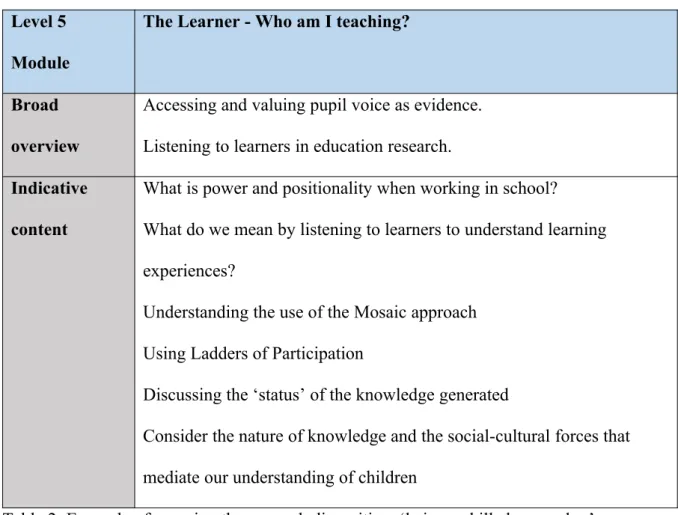
An example of mapping the research disposition ‘being a skilled researcher’ to a Level 5
module is shown in table 2.
Level 5 Module
The Learner - Who am I teaching?
Broad overview
Accessing and valuing pupil voice as evidence.
Listening to learners in education research.
Indicative content
What is power and positionality when working in school?
What do we mean by listening to learners to understand learning
experiences?
Understanding the use of the Mosaic approach
Using Ladders of Participation
Discussing the ‘status’ of the knowledge generated
Consider the nature of knowledge and the social-cultural forces that
mediate our understanding of children
Table 2: Example of mapping the research disposition, ‘being a skilled researcher’, across
Selecting which modules would embed the dispositional development depended on looking
for clues within the module content that more naturally invited an association. Working in
this way avoided the temptation to make artificial or forced connections with the module
content. For example, a module related to understanding how young children learn invited the
development of the disposition to be sceptical - to understand that there is contested terrain in
the existence of political and economic drivers for preferred models of young children’s
learning. Whereas, the module related to the place of culture, socio-economics and social
capital in education more readily related to the disposition of being part of an inquiring
profession as a means of seeking answers to pedagogical questions related to social justice.
It is recognised that this approach meant that the research dispositions were not equally
spread through the modules, and the APLP acknowledge that a holistic development means
that all four dispositions would play their part throughout all of the modules. Nonetheless, the
approach sought to make explicit the research disposition development and to give concrete
opportunities for student-teachers to become research-informed and research-engaged.
Model of Learning Progression
In order to further support the aim of student-teachers moving towards more sophisticated
and expert knowledge and understanding of the research dispositions over the time of ITE
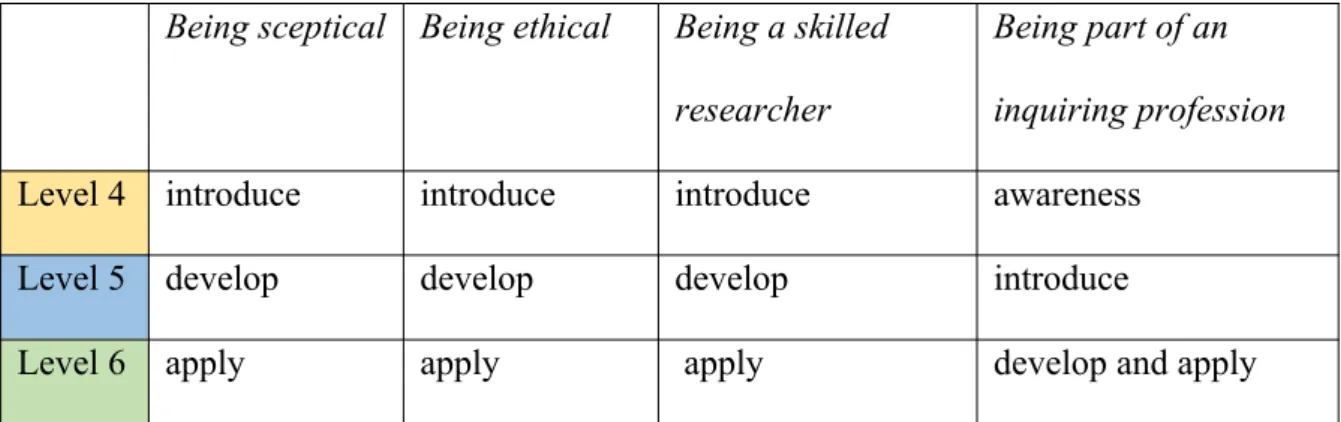
programmes, mapping was broadly aligned to a model of learning progression. The learning
model is based on the principles of introduce, develop and apply where apply is taken to be
re-imagine and renewal and not the transference of knowledge from one place to another –
typically university to school.
Being sceptical Being ethical Being a skilled
researcher
Being part of an
inquiring profession
Level 4 introduce introduce introduce awareness
Level 5 develop develop develop introduce
Level 6 apply apply apply develop and apply
Table 3: Model of progression of research dispositions through an undergraduate ITE
programme, (APLP 2017).
Whilst it is accepted that the development of the research dispositions is more holistic than
this model suggests and certainly not a linear process, it was felt that explicitly mapping
progression would orientate the learning around the principles of the research dispositions
( the ‘big ideas’) and allows space for the concepts, theories and practicalities to be learned.
Emerging Tensions - Operationalising the Mapping
Following the mapping of the research dispositions, the teacher educators for each module
began to draft the detailed content using the maps as a guide to what disposition should be
developed. This process was a collaborative endeavour between university-based and
school-based staff, who came together to design the detail of module content. This collaborative
planning enacted the intentions central to the ITE reforms (Furlong, 2016; Welsh
Government 2018). However, as this piece of work was being undertaken, two specific
tensions began to surface at the interface of the mapping and the detailed planning of
teaching sessions, seminars, directed tasks and required reading.
These tensions can be described as lying between polarised patterns of behaviour and
Performative vs embodied behaviour: a performative approach to ‘ticking off’ the
dispositions in the module planning lies in tension with an embodied approach in
which the dispositions are enacted through module content and pedagogy ;
Understanding learning as product vs learning as process: approaching research
development as a series of activities to be undertaken lies in tension with approaching
the development of research dispositions as a progression in conceptual thinking.
There is a significant literature pertaining to the creation of performative behaviours within
the education system (e.g. Osgood, 2006a,b 2009; Fenech and Sumison, 2007;
Roberts-Holmes, 2015; Kilderry, 2015).This literature builds on the work of Ball who set out the way
in which state regulation ‘requires individual practitioners to organize themselves as a
response to targets, indicators and evaluations’ (2003:215).
Ball goes on to describe a ‘performative worker… with a passion for excellence’ (2003:215)
as delineated by the measures against which excellence is externally judged. Ball refers to
cultures of performativity creating internal struggle in teachers – ‘inner conflicts,
inauthenticity and resistance’ (ibid.), though Holloway and Brass contend that more than a
decade of normalisation of neo-liberal approaches to education policy has led to education
professionals positioning ‘accountability mechanisms as the very modes by which they
kn[o]w themselves and their quality’ (2018:361). In Wales, accountability systems have been
significant drivers for education professional activity for over a decade and indeed, have been
highlighted as one of the reasons why the current education reform was required (see
Donaldson, 2015). Responding to the requirements of high stakes accountability in a
performative manner is therefore, arguably, a professional default position within the Welsh
education system; overcoming this position requires the professional ‘culture shift’ that is
It is possible, that performative behaviours and an activity-driven understanding of
progression came into play when operationalising the research mapping. Typically, in the
past taught modules in ITE have been framed by a performative outcome – usually an
assessment point with all of its summative measures and data driven implications; modules
that are practice-facing have previously been framed by a list of instrumental standards that
have invited a performative response. These measures became the inherent drivers in a few
examples of the mapping and implied that teaching and learning was product-focused; that is,
the focus was on preparing student-teachers to complete a task strongly aligned to the
assessment point rather than to embody the disposition. For example:
Preparing student-teachers to successfully complete an ethical approval
application (as a product) rather than viewing ethical behaviours as framework for
ongoing practice (as a conceptual process).
Preparing student-teachers to complete a literature review for assessment
(product), rather than as a mechanism for making explicit the links with
pedagogical thinking orientated towards practice (process).
Viewing learning as a process rather than a product is central to the pedagogies outlined in
Successful Futures where ‘one of the defining features of twenty-first century education will
be the capacity to make connections and transfer knowledge and understanding across
different contexts in order to address unfamiliar problems’ (Donaldson, 2015:53). If this
concept is applied to ITE, teacher educators - whether university-based or school-based - and
student-teachers, cannot define success in learning during the ITE period as being directed
towards an isolated summative outcome, but as a connected set of knowledge, skills and
behaviours that ‘combines theoretical and practical knowledge and skills with fine judgement
about what is required to promote effective learning in particular contexts. It lies at the heart
Lessons learned:
The experience of mapping the partnership’s research dispositions to the module content has
highlighted the need to consider critically our own pedagogical behaviours in bringing the
newly accredited APLP programmes to fruition. The fact that the initial mapping, (first
drafted by university-based staff as a pragmatic start point), was not significantly changed
when discussed and reviewed by school-based staff may indicate that there was a sense that
this area of learning belongs or is owned by the university-based elements of the programme
more so than school-based elements. While this indication has not been robustly explored as
yet, this is an area of development that the APLP collectively will be returning to consider
carefully; such notions will need to be challenged to ensure that collaborative planning – and
ownership of the content of ITE programmes, is authentic. Returning to the work of Fielding,
whereby ‘transformation requires a rupture of the ordinary’ (2004:296) it would seem that a
disruption of historic ways of thinking is needed if teacher educators are to think and act
differently. In particular, this relates to how subsidiarity in a partnership can be used
effectively to move away from performativity thinking and more towards embodiment of the
research dispositions through valuing the processes of learning.
An example of how subsidiarity might not have been used to the best effect potentially lies in
mapping the research dispositions across the modules. It is possible that the idea of mapping
the research dispositions in such an explicit way inadvertently led to performative and
product–led behaviours as teacher educators worked through the maps and matched the
dispositions to the module content. This raises the question of whether the teacher educators
were truly empowered in the sense of owning the action and decision making, or whether
they were partly in receipt of decisions made by a smaller organisational group, as intimated
above. Going forward and building on the APLP’s successful history of co-construction to
discussion on how to frame the module content through the dispositions and thus strengthen
the element of subsidiarity. Such a reflection mirrors the findings in Australia that
‘partnerships between schools and universities can enhance learning opportunities for all
participants when commitments are made to creating collaborative and dialogical spaces to
support new approaches to teacher education’ (Grimmet et al., 2018). As a part of this
discourse, teacher educators, whether they be school- or university-based, will need to be
supported to identify performative or product-driven responses and be able to re-imagine and
renew their own default positions in an atmosphere of mutual trust.
This authentic aspect of subsidiarity will also give space and time for the APLP to develop a
shared vocabulary and understanding of what characteristics of a professional teacher
embody the research dispositions, and more importantly what actions need to be taken by
each stakeholder to ensure student-teachers progress towards this shared vision. Such
transformation will be essential to effect the cultural change needed in education in Wales.
The APLP aims to contribute to this change by educating student-teachers who embody the
research dispositions in such a way that they are activists for change, transformative in their
approach and who enter their NQT year expecting to be a part of an inquiring profession.
Only then will the concepts of progression, principles of pedagogical understanding and
focus on learning and experience put forward in Successful Futures be enacted in A
Curriculum for Wales 2022.
References
Athrofa Professional Learning Partnership (APLP) (2018) Proforma for the submission of ITE programmes for professional accreditation by the EWC. Unpublished document. APLP
Barnes, J., Tanner , H. & Waters, J. (2016) Exploring Clinical Practice in Initial Teacher Education in Wales Paper presented to British Education Research Association (BERA) annual conference: Leeds 13-15 September 2016.
Barnes, J., and Waters, J. (2016) Initial Teacher Education in Wales; Innovation Inspired Across Borders, in proceedings of Teacher Education Policy in Europe Network, Malta.
BERA-RSA (2014) Research and the Teaching Profession: Building the capacity for a self-improving education system. BERA.
Burn, K. & Mutton, T. (2013) Review of ‘research-informed clinical practice’ in Initial Teacher Education. Paper 4: Research and Teacher Education: the BERA-RSA Inquiry.
City, E.A., Elmore, R.F., Fiarman, S.E, &Teitel, L. (2009) Instructional Rounds in Education; a network approach to improving teaching and learning. Cambridge, Massachusetts: HarvardEducation Press
Cochran Smith, M. (2011) Does Learning to Teach Ever End? ‐ Kappa Delta Pi 48 (1) 22 24 ‐
Cordingley, P., Higgins, S., Greany, T., Buckler, N., Coles-Jordan, D., Crisp, B., Saunders, L., Coe, R. (2015) Developing Great Teaching: Lessons from the international reviews into effective professional development. Teacher Development Trust. 2015. Available online in full and summary format: http://tdtrust.org/about/dgt Accessed 27-04-17
Darling-Hammond, L. (2016) Research on Teaching and Teacher Education and its Influences on Policy and Practice. Educational Researcher 45 (2) 83–91. DOI: 10.3102/0013189X16639597
Donaldson, G. (2015) Successful Futures Cardiff: Welsh Government.
Dudley, P. (2011) Lesson Study: a handbook. Available online:
http://lessonstudy.co.uk/wp-content/uploads/2012/03/Lesson_Study_Handbook_-_011011-1.pdf Accessed 27-04-17
Dudley, P. (2015) Lesson Study: Professional learning for our time. Routledge: Oxon
Fielding, M. (2004) Transformative Approaches to Student Voice: Theoretical
Underpinnings, Recalcitrant Realities. British Educational Research Journal 30 (2) 295-311
Furlong J. (2015) Teaching Tomorrow’s Teachers. Oxford University
Furlong, J. (2016) Initial Teacher Education in Wales – a Rationale for Reform Wales Journal of Education 18 (1) 45-63
Gorski, Paul C. (2012) Perceiving the Problem of Poverty and Schooling: Deconstructing the Class Stereotypes that Mis-Shape Education Practice and Policy. Equity & Excellence in Education 45 2 302-319Grimmett, H. (2018) Reimagining the role of mentor teachers in professional experience: moving to I as fellow teacher educator. Asia-Pacific journal of teacher education. 46 (4) 340-353
Hadfield, M., Connolly, M., Barnes, Y. & Snook, J. (2017) Developing the Capacity to Support Beginning Teachers in Wales: lessons learnt from the Masters in Educational Practice. Wales Journal of Education. 19.1 90-106.
Hagger, H. & McIntyre, D. (2000) What Can Research Tell us about Teacher Education?
Oxford Review of Education 26 3&4 483-494
James, D. (2017) Professional Identity, Learning Cultures and Educational Quality: some lessons from further education. Wales Journal of Education. 19.1 107-124.
Jones, S., Tanner, H., Kennewell, S., Parkinson, J., Denny, H., Anthony, C., Beauchamp, G., Jones, B., Lewis, H. & Loughran, A. (2009) Using Video Stimulated Reflective Dialogue to support the development of ICT based pedagogy in Mathematics and Science. The Welsh Journal of Education 14, 2, 63-77
Korthagen, F., Loughran, J., & Russell, T. (2006). Developing fundamental principles for teacher education programs and practices. Teaching and Teacher Education, 22, 1020-1041.
Mezirow, J., & Taylor, E. (2009). Learning as transformation. San Francisco: Jossey Bass.‐
Mockler, N. (2005) Trans/forming teachers: new professional learning and transformative teacher professionalism, Journal of Inservice Education 31(4) 733-746
Orchard, J., & Winch, C. (2015a) What training do teachers need? IMPACT 22 1-43. London: Blackwell
Orchard, J. & Winch, C. (2015b) Philosophical Perspectives on Education Policy: What Training Do Teachers Need? Why Theory is Necessary to Good Teaching. Oxford: Blackwell.
Philpott, Carey and Oates, C. (2015) Learning Rounds: what the literature tells us (and what it doesn’t), Scottish Educational Review 47(1), 49-65.
Schön, D. (1983). The Reflective Practitioner: How professionals think in action. London: Temple Smith
Scottish Government (2010) Literature Review on Teacher Education in the 21st Century. Available online http://www.gov.scot/Publications/2010/09/24144019/4 [Accessed 27-04-17]
Sing Chai, C., Teo, T. & Lee, C.B. (2009) The change in epistemological beliefs and beliefs about teaching and learning: a study among pre-service teachers Asia-Pacific Journal of Teacher Education 37 (4) 351–362 DOI: 10.1080/13598660903250381
Stopp, P. (2008). From feedback to dialogic review. Available online at:
www.leeds.ac.uk/educol/documents/174590.doc. Accessed 14/5/16
Tillema, H. H., & Knoll, W. E. (1997). Promoting student-teacher learning through conceptual change or direct instruction. Teaching and Teacher Education, 13, 579–595.
Welsh Government (2015) A Curriculum for Wales: A Curriculum for Life. Welsh Government: Cardiff
Welsh Government (2015a) Rewriting the Future 2015: A Year On. Welsh Government: Cardiff
Welsh Government (2017) Education in Wales: Our National Mission. Action Plan 2017-2021 Cardiff.
Welsh Government (2017) Professional Standards for Teaching and Leadership Cardiff: Welsh GovernmentWelsh Government (2018) circular 001/2018 Criteria for the
Accreditation of Initial Programmes of Teacher Education in Wales. Welsh Government: Cardiff
Winch, C., Oancea, A. & Orchard, J. (2013) The Contribution of Educational Research to Teachers’ Professional Learning – Philosophical Understandings. Research and Teacher Education: the BERA-RSA Inquiry. BERA; available