Differentiation, context and teacher education: the changing profile of trainees on
in-service initial teacher training programmes in the lifelong learning sector
Penny Noel
University of Hudderfield
HUDCETTAbstract
Analysis of initial teacher training (ITT) student data relating to the University of Huddersfield part-time in-service Cert Ed/PGCE over a three-year period has revealed significant change in the make-up of trainee cohorts. There has been an increase in younger trainees and in trainees very new to teaching, although more experienced and older trainees do continue to enrol. There has also been a considerable shift in the balance of trainees away from further education (FE) college staff. These changes have implications for those who manage and deliver teacher education for the sector. It remains of key importance that the curriculum is not experienced as overly ‘FE-college centric’ and that mentoring arrangements acknowledge the needs of trainees from diverse contexts. It is clear that in the delivery of ITT for the lifelong learning sector, increasingly, one size will not comfortably fit all. Within teacher education much emphasis is placed upon the role of differentiation in regard to trainee practice. The changing trainee profile identified requires that teacher education itself unambiguously models a differentiated approach – and, in relation to teacher education for the lifelong learning sector, differentiation must address workplace context.
Introduction
This article draws attention to key changes in the profile of initial teacher education trainee populations in the lifelong learning sector and considers the impact of these for the teacher educator. The article summarises diversity characteristics of staff who teach in the lifelong learning sector and identifies their teaching qualification status. An aim of the article is to encourage further exploration of how we might best address the needs of, and ensure relevance for, the diverse groups of trainees identified.
Government reform of initial teacher training (ITT) involves the requirement that teachers across the learning and skills sector should be appropriately qualified. A letter sent by Lifelong Learning UK (LLUK) in March (2008a) to college principals and FE sector management provides a reminder of this and draws attention to the aim of the Workforce Strategy for the Further Education Sector in England, 2007-2012 (2008b) that “all teachers, tutors and trainers are qualified or working towards a qualification” (2008a, p.2). The letter goes on to highlight research undertaken for LLUK which established that “97% of colleges asked were aware of the reforms and 93% have plans in place to make sure that their staff benefit from increasing professionalism in the workforce” (p.1). It was predictable that one consequence of ITT reform was going to be change in the profile of the in-service trainees more recently entering post-compulsory education and training (PCET) teacher-training programmes, as future trainee groups increasingly involve fewer people with significant teaching experience and a greater proportion of people very new to teaching. It is argued that in order to meet the needs of diverse trainees more effectively, questions confronting ITT providers now arise concerning the implications for the curriculum and the appropriate support that may be required. The importance of a differentiated approach is highlighted.
Background
The trainees to whom attention is drawn in this article were studying for the Certificate in Education (Cert Ed) and the Professional Graduate Certificate in Education (PGCE) within a consortium network of initial teacher education providers located across the North of England, including the University of Huddersfield, which provides the award. The Consortium comprises the largest network of in-service teacher education providers for the lifelong learning sector in the UK, and currently has a yearly intake of over 2000 trainees. In 2008, HUDCETT commissioned research into the changing nature of trainee profiles. This involved the collection and analysis of Consortium trainee data for the previous three years. The analysis was undertaken in part to inform a future qualitative study.
Learning and skills sector staff diversity profile (England)
where over 75% of teachers are female (Jones, 2007). WBL has a similar gender profile as that of FE colleges (Pye Tait, 2007). The number of disabled people teaching in the learning and skills sector is not precisely known because disclosure is so low. LLUK data analyses relate only to declared disability and, for instance, for over a tenth of FE college teachers disability status is unknown. The Commission for Disabled Staff (2008) found that reluctance to disclose relates to anxiety about discrimination. Rather more than 2% of FE teaching staff declared a disability in 2006-07 (LLUK, 2008c). The most recent Census (2001) identified almost 8% of the population of Great Britain as belonging to a non-White minority ethnic group. Across the wider learning and skills sector 7% of teachers have been identified as non-White minority ethnic (Parsons and Berry-Lound, 2004); in the most recent LLUK analyses of FE college data, for 2006-07, this figure is 8%, although there are clear regional variations. However, for almost 10% of FE college teachers, ethnicity is recorded as ‘not known/not provided’ (LLUK, 2008c).
Teaching qualification status of learning and skills sector staff
In 2007, LLUK commissioned two pilot studies designed to explore the scope for collecting workforce data relating to the ACL and WBL sectors. Some limited workforce data was collected through the pilots, and the findings were reported separately (Jones, 2007; Pye Tait, 2007). Both reports look at the qualifications of the respective workforces – and this includes reference to teaching qualifications. ACL data suggests that the Cert Ed was the most common teaching qualification for this sector, but it does not indicate what proportion of the workforce held a teaching qualification. Qualification data submitted reveals that ‘the vast majority’ had teaching qualifications; however qualification data was available for only 14.5% of the total sample (Jones, 2007: pp. 3-4). In addition, the low response rate to the overall ACL data collection exercise makes it difficult to draw reliable conclusions about the sector as a whole. Data provided in the WBL report shows that almost 50 per cent of the workforce had no teaching qualification. Again, this is difficult to interpret as it is unclear what proportion of the workforce was involved in the data collection. Nor is it clear whether this statistic applies to the overall WBL workforce sample, or applies only to those staff within the workforce sample with a teaching role.
Information about the teaching qualification status of FE college staff is more comprehensive. LLUK data shows that in 2006-07 89.9% of full-time FE teachers were qualified or enrolled on a teaching qualification; for part-time staff the equivalent figure is 83.5% (LLUK, 2008d). It is of note that in relation to the area covered by the Consortium:
‘Of the nine English regions, the North West, the North East and Yorkshire and Humber are those in which 90% or more of full-time FE teaching staff currently hold either a PGCE, Cert Ed, BABEd/BSc with concurrent QTS, Level 3 Teaching Qualification or a Level 4 FE Teaching Qualifiation – Stage 3 in more than half of the regions institutions’
(LLUK, 2008c: p. 26).
Methodology
Categories of information provided on course application forms were examined and those judged appropriate selected for analysis. An SPSS datasheet was set up. Application forms for the University of Huddersfield part-time in-service Cert Ed/PGCE for the years 2005-06, 2006-07 and 2007-08 were received from Registry. Data from 2,737 application forms was entered, interpreted and analysed using the SPSS software package. Data for the majority of PGCE trainees for the year 2005-06 was unavailable. As a result most of the analyses that follow involve data relating to Cert Ed trainees for each of the three years and PGCE trainees for the latter two years only (2006-07 and 2007-08). It is possible that some application forms for the years in question were not included, and therefore data may not be fully comprehensive. However, the actual numbers of both Cert Ed and PGCE trainees involved – 1,839 and 897 respectively, do allow for a robust analysis of emerging trends in trainee profiles. Where data is clearly incomplete, this has been specified.
The analysis of data – P/T in-service Cert Ed/PGCE trainees (2005-06, 2006-07 and 2007-08) Changes in the age profile
In terms of age, the profile of Consortium trainees has become younger over the three-year period, with the greatest increase in trainee numbers year by year found in the 21-30 year age group. This has been mirrored by an overall decrease in numbers year by year of those aged 31 years and over. However, the majority of trainees still fall within the age band 31-50 years, and 9% of trainees who enrolled in 2007-08 were aged 51 and over, although overall numbers in this group have declined since the previous year. The proportion of trainees from FE colleges, Colleges of HE and Sixth Form Colleges aged 21-30 has increased significantly over the three-year period.
Although slight variations have been identified year by year, the overall gender balance of Consortium trainees, at just less than 60% female to 40% male, matches that found in FE colleges.
The number of trainees stating that they have ‘no known disability’ has increased over the three years examined. However, this is somewhat misleading, as the number of trainees declaring a disability has in fact risen from just over 5% in 2005-06 to around 6.5% in the two subsequent years. The reason for this seeming anomaly is that there has been a significant decrease in the percentage of trainees declining to provide information relating to disability status. Over 4% of trainees chose not to provide this information in 2005-06, whereas this figure had reduced to 0.7% by 2007-08 (i.e. 9 out of 1,268 trainees).
Over the last three years there has been a decrease of more than 5% in the proportion of trainees whose ethnicity has been recorded as White British. This has been matched by an increase in the number of trainees from a Black and minority ethnic (BME) background. In 2007-08 the percentage of BME trainees had risen to just over 6%, from the 1% of two years earlier. There has been little change in the very small proportion of trainees whose ethnicity falls into another category (for example – other White or other ethnic background). For a small percentage of trainees, ethnicity was not declared on application forms.
Classification of trainee key employers
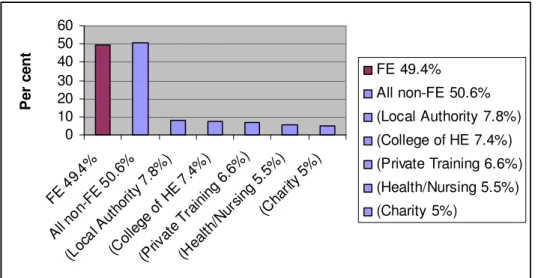
Although Colleges of FE have retained their position as the most significant trainee employer over the period 2005-06 – 2007-08, in two of these three years less than 50% of trainees classified their employer as an FE college. Overall, 50.6% of trainees worked outside FE, with the 46.7% of trainees in FE during 2007-08 the lowest proportion during these years, and a drop of 7.2% from the previous year. Figure 1 shows overall trainee representation in key employment categories (i.e. those involving 5% or more of the total trainee cohort). As some data is missing, statistics are given as valid percentages.
0 10 20 30 40 50 60
FE 4 9.4%
All no n-FE
50. 6%
(Loc al A
utho rity 7.8% ) (Col lege
of H E 7
.4% ) (Priv ate Trai ning 6.6 %) (Hea lth/N ursi ng 5
.5% ) (Cha rity 5% ) P e r c e n t FE 49.4% All non-FE 50.6% (Local Authority 7.8%) (College of HE 7.4%) (Private Training 6.6%) (Health/Nursing 5.5%) (Charity 5%)
Figure 1: Classification of trainee key employers 2005-06 to 2007-08 (P/T Cert Ed/PGCE) (Note: Data does not include the majority of PGCE trainees for 2005-06)
No other major patterns were discernible during this time scale regarding the trainee profile and employment classification. There were a few very small but consistent upward or downward trends. In 2007-08, more trainees were working in 6th Form Colleges, in University, in the Armed forces or were self-employed than in the previous year. In this year too, fewer trainees than before were working in Health/Nursing (down 2.5% from 2005-06), in the Fire Service and in Careers and Guidance. However, other than for Health/Nursing, these trends were too small to be really noteworthy.
Highest qualification in subject taught
The analysis here has had to make use of incomplete data, particularly in relation to the qualifications of Cert Ed trainees – where over 5% of them had not provided the relevant information on application forms. There were difficulties in the certain identification of the level of some of the qualifications recorded on trainee application forms. This frequently concerned nursing and health qualifications that had been achieved some time ago. Further, it is probable that some of the information provided on application forms is either incorrect – or has been incorrectly coded. For example, it is unlikely that there were as many as 40 in number of Cert Ed trainees with a degree at enrolment, or that 15 of them began the course with a Master’s degree. However, the quantity of unproblematic data does allow for a useful analysis.
including almost 9% overall teaching a subject where their highest qualification was at L3 (12.1% in 2006-07). Data analysis for the year 2007-08 does indicate that this may be a declining trend. Conversely, Cert Ed trainees were most likely to be qualified at L3 in the subject they taught – almost 64% of them, with a further 25.5% qualified at L4 and 5.
Literacy, numeracy and IT qualifications
From 2005-06 – 2007-08, the overall number of trainees with an L2 qualification in English, literacy and/or communications at enrolment increased by 10%. However, almost one in four had no literacy or similar qualification. This percentage was higher for Cert Ed trainees and lower for PGCE trainees (in 2007-08, this was 29.1 and13.4% respectively).
0 10 20 30 40 50 60 70 80 90
L2/L2+ No quals Info missing
P
e
r
c
e
n
t 2005-06 (Cert Ed only)
2006-07 (all) 2007-08 (all)
Figure2: Profile of trainee English, literacy and/or communications qualifications at enrolment 2005-06 to 2007-08 (P/T Cert Ed/PGCE)
As with literacy qualifications, from 2005-06 – 2007-08, the number of trainees with an L2 qualification in maths and/or numeracy at enrolment increased by 14%. However, over 36% of trainees overall had no maths or numeracy qualification. Again, this percentage was higher for Cert Ed trainees and lower for PGCE trainees (in 2007-08, this was 40.5 and 22.9% respectively).
0 10 20 30 40 50 60 70
L2/L2+ No quals Info missing
P
e
r
c
e
n
t 2005-06 (Cert Ed only)
2006-07 (all) 2007-08 (all)
Figure 3: Profile of trainee maths and numeracy qualifications at enrolment 2005-06 to 2007-08 (P/T Cert Ed/PGCE)
The proportion of trainees with no information technology qualification at any level appears to have increased over the last three years; in 2007-08 this involved almost 72% of trainees overall. The number of trainees with an L3/L3+ information technology qualification has remained at around 15% throughout this period. Cert Ed trainees are slightly more likely than PGCE trainees to hold an IT qualification.
Trainee years of teaching experience
experience appears to be increasing; this is in contrast to those with between one to five years experience, where numbers have declined from 2005-06 – 2007-08. Over the last two years, there has been a slight increase in the number of trainees with six to fifteen years and sixteen plus years teaching experience. However, the actual number of the latter is relatively small, with 52 trainees recorded as having 16 plus years experience from a total of 1268 in the year 2007-08.
0 10 20 30 40 50 60 70 80
Less than 1 year
1-5 years 6-15 years
16+ years
P
e
r
c
e
n
t 2005-06 (Cert Ed only)
2006-07 (all) 2007-08 (all)
Figure 4: Trainee years of teaching experience at enrolment 2005-06 to 2007-08 (P/T Cert Ed/PGCE)
Discussion
There have been changes in the diversity profile of Consortium trainees over the three-year period examined; this can be summarised as follows. The trainee cohort now includes many more people in the youngest age group. The gender balance of trainees has remained relatively constant, with women continuing to outnumber men. This reflects the fact that women predominate in all the largest teaching specialisms. More trainees are now declaring a disability and this presumably indicates a lessening of anxiety about doing so. The proportion of BME trainees has increased. Consortium provision is in-service and therefore the recruitment and selection of the teachers who become Consortium trainees is the responsibility of a range of different employers. However, it is worthy of note that during a period of much focused equality and diversity activity within the Consortium, the diversity profile of Consortium trainees is gradually improving in important regards.
There has been a significant year on year increase in the proportion of younger and less experienced trainees. This is predictable and is a consequence of ITT reform in the sector. In 2007-08 about a quarter of all trainees were in the youngest age group. In the same year around a quarter had less than one year’s teaching experience. By comparison, an examination of data for five years earlier, collected in the context of research into retention and achievement, indicates the scale of change. Then the proportion of similarly inexperienced trainees was just over 4% – a sizeable difference. Very inexperienced trainees are likely to have training needs not too dissimilar to those of pre-service trainees. However, the analysis also reveals that significant numbers of more experienced and older trainees are still enrolling on Consortium ITT programmes. Again, this is unsurprising in view of data relating to progress towards a qualified lifelong learning teacher workforce. In 2007-08 almost 15% of FE college trainees were either experienced or very experienced teachers (i.e. with from 6-15 or 16 plus years of teaching experience). Future trainee cohorts – in the short term at least, are also likely to involve numbers of more experienced FE college teachers. It is known that FE colleges in particular are aware of the requirements of ITT reform and yet LLUK data shows that 10% plus of their teachers remain unqualified. It may be there remains some reluctance on the part of more experienced FE staff to undertake the training; this was found to be so during the course of the earlier Consortium research into retention and achievement. The approach to be adopted by mentors in this regard (see Robinson, 2005) and the management of the undifferentiated requirement for eight teaching observations are both issues that are increasingly likely to require sensitivity in relation to working with the most experienced, and possibly reluctant trainees – studying alongside their very inexperienced colleagues.
FE (Noel, 2004). Trainees teaching in non-FE college education and/or training were also more likely to think about leaving. Half of these trainees identified themselves as needing much support with ‘clear links made to the context in which I teach’ (p.16). The shift in balance towards non-FE college trainees identified through the current analysis means that it remains essential that the curriculum is not experienced as overly ‘FE-college centric’. The dominance of non-FE college trainees is likely to continue for some time. This will require ongoing scrutiny on the part of teacher educators in regard to the context in which curriculum content is located, and the identification and development of case study and other material relating to a range of workplaces. The changing profile has implications for mentoring arrangements. Ofsted found that ‘provision of effective support and development for subject specialisms, through mentoring, continued to challenge both providers and employers. This was a particular issue for trainees working outside a further education college setting’ (Ofsted, 2008: p.11) (my italics). It has been observed that Ofsted has not yet made known:
‘…the process by which teachers trained under the preceding ‘inadequate’ system of ITT, through the passage of time, became those best placed to initiate younger colleagues into subject-specific pedagogy’
(Thompson & Robinson, 2008: p. 166)
As noted, significant numbers of teaching staff working outside an FE college setting, and from whom potential mentors might be drawn, have no teaching qualification and probably no training – adequate or otherwise, in subject-specific pedagogy. Emerging trends identified in trainee profiles suggest that workplace context is likely to continue to present an additional challenge in relation to the provision of effective mentoring support. The Associate Online e-mentoring system, designed as a virtual learning environment (VLE) supplement to the usual assignment of mentors, has some potential to address this issue ‘where a trainee’s work or placement situation does not allow them to benefit from face-to-face mentoring with a tutor who shares the same specialism (ASSOCiate Online, 2008, p.1). The system does allow for a matching by sub-specialism, by level of teaching and importantly, by professional practice setting.
There has been a yearly increase in the number of trainees with entry qualifications at L2 or above in literacy and/or numeracy. However there remain sizeable proportions without. The initial assessment of trainees linked to ‘established referral systems to appropriate literacy and numeracy support where needed’, specified in the recent position statement of DUIS/IfL/SVUK/LLUK (2008) will remain key. Analysis of data shows that there has been a year-by-year increase in the proportion of trainees working towards an additional qualification; this was the case for 72.5% of trainees in 2007-08. Whilst it was outside the scope of the analysis reported here to identify the specific qualifications involved, it is probable that much of this activity relates to literacy and/or numeracy.
Conclusion
Within teacher education much emphasis is placed upon the importance of differentiation in regard to trainee practice. The changing trainee profile identified requires that teacher education itself unambiguously models such an approach – and, in relation to the lifelong learning sector, differentiation must also address context – in addition to other aspects of diversity. Attention has already been drawn to the earlier Consortium research that clearly identified perceptions of a lack of course relevance expressed by trainees who had thought about leaving the course. (Noel, 2004). Such perceptions were often related to context.
References
Burrows, J. (2008) Cross-context exchanges (report). Huddersfield: HUDCETT .
Commission for Disabled Staff in Lifelong Learning (2008) From compliance to culture change: disabled staff working in lifelong learning. Leicester: NIACE.
Eraut, M. (1994) Developing professional knowledge and competence. London: Falmer Press.
Jones, C. (2007) Adult and Community Learning: Workforce Data 2007. London: ORC International. LLUK, (2004) Market Assessment. London: LLUK.
Lunenberg, M., Korthagen, F., Swennen, A. (2007) ‘The teacher educator as role model’, Teaching and Teacher Education, Vol. 23, No 5, pp. 586-601. http://dx.doi.org/10.1016/j.tate.2006.11.001
Noel, P. (2004) Retention and achievement in CPCET programmes: A report to the Consortium Steering Committee, Huddersfield: Consortium for Post-Compulsory Education and Training.
Ofsted (2008) The initial training of further education teachers: Findings from 2006/07 inspections of courses leading to national awarding body
qualifications, London: Ofsted.
Parsons, D., Berry-Lound, D. (2004) Qualifications of Staff in LSC-funded Provision London: Department for Education and Skills/HOST Policy Research.
Pye Tait (2007) WBL Workforce Data Analysis: Draft final report, Harrogate: Pye Tait.
Robinson, D. (2005) Mentoring Pilot: Report to the Department of Education and Skills, May 2005 Huddersfield: Consortium for Post-Compulsory Education and Training.
Thompson, R., Robinson, D. (2008) ‘Changing step or marking time: Teacher education reforms for the learning and skills sector in England’, Journal of Further and Higher Education, Vol. 32, No 2, pp. 161-173. http://dx.doi.org/10.1080/03098770801975330
ASSOCiate Online (2008) ‘Implementation briefing 2b: Operation of the e-Mentoring system’. http://associate.hud.ac.uk/documents/PB005-Brief2b_e-Mentors.doc [accessed 28.7.08].
DIUS/IfL/SVUK/LLUK (2008) ‘Evidencing the personal skills requirement for teachers, tutors and trainers in the lifelong learning sector’. http://www.lluk.org/evidencing-personal-skills-requirements-for-teachers-in-lifelong-learning-sector-16-july-2008.htm [accessed 20.7.08].
LLUK (2008a) ‘Letter sent in March 2008 to principals and the management of FE and sixth form colleges’. http://www.lluk.org/documents/fewr_feletter_0408_v3.pdf [accessed on 17.7.08].
LLUK (2008b) ‘The Workforce Strategy for the Further Education Sector in England, 2007-2012’.
http://www.lluk.org/documents/the_workforce_strategy_for_the_further_education_sector_in_england_2007_2012_full_publicatio n.pdf [accessed 17.7.08].
LLUK (2008c) ‘Further Education Workforce Data for England: An Analysis of Staff Individualised Record (SIR) Data 2006/07’. http://www.lluk.org/documents/SIR_Data_Web.pdf [accessed on 17.7.08].
LLUK (2008d) ‘Progress between 2003 and 2007 on the ‘Success for All’ qualified further education workforce target’. http://www.lluk.org/documents/Success_for_All_200607_results_final.pdf [accessed 20.7.08].