A metapopulation model for highly pathogenic avian in
fl
uenza:
implications for compartmentalization as a control measure
S. NICKBAKHSH1, L. MATTHEWS1, S. W. J. REID2 A N DR. R. KAO1*
1
Institute of Biodiversity, Animal Health and Comparative Medicine, University of Glasgow, Bearsden Road, Scotland, UK
2
Royal Veterinary College, University of London, North Mymms, Hatfield, Hertfordshire, UK
Received 4 July 2013; Final revision 18 October 2013; Accepted 30 October 2013;
first published online 5 December 2013
SUMMARY
Although the compartmentalization of poultry industry components has substantial economic
implications, and is therefore a concept with huge significance to poultry industries worldwide,
the current requirements for compartment status are generic to all OIE member countries.
We examined the consequences for potential outbreaks of highly pathogenic avian influenza in
the British poultry industry using a metapopulation modelling framework. This framework was used to assess the effectiveness of compartmentalization relative to zoning control, utilizing empirical data to inform the structure of potential epidemiological contacts within the British
poultry industry via network links and spatial proximity. Conditions were identified where,
despite the efficient isolation of poultry compartments through the removal of network-mediated
links, spatially mediated airborne spread enabled spillover of infection with nearby premises
making compartmentalization a more‘risky’option than zoning control. However, when zoning
control did not effectively inhibit long-distance network links, compartmentalization became a relatively more effective control measure than zoning. With better knowledge of likely distance
ranges for airborne spread, our approach could help define an appropriate minimum inter-farm
distance to provide more specific guidelines for compartmentalization in Great Britain.
Key words: Avian influenza, mathematical modelling, notifiable infectious diseases, Susceptible-Infected-Removed (SIR) model, veterinary epidemiology.
I N T R O D U C T I O N
Within the context of controlling notifiable livestock
disease epidemics, the World Organization for Animal
Health (OIE) stipulates that ‘establishing and
main-taining a disease-free status throughout the country
should be the final goal for OIE members’ (chapter
4·3, OIE Terrestrial Animal Health Code [1]).
However, these guidelines also recognize the difficulty
in ‘establishing and maintaining a disease-free status
for an entire territory’and therefore promote the
ben-efits of establishing and maintainingsubpopulationsof
animals with a distinct health status. These
subpopu-lations are usually defined throughzoning(or
regiona-lization), where geographical boundaries separate parts of a territory (or country). An example is the im-plementation of control zones used to enforce move-ment restrictions and enhanced biosecurity measures during outbreaks of notifiable disease [2].
The relatively recent concept of
compartmentaliza-tion extends this idea by considering pathways other
* Author for correspondence: Professor R. R. Kao, Institute of Biodiversity, Animal Health and Comparative Medicine, University of Glasgow, 464 Bearsden Road, Scotland G61 1QH, UK.
(Email: [email protected])
Epidemiol. Infect.(2014),142, 1813–1825. © Cambridge University Press 2013
doi:10.1017/S0950268813002963
The online version of this article is published within an Open Access environment subject to the conditions of the Creative Commons Attribution license <http://creativecommons.org/licenses/by/3.0/>.
https://www.cambridge.org/core/terms. https://doi.org/10.1017/S0950268813002963
than geographical proximity that may jeopardize the biosecurity of a compartment. The OIE guidelines
stipulate that‘the definition of compartment may
re-volve around disease-specific epidemiological factors,
animal production systems, biosecurity practices,
infra-structural factors and surveillance’ (chapter 4·4, OIE
Terrestrial Animal Health Code [3, 4]). These,
gen-erally speaking, non-spatial factors include the move-ments of animals, equipment, other fomites, feed and people. Biosecurity considerations will also include spatial proximity to adjacent animal populations; in
this respect compartmentalization is comparable to
zoningcontrol.
The major benefit of compartmentalization is the
potential continuation of exports from compartments during an outbreak (upon agreement with the trade partners) and it is this economic aspect that is driving the growing interest in European Union Member States, and their poultry and swine production indus-tries, in adopting this concept [5]. Compartmentaliza-tion is also a means of outbreak prevenCompartmentaliza-tion by minimizing spatial- and fomite-mediated mechanisms of spread and can facilitate the eventual elimination of disease by concentrating personnel and resources in areas where elimination is most likely to succeed [6].
Compartmentalization is not conceptually new given that, historically, disease control programmes have been based on the concept of disease-free herds
or flocks [3]. However, compartmentalization has
not yet been formally appraised, nor has it been applied, so currently there are no examples of success
and any potential associated risks are difficult to
determine. Appraisal is made all the more difficult
because the requirements for compartment status are
not specific, yet it is recognized that the
implemen-tation of both compartmentalization and zoning will
be influenced by factors specific to the pathogen,
in-dustry and country in question [6].
Of particular concern for governments worldwide in relation to commercial poultry production is the
global spread of avian influenza, particularly in its
highly pathogenic form (HPAI). The OIE has pro-duced guidelines on the practical implementation
of compartmentalization for avian influenza and
Newcastle disease (which is another important notifi
-able disease of poultry) [7], with consideration of the
specific risks of entry and spread of avian influenza.
A better understanding of the potential epidemiologi-cal links, both through spatial proximity and through
movements of people, vehicles and equipment [8–10],
could help provide a more specific definition of
compartmentalization for the British commercial poultry industry.
Given the current lack of appraisal of the applicat-ion of compartmentalizatapplicat-ion, and the potential need to refine the definition under different disease,
indus-try and counindus-try-specific circumstances, we aim to
pro-vide an example modelling framework developed to investigate the risks of infection leakage from compart-ments within the British commercial poultry industry. We focus our analyses on integrated poultry com-panies (premises with common ownership) as they are suitable candidates for compartmentalization due
to the vertical integration of their business [6]. We
explore a range of outbreak scenarios, characterized
by their basic reproduction number (R0), in order to
provide a quantified measure of risk under
compart-mentalization in comparison to that under zoning control.
M E TA P O P U L AT I O N F R A M E WO R K
Network characterization
The Poultry Network Database (PND) was collated in 2006 by the Veterinary Laboratories Agency (now known as Animal Health and Veterinary Laboratories Agency; AHVLA) and describes the poultry premises
(n= 4067), which are the clients of major
slaughter-houses (SH; n= 96) and catching companies (CC;
n= 102) within the Great Britain (GB) commercial
poultry industry [8, 11]. These SH–client and
CC–client associations were assumed to represent a
potential epidemiological link representing the risk for pathogen spread via fomites during on-farm
catching-team visits, particularly during fl
ock-thinning which is carried out mid-production cycle (i.e. risks via personnel, clothing, equipment, forklift trucks, slaughterhouse vehicles). We note the activity of catching teams is recognized to be relevant to the
potential risk of avian influenza spread within the
GB poultry industry [8,12].
We define a poultry company as a group of multiple
individual premises under common ownership which make up the individual components of a compart-ment; these individual premises we denote multi-site (MS) premises. Overall, MS premises status was highly correlated with membership of an integrated
company (Pearson’s product-moment correlation
co-efficient = 0·92, 95% CI 0·91–0·93, P< 0·0001). We generated a bipartite network where premises and
(or CC–client) associations informed the links be-tween the nodes. This network characterization was then used to generate an unweighted and undirected unipartite network where a single set of nodes repre-sented poultry companies and links reprerepre-sented shared SH or CC associations (see [13]). If at least one prem-ises from each of two companies shared a SH (or CC), the respective companies were deemed to be associated.
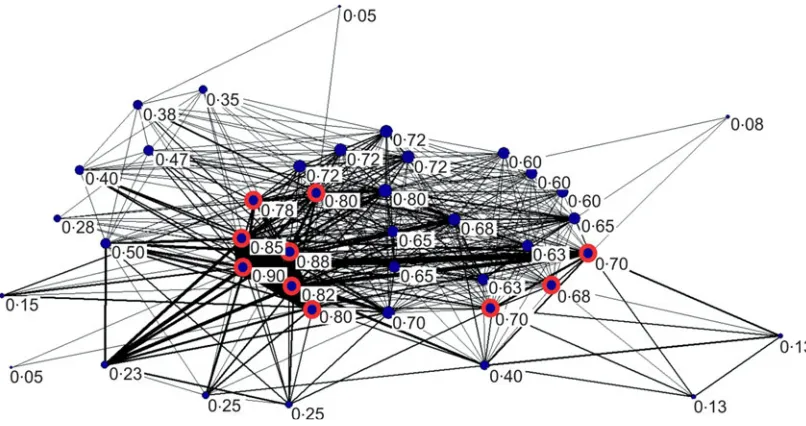
Figure 1shows that the company-level GB poultry network was highly connected forming one giant com-ponent (consisting of 91% of premises in the PND). The network giant component represents the largest
of all possible components [15]. Each individual
node within a giant component can reach all other nodes via at least one path, providing an estimate for the maximum possible epidemic size for networks
representing disease transmission [14, 15]. This high
connectivity has important implications for the nature of epidemiological risks that should be considered in
the definition of compartmentalization for GB.
The topological properties of a network can be
quantified by a number of measures. The most widely
used measures the centrality, or importance, of the network node. The degree centrality, in its most com-mon form, measures the total number of nodes
directly adjacent to each node [16]. Other measures
consider network paths; these quantify the routes across the network from one node to another via
each link, e.g. the betweenness centrality quantifies
the number of shortest paths between pairs of nodes [17].
In this study we used degree and betweenness as measures of network centrality computed using
Pajek v. 2.04 software [18]. The network giant
com-ponent could be divided into two main subgroups:
(i) a core group of companies with relatively high
degree centrality, some of which also had relatively high betweenness (see inner nodes circled in red with degree centrality, normalized by the largest value, >0·6,Fig. 1), and (ii) aperipherygroup of companies with both relatively low degree and betweenness cen-tralities (see outer nodes with degree, normalized by the largest value, <0·6,Fig. 1). We used these network links between companies to inform a metapopulation model of HPAI transmission with connections be-tween two populations; one population represents a company/compartment within the core network group and the other represents a company/compart-ment within the periphery network group.
Population structure
We aimed to capture the potential for spread between MS premises (that are under common ownership, i.e. a compartment) and other premises at risk of infec-tion. As single-site (SS) premises tended to be spatially
clustered around MS premises (80–90% of premises
Fig. 1 [colour online]. Unipartite representation of the poultry company network of associations via slaughterhouses and catching companies;n= 41 poultry companies (excluding four that were unconnected to the giant component). Node labels are the normalized (by largest possible value) degree centralities with relative magnitudes represented by node size. Nodes circled in red represent companies which also had a relatively high betweenness centrality. The line widths represent the number of slaughterhouses and/or catching companies that formed the associations.
Compartmentalization and the control of poultry diseases 1815
https://www.cambridge.org/core/terms. https://doi.org/10.1017/S0950268813002963
within the proximity of MS were SS premises across
distances of 1–10 km), we captured the potential for
transmission between MS and SS premises both with-in and between the two compartment populations.
More specifically, each population comprised of the
MS premises of a single company and nearby SS
pre-mises. Hereafter ρ= 1 denotes a company within the
network core group and ρ= 2 denotes a company
within the networkperiphery group.
Interrogation of the PND showed that the mean number of premises for companies within the core and periphery groups were 70 and 10, respectively,
reflecting the typical size of a poultry company within
the respective network groups. These data regarding company size informed the number of MS premises
within population 1 (n1,MS= 70) and population 2
(n2,MS= 10). The mean number of SS premises (nSS)
in the proximity of MS premises (nMS) was determined
for each population across varying distance radii, cor-responding with assumptions considered for airborne transmission of HPAI. Results are shown for 1 km radii (corresponding with airborne transmission up to 1 km) where nSS<nMS (n1,SS= 35 for population
1 andn2,SS= 5 for population 2).
Transmission mechanisms
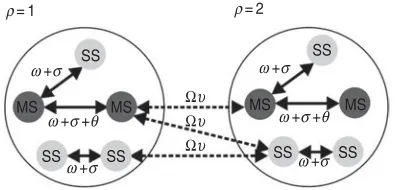
Figure 2 provides a schematic representation of the model structure. Two mechanisms at the farm-level that could potentially allow for HPAI introduction onto a farm are: (i) onto-farm movements related to the catching and transportation of birds to the slaugh-terhouse (i.e. both the catching team and slaughter-house vehicle components of these on-farm visits),
referred to hereafter as ‘network-mediated links’,
and (ii) airborne or environmental spread, referred to hereafter as‘spatially mediated links’.
Network-mediated links between farms occurring through slaughterhouses and catching companies
were inferred from the PND (n= 3044 farms) as
de-scribed previously [see 11]. Spatially mediated links
between farms through proximity were inferred from the geographical locations provided by the PND
(n= 3153) and the Great Britain Poultry Register
(n= 1991). The threshold for spatially mediated links
was varied in a sensitivity analysis due to a poor under-standing of the likely distance for airborne spread in GB. For most farms, the between-farm distances were relatively large (>150 km), although 67% of farms had at least one neighbour within 3 km suggest-ing there is potential for airborne transmission
between these premises. Based on the experience of
The Netherlands, which was afflicted by a major
out-break of HPAI in 2003, evidence of meaningful
trans-mission beyond 10 km is limited [19, 20], therefore
we considered distances from 1 km to 10 km and pre-sent results for 1 km.
Within a population, MS premises could transmit infection to other MS premises, as well as to SS prem-ises via both network and spatial links. MS premprem-ises could also transmit infection within their company, representing transmission via shared staff and
equip-ment [21]. Similarly, SS premises could transmit to
other SS premises as well as to MS premises within the same population via both network and spatial links. Between-population transmission events were
assumed to only occur via network links, reflecting
the observation that MS premises were less likely to be within close proximity of the MS premises of another company, thereby limiting the potential for airborne spread.
Informing contact heterogeneity
Pairwise matrices summarizing the links between premises via network-mediated and spatially mediated mechanisms of contact were used to determine the proportions of contact, both within and between popu-lations, in the metapopulation model. Specifically,σjk is the proportion of all spatially mediated links from
premises of type k to premises of type j, ωjk is the
ρ= 1
SS
MS MS MS MS
SS SS SS SS
SS ρ= 2
ω +σ
ω +σ +θ ω +σ +θ
ω +σ ω +σ
ω +σ Ωυ
Ωυ Ωυ
Table 1. SIR metapopulation model notation, parameters and initial conditions
Parameter Definition Initial/default values/ranges
Reference/ source
n1,MS Total number of multi-site premises within population 1 70 PND
n2,MS Total number of multi-site premises within population 2 10 PND
n1,SS Total number of single-site premises within population 1 35 PND
n2,SS Total number of single-site premises within population 2 5 PND
ˉ
nMS Median number of multi-site premises across all populations 15 PND
ˉ
nSS Median number of single-site premises across all populations 8 PND
β Between-farm transmission rate (days−1) assuming density-independence 0·01–0·2, increments of 0·00255 [23–25]
β′ Between-farm transmission rate (days−1) assuming density-dependence* 0·0063–0·93, increments of 0·00255 –
γ Rate at which infected farms were depopulated (days−1) 0·17, 0·25 or 0·33 [23,24]
ωjk Within-population proportion of network links from premises of typektoj, wherej,k={MS, SS} SeeTable 2 PND
θ Within-population proportion of network links between MS premises only (i.e. within-company links) 1 Fixed†
σjk Within-population proportion of spatial links from premises of typektoj, wherej,k={MS, SS} SeeTable 2 PND
Ωjk Between-population proportion of network links from premises of typektoj, wherej,k={MS, SS} SeeTable 2 PND
ν Between-population interaction strength 0–10, increments of 0·1335 Fixed†
δjk Kronecker delta function used to ensureθonly applies to transmission within a company 0, ifj=SS 1, ifj=MS −
Wρj Within-population force of infection acting on premisesjwithin populationρ – Simulated
Bρj Between-population force of infection acting on premisesjwithin populationρ – Simulated
PND, Poultry network database; MS, multi-site premises; SS, single-site premises. * This parameter was informed byβ,nˉjandnρj.
†These parameters werefixed; an assessment of model sensitivity found these parameters to have little impact on the qualitative model results.
Compartmentalization
and
the
control
of
poultry
disea
ses
1817
https://www.cambridge.org/core/terms
.
https://doi.org/10.1017/S0950268813002963
Downloaded from
https://www.cambridge.org/core
. Royal Veterinary College
, on
19 Nov 2018 at 16:51:51
proportion of all network-mediated links within a compartment population from premises of type k to
premises of type j and Ωjk is the proportion of all
network-mediated links between compartment
popu-lationsfrom premises of type k to premises of type j
(wherej, ktake values MS premises or SS premises).
Appendix A in the Supplementary online material provides further details of how these link-type prob-abilities were scaled to the distribution of MS premises and SS premises according to the more demographi-cally representative Great Britain Poultry Register
(see [11] for details regarding demographic biases
in the PND). These link-type probabilities were used to apply a weighting to the transmission rates in the Susceptible-Infected-Removed (SIR) model (described below). All network and spatial links were assumed to be active at any given time; in the case of the network links, this is equivalent to assuming that visits are rela-tively frequent compared to infectious periods, and infectious connections between associated premises are random. As this approximates many of the
proper-ties of homogeneous mixing within groups [22], the
model therefore provides an insight into outbreak risk under a scenario of maximal connectivity between poultry premises.
Link-type probabilities are later used to weight the transmission rates informing heterogeneous mix-ing within and between populations in the
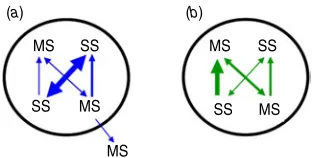
metapopu-lation model.Figure 3shows all possible link-types for
a single population, comparing the two transmission mechanisms. Network-mediated links were predomi-nantly between SS premises, whereas for spatially mediated links this was the least probable and links between MS premises and SS premises predominated. For MS premises, spatially mediated links to the MS premises of another population (i.e. between-company) was relatively more probable than with MS premises of the same company for distances up to 3 km.
The SIR models
Disease transmission over the metapopulation model was implemented using a deterministic SIR com-partmental framework. The total number of premises within each infection state per premises type and popu-lation were tracked throughout the duration of an
outbreak. The transition to compartment‘R’
represen-ted disease detection and subsequent total flock
de-population following the implementation of
con-trol measures which was assumed to occur at rate γ
(days−1). Once premises reached this status, they
posed no further transmission risk to other premises through either network or spatial mechanisms. We
considered a range of values for γ (0·33, 0·25, 0·17
day−1), given by the reciprocal of anticipated
farm-level infectious periods, ranging 3–6 days consistent
with previous models of the between-farm spread of
avian influenza in GB [23, 24]. It was assumed that
repopulation of premises occurred outside of the time-frame of an outbreak.
The baseline model for the interaction between
population 1 (networkcore group) and population 2
(networkperipherygroup) is described by the
follow-ing set of ordinary differential equations:
dSpj
dt = −Spj(Wpj+Bpj),
dIpj
dt =Spj(Wpj+Bpj) −γIpj,
dRpj
dt =γIpj,
whereρ={1, 2} for population 1 (network core) and
population 2 (network periphery) and j={MS, SS}
for multi-site and single-site premises types and Wρj
andBρjrepresent the within- and between-population
forces of infection acting upon premises typejwithin
populationρ.
The force of infection acting on j= MS premises
within ρ= 1 (network core group) is further
decon-structed as follows:
W1,MS=β ωMS,MSI1,MS
n1,MS+ωMS,SS I1,SS
n1,SS
+β1′,MS σMS,MS
I1,MS
n1,MS+σMS,SS
I1,SS n1,SS
+β θδMS,1
I1,MS n1,MS
(a) (b)
MS
MS
MS
MS
MS SS
SS
SS
SS
B1,MS=β ΩMS,MSνnI2,MS 2,MS
+β ΩMS,SSνnI2,SS 2,SS
,
where β and β′1,MS are density-independent and
density-dependent transmission rates (days−1), respec-tively,σMS,kandωMS,kweight the rate of transmission
from premises type k={MS, SS} to MS premises
through spatial proximity and network links
res-pectively, θ weights the rate of transmission between
MS premises of the same company, δMS,1 is the
Kronecker delta function, whereδjk= 1 ifj= MS
pre-mises or zero otherwise, ΩMS,k weights the rate of
transmission between populations and υis a uniform
weighting applied toΩMS,kin order to vary the
rela-tive strength of transmission between populations (i.e. the interaction, or coupling, strength). These equations can equivalently represent the force of infection acting on SS premises by substituting
j= SS premises and for population 2 by substituting
ρ= 2.
The density-dependent transmission rate β′ρj is
given by (β/nˉj)nρj where the density-independent
transmission rate β (days−1) is now proportional to
the number of premises of type j within population
ρ(nρj) and is further scaled by an overall median num-ber of jpremises (nˉj) across all populationsρ. Given
the lack of experience of large HPAI outbreaks in
GB, and therefore the uncertainty in the pathogen’s
likely transmissibility, we explored a range of
trans-mission rates (0·0063–0·93 day−1) that generated
basic reproduction numbers (R0) ranging from
<1 to 8 in accordance with the published literature investigating potential outbreaks of HPAI in GB, as
well as the experiences of other countries [23–25].
Table 1 provides further details of the parameter values explored in these analyses.
Although the likely mode of transmission of HPAI within GB is not well understood, our model was insensitive to the distance assumed for spatial trans-mission except under density-dependent transtrans-mission. We therefore present results for this scenario to demonstrate the potential for disease spread under maximal possible airborne spread for the distances considered. The overall potential for an epidemic
of HPAI was represented by the between-farm R0,
computed as the dominant eigenvalue of the Next Generation Matrix for the ODE model system.
Further details of the calculation of R0are provided
in Appendix B (Supplementary online material).
Defining control models
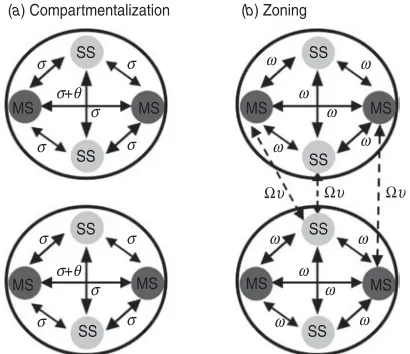
The baseline model described above was adapted to assess the risk of an outbreak under compartmentali-zation. To provide practical insight, this risk was
assessed through a relative comparison with a zoning
control scenario. Figure 4 shows the outbreak
inter-ventions assumed. For compartmentalization, all net-work links within and between compartments were inhibited; however, the possibility remained of infec-tion spillover between compartments and SS premises within proximity. Therefore we use a global value of
R0as a measure of when these spillovers may have a
Table 2. Between-premises link-type probabilities via network and spatial mechanisms
Link type*
Network (ωandΩ)†
Network >10 km (ωandΩ)† ‡
Spatial (σ): 0–1 km†
Spatial (σ): 0–3 km†
Spatial (σ): 0–10 km†
jk= MS, MS§ 0·366 0·389 0·088 0·043 0·020
jk= MS, MS¶ 0·008 0·010 –∥ –∥ –∥
jk= MS, SS 0·431 0·450 0·373 0·362 0·247
jk= SS, MS 0·360 0·353 0·449 0·567 0·744
jk= SS, SS 0·879 0·842 0·0002 0·0002 0·0002
*jkrepresents all possible link-types between premises typesj= {MS, SS} andk= {MS, SS}, wherejk= MS, MS represents links between multi-site premises, jk= MS,SS andjk= SS,MS represents links between multi-site and single-site premises; jk= SS, SS represents links between single-site premises.
†See Appendix A (Supplementary material) for further details of how link-type probabilities were scaled to the expected dis-tribution of multi-site and single-site premises according to the Great Britain Poultry Register. The scaled link-type probabil-ities were used to apply a weighting to the transmission rates in the SIR model.
‡Used to inform network links under zoning in the control scenarios (see‘R0thresholds: compartmentalization’section). § Within-compartment (or within company).
¶ Between compartment (or between companies).
∥No spatial links occurred between compartment populations.
Compartmentalization and the control of poultry diseases 1819
https://www.cambridge.org/core/terms. https://doi.org/10.1017/S0950268813002963
widespread impact. These conditions were motivated by the OIE guidelines for the epidemiological separ-ation of compartments. The guideline for GB
com-partments specifies a minimum distance of 400 m
to other premises [26]. Given that it is possible that
airborne spread of HPAI could occur at distances beyond 400 m (based on the experience of other coun-tries [19,20,27]), we explored the impact of allowing spatially mediated transmission to occur at distances >400 m.
In contrast, under zoning all spatial links, network-mediated links within 10 km and within-company links were inhibited thereby mitigating all trans-mission risks operating at relatively short distances. The purpose of zoning control is to enforce enhanced biosecurity and to limit movement of poultry between affected and non-affected areas (generally, in the case of HPAI, 3 km protection zones and 10 km surveil-lance zones are implemented which enforce different
levels of restrictions [2]). The zoning scenario in
these analyses corresponds to a specific situation
where infection is assumed to have already spread beyond 10 km surveillance zones through the move-ments of fomites (i.e. people, vehicles, equipment), prior to the enforcement of control measures
follow-ing identification of the index premises (see
Table 2 for network link-type probabilities under zoning).
R0 T H R E S H O L D S : B A S E L I N E M O D E L
Figure 5 shows R0= 1 thresholds for varying values
of the transmission rate (β) and between-population
interaction strength (υ). Parameter combinations
above each line (i.e. whereR0>1), indicate the
poten-tial for an outbreak, while parameter combinations below each line (i.e. whereR0<1) indicate no outbreak
potential. Each line corresponds to a different
out-break (informed byβ) and control measure (informed
by υ) scenario; the link types enabling a
between-population interaction are represented by line colour,
and the premises-level infectious periods (1/γ) are
represented by line type.
The clustering of lines by colour shows that out-break risk was most sensitive to the link types enabling between-population transmission and relatively less sensitive to the premises-level infectious period (1/γ).
Transmission between poultry companies (i.e. ΩMS)
alone was sufficient forR0>1; additional transmission
involving SS premises (i.e.ΩMS, ΩSMorΩSS) further
enhanced this, an effect which increased with the in-teraction strength (υ). There was also little sensitivity to the assumed distances for spatially mediated links (seeTable 2).
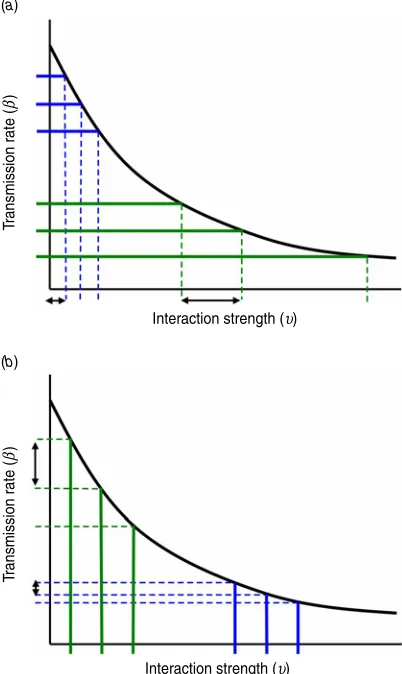
Figure 6 demonstrates how the nonlinear
relation-ship betweenR0,βandυenables the epidemic
thresh-old to be exceeded for relatively small changes to parameter values. For example, for incremental
decreases from high values ofβ, only relatively small
increases to υ were required to maintain the system
above the epidemic threshold (Fig. 6a). The converse
was also true; incremental decreases from high values
ofυ only requiring a small increase in βto maintain
the epidemic threshold (Fig. 6b).
R0 T H R E S H O L D S :
C O M P A R T M E N TA L I Z AT I O N
Compartmentalization and zoning produce different characteristics for the epidemic threshold, as shown
schematically in Figure 7. The different areas under
the curves represent the difference in risk; the ad-ditional risk due to compartmentalization is shown by the dark-shaded region, while the additional risk from zoning is shown by the light-shaded region.
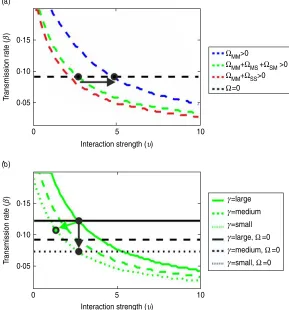
Figure 8 overlays the R0thresholds corresponding
to compartmentalization (black horizontal lines) and zoning (coloured curves) to identify the parameter space where additional risk could be attributed to
compartmentalization (seeFig. 7). Note that there is
(a) Compartmentalization (b) Zoning
SS SS
SS
SS
SS SS
SS SS
MS MS
MS MS MS MS
MS MS
σ+θ σ+θ
σ ω ω
ω ω ω
ω
Ωυ Ωυ Ωυ
ω ω
ω ω ω
ω σ
σ σ σ
σ σ
σ σ σ
no sensitivity to υ under compartmentalization as between-population transmission is inhibited. A rela-tively greater risk under compartmentalization was
found when: (a) removing the links enabling
between-population interactions (i.e. decreasing the risk under
zoning), or (b) increasing the infectious period. The
impact of link types was greater than the infectious period, as shown by comparing the relative difference
in arrow lengths inFigure 8a(for changes to the link
types,Ω) andFigure 8b(for changes to the farm-level
infectious period, 1/γ).
Although a greater risk for compartmentali-zation was found when fewer link types enabled
0·18 γ=large, ΩMM>0
γ=large, ΩMM+ΩMS+ ΩSM>0
γ=medium, ΩMM+ΩMS+ ΩSM>0
γ=small, ΩMM+ΩMS+ ΩSM>0
γ=large, ΩMM+ ΩSS>0
γ=medium, ΩMM+ ΩSS>0
γ=small, ΩMM+ ΩSS>0
γ=medium, ΩMM>0
γ=small, ΩMM>0 0·16
0·14
0·12
Tr
ansmission r
ate (
β
)
0·10
0·08
0·06
0·04
0·02
0 2 4 6 8 10
Interaction strength (υ)
Fig. 5. Sensitivity of R0 thresholds to farm-level parameters. γ= rate of premises depopulation (small = 0·17 day− 1
, medium = 0·25 day−1, large = 0·33 day−1;ΩMM=links between multi-site premises,ΩMSandΩSM= links between multi-site and single-site premises; ΩSS =links between single-site premises. Link types not shown in the legend are switched-off (i.e.Ω= 0). This model scenario assumed density-dependent spatial transmission occurred within a distance radius of 1 km.
(a)
Tr
ansmission r
ate (
β
)
Interaction strength (υ)
(b)
Tr
ansmission r
a
te (
β
)
Interaction strength (υ)
Fig. 6 [colour online]. Schematic representation of how parameter trade-offs maintain outbreak potential. (a) When decreasing from high β (blue lines), only relatively small increases toυ maintains theR0 threshold, compared to decreases from small values ofβ(green lines). (b) When decreasing from high υ (blue lines), only relatively small increases to β maintains the R0 threshold, compared to decreases from small values ofυ(green lines).
Tr
ansmission r
ate (
β
)
Interaction strength (υ) Zoning
Compartmentalization
R0 <1
R0 >1
Fig. 7. Schematic representation of the relative risk of in-fection spillover under compartmentalization. Dark-shaded area represents the additional risk of an outbreak (where R0>1) under compartmentalization and light-shaded area represents the additional risk of an outbreak (whereR0>1) under zoning. The relative risk under compartmentaliza-tion can be increased through two ways: (i) a rightwards shift to the curve under zoning or (ii) a downwards shift to the line under compartmentalization.
Compartmentalization and the control of poultry diseases 1821
https://www.cambridge.org/core/terms. https://doi.org/10.1017/S0950268813002963
between-population spread under zoning, the converse is also true; should zoning control be ineffective in inhibiting the risk of spread between populations through network links (i.e. because these connect
many premises outside defined zones),
compartmenta-lization would be a relatively more effective measure for protecting against an outbreak.
D I S C U S S I O N
Compartmentalization is a concept which could have major implications for poultry industries. However, there are no data to support its application during
an outbreak, and so the refinement of its definition
and exploration of its potential efficacy warrants
further attention. In particular, the definition of
epi-demiological links and minimum distances to
neighbouring farms could be made more specific
through quantification of risk based on empirical
data informing the structure of a specific poultry
industry.
Our analysis centred on the fundamental structure underpinning poultry production in GB, as repre-sented by a metapopulation of linked poultry com-pany compartments and the SS premises within proximity. We used this modelling framework to assess the potential for an outbreak involving a compartment by quantifying the basic reproduction
number,R0. While demographic stochasticity can be
important in small populations, here we aimed to
compare therelative potential for an outbreak under
compartmentalization and zoning control; it was not our intention to assess the absolute risk of an outbreak occurring under one of these measures alone.
(a)
Tr
ansmission r
ate (
β
)
Interaction strength (υ)
(b)
Tr
ansmission r
ate (
β
)
Interaction strength (υ) 0·15
0·10
0 5 10
0 5
0·05
10 0·15
0·10
0·05
ΩMM>0
ΩMM+ΩMS +ΩSM >0
ΩMM+ΩSS>0
Ω=0
γ=large
γ=medium
γ=small
γ=large, Ω=0
γ=medium, Ω=0
γ=small, Ω=0
Ideally, these analyses should differentiate the different outbreak risks expected across poultry indus-try sectors (particularly layer hens and broiler chick-ens; Nick Sparks, personal communication). Indeed, previous analyses have highlighted the role of layer producers in the high farm-level network connectivity in GB through slaughterhouses and catching
com-panies [11]. With respect to the poultry company-level
network described here, the mean number of possible associated companies was similar between companies involved with layer and broiler production (29 and 26 company associations, respectively), although we note that layers had a greater minimum number (range 24–36 for layersvs.2–36 for broilers).
With respect to farm-level network links, we focused on those between premises through catching teams and slaughterhouses as they are recognized to be of high risk for disease transmission within the
GB poultry industry (during flock-thinning) and so
our analyses largely reflect the commercial broiler
chicken sector [9]. No data were available for other
potential links between premises such as through feed delivery or egg collections in relation to layer hens. These additional links could also present epi-demiological risks and could be added to future analyses concerning compartmentalization should national-level data describing these movements be-come available.
Regardless of production type, integrated poultry companies may be considered of low risk of dissemi-nating infection through fomite-mediated mechanisms
to external premises. However, we have identified
links between different companies through shared slaughterhouse and catching companies at the farm level. This indicates the potential for disease trans-mission from these companies should
compartmenta-lization be defined on the basis of shared ownership.
By comparing the sensitivity of R0 across different
farm-level factors, we found that outbreak risk was most sensitive to the type of links between populations (Fig. 5). The relatively greater probability of network links from a poultry company to external single sites (Fig. 3, Table 2) highlights the importance of con-sidering these external premises when assessing the risk of disease spread from a compartment.
The ability to produce risk profiles for premises
in this way is valuable when resources are restricted and their distribution must be prioritized. For
exam-ple, R0 was relatively more sensitive to link-types
(Ω) than to the farm-level infectious period (1/γ).
This suggests that measures to restrict link types,
representing industry-related movements, may have a greater impact on outbreak potential compared to the speed of outbreak detection. However, as restrict-ing slaughterhouse or catchrestrict-ing-team clientele to re-duce between-farm connectivity may not be feasible, a more useful application might be to direct resources to forwards and backwards contact tracing during an outbreak.
When considering the potential effect of targeting control measures at network links, the nonlinear relationship between transmission rate (β) and interac-tion strength (υ) highlights how outbreak risk might be maintained even when the transmission rate is reduced (Fig. 6). Control measures that influence one aspect of
transmission risk could alter another should farmers’
respond to control measures with compensatory be-haviour. These results imply the long-term impact could require further investigation if movement
re-strictions (which could alter β, υor both) were to be
a condition for compartmentalization.
Poultry companies typically locate their premises out of close proximity to one another, or to other non-company premises, to meet biosecurity requirements (Nick Sparks, personal communication); however, quantitative evidence supporting the minimum
inter-farm distance of 400 m in the GB guidelines [26] is
lacking. Our results show that even if all network links were to be inhibited under compartmentali-zation, the risk of an outbreak may be maintained
via spatially mediated airborne spread alone (Fig. 8).
Outbreak conditions were found where the risk was relatively greater under compartmentalization than under zoning control (where instead spatial links were inhibited). We could not have predicted that the risk under zoning control would decrease as the risk under compartmentalization increased for our combination of parameter ranges.
Although most between-farm distances were large (>10 km), and R0was relatively insensitive to spatial
separation of farms, the sensitivity of R0was
heigh-tened under density-dependence and resulted in the potential for relatively greater risk through compart-mentalization compared to zoning control. This rela-tively greater risk under compartmentalization was found for airborne transmission within a distance of
1 km–only a short increase above the current
recom-mended minimum distance of 400 m for
compart-ments in GB [28]. At this relatively short distance,
multi-site farms were more likely to be in the proxim-ity of other multi-site farms external to their company. With greater knowledge of the likely transmissibility
Compartmentalization and the control of poultry diseases 1823
https://www.cambridge.org/core/terms. https://doi.org/10.1017/S0950268813002963
of HPAI in GB, as well as farm-level biosecurity practices, our analysis could provide a framework to inform evidence-based criteria for compartments in GB. Furthermore, this framework could be used as a decision-making tool in the event of an outbreak to inform whether compartmentalization is preferable to zoning as a control measure against HPAI.
C O N C L U S I O N S
The current requirements enabling farms to achieve
compartment status are not specific to a country’s
poultry industry structure, or to the likely mechanism enabling epidemiological links between farms. Our analyses highlight the potential for infection spread from compartments via: (i) epidemiologically relevant network links between premises of unrelated com-panies and (ii) through airborne spread to single-site premises in proximity. With greater knowledge of the likely transmissibility of HPAI in GB, these
analy-ses could help define an appropriate evidence-based
minimum between-farm distance to inform more
specific guidelines for compartmentalization in GB.
S U P P L E M E N TA R Y M AT E R I A L
For supplementary material accompanying this paper visit http://dx.doi.org/10.1017/S0950268813002963.
AC K N O W L E D G E M E N T S
We thank Defra and the VLA (now AHVLA) for providing the databases, in particular Dr Jennifer Dent, Dr Lucy Snow and Dr Mark Arnold for allow-ing us the opportunity to use the Poultry Network Database and Professor Nick Sparks, Professor Javier Guitian, Dr Tim Parkin and Professor Dominic Mellor for helpful discussions. We also thank the anonymous referees for their constructive suggestions which improved the clarity of our manuscript.
This work was supported by ICHAIR through the Scottish Research Council (S.N., HR07007), The
Scottish Government’s EPIC Centre of Expertise
on Animal Disease Outbreaks (S.N., 65206) and The Wellcome Trust (R.R.K., WT098039MA).
D E C L A R AT I O N O F I N T E R E S T
None.
R E F E R E N C E S
1. OIE Terrestrial Animal Health Code. Chapter 4·3. Zoning and compartmentalisation (http://www.oie.int/
fileadmin/Home/eng/Health_standards/tahc/2010/chapi tre_1.4.3.pdf). Accessed 3 July 2013.
2. EU European Commission Council Directive 1005/94/EC (http://eur-lex.europa.eu/LexUriServ/LexUriServ.do?uri= OJ:L:2006:010:0016:0016:EN:PDF). Accessed 3 July 2013.
3. OIE Terrestrial Animal Health Code. Chapter 4·4. Application of compartmentalisation (http://www.oie. int/fileadmin/Home/eng/Health_standards/tahc/2010/ chapitre_1.4.4.pdf). Accessed 3 July 2013.
4. Scott A, et al. The concept of compartmentalisation. Revue Scientifique et Technique de l’Office International des Epizooties2006;25: 873–879.
5. Gemmeke EA,et al.Compartmentalisation and zoning: the Dutch perspective.Revue Scientifique et Technique de l’Office International des Epizooties 2008; 27: 679–688.
6. Bruschke C, Vallat B.OIE standards and guidelines re-lated to trade and poultry diseases.Revue Scientifique et Technique de l’Office International des Epizooties2008; 27: 627–632.
7. OIE Checklist on the Practical Application of Compartmentalisation for Avian Influenza and New-castle Disease (http://www.oie.int/fileadmin/Home/eng/ Internationa_Standard_Setting/docs/pdf/En_final_Com partmentalisation_AI_ND_10_05_2007.pdf). Accessed 3 July 2013.
8. Dent JE,et al.Contact structures in the poultry industry in Great Britain: exploring transmission routes for a po-tential avian influenza virus epidemic.BMC Veterinary Research2008;4: 27.
9. Dent JE, et al. The potential spread of highly pathogenic avian influenza virus via dynamic contacts between poultry premises in Great Britain. BMC Veterinary Research2011;7: 59.
10. Nickbakhsh S,et al.Implications of within-farm trans-mission for network dynamics: Consequences for the spread of avian influenza.Epidemics2013;5: 67–76. 11. Nickbakhsh S, et al. Generating social network data
using partially described networks: an example inform-ing avian influenza control in the British poultry indus-try.BMC Veterinary Research2011;7: 66.
12. Gittins J, Canning P, ADAS Poultry Consultancy Group. Review of the poultry catching industry in England and Wales (http://archive.defra.gov.uk/food farm/farmanimal/diseases/documents/catchersreview.pdf). Accessed 3 July 2013.
13. Strogatz SH. Exploring complex networks. Nature 2001;410: 268–276.
14. Newman M, Networks: An Introduction. New York: Oxford University Press, 2010.
16. Nieminen J.On the centrality in a graph.Scandinavian Journal of Psychology1974;15: 332–336.
17. Freeman L.A set of measures of centrality based upon betweenness.Sociometry1977;40: 35–41.
18. Batagelj V, Mrvar A.Wiki–program for large network analysis (http://pajek.imfm.si/doku.php). Accessed 3 July 2013.
19. Boender GJ,et al.Risk maps for the spread of highly pathogenic avian influenza in poultry.PLoS Computa-tional Biology2007;3: e71.
20. Ssematimba A, Hagenaars TJ, de Jong MC.Modelling the wind-borne spread of highly pathogenic avian influenza virus between farms. PLoS ONE 2012; 7: e31114.
21. Leibler JH, Carone M, Silbergeld EK.Contribution of company affiliation and social contacts to risk estimates of between-farm transmission of avian influenza.PLoS ONE2010;5: e9888.
22. Keeling MJ, Grenfell BT. Individual-based perspec-tives on R0. Journal of Theoretical Biology2000;203: 51–61.
23. Truscott J,et al.Control of a highly pathogenic H5N1 avian influenza outbreak in the GB poultry flock.
Proceedings of the Royal Society of London, Series B: Biological Sciences2007;274: 2287–2295.
24. Sharkey KJ,et al.Epidemiological consequences of an incursion of highly pathogenic H5N1 avian influenza into the British poultryflock.Proceedings of the Royal Society of London, Series B: Biological Sciences 2008; 275: 19–28.
25. Garske T, Clarke P, Ghani AC.The transmissibility of highly pathogenic avian influenza in commercial poultry in industrialised countries.PLoS ONE2007;2: e349. 26. Defra Compartments for protection against avian
in-fluenza and Newcastle disease in poultry breeding compa-nies in Great Britain. Summary of rules for a poultry breeding compartment in Great Britain (http://archive. defra.gov.uk/foodfarm/animaltrade/compartment/pdf/ summaryrules.pdf). Accessed 3 July 2013.
27. Dorigatti I,et al.Modelling the spatial spread of H7N1 avian influenza virus among poultry farms in Italy. Epidemics2010;2: 29–35.
28. Defra Archive. International trade: compartmentalisa-tion for poultry breeding companies (http://archive. defra.gov.uk/foodfarm/animaltrade/compartment/index. htm). Accessed 3 July 2013.
Compartmentalization and the control of poultry diseases 1825
https://www.cambridge.org/core/terms. https://doi.org/10.1017/S0950268813002963