C h all e n , Val, L a a n el ai d , Z. a n d Ku k k e s , T. ( 2 0 1 7 ) A q u a li t a tiv e
s t u d y of p e r c e p ti o n s of p r of e s sio n ali s m a m o n g s t r a d i o g r a p h y
s t u d e n t s . R a di o g r a p hy, 2 3 ( S 1). S 2 3-S 2 9 .
Do w n l o a d e d fr o m : h t t p ://i n si g h t . c u m b r i a . a c . u k /i d/ e p ri n t/ 2 5 3 5 /
U s a g e o f a n y i t e m s f r o m t h e U n i v e r s i t y o f C u m b r i a’ s i n s t i t u t i o n a l r e p o s i t o r y ‘I n s i g h t ’ m u s t c o n f o r m t o t h e f o l l o w i n g f a i r u s a g e g u i d e l i n e s .
Any it e m a n d it s a s s o ci a t e d m e t a d a t a h el d i n t h e U niv e r si ty of C u m b r i a ’s in s ti t u ti o n al r e p o si t o r y I n si g h t ( u nl e s s s t a t e d o t h e r wi s e o n t h e m e t a d a t a r e c o r d ) m a y b e c o pi e d , di s pl ay e d o r p e rf o r m e d , a n d s t o r e d i n li n e wi t h t h e JIS C f ai r d e a li n g g ui d eli n e s ( av ail a bl e
h e r e) fo r e d u c a t i o n al a n d n o t-fo r-p r ofi t a c tiviti e s
p r o v i d e d t h a t
• t h e a u t h o r s , ti tl e a n d full bi blio g r a p h i c d e t ail s of t h e it e m a r e ci t e d cl e a rly w h e n a n y p a r t
of t h e w o r k is r ef e r r e d t o v e r b a lly o r i n t h e w ri t t e n fo r m
• a h y p e rli n k/ U RL t o t h e o ri gi n al I n si g h t r e c o r d of t h a t it e m is i n cl u d e d i n a n y ci t a ti o n s of t h e w o r k
• t h e c o n t e n t is n o t c h a n g e d i n a n y w a y
• all fil e s r e q ui r e d fo r u s a g e of t h e it e m a r e k e p t t o g e t h e r wi t h t h e m a i n it e m fil e.
Yo u m a y n o t
• s ell a n y p a r t of a n it e m
• r e f e r t o a n y p a r t of a n it e m wi t h o u t ci t a ti o n
• a m e n d a n y it e m o r c o n t e x t u ali s e it i n a w a y t h a t will i m p u g n t h e c r e a t o r ’s r e p u t a t i o n
• r e m ov e o r a l t e r t h e c o py ri g h t s t a t e m e n t o n a n it e m .
T h e full p oli cy c a n b e fo u n d h e r e.
Alt e r n a t iv ely c o n t a c t t h e U niv e r si t y of C u m b ri a R e p o si t o ry E di t o r b y e m a ili n g
A qualitative study of perceptions of professionalism amongst radiography
students
Val Challen, Z. Siinalaanelaid and T. Kukkes
Radiography
Introduction
It is only since the turn of the 21st century that professionalism in medical and healthcare professions has been discussed extensively partially due to concerns over reported unethical, illegal and
unprofessional physician behaviour in the USA1 as well as high profile cases in the UK2 and
elsewhere.3 The recognition that concepts of medical professionalism have to evolve in tune with the
collaborative nature of modern healthcare, involving all healthcare professions (including
radiography), has led to the notion of “professionalism in modern healthcare” as the prevailing trope.4
Students being novice radiographers undergo ethical enculturation5 into the profession through a
variety of experiences in different educational environments to gain an understanding of professional expectations. Their perceptions of professionalism and the factors influencing their professional development are related, to some extent, to their own personality and attitudes.6 and 7
Professionalism is now an integral part of the radiography curriculum in many countries although research on radiography student perceptions of professionalism and the factors influencing their perception development has been limited. For this reason, it was felt timely to explore the perceptions of professionalism amongst radiography students in Estonia. To achieve the determined study, four objectives were specified for exploration: perceptions regarding the nature of professionalism; perceptions of unprofessionalism; the development of professionalism; perceptions regarding student developmental needs.
Literature review
Professionalism can be thought of as a belief system or an ideology although it is not well defined either ‘methodologically or conceptually’10 because of the “numerous complexities, connotations and nuances” 13 associated with the term. 7, 8, 9 and 10 No amount of discussions has made a definition of
professionalism clear to all professions 4, 11 and 12 including the allied health professions (AHPs).7
While the word is used extensively in diverse situations, as Swick notes ‘it is easy to recognise but difficult to define’. 13
Studies and reports of perceptions of professionalism by non medical staff found that interpretations of professionalism encompassed many and varied aspects of behaviour, communication and
appearance.7, 14 and 15 The research study by the Health & Care Professions Council (HCPC) on
professionalism found that the participants, educators as well as students, perceived professionalism as both a holistic concept linked to good clinical practice and a set of specific appropriate behaviours. It also identified professionalism not as an absolute but constructed in the interaction of individual and context.7 Context dependency has been seen to affect individuals' perceptions of professionalism.11, 16 and 17 This understanding of contextual variables is reinforced by a number of research studies
Whiting notes that within the radiography profession the perception of professionalism has been seen as a multi-dimensional concept that embodies the unification of personal attributes and behaviours requiring obligations and commitments to the patient, the healthcare system, the practice discipline and society.20 and 6
Professionalism can be seen to be a curricular necessity in healthcare educational programmes not least, according to Sullivan & Tiessen, to develop students’ ‘dynamic reflexive abilities’.19
Professionalism is a difficult concept for students to understand and should be taught 21 not only
explicitly but also implicitly as it has been identified that taught sessions alone cannot convey all its various nuances.22 and 23 In the academic environment during the teaching of professionalism, students
will note any differences in the attitudes and behaviours of staff and assess any discordance between the content and its delivery.24 and 25 This applies even more so in the clinical situation where students,
attempting to identify with the practising staff, soon become aware of a range of behaviours which may challenge their perceptions.12 and 26 Particularly in the medical profession, role modelling plays an
important part in developing professional behaviour and in students’ perceptions of professionalism.
27, 28 and 29 Cruess & Cruess identified it is negative role modelling and not positive as often having
more of an impact on student behaviour 30 which may ultimate hinder the individual’s professionalism
development.31 Role modelling can shape a student’s future as a radiographer 32 especially in relation
to students’ patient-centred values.33
Methods
This study focuses on the Tartu Health Care College radiography students' perceptions of
professionalism. The population of the country, mainly Estonian, speak the official language Estonian with a very large community speaking Russian. For 15 years, Estonian radiography education and training has been at the level of professional higher education with Estonian being the language of instruction in all higher education institutions (HEIs). Different components of professionalism are present in various subjects and modules of the radiography programme but the understanding of professionalism acquired by students within the study process is unclear.
A qualitative study was chosen to explore first and third year radiography students' perceptions of professionalism using focus groups. A qualitative study was deemed appropriate as it is able to explore and attempt to disclose poorly understood phenomena.34 and 35 The qualitative paradigm
approach is discovery-oriented and as well as being descriptive enables the exploration of attitudes, beliefs and preferences through the research participants' own personal perspectives36 and 37 thus
allowing for authenticity. Focus groups have been used widely in the field of radiography and radiation therapy.38 and 39 The focus group approach for this survey was influenced by the UK's HCPC
research on professionalism7 where the choice of data collection had the capacity to explore beliefs as
well as perceptions.
As the research involved perceptions of only present student radiographers, purposive sampling was used. To enable comparison of different experiences, first year students had only a placement in an intensive care unit whereas third year students had had a number of clinical placements in various radiology departments of mainly public institutions.
All first and third year radiography students were asked to participate in the study; voluntary
A semi-structured interview scheme was compiled based on the study carried out by the HCPC,7
providing four main questions: In relation to the radiographer's profession, 1. What does the word professionalism mean to you? 2. What does the word unprofessionalism mean to you? 3. What has influenced your understanding of professionalism? 4. What is your current understanding of what you need to learn to become professional? Student responses to the four questions provided four broad themes related to the perceptions of professionalism: 1) characteristics of professionalism, 2) common manifestations of unprofessionalism, 3) factors influencing the development of professionalism, and 4) student developmental needs in regard to professionalism.
The interviews with first and third year students, lasting for 70 and 74 min respectively, were recorded and transcribed verbatim by researcher 3. Thematic content analysis was carried out by researcher 2 and researcher 3 independently. In the event of differences, discussions were carried out to reach consensus. To categorise the student responses to the four posed questions, a grounded approach was used as the concept of professionalism. In relation to themes 1, 3 and 4 similar sub-themes emerged (specific skills, general skills, personal features). The sub-sub-themes that emerged in relation to the factors influencing the development of professionalism perceptions involved the impact of theoretical studies, clinical placement/clinical environment and personal features.
Prior to the study, participants were explained both verbally and in writing the voluntary nature of their participation, the anonymous use of the study results and the right to discontinue their participation at any time without explanation.
The study protocol was approved by the College Board of Applied Research and the Research Ethics Committee of the University (236/T-27) prior to data collection.
Results and discussion
In this study, there was no attempt or requirement of the students to define professionalism, so the presumption was that student perceptions came from their knowledge and understanding of the concept through taught theoretical sessions in the college environment, from their own personal perspectives, and beliefs and through the observation of the attitudes and behaviours of others.
Professionalism and unprofessionalism
All respondents, irrespective of their study year, mentioned good technical skills, hospital infection control skills and ethical conduct amongst the characteristics of professionalism regarding specific skills. Similar unanimity of responses was found in relation to the general skills that characterise professionalism, including skills of communication (teaching), teamwork, problem solving, learning and development. Respondents also emphasised the relevance of learning skills in the lifelong
perspective as well as development skills in relation to personal, professional as well as organisational levels. As the radiographer lies at the interface between the patient and technology it was not
surprising that the radiography students perceived communication and empathy with patients as major influences in defining the characteristics of professionalism.
Interestingly, the radiography students of this study, unlike medics,17 nurses12 and other allied health
professionals7 did not refer to appearance, dress codes or self hygiene as a demonstration of and
characteristic of professionalism.
The students, in common with other medical and healthcare students,26 and 7 reported that
professionalism depends to a large extent on values and personal features, highlighting a number of features that support the development of professionalism like quick reaction (in emergencies), creativity, independence, confidence and helpfulness. Some students expressed the opinion that some radiographers with excellent technical skills may never demonstrate professionalism due to poor personal features like laziness, arrogance and carelessness.
“In my opinion professionalism for a radiographer is like a lifestyle or an attitude to your work and your working environment. And as it is an attitude, some people may never have it, he or she may always be a bit withdrawn or arrogant or whatever … . He or she may be excellent in the technical sense but, so to say, a poor personality.” (3rd year student)
Third year students reported seeing radiographers demonstrate technical incompetence resulting in unjustified re-takes and/or the production of images of unsatisfactory quality. Poor image quality was sometimes accompanied by an explanation from the radiographer that another practitioner (usually the radiologist) might still be able to read the image. Denying personal responsibility in a professional situation is untenable. In line with other AHPs, accepting responsibility was seen as key to students' concept of professionalism.27
Non-adherence to radiation and infection safety rules were the most frequently reported
manifestations of unprofessionalism, particularly in regard to elderly patients, posing hazards to the patient as well as to the staff. Non-adherence to privacy and confidentiality had also been experienced by students, irrespective of the location or size of the placement facility.
“I was scared when I saw it because when I saw that the patient was infectious, and the staff member approached the patient without any gloves on, I thought that she might catch this infection and she may carry it on, in her turn … It was scary.” (1st year student)
“To my mind people don't care about their health in relation to radiation. … we learn a lot how
dangerous radiation is … and when I watch those practitioners … and I have asked them why they were not using the aprons themselves then they said that they were old and …. “(3rd year student)
Healthcare students' experiences of observing unprofessionalism among some staff members with whom the students interact, have been noted in previous studies.29 and 12 It has been suggested by
Hammer that ‘professionalism-enhancing activities’ in a college or clinical setting may be thwarted by such individuals.40
Inefficient time management, lack of teamwork and empathy, discrimination on grounds of nationality, age, social status etc. were reported by third year students. Poor time management was reflected in carelessly performed examinations due to hurrying thus compromising image quality and the quality of patient care. This kind of “hurrying culture” was noted even under the circumstances of planned investigations where there was sufficient time for each investigation.
“It's really funny, we had been sitting for about an hour, just doing nothing, and then a patient came … . We had enough time for this patient because the next one was coming a half an hour after that.
But somehow there was a real panic that now everybody up and go … I couldn't understand why we had to hurry up … And that was the reason why some images were not good at all.” (3rd year
Students were aware of issues related to the multilingual situation in the country with language barriers seen to present an important challenge to effective radiographer-patient communication. Radiographers tended to speak in their native language, either in Estonian or in the language dominant in the particular community/area, and although they were able to speak in the language
understandable to the patient or the student, they were reluctant to do so.
“I have seen it [discrimination] a lot on the grounds of nationality/language as my parents are of different nationalities, and I remember one situation in my clinical placement, for example, where all the staff members spoke the official language as they all were native speakers of this language. And then arrived a patient … there are many patients in that area who do not speak the official language … then the radiographer was just pointing with her finger that you should lie down here and that's it … your doctor will get the results and …. ” (3rd year student)
The students found that this kind of behaviour not only built barriers between the staff and the patient but also between the staff and student. Language discordance is one of many obstacles to good communication with others.41
Moodiness and arrogance, irrespective of the age or working experience of the radiographer was perceived by students during communication with patients as well as other staff members and students. Self confidence however may sometimes be mistaken for arrogance.42
Students surmised that this often led to poor teamwork.
“Age is not an issue here, it doesn't matter how long a person has been working … I have seen how people take their personal problems to their workplace, it is so obvious, maybe they don't realise it themselves … if something had been wrong at home then patients suffer because of that … a lot of negative communication follows after that .” “(3rd year student)
Students observing any unprofessional behaviour are entitled to be confused, angry and
disappointed.43 Yet students must be made aware that a variety of triggers that can contribute to
unprofessional behaviours, not just personal or interpersonal but also situational and organisational triggers.8 Organisational and managerial structures may encourage or inhibit the emergence of
professionalism.7 Expectations on practitioners in terms of time, workload and resource pressures run
the risk of unprofessional behaviours arising. Students are ‘inevitably’ influenced by what they see in clinical placements,44 but should be aware of the influence of any trigger that might be present.
Factors influencing the development of professionalism
Students reported a number of factors influencing their development of professionalism which included personal features and the impact of theoretical studies, practical training and the clinical placement environment. Such impacts have been shown to be related to three types of curriculum viz. formal, informal and hidden.45 The formal curriculum is the taught course content and intended
learning outcomes whereas the informal curriculum is the learning and teaching which takes place in a range of different settings and which can occur through role modelling,critical reflection and expert supervision.8 These factors were also identified by both the 1st and 3rd year students. The hidden
curriculum refers to a set of influences rooted in the culture of an organisation e.g. clinical department or college which result in unintended lessons being learned.8 Students named, explained and
illustrated those impacts on the basis of their personal education and training experiences.
supportive, including the provision of basic theoretical knowledge and practical skills, the ideal of professional performance and good role modelling.
In addition, third year students reported the continuous support of academic staff in the adherence to the principles of professional conduct through the assignments related to reflection on clinical placement experience and the feedback on those assignments. It has been shown that students undertaking reflective pieces of work related to clinical placements result in both improvement in patient care and professional development46 and 47 as well as improving learning and professionalism.8 “College is the place where professionalism is taught to us to a large extent, and clinical placement give us an opportunity to reflect upon all of it and compare with it, ….and often things are not so professional in hospitals. In this sense college plays a bigger role, to my mind, in the teaching and development of professionalism.” (3rd year student)
Students emphasised the critical impact of clinical placements on their perception of professionalism, highlighting three aspects: a better understanding of theoretical knowledge, the diverse nature of the radiographer's work and excellent role modelling. The more clinical placement periods the students had had the better they perceived the diversity of their future work, not only in the sense of different diagnostic and therapeutic equipment and modalities, but also in regards of the patient populations, the ways of communication and patient teaching. The qualified radiographers who were accomplished in their knowledge, skills and behaviour served as role models for teamwork, technical performance and communication and provided commendable student supervision.
“… she is so much attracted to what she is doing and she is continuously promoting her knowledge on her own. She is able to answer all your questions, whatever it may be, she is explaining you
everything, not only how you should do, but also why it should be done like that, not just that the textbook says so. To my mind, that shows professionalism.” (3rd year student)
“… I can give an example of one department how they are a team … when one of them didn't know, they discussed within the team and based on the pooled knowledge they reached a conclusion and solved the problem. It was a real pleasure to watch them acting as a team.” (3rd year student)
Educators are concerned that students may imitate poor communication or adopt negative attitudes, yet from students' statements it is apparent that they deplore any situation or behaviour that they see as detrimental to radiographer-patient communication. Unprofessional behaviour as might be demonstrated and thought of as anti-modelling rather than having detrimental effects on students themselves28 may be used by students and qualified staff to inform their own practice in a positive
way.12 and 48 This appeared to be the case for the student radiographers as, in common with other
medical and healthcare students they appeared to have developed the necessary judgement to identify who they found inspiring and wished to emulate whilst simultaneously rejecting behaviours and values which they thought were disrespectful or inappropriate.28 and 7
Role models occur in formal, informal and hidden curriculums45 and for both years of students it
could be interpreted that they present a major agent for students' understanding of what ‘professionalism looks like’ and the factors which influence it.14
“In my opinion professionalism means that when you start working [as a radiographer] one day, you should not adapt to the environment, should not accept … their [improper] behaviour that is
dominating there, but you should stick to the principles acquired at college.” (3rd year student)
Students influenced by the positive facets of the classroom role-modelling may adapt those same attitudes and behaviours in the more demanding clinical arena; ‘whether they are aware of it or not’.49
This appears to be of importance as attitudes developed in undergraduate education inform practice once qualified.50
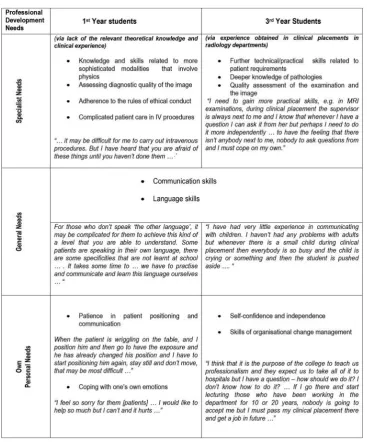
Students' professional developmental needs (Fig. 1)
Whilst identifying the skills and features that need to be developed in order to become a professional, differences were found between the perceptions of first years and third years in the area of specific skills. Third years, due to their experience in clinical placements, were able to identify specific technical skills to be developed; first years' statements of specific skills were general due to their lack of the relevant theoretical knowledge and clinical experience.
Contrary to the perceptions regarding specialist skills, the development needs related to general skills were almost identical among the students, irrespective of their year of study. Students perceived that their communication skills had to be developed especially involving children, the elderly and patients with special needs. Respondents noted unanimously that they should advance their language skills to be able to communicate with the patient not only in the official language but also in Russian which is spoken by a large group of the patient population.
First year students' personal needs were to learn more patience and an empathetic approach towards patients whilst at the same time not being overly emotional. It is shown that empathy can be taught and also improved resulting in changes in behaviour.51 and 52 Third year students were particularly concerned with the development of skills in organisational change management in order to be able to improve the substandard practice they frequently experienced in some radiology departments.
Limitations
Interviewers were members of the academic and research staff and for this reason well known to the students. This situation might have ensured students a comfortable situation for answering, but at the same time might have restrained them from expressing criticism. To ensure more trustworthiness of data, participant checking or some other technique could have been applied.
Conclusions
Student perceptions arise from their understanding of the concept of professionalism through taught theoretical sessions (explicit teaching) and through the observation of the behaviours of others in both the college and clinical environments (intrinsic teaching). The observation of behaviours played a significant part in students' understanding of what professionalism/unprofessionalism looks like with students appearing to have developed their own judgement distinguishing between
appropriate/inappropriate professional behaviour.
Any degree of dissonance between what is taught and what is observed is related to the presence of role models and anti-models thus demonstrating the importance of the intrinsic personal qualities of individuals. In this study, the identification of anti-models, rather than downgrading students' approach to professionalism was used in a positive way to consolidate their perspectives of professionalism.
As ‘professionalism evolves over time and can be developed through the processes of reflection and exploration’9 there are implications for curriculum development including increasing opportunities for students to reflect on their own and others' performances in different situations and contexts and developing student self awareness and confidence to resist being socialised into substandard practice. Involving clinical staff in discussions and conversations about professionalism and emphasising the importance of the clinical supervisor role would strengthen staff–student relationships without censuring the qualified staff or criticising individuals.
The results of this study should assist educators, clinical supervisors and programme leaders to assure the content and organisation of theoretical studies and clinical placement in the ways that facilitate the impact of positive factors and minimise the impact of negative ones in the radiography students' development of professionalism.
None.
References
1
G.B. Hickson, J.W. Pichert, L.E. Webb, S.G. Gabbe
A complementary approach to promoting professionalism: identifying, measuring, and addressing unprofessional behaviours
Acad Med, 82 (11) (2007), pp. 1040–1048 2
R. Francis
Report of the mid Staffordshire NHS foundation trust public inquiry. Executive summary The Stationery Office, London (2013)
https://www.gov.uk/government/uploads/system/uploads/attachment_data/file/279124/0947.pdf [Accessed 14 July 2016]
3
Morris A. Bundaberg hospital commission of inquiry. www.qphci.qld.gov.au;2010. [Accessed 7 November 2016].
4
S. Christmas, L. Millward
New medical professionalism: a scoping report for the Health Foundation The Health Foundation, London (2011)
5
D.P. Newton, L.D. Newton
Enculturation and understanding: some differences between sixth formers and graduates conceptions of understanding in history and science
Teach High Educ, 3 (3) (1998), pp. 339–364 6
C. Whiting
Developing professionalism: how effective are we? Imaging Ther Pract (June 2010), pp. 16–20
7
Health Care Professions Council (HCPC), Research report, Professionalism in healthcare professionals, 2014, HCPC
http://www.hpc-uk.org/assets/documents/10003771Professionalisminhealthcareprofessionals.pdf [Accessed 14 July 2016]
8
W. Levinson, S. Ginsburg, F.W. Hafferty, C.R. Lucey
Understanding medical professionalism, McGraw-Hill, New York (2014) 9
V. Passi, M. Doug, E. Peile, J. Thistlethwaite, N. Johnson
J. Thistlethwaite, J. Spencer Professionalism in medicine Oxford, Radcliffe (2008) 11
W.N.K.A. Van Mook, W.S. de Grave, V. Wass, J.H. Zwaveling, L.W. Schuwirth, et al. Professionalism: evolution of the concept
Eur J Int Med, 20 (4) (2009), pp. e81–e84 12
J. Keeling, J. Templeman
An exploratory study: student nurses' perceptions of professionalism Nurse Educ Pract, 13 (1) (2013), pp. 18–22
13
H.M. Swick
Towards a normative definition of medical professionalism Acad Med, 75 (2000), pp. 612–616
14 NMAHP
Professionalism in nursing, midwifery and the allied health professions in Scotland: a report to the Coordinating Council for the NMAH
Contribution to the Healthcare Quality Strategy for NHS Scotland (Jan 2012) http://www.gov.scot/Publications/2012/07/7338 [Accessed 14 July 2016] 15
G. Morrow, B. Burford, C. Rothwell, M. Carter, J. McLachlan, J. Illing
Professionalism and conscientiousness in healthcare professionals. Final report for study 1 – perceptions of professionalism. Medical education research group, school of medicine and health Durham University (21 April 2011)
http://www.hcpc- uk.org.uk/assets/documents/1000361BProfessionalismandconscientiousnessinhealthcareprofessionals-progressreportS2.pdf [Accessed 14 July 2016]
16
N. Akhtar-Danesh, A. Baumann, C. Kolotylo, Y. Lawlor, C. Tompkins, R. Lee Perceptions of professionalism among nursing faculty and nursing students
West J Nurs Res, 35 (2) (2013), pp. 248–271 http://dx.doi.org/10.1177/0193945911408623 17
G.F. Finn, J. Garner, M. Sawdon
‘You’re judged all the time!’ Students' views on professionalism: a multicentre study Med Educ, 44 (8) (2010), pp. 814–825
18
A.J. Robinson, C.J. Tanchuk, T.M. Sullivan
Professionalism and occupational therapy: an exploration of faculty and students' perspectives Can J Occup Ther, 79 (5) (2012), pp. 275–284
19
T.M. Sullivan, A.K. Tiessen
Occupational therapy students' perspectives of professionalism: an exploratory study OJOT, 3 (4) (2015), pp. 1–19 http://dx.doi.org/10.15453/2168-6408.1154
C. Whiting
Investigating the development of professionalism amongst diagnostic radiography students [unpublished Doctoral Thesis]
The Open University, Milton Keynes (2009) 21
S.R. Cruess, R.L. Cruess
Teaching professionalism – Why, What and How. FVV and Ob Gyn
Monograph (2012), pp. 2–8 http://www.fvvo.be/assets/244/03-Cruess_et_al.pdf [Accessed 14 July 2016]
22
S.W. Fraser, T. Greenhalgh
Coping with complexity: educating for capability
BMJ, 6 (323) (2001), pp. 799–803 http://dx.doi.org/10.1136/bmj.323.7316.799 23
S. Mennin
Self-organisation, integration and curriculum in the complex world of medical education Med Educ, 44 (1) (2010), pp. 20–30 http://dx.doi.org/10.1111/j.1365-2923.2009.03548.x 24
A.A. Salinas-Miranda, E.J. Shaffer-Hudkins, K.L. Bradley-Klug, A.D.H. Monroe
Student and resident perspectives on professionalism: beliefs, challenges and suggested teaching strategies
Int J Med Educ, 5 (2014), pp. 87–94 25
D. Bennet, M. McCarthy, S. O'Flynn, M. Kelly
In the eye of the beholder: student perspectives on professional roles in practice Med Educ, 47 (4) (2013), pp. 397–407 http://dx.doi.org/10.1111/medu.12114 26
M.V. Kavas, M. Demirören, A.M.A. Koşan, S.T. Karahan, N.Y. Yalim
Turkish students' perception of professionalism at the beginning and at the end of medical education: a cross-sectional qualitative study
Med Educ Online, 20 (2015), p. 26614 http://dx.doi.org/10.3402/meo.v20.26614 [Accessed 14 July 2016]
27 D. Wright
Conformists or dynamic professionals: What's the current image that students are identifying with as a result of english allied health professional higher education programmes?
J Allied Health, 37 (4) (2008), pp. e338–e353 28
B. Michalec
Clinical experiences during preclinical training: the function of modeled behaviour and the evidence of professionalism principles
IJME, 3 (2012), pp. 37–45 http://dx.doi.org/10.5116/ijme.4f42.5c99 29
A. Byszewski, W. Hendelman, C. McGuinty, G. Moineau
Wanted: role models − medical students' perceptions of professionalism
30
R.L. Cruess, S.R. Cruess
Expectations and obligations: professionalism and medicine's social contract with society Perspect Biol Med, 51 (4) (2008), pp. 579–598 http://dx.doi.org/10.1353/pbm.0.0045 31
N.P. Kenny, K.V. Mann, H. MacLeod
Role modeling in physicians' professional formation: reconsidering an essential but untapped educational strategy
Acad Med, 78 (12) (2003), pp. 1203–1210 32
A. Conway, S. Lewis, J. Robinson
Final year diagnostic radiography students' perceptions of role models within the profession J Allied Health, 37 (4) (2008), pp. 214–220
33
C.B. White, A.K. Kumagi, P.T. Ross, J.C. Fantone
A qualitative exploration of how the conflict between formal and informal curriculum influences student values and behaviours
Acad Med, 84 (5) (2009), pp. 597–603 34
J. Corbin, A. Strauss
Basics of qualitative research: techniques and procedures for developing grounded theory Sage Publications, Newbury Park (2015)
35
K. Van de Camp, M.J.F.J. Vernooij, R.P.T.M. Grol, B.J.A.M. Bottema How to conceptualize professionalism: a qualitative study
Med Teach, 26 (8) (2004), pp. 696–702 36
S.A. Thomas, I. Steven, C.J. Browning, E. Dickens, L. Eckermann, L. Carey, et al. Focus groups in health research: a methodological review
Annu Rev Health Soc Sci, 2 (1992), pp. 7–20 http://dx.doi.org/10.5172/hesr.1992.2.1.7 37
J. Kitzinger
Qualitative research. Introducing focus groups Br Med J, 311 (1995), pp. 299–302
38
C.A. Wright, M.E. Schneider-Kolsky, B. Jolly, M.A. Baird
Defining fitness to practise in Australian radiation therapy: a focus group study Radiography, 17 (1) (2011), pp. 6–13
39
C.A. Wright, M.E. Schneider-Kolsky, B. Jolly, M.A. Baird
Using focus groups in radiation therapy research: ethical and practical considerations
J Radiotherapy Pract, 11 (2012), pp. 217–228 http://dx.doi.org/10.1017/S1460396911000379 40
Professional attitudes and behaviours: the “A’s and B’s” of Professionalism Am J Pharm Educ, 64 (2000), pp. 455–464
41 Y. Partida
Language barriers and the patient encounter AMA J Ethics, 9 (8) (2007), pp. 566–571 42
Royal College of Physicians (RCP)
Doctors in society: medical professionalism in a changing world. Report of a working party of the RCP
RCP, London (2005) 43
E. Paice, S. Heard, F. Moss
How important are role models in making good doctors? BMJ, 325 (7366) (2002), pp. 707–710
44
E. Schafheutle, K. Hassell, D. Ashcroft, J. Hall, S. Harrison Professionalism in pharmacy education final report
Centre for Pharmacy Workforce Studies, Manchester (2010) 45
F.W. Hafferty
Beyond curriculum reform: confronting medicine's hidden curriculum Acad Med, 73 (4) (1998), pp. 403–407
46
C. Johns, D. Freshwater
Transforming nursing through reflective practice Blackwell Publishing, Oxford (2005)
47
J. Sim, A. Radloff
Profession and professionalisation in medical radiation science as an emergent profession Radiography, 15 (3) (2009), pp. 203–208 http://dx.doi.org/10.1016/j.radi.2008.05.001 48
A.K. Brownell, L. Côté
Senior residents' views on the meaning of professionalism and how they learn about it Acad Med, 76 (7) (2001), pp. 734–737
49
J. Horsfall, M. Cleary, G. Hunt
Developing a pedagogy for nursing teaching -learning Nurse Educ Today, 32 (2012), pp. 930–933
50
V. Jha, H.L. Bekker, S.R. Duffy, T.E. Roberts
Perceptions of professionalism in medicine: a qualitative study
R. Buckman, J.A. Tulsky, G. Rodin
Empathic responses in clinical practice: intuition or tuition?
CMAJ, 183 (5) (2011), pp. 569–571 http://dx.doi.org/10.1503/cmaj.090113 52
S. Brunero, S. Lamont, M. Coates
A review of empathy education in nursing