Patient-centred orientation of students from different health care disciplines and their perceptions regarding experiential learning, teaching and application of patient-centred care- A mixed methods study.
Introduction
Target-oriented culture and mismanagement has resulted in poor quality of care in many NHS trusts leading to a need for a reformed healthcare system (Kennedy, 2001; Francis, 2013; Keogh, 2013). This deterioration is despite policies and guidelines that direct service providers to adopt a patient-centred approach to care delivery (Department of Health (DoH), 2010; Department of Health, 2013; Department of Health (DoH), 2013). However, adoption of patient-centred care is a challenge due to the concept’s multifaceted composition and interpretations. Patient-centred care has been suggested to include communication,
collaboration, respect, therapeutic relationship between parties, consideration and care for all aspects of heath (including psychological and social needs)(Mead and Bower, 2000). Such an approach to care is seen as a necessity in the changing demography of increasing older population and chronic illnesses which requires long-term relationships, self-management and coping strategies (Bosma et al., 2010).
Patient-centred care orientation in clinicians has resulted in patients being satisfied with the clinician (Krupat 2000), better emotional health, better recovery from discomfort and concerns and fewer referrals (Stewart et al., 2000). Despite guidelines and evidence for adoption of patient-centred approach to care, culture and attitude of healthcare professionals within many hospitals seems to be defensive and hence resistant to change (Dixon-Woods et al., 2013).
Professional behaviours are cultivated and developed primarily when clinicians are students. Certain factors such as being a female, religious background, earlier years of study, content of the curriculum and community placements were identified as factors that influenced students’ patient-centred orientation amongst medical students (Howe, 2001; Haidet et al., 2002b; Bosma et al., 2010; Archer et al., 2014). It has been found that some nursing and medical students have attitudes that are more clinician-centred rather than patient-centred, more so in the later years of their training (Haidet et al., 2002a; Tsimtsiou et al., 2007; Grilo et al., 2014). However, patient-centred orientation has not been explored adequately in allied healthcare professionals who work in teams to provide care. It is important to explore
orientations of all healthcare professional students as they work closely in multidisciplinary teams and potentially learn from and influence each other as future professionals.
and Bonner, 2012), extended community based learning (Rapport, Rodriguez and Bade, 2010) and in some instances the use of virtual patients (Smith et al., 2007) to improve patient-centred attitudes in health professional students. Despite an established practice of delivering curriculum that reinforced patient-centred care through teaching communication skills, professional values, humanistic attitudes, behaviours (Schmidt, 1998) and despite prolonged contact with the patients in community (Bosma et al., 2010) medical students were found to be doctor-centred. Some authors suggest that this lack of transference of skills to deliver complex skills such as patient-centred care might be due to the intervening variables such as the experience, culture and role-models in the working environment (sometimes described as the hidden curriculum) (Tsimtsiou et al., 2007; Skelton, 2016). An
understanding of the students’ perspectives could highlight factors causing their deviation from patient-centred attitudes and behaviours. Moreover, this knowledge from students views is essential to develop curriculum that health professional students would engage in, reduce barriers for transference of principles in to practice and make curriculum student-led. In the long-term, patient-centred curriculum delivery is bound to change practice and eventually culture within healthcare focusing on healing rather than curing (Boudreau, Cassell and Fuks, 2007).
Aims and objectives: The aim of this project is to explore the patient-centred orientation of students from different health disciplines and whether the key variables of age, gender, programme of study or placement exposure predicted their patient-centred orientation scores. Secondary aim was to explore their perspectives regarding their understanding of the
approach and factors that influenced their development as a patient-centred professionals during their training period.
Methods: The study adopted an explanatory sequential approach using cross-sectional mixed method design involving both quantitative and qualitative methods. The population of
interest were students in various health professional courses such as medicine, physiotherapy, speech and language therapy, occupational therapy and nursing to represent the wide
membership of a multi-disciplinary healthcare team. Three universities across West Midlands that delivered health professional courses were approached for their participation in this study. Sampling strategy was purposive, and criterion based. Inclusion criteria were that the students are registered on any of the above listed professional courses, of both gender and willingness to participate. They should have done a minimum of two placements so that experiences from these placements can be explored. To standardise across programmes, third year students from all the above courses were invited to participate in the first part of the study. The students were approached at the end of a whole group lecture by a tutor from a different programme to avoid coercion and participation bias. Students were given
sample sizes were representative of each programme. Ethical approval was sought and granted by the University STEM ethics committee (ERN_17-0413)
Mixed methods were used to gain holistic perspectives within this area and to complement the data collected from each of the methods. The questionnaire collected information regarding their demographics such as their programme, year of education, the number of placements and details of placements. Their patient-centred attitudes were measured using Patient Practitioner Orientation Questionnaire (PPOS) a valid and reliable outcome measure with 18 items (Shaw 2012). The PPOS has a six-point Likert (strongly agree-strongly disagree) to score nine-items each for Sharing (belief that patients desire information) and Caring.
Focus groups were set up for self-selected groups of students from within these participating cohorts, to gain understanding of their knowledge about this concept, its application and the facilitators and challenges from their learning experiences (appendix 1). Focus groups were optimal as they were time-efficient to collect qualitative data, yet, collected information that was moderated within the group and hence was collective knowledge. The FG guide was piloted in two groups of physiotherapy students from a previous cohort. Each focus group was conducted by tutors from a programme different to that the students were enrolled on. A scribe also a tutor from a different programme was present at each FG meeting. All
researchers involved in conducting FG and analysing data had a masters qualification, had previous experience in conducting qualitative research involving FG and were educators interested in improving patient-centred curriculum.
Analysis: The quantitative data from the questionnaire and the sample characteristics such as age, gender, programme and placements experienced were descriptively summarised using descriptive measures using SPSS software (version 21). The demographic variables were not normally distributed. Tests for differences between programmes were carried out using Pearson’s chi squared or Kruskal-Wallis H test. Post hoc tests for direction of differences were explored using Dunn’s test with Bonferroni correction for age and number of
placements. Following descriptive analysis of the PPOS scores for caring, sharing and totals, one-way ANOVA or Welch tests were used to explore differences in these scores between these groups depending on their distribution and homogeneity. Post hoc tests to determine direction of differences included Games Howell’s or Tukey’s tests. Regression analysis was carried out to see if any of the demographic variables influenced the patient centred
orientation scores for caring, sharing or both.
FG. The different FG data were independently analysed by different researchers. At least two members of the team coded each of the transcripts independently and met to discuss the categories and themes that were derived from the data. These meetings served to clarify themes and enrich interpretations that were derived by the primary analyst. Once all the FG data were analysed the key themes across all FGs were synthesised by the first author. This synthesis involved highlighting the common and salient features and comparing and
contrasting information presented from each of the disciplines. Results:
Of the three universities approached, one of the programmes refused participation. Within two universities four program leads agreed to participate. Of the 215 questionnaires that were completed 211 had complete demographic data and were included in the analysis. The
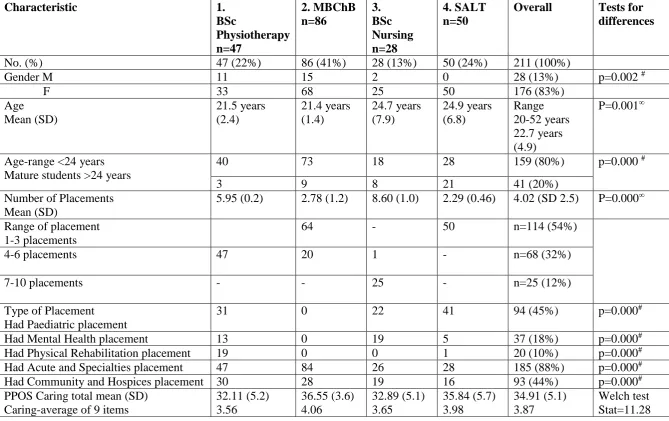
highest number of students were from the medical programme (41%) and 83% were females. Age range was between 20-52 years with a mean age of 22.7 years (SD 4.9) and 20% of the students were mature students at the point of enrollment on their programme. On average the students had 4 placements, nurses had the highest number ranging between 7-10 placements and medical students and SALT students had the lowest ranging from 2-5 placements by the time they were near the end of their 3rd year. Students listed placement experiences in various types of placements which have been classified into five categories of Paediatric, Mental Health, Acute and specialisms, Physical rehabilitation and community and hospices. The various types of placements within these categories have been listed in appendix 2. The highest number of the placements were reported to be the Acute and specialisms with 88% students having had at least one in these areas. Physical rehabilitation and mental health placement were lower with 10% and 20% of students reporting that they had at least one of these. All these demographic variables were not normally distributed (shapiro-wilks p=0.00) and were significantly different in the student groups from various programmes (Pearson Chi squared & non-parametric equivalence Kruskal-Wallis H test, p<0.05). Post hoc tests
revealed significant differences in age between SALT and medical and SALT and
physiotherapy students. There was a higher percentage of mature students in the SALT group (56%). Post hoc tests also showed that there were significant differences in the number of placements between SALT and physiotherapists and nurses and between Medical students and physiotherapists and nurses (table 1).
The overall total PPOS scores averaged at 73.62 (SD 8.81) for the study participants therefore with an average of 4.0 for the 18 items assessed. The physiotherapists scored the lowest average of 68.66 (SD 9.07; item mean 3.81) and the medical students scored the highest with an average of 76.77 (SD 6.29; item mean 4.26) (figure 1). Welch test showed that there were statistically significant differences between the four groups (Stat- 12.11, Df= 3, 79.99, p=0.000). Games-Howell test indicated that the significant differences were
difference of -4.44 (p= 0.000, CI - 6.69 -2.19). Likewise, in the Sharing component, students had an average score of 38.72 (SD 5.4) and a mean item score of 4.30. One-way Anova indicated significant differences in these groups (F=5.770 p=0.001) with the post hoc Tukey’s HSD indicating difference between the medical and physiotherapy students with a mean difference of -3.67 (p= 0.001, CI -6.12 -1.22).
Table 1: Participant characteristics and differences in groups.
Characteristic 1.
BSc Physiotherapy n=47 2. MBChB n=86 3. BSc Nursing n=28 4. SALT n=50
Overall Tests for differences
No. (%) 47 (22%) 86 (41%) 28 (13%) 50 (24%) 211 (100%)
Gender M 11 15 2 0 28 (13%) p=0.002 #
F 33 68 25 50 176 (83%)
Age Mean (SD) 21.5 years (2.4) 21.4 years (1.4) 24.7 years (7.9) 24.9 years (6.8) Range 20-52 years 22.7 years (4.9) P=0.001∞
Age-range <24 years Mature students >24 years
40 73 18 28 159 (80%) p=0.000 #
3 9 8 21 41 (20%)
Number of Placements Mean (SD)
5.95 (0.2) 2.78 (1.2) 8.60 (1.0) 2.29 (0.46) 4.02 (SD 2.5) P=0.000∞ Range of placement
1-3 placements
64 - 50 n=114 (54%)
4-6 placements 47 20 1 - n=68 (32%)
7-10 placements - - 25 - n=25 (12%)
Type of Placement Had Paediatric placement
31 0 22 41 94 (45%) p=0.000#
Had Mental Health placement 13 0 19 5 37 (18%) p=0.000#
Had Physical Rehabilitation placement 19 0 0 1 20 (10%) p=0.000#
Had Acute and Specialties placement 47 84 26 28 185 (88%) p=0.000#
Had Community and Hospices placement 30 28 19 16 93 (44%) p=0.000#
PPOS Caring total mean (SD) Caring-average of 9 items
Df= 3,79.86 p=0.000 * Sharing Total mean (SD)
Sharing - average of 9 items
36.55 (5.66) 4.06
40.22 (4.4) 4.46
37.32 (6.4) 4.14
38.94 (5.4) 4.32
38.72 (5.4) 4.30
One-way Anova F=5.770 p=0.001 ** Total Scores mean (SD)
Average of 18 items
68.66 (9.07) 3.81
76.77 (6.29) 4.26
70.21 (9.06) 3.90
74.78 (9.65) 4.15
73.62 (8.81) 4.09
Welch test Stat- 12.11 Df= 3, 79.99 p=0.000 ***
Tests for differences
‡ Post Hoc Dunn’s with Bonferroni correction for Age p=0.005 between 1 and 4 and 2 and 4; For Number of placements p=0.001 between 4 and 1,
4 and 3, 2 and 1, 2 and 3.
Figure 1: Distribution of Sharing, Caring and Total PPOS Scores.
N
ur
sing
P
h
y
siot
he
ra
p
y
Me
dicine SA
L
T
Nur
sing
P
h
y
siot
he
ra
p
y
Me
dic
ine
S
A
L
T
Nur
sing
P
h
y
siot
he
ra
p
y
Me
dicine SAL
Table 2: Multiple Regression Analysis
CARING SHARING TOTAL SCORES
Β SE T value P value β SE T value P value β SE T value P value
(Intercept) 32.03 2.053 15.604 0 35.02 2.282 15.345 0 32.03 2.053 15.604 0
ProgPhysio -1.675 1.375 -1.218 0.225 0.106 1.529 0.069 0.945 -1.675 1.375 -1.218 0.225 ProgMedicine 3.462 1.578 2.193 0.029 3.012 1.755 1.716 0.088 3.462 1.578 2.193 0.029
ProgSpeech 4.206 1.493 2.817 0.005 2.743 1.66 1.653 0.1 4.206 1.493 2.817 0.005
Sex M -1.627 1.017 -1.6 0.111 -1.74 1.13 -1.539 0.125 -1.627 1.017 -1.6 0.111
Maturity -1.259 0.88 -1.432 0.154 0.236 0.978 0.242 0.809 -1.259 0.88 -1.432 0.154 Paediatric -0.776 1.039 -0.746 0.456 -0.278 1.156 -0.241 0.81 -0.776 1.039 -0.746 0.456 Mental health 0.119 1.102 0.108 0.914 0.402 1.225 0.328 0.743 0.119 1.102 0.108 0.914 Physical
rehabilitation
1.725 1.404 1.229 0.221 -1.817 1.561 -1.164 0.246 1.725 1.404 1.229 0.221
Acute hospitals and specialisms
1.421 1.323 1.074 0.284 2.2 1.471 1.495 0.137 1.421 1.323 1.074 0.284
Community and Hospices
0.641 0.722 0.888 0.376 0.826 0.803 1.028 0.305 0.641 0.722 0.888 0.376
Qualitative findings:
Table 3. Characteristics of students who participated in the focus groups.
No Programme Year of
Study
Gender Number of
Placements Age
1. SALT 3 F 2 23
2. SALT 3 F 2 35
3. SALT 3 F 2 42
4. SALT 3 F 2 22
5. SALT 3 F 2 -
6. SALT 3 F 2 28
7. SALT 3 F 2 29
8. Physio 3 M 6 20
9. Physio 3 F 6 20
10. Physio 3 F 6 20
11. Physio 3 F 6 21
12. Physio 3 F 6 21
13. Physio 3 M 6 21
14. Physio 3 F 6 25
15. MBChB 3 F 2 21
16. MBChB 3 F 2 21
17. MBChB 3 F 2 20
18. Nursing 3 F 9 28
19. Nursing 3 F 9 22
20. Nursing 3 F 8 21
Figure 2: Qualitative findings presented as Themes and Categories
Understanding of the patient-centred approach:
Understanding of concept
Holistic yet individualised care
Patient-professional partnership
MDT role in providing PCC
Communicatio n
Altruis m
Purpose of being patient-centred
Patient benefits
Professional’s personal benefits
Factors influencing adoption
Personality knowledge Student status
experience Mentoring
Observation and
assessments
Workplace culture Practices
Type of Setting Patient’s condition Family involvement
Dilemmas shaping development
Learning objective skills
Increased workload Constant Prioritising
Twenty-one students participated in four focus groups, whose characteristics are outlined in table 3. More females than males volunteered to participate in the focus groups. The SALT FG had a higher number of mature students compared to the other groups. The durations of the groups were: medicine- 44 mins, physiotherapy 76 mins, SALT 27 mins, nursing 93 mins. The qualitative themes derived from these discussions mainly outline the students’ understanding of the approach and the factors influencing development of patient-centred skills. The key themes derived from the data are represented in figure 2, following which they are explained with illustrative quotes.
1. Understanding of concept:
Students from the various healthcare professions had a broad understanding of the approach and what it entails. All four groups mentioned aspects related to holistic yet individualised care, patient-professional partnership and the MDT role in providing PCC.
a) Holistic care involved use of tailored approach to meet individualistic needs. The focus was suggested to be on the person. Understanding of personal situation, beliefs, values, emotions and needs were a precursor to building personalised care. Being empathetic and considerate were suggested as moral values.
Having the patient as the focus,
Yes, I think it's like understanding what the patient wants from their care, because some of them have a specific thing, like for example, they might have a condition, but what's really worrying them is that they want to go on holiday with their family at this time, and they don't know if they'll be able to. So like understanding what their
concerns are when you're treating them. Medical FG
I think like the main principles of patient-centred care, and empathy and taking in people's considerations, it's more - before uni though that's just like pure morals, Physio FG
b) Patient-professional partnership involved shared decision making, effective
communication and building a relationship with patients. As partners in care patients were to be given information to enable informed decision making, involve them in planning and to set and address their goals. Ultimately goals were to link with the patient outcomes.
“Their goals and targets what they personally want with their goal is important rather than what we may want personally as their goal…
Yea so they are involved in the decision-making process and like the choices
be an equal partner …and we have to facilitate this by providing them with accessible information on their condition and what’s available to them”
SALT FG
Communication was a key aspect of PCC that involved listening to patient to decide on treatment. All students mentioned open communication about clinical needs that is
I feel as though patient-centred care is listening to the patient, taking their values into consideration and communicating to them as equally as you'd communicate to the MDT.
You try to individualise it and listen to what their specific goals are and try and incorporate that into your treatment.
Physio FG
So we had to explain to the patient and the family like we don't have the time and resources to be able to do that every single time unless it's clinically needed. It was kind of explain to the patient that they didn't need that every time and reassure them Nursing FG
So if you don't rush off when they start talking about their grandchildren or whatever, then if you stay and listen to that then, in the future, you'll have a much better rapport with them. Medical FG.
Altruistic motives underlined PCC. Students described as wanting to help patients, build relationships and rapport, do kind acts and decent gestures such as call patients by names. They wanted patients to feel valued.
I think, for me, like I came into the profession because I wanted to help people and that's what I wanted to do. You do always like - I always want to do the best for the patients and that's what I'm there to do,
Nursing FG
I think its about trust as well you need to gain a good enough rapport and you need to build that rapport so they trust you and if you give them options that are genuine options then if you say you don’t know then you really don’t know and you will go and find out and come back to them .
SALT FG
I think the patients respond so much better to someone calling them the right name. I mean how annoying would it be to just constantly have to clarify what you want to be called whereas when the staff learn that and just to know to call the patient what they'd like to be called the patient is immediately much more relaxed and responsive Nursing FG
c) The MDT was mentioned by all the groups to play a key role in delivering PCC by discussing patient information within team, having a good communication, serving as a patient advocate. Nurses specially believed they were the link for patient family and MDT to deliver PCC. Family involvement was stressed by the nurses.
Learning as well to work with the multi-disciplinary team so you know you might have to refer them to that first before you can actually look after them and help them SALT FG
you're never going to see the whole person unless you can communicate effectively as a group
Yes, but having the family because, of course, they can't really articulate it perhaps as well as an adult but having families and friends and siblings there, to advocate for them on their behalf and say, 'This is really important to them or…' That's invaluable a lot of the time.
Nursing FG
We get that contact with them that other, that the other professionals don't but when the medic or the pharmacist or the physio comes in to see that patient we, having more exposure to working with them gives more of a chance to… We can bring that holistic care into their practice as well and it can… So it can act as their advocate as the patients' advocates. I think all healthcare professionals are but…, we're just there all the time
Nursing FG
2. Purpose of being patient-centred:
The purpose was two-fold, primarily to benefit patients and their experience but also for students’ own personal reasons.
a) Students believed that PCC gives them opportunity to deliver what patients want, gain their trust and build rapport with patients. Ultimately, all four groups believed, it improves compliance with treatment and therefore makes treatment effective bringing about better outcomes for the patient. Especially the physio group were focused on goal-setting and empowerment to ensure patients take control of management. Their intention for developing relationship was that it could help to steer therapy.
I think like a patient/physio relationship makes them have more trust in you. Like when you're giving them something and they're a bit apprehensive, although they're willing to do it, it makes them a bit more trust - makes you seem a bit more trustworthy as in like you've got their best interests at heart. They're more likely to comply with what you've asked them to do.
Physio FG
Students suggested patients would be better satisfied, grateful, less distressed and happy with care. Integrating physiotherapy and patient goals through patient-centred care would inspire patients, give them hope. a sense of direction and a sense of control and achievement.
Well, what I want from a doctor is people who listen to what I want and tell me that I can have what I want', and that kind of thing, and they tell you what they want, and I think that if you get that right from early on, that's what you want to become, so you want to be the kind of doctor that makes people happy.
Medical FG
The small short-term goals, they're patient-centred care in that they give them a sense of achievement and a sense of direction. They're feeling like they are actually in control of their health and they are achieving things… and it's not just like, 'Oh, it's never going to happen’
b) Interestingly, they also mentioned their own benefits from being patient-centred. Nursing students reported that patient-centred care saved time in some instances, gained them appreciation from patient and family, gave them a sense of satisfaction and happiness from their jobs. Medics described it as the fun part of being a clinician, whereas physios mentioned patient consent, a part of PCC, as a legal requirement and patient-centred attributes were employable skills.
Nowadays, when so many things depend on like imaging, or different diagnostic tests and stuff, it's so important to keep the only fun part of it, where you actually get to interact with a patient nicely. I think that's like a real doctory part of the job. Medical FG
3. Factors influencing development of PCC attributes
Students reported various factors that they felt had influenced their practice and development as patient-centred student practitioners. Their knowledge and roles shaped their experiences on placements. They also attributed their patient-centred practice behaviours and learning to intrinsic factors such as their perceived status and certain external influences. They were faced with dilemmas that shaped their development as patient-centred professionals in practice.
a) The key factor was their knowledge and role as a student. They suggested that they had limited prior practical experience even though they had been taught to adopt patient-centred attributes. Their major focus had been on developing knowledge of physical aspects or bio-medical knowledge till they came on to placements. They even felt that teaching and practice were not linked in some areas such as when assessments focussed on skills and targets. Hence classroom teaching did not equip them to approach patients without fear.
“It sometimes can be difficult in practice when we're very much taught to be physical health nurses and I think sometimes the other things can be a little bit of an add-on” Nursing FG
I think, because we have this clinic skills passport, which we need to get signed off for certain things, especially towards the end of term when all the students start to panic and say, 'Oh, I haven't done three bloods yet', they would go specifically to a ward and ask the nurses and doctors if they had any patients for bloods that needed taking, whereas - I don't know, because that's not really patient-focused, but just trying to get something out of them, like you want their blood rather than to actually give them care.
Medical FG
“As a student we don’t yet hold that qualifications, so our experience is confined to what we have learnt in the classroom are artificial”
SALT FG
I mean, when I got to hospital, I was just scared to talk to doctors, basically. I thought everyone was so busy I didn't want to interrupt them to ask questions are anything like that, because they had lots going on, they didn't have time to talk to me. Then also approaching patients, I was like, well, I don't see why they'd want to talk to us
because we can't really help them, you know, and the more - and everyone says like, 'Oh, patients love talking to you', and things, and at first I just didn't believe them. Yes, and it really took me a while to realise that, actually, they do like talking to you and things, but as much as anyone told me that, it took me to work that out, kind of thing.
Medical FG
Despite their student status being considered as not conducive to patient-centred behaviours, some students felt that they had more time as students to spend with patients due to lesser responsibilities, patients find them more approachable than the busy clinicians and hence have a good rapport with them that feeds in to their planning and care. They tend to spend more time doing elaborate assessments as students and work hard to earn patients’ trust and offer to do small acts of kindness.
So you do just pop your head into the bay, say, 'Hello,' to people. Then they do feel you've got that time to chat to them I think, which maybe once you're qualified you don't always have that spare time.
Physio FG
Her hair was everywhere and she was sweating and I was like, 'Do you want me to just pull your hair back for you?' Having that tied back, like the relief on her face because she was hot and clammy and she just really appreciated it, which was nice. Nurse FG
c) Majority of the influences mentioned were external and a key external factor was the mentoring or the role models in practice. Mostly they claimed that their natural exhibition of patient-centred behaviours was limited because of them being observed, assessed or
dominated by clinicians who served as their educators or mentors. Due to the power
differences, in instances where there were negative role models, students still had to agree to the clinician’s approach to care. They reported not having the courage to upset the mentor and the lack of support or encouragement from mentors to be patient-centred. This was prevalent in all health care professions but, specifically the medical students highlighted that senior clinicians were very bio-medical and they tended to look to junior clinicians as role models to be more patient-oriented.
I'd say a lot of the time, like as a student, it's if you're being assessed. If you're being watched by someone or you're very conscious that they're like expecting you to maybe do certain things to meet the assessment criteria, that can overcome what… Say, you're trying to have a conversation with them, just about them, and you're very conscious that you've got somebody watching you who's expecting you to meet these assessment criteria.
Physio FG.
let people ask questions and things, and I think that's probably part of their job in terms of they've got the most pressure on them and things, but I also wonder whether it's the further away they get from med school where they've had all of this training, like it becomes automatic to just carry on rather than stopping to think as much.
I think as well, though, the consultants that we see now, obviously trained, what, 30, 40 years ago, where it was more a kind of, you are the doctor, you tell people what to do, this is your job, and it's not like that anymore. But it's only recently that that's changed.
Medical FG
The other common factors that were mentioned by the students were the type of setting where they were placed and status of patients. Culture of the workplace, size of patient group, complexity of the patient’s condition and their personalities with the needy ones getting more attention.
I think perhaps sometimes the culture of the place that you're working. I know we're lucky here that we get to experience all fields of practice so I remember my very first placement was at a mental health rehabilitation in-patient unit. Actually, the holistic care there was very much like helping with housing and a lot of social support and helping people, you know, focus on being able to cook themselves a meal as well as very much integral to their health and wellbeing.
Nursing FG.
To try and get you more comfortable with patients, because I know from my GP placements in first year, especially, we were just like thrown into a room of a patient and they just said, 'Chat to them', and you'd be terrified.
Medical FG
I think like it depends on the complexity of the condition, because I had a patient at a previous placement with multiple myeloma and there was lots of different MDT teams involved.
Physio FG
Certain work practices with nursing helped them to do better as patient-centred practitioners such as comprehensive handovers that gave and insight in to the non-medical aspects for the patients’ situation and emotion.
Not all nurses will do this but a lot of nurses will go through all their medical needs, everything, go through their drugs and stuff and then they'll say how they've been in the day. Like, if they've been upset by anything or… I don't know, like, if they've been to school, like different things and they will include that in handover. So mainly, so you don't go and put your foot in it like or if it's something particularly important or some nurses just literally just build it in, they'll do it for every patient how they've generally been and what their additional needs are. It helps me so much because you go with that mindset,
Nursing FG
learning situations such as wards rounds. They perceived a rift between learning the
objective skills and developing patients-centred attitudes. Students especially physios felt the burden of the workload and found balancing the ideal and realistic commitments challenging. They were constantly prioritising which was frustrating and sometimes disappointing.
Especially on ward rounds, when you go around with them they can see all of the patients as more of like a list to get through before a certain amount of time. I suppose, the time pressure and all the - almost they turn it into like tours for all the tests that need to be done for each patient, every single morning. I suppose, it makes it less patient-centred and more like a factory sometimes.
Medical FG
like obviously with the limitations of your workload and the number of staff you've got, sometimes you just can't give every patient what is best for them, I think…. You've got to balance what they want but the actual clinical needs as well, and it's trying to find that balance, or as much as possible, within the limitations of the service and everything.
Physio FG
Nurses struggled to divide attention between the physical care and spending time with
patients. Physios prioritised physical care for those in more acute need for it. They concluded that PCC is not always possible in the real world as they must prioritise the clinical need of the patients. This sometimes meant establishing a balance between patient’s freewill and their clinical need.
I think that's my biggest barrier to it is being so concerned with other things that maybe my patient-centred or family-centred care lacks, or at times is so much of a focus of one particular situation that my other more medical care suffers for it. So I think that's my main thing.
Nursing FG.
I think sometimes it doesn't happen though. I think everyone's purpose here, like all healthcare professionals, is doing what the patient wants to help them get better, but obviously patient-centred practice can't be like the main forefront. The main aim of like people in hospital is to get them out again because of the measures, like costs and the effectiveness, so patient-centred care is going to take a bit of a back burner in certain situations, if that makes sense.
Discussion:
The key findings showed that there were significant differences within the four groups of health care professional students in caring, sharing and total PPOS scores especially between the medical and physiotherapy students. None of the variables could predict the level of students’ patient-centred orientation except the programme in which they were enrolled. SALT programme predicted significantly higher caring orientation and overall PPOS scores. Enrollment in medicine predicted significantly higher total PPOS scores. The focus groups revealed that students understood patient-centredness as holistic care tailored to each person through understanding of individual needs and through building a relationship. Students from all four disciplines identified placement learning as vital and role models from placements as the key factor that could either positively or negatively influence development of patient-centred attributes. They suggested working situations and their status as students caused them dilemmas that shaped their attitudes towards patient-centred care.
To our knowledge this is the first study that explores and compares patient-centred
orientations of multiple health professional students whereas majority of other studies focus on medical students (Hur 2016). Further this study is unique in that we sought to explain the influences for extent of patient-centred orientation in these students through qualitative data. In this study medical students scored better than the other groups of students despite the fact they were still halfway through their education and had lesser placement experiences
compared to nursing or physiotherapy students. It is known that professionals are more patient-centred early in their career compared to in later years (Krupat et al 2000). The third year of education has been revealed as the turning point when students tend to step away from patient-centred attitudes (Hojat et al., 2009). Despite this, medical students showed better patient-centred orientation compared to other groups possibly due to lesser influence of the hidden curriculum due to reduced exposure to the NHS working practices and culture. Meanwhile the nurses and physiotherapists had faced high workload and demanding responsibilities and had moved away from idealism.
Females have previously been shown to be more patient-centred and scored higher in caring and total scores compared to male clinicians (Lumma-Sellenthin 2012, Krupat et al 2000). Perhaps the higher scores of the SALT group is a reflection of the gender composition of this group with 100% of them being females. Moreover there was a higher percentage of mature students within the SALT group who were identified to be more patient-centred in other studies (Lumma-Sellenthin 2012 (Wahlqvist et al., 2010)). It is possible that mature students choose to do health professional courses due to intrinsic motivation gained from life
to medical and SALT students who had fewer placement experiences by this point. Perhaps not having positive role models on placements, inadequate support from mentors, influence of ‘hidden curriculum’ might account for work experience not enabling their patient-centred attitudes (Tsimtsiou et al 2007). This is supported by data from the current study’s focus groups which highlight the negative influence of mentoring in all four groups resulting in students being unable to resist cultural influences and instead followed prevalent practices. Hence it is important to turn the negative influence of the socialisation process (Hafferty 1998) around by creating awareness and training mentors in this aspect. This is especially important as qualified nurses who are current mentors had previously shown reduced patient-centred attitudes compared to students (Grilo et al., 2014).
Practice placement type did not predict their patient-centred orientation in this study. In Nigeria psychiatry doctors were found to be most patient centred compared to those working in internal and family medicine (Abiola et al., 2016). The authors had suggested that this could’ve been since mortality was very low in these patient groups, therefore patients were in the care system for long periods. Moreover, consultation times were longer, 45 mins for each psychiatry patient. Even though this could hold true for UK practice due the above reasons, medical students seem to have observed differently. In the focus groups they reported that mental health patients were not given adequate information due to assumption of reduced mental capacity. Whether these observed learning influences their future practice in mental health or other areas with reduced mental capacity needs to be explored.
Physiotherapy students scored lower than the other groups in caring, sharing and total scores. Their focus group data sheds some light on this aspect. Their understanding of the patient-centred approach involved being task oriented and getting patients to be compliant to achieve goals. They identified high workloads interfering with adoption of patient centred principles. Their approach to care was pragmatic and suggested patient-centred care might not always be possible. The approach cannot be one size fits all for different caring and therapy professions. Nursing students being in the caring profession have shown to score higher in caring than sharing (Grilo et al., 2014). Just as patient-centred care is individualistic to each person, ways of adopting principles should be differently designed for professions that deliver care and for other therapy professions that devolve ownership of health to patients.
More widely, the PPOS scores of the UK students within the current healthcare system is higher than Asian medical students (3.90) (Hur, 2016) (3.40) (Ahmad et al 2015), but lower than the medical students training in the USA (4.76-4.84) (Ref). This has been attributed to the doctor-centred approach to care in Asian countries (Tor, 2001; Shankar and Piryani, 2009; Ahmad et al., 2015). Research suggests that patients lean towards family centred care in these countries (ref). There have been calls to improve patient-centred orientation in health care due to economic and technological developments in these countries. However cultural influences should be considered while researching and designing patient-centred education for these populations.
Limitations: The response rate was 50% and less for nurses and medical students, but
the survey close to the end of the year and close to exam period might have affected the response rate. This and the study taking place in two Universities in the West Midlands might reduce the generalisability of findings to wider Universities. A sample size was not estimated for the survey due the exploratory nature of the study. There could’ve been other factors such as spirituality (Tsimtisou 2007), cultural background, specific training elements that could’ve contributed to the patient-centred orientation but were not studied in this research. Regarding FG methodology, no repeat groups were arranged to seek data saturation as the ongoing analysis showed repetition and overlap within data from different groups. Member checking was not possible as most of the students left University following completion of their studies. Future research should investigate other variables that influence patient-centred orientation in students in a bigger sample size across a wider geographical area. There is evidence that patient-centred attitudes deteriorate over time (Haidet et al., 2002b; Grilo et al., 2014) and hence following up these students into their careers in longitudinal studies could shed light on what causes deterioration of these attitudes. It is also important to explore aspects within the curriculum that influence the development of patient-centred attributes. This will help build curriculum that is based on students’ values and needs. Since the role of mentoring in developing patient-centred attributes is heavily highlighted from this study, future research should focus on how educators and clinicians perceive their role and contribution in this aspect. Perhaps placement education should provide training based on the study’s findings to enhance educators’ contribution towards developing patient-centred health care work force. Innovative curriculum has been shown to mediate erosion of these values (Krupat et al., 2009). A review of how students are assessed on placements (Hafferty, 1998) and incorporating patient-centred values within skills assessment could be a way forward. Conclusion:
Despite increasing focus on developing patient-centred health care practitioners in the past decade, there is limited research on how students from different professions working in a team compare to each other in patient-centred orientations and what factors influence this. This is a mixed methods study that explores student perceptions from different disciplines. In this geographical area, medical students and SALT students seem to exhibit better patient-centred attitudes. However, all the four disciplines have highlighted challenges in their development as patient-centred professionals. The future research should look at how these influencing factors can be modified and build better ways of training and assessment
especially in the clinical placements as highlighted by this study. After all patient-centredness should blend and flow within every aspect of teaching and assessment as one student
References:
Ahmad, W., Krupat, E., Asma, Y., Fatima, N. E., Attique, R., Mahmood, U. & Waqas, A. (2015). 'Attitudes of medical students in Lahore, Pakistan towards the doctor-patient relationship'. PeerJ, 3, e1050.
Archer, E., Bezuidenhout, J., Kidd, M. & Van Heerden, B. B. (2014). 'Making use of an existing questionnaire to measure patient-centred attitudes in undergraduate medical students: A case study'. African Journal of Health Professions Education, 6, 150.
Arenson, C., Umland, E., Collins, L., Kern, S. B., Hewston, L. A., Jerpbak, C., Antony, R., Rose, M. & Lyons, K. (2015). 'The health mentors program: three years experience with longitudinal, patient-centered interprofessional education'. Journal of Interprofessional Care, 29, 138-143 6p.
Bosma, H., Diederiks, J., Scherpbier, A. & Van Eijk, J. (2010). 'A gender-specific evaluation of a care-oriented curricular change in a Dutch medical school'. Medical Teacher, 32, e18-23 1p.
Boudreau, J. D., Cassell, E. J. & Fuks, A. (2007). 'A healing curriculum'. Medical Education, 41, 1193-201.
Department of Health. (2013). The NHS Constitution.London: Department of Health.
Department of Health (DoH). (2010). Equity and excellence: Liberating the NHS.London:
Department of Health (DoH). (2013). Patients First and Foremost-The Initial Government Response to
the Report of The Mid Staffordshire NHS Foundation Trust Public Inquiry.Norwich: The Stationery
Office.
Dixon-Woods, M., Baker, R., Charles, K., Dawson, J., Jerzembek, G., Martin, G., McCarthy, I., McKee, L., Minion, J., Ozieranski, P., Willars, J., Wilkie, P. & West, M. (2013). 'Culture and behaviour in the English National Health Service: overview of lessons from a large multimethod study'. BMJ Quality
and Safety, 106-115.
Francis, R. (2013). Report of the Mid Staffordshire NHS Foundation Trust Public Inquiry.London: The Stationery Office.
Grilo, A. M., Santos, M. C., Rita, J. S. & Gomes, A. I. (2014). 'Assessment of nursing students and nurses' orientation towards patient-centeredness'. Nurse Education Today, 34, 35-39 5p.
Hafferty, F. W. (1998). 'Beyond curriculum reform: confronting medicine's hidden curriculum'. Acad
Haidet, P., Dains, J. E., Paterniti, D. A., Hechtel, L., Chang, T., Tseng, E. & Rogers, J. C. (2002a). 'Medical student attitudes toward the doctor-patient relationship'. Medical Education, 36, 568-574 7p.
Haidet, P., Joyce E Dains, Paterniti, D. A., Laura Hechtel, Tai Chang, Tseng, E. & Rogers, J. C. (2002b). 'Medical student attitudes toward the doctor–patient
relationship'. Medical Education, 36, 568-574.
Hojat, M., Vergare, M. J., Maxwell, K., Brainard, G., Herrine, S. K., Isenberg, G. A., Veloski, J. & Gonnella, J. S. (2009). 'The devil is in the third year: a longitudinal study of erosion of empathy in medical school'. Acad Med, 84, 1182-91.
Howe, A. (2001). 'Patient-centred medicine through student-centred teaching: a student perspective on the key aspects of community-based learning in undergraduate medical education'. Medical
Education, 35, 666-672.
Kennedy, I. (2001). Bristol Royal Infirmary Inquiry. Learning from Bristol:the report of the public
inquiry into children’s heart surgery at the Bristol Royal Infirmary 1984-1995.London: The Stationery
Office.
Keogh, B. (2013). Review into the quality of care and treatment provided by 14 hospital trusts in
England: overview report.London: The Stationery Office.
Klocko, D. J., Krumwiede, K. H., Olivares-Urueta, M. & Williamson, J. W. (2012). 'Development, Implementation, and Short-term Effectiveness of an Interprofessional Education Course in a School of Health Professions'. Journal of Allied Health, 41, 14-20 7p.
Krupat, E., Pelletier, S., Alexander, E. K., Hirsh, D., Ogur, B. & Schwartzstein, R. (2009). 'Can changes in the principal clinical year prevent the erosion of students' patient-centered beliefs?'. Acad Med, 84, 582-6.
McCormack, B. (2003). 'A conceptual framework for person-centred practice with older people'.
International Journal of Nursing Practice, 9, 202-209.
Mead, M. & Bower, P. (2000). 'Patient-centredness: a conceptual framework and review of the empirical literature'. Social Sciences and Medicine, 51, pp.1087-1110.
Miles, M. B., Huberman, A. M. & Saldana, J. (2014). 'Drawing and Verifying Conclusions'. Qualitative
Data Analysis-A Methods Sourcebook. 3rd ed. London: Sage
Rapport, M. J., Rodriguez, J. & Bade, M. (2010). 'Use of a community volunteer program to develop value for patient-centered care in physical therapist professional education'. JOURNAL OF PHYSICAL
THERAPY EDUCATION, 24, 53-59 7p.
Roskell, C., White, D. & Bonner, C. (2012). 'Developing patient-centred care in health professionals: Reflections on introducing service-learning into the curriculum'. INT J THER REHABIL, 19, 448.
Schmidt, H. (1998). 'Integrating the teaching of basic sciences, clinical
sciences, and biopsychosocial issues.
73:S24–31.'. Academic Medicine, 73.
Shankar, R. P. & Piryani, R. M. (2009). 'Medical Education and Medical Educators in South Asia –
A Set of Challenges'. Journal of the College of Physicians and Surgeons Pakistan, 19, 52-56.
Skelton, J. (2016). 'Impact of Training'. in: Brown, J., Kidd, J., Noble, L., et al. (eds.) Clinical
Communication in Medicine. Chichester: John Wiley & Sons.49-56.
Smith, S. R., Cookson, J., McKendree, J. & Harden, R. M. (2007). 'Patient-centred learning -- back to the future'. Medical Teacher, 29, 33-37 5p.
Stewart, M., Brown, J. B., Donner, A., McWhinney, I. R., Oates, J., Weston, W. W. & Jordan, J. (2000). 'The impact of patient-centered care on outcomes'. J Fam Pract, 49, 796-804.
Tor, P. C. (2001). 'New challenges facing the doctor–patient relationship in the next millennium'.
Singapore Medical Journal, 42, 572-575.
Tsimtsiou, Z., Kerasidou, O., Efstathiou, N., Papaharitou, S., Hatzimouratidis, K. & Hatzichristou, D. (2007). 'Medical students' attitudes toward patient-centred care: a longitudinal survey'. Medical
Education, 41, 146-153 8p.
Wahlqvist, M., Gunnarsson, R. K., Dahlgren, G. & Nordgren, S. (2010). 'Patient-centred attitudes among medical students: gender and work experience in health care make a difference'. Med Teach, 32, e191-8.