The European Society for
Vascular Surgery
Second
Vascular Surgery
Database Report
2008
Prepared by
Chris Gibbons MA DPhil MCh FRCS on behalf of the European Society for Vascular Surgery
Robin Kinsman BSc PhD
The European Society
for Vascular Surgery
Second
Vascular Surgery
Database Report
2008
Report compiled by
Chris Gibbons Chairman VASCUNET
Robin Kinsman Peter Walton
Dendrite Clinical Systems
Martin Björck Leif Panduro Jensen Jesper Laustsen Tim Lees
Rosa Moreno-Carriles Thomas Troëng Pius Wigger
VASCUNET Committee
The European Society for Vascular Surgery gratefully acknowledge the assistance of Dendrite Clinical Systems for
• data merging
• data analysis and
• publishing this report
Dendrite Clinical Systems Ltd is registered under the Data Protection Act; Data Protection Act Registration Register Number Z98 44 379
This document is proprietary information that is protected by copyright. All rights reserved. No part of this document may be photocopied, stored in a retrieval system, transmitted in any form or by any means, electronic, mechanical, photocopying, recording or otherwise, without the permission of the publishers and without prior written consent from the European Society for Vascular Surgery (ESVS) Rigshospitalet 9631 Blegdamsvej 9 DK-2100 Copenhagen Ø, Denmark and Dendrite Clinical Systems Ltd.
Windows and Excel are registered trademarks of the Microsoft Corporation.
Crystal Reports is a registered trademark of Business Objects.
InDesign CS2 is a registered trademark of Adobe Systems Incorporated.
€45.00
July 2008 A catalogue record for this book is available from the British Library.
ISBN 1-903968-21-6
Published by
59A Bell Street, Henley-on-Thames, Oxfordshire RG9 2BA, United Kingdom
Phone: +44 1491 411 288
Fax: +44 1491 411 377
E-mail: [email protected]
Printed & bound by
DENDRITE
VASCUNET (on behalf of the ESVS)
Second Annual Vascular Surgery Database Report 2008
3
DENDRITE CLINICAL SYSTEMS
Message from the President of ESVS
Evidence-based medicine is an essential component of modern practice. As vascular surgeons we can be quite proud of our attempts to base our decisions on large, well-organised, randomised trials, but an important second pillar to our practice is a good knowledge of results from unit and national registries.
A third pillar is a European-wide registry, which has the potential of an enormous database. As we know, results from registries do not always reflect the results of randomised trials, which tend to be performed on selected patients in selected centres. A knowledge of an overall expected outcome in our patients is an essential component of our discussions with healthcare systems throughout Europe. The VASCUNET registry was set up to fulfil this purpose. The enthusiastic instigators of this registry are to be congratulated on its development and deserve our increasing support. By submitting accurate data from all the national registries we can all learn a great deal about our practices.
Many of you are already involved and I would encourage others to expand our database. The VASCUNET Committee work in close collaboration with the European Society for Vascular Surgery and are keen to assist you.
We should be proud of this development.
Mr John Wolfe
VASCUNET (on behalf of the ESVS)
Second Annual Vascular Surgery Database Report 2008
4
Introduction from the
first
VASCUNET report
Audit is essential in surgery, where outcomes are dependent on the careful selection of patients and the skills of the surgical and anaesthetic teams. It is important for surgeons and interventionists to know their results and how these compare with others in their field. Those whose outcomes fall short must find and correct the cause whilst those who excel may be able to show others how to improve. It is also important to examine and compare the outcomes of patients in different healthcare systems and in different countries so that we can investigate disparity and learn from each other to help improve outcomes for our patients. Do our patients differ in their characteristics and risk factors? Are there national differences in the way we treat patients and, if so, do these affect outcome?
VASCUNET was originally formed by a group of enthusiasts as a working group within The European Society for Vascular Surgery to exchange ideas and promote discussion between those responsible for the National Registries and other interested individuals in Europe. The first meeting was held in Lisbon in 1997 and since then annual symposia have been held, dealing with such topics as validation, case-mix, quality assurance, computer technology (in particular on-line registration and automated analyses) and legal issues. However, it has always been a common aim that the various databases should somehow be combined to form a common dataset so that international comparisons can be achieved. Whereas, this was essentially a European initiative, interest and enthusiasm from New Zealand and Australia has led to the widening of contributing registries.
The First VASCUNET Report on Abdominal Aortic Aneurysm Surgery results from a pilot project to merge data from existing vascular registries. It is the largest vascular database of its kind, merging data from 33,780 aneurysm repairs from five national registries (The Danish Vascular Registry1, Swedvasc 2, Swissvasc 3, The UK National
Vascular Database4, The New Zealand Vascular Database5) and one large regional registry (The State of Victoria,
Australia 6). The choice of aortic aneurysm repair for this project was pragmatic: it is one of the most common vascular operations, with a single major outcome (survival) and is recorded by all participating registries. The registries have been set up independently and have collected data for different time periods ranging from one to 12 years. The data fields within the individual national databases differ but have many common features that have allowed data merging. Some rely on voluntary contribution (e.g. United Kingdom), capturing only half of all the cases performed nationwide whereas those from Denmark and Sweden have much greater levels of participation of over 90%. Validation of the data has been variable (see below) and the definitions of individual data fields have also differed from country to country (see below). For these reasons care must be taken in drawing definitive conclusions from the data at present.
We have shown that it is possible to merge vascular audit data from several countries, collected and stored in different languages and different database systems with different suites of variables. We have deliberately avoided the comparison of national mortality in this first report because of the differences between the databases and questions regarding data validation but it is hoped that such analyses may be possible in the future and will stimulate analysis and discussion, which may lead to future improvements in care.
Such international audit projects are new to vascular surgery but not new to medicine as a whole. A shining example has been the Dialysis Outcomes and Practice Patterns Study, which has compared data on patients with end-stage renal failure in randomly selected units throughout the world for over ten years and has undoubtedly stimulated improvement initiatives within nephrology and vascular access services in several countries 7(www.
dopps.org).
A project in cardiac surgery similar to our initiative has already been undertaken by The European Association of Cardio-Thoracic Surgeons: Their first report was published in 2003 and the project has now grown to include data from 23 national registries from smaller beginnings 8. We hope that a similar growth in national or regional vascular registries contributing to the VASCUNET database will occur in future years. It is also anticipated that its scope will be widened in future years to include other common vascular procedures such as carotid endarterectomy and stenting and infrainguinal bypass.
We are grateful to Dendrite Ltd for their excellent advice, data merging and analyses and to the Council of the ESVS which has supported and financed the project.
Chris Gibbons
VASCUNET (on behalf of the ESVS)
Second Annual Vascular Surgery Database Report 2008
5
DENDRITE CLINICAL SYSTEMS
1. Annual reports from the Danish Vascular Registry (Karbase) 2005; see: www.karbase.dk
2. Annual reports from the Swedvasc, 2002-2008; see: http://www.ucr.uu.se/swedvasc/
3. Annual report of the Swissvasc Registry 2005; can be ordered via e-mail: [email protected]
4. The Vascular Society of Great Britain and Ireland. Fourth National Vascular Database Report 2004. Dendrite Clinical Systems Ltd, Henley-on-Thames, United Kingdom.
5. The New Zealand Vascular Database; see: www.otago.ac.nz/ouaudit/
6. Beiles CB, Melbourne Vascular Surgical Association Audit Committee. Melbourne vascular surgical association audit. ANZ J Surg. 2003; 73: 69-76.
7. Dialysis Outcomes and Practice Patterns Study; see: www.dopps.org
8. Keogh BE & Kinsman R. First European Adult Cardiac Surgical Database Report 2003. Windsor. The European Association for Cardio-Thoracic Surgery, 2003. Dendrite Clinical Systems Ltd, Henley-on-Thames, United Kingdom.
Introduction to the
second
VASCUNET report
Audit is the key to improvement. It is essential to compare one’s own performance against that of others in the field in order to expose discrepancies and correct deficiencies. Whereas randomised controlled trials give answers to specific questions, large registries can provide a wealth of information on actual practice. The larger the database and the greater the representation, the more accurate is the data and the more generalisable the conclusions.
In this second VASCUNET database report we have recruited data from four more national databases to give a total of ten contributing countries in Europe and Australasia. Data from over 84,000 vascular patients have been analysed making this the largest database of its kind. We have expanded the scope to include not only aortic aneurysm repair but also carotid reconstruction, and for the first time have included comparisons of national outcome data. In order to improve the validity of comparisons and ensure contemporary data, we have restricted the analysis to the last five years.
Whilst, as before, there are discrepancies in the data definitions and the degree of validation between the various national registries, some general conclusions can be legitimately drawn from the data. Some of the analyses have provided further support to the conclusions of certain randomised trials and revealed some surprising national differences in outcome that deserve further investigation.
It is hoped that these results will provide a stimulus for further geographical expansion of the VASCUNET registry and it is anticipated that the scope of the audit will increase further in subsequent years.
Chris Gibbons
The second
VASCUNET (on behalf of the ESVS)
Second Annual Vascular Surgery Database Report 2008
92
T
able of c
o
n
ten
ts
Message from the President of ESVS
3
Introduction from the first VASCUNET report
4
Introduction to the second VASCUNET report
5
Prelude
Basic principles of abdominal aortic aneurysm (AAA) repair
12
The open operation 12
Endovascular aneurysm repair (EVAR) 13
The basic principles of carotid artery reconstruction
14
Indications for surgery 14
Contributors
18
The European Vascular Surgery Database
30
Import, merging and analysis methodology 30
Data submitted
32
AAA surgery 32
Carotid surgery 35
Data validity
36
Validity and definitions in the ten registries 37
Conventions used in the report
42
Conventions used in tables 42
Conventions used in graphs 43
Data analysis
Analyses based on the merged AAA surgery data
46
Age at operation 46
Risk factors 49
Hypertension 49
Cardiac disease 50
Respiratory disease 51
Renal disease 52
Smoking history 53
Aortic findings 54
Mortality 55
Mortality and country 56
Mortality and type of operation 60
Mortality and age at surgery 61
Mortality and hypertension 62
Mortality and respiratory disease 62
Mortality and cardiac disease 63
Mortality and renal disease 63
Mortality and a history of smoking 64
VASCUNET (on behalf of the ESVS)
Second Annual Vascular Surgery Database Report 2008
93
DENDRITE CLINICAL SYSTEMS
T
able of c
o
n
ten
ts
Post operative stay 65
Post-operative stay overview 65
Post-operative stay and country 66
Post-operative stay and graft type 67
Analyses based on the merged carotid surgery data
68
Age at operation 68
Gender 70
Presentation 71
Contralateral occlusion 72
Operation 73
Type of operation 73
Type of carotid endarterectomy 74
Anaesthesia for carotid endarterectomy 75
Mortality 76
Mortality and procedure 76
Mortality and country 79
Stroke 80
Stroke and procedure 80
Stroke and country 83
Cranial nerve injury 84
Cranial nerve injury and procedure 84
Cranial nerve injury and country 87
Post-operative stay 88
Post-operative stay and procedure 88
Post-operative stay and country 89
Summary and conclusions
90
Aortic aneurysm repair 90
Carotid reconstruction 91
Conclusions 92
Database form
The European Society for Vascular Surgery database forms
96
Changes to the AAA surgery dataset 96
The new carotid surgery dataset 96
AAA surgery dataset 97
Carotid surgery dataset 98
Submission of data
Submission of data to the ESVS database
102
Contacts for further information 102
Scope of this appendix 102
File formats 102
Minimum requirements for each row of data 103
VASCUNET (on behalf of the ESVS)
Second Annual Vascular Surgery Database Report 2008
10
Basic principles
Basic principles of abdominal aortic aneurysm (AAA) repair
An aneurysm is a permanent localized arterial dilatation with a 50 percent or greater increase over the normal diameter of the affected artery. An abdominal aortic aneurysm is a swelling of the main artery in the abdomen of over 3 cm in diameter. The main risk factors associated for abdominal aneurysms are:
• hypertension (high blood pressure)
• smoking
• elevated cholesterol
• predisposing genetic factors
AAAs are often found during routine medical tests or via screening programs. Most patients have no symptoms prior to rupture.
An aneurysm should be treated before the risk of rupture rises significantly. To date there has been no known effective medical treatment. Principally there are two treatment options:
• Open operation
• Endovascular aneurysm repair (EVAR)
The open operation
The traditional way for the last 50 years was the open repair by a direct surgical approach to the artery through an abdominal incision. The normal artery above and below the aneurysm is exposed to permit clamping of the vessel. After clamping the aneurysm is opened by a longitudinal incision. A prosthetic graft made of Dacron or polytetrafluorethylene (PTFE) is sewn to the rim of the normal artery above and below so that the graft lies within the aneurysm sac. After completion the clamps are removed allowing the blood to flow through the graft. The wall of the aneurysm then is closed over the graft for protection.
Figure 2A Figure 2B
Figure 2.
Figures 2A and 2B show an abdominal aortic aneurysm before and after surgical repair, using a Dacron graft. The aneurysm arises below the arteries and veins that supply the kidneys and above the iliac (pelvic) arteries. In this case, a trouser graft has been used to replace the aortic aneurysm because there was also an aneurysm affecting the left iliac artery
Figure 1.
VASCUNET (on behalf of the ESVS)
Second Annual Vascular Surgery Database Report 2008
11
DENDRITE CLINICAL SYSTEMS
Basic principles
Images reproduced with the kind permission of Thomas Troëng. Endovascular aneurysm repair (EVAR)
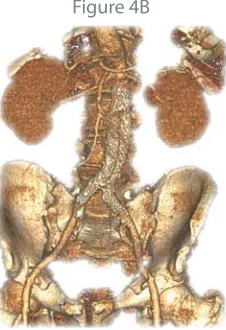
During the past 15 years, a keyhole version of aneurysm repair for the aorta has been developed. In this procedure, the inside of the artery is re-lined with a graft (Dacron or PTFE). The graft is supported and held in place by a springy metal alloy framework (stent) sewn to it (stent graft). The device is delivered in two parts each of which are squashed down into a slim delivery tube 6-8 mm in diameter. The parts are brought into position via the pelvic arteries from a small incision in each groin and assembled within the aneurysm to form a trouser graft. The correct position is checked by X-ray before unfolding the stent-graft. Once delivered, the aneurysm remains in place, but the blood passes through the stent graft within the aneurysm. Thus the pressure is removed from the aneurysm wall that prevents rupture and eventually leads to shrinkage of the aneurysm.
Figure 4A Figure 4B
Figure 4.
These diagrams show an endovascular repair (EVAR) of an aneurysm. In figure A the first part of the stent graft is already delivered and the second part is put in place but not yet unfolded (A). Figure B shows a CT-scan with a stent graft in place.
Figure 3.
VASCUNET (on behalf of the ESVS)
Second Annual Vascular Surgery Database Report 2008
12
Basic principles
The basic principles of carotid artery reconstruction
The brain is supplied blood via two carotid arteries and two vertebral arteries which, in most people, have intercommunications between them at the base of the brain, forming the so-called Circle of Willis. The carotid arteries in particular can become narrowed (stenosed) by atherosclerosis, particularly in smokers and diabetics and also in those with a high blood pressure or a raised blood cholesterol level. This disease usually occurs where the common carotid artery divides into its two main branches: the internal carotid artery, which supplies much of the brain and especially the cerebral cortex, and the external carotid artery, which supplies blood to the rest of the head and upper part of the neck (fig 1).
When an internal carotid artery becomes very narrow (usually greater than 70% stenosed so that less than 30% of the diameter remains) clots can form and become dislodged (embolized) into the brain, blocking part of the blood supply to the cerebral cortex. This causes a transient (transient ischaemic attacks or TIA) or permanent stroke (cerebrovascular accident or CVA) with a temporary or permanent numbness, weakness or paralysis of part or all of the opposite side of the body. Speech or understanding of words can also be affected, usually following emboli from the left carotid artery. Similar symptoms can occur when a carotid artery becomes completely occluded by the disease. Small clots can also embolize to the eye causing a transient or permanent interruption of the retinal blood supply resulting in a short lasting (amaurosis fugax) or permanent (central retinal artery thrombosis) blindness in one eye (on the same side as the responsible carotid).
The principles of treatment are to reduce the progression of the underlying arterial disease by smoking cessation, blood pressure control, cholesterol lowering drugs such as statins and control of diabetes and to correct the carotid stenosis by surgical means.
Indications for surgery
Carotid endarterectomy (CEA) is one of the surgical methods most extensively evaluated in large randomized controlled trials. The earlier the intervention, the greater is the benefit in terms of stroke prevention. For this reason efforts are being made to reduce delays in the referral and treatment of symptomatic carotid disease in many countries.
Indications for intervention are
• A stenosis of >70% with relevant symptoms: TIA, CVA with a good recovery, amaurosis fugax or central retinal artery thrombosis.
• A stenosis of >60% in asymptomatic patients below the age of 75 years.
Figure 2.
A carotid angiogram showing a tight stenosis at the origin of the internal carotid artery in a patient presenting with TIA.
Internal carotid artery
External carotid artery
Carotid stenosis
Common carotid artery Common carotid artery
External carotid artery Figure 1.
A photograph taken during carotid endarterectomy showing the anatomy of the carotid bifurcation.
VASCUNET (on behalf of the ESVS)
Second Annual Vascular Surgery Database Report 2008
13
DENDRITE CLINICAL SYSTEMS
Basic principles
In some patients with recurrent symptoms and lesser degrees of stenosis (>50%) surgery may also be indicated particularly when associated with ulcerated or soft atherosclerotic plaque. The morphologic diagnosis and degree of stenosis is usually obtained by duplex ultrasound, but angiography (conventional, magnetic resonance or computer tomography) may also be required in some cases (fig 2).
The procedure
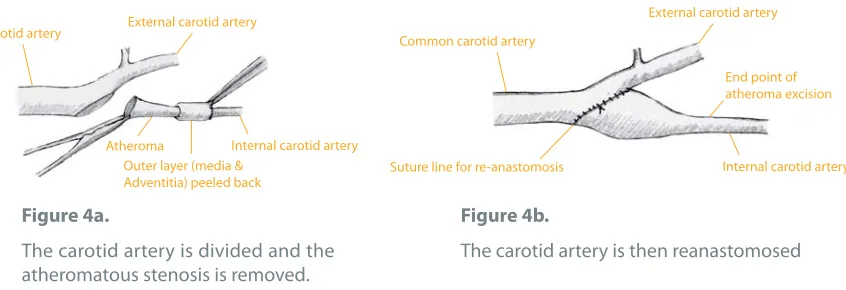
Today, open surgery by carotid endarterectomy is the treatment of choice and so far seems to be better than endovascular stent treatment (carotid artery stent, CAS) although further evaluation is ongoing. The principle of carotid endarterectomy (CEA) is to remove the atherosclerotic stenosis to widen the artery. This can be performed in a standard way with a longitudinal incision in the artery (fig 3) or by an eversion technique (fig 4).
One important step in the surgical procedure is to be sure that adequate cerebral circulation is maintained whilst the carotid artery is clamped. This may be accomplished by temporarily inserting a plastic tube (a shunt)
into each end of the artery whilst the diseased area is exposed. Because of the anastomosis at the base of the brain most patients can tolerate clamping of one carotid artery without ill effects. However, the problem is to select those patients in need of a shunt (that is to estimate the collateral potential). The most common ways of doing this are:
• Operation under local anaesthesia, i.e., with the patient wide awake. Or if under general anaesthesia:
• Measuring the stump pressure, that is the back pressure (via the circle of Willis) in the internal carotid artery after the common carotid artery has been clamped.
• Using trans-cranial Doppler to measurement the blood flow in the middle cerebral artery.
Most patients are already taking acetylsalicylic acid (aspirin) and / or dipyridamole (persantin) when they come to treatment, and many surgeons also add another platelet inhibitor peri-operatively, e.g., clopidogrel or dextran, to reduce the risk of clotting in the artery. Heparin is also commonly injected to reduce clotting whilst the carotid artery is clamped.
Figure 3.
A diagram showing a standard carotid endarterectomy using a longitudinal arteriotomy with a Dacron patch closure
Figure 4.
Diagrams showing the eversion technique for carotid endarterectomy
Figure 4a.
The carotid artery is divided and the atheromatous stenosis is removed.
Figure 4b.
The carotid artery is then reanastomosed
Common carotid artery External carotid artery
Internal carotid artery Atheroma
Outer layer (media & Adventitia) peeled back
Common carotid artery
External carotid artery
Internal carotid artery Suture line for re-anastomosis
End point of atheroma excision Internal carotid artery
Common carotid artery
Longitudinal incision repaired with a patch
VASCUNET (on behalf of the ESVS)
Second Annual Vascular Surgery Database Report 2008
14
Basic principles
The longitudinal carotid artery incision is often closed with a patch (vein, PTFE or Dacron can be used) to widen the artery, especially when the internal carotid artery is small, as is often the case in women, or when there have been technical problems.
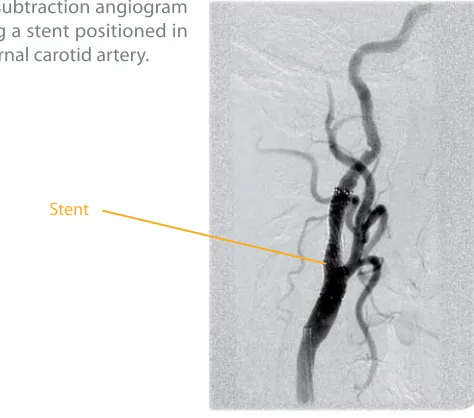
Carotid artery stenting (CAS) is performed under X-ray control using local anaesthetic. A metal stent (a tube made from a special wire mesh) is inserted inside the carotid artery via a catheter usually passed up from an artery in the groin. When it is in the correct position across the stenosis the stent is deployed to force open the artery and maintain its lumen (fig 5). CAS is currently being evaluated in large randomized studies and should only occasionally be used outside these for cases where open surgery would be problematic, e.g., after radiotherapy to the neck or restenosis after previous carotid endarterectomy. Usually CAS is performed using one of several cerebral protection devices to prevent embolization to the brain whilst manipulating the device inside the artery.
In addition to a very small risk of post-operative death (most often due to myocardial infarction or stroke), there are local and central complications. The local ones are neck haematoma and cranial nerve damage, which is often reversible (the hypoglossal nerve, the superior laryngeal nerve, the accessory nerve , the mandibular branch of the facial nerve and very rarely the glossopharyngeal or aberrant recurrent laryngeal nerves). Cranial nerve damage may result in (usually temporary) weakness of the tongue, hoarseness, weakness of the angle of the mouth or shoulder weakness.
Central complications in the form of stroke are multi-factorial: ischaemia during clamping, embolism, thrombotic occlusion and bleeding because of hyperperfusion. A usual outcome criterion used in trials is the combined permanent stroke and / or death rate within 30 days of the procedure. It is important to realize that carotid reconstruction is a preventive or prophylactic procedure to avoid stroke in the future and the value for any individual patient is not known – just the statistical risk in a group of patients. The complication rate must therefore be kept very low.
Figure 5.
Digital subtraction angiogram showing a stent positioned in the internal carotid artery.
Proposed site for advert
VASCUNET (on behalf of the ESVS)
Second Annual Vascular Surgery Database Report 2008
16
C
o
n
tributors
Contributors
The VASCUNET committee would like to extend their thanks to all the countries and hospitals listed below for their efforts in collecting data and also for submitting their data to the VASCUNET database.
The key contacts representing their country / state were:
• Barry Beiles Australia [email protected]
• Leif Panduro Jensen Denmark [email protected]
• Maarit Venermo Finland maarit.venermo@hus.fi
• Gabor Menyhei Hungary [email protected]
• Domenico Palombo Italy [email protected]
• Ian Thomson New Zealand [email protected]
• Erik Halbakken Norway [email protected]
• Thomas Troëng Sweden [email protected]
• Pius Wigger Switzerland [email protected]
Proposed site for advert
VASCUNET (on behalf of the ESVS)
Second Annual Vascular Surgery Database Report 2008
18
C
o
n
tributors
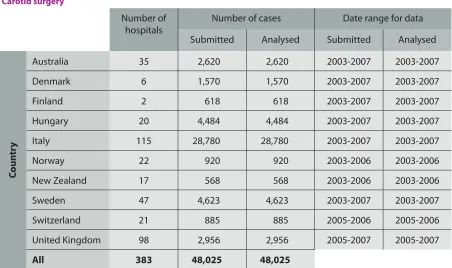
Table to show the number of cases submitted by each contributor country and the date-range that these cases span.
AAA surgery
Number of hospitals
Number of cases Date range for data
Submitted Analysed Submitted Analysed
C
oun
tr
y
Australia 35 3,928 2,312 1999-2007 2003-2007
Denmark 9 7,885 3,533 1996-2007 2003-2007
Finland 2 481 481 2003-2007 2003-2007
Hungary 20 1,054 1,053 2003-2007 2003-2007
Italy 115 13,893 13,893 2003-2007 2003-2007
Norway 22 2,671 2,671 2003-2006 2003-2006
New Zealand 17 3,197 ,846 1994-2006 2003-2006
Sweden 47 12,445 4,894 1994-2007 2003-2007
Switzerland 21 1,156 1,156 2005-2006 2003-2006
United Kingdom 98 8,540 5,202 1994-2006 2003-2006
All 386 55,250 36,041
Carotid surgery
Number of hospitals
Number of cases Date range for data
Submitted Analysed Submitted Analysed
C
oun
tr
y
Australia 35 2,620 2,620 2003-2007 2003-2007
Denmark 6 1,570 1,570 2003-2007 2003-2007
Finland 2 618 618 2003-2007 2003-2007
Hungary 20 4,484 4,484 2003-2007 2003-2007
Italy 115 28,780 28,780 2003-2007 2003-2007
Norway 22 920 920 2003-2006 2003-2006
New Zealand 17 568 568 2003-2006 2003-2006
Sweden 47 4,623 4,623 2003-2007 2003-2007
Switzerland 21 885 885 2005-2006 2005-2006
United Kingdom 98 2,956 2,956 2005-2007 2005-2007
VASCUNET (on behalf of the ESVS)
Second Annual Vascular Surgery Database Report 2008
19
DENDRITE CLINICAL SYSTEMS
C
o
n
tributors
Australia (Victoria State only)
• Alfred Hospital, Melbourne • Austin Hospital, Melbourne • Avenue Hospital, Melbourne • Ballarat Hospital, Ballarat • Bays Hospital, Mornington • Beleura Hospital, Mornington • Box Hill Hospital, Melbourne • Cabrini Hospital, Melbourne • Cotham Hospital, Melbourne • Dandenong Hospital, Melbourne • Epworth Hospital, Melbourne • Epworth Eastern Hospital, Melbourne • Frankston Hospital, Frankston • Geelong Private Hospital, Geelong • Geelong Public Hospital, Geelong • Jessie McPherson Hospital, Melbourne • John Fawkner Hospital, Melbourne • Knox Private Hospital, Melbourne
• Linacre Hospital, Melbourne • Masada Hospital, Melbourne • Monash Hospital, Melbourne • Northern Hospital, Melbourne • Peninsula Hospital, Mornington • Ringwood Private Hospital, Melbourne • Rosebud Hospital, Rosebud
• Royal Melbourne Hospital, Melbourne • St. John of God Hospital, Ballarat • St. John of God Hospital,Geelong • St. Vincent’s Private Hospital, Melbourne • St. Vincent’s Public Hospital, Melbourne • Valley Hospital, Melbourne
• Warringal Private Hospital, Melbourne • Western Public Hospital, Melbourne • Western Private Hospital, Melbourne • Williamstown Hospital, Melbourne Contributors to the VASCUNET database
Finland
• Meilahti Hospital, Helsinki • Jorvi Hospital
Denmark
• Aalborg Sygehus, Aalborg • Skejby Sygehus, Aarhus
• Gentofte Hospital, Copenhagen • Rigshospitalet, Copenhagen • Hillerød Sygehus, Hillerød
• Kolding Sygehus, Kolding
• Odense Universitetshospital, Odense • Slagelse Sygehus, Slagelse
VASCUNET (on behalf of the ESVS)
Second Annual Vascular Surgery Database Report 2008
20
C
o
n
tributors
Hungary• Állami Egészségügyi Központ, Budapest • Bajcsy Zsilinszky Kórház , Budapest
• Bács-Kiskun Megyei Önkormányzat Kórháza, Kecskemét
• Borsod-Abaúj-Zemplén Megyei Kórház • Debreceni Tudományegyetem Orvos- és
Egészségtudományi Centrum • Fejér Megyei Szent György Kórház,
Székesfehérvár
• Jósa András Kórház, Nyíregyháza
• Kaposi Mór Megyei Oktató Kórház, Kaposvár • Markhot Ferenc Kórház, Eger
• Pándy Kálmán Kórház, Gyula
• Pest Megyei Floór Ferenc Kórház, Kistarcsa
• Petz Aladár Megyei Kórház, Győr • Pécsi Tudományegyetem Általános
Orvostudományi Kar Sebészeti Tanszék, Baranya Megyei Kórház
• Semmelweis Egyetem Ér- és Szívsebészeti Klinika
• Semmelweis Egyetem I. sz. Sebészeti Klinika • Szegedi Tudományegyetem
Orvostudományi és Egészségtudományi Centrum
• Szent Imre Kórház, Budapest • Szent Lázár Kórház, Salgótarján
• Veszprém Megyei Cholnoky Ferenc Kórház Non Profit Zrt.
• Zala Megyei Kórház Contributors to the VASCUNET database continued …
Italy
• Ospedale Regionale Miulli, Acquaviva Delle Fonti (BA)
• Ospedale di Alessandria, Alessandria • Ospedale Regionale U. Parini, Aosta • Ospedale San Salvatore - UO Chirurgia
Vascolare, Aquila
• S.C. Chirurgia Vascolare c/o Ospedale San Donato, Arezzo
• Azienda Ospedaliera Moscati - UO Chirurgia Vascolare, Avellino
• Ospedale di Avezzano S. Filippo e Nicola, Avezzano (AQ)
• ASL BA - Presidio Osp. Bari Sud - Stabilim. Ospedale Di Venere, Bari
• Ospedale Policlinico Consorziale, Bari • Ospedale Bassano del Grappa, Bassano Del
Grappa (VI)
• Azienda Ospedaliera Rummo, Benevento • Humanitas Gavazzeni, Bergamo
• OO.RR. di Bergamo, Bergamo • Univ. Degli Studi di Bologna, Bologna • Ospedale Maggiore C A Pizzardi, Bologna • Istituto Clinico S.Anna, Brescia
• Fondazione & Poliambulanza, Brescia • AZ USL 3, Busto Arsizio (VA)
• Azienda Ospedaliera, Cagliari • Ospedale Sant Elia, Caltanissetta
• Azienda Ospedaliera Monaldi, Camaldoli, Napoli
• Azienda Ospedaliera A. Cardarelli , Campobasso
• Azienda Ospedaliera di Caserta, Caserta • Multimedica Holding SpA - Struttura
Ospedaliera, Castellanza (VA)
• Azienda Ospedaliera Ferrarotto, Catania • Ospedale Cannizzaro, Catania
• UO di Chirurgia Vascolare Ospedale Civile San Bortolo, Vicenza
• Ospedale SS.Annunziata Chieti, Chieti • Ospedale San Paolo, Civitavecchia
• UO Chirurgia Vascolare Azienda Ospedaliera Maggiore, Crema (CR)
• Ospedale Santa Croce, Cuneo
• Arcispedale St. Anna di Ferrara, Ferrara • Nuovo Ospedale San Giovanni di Dio -
Torregalli, Firenze
• Ospedale G. Salvini USSL 32, Garbagnate Milanese (MI)
• Università di Genova, Genova
• U.O. di Chirurgia Vascolare dell'Azienda Ospedaliera Villa Scassi di Genova, Genova • Ospedale S. Martino, Genova
• E.O Ospedali Galliera, Genova
VASCUNET (on behalf of the ESVS)
Second Annual Vascular Surgery Database Report 2008
21 DENDRITE CLINICAL SYSTEMS
C
o
n
tributors
Contributors to the VASCUNET database continued …
Italy continued …
• Ospedale Sant'Andrea, La Spezia • Ospedale S. Maria Goretti, Latina • Clinica Città di Lecce Hospital, Lecce • Azienda Ospedaliera di Lecco, Lecco • Chirurgia Vascolare Legnano, Legano • Unità Operativa Chir. Vascolare ASL Lodi
- Presidio Lodi, Lodi (MI)
• Azienda Ospedaliera Carlo Poma, Mantova • Univ. degli Studi di Messina, Messina • SC Chirurgia Vascolare - Azienda ULSS 12
Veneziana - Osp. Umberto I, Mestre (VE) • Azienda Ospedaliera di Milano, Milano • Casa di Cura San Pio X, Milano
• Istituto Galeazzi - Chirurgia Vascolare, Milano
• Istituto Galeazzi - UO Chirurgia Vascolare II, Milano
• Istituto Policlinico San Donato Università di Milano - Div. di Chir. Vascolare, Milano • Ospedale G. Pini, Milano
• Ospedale Niguarda, Milano
• UOS di Chirurgia Vascolare,Ospedale L. Sacco , Milano
• IRCCS H. San Raffaele, Milano
• Policlinico Univ. di Cagliari UO di Chirurgia Vascolare e Toracica, Monserrato (CA) • Univ. Cattolica Sacro Cuore; Centro di ricerca e formazione ad alta tecnologia nelle scienze biomediche; Giovanni Paolo II, Campobasso
• Azienda Ospedaliera , Napoli
• Universita degli studi di Napoli Federico II. Cattedra di Chirurgia Vascolare, Napoli • Ospedale dei Pellegrini Vecchio, Napoli • Azienda Sanitaria Ospedaliera Maggiore
della Carità, Novara
• Istituti Clinici Zucchi-U.F. Chirurgia Vascolare II , Monza (MI)
• Clinica S. Carlo, Paderno Dugnano • Azienda Ospedaliera di Padova, Padova • UF di Chirurgia Vascolare - Casa di cura
Noto-Pasqualino, Palermo
• UOC di Chirurgia Vascolare, Azienda Ospedaliera-Universitaria Policlinico Paolo Giaccone, Palermo
• Ospedale Civico e Benfratelli, Palermo
• Segreteria di Chir. Vasc Cattedra di Chirurgia Vascolare, Parma
• Rep. C. Malchiodi Chirurgia Generale e Vascolare, Piacenza
• Ospedale Santa Corona, Pietra Ligure (SV) • Azienda Ospedaliera Pisana - Presidio
Ospedaliero Cisinello, Pisa
• Azienda Ospedaliera San Carlo - UO Dipartimentale di Chirurgia Vascolare - Dipartimento dell'Alta Specialità del Cuore, Potenza
• Ospedale S.M.Nuova, Reggio Emilia • Cattedra e UO di Chirurgia Vascolare -
Università degli Studi di Firenze, Firenze • Ospedali Infermi, Rimini
• Cattedra di Chirurgia Vascolare - , Roma • Dipartimento Interospedaliero di Chirurgia
Vascolare, Endovascolare e Angiologia , Roma
• Istituto Dermopatico dell’Immacolata (IRCCS), Roma
• Ospedale Nuovo Regina Margherita, Roma • Ospedale Sant'Andrea, Roma
• Policlinico Militare Roma Celio, Roma • Policlinico Tor Vergata - Dip. di Chirurgia,
Roma
• UOC di Chirurgia Vascolare B - Dipartimento di Chirurgia Generale, Specialità Chirurgiche e Trapianti d’Organo, Roma
• Univ. Cattolica Pol. Gemelli - Roma, Roma • Ospedale S. Camillo, Roma
• Ospedale S. Eugenio, Roma
• Ist. Clinico Humanitas - Rep. di Chirurgia Vascolare I, Rozzano (MI)
• Ospedale Casa Sollievo della Sofferenza, S. Giovanni Rotondo (FG)
• Università degli Studi di Bologna, S. Lazzaro (BO)
• Ist. Policlinico San Donato, San Donato Milanese
• Casa di Cura Privata Polispecialistica , Schiera Del Garda (VR)
• UO Chirurgia Vascolare - Policlinico Multimedica, Sesto San Giovanni (MI) • Università di Siena, Siena
VASCUNET (on behalf of the ESVS)
Second Annual Vascular Surgery Database Report 2008
22
C
o
n
tributors
Contributors to the VASCUNET database continued …
Norway
• Aker Universitetssykehus HF • Sørlandet Sykehus HF, Arendal • Sykehuset Buskerud HF
• Sykehuset Asker og Bærum HF, Bærum Sykehus
• Helse Nordmøre og Romsdal HF, Molde Sjukehus
• Sykehuset Innlandet HF, Hamar • Helse Bergen HF, Haukeland
universitetssykehus • St. Olavs Hospital HF
• Universitetssykehuset Nord-Norge HF • Rikshospitalet HF, Kirurgisk avd.
• Rikshospitalet HF, Thoraxkir.avd. • Akershus Universitetssykehus HF • Helse Stavanger HF, Sentralsykehuset i
Rogaland
• Helse Førde HF, Førde sentralsjukehus • Sykehuset i Vestfold HF
• Sykehuset Østfold - Fredrikstad HF • Sykehuset Telemark Avd. Skien HF • Ullevål Universitetssykehus HF • Sørlandet Sykehus HF, Kristiansand • Helse-Fonna, Haugesund Sjukehus HF • Helse Sunnmøre HF, Ålesund sjukehus • Nordlandssykehuset HF, Bodø
New Zealand
• Auckland City Hospital, Auckland • Middlemore Hospital, Auckland • Wairau Hospital, Blenheim
• Christchurch Hospital, Christchurch • Dunedin Hospital, Dunedin • Gisborne Hospital, Gisborne • Waikato Hospital, Hamilton • Hawkes Bay Hospital, Hastings • Southland Hospital, Invercargill
• Napier Hospital, Napier • Nelson Hospital, Nelson
• Taranaki Base Hospital, New Plymouth • Palmerston N. Hospital, Palmerston North • Rotorua Hospital, Rotorua
• Tauranga Hospital, Tauranga • Timaru Hospital, Timaru • Wellington Hospital, Wellington
Italy continued …
• Azienda Ospedaliera della Valtellina e della Valchiavenna - Ospedale E. Morelli Sondalo, Sondalo (SO)
• Istituto Clinico Mater Domini - Chirurgia Arteriosa ed Endovascolare, Stellanza - Varese
• Ospedale Civile Regionale SS. Annunziata, Taranto
• Ospedale Civile , Teramo
• Ospedale Belcolle - UOC Chirurgia Vascolare ed Endovascolare , Viterbo
• UO Chirurgia Vascolare, Terni • Ospedale S. Giovanni Bosco, Torino
• Azienda Ospedaliera S. Giovanni Battista di Torino Le Molinette, Torino
• Ospedale Mauriziano Umberto I, Torino • SOD Complessa di Chirurgia Vascolare,
Azienda Ospedaliero-Universitaria Ospedali Riuniti Ancona, Torrette (AN)
• Ospedale Civile Ca’ Foncello, Treviso • Azienda Ospedaliera - Tricase - Pia
Fondazione di Culto e Religione Card. G. Panico, Tricase (LE)
• SS Chir. Vascolare a direzione Universitaria, Ospedale di Cattinara, Trieste
• Ospedale di Circolo Univ. dell'Insubria, Varese
• Ospedale Sacro Cuore - Negrar, Verona • Policlinico Universitario GB. Rossi Verona,
Verona
• UO Complessa Chirurgia Vascolare ed Endovascolare - Ospedale Belcolle-Polo Centrale, Viterbo (VT)
VASCUNET (on behalf of the ESVS)
Second Annual Vascular Surgery Database Report 2008
23 DENDRITE CLINICAL SYSTEMS
C
o
n
tributors
Switzerland• Kantonsspital Aarau, Gefässchirurgie • Kantonsspital Uri, Altdorf
• Uniklinik Basel, Gefässchirurgie • Inselspital Bern, Klinik für Herz- und
Gefässchirurgie
• Kantonsspital Bruderholz • Kantonsspital Graubünden, Chur • Spital Thurgau AG, Spital Frauenfeld • Hôpitaux Universitaires de Genève Service
of Cardiovascular Surgery • Spital Lachen, Chirurgische Klinik • CHUV Service de Chirurgie thoracique et
vasculaire, Lausanne
• Kantonsspital Liestal
• Ospedale Regionale di Lugano • Kantonsspital Luzern, Gefässchirurgie • Spital Thurgau AG, Spital Münsterlingen • Hôpitaux de la Ville de Neuchâtel • Kantonsspital St. Gallen, Gefässchirurgie • Kantonsspital Schaffhausen
• Spital Limmattal, Schlieren • Kantonsspital Winterthur • Zuger Kantonsspital, Zug
• Universitätsspital Zürich, Abteilung Gefässchirurgie
Sweden
• Akademiska Hospital, Uppsala • Alingsås District Hospital • Ängelholm District Hospital
• Blekinge County Hospital, Karlskrona • Boden County Hospital
• Borås County Hospital
• Danderyd Hospital, Stockholm • Eksjö District Hospital
• Eskilstuna County Hospital • Falun County Hospital • Gävle County Hospital • Halmstad County Hospital • Hässleholm District Hospital • Helsingborg County Hospital • Hudiksvall District Hospital • Jönköping County Hospital • Kalmar County Hospital • Karlstad County Hospital • Karolinska Hospital, Stockholm • Kristianstad County Hospital • Kungälv District Hospital • Linköping University Hospital • Malmö General University Hospital
• Mölndal District Hospital • NU-sjukhuset County Hospital • Nyköping District Hospital • Örebro University Hospital • Örnsköldsvik District Hospital • Oskarshamn District Hospital • Östersund County Hospital • St. Göran Hospital, Stockholm
• Sahlgrenska Univ. Hospital, Gothenburg • Skellefteå District Hospital
VASCUNET (on behalf of the ESVS)
Second Annual Vascular Surgery Database Report 2008
24
C
o
n
tributors
Contributors to the VASCUNET database continued …
United Kingdom
• Kent and Canterbury Hospital, Ashford • Royal United Hospital, Bath
• Bedford Hospital, Bedford • Belfast City Hospital, Belfast • Birmingham Heartlands Hospital • City Hospital Birmingham, Birmingham • Selly Oak Hospital, Birmingham • Blackburn Royal Infirmary, Blackburn • Royal Bournemouth Hospital, Bournemouth • Princess of Wales Hospital, Bridgend • Royal Sussex County Hospital, Brighton • Bristol Royal Infirmary, Bristol
• Frenchay Hospital, Bristol
• Burnley General Hospital, Burnley • Addenbrookes Hospital, Cambridge • University Hospital of Wales, Cardiff • St Helier Hospital, Carshalton
• Countess of Chester Hospital, Chester • St Richard's Hospital, Chichester • Colchester General Hospital, Colchester • Craigavon Area Hospital, Craigavon • Leighton Hospital, Crewe
• Derbyshire Royal Infirmary, Derby • Pinderfields General Hospital, Dewsbury • Doncaster Royal Infirmary, Doncaster • Dorset County Hospital, Dorchester • Russells Hall Hospital, Dudley • Ninewells Hospital, Dundee
• Queen Margaret Hospital, Dunfermline • University Hospital of North Durham • Royal Infirmary of Edinburgh, Edinburgh • Chase Farm Hospital, Enfield
• Frimley Park Hospital, Frimley • Hairmyres Hospital, Glasgow • Royal Infirmary Glasgow, Glasgow
• Gloucestershire Royal Hospital, Gloucester • Diana Princess of Wales Hospital, Grimsby • Calderdale Royal Hospital, Halifax
• Princess Alexandra Hospital , Harlow • Hereford County Hospital, Hereford • Huddersfield Royal Infirmary, Huddersfield • Hull Royal Infirmary, Hull
• King George Hospital, Ilford
• Raigmore Hospital, Inverness • Ipswich Hospital, Ipswich
• Leicester Royal Infirmary, Leicester • Lincoln County Hospital, Lincoln • Royal Liverpool University Hospital • University Hospital Aintree, Liverpool • Barnet General Hospital, London • Charing Cross Hospital, London • Hillingdon Hospital, London • Kings College Hospital, London • Mayday University Hospital, London • Royal London Hospital, London • St George's Hospital, London • St Mary's Hospital, London • St Thomas' Hospital, London
• Whipps Cross University Hospital, London • Manchester Royal Infirmary, Manchester • James Cook University Hospital,
Middlesborough
• Freeman Hospital, Newcastle Upon Tyne • Newcastle General Hospital, Newcastle
Upon Tyne
• Royal Gwent Hospital, Newport • Northampton General Hospital • Norfolk & Norwich University Hospital,
Norwich
• Queen's Medical Centre, Nottingham • Royal Oldham Hospital, Oldham • Peterborough District Hospital • Derriford Hospital, Plymouth • East Surrey Hospital, Redhill • Queen's Hospital, Romford
• Salisbury District Hospital, Salisbury • Scarborough Hospital, Scarborough • Northern General Hospital, Sheffield • Southampton General Hospital • Southport & Formby District General
Hospital, Southport
• Stafford General Hospital, Stafford • Stirling Royal Infirmary, Stirling
• Sunderland Royal Hospital, Sunderland • Morriston Hospital, Swansea
VASCUNET (on behalf of the ESVS)
Second Annual Vascular Surgery Database Report 2008
25
DENDRITE CLINICAL SYSTEMS
C
o
n
tributors
United Kingdom continued …
• Royal Cornwall Hospital, Truro
• Kent and Sussex Hospital, Tunbridge Wells • Pinderfields General Hospital, Wakefield • Watford General Hospital, Watford • Sandwell District General Hospital, West
Bromwich
• Southmead Hospital, Westbury-On-Trym • West Cumberland Hospital, Whitehaven • Royal Albert Edward Infirmary, Wigan
• Royal Hampshire County Hospital, Winchester
• Arrowe Park Hospital, Wirral • Wishaw General Hospital, Wishaw • New Cross Hospital, Wolverhampton • Worcestershire Royal Hospital, Worcester • Worthing Hospital, Worthing
Proposed site for advert
VASCUNET (on behalf of the ESVS)
Second Annual Vascular Surgery Database Report 2008
28
Da
ta managemen
t
The European Vascular Surgery Database
Import, merging and analysis methodology
Each country contributor that had agreed to participate in this project was sent a set of standard instructions on the required format for electronic data transfer (see Appendix for instructions on data submission) together with a list of the requested variables for each procedure. Data files from ten countries (which represented in excess of 100,000 individual patient records from a 386 individual vascular surgery centres), were submitted over the Internet to Dendrite Clinical Systems’ offices in the United Kingdom for data processing. The files were received over a four-month period from February 2008 to May 2008 and were imported sequentially onto Dendrite’s database platform.
The schematic diagram opposite illustrates the data flow and the complexity of the processes behind the importing and merging of a wide variety of original Source Registry data to produce this second VASCUNET database report. The process of data harvest and data import was represented by two main scenarios:
1. Where the national registry is already using Dendrite’s national database software for its central registry e.g. the Vascular Society of Great Britain & Ireland's web-based National CEA Database, the data were simply copied across to the Dendrite database as a discrete database.
2. Where the national registry is using a third-party generic or proprietary system such as Microsoft Access™, e.g. the Italian National Vascular Surgery Registry, the data were imported into the Dendrite VASCUNET central database using Dendrite's Import Manager Module software. In some cases language translation was also required as in the case of handling the Italian data.
Once all the data had been mapped across into the Dendrite / VASCUNET central data repository, as 10 parallel Import Registries, the data were corresponded across to one common merged database, the so-called target registry.
The correspondence process entailed mapping the response options of the questions in the temporary Import Registries to identical or similar options in the final target VASCUNET registry. Where there were incompatibilities in data definitions or only partial matches between source and target questions, only perfect / near perfect options were mapped. Hence not all the data analyses presented in this report involved data from all 10 of the countries that are represented.
VASCUNET (on behalf of the ESVS)
Second Annual Vascular Surgery Database Report 2008
29 DENDRITE CLINICAL SYSTEMS
Da
ta managemen
t
A schematic of the processes involved in the production of the VASCUNET merged database
Basic analysis Advanced analysis Risk modelling
Data submission Pre-processing & manipulation Dendrite Import Manager Module VASCUNET merged database Dendrite software Merge Australia Excel™ file Denmark Excel™ file Finland Excel™ file Hungary Excel™ file Italy Excel™ file New Zealand Excel™ file Norway Excel™ file Sweden Excel™ file Switzerland Excel™ file United Kingdom Dendrite Australia Denmark Finland Hungary Italy New Zealand Norway Sweden Switzerland United Kingdom Australia Dendrite registry Denmark Dendrite registry Finland Dendrite registry Hungary Dendrite registry Italy Dendrite registry New Zealand Dendrite registry Norway Dendrite registry Sweden Dendrite registry Switzerland Dendrite registry United Kingdom Dendrite registry Data analysis
The European Society for Vascular Surgery Second VASCUNET Database Report 2008 Prepared by ********* **** ****
on behalf of the European Society for Vascular Surgery
Robin Kinsman BSc PhD
VASCUNET (on behalf of the ESVS)
Second Annual Vascular Surgery Database Report 2008
30
Da
ta submitted
Data submitted
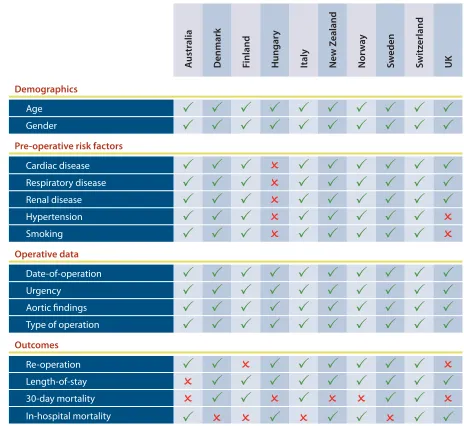
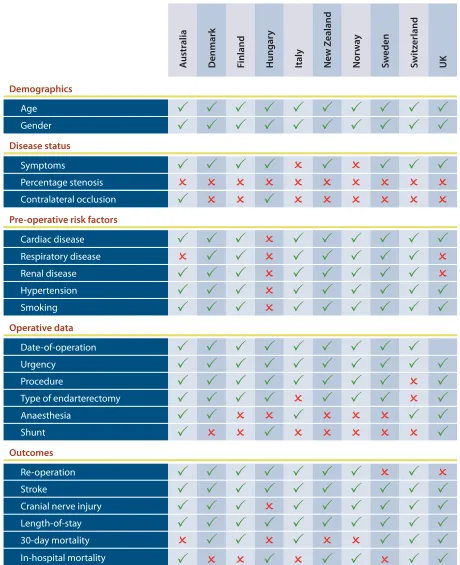
Whereas there was a considerable agreement on the data fields between national registries, not all registries recorded every parameter. The tables on the next two pages show the data fields submitted by each country in a format that was suitable for import, for aortic aneurysm repair and carotid reconstruction, respectively.
AAA surgery
Table to show the data-items submitted in a format that could be imported by each contributor country
A
ustr
alia
Denmark Finland Hungar
y
Italy New Z
ealand
Nor
w
a
y
S
w
eden
S
witz
erland
UK
Demographics
Age
Gender
Pre-operative risk factors
Cardiac disease
Respiratory disease
Renal disease
Hypertension
Smoking
Operative data
Date-of-operation
Urgency
Aortic findings
Type of operation
Outcomes
Re-operation
Length-of-stay
30-day mortality
Proposed site for advert
Proposed site for advert
VASCUNET (on behalf of the ESVS)
Second Annual Vascular Surgery Database Report 2008
33
DENDRITE CLINICAL SYSTEMS
Da
ta submitted
Carotid surgery
Table to show the data-items submitted in a format that could be imported by each contributor country
A
ustr
alia
Denmark Finland Hungar
y
Italy New Z
ealand
Nor
w
a
y
S
w
eden
S
witz
erland
UK
Demographics
Age
Gender
Disease status
Symptoms
Percentage stenosis
Contralateral occlusion
Pre-operative risk factors
Cardiac disease
Respiratory disease
Renal disease
Hypertension
Smoking
Operative data
Date-of-operation
Urgency
Procedure
Type of endarterectomy
Anaesthesia
Shunt
Outcomes
Re-operation
Stroke
Cranial nerve injury
Length-of-stay
30-day mortality
VASCUNET (on behalf of the ESVS)
Second Annual Vascular Surgery Database Report 2008
34
Da
ta v
alidity
Data validity
There are two main aspects of validity of registry data:
1. External validity concerns generalizability. If virtually all patients with a given disease or procedure in a well-defined population are registered, they will represent the incidence or prevalence in a similar general population, since the data collection is almost complete. Thus registry managers should provide data from an independent source to estimate the degree to which cases in question are registered. A clinical vascular registry should preferably be validated by comparison with administrative hospital data, a national patient index or other data sources with information on hospital stays, procedure codes and diagnostic codes i, ii.
2. Internal validity is the degree to which the registry is correct concerning data on patients actually included. How many patients had a certain degree of heart disease although it was not recorded? What was the definition of hypertension? Were all emergency procedures really acute? According to what definition? Strict definitions of variables are compulsory. Internal validity can be assessed through a study of a sample of patient records where data are re-registered, to evaluate reproducibility. The re-entering of data can be done either by the local centre itself, or as part of an external validation ii, iii.
The tables on the following pages summarise the work the individual countries are doing for external and internal validity, as well as the definitions of data.
Both the external and internal validity of data is of utmost importance if comparison is to be made between institutions, or in this case, between countries. An important part of the work with the internal validity is to verify that the same definitions and cut-off values are used by the institutions or countries to be compared. That this work is still in the early stages in the VASCUNET collaboration is reflected in the differences seen in the table above, which reveal the need for more uniform variables, definitions and methods of validation. These issues have to be improved, to produce valid and more extensive National reporting of vascular data in the future.
i. Aylin P, Lees T, Baker S, Prytherch D, Ashley S. Descriptive study comparing routine hospital administrative data with the Vascular Society of Great Britain and Ireland’s National Vascular Database. Eur J Vasc Endovasc Surg. 2007; 33: 461-465.
ii. Troëng T, Malmstedt J, Björck M. External validation of the Swedvasc registry. A first-time individual cross-matching with the unique personal identity number. Eur J Vasc Endovasc Surg. 2008 (In Press)
VASCUNET (on behalf of the ESVS)
Second Annual Vascular Surgery Database Report 2008
35
DENDRITE CLINICAL SYSTEMS
Da
ta v
alidity
Validity and definitions in the ten registries
The tables on the following pages summarize what the different registries do to safeguard their data validity and how well their definitions of risk factors and outcomes allow for comparison across country borders.
Most of the registries are national, or are regional with coverage of a large proportion of the country. Six out of ten examine their external validity by comparisons with national administrative hospital episode registries. Such a procedure is indispensable to safeguard against biased recruiting to the registry, and the fact that it is not done for all registries could be a source of significant bias when comparing data. If access is admitted to administrative registries such validation is technically simple and not expensive.
Eight registries check their internal validity through studies of a sample by re-registering data or by local checks in each hospital. This is usually a quite laborious and time-consuming task but will of course add to the value of conclusions, and serves as a tool for optimising the data definitions.
Medical risk factors are, to a large extent, obtained from the patient history (PH), taken from patient records. However, such a way of data collection can be considered weak and is likely to lead to variability within and between registries. Whilst some data definitions, such as that of renal insufficiency, are already similar across the registries, it is hoped that a consensus will gradually develop so that identical data are collected by all countries. This will improve the overall validity of the conclusions and allow more accurate international comparisons.
Whilst death is the ultimate hard endpoint, survival statistics may also vary between registries: several registries use 30-day mortality whereas others use in-hospital mortality. These are obtained from patient records and may not differ much in practice. However, deaths may be under-reported as a result of patients who are lost to follow-up. For this reason, data sources other than the hospital records may be preferable.
The presentation of carotid disease and the indications for carotid intervention are relatively hard data, as TIA, amaurosis fugax stroke and asymptomatic stenosis are easily distinguishable (although one registry combines TIA and amaurosis fugax). In contrast, the definitions of minor and major stroke are much more variable. Patients who become lost to follow-up may result in the under-reporting of postoperative neurological complications after carotid surgery. It is also well known that independent neurologists detect more post-operative neurological complications than surgeons. Whilst such routine independent neurological assessment is ideal, it is at present impractical except in clinical trials.
VASCUNET (on behalf of the ESVS)
Second Annual Vascular Surgery Database Report 2008
36
Da
ta v
alidity
Validity and definitions: AAA surgery
PH: Patient history; data obtained from the patient history as a current condition / medication.
Australia Denmark Finland Hungary
Scope
National or regional Regional National Regional, ~30% of
the population
National
EVAR included Yes Yes No Yes
External validation Compared with the
Victorian adverse outcome data
Comparison with the National In-patient registry or operation protocols locally.
Data is compared to the National inpatient registry and missing data completed
No systematic comparison with other data sources
Internal validation of the registry Internal validation of a 5 % sample from public hospitals
Internal and external re-entry of data for a sample of patient data; performed 1998 and 2006
Data is compared to the National inpatient registry and missing data completed
Internal re-entry of data on a sample of patient data
Definition of risk factors
Heart disease PH; ECG / stress test PH PH; previously
documented MI ± ongoing angina or previous coronary revascularization
Not included
Respiratory disease Not registered PH PH; asthma / COPD PH
Renal disease Serum creatinine
>180 mmol l-1
Serum creatinine
>150 mmol l-1 or
dialysis
PH; serum creatinine
>150 mmol l-1 or
dialysis
Not included
Hypertension PH or by WHO-limits
for blood-pressure
PH or newly discovered and requiring medication at admission
PH; medication for hypertension or arterial pressure >160/95 mm Hg
Not included
Smoking PH; Current or
Ex-smoker (> 2 weeks)
PH; Never, Ex-smoker (> 6 weeks) or Current
PH; regular smoking within 5 years
Not included
Outcomes
30-day mortality No systematic
collection of data from other sources; systematic internal validation
Date-of-death obtained from the national population registry
100% reliable
Date-of-death obtained from the national population registry
100% reliable
No data
In-hospital mortality Collected As above, 100 %,
compared to date of discharge
As above, 100 %, compared to date of discharge
Date of death obtained from the patient’s record, 100%reliable
Long-term mortality Not As above, data
updated monthly for all patients
VASCUNET (on behalf of the ESVS)
Second Annual Vascular Surgery Database Report 2008
37 DENDRITE CLINICAL SYSTEMS
Da
ta v
alidity
Italy Norway New Zealand Sweden Switzerland UK
National (~ 50% completeness)
National National National All University (5)
and larger public hospitals (16)
National, ~50% of all open repairs
Yes Yes Yes Yes Yes Patrial
No No systematic
comparison with other data sources.
Comparison with the National In-patient registry in one study
Comparison with the National In-patient registry
No systematic comparison with other data sources
Comparison with the Hospital Episode Statistics in one study
A sample of data is checked for 10 randomly selected participating centres
No Internal validation
of a 10 % sample in one study
Internal re-entry of data on a sample of patient data
Completeness of follow-up checked by each hospital
No
PH; ECG / stress test PH PH PH PH PH
PH; spirometry PH PH PH PH PH
No; creatinine ranges 1.2-2.4, 2.5-3.5, 3.6-5.9 or
>5.9 mg dl-1; dialysis;
transplant
Serum creatinine
>150 mmol l-1
PH; serum creatinine
>150 mmol l-1
PH or serum creatinine >150
mmol l-1
Serum creatinine
>150 mmol l-1
Creatinine >150
mmol l-1, dialysis, or
transplant
No, controlled with 1 drug, controlled with 2 drugs, controlled with >2 drugs or not controlled
On medication or diastolic systemic blood pressure >110 mmHg
PH PH* or diastolic
systemic blood-pressure >110 mmHg at admission
PH Not included
Non-smoker, Ex-smoker, Smoker (1 to 5 daily), Smoker (6-20 daily), Smoker (>20 daily)
PH; smoking during last 5 years
PH; current or recent smoker
PH; regular smoking within 5 years
PH; current or previous
Not registered
Date-of-death obtained from the patient record
No systematic collection of data from other sources
Date-of-death obtained from the patient record
Date-of-death from the national population registry, 100% reliable
Date-of-death obtained from the patient record
Date-of-death obtained from the patient record
Date-of-death obtained from the patient record
Obtained from patient record
Collected From discharge data
No data are included Obtained from
patient record
Not col