www.nonlin-processes-geophys.net/15/1033/2008/ © Author(s) 2008. This work is distributed under the Creative Commons Attribution 3.0 License.
Nonlinear Processes
in Geophysics
Estimating return levels from maxima of non-stationary random
sequences using the Generalized PWM method
P. Ribereau1, A. Guillou2, and P. Naveau3
1Universit´e Montpellier 2, Equipe Proba-Stat, CC 051, Place Eug`ene Bataillon, 34095 Montpellier Cedex 5, France 2Universit´e de Strasbourg, IRMA; 7, rue Ren´e Descartes, 67084 Strasbourg Cedex, France
3Laboratoire des Sciences du Climat et de l’Environnement, IPSL-CNRS, Orme des Merisiers, 91191 Gif-sur-Yvette, France Received: 28 July 2008 – Revised: 13 October 2008 – Accepted: 14 October 2008 – Published: 23 December 2008
Abstract. Since the pioneering work of Landwehr et al. (1979), Hosking et al. (1985) and their collaborators, the Probability Weighted Moments (PWM) method has been very popular, simple and efficient to estimate the parameters of the Generalized Extreme Value (GEV) distribution when modeling the distribution of maxima (e.g., annual maxima of precipitations) in the Identically and Independently Dis-tributed (IID) context. When the IID assumption is not satis-fied, a flexible alternative, the Maximum Likelihood Estima-tion (MLE) approach offers an elegant way to handle non-stationarities by letting the GEV parameters to be time de-pendent. Despite its qualities, the MLE applied to the GEV distribution does not always provide accurate return level estimates, especially for small sample sizes or heavy tails. These drawbacks are particularly true in some non-stationary situations. To reduce these negative effects, we propose to extend the PWM method to a more general framework that enables us to model temporal covariates and provide accu-rate GEV-based return levels. Theoretical properties of our estimators are discussed. Small and moderate sample sizes simulations in a non-stationary context are analyzed and two brief applications to annual maxima of CO2 and seasonal maxima of cumulated daily precipitations are presented.
1 Introduction
Extreme value theory provides a solid mathematical foun-dation (e.g. Embrechts et al., 1997; Beirlant et al., 2004; de Haan and Ferreira, 2006) for studying maxima in fields like hydrology or climatology (e.g. Katz et al., 2002). In the Iden-tically and Independently Distributed (IID) setup, this theory states that maxima should follow the Generalized Extreme
Correspondence to: P. Ribereau
Value (GEV) distribution whenever re-normalized maxima of a random sample converges to a non-degenerate random variable (e.g. Coles, 2001). From a statistical point of view, this means that the cumulative probability distribution func-tion of maxima from IID samples is very likely to be cor-rectly fitted by the following GEV distribution
G(x;µ, σ, γ )=exp−n1+γx−µ σ
o−1/γ
(1) whereσ >0,γ6=0 andµ∈Rare called the GEV scale, shape and location parameters, respectively, and with the constraint 1+γx−σµ>0. Ifγ→0, then Eq. (1) corresponds to the Gum-bel case and is equal to exp −exp{−x−µ
σ }
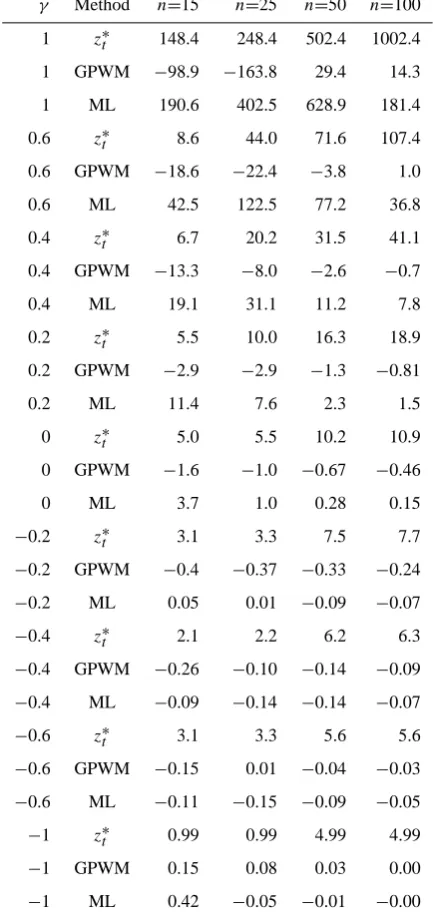
Table 1. Bias of the estimated return levels obtained by the GPWM and ML method (for a return periodt=10×n).
γ Method n=15 n=25 n=50 n=100 1 zt∗ 148.4 248.4 502.4 1002.4
1 GPWM −98.9 −163.8 29.4 14.3
1 ML 190.6 402.5 628.9 181.4
0.6 zt∗ 8.6 44.0 71.6 107.4
0.6 GPWM −18.6 −22.4 −3.8 1.0
0.6 ML 42.5 122.5 77.2 36.8
0.4 zt∗ 6.7 20.2 31.5 41.1
0.4 GPWM −13.3 −8.0 −2.6 −0.7
0.4 ML 19.1 31.1 11.2 7.8
0.2 zt∗ 5.5 10.0 16.3 18.9
0.2 GPWM −2.9 −2.9 −1.3 −0.81
0.2 ML 11.4 7.6 2.3 1.5
0 zt∗ 5.0 5.5 10.2 10.9
0 GPWM −1.6 −1.0 −0.67 −0.46
0 ML 3.7 1.0 0.28 0.15
−0.2 zt∗ 3.1 3.3 7.5 7.7
−0.2 GPWM −0.4 −0.37 −0.33 −0.24
−0.2 ML 0.05 0.01 −0.09 −0.07
−0.4 zt∗ 2.1 2.2 6.2 6.3
−0.4 GPWM −0.26 −0.10 −0.14 −0.09
−0.4 ML −0.09 −0.14 −0.14 −0.07
−0.6 zt∗ 3.1 3.3 5.6 5.6
−0.6 GPWM −0.15 0.01 −0.04 −0.03
−0.6 ML −0.11 −0.15 −0.09 −0.05
−1 zt∗ 0.99 0.99 4.99 4.99
−1 GPWM 0.15 0.08 0.03 0.00
−1 ML 0.42 −0.05 −0.01 −0.00
regularity of the ML based estimators. Although it is rare to work with bounded upper tails, they can be encountered in geophysics. For example, atmospheric scientists can be interested in relative humidity maxima, a bounded random variable. One problem with the PWM method is the range of validity (γ <1/2) to derive the asymptotic properties of the PWM estimators. This constraint may be too restrictive for some applications in hydrology and climatology. Recently, Diebolt et al. (2008) introduced the concept of the
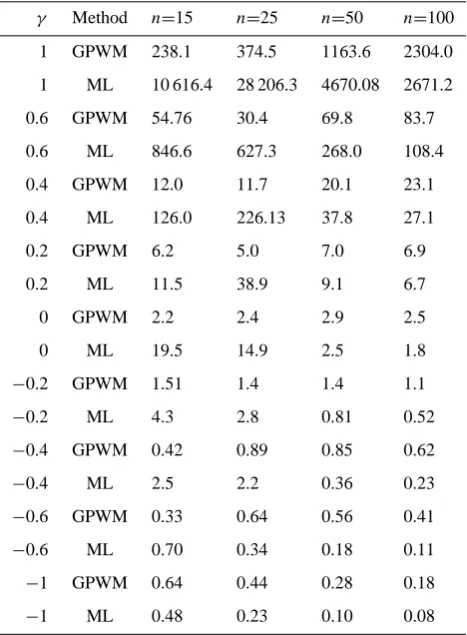
General-ized Probability Weighted Moments (GPWM) for the GEV. It broadens the domain of validity of the PWM approach, allowing heavier tails to be fitted. Despite this advantage, the ML method has kept a strong advantage over a PWM approach: its inherent flexibility in a non-stationary context. When studying climatological and hydrological data, it is not always possible to assume that the distribution of the max-ima remains unchanged in time. For example, trends can be present in extreme values of different hydroclimatolog-ical series (e.g., Kharin et al., 2007; IPCC Report, 2007). The MLE can easily integrate temporal covariates within the GEV parameters (e.g., Katz et al., 2002; Coles, 2001; El Ad-louni et al., 2007) and conceptually, the MLE procedure re-mains the same if the GEV parameters vary in time (see El Adlouni and Ouarda (2008) for a comparison study of dif-ferent methods for non-stationary GEV models). In prac-tice, numerical problems quickly arise and estimated ML re-turn levels can be misleading in some non-stationary situa-tions (see Tables 1 and 2), especially for strong heavy tails (γ≥0.4). With these limitations in mind, our aim is to pro-pose and to study a novel GPWM procedure that can handle temporal covariates. Our main motivation is to keep the in-teresting GPWM properties identified in the IID case while adding the needed flexibility to handle non-stationarities that are often present in real case studies. This will provide a valuable alternative to the MLE for non-stationary GEV dis-tributed data.
Before closing this introduction, we would like to empha-size that, beyond the three aforementioned estimation meth-ods (MLE, PWM and GPWM), there exists other variants and extensions. For example, Hosking (1990) proposed and studied the L-moments, Zhang (2007) recently derived a new and interesting method-of-moments, and Bayesian estima-tion has also generated a lot of interest in extreme value analysis (e.g. Lye et al., 1993; Coles, 2001; Cooley et al., 2007). But we will neither compare nor discuss these al-ternatives with respect to our proposed method for the fol-lowing reasons. The objective of this work is not to write a review paper that compares all existing estimation meth-ods. Instead our aim is to extend the applicability of a well-known approach (PWM) by working with a larger class of estimators (GPWM) and by proposing an algorithm that en-compasses temporal dependences. We focus on comparing our approach with the classical MLE because the later may be the most popular in statistical climatology and hydrology for non-stationary time series analysis.
2 A GEV regression model
One of the most simples, most frequently used and most stud-ied models in statistics is the classical regression
where Y=(Y1, . . . , Yn)t represents an observational vector of lengthn, X is an×pknown matrix of explanatory vari-ables and β a vector of unknown parameters of length p that characterizes the relationship between observations and explanatory variables. For example, in a time series con-text where a cycle of lengthT can be present, a model like Yi=β0+β1cos(2π i/T )+i corresponds to a matrix
X=
1 cos(2πT ) ..
. ... 1 cos(2π nT )
andβ =
β0 β1
. (3)
A regression like Eq. (2) can also model linear and even polynomial trends and consequently, it can handle various types of non-stationarities in time. Classically, the vector in Eq. (2) is assumed to be a zero-mean Gaussian vector, but this hypothesis is not reasonable whenever the observations can be considered as maxima. As already mentioned in the Introduction, Extreme Value Theory tells us that a more ad-equate fit for maxima should be the GEV distribution de-fined by Eq. (1). For this reason, we assume in this paper that the vectorin Eq. (2) consists of IID random variables from a GEV distribution defined by Eq. (1) and with param-eters(0, σ, γ ). Note thatµis set to zero here becauseβ0in the vectorβ usually plays the role of the location parame-ter. Overall, this is equivalent to state that the sequence of maximumYirepresents a sequence of independent GEV dis-tributed random variables with the same scale parameterσ, the same shape parameterγ but with a varying location pa-rameterµi that depends on the covariate X, i.e.µi=(Xβ)i.
Classically, most estimation methods for estimatingβin a regression model assume that the “noise”is zero-mean. In our case, we have imposed thatifollows a GEV distribution withµ=0. But this does not imply that the meani is null because the GEV density is not always symmetric aroundµ. To be in accordance with the zero-mean constraint, we just have to re-parametrize our model
Y=Xβ∗+∗ (4)
where
X=
1x11 · · ·x1p−1 ..
. ... ... 1xn1· · ·xnp−1
,
∗=
1−E(1) .. . n−E(1)
, (5)
β∗= β0+E(1), β1, . . . , βp−1t, and E(1)corresponds to the mean value of1.
To estimate return levels, we propose to implement the fol-lowing three-steps algorithm:
Step a: Implement an existing regression method on Eq. (4) to find regression estimates that we call(bβ1, . . . ,bβp−1).
Table 2. Standard deviation of the estimated return levels obtained by the GPWM and ML method (for a return periodt=10×n).
γ Method n=15 n=25 n=50 n=100
1 GPWM 238.1 374.5 1163.6 2304.0
1 ML 10 616.4 28 206.3 4670.08 2671.2
0.6 GPWM 54.76 30.4 69.8 83.7
0.6 ML 846.6 627.3 268.0 108.4
0.4 GPWM 12.0 11.7 20.1 23.1
0.4 ML 126.0 226.13 37.8 27.1
0.2 GPWM 6.2 5.0 7.0 6.9
0.2 ML 11.5 38.9 9.1 6.7
0 GPWM 2.2 2.4 2.9 2.5
0 ML 19.5 14.9 2.5 1.8
−0.2 GPWM 1.51 1.4 1.4 1.1
−0.2 ML 4.3 2.8 0.81 0.52
−0.4 GPWM 0.42 0.89 0.85 0.62
−0.4 ML 2.5 2.2 0.36 0.23
−0.6 GPWM 0.33 0.64 0.56 0.41
−0.6 ML 0.70 0.34 0.18 0.11
−1 GPWM 0.64 0.44 0.28 0.18
−1 ML 0.48 0.23 0.10 0.08
Step b: Apply the GPWM approach described in Appendix B to estimate the GEV parameters of the “pseudo-residuals ”
bεi=Yi − p−1 X j=1
b
βjxij, fori=1, . . . , n. (6)
Step c: From the GEV estimates obtained from Step b, compute the desired return levels.
Although each of these three steps appears to be simple, they deserve careful examinations. In order to apply Step b, the pseudo-residuals (bε1, . . . ,bεn)should be IID and GEV dis-tributed. This is not true becauseβj has to be estimated in Step a (it would be true if we knewβj). This issue is less relevant if the sample sizengets larger. For example, if the classical least squares regression1is used for Step a, our es-timation of βj asymptotically becomes better and our IID GEV assumption for our residuals truer. More precisely, a
1 b
general result (Azais and Bardet, 2005), about least squares regression tells us that, under the assumptions
lim n→∞n
−aX0
X equals a positive definite matrix fora>0 lim
n→∞1max≤i≤n
X X0X−1 X0
(i,i)
=0 (7)
the variance of alli is finite (i.e.γ <12)
the pseudo-residualsbεi can be asymptotically viewed as independent random variables distributed according to a GEV(β0, σ, γ )distribution. This result is general because it does not impose a specific type of distribution for thein Eq. (2) but only a finite variance condition. Still extreme val-ues like maxima do not necessary obey the conditionγ <12, it may be more appropriate to implement a robust/resistant regression in Step a.
Such a remark was confirmed by our simulation study. In Sect. 3 we take advantage of the Least Trimmed Squares (LTS) regression (Venables and Ripley, 2002, p. 156–163). Basically, the influence of very high values that could mislead the estimation of theβj’s is trimmed by minimizing an error/cost function that is only based on the core data. This LTS method usually gives accurate estima-tors even in the presence of large values but it needs a long computation time. This is not an important issue for maxima because of the rarity of the observations. Hence, for Step a, we advice to apply such a resistant/robust method for heavy tail distributions.
Concerning Step c, the return levelzt for the fixed time periodtcan be easily defined in the IID case. More precisely, the returnzt corresponds to the 1−1/tquantile, i.e. it is the level that, in average, is crossed one time during the time periodt. For the GEV(µ, σ, γ )distribution, this means that zt =µ+
σ γ
"
−1+
−ln
1−1
t −γ#
. (8)
In a non-stationary context, no unique definition exists for zt because extreme values recorded during the time 1, . . . , n have a different distribution than the extremes occurring dur-ing any translated time 1+C, . . . , n+C for anyC6=0. With respect to our regression model Eq. (4), the IID return level defined by Eq. (5) can be adapted in the following way zt∗=(Xβ)t+
σ γ
"
−1+
−ln
1−1
t
−γ#
. (9) This means the trend at timet plus an IID return level based on the residual of the regression.
To estimate beyond the range of observations, e.g. to com-pute the centennial return level with only 50 years of data, one needs to extrapolate the trends in Eq. (9) captured by (Xβ)t=µt. As it is well know in statistics, it is very dan-gerous to extrapolate a linear regression outside the sample support. Hence, extra caution is required when interpreting zt∗ in real applications because it means that the trend will remain the same until timet.
3 Analysis of non-stationary maxima 3.1 Simulations
Simulations are performed for four sample sizes n=15,25,50 and 100 and for nine shape parameters γ=−1,−0.6,−0.4,−0.2,0,0.2,0.4,0.6 and 1. Without loss of generality, we can setσ to one. As covariates, we fix
X=
1 cos(π/2×1) 1 cos(π/2×2) ..
. ... 1 cos(π/2×n)
andβ=
β0 β1
=
2 2
. (10)
For each combination ofnandγ, 10 000 random samples are generated from a GEV(β0+β1×cos(π/2×i),1, γ ) dis-tribution.
To estimate all parameters and return levels with our ap-proach the same procedure is followed. Step a is imple-mented by regressing with a LTS method. Then Step b is applied. Finally, Step c is used to estimate the return levelz∗t defined by Eq. (9) fort=10×n.
To obtain the return level estimate from the ML approach, we directly obtain estimation ofβ0,β1,γandσby maximiz-ing the log-likelihood function (see Appendix C). Abnormal ML estimates have been eliminated by removing all samples that provide ML estimates ofγ greater than 2.52.
For both estimation methods, the bias between true and es-timated return values is displayed in Table 1 and the standard deviation in Table 2. These tables clearly showed that, for this specific example, the MLE does not provide adequate estimates whenever the sample size is small (n<50) and the shape parameter is large, especially in terms of standard de-viation. In contrast, our GPWM regression method does a better job at handling small samples and largeγ (except for γ=1 where both methods fail), especially in terms of stan-dard deviation. Other simulations have been done, in partic-ular a comparison between the two methods in a linear de-pendence case. Since the conclusions are the same, we do not include them.
3.2 Annual maxima of CO2concentrations
We consider the annual concentrations of CO2at Amsterdam in the Indian Ocean from 1981 to 2001. These observations are available on the website of RAMCES (http://www.ipsl. jussieu.fr/services/Observations/fr/RAMCES.htm) where an extensive bibliography can be found on this subject, for ex-ample in Gros et al. (1999). Each of the 21 measures is assumed to follow a GEV(β0+β1×year, σ, γ )distribution. With the GPWM and ML approaches, we have estimated γ, σ, β0 and β1 and also the return level for a period of 200 years. The results are listed in Table 3. We observe that 2Without this thresholding, the ML standard deviations would
the two methods lead to very similar results for all the param-eters estimated. This corroborates our simulations analysis. For light tailed random variables such as CO2concentration maxima, the GEV parameters estimates are fairly similar for values ofγ near zero, see Table 1.
3.3 Seasonal maximum of cumulated daily precipitations We treat here seasonal maxima of cumulated daily precipitations recorded in the Orgeval basin (France) during 31 years. We suppose that each of the 124 measures (Yi,j)i=1,...,31;j=1,..,4 follows a GEVβ0+β1×cos π2×j+β2×i, σ, γ distribution. The indicei corresponds to the year while the indicej corre-sponds to the season. The parameterβ2indicates the trend of the series. Table 4 provides the estimates of γ, σ, β0, β1 andβ2 and the 100-year return level obtained from the GPWM and ML approaches.
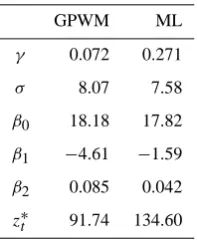
In contrast to our previous example summarized by Ta-ble 3, the MLE and GPWM procedures give very different estimates of the 100-year return level estimates in Table 4. To better understand this difference, we re-estimate the GEV parameters but with only the first 20 years. Table 5 summa-rizes our findings. As observed in Tables 1 and 2, the prop-erties of a GPWM estimated shape parameter around 0–0.2 does not vary greatly when the sample size changes. This is not the case for the ML approach where the estimates ofγ can double by changing the sample size, see Table 5. This also impacts the estimates of the return levels.
4 Conclusions
In this paper, we propose an extension of the PWM method which can be viewed as an alternative to the MLE method that enable us to model temporal covariates and provide ac-curate return levels. We illustrate our approach by a simula-tion study and by applying our approach to two time series of maxima. Compared to the ML method, the GPWM method performs better and is computationally easy, but we cannot obtain confidence intervals and, up to now, we can only have a non-stationary location parameter, whereas with the MLE method the three parameters of the GEV distribution can be non-stationary. Concerning the estimation of return levels in such non-stationary cases, we would like to conclude with a word of caution. Extrapolating the trend beyond the range of observations is always a delicate and sometimes danger-ous operation (since we assume that the trend will remain the same in the future), especially when dealing with extremes. Hence high return levels in a non-stationary context must be interpreted with extreme care.
Table 3. Annual maxima of CO2 concentrations analysis with a GEV(β0+β1×year, σ, γ ).
GPWM ML
γ −0.1102 0.044
σ 0.52 0.52
β0 −2528.96 −2528.94
β1 1.44 1.44
z∗t 441.89 439.53
Table 4. Seasonal maxima of cumulated daily precipitations analy-sis with a GEVβ0+β1×cos π2×j+β2×i, σ, γdistribution fit-ted to 31 years of data.
GPWM ML
γ 0.068 0.152
σ 7.44 7.51
β0 16.42 17.60
β1 −3.49 −2.35
β2 0.113 0.038
z∗t 86.35 97.51
Table 5. Seasonal maxima of cumulated daily precipitations analy-sis with a GEVβ0+β1×cos π2×j
+β2×i, σ, γ
distribution but only with the first 20 years of data.
GPWM ML
γ 0.072 0.271
σ 8.07 7.58
β0 18.18 17.82
β1 −4.61 −1.59
β2 0.085 0.042
Appendix A
Probability Weighted Moments (PWM)
The PWMs of a random variableZwith distribution function F are the quantities (see Greenwood et al., 1979)
Mp,r,s =E h
Zp(F (Z))r(1−F (Z))si
wherep, r andsare real numbers. When the distributionF equals to the GEV distribution defined by Eq. (1), a subclass of PWM (p=1, r=0,1,2, ...ands=0) can be explicitly ob-tained (see Hosking et al., 1985)
M1,r,0= 1 r+1
( µ−σ
γ h
1−(r+1)γ0(1−γ )i )
, (A1) forγ <1 andγ6=0. This provides a system of three equations with three unknown parameters(µ, σ, γ )
M1,0,0=µ− σ γ
1−0(1−γ ) 2M1,1,0−M1,0,0=
σ
γ0(1−γ )(2 γ −1) 3M1,2,0−M1,0,0
2M1,1,0−M1,0,0 =3
γ−1 2γ−1
(A2)
In the IID case, the PWM M1,r,0 can be estimated by the unbiased estimator (see Landwehr et al., 1979)
b M1,r,0=
1 n
n X j=1
Yr `=1
j−` n−`
Zj,n
or by the asymptotically equivalent consistent estimator
e M1,r,0=
1 n
n X j=1
prj,nZj,n,
where(Z1, . . . , Zn)is an IID sample, Z1,n ≤ ... ≤ Zn,n the ordered sample and pj,n a plotting position, i.e. a distribution-free estimate ofF (Zj,n). Hence, the PWM esti-mators(bµ,bσ ,bγ )of(µ, σ, γ )are the solutions of the system Eq. (A2). In particular, we have
b
µ=Mb1,0,0+b σ
b γ
1−0(1−
b
γ )andbσ=b
γh2Mb1,1,0−Mb1,0,0 i
0(1−
b
γ )(2bγ−1)
.
To obtainbγ, the last equation of (A2) has been solved nu-merically. In the specific case where−1/2<γ <1/2,γ can be estimated by :
b
γ = −7.859c+2.9554c2withc=2M1,1,0−M1,0,0
3M1,2,0−M1,0,0 −log 2
log 3. Under the condition γ <0.5, Hosking et al. (1985) estab-lished the asymptotic normality of the vectorθ=(µ, σ, γ )0, i.e., as the sample sizenincreases,√n(bθ−θ )converges in distribution to a trivariate zero-mean Gaussian vector whose covariance structure is given in Hosking et al. (1985).
Appendix B
Generalized Probability Weighted Moments (GPWM) Introduced and studied by Diebolt et al. (2008) for the GEV, the Generalized Probability Weighted Moments (GPWM) can be viewed as an extension of the PWMs. They are de-fined as
νω= Z ∞
−∞
xω(G(x))dG(x),
whereGrepresents the GEV distribution defined by Eq. (1) andω(.)is any suitable continuous function. One advantage of this definition is that it is easy to propose estimators ofνω. By rewriting the GPWMs as
νω= Z 1
0
G−1(u)ω(u)du,
the following estimator can be easily computed for any given ω(.)
bνω,n= Z 1
0 F
−1
n (u)ω(u)du (B1)
where F−1
n denotes the inverse of the classical empirical distribution function of a IID GEV distributed sample. To make the link between PWMs and GPWMs, one can choose ω(u)=ur. Thenνω corresponds to the classical PWM cap-tured by Eq. (A1). But this choice imposes a strong re-striction on the GEV shape parameter γ <1/2. To handle heavier tails (i.e. larger γ), it is preferable to work with ω(u)=ua(−logu)b. For such a type of function, Diebolt et al. (2008) showed that
νω = σ γ
0b−γ+1 (a+1)b−γ+1−
σ γ −µ
0
b+1 (a+1)b+1.
If b is chosen such that γ <b+1, then νω exists. In this case, the asymptotic normality forbνω,nholds whenγ <12+b (Diebolt et al., 2008) and confidence intervals can be pro-vided for bounded, light and heavy tails. To simplify nota-tions,νωis now calledνa,bwhenω(u)=ua(−logu)b.
To estimate the three GEV parameters fromνa,b, we need to solve a system of three equations. In practice, we fix three pairs for(a, b): (1,1),(1,2)and(2,1). This simple choice provides an easy system to solve
b γ
1−(32)bγ
=2[bν11−bν12] bν11−
9 4bν21
,
bσ =2
3−bγbν11−bν12 0(2−
b
γ ) and bµ= bσ b γ− bσ b γ2 b γ0(2−
Appendix C
Maximum Likelihood Estimation (MLE)
Let(Y1, ..., Yn)be a sequence of independent random vari-ables such thatYi follows a GEV((Xβ)i, σ, γ )distribution. Letθ be the vector of unknown parameters to be estimated (in our case,θ=(β, σ, γ )). In the caseγ6=0, the log likeli-hood function is given by :
logL(β, σ, γ )= −nlogσ
−1
γ +1 Xn
i=1
log1+γYi−(Xβ)i σ
− n X i=1
1+γYi−(Xβ)i σ
−γ1
(C1)
provided 1+γYi−(Xβ)i
σ >0 for alli=1, ..., n. The Maximum Likelihood estimates(bβ,bσ ,bγ ) are obtained by maximizing Eq. (C1). In the caseγ >−1
2, the usual properties of consis-tency, asymptotic efficiency and asymptotic normality hold. Since there is no explicit formula from the maximization, we obtain the estimates by numerically optimizing Eq. (C1), e.g. by using a Newton Raphson algorithm.
Acknowledgements. This work was supported by the CS of Stras-bourg University, the french ANR-AssimilEx project, the european E2–C2 grant, and by The Weather and Climate Impact Assessment Science Initiative at the National Center for Atmospheric Research (NCAR). The authors would also like to credit the contributors of the R project. Finally, the suggestions of the reviewers have improved the clarity of this article.
Edited by: G. Zoeller
Reviewed by: H. Rust and S.-E. El Adlouni
References
Azais, J. M. and Bardet, J. M.: Le mod`ele lin´eaire par l’exemple, r´egression, analyse de la variance et plans d’exp´eriences illustr´es avec R, SAS et Splus, Dunod, 2005.
Beirlant, J., Goegebeur, Y., Segers, J., and Teugels, J.: Statistics of Extremes: Theory and Applications, Wiley Series in Probability and Statistics, 2004.
Coles, S. G.: An introduction to statistical modeling of extreme values, Springer, 2001.
Coles, S. G. and Dixon, M. J.: Likelihood-based inference of ex-treme value models, Exex-tremes, 2, 5–23, 1999.
Cooley, D., Nychka, D., and Naveau, P.: Bayesian Spatial Modeling of Extreme Precipitation Return Levels, J. Amer. Statist. Assoc., 102–479, 824–840, 2007.
de Haan, L. and Ferreira A.: Extreme Value Theory: An Introduc-tion, Springer Series in Operations Research, 2006.
Diebolt, J., Guillou, A., Naveau, P., and Ribereau, P.: Improving probability-weighted moment methods for the generalized ex-treme value distribution, REVSTAT – Statistical Journal, 6–1, 33–50, 2008.
El Adlouni, S. and Ouarda, T. B. M. J.: Comparaison des m´ethodes d’estimation des param`etres du mod`ele GEV non-stationnaire, Revue des Sciences de l’Eau, 21(1), 35–50, 2008.
El Adlouni, S., Ouarda, T. B. M. J., Zhang, X., Roy, R., and Bob´ee, B.: Generalized maximum likelihood estimators for the nonsta-tionary generalized extreme value model, Water Resour. Res., 43, W03410, doi:10.1029/2005WR004545, 2007.
Embrechts, P., Kl¨uppelberg, C., and Mikosch, T.: Modelling Ex-tremal Events for Insurance and Finance, vol. 33, Applications of Mathematics, Springer-Verlag, Berlin, 1997.
Greenwood, J. A., Landwehr, J. M., Matalas, N. C., and Wallis, J. R.: Probability-weighted moments: definition and relation to parameters of several distributions expressable in inverse form, Water Resour. Res., 15, 1049–1054, 1979.
Gros, V., Bonsang, B., Martin, D., Novelli, P. C., and Kazan, V.: Short term carbon monoxide measurements at Amsterdam Is-land: estimations of biomass burning emissions rates, Chemo-sphere, 1, 163–172, doi:10.1016/S1465-9972(99)00009-4, 1999. Hosking, J. R. M.: L-moments: analysis and estimation of distri-butions using linear combinations of order statistics, J. R. Stat. Soc., 52, 105–124, 1990.
Hosking, J. R. M., Wallis, J. R., and Wood, E. F.: Estimation of the generalized extreme-value distribution by the method of probability-weighted moments, Technometrics, 27, 251–261, 1985.
IPCC Climate Change: Synthesis Report, http://www.ipcc.ch/ ipccreports/, 2007.
Katz, R., Parlange, M., and Naveau, P.: Extremes in hydrol-ogy, Adv. Water Resour., 25, 1287–1304, doi:10.1016/S0309-1708(02)00056-8, 2002.
Kharin, V. V., Zwiers, F. W., Zhang, X., and Hegerl, G. C.: Changes in temperature and precipitation extremes in the IPCC ensemble of global coupled model simulations, J. Climate, 20, 1419–1444, 2007.
Landwehr, J., Matalas, N., and Wallis, J. R.: Probability weighted moments compared with some traditional techniques in estimat-ing Gumbel parameters and quantiles, Water Resour. Res., 15, 1055–1064, 1979.
Lye, L. M., Hapuarachchi, K. P., and Ryan., S.: Bayes estimation of the extreme-value reliability function, IEEE Trans. Reliab., 42, 641–644, doi:10.1109/24.273598, 1993.
Smith, R. L.: Maximum likelihood estimation in a class of nonreg-ular cases, Biometrika, 72, 69–90, 1985.
Venables, W. N. and Ripley, B. D.: Modern Applied Statistics With S, Springer, 2002.