Atmos. Meas. Tech., 7, 3431–3444, 2014 www.atmos-meas-tech.net/7/3431/2014/ doi:10.5194/amt-7-3431-2014
© Author(s) 2014. CC Attribution 3.0 License.
Space-based retrieval of NO
2
over biomass burning regions:
quantifying and reducing uncertainties
N. Bousserez1,*
1Dalhousie University, Halifax, N.S., Canada
*now at: University of Colorado at Boulder, Boulder, Colorado, USA
Correspondence to: N. Bousserez ([email protected])
Received: 9 June 2013 – Published in Atmos. Meas. Tech. Discuss.: 22 July 2013 Revised: 30 June 2014 – Accepted: 8 July 2014 – Published: 8 October 2014
Abstract. The accuracy of space-based nitrogen dioxide (NO2) retrievals from solar backscatter radiances critically
depends on a priori knowledge of the vertical profiles of NO2
and aerosol optical properties. This information is used to calculate an air mass factor (AMF), which accounts for at-mospheric scattering and is used to convert the measured line-of-sight “slant” columns into vertical columns. In this study we investigate the impact of biomass burning emis-sions on the AMF in order to quantify NO2 retrieval
er-rors in the Ozone Monitoring Instrument (OMI) products over these sources. Sensitivity analyses are conducted us-ing the Linearized Discrete Ordinate Radiative Transfer (LI-DORT) model. The NO2 and aerosol profiles are obtained
from a 3-D chemistry-transport model (GEOS-Chem), which uses the Fire Locating and Monitoring of Burning Emissions (FLAMBE) daily biomass burning emission inventory. Air-craft in situ data collected during two field campaigns, the Arctic Research of the Composition of the Troposphere from Aircraft and Satellites (ARCTAS) and the Dust and Biomass-burning Experiment (DABEX), are used to evaluate the mod-eled aerosol optical properties and NO2profiles over
Cana-dian boreal fires and West African savanna fires, respectively. Over both domains, the effect of biomass burning emissions on the AMF through the modified NO2shape factor can be
as high as −60 %. A sensitivity analysis also revealed that the effect of aerosol and shape factor perturbations on the AMF is very sensitive to surface reflectance and clouds. As an illustration, the aerosol correction can range from−20 to
+100 % for different surface reflectances, while the shape factor correction varies from−70 to−20 %. Although previ-ous studies have shown that in clear-sky conditions the effect of aerosols on the AMF was in part implicitly accounted for
by the modified cloud parameters, here it is suggested that when clouds are present above a surface layer of scattering aerosols, an explicit aerosol correction would be beneficial to the NO2 retrieval. Finally, a new method that uses slant
column information to correct for shape-factor-related AMF error over NOxemission sources is proposed, with possible
application to near-real-time OMI retrievals.
1 Introduction
Nitrogen oxides (NOx= NO2+NO) play a key role in
tropo-spheric chemistry by affecting ozone, atmotropo-spheric oxidation, and aerosol formation (Logan, 1983). Biomass burning is a significant source of NOx, which accounts for∼15 % of the
global emissions (IPCC, 2007). However this source remains difficult to quantify due to its high spatio-temporal variability (Mebust and Cohen, 2013; Mebust et al., 2011). On the one hand, bottom-up inventories rely on an accurate representa-tion of the different factors controlling NOx emission from
fires, including the type of vegetation, the burning phase and the combustion efficiency (Wiedinmyer et al., 2006; Andreae and Merlet, 2001). This information is generally only avail-able at local scale, and extrapolations needed for regional or global estimates are therefore associated with uncertainties. On the other hand, top-down estimates from space-based ob-servations allow for the inference of global monthly to daily NOxemission inventories (Miyazaki et al., 2012; Lamsal et
al., 2011; Martin et al., 2003), with some recent studies hav-ing developed capabilities to characterize NOxemissions at
others, these estimates are affected by errors in the retrieved NO2 columns (Boersma et al., 2004; Herron-Thorpe et al.,
2010). Since incomplete knowledge of the optical properties of the atmosphere greatly contributes to errors in the inferred NO2columns, retrievals over biomass burning events are
es-pecially challenging due to the emission of large amounts of aerosol with fire-dependent characteristics. Quantifying and reducing errors in the NO2retrievals is therefore critical to
assess and mitigate uncertainties in top-down emission in-ventories.
Satellite retrievals of NO2columns from solar backscatter
radiations are based on several steps (Richter and Burrows, 2002; Martin et al., 2002). First, a total slant column is in-ferred from spectral fitting. A stratospheric contribution is then estimated using either a reference slant column over clean areas or a model simulation in order to derive a tro-pospheric slant column. The trotro-pospheric slant column is subsequently converted into a vertical column using an air mass factor (AMF). The AMF corrects the measurements for the viewing geometry and the atmospheric scattering effects based on a priori knowledge of the NO2profile shapes,
sur-face characteristics (reflectance, pressure) and atmospheric optical properties. It has been shown that the AMF is the largest source of error in NO2 retrievals (Boersma et al.,
2004; Martin et al., 2002). One fundamental issue is re-lated to the fact that the resolution of the input parameters in the AMF calculation is usually much coarser than the satellite pixel area. Recent studies showed that using high-resolution terrain information and NO2 profile simulations
can result in large differences (more than a factor of 2) in the retrieved NO2columns compared to products that use a
priori data at typical global chemical transport model reso-lution (Zyrichidou et al., 2013; Heckel et al., 2011; Boersma et al., 2011; Russell et al., 2011; Hains et al., 2010; Zhou et al., 2009). Another approach to tackle the representativeness problem is to use information from the observations them-selves, which has been proposed by Lamsal et al. (2008) in the context of top-down estimate of surface NO2
concen-trations. In their study, a downscaling technique based on the variability of OMI tropospheric NO2 columns within a
coarse model grid cell is used to infer NO2surface
concen-tration at OMI pixel resolution. Similarly, in this study we will propose a measurement-based correction intended to re-duce retrieval errors related to the use of low-resolution NO2
shape profiles and missing sources in the model.
Besides the difficulty of adequately reproducing NO2
shape profiles, biomass burning provides an additional com-plication by altering the scattering properties of the atmo-sphere. Previous studies have investigated the impact of aerosols on the AMF using modeled profiles of aerosol char-acteristics (Leitão et al., 2010; Martin et al., 2003). Dif-ferences in the retrieved NO2 columns as large as a
ftor of 2 were obtained when the aerosol effect was not ac-counted for in the retrieval. An important finding is that the relative distribution of the aerosol and NO2 profiles plays
a key role in determining the aerosol effect on the AMF (Leitão et al., 2010; Chen et al., 2009; Fu et al., 2007). Typi-cally, co-located aerosol and NO2layers will tend to increase
the AMF, while the presence of an aerosol layer above the boundary layer NO2bulk will decrease the AMF (shielding
effect). However, it is still unclear how to account for the aerosol effect, since cloud products used in AMF calculations are also sensitive to aerosols (Boersma et al., 2011, 2004). Although Boersma et al. (2011) found that the modified cloud parameters implicitly account for part of the aerosol effect (underestimation of 10–20 %), it is unclear to which extent their findings are applicable to retrievals with different aerosol and NO2vertical distribution characteristics.
More-over, the case where meteorological clouds and aerosols are present in the scene has not been studied yet (Leitão et al., 2010).
As a result of all the aforementioned factors, a recent study by Mebust et al. (2011) suggested that there may be a large negative bias of about 50–100 % in the OMI NO2
retrievals over wildfire. Their conclusion was based on the fact that NOxemission coefficients derived from combining
OMI NO2 columns and MODIS fire radiative power
mea-surement were significantly lower than in previous studies. Further investigation of the properties of NO2retrievals over
fires is therefore critical. Given the high uncertainty in the prior information used, such a study would ideally need to incorporate in situ observations of aerosols and NO2profiles
over different type of fires.
The Arctic Research of the Composition of the Tropo-sphere from Aircraft and Satellites (ARCTAS) and The Dust And Biomass EXperiment (DABEX) experiments provide extensive aircraft in situ measurements of NO2
concentra-tions and aerosol optical properties over boreal and savanna fires, respectively. ARCTAS-B took place in June–July 2008 with a major emphasis on boreal forest fire influences over Canada (Parrington et al., 2013; Corr et al., 2012; Jacob et al., 2010). DABEX, part of the African Monsoon Multidis-ciplinary Analysis (AMMA) experiment, took place in Jan-uary 2006 over West Africa (Johnson et al., 2008a; Capes et al., 2008; Redelsperger et al., 2006). These two cam-paigns provide an unprecedented data set to evaluate mod-eled aerosol and NO2 profiles that are used in the AMF
calculation over different biomass burning regions. To our knowledge, a comprehensive analysis of NO2retrievals over
biomass burning supported by detailed aerosol and NO2in
situ measurements has not been conducted yet.
In this study, the impact of biomass burning emissions on the AMF is assessed using the the Linearized Discrete Ordi-nate Radiative Transfer (LIDORT) model (Spurr et al., 2001; Spurr, 2002) combined with aerosol and NO2profiles from
N. Bousserez: Retrieval of NO2over biomass burning regions 3433
the ARCTAS-B and DABEX experiments is provided. In Sect. 4, the modeled aerosol optical properties and NO2
pro-file shapes are evaluated against the ARCTAS and DABEX observations. In Sects. 5 to 8, the sensitivity of the AMF to biomass burning emissions and its dependence to several re-trieval parameters is investigated. Finally, in Sect. 9, an ap-proach based on slant column measurement information to reduce AMF errors associated with NO2shape factor
uncer-tainties is proposed.
2 AMF calculation
The tropospheric AMF is defined as the ratio of the tropo-spheric slant column, which is the total tropotropo-spheric amount of trace gas along an average backscattered path observed by a satellite instrument, to the tropospheric vertical column of this trace gas. Following Palmer et al. (2001), the tropo-spheric AMF can be expressed as
AMF=AMFG 1
Z
0
ω(σ )S(σ )dσ. (1)
In this equation AMFGis the geometric AMF accounting for
the satellite viewing geometry. The term σ represents the sigma vertical coordinate of the model, related to the pres-sureP byP =σ (PS−PT)+PT, wherePSandPT are the
pressure at the surface and the top of the troposphere, respec-tively.S(σ )is the shape factor, a dimensionless normalized NO2vertical profile, andω(σ )are the scattering weights
de-scribing the sensitivity of the backscattered spectrum to the abundance of NO2at eachσ-level.
The AMF formulation used takes into account cloud-contaminated pixels following the independent pixel approx-imation, as described in Martin et al. (2002). The cloud frac-tion and cloud pressure are retrieved from OMI using the O2-O2 algorithm (Acarreta et al., 2004). Surface
reflectiv-ity was obtained from a climatology from OMI at 440 nm (Kleipool et al., 2008). Scattering weights are calculated us-ing the Linearized Discrete Ordinate Radiative Transfer (LI-DORT) model (Spurr et al., 2001; Spurr, 2002). The NO2
shape factors and aerosol optical characteristics are obtained from a GEOS-Chem simulation described in Appendix A.
3 Observational data set
3.1 ARCTAS-B campaign
The summer ARCTAS-B campaign took place in late June and early July 2008 (Jacob et al., 2010). The primary goal of this experiment was to better understand the factors driv-ing current changes in Arctic atmospheric composition and climate.
The campaign included the DC-8 research aircraft to mea-sure chemical and radiative properties of the atmosphere.
From 26 June to 14 July 2008, the aircraft was based in Cold Lake, Canada (54◦N, 110◦W), where it sampled many fresh and aged biomass burning plumes at a wide range of altitudes (Alvarado et al., 2010). The DC-8 included highly sensitive high-frequency (1–10 s) measurements of key ozone precur-sors (NOy, HOx, PAN, HCHO) as well as aerosol optical
and physical properties. Measurement characteristics for the species considered in this study are summarized Table 1. For a more detailed description of the chemical and optical prop-erties of biomass burning plumes sampled during ARCTAS-B the reader is referred to Singh et al. (2010) and Alvarado et al. (2010).
3.2 DABEX campaign
The African Monsoon Multidisciplinary Analysis (AMMA) is a major international experiment designed to improve our understanding of the West African monsoon (Redelsperger et al., 2006). The Dust And Biomass burning EXperiment (DABEX) was part of the Special Observing Period (SOP) dry season (January–February 2006). It was carried out over West African by the UK Met Office, which used the FAAM BAe-146 aircraft to perform high-quality in situ measure-ments of the chemical, optical and physical properties of biomass burning and dust aerosols over West Africa. The area sampled covered a narrow domain spanning from west-ern Niger, where mineral dust is predominant, to central Benin, where savanna fires occur.
Physical and optical properties of dust and biomass burn-ing aerosols durburn-ing DABEX were analyzed in detail in several studies (Johnson et al., 2008a, b; Osborne et al., 2008; Capes et al., 2008). Analysis of fresh biomass burning aerosols was especially challenging due to frequent mixing with mineral dust near the surface. Nevertheless, results show similar aerosol characteristics than previously found during the SAFARI-2000 campaign over southern Africa (Haywood et al., 2003).
Table 2 summarizes the measurement characteristics for the data considered in this study. To complete our model evaluation, we also used aerosol optical depth (AOD) and single scattering albedo (SSA) surface in situ data from the Aerosol Robotic Network (AERONET) network, which con-sist of sun photometer measurements (Dubovik et al., 2002).
4 Model evaluation
The GEOS-Chem 3-D chemistry transport model described in Appendix A is a central tool in our AMF analysis, since it provides the aerosol and NO2 profiles used in the
Table 1. DC-8 research payload during ARCTAS-B for the species considered in this study.
Species, parameters Method Investigator Reference
NO2 TD-LIF R. Cohen, UC Berkeley Cleary et al. (2002)
Aerosol optical properties Nephelometer, PSPAP B. Anderson, NASA LaRC Anderson and Ogren (1998)
Black carbon aerosol SP2 Y. Kondo, U. Tokyo Moteki and Kondo (2008); Moteki et al. (2007)
TD-LIF = Thermal dissociation-laser induced fluorescence, SP2 = Single particle soot photometer
aerosol optical properties and NO2 profiles were evaluated
against aircraft in situ measurements from the DABEX and ARCTAS campaigns. For this purpose, model outputs were interpolated along the flight tracks and filtered to retain only observations influenced by biomass burning emissions.
For ARCTAS, measurements impacted by biomass burn-ing emissions were identified by enhancements in HCN and CO concentrations greater than 20 % of the regional back-ground.
For DABEX, measurements influenced by biomass burn-ing were defined accordburn-ing to Johnson et al. (2008b), who derived the following criteria:
– scattering at 550 nm (green)>30×10−6m – Ångström exponent>1.
A model sensitivity simulation was performed to ensure that the selected observations were also associated with biomass burning influences in the model. Mean modeled and observed profiles were subsequently derived by vertically binning the data over the entire ARCTAS (150–80◦W, 49– 70◦N) and DABEX (2◦W–8◦E, 8–20◦N) domains.
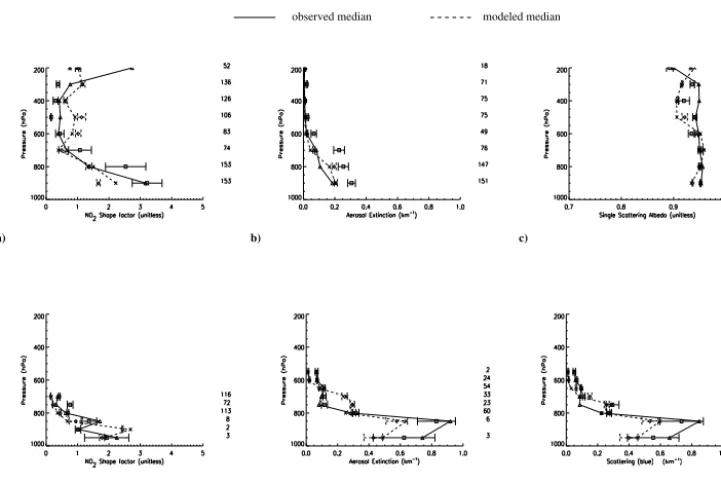
Figure 1 shows the observed and simulated shape factor, aerosol extinction coefficient (440 nm) and SSA (440 nm) mean profiles during ARCTAS. There is an overall good agreement between the model and the measurements. The NO2shape factor shows a sharp enhancement near the
sur-face due to fire emissions. Model analyses (not shown) sug-gest that the gradient observed at the top of the troposphere and not seen in the model is due to an underestimation of lightning NOxemissions. Aerosol extinction coefficients also
increase in the boundary layer as a result of biomass burning emissions. The shape and magnitude of the extinction is sim-ilar in the model and the measurements. The mean SSA pro-file is also reasonably well reproduced by the model, with relatively homogeneous values of 0.90–0.95. These obser-vations are consistent with SSA values derived by Reid et al. (2005) over boreal fires using AERONET measurements. Figure 1 shows the profiles of the shape factor, aerosol extinction coefficient (440 nm) and aerosol scattering coef-ficient (440 nm) from GEOS-Chem and the FAAM BAe-146 measurements during DABEX. Since aerosol absorption measurements were available only at 565 nm, the observed extinction at 565 nm has been scaled to 440 nm by apply-ing the ratio between the scatterapply-ing coefficients at 440 and 565 nm. In order to conserve original measurements in the
comparison, here the choice has been made to show the scat-tering coefficient at 440 nm instead of the SSA. The mod-eled and observed shape factors show a significant increase near the surface, similar to the one observed over boreal fires. Aerosol extinction and scattering coefficient profile shapes are well reproduced by GEOS-Chem. The model underes-timation near the surface may be attributed to representa-tiveness errors given the coarse resolution used. Note that the poor sampling of the boundary layer during DABEX limits confidence in the results near the surface. Aerosol extinction coefficients measured over savanna fires (∼0.4– 0.8 km−1) are significantly greater than those observed over boreal fires during ARCTAS (∼0.1–0.2 km−1). Again, the boundary layer observations during DABEX are representa-tive of specific fire events rather than average characteris-tics. Table 3 contains the AOD and SSA columns for GEOS-Chem and the AERONET measurements at several stations in West Africa. The modeled SSA agrees with observations within 0.02 in average, and the modeled AOD within 23 %.
In conclusion, the evaluation of the simulated NO2
pro-files and aerosol optical properties over boreal and savanna fires shows that the GEOS-Chem model reproduces reason-ably well the observed vertical distributions. In the following, aerosol and NO2shape profiles simulated by GEOS-Chem
are used to calculate the AMF and to analyze its sensitivity to biomass burning emissions.
5 Impact of biomass burning emissions on the AMF
Generally the high spatial and temporal variability of fire emissions is not fully resolved in CTMs. This is in part due to representativeness errors owing to the coarse resolution of the model simulations as well as to incomplete knowledge of the different factors influencing fire emissions, such as the vegetation type and the combustion efficiency, as well as the phase of the fires (flaming, smoldering), which can be asso-ciated with different NOx/ aerosol emission ratios (Andreae
and Merlet, 2001). Assuming the aerosol effect is at least partially accounted for by the cloud correction, only the im-pact of biomass burning on the NO2shape factor is
N. Bousserez: Retrieval of NO2over biomass burning regions 3435
b)
a) c)
e) f)
d)
observed median modeled median
b)
a) c)
e) f)
d)
observed median modeled median
b)
a) c)
e) f)
d)
observed median modeled median
b)
a) c)
e) f)
d)
observed median modeled median
b)
a) c)
e) f)
d)
observed median modeled median
b)
a) c)
e) f)
d)
observed median modeled median
Figure 1. Simulated and observed vertical profiles of NO2shape factors (a), aerosol extinction coefficient (440 nm) (b), and single scattering albedo (440 nm) (c) during ARCTAS, and NO2shape factors (d), aerosol extinction coefficient (440 nm) (e), and aerosol scattering coefficient (440 nm) (f) during DABEX. Modeled median values (dashed line) are represented by crosses and observed median values (solid line) by triangles. Modeled mean values are represented by diamonds and observed mean values by square. Bars indicate the standard error of the mean at each altitude level.
Table 2. FAAM BAe-146 research payload during DABEX for the species considered in this study.
Species, parameters Instrument Comment
NO2 TECO 42 detection limit<2 ppbv
Aerosol absorption Radiance Research PSAP wavelength,λ= 0.568 mum Dry aerosol scattering TSI 3563 Nephelometer λ= 0.45, 0.55, 0.70 µm
AMFcor=
AMFbb
AMFnobb
, (2)
where subscripts on the right-hand side specify if biomass burning emissions are included (bb) or not (nobb) in the AMF calculation.
Figure 2 shows the mean shape factor correction over bo-real and savanna fires during ARCTAS and DABEX, respec-tively. Only OMI scenes with cloud fraction<5 % have been considered here in order to limit the interference of clouds in the analysis while retaining a statistically significant number of data. The AMF correction ranges from−60 to 0 %. Fire emissions reduce the AMF by increasing the NO2shape
fac-tor near the surface (and decreasing it above) where measure-ment sensitivity is minimum. These results show that NO2
retrievals over fires can underestimate NO2 tropospheric
columns by a factor of 2 when some of these sources are missing in the model. This scenario will generally corre-spond to wildfire events, which are by nature unpredictable
and whose emissions are not currently accounted for in real-time retrievals. Note that the AMF correction presented here does not take into account representativeness errors due to the coarse model resolution. This problem will be addressed in Sect. 9.
Also, although here it is assumed that the aerosol effect is implicitly accounted for by the cloud correction algorithm, this assumption has been questioned in a recent study by Leitão et al. (2010) in the case of cloudy scenes. A better understanding of the effect of aerosols on the AMF can help investigate this issue further. This effect needs to be charac-terized for different retrieval parameters (e.g., SSA, surface reflectance). Similarly, the impact of the modified NO2shape
factor on the AMF is modulated by changes in these param-eters.
In the next two sections we study in detail the sensitivity of the AMF to aerosol and NO2shape factor perturbations for a
Figure 2. Mean AMF shape factor correction over Canadian fires during ARCTAS (30 June–10 July 2008) (left) and West African fires
during DABEX (13 January–2 February 2006) (right). Retrievals with a cloud fraction>5 % have been excluded.
Table 3. Simulated and observed mean SSA and AOD columns at
several AERONET sites during DABEX.
SSA AOD
Banizoumbou (13◦N, 2◦E)
AERONET 0.84 0.75
GC 0.84 0.63
Djougou (9◦N, 1◦E)
AERONET 0.82 1.05
GC 0.84 1.19
IER-Cinzana (13◦N, 5◦W)
AERONET 0.83 0.65
GC 0.85 0.61
Ilorin (8◦N, 4◦E)
AERONET 0.86 1.37
GC 0.89 0.80
DMN-Maine Soroa (13◦N, 12◦E)
AERONET 0.88 0.80
GC 0.82 1.23
Dakar (14◦N, 16◦W)
AERONET 0.83 0.84
GC 0.85 0.95
6 Aerosol correction factor sensitivity analysis
In this section, we assess the influence of aerosols on the AMF and its dependence to aerosol characteristics (optical properties, profile shape) as well as key retrieval parameters (satellite viewing geometry, surface reflectance, clouds). A sensitivity analysis is conducted using a reference profile for aerosols and NO2from the DABEX GEOS-Chem simulation
evaluated in Sect. 4. The reference solar zenith angle (SZA), SSA and surface reflectance are 40◦, 0.91, and 0.03, respec-tively. In the sensitivity experiment, each parameter varies while others are kept constant. Since the model horizontal
resolution (2◦×2.5◦) is much coarser than the OMI’s, and in order to minimize the representativeness error above biomass burning sources, the grid cell associated with highest emis-sions during the DABEX period has been selected. Figure 3 shows the corresponding simulated NO2and aerosol profiles
at OMI overpass time (13:30 p.m., local time). The presence of an elevated aerosol layer is consistent with previous obser-vations and analyses over African biomass burning regions (Jury and Winter, 2010; Anderson et al., 1996; Johnson et al., 2008b). During DABEX, this pattern has been shown to be due to the uplift of biomass burning aerosols by the Har-mattan front (Haywood et al., 2008).
The aerosol correction factor is defined as the ratio be-tween an AMF that includes aerosol effects and an AMF that does not include them. The sensitivity of the aerosol correction factor to aerosol profile shape has been evalu-ated by comparing the correction with and without the ele-vated aerosol layer, as represented Fig. 3. As a result of the shielding effect, the aerosol correction factor decreases from
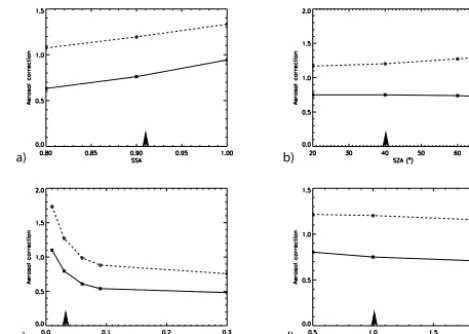
+20 to−30 % in the presence of the elevated aerosol layer. Figure 4 shows the influence of SSA, SZA and surface re-flectance on the aerosol correction factor for the two types of profile considered. For each of these parameters, the sen-sitivity of the aerosol correction factor is similar whether or not the elevated aerosol layer is included. The AMF being a vertical integration of the scattering coefficients weighted by the NO2shape factor, its sensitivity is driven by optical
prop-erties near the surface where the NO2 shape factor peaks,
which explains the similarities observed.
N. Bousserez: Retrieval of NO2over biomass burning regions 3437
Aerosol correction:
0.77 1.22
Figure 3. Left: GEOS-Chem aerosol extinction coefficients profile
with (solid line) and without (dashed line) the elevated aerosol layer for a single grid cell over West African fires at OMI overpass time (13:30 LT). The aerosol correction factor values corresponding to each type of aerosol profile are reported in the figure. Right: GEOS-Chem NO2profile shape for the same grid cell.
profile configurations and fine aerosol particles (more rep-resentative of savanna fires). Note that, as their results show, the decrease of the aerosol correction with surface reflectance is faster when coarse aerosol particles are considered (more representative of forest fires). When compared to the refer-ence case, the change in the aerosol correction due to surface reflectance variations ranges from−40 to+40 %. Russel et al. (2011) report similar changes in OMI NO2 column
re-trievals when using a high-resolution surface albedo prod-uct over California compared to the low-resolution standard product. Local changes of −20 to+10 % in retrieved NO2
columns are also obtained using a high-resolution surface albedo product in Boersma et al. (2011).
A linear increase of the aerosol correction factor with SSA is observed, while the viewing geometry (SZA) has negligi-ble impact on the correction, which is consistent with find-ings by Leitão et al. (2010) over urban areas.
The impact of emission intensity on the aerosol correc-tion factor has been assessed by rescaling the aerosol and NO2concentrations within a 0–1 km surface layer. Figure 4d
shows that the effect of aerosols on the AMF is almost insen-sitive to emission intensity. This reflects the balance between the AMF increase caused by aerosol scattering effects and the AMF decrease due to NO2shape factor enhancements at
the surface. A direct consequence is that the aerosol correc-tion factor will be only weakly impacted by emission repre-sentativeness errors within one model grid cell as long as the aerosol / NO2emission factors are homogeneous inside that
domain.
The presence of clouds above the aerosol layer can mod-ify the aerosol correction factor through its shielding effect. Figure 5 shows the aerosol correction factor as a function of cloud fraction for different AODs, and for the two aerosol profiles considered in Fig. 3. Here the cloud top pressure was set to 460 hPa, which corresponds to clouds above the elevated aerosol layer. For any AOD value, the aerosol cor-rection factor increases linearly with cloud fraction. This re-flects the higher relative impact of aerosol scattering on the AMF for higher shielding effects, due to the aerosol correc-tion being a ratio of smaller AMFs. Note that increasing the
a) b)
c) Surface Reflectance d)
Figure 4. Aerosol correction factor sensitivity to (a) single
scat-tering albedo, (b) solar zenithal angle, (c) surface reflectance, and
(d) emissions (aerosol and NO2 surface concentration rescaling). Solid and dashed lines correspond to the case with and without the elevated aerosol layer, respectively. For each parameter, the arrow indicates the value corresponding to the reference case.
optical thickness of the elevated aerosol layer does not mod-ify the sensitivity of the aerosol correction factor to cloud fraction. This is expected since an elevated aerosol layer will essentially play the same role as an increase in cloud fraction in the retrieval algorithm. However, in the case where NO2
and aerosols are co-located near the surface, the aerosol cor-rection factor sensitivity to cloud radiance fraction increases with AOD. As a result, for an AODs>1, which is commonly measured over biomass burning events (Gogoi et al., 2013), we see from Fig. 5 that the aerosol correction can vary from
+20 to+100 % between clear-sky and cloudy (cloud fraction of 20 %) conditions. As discussed in Boersma et al. (2011, 2004), it is important to realize that in real retrieval condi-tions aerosols will impact the retrieved clouds parameters used in the AMF calculation. This important aspect is dis-cussed in the next section.
7 Do clouds implicitly account for aerosol effects?
Since aerosols impact the retrieved cloud parameters in the UV-Vis, correcting AMFs for aerosols cannot be decou-pled from correcting cloud retrieval schemes for aerosols. In Boersma et al. (2011, 2004), it is shown that the effect of aerosols on the AMF is partly accounted for through the modified cloud parameters for clear-sky scenes and exponen-tially decreasing shape profiles for aerosols and NO2.
AOD = 0.76 AOD = 1.22 AOD = 1.86
AOD = 0.33 AOD = 0.61 AOD = 1.04 AOD = 1.48
Figure 5. Aerosol correction factor sensitivity to cloud fraction for
different AODs. Left: case with an elevated aerosol layer. Right: case with a surface-only aerosol layer. Different AODs were ob-tained by rescaling either the elevated aerosol layer (left panel) or the surface aerosol layer (right panel).
explicitly accounting for the aerosol scattering effect would counterbalance the additional shielding effect from clouds and may therefore improve the retrieval. This is illustrated by the following relationships, valid for cloudy retrievals in-cluding a surface layer of scattering aerosols:
AMFδcloud<AMFδaerosolcloud ≤AMFaerosol, (3)
where “aerosol” indicates that an explicit aerosol correction is used, andδcloud represents the perturbation of cloud frac-tion by aerosols. Here we see that the AMF using an ex-plicit aerosol correction factor (AMFδaerosolcloud) yields a better approximation to the true AMF (AMFaerosol). The fact that
it is theoretically possible to reproduce the true AMF (weak inequality) follows from our previous result that an increase in cloud fraction induces an increase in the aerosol correction factor. Therefore, this suggests that in the presence of clouds and surface scattering aerosols, the aerosol effects should be explicitly accounted for in the AMF calculation. On the other hand, as explained in Leitão et al. (2010), if the surface aerosols are very absorbing, the retrieved cloud fraction will be reduced, which cannot compensate for the shielding effect of aerosol absorption.
8 Shape factor correction sensitivity analysis
The impact of biomass burning emissions on the AMF through the modified NO2 shape factors is also altered by
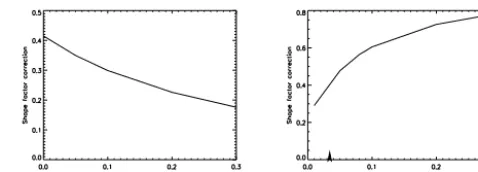
changes in other retrieval parameters. Figure 6 shows the sen-sitivity of the shape factor correction to cloud fraction and surface reflectance. The shape factor correction decreases al-most linearly with cloud fraction. The shape-factor-related AMF errors vary from−60 to−80 % between clear-sky con-ditions and a cloud fraction of 30 %.
Similarly to the aerosol correction factor, the shape fac-tor correction is highly sensitive to surface reflectance at low values (0–0.1). As an illustration, for the surface reflectance associated with our reference case over West African fires (0.03), the AMF error associated with missing fire sources can be as high as 60 %, but only 20 % for a surface re-flectance of 0.3. This highlights the need for high spatial res-olution surface albedo climatology in the AMF calculation,
Surface Reflectance
Figure 6. Shape factor correction sensitivity to cloud fraction (left)
and surface reflectance (right). The arrow indicates the surface re-flectance value corresponding to the reference case.
as has been recently implemented in an improved OMI NO2
product by Boersma et al. (2011). This latter product uses monthly surface albedo climatology based on OMI data at 0.5◦×0.5◦. Given the very high sensitivity of the shape factor correction to surface reflectance, the much-improved prod-uct proposed by Russell et al. (2011), which, consisting in weekly 0.05◦×0.05◦surface albedo data based on MODIS observations, would certainly be a key improvement to NO2
retrievals over biomass burning areas.
9 Measurement-based shape factor correction
It has been recently shown that uncertainties in the simu-lated NO2shape factors and in surface albedo input data are
the dominant sources of error in the AMF (Heckel et al., 2011). Of concern is that current operational OMI NO2
re-trievals cannot fully represent the true spatial and temporal variation of NO2profiles needed for accurate retrievals over
fast-changing sources (e.g., biomass burning). For instance, the NASA standard OMI NO2 product currently uses
geo-graphically gridded monthly average NO2profiles from GMI
CTM multi annual (2005–2007) simulations (Bucsela et al., 2013). Here we investigate a method to infer shape factor corrections using measurement information. As explained in Sect. 2, measurement information is contained in the slant columns. Over high NOxsources like fires, most of the NO2
column will be concentrated in the boundary layer (Lamsal et al., 2008; Bucsela et al., 2008). Local variability of the slant columns will therefore be primarily affected by variability of the lower part of the NO2profile.
Here we use this property to establish a relationship be-tween the shape factor correction and the associated slant column perturbation, defined as the relative increase of the slant column with respect to a case without biomass burn-ing emissions. Slant columns and shape factor corrections are computed using a pseudo-retrieval experiment, in which OMI NO2averaging kernels are applied to the GEOS-Chem
NO2profiles (Eskes and Boersma, 2003). Two GEOS-Chem
N. Bousserez: Retrieval of NO2over biomass burning regions 3439
(NOBBsim) are used to generate three types of pseudo NO2
retrievals:
– A, of BBsimusing NO2shape factors from NOBBsim – B, of NOBBsimusing NO2shape factors from NOBBsim – C, of BBsimusing NO2shape factors from BBsim.
Note that using a perfect shape factor in B and C (the one corresponding to the column retrieved) results in B and C being the actual GEOS-Chem columns.
We further define the following:
– 1NO2=A−BB, the relative NO2 column increase
com-pared to the case without biomass burning – NO2correction factor =AC.
Since the same AMF is used in A and B (AMFA= AMFB),
the dependence of1NO2to measurement information can be
made explicit by rewriting
1NO2 =
SltA
AMFA
− SltB
AMFB
SltB
AMFB
(4)
= SltA−SltB
SltB
,
where “Slt” represents the slant column.
Pseudo NO2observations were generated at OMI overpass
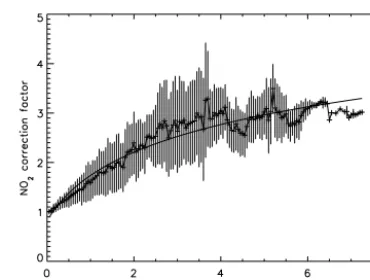
time and with a horizontal resolution of 0.1◦×0.1◦for the entire DABEX period (January 2006). Figure 7 shows the re-lationship between1NO2and the NO2correction factor over
West African fires during DABEX. The correction factor in-creases with1NO2with a “saturation effect” for1NO2>4,
where the NO2correction is almost constant (= 3). Further
in-creasing NOxemissions above this threshold does not change
the shape factor since almost the totality of the NO2column
is already concentrated in the boundary layer. The relation-ship between the NO2 correction factor and1NO2 can be
well approximated by the following logarithmic fit:
NO2correction factor=log(3.41NO2+2.2) . (5)
The above formula can be applied to real retrievals by re-placing the pseudo slant columns SltA in Eq. (4) by the
re-trieved NO2 slant column, and assuming the pseudo slant
column SltBis a good approximation of what would be the
retrieved slant column without the fire source. The standard deviations of the NO2correction in Fig. 7 can be interpreted
as the errors associated with the logarithmic fit approxima-tion (Eq. 5). Although large standard deviaapproxima-tions are observed, one sees that they are all significantly smaller than the mean NO2correction itself. Using this measurement-based
correc-tion should therefore reduce NO2retrieval errors over fires.
Although this correction has been derived for retrievals over West African fire sources, it could easily be extended to other regions and sources. In an operational near-real-time
Figure 7. Relationship between the NO2 correction factor and
1NO2. Vertical bars represent the standard deviation of the NO2 correction factor within each1NO2bin. The solid black line repre-sents the logarithmic fit to the curve.
retrieval setting,1NO2 in Eq. (5) can be obtained using a
“clean” NO2 profile to derive SltB (reference “clean” slant
column) and A. For instance, the reference NO2profile can
be taken from a model simulation without NOxemissions.
Note that the availability of the retrieval averaging kernels is necessary in order to apply the proposed methodology.
This measurement-based correction is intended to reduce uncertainties related to both representativeness errors and misrepresentation of the location and time of NOx
emis-sions in model simulations. Due to the lack of aircraft mea-surements in the boundary layer during DABEX, our ap-proach cannot be rigorously evaluated using in situ-derived NO2 columns. However, a comparison between OMI NO2
retrievals using the GEOS-Chem NO2shape profiles at 2◦×
2.5◦ resolution and the corrected OMI NO2 retrievals
pro-posed here showed an increase in the NO2 columns of up
to 40 % over West African fires (not shown). This is con-sistent with the changes in retrieved NO2columns over
pol-luted areas found in Russell et al. (2011) when using high-resolution NO2profiles. A study using in situ data from
pre-vious aircraft campaigns (e.g., INTEX-A, INTEX-B, PAVE) (see also more recently Oetjen et al., 2013) as well as from ground-based measurements of NO2 columns (Ma et al.,
2013; Rivera et al., 2013; Irie et al., 2012) would allow for a proper evaluation of the robustness of the above formula for different retrieval conditions (biomass burning, urban or remote areas) as well as to better characterize errors.
10 Conclusions
In this study, the sensitivity of the air mass factor (AMF) to biomass burning emissions is analyzed in order to better characterize and understand NO2retrieval uncertainties over
simulation (GEOS-Chem) which uses daily resolved biomass burning emissions (FLAMBE). The simulated aerosol opti-cal properties and NO2profiles were evaluated over
Cana-dian and West African fires using aircraft in situ measure-ments from the ARCTAS-B 2008 and DABEX 2006 cam-paigns, respectively.
In clear-sky conditions (cloud fraction<5 %), the effect of biomass burning emissions on the AMF through the modified NO2shape factor ranges from−60 to 0 % over both boreal
and savanna fires. These values provide an estimate of the AMF errors associated with NO2shape factor uncertainties
due to missing fire sources in the model, but representative-ness errors associated with low-resolution NO2 shape
pro-files can further enhance these errors. The influence of sev-eral retrieval parameters (surface reflectance, clouds, viewing geometry) on the AMF sensitivity to aerosols and shape fac-tors was also analyzed. Both aerosol and shape factor effects are very sensitive to surface reflectance. As an illustration, the aerosol correction can range from−20 to+100 % for dif-ferent surface reflectances, while the shape factor correction varies from −70 to−20 %. Using highly spatially resolved surface reflectance data is therefore critical to mitigate NO2
retrieval errors over biomass burning areas. It was found that the intensity of fire emissions does not significantly impact the effect of aerosol for a given NO2/ aerosols emission
ra-tio. This suggests that emissions-related representativeness errors may be weak when modeling the aerosol effects. It was found that the impact of biomass burning emissions on the AMF is also very sensitive to clouds. The aerosol and shape factor corrections can vary from+20 to+100 % and
−60 to−80 %, respectively, when a cloud fraction of 20 % is added to the scene.
Since the OMI clouds retrieval is sensitive to aerosols, pre-vious studies suggested that the aerosol effect on the AMF was implicitly accounted for through the modified cloud pa-rameters. A previous analysis by Leitão et al. (2010) and results from our sensitivity experiment suggest that when clouds are present above a scattering aerosols layer, explicitly taking aerosol effects into account should improve the AMF calculation. More investigations based on sensitivity experi-ments simulating the effect of aerosols on the cloud retrieval would be necessary to better understand in what cases an ex-plicit aerosol correction would be beneficial to the retrieval.
Finally, a new method has been proposed to reduce NO2
retrieval errors associated with misrepresentations of the NO2 shape profile in the AMF calculation. The approach
is based on the local sensitivity of the slant column to NO2
sources. Using a pseudo-retrieval analysis, a relationship be-tween the AMF shape factor correction and the associated slant column perturbation was established. Although this measurement-based correction has been derived over West African fires, it could be extended to any type of NOxsource.
In practice it requires only the retrieval averaging kernels in-formation as well as a “clean” NO2reference profile, which
can be obtained from a model simulation. Future studies us-ing in situ-derived NO2 columns over urban and biomass
N. Bousserez: Retrieval of NO2over biomass burning regions 3441
Appendix A: GEOS-Chem simulations
GEOS-Chem is a global 3-D chemical transport model driven by assimilated meteorological observations from the Goddard Earth Observing System (GEOS) of the NASA Global Modeling and Assimilation Office (GMAO) (www. geos-chem.org; Bey et al., 2001). We use the GEOS-5 me-teorological data regridded to 2◦ latitude×2.5◦ longitude, with 47 vertical layers. For both the DABEX and ARCTAS-B period we use the NRT-ARCTAS GEOS-Chem simu-lation, which was originally developed in support of the ARCTAS mission and is based on GEOS-Chem v8-01-01 with minor modifications (Mao et al., 2010). The simula-tion includes ozone-NOx-HOx-VOC-aerosol chemistry as described in Park et al. (2005).
A daily biomass burning emission inventory at 1◦×1◦ resolution obtained from Fire Locating and Monitoring of Burning Emissions (FLAMBE) (Reid et al., 2009) is used to capture the high spatial and temporal variability of fire emissions. The FLAMBE product is constrained by Geo-stationary Operational Environmental Satellite (GOES) and
Moderate Resolution Imaging Spectrometer (MODIS) fires count data and provides daily global smoke and carbon emis-sions. Emissions for black carbon and organic carbon species in GEOS-Chem are obtained by applying emission factors to the FLAMBE smoke emissions, while emissions for other species, including NOx, are derived by applying emission
factors to the FLAMBE carbon emissions. Emission factors are those proposed by Andreae and Merlet (2001). Further in-formation about the biomass burning emissions in the model can be found in Fisher et al. (2010).
Dust aerosol concentrations can be significant over West Africa due to transport from the Sahara. The mineral dust module in GEOS-Chem simulates the mobilization of dust from the earth’s surface, gravitational settling, and wet and dry deposition as described in Fairlie et al. (2007).
For our ARCTAS simulation, a 70 % decrease of carbon emissions and a 60 % decrease of smoke emissions in the FLAMBE inventory, as well as the use of an extra-tropical forest fires NOx emission factor of 0.42 g NO (kg DM)−1
Acknowledgements. This work was supported by the Canadian
Foundation for Climate and Atmospheric Sciences. Nicolas Bousserez would also like to acknowledge support from NASA grant NNX09AN77G.
Edited by: H. Worden
References
Acarreta, J., De Haan, J., and Stammes, P.: Cloud pressure retrieval using the O2-O2absorption band at 477 nm, J. Geophys. Res.-Atmos., 109, D05204, doi:10.1029/2003JD003915, 2004. Alvarado, M. J., Logan, J. A., Mao, J., Apel, E., Riemer, D., Blake,
D., Cohen, R. C., Min, K.-E., Perring, A. E., Browne, E. C., Wooldridge, P. J., Diskin, G. S., Sachse, G. W., Fuelberg, H., Sessions, W. R., Harrigan, D. L., Huey, G., Liao, J., Case-Hanks, A., Jimenez, J. L., Cubison, M. J., Vay, S. A., Weinheimer, A. J., Knapp, D. J., Montzka, D. D., Flocke, F. M., Pollack, I. B., Wennberg, P. O., Kurten, A., Crounse, J., Clair, J. M. St., Wisthaler, A., Mikoviny, T., Yantosca, R. M., Carouge, C. C., and Le Sager, P.: Nitrogen oxides and PAN in plumes from boreal fires during ARCTAS-B and their impact on ozone: an integrated analysis of aircraft and satellite observations, Atmos. Chem. Phys., 10, 9739–9760, doi:10.5194/acp-10-9739-2010, 2010. Anderson, B. E., Grant, W. B., Gregory, G. L., Browell, E.
V., Collins Jr., J. E., Sachse, G. W., Bagwell, D. R., Hud-gins, C. H., Blake, D. R., and Blake, N. J.: Aerosols from biomass burning over the tropical South Atlantic region: Dis-tributions and impacts, J. Geophys. Res., 101, 24117–24137, doi:10.1029/96JD00717, 1996.
Anderson, T. L. and Ogren, J. A.: Determining aerosol radiative properties using the TSI 3563 integrating nephelometer, Aerosol Sci. Technol., 29, 57–69, 1998.
Andreae, M. O. and Merlet, P.: Emission of trace gases and aerosols from biomass burning, Global Biogeochem. Cy., 15, 955–966, 2001.
Bey, I., Jacob, D., Yantosca, R., Logan, J., Field, B., Fiore, A., Li, Q., Liu, H., Mickley, L., and Schultz, M.: Global modeling of tropospheric chemistry with assimilated meteorology: Model de-scription and evaluation, J. Geophys. Res.-Atmos., 106, 23073– 23095, doi:10.1029/2001JD000807, 2001.
Boersma, K. F., Eskes, H., and Brinksma, E.: Error analysis for tro-pospheric NO2retrieval from space, J. Geophys. Res.-Atmos., 109, D04311, doi:10.1029/2003JD003962, 2004.
Boersma, K. F., Eskes, H. J., Dirksen, R. J., van der A, R. J., Veefkind, J. P., Stammes, P., Huijnen, V., Kleipool, Q. L., Sneep, M., Claas, J., Leitão, J., Richter, A., Zhou, Y., and Brunner, D.: An improved tropospheric NO2column retrieval algorithm for the Ozone Monitoring Instrument, Atmos. Meas. Tech., 4, 1905– 1928, doi:10.5194/amt-4-1905-2011, 2011.
Bucsela, E. J., Perring, A. E., Cohen, R. C., Boersma, K. F., Celarier, E. A., Gleason, J. F., Wenig, M. O., Bertram, T. H., Wooldridge, P. J., Dirksen, R., and Veefkind, J. P.: Comparison of tropospheric NO2from in situ aircraft measurements with near-real-time and standard product data from OMI, J. Geophys. Res., 113, D16S31, doi:10.1029/2007JD008838, 2008.
Bucsela, E. J., Krotkov, N. A., Celarier, E. A., Lamsal, L. N., Swartz, W. H., Bhartia, P. K., Boersma, K. F., Veefkind, J. P., Gleason, J. F., and Pickering, K. E.: A new stratospheric and
tropospheric NO2retrieval algorithm for nadir-viewing satellite instruments: applications to OMI, Atmos. Meas. Tech., 6, 2607– 2626, doi:10.5194/amt-6-2607-2013, 2013.
Capes, G., Johnson, B., McFiggans, G., Williams, P. I., Haywood, J., and Coe, H.: Aging of biomass burning aerosols over West Africa: Aircraft measurements of chemical composition, mi-crophysical properties, and emission ratios, J. Geophys. Res.-Atmos., 113, D00C15, doi:10.1029/2008JD009845, 2008. Chen, D., Zhou, B., Beirle, S., Chen, L. M., and Wagner, T.:
Tropospheric NO2 column densities deduced from zenith-sky DOAS measurements in Shanghai, China, and their applica-tion to satellite validaapplica-tion, Atmos. Chem. Phys., 9, 3641–3662, doi:10.5194/acp-9-3641-2009, 2009.
Cleary, P. A., Wooldridge, P. J., and Cohen, R. C.: Laser-induced fluorescence detection of atmospheric NO2with a commercial diode laser and a supersonic expansion, Applied Optics, 41, 6950–6956, 2002.
Corr, C. A., Hall, S. R., Ullmann, K., Anderson, B. E., Beyers-dorf, A. J., Thornhill, K. L., Cubison, M. J., Jimenez, J. L., Wisthaler, A., and Dibb, J. E.: Spectral absorption of biomass burning aerosol determined from retrieved single scattering albedo during ARCTAS, Atmos. Chem. Phys., 12, 10505–10518, doi:10.5194/acp-12-10505-2012, 2012.
Dubovik, O., Holben, B., Eck, T., Smirnov, A., Kaufman, Y., King, M., Tanre, D., and Slutsker, I.: Variability of absorption and op-tical properties of key aerosol types observed in worldwide loca-tions, J. Atmos. Sci., 59, 590–608, 2002.
Eskes, H. J. and Boersma, K. F.: Averaging kernels for DOAS total-column satellite retrievals, Atmos. Chem. Phys., 3, 1285–1291, doi:10.5194/acp-3-1285-2003, 2003.
Fairlie, T. D., Jacob, D. J., and Park, R. J.: The impact of transpacific transport of mineral dust in the United States, Atmos. Environ., 41, 1251–1266, doi:10.1016/j.atmosenv.2006.09.048, 2007. Fisher, J. A., Jacob, D. J., Purdy, M. T., Kopacz, M., Le Sager, P.,
Carouge, C., Holmes, C. D., Yantosca, R. M., Batchelor, R. L., Strong, K., Diskin, G. S., Fuelberg, H. E., Holloway, J. S., Hyer, E. J., McMillan, W. W., Warner, J., Streets, D. G., Zhang, Q., Wang, Y., and Wu, S.: Source attribution and interannual vari-ability of Arctic pollution in spring constrained by aircraft (ARC-TAS, ARCPAC) and satellite (AIRS) observations of carbon monoxide, Atmos. Chem. Phys., 10, 977–996, doi:10.5194/acp-10-977-2010, 2010.
Fu, T.-M., Jacob, D. J., Palmer, P. I., Chance, K., Wang, Y. X., Barletta, B., Blake, D. R., Stanton, J. C., and Pilling, M. J.: Space-based formaldehyde measurements as constraints on volatile organic compound emissions in east and south Asia and implications for ozone, J. Geophys. Res., 112, D06312, doi:10.1029/2006JD007853, 2007
Gogoi, M. M., Suresh Babu, S., Krishna Moorthy, K., Manoj, M. R., and Jai Prakash Chaubey: Absorption characteristics of aerosols over the northwestern region of India: Distinct seasonal signa-tures of biomass burning aerosols and mineral dust, Atmos. En-viron., 73, 92–102, 2013.
N. Bousserez: Retrieval of NO2over biomass burning regions 3443
INTEX-B validation campaigns, J. Geophys. Res.-Atmos., 115, D05301, doi:10.1029/2009JD012399, 2010.
Haywood, J. M., Osborne, S. R., Francis, P. N., Keil, A., Formenti, P., Andreae, M. O., and Kaye, P. H.: The mean physical and op-tical properties of regional haze dominated by biomass burning aerosol measured from the C-130 aircraft during SAFARI 2000, J. Geophys. Res., 108, 8473, doi:10.1029/2002JD002226, 2003. Haywood, J. M., Pelon, J., Formenti, P., Bharmal, N., Brooks, M., Capes, G., Chazette, P., Chou, C., Christopher, S., Coe, H., Cuesta, J., Derimian, Y., Desboeufs, K., Greed, G., Harrison, M., Heese, B., Highwood, E. J., Johnson, B., Mallet, M., Mar-ticorena, B., Marsham, J., Milton, S., Myhre, G., Osborne, S. R., Parker, D. J., Rajot, J., Schulz, M., Slingo, A., Tanre, D., and Tulet, P.: Overview of the Dust and Biomass-burning Ex-periment and African Monsoon Multidisciplinary Analysis Spe-cial Observing Period-0, J. Geophys. Res.-Atmos., 113, D00C17, doi:10.1029/2008JD010077, 2008.
Heckel, A., Kim, S.-W., Frost, G. J., Richter, A., Trainer, M., and Burrows, J. P.: Influence of low spatial resolution a priori data on tropospheric NO2satellite retrievals, Atmos. Meas. Tech., 4, 1805–1820, doi:10.5194/amt-4-1805-2011, 2011.
Herron-Thorpe, F. L., Lamb, B. K., Mount, G. H., and Vaughan, J. K.: Evaluation of a regional air quality forecast model for tropospheric NO2 columns using the OMI/Aura satellite tro-pospheric NO2 product, Atmos. Chem. Phys., 10, 8839–8854, doi:10.5194/acp-10-8839-2010, 2010.
Irie, H., Boersma, K. F., Kanaya, Y., Takashima, H., Pan, X., and Wang, Z. F.: Quantitative bias estimates for tropospheric NO2 columns retrieved from SCIAMACHY, OMI, and GOME-2 us-ing a common standard for East Asia, Atmos. Meas. Tech., 5, 2403–2411, doi:10.5194/amt-5-2403-2012, 2012.
IPCC (Intergovernmental Panel on Climate Change): Couplings be-tween changes in the climate system and biogeochemistry, in: Climate Change 2007: The Physical Science Basis. Contribution of Working Group I to the Fourth Assessment Report of the In-tergovernmental Panel on Climate Change, edited by: Solomon, S., Qin, D., Manning, M., Chen, Z., Marquis, M., Averyt, K. B., Tignor, M., and Miller, H. L., 499–587, Cambridge Univ. Press, Cambridge, New York, 2007.
Jacob, D. J., Crawford, J. H., Maring, H., Clarke, A. D., Dibb, J. E., Emmons, L. K., Ferrare, R. A., Hostetler, C. A., Russell, P. B., Singh, H. B., Thompson, A. M., Shaw, G. E., McCauley, E., Ped-erson, J. R., and Fisher, J. A.: The Arctic Research of the Compo-sition of the Troposphere from Aircraft and Satellites (ARCTAS) mission: design, execution, and first results, Atmos. Chem. Phys., 10, 5191–5212, doi:10.5194/acp-10-5191-2010, 2010.
Johnson, B. T., Heese, B., McFarlane, S. A., Chazette, P., Jones, A., and Bellouin, N.: Vertical distribution and radiative ef-fects of mineral dust and biomass burning aerosol over West Africa during DABEX, J. Geophys. Res.-Atmos., 113, D00C12, doi:10.1029/2008JD009848, 2008a.
Johnson, B. T., Osborne, S. R., Haywood, J. M., and Harrison, M. A. J.: Aircraft measurements of biomass burning aerosol over West Africa during DABEX, J. Geophys. Res.-Atmos., 113, D00C06, doi:10.1029/2007JD009451, 2008b.
Jury, M. R. and Winter, A.: Warming of an elevated layer over the Caribbean, Climatic Change, 99, 247–259, doi:10.1007/s10584-009-9658-3, 2010.
Kleipool, Q. L., Dobber, M. R., de Haan, J. F., and Lev-elt, P. F.: Earth surface reflectance climatology from 3 years of OMI data, J. Geophys. Res.-Atmos., 113, D18308, doi:10.1029/2008JD010290, 2008.
Lamsal, L. N., Martin, R. V., van Donkelaar, A., Steinbacher, M., Celarier, E. A., Bucsela, E., Dunlea, E. J., and Pinto, J.: Ground-level nitrogen dioxide concentrations inferred from the satellite-borne Ozone Monitoring Instrument, J. Geophys. Res., 113, D16308, doi:10.1029/2007JD009235, 2008.
Lamsal, L. N., Martin, R. V., Padmanabhan, A., van Donke-laar, A., Zhang, Q., Sioris, C. E., Chance, K., Kurosu, T. P., and Newchurch, M. J.: Application of satellite ob-servations for timely updates to global anthropogenic NOx emission inventories, Geophys. Res. Lett., 38, L05810, doi:10.1029/2010GL046476, 2011.
Leitão, J., Richter, A., Vrekoussis, M., Kokhanovsky, A., Zhang, Q. J., Beekmann, M., and Burrows, J. P.: On the improvement of NO2satellite retrievals – aerosol impact on the airmass factors, Atmos. Meas. Tech., 3, 475–493, doi:10.5194/amt-3-475-2010, 2010.
Logan, J. A.: Nitrogen oxides in the troposphere: Global and regional budgets, J. Geophys. Res., 88, 10785–10807, doi:10.1029/JC088iC15p10785, 1983
Ma, J. Z., Beirle, S., Jin, J. L., Shaiganfar, R., Yan, P., and Wagner, T.: Tropospheric NO2vertical column densities over Beijing: re-sults of the first three years of ground-based MAX-DOAS mea-surements (2008–2011) and satellite validation, Atmos. Chem. Phys., 13, 1547–1567, doi:10.5194/acp-13-1547-2013, 2013. Mao, J., Jacob, D. J., Evans, M. J., Olson, J. R., Ren, X., Brune, W.
H., Clair, J. M. St., Crounse, J. D., Spencer, K. M., Beaver, M. R., Wennberg, P. O., Cubison, M. J., Jimenez, J. L., Fried, A., Weibring, P., Walega, J. G., Hall, S. R., Weinheimer, A. J., Co-hen, R. C., CCo-hen, G., Crawford, J. H., McNaughton, C., Clarke, A. D., Jaeglé, L., Fisher, J. A., Yantosca, R. M., Le Sager, P., and Carouge, C.: Chemistry of hydrogen oxide radicals (HOx) in the Arctic troposphere in spring, Atmos. Chem. Phys., 10, 5823-5838, doi:10.5194/acp-10-5823-2010, 2010.
Martin, R., Chance, K., Jacob, D., Kurosu, T., Spurr, R., Bucsela, E., Gleason, J., Palmer, P., Bey, I., Fiore, A., Li, Q., Yantosca, R., and Koelemeijer, R.: An improved retrieval of tropospheric nitro-gen dioxide from GOME, J. Geophys. Res.-Atmos., 107, 4437, doi:10.1029/2001JD001027, 2002.
Martin, R., Jacob, D., Chance, K., Kurosu, T., Palmer, P., and Evans, M.: Global inventory of nitrogen oxide emissions constrained by space-based observations of NO2columns, J. Geophys. Res.-Atmos., 108, 4537, doi:10.1029/2003JD003453, 2003.
Mebust, A. K. and Cohen, R. C.: Observations of a seasonal cycle in NOxemissions from fires in African woody savannas, Geophys. Res. Lett., 40, 1451–1455, doi:10.1002/grl.50343, 2013. Mebust, A. K., Russell, A. R., Hudman, R. C., Valin, L. C., and
Cohen, R. C.: Characterization of wildfire NOxemissions us-ing MODIS fire radiative power and OMI tropospheric NO2 columns, Atmos. Chem. Phys., 11, 5839–5851, doi:10.5194/acp-11-5839-2011, 2011.
Moteki, N. and Kondo, Y.: Method to measure time-dependent scat-tering cross sections of particles evaporating in a laser beam, J. Aerosol Sci., 39, 348–364, 2008.
Moteki, N., Kondo, Y., Miyazaki, Y., Takegawa, N., Komazaki, Y., Kurata, G., Shirai, T., Blake, D. R., Miyakawa, T., and Koike, M.: Evolution of mixing state of black carbon particles: Aircraft measurements over the western Pacific in March 2004, Geophys. Res. Lett., 34, L11803, doi:10.1029/2006GL028943, 2007. Oetjen, H., Baidar, S., Krotkov, N. A., Lamsal, L. N.,
Lech-ner, M., and Volkamer, R.: Airborne MAX-DOAS measure-ments over California: Testing the NASA OMI tropospheric NO2 product, J. Geophys. Res.-Atmos., 118, 7400–7413, doi:10.1002/jgrd.50550, 2013.
Osborne, S. R., Johnson, B. T., Haywood, J. M., Baran, A. J., Harrison, M. A. J., and McConnell, C. L.: Physical and optical properties of mineral dust aerosol during the Dust and Biomass-burning Experiment, J. Geophys. Res.-Atmos., 113, D00C03, doi:10.1029/2007JD009551, 2008.
Palmer, P., Jacob, D., Chance, K., Martin, R., Spurr, R., Kurosu, T., Bey, I., Yantosca, R., Fiore, A., and Li, Q.: Air mass fac-tor formulation for spectroscopic measurements from satellites: Application to formaldehyde retrievals from the Global Ozone Monitoring Experiment, J. Geophys. Res.-Atmos., 106, 14539– 14550, doi:10.1029/2000JD900772, 2001.
Park, R., Jacob, D., Palmer, P., Clarke, A., Weber, R., Zondlo, M., Eisele, F., Bandy, A., Thornton, D., Sachse, G., and Bond, T.: Export efficiency of black carbon aerosol in continental outflow: Global implications, J. Geophys. Res.-Atmos., 110, D11205, doi:10.1029/2004JD005432, 2005.
Parrington, M., Palmer, P. I., Lewis, A. C., Lee, J. D., Rickard, A. R., Di Carlo, P., Taylor, J. W., Hopkins, J. R., Punjabi, S., Oram, D. E., Forster, G., Aruffo, E., Moller, S. J., Bauguitte, S. J.-B., Allan, J. D., Coe, H., and Leigh, R. J.: Ozone photochemistry in boreal biomass burning plumes, Atmos. Chem. Phys., 13, 7321– 7341, doi:10.5194/acp-13-7321-2013, 2013.
Redelsperger, J., Thorncroft, C. D., Diedhiou, A., Lebel, T., Parker, D. J., and Polcher, J.: African monsoon multidisciplinary anal-ysis – An international research project and field campaign, B. Am. Meteorol. Soc., 87, 1739–1746, doi:10.1175/BAMS-87-12-1739, 2006.
Reid, J. S., Eck, T. F., Christopher, S. A., Koppmann, R., Dubovik, O., Eleuterio, D. P., Holben, B. N., Reid, E. A., and Zhang, J.: A review of biomass burning emissions part III: intensive optical properties of biomass burning particles, Atmos. Chem. Phys., 5, 827–849, doi:10.5194/acp-5-827-2005, 2005.
Reid, J. S., Hyer, E. J., Prins, E. M., Westphal, D. L., Zhang, J., Wang, J., Christopher, S. A., Curtis, C. A., Schmidt, C. C., Eleu-terio, D. P., Richardson, K. A., and Hoffman, J. P.: Global Moni-toring and Forecasting of Biomass-Burning Smoke: Description of and Lessons From the Fire Locating and Modeling of Burn-ing Emissions (FLAMBE) Program, IEEE J. Sel. Top. Appl., 2, 144–162, doi:10.1109/JSTARS.2009.2027443, 2009.
Richter, A. and Burrows, J.: Tropospheric NO2 from GOME measurements, Remote Sensing of Trace Constituents in the Lower Stratosphere, Troposphere and the Earth’s Surface: Global Observations, Air Poll. Atmos. Correct., 29, 1673–1683, doi:10.1016/S0273-1177(02)00100-X, 2002.
Rivera, C., Stremme, W., and Grutter, M.: Nitrogen dioxide DOAS measurements from ground and space: comparison of zenith scattered sunlight ground-based measurements and OMI data in Central Mexico, Atmosfera 26, 401–414, 2013.
Russell, A. R., Perring, A. E., Valin, L. C., Bucsela, E. J., Browne, E. C., Wooldridge, P. J., and Cohen, R. C.: A high spa-tial resolution retrieval of NO2 column densities from OMI: method and evaluation, Atmos. Chem. Phys., 11, 8543–8554, doi:10.5194/acp-11-8543-2011, 2011.
Singh, H. B., Anderson, B. E., Brune, W. H., Cai, C., Cohen, R. C., Crawford, J. H., Cubison, M. J., Czech, E. P., Emmons, L., Fuel-berg, H. E., Huey, G., Jacob, D. J., Jimenez, J. L., Kaduwela, A., Kondo, Y., Mao, J., Olson, J. R., Sachse, G. W., Vay, S. A., Weinheimer, A., Wennberg, P. O., Wisthaler, A., and ARC-TAS Sci Team: Pollution influences on atmospheric composi-tion and chemistry at high northern latitudes: Boreal and Cal-ifornia forest fire emissions, Atmos. Environ., 44, 4553–4564, doi:10.1016/j.atmosenv.2010.08.026, 2010.
Spurr, R.: Simultaneous derivation of intensities and weighting functions in a general pseudo-spherical discrete ordinate radia-tive transfer treatment, J. Quant. Spectrosc. Ra., 75, 129–175, doi:10.1016/S0022-4073(01)00245-X, 2002.
Spurr, R., Kurosu, T., and Chance, K.: A linearized discrete ordinate radiative transfer model for atmospheric remote-sensing retrieval, J. Quant. Spectrosc. Ra., 68, 689–735, doi:10.1016/S0022-4073(00)00055-8, 2001.
Wiedinmyer, C., Tie, X., Guenther, A., Neilson, R., and Granier, C.: Future changes in biogenic isoprene emissions: how might they affect regional and global atmospheric chemistry?, Earth Inter-act., 10, 1–19, 2006.
Zhou, Y., Brunner, D., Boersma, K. F., Dirksen, R., and Wang, P.: An improved tropospheric NO2retrieval for OMI observations in the vicinity of mountainous terrain, Atmos. Meas. Tech., 2, 401–416, doi:10.5194/amt-2-401-2009, 2009.