RESEARCH ARTICLE
EXPERIMENTAL STUDY AND EFFECTS OF THE DRYING KINETICS OF STABILIZED EARTH BRICKS
BASED ON SUGAR CANE MOLASSES
1,*
Narcisse Malanda,
1Gildas Ngouono-Ngakali,
1Gilbert Ganga,
2Raymond Gentil Elenga,
1
Venceslas Nzingoula and
1,2Paul Louzolo-Kimbembe
1
National Higher Polytechnic School
2HigherTeacher Training School
3
Faculty of Science and Technology, Marien Ngouabi University, BP 69, Brazzaville, Congo
ARTICLE INFO
ABSTRACT
This work is devoted to the experimental study and effects of the drying kinetics of stabilized earth bricks based on sugar cane molasses. Drying experiments were carried out in the laboratory under different temperature conditions, with briquettes with molasses percentages varying from 0%, 5%, 10% and 20%. Experimental curves of reduced mass losses as a function of time and fixed temperatures are studied in order to determine drying kinetics and linear shrinkage problems. These drying kinetics curves are approximated by four other mathematical models (Avrami, Khazaei, Peleg) and the diffusion model. The statistical analysis of the results of this modelling led to the conclusion that the Khazaei model best approaches the experimental curves. Similarly, for molasses rates ranging from 15 to 20%, drying shrinkage increases, as a result of the supposed chemical reactions, and occurs between molasses and clay, in view of its mineralogical composition. In short, we note that briquettes stabilized at 20% molasses and dried at 150°C have several microcracks, thus causing a problem of early damage to them. Thus, sustained attention should be paid to stabilizing the bricks at 10% molasses.
Copyright © 2019,Narcisse Malanda et al. This is an open access article distributed under the Creative Commons Attribution License, which permits unrestricted use, distribution, and reproduction in any medium, provided the original work is properly cited.
INTRODUCTION
Since ancient times, earthen housing has always been the most rational means of providing access to decent housing that can affect all segments of society. Easily available, the earth material is processed according to different technologies according to its physicochemical characteristics. However, many earthen buildings, particularly those built with raw earth materials, without any prior treatment, are subject to sustainability problems, especially in tropical climate zones where rainfall is very regular. However, with the housing deficit observed in developing countries (DCs) and particularly in Africa, the solution can be found in the soil material (UN-Habitat, 2008). Savings can therefore be made to also take into account the problems of high poverty in these countries, by making choices of new building materials whose thermal behaviour, for example, is acceptable or tolerable (Meukam, 2004). In Congo, according to preconceived ideas, it appears that brick lands have commendable geotechnical performance (Elenga et al., 2018).
*Corresponding author: Narcisse Malanda,
National Higher Polytechnic School.
But, unlike concrete, earth material is used in civil construction for the manufacture of bricks used as building envelopes, and then for the construction of embankments under concrete paving or for the various layers of road pavements for road works, provided that it has the desired technical performance. (Myriam, 1994). In this study, we are interested in stabilized land bricks. Certainly, the earth material has many advantages; ecological, thermal and even economic. This stabilization can be done mechanically, physically, chemically or thermally... Of course, whatever the means used for this stabilization operation, the brick must absolutely be dried at room temperature or in the oven in order to better optimize its efficiency and exploitation. However, drying in the case of our study consists in completely eliminating the water contained in the brick considered wet from the point of view of its hydration. Thus, in the context of this work, the technical performance of bricks stabilized with molasses depends essentially on the variables characterizing the drying kinetics, such as reduced mass, shrinkage, temperature, air humidity, water absorption capacity, drying speed, etc., all this, by limiting any loss of quality of the said material and thus the bricks manufactured (Keita, 2014; Ngoulou, 2019).
ISSN: 0976-3376
Vol. 10, Issue, 10, pp.10380-10391, October,Asian Journal of Science and Technology 2019SCIENCE AND TECHNOLOGY
Article History:
Received 15th July, 2019
Received in revised form 09th August, 2019
Accepted 17th September, 2019
Published online 30st October, 2019
Key words:
Stabilized Earth Brick, Sugar Cane molasses, Temperature, Reduced Mass,
Drying Kinetics, Shrinkage, Time, Modeling.
Citation: Narcisse Malanda, Gildas Ngouono-Ngakali, Gilbert Ganga, Raymond Gentil Elenga, Venceslas Nzingoula and Paul Louzolo-Kimbembe. 2019.
“Experimental study and effects of the drying kinetics of stabilized earth bricks based on sugar cane molasses”, Asian Journal of Science and Technology, 10, (10),
10380-10391.
Key words:
Stabilized Earth Brick, Sugar Cane molasses, Temperature, Reduced Mass,
However, given the complexity of mass and heat transfer mechanisms, knowledge of the basic data, in this case kinetic curves, is necessary. Indeed, the work of Malanda et al (2017) has shown the interest of using molasses considered as a sugar cane residue to stabilize clay bricks in order to increase their mechanical resistance (Malanda et al., 2017). However, the complexity of the physical phenomena involved in the drying process of the said bricks has not been studied, hence the use of this experiment. This means that the issue of hydration and drying remains at the heart of this study. Here, the first objective is to reproduce the evolution of the reduced mass loss of a sample of stabilized earth bricks as a function of time and in relation to the set temperature. Thus, the variation in the kinetics of mass loss corresponds to the evolution of the water flow at the surface, which is at the origin of the temperature evolution.
Then, the second is the effect that this kinetics produces as a function of temperature variation. Similarly, the increase in temperature with little influence on hydration kinetics but it promotes the rapid evaporation of water from the surface, and if the phenomenon is not controlled, this can lead to early damage to the bricks. However, during the drying phase, the evacuation of the shaping water inevitably introduces a variation in the dimensions of the parts (shrinkage). So, if this shrinkage is not homogeneous throughout the mass of the part, it results in deformations or even cracks that can substantially exceed a certain threshold, making the products (bricks) unsuitable or non-conforming for its use (Itaya, 2018; Aregbaet al., 1990). In this work, drying is a decisive factor in the manufacture of these stabilized earth bricks, given the associated economic and energy expenditure and even, from a technical point of view, the negative impact on the final properties of the material (cracks, heterogeneity of resistances, residual moisture, etc.) that this can have (Wyss, 2005). In sub-Saharan Africa, energy consumption in buildings is in the order of 50 to 70%. However, the prediction of a building's energy performance is linked to the final properties of the materials used (Fezzioui, 2012).
For this reason, it is therefore important to set up a predictive model of this type of drying experiment. Thus, several theories and models have been developed to account for drying kinetics and to understand the physical laws that control transfers. These theories include the drying characteristic curve and empirical or numerical models (Mariem, 2017). Philip and De Vries (1957) are among the first authors to describe water transfers in porous media and especially in soils (Philip, 1957). They described moisture transfers in liquid and vapour form by highlighting diffusion phenomena generalizing the Darcy's law or Fick's law, from the point of view of macroscopic modelling. They highlighted a diffusion coefficient (non-linear or non-linear) in the analysis of the phenomena. Thus, for the liquid phase, the transport coefficient is related to permeability and the capillary pressure curve. For the gas phase, they consider a purely diffusive movement of water vapour from the gradient of its density (Keita, 2014; Ngoulou et al., 2019; Samri, 2008; Nguyen, 2018). Similarly, Moyne (1982) is one of the first to take into account the Darcean movement of the gas mixture, which consists of dry air and water vapour (Moyne, 1982; Moyne, 1991). However, several researchers have proposed models for representing the results of drying kinetics in different experiments.
These results make it possible to draw the drying characteristic curves and linear shrinkages generated by thermo mechanical phenomena. Thus, the main objective of our work is twofold: on the one hand, it is to valorize local materials, in this case clay, and on the other hand, to determine the characteristic drying curves of molasses-stabilized bricks and the shrinkage curves in order to highlight, not only the optimization of the drying of the said bricks but also the impacts of drying the material subjected to different drying phases and different temperatures. Such a study is essential for understanding the thermo mechanical phenomena of the said bricks during the drying phases in order to better exploit them and limit the risks of cracking or linear shrinkage of the said bricks.
MATERIALS AND METHODS
Study area: It is located in the city of Nkayi, in the
department of Bouenza, in southwestern Congo-Brazzaville, about 250 km from the capital.Its location is: 4°9'56" S longitude and 13°17'34" - E latitude.
Climate: Studies by researchers Samba and Nganga (2011)
have shown that long climate data series subdivide Congo-Brazzaville into two climate types: equatorial climate in the north and humid tropical climate in the south. The area of Nkayi city belongs to the humid tropical climate. This climate is under the predominant influence of low intertropical pressures from October to May and high subtropical southern pressures from June to September. Cloud cover is all the more important and almost permanent as the activity of the inter-tropical convergence zone (ITCZ) is reversed. It directly influences sunstroke and solar radiation. It is also characterized by an alternation of two seasons: a rainy and warm season that extends from November to April with very heavy rainfall and a dry and cool season from June to September during which the water balance is probably in deficit. October and May provide a transition period for the entry and exit of the dry season (Samba et Nganga, 2011; IPCC, 2007).
Materials and equipment used: Two materials were used to
carry out this study: sugar cane molasses from the agro-industrial company Saris Congo and soil material from the city of N'Kayi. Soil samples (clay) were taken at a depth of -30 cm from the natural ground level. This earth material used for the manufacture of all series of specimens (stabilized bricks) is identical to that used in the study on mechanical resistances of the same bricks. This material used is clay (fine soils of class A1) according to the GTR classification (Guide de Terrassement Routier) (Malanda et al, 2017; Standards NF P94-056, 1996 and NF P94-07, 1992), (figures 1, 2, 3, 4 and 5). In the literature, there are some data on the composition of sugar cane molasses (Table 1). Its density is about 1390 kg/m3 (Malanda et al, 2017; Seid et al, 2016).
Origin Pro 8 software for modelling: In this composition, we
Figure 1. Preparation of soil samples (7)
Figure 2. Sugar cane molasses storagedrum (SARIS Congo) (7)
Figure 3. Memmertoven (001/GM/P/15 oven)
Figure 4. Precision balance brand KERN 440-47
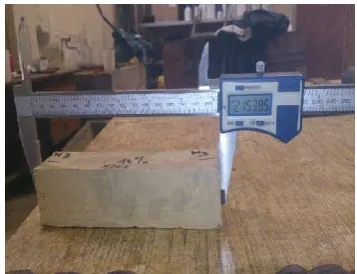
Figure 5. STAINLESS HARBENED brand calliper
Table 1. Chemical composition of sugar cane molasses (Malanda et al., 2017; Seid, 2016)
Components of the system Quantity
Dry matter% 73
Mineralmaterials (%MS) 14
Total nitrogenousmaterials (%MS) 6
Total sugars (%MS) 64
Calcium (g/KgMS) 7.4
Phosphore (g/KgMS) 0.7
Potassium (g/KgMS) 40
Figure 6. The Mortar Mixer
Figure 7. Briquettes onmoulds
Method of making stabilized earth bricks and drying: After
This addition of water facilitates the dilution of molasses in water beforehand in order to make the soil mixture more molasses much more homogeneous, this in relation to its densification. Also, this operation is facilitated by the fact that molasses is soluble in water. The homogeneity of the mixture is decisive for the quality of the briquette. The dynamic compaction of the sample for the realization of the specimens is done manually and then on a standardized impact table in two layers and 60 strokes per layer. Once the demoulding is done, the last step of the manufacture of our briquettes and drying comes. The bricks were made by compaction with the mould used to make the bricks at percentages varying from 5%, 10%, 15% and 20% molasses, and previously mixed with the mortar mixer for 5 to 10 minutes. The briquettes are 16*4*4*4 cm3 in size, manufactured in groups of three in the moulds (Figure 6 and 7). The drying experiment was carried out isothermally in the oven with different drying temperatures: 100°C ; 120°C ; 150°C (figures 6 and 7). The drying is preceded by three (03) days of curing to avoid a rapid departure of water that would cause early shrinkage cracks.
Drying kinetics: The drying study was carried out using
measurements of the variation of the reduced mass of briquettes over time. To this end, measurements were taken every eight (08) hours on the briquettes. When monitoring the drying process, we obtain a first curve giving the mass as a function of time. M = f(t). In order to be able to compare the samples with each other, the mass percentage of loss is used:
%losses =∆ × 100 = ( )× 100 (1)
WithM0: initial mass of the sample (in g) and M(t) : mass of
the sample at t time (in g).
Withdrawal measure:During drying, there is a contraction of
dimensions (length, width and height) and mass due to evaporation of water and reduction of some pores. The shrinkage was measured every eight (08) hours during the drying of the briquettes using the caliper. Let D0 be a
dimension of the briquette before drying and Dt the dimension
after a drying time t. The linear shrinkage of drying at time t is given by the relationship:
, (mm/m) (2)
Mathematical modelling (Chen, 1989): In order to
investigate the mathematical application that can best simulate the experimental curves of drying kinetics, four models (Avrami, Peleg, Khazaei and the Diffusion model) were used; the aim is to understand the behaviour of the parameters that characterize water transfer problems based on a statistical analysis of the modelling results. The modeling of the drying kinetics allows its optimization and the complementing of experimental data that are difficult to measure, and allows to observe the impact of modifications of the operating parameters (duration, temperature) without the need for new experiments. It has multiple interests in the characterization of physical quantities derived from models leading to the simulation of experimental curves.
The coefficients of the different models were adjusted with Origin Pro 8 software. On the other hand, the mass variation over time curve (drying kinetics curve) is determined from the reduced mass. It is given by the following formula:
Mr =( )
( ) (3)
With:
m : Initial mass of the sample ;
m : Mass of the sample at the end of drying;
m : Mass of the sample at a drying time;
(m − m ) : Mass of water to be evaporated at a drying
t time.
(m − m ) : Mass of water to be evaporated (Nebhani,
2007).
Avrami model or model (KJMA)
The mathematical expression of this model is as follows:
M = exp (−kt )
(4)
Where the constant n is an integer or half integer whose value depends on the nucleation mode of the new phase. The coefficient k depends on the germination mode. This model is used to simulate some phase transformation problems (Nebhani, 2007; Avrami, 1940).
Peleg Model: This Peleg model has as its mathematical
expression:
M = 1 −
(5)
Where is a parameter that represents the inverse of the drying rate, given by the formula:
a = − à = 0, (Taallah; 2014; Peleg, 19887).
Khazaei Model: This model of Khazaei has for mathematical
expression:
M = (1 − a) + a. exp − − bt (6)
Where a is a parameter that represents the inverse of the drying rate and is approximately given by the formula
1 − (t) . kis a time parameter, it represents the time after which 63.2% water of the material is evaporated and b the drying rate close to equilibrium (Taallah, 2014; Khazaei, 2017).
Diffusion Model: This diffusion model has as its
mathematical expression:
M = a. exp(−kt) + (1 − a)exp (−bkt), (29; 30)
Where k is a parameter proportional to the diffusion coefficient (Table 2). The modeling starts with the initialization of the parameters of each model. This initialization is done by an approximate calculation of the parameters according to the equation of the model used. The parameters of different models are then adjusted using Origin Pro 8 software. If the initialized parameters are far from the software adjustment parameters, the modelled curve deviates from the experimental curve and vice versa. t is considered as the time step. The different models are compared according to their determination coefficient (r²), the chi-square statistical parameter (x²) and the Akaike Information Criterion (AIC).The determination coefficient is a measure of the quality of the prediction of a linear regression.
It is defined by: =∑ ( )
∑ ( ) (8)
Where n is the number of measurements, yi the value of the
measurement , the corresponding predicted value and the average of the measurements. The reduced chi-square statistical parameters (x²) is used to improve the smoothing accuracy. It is defined
by: =∑ ( , ,) (9)
With: - ,: is the ith experimental equilibrium water
content;
- , : The ith equilibrium water content
predicted by each model;
-- : is the number of experimental points and df is the degree of freedom of regression of the model such that =
− where refers to the number of constants of each model.
The Akaike Information Criterion (AIC) is defined by:
= −2 log( ) + 2 (10)
where L is the maximized likelihood and k is the number of parameters in the model. In fact, a model better simulates a drying kinetics curve when its determination coefficient (r²) is close to the unit (1), its chi-square (x²) is very close to zero (0) and its AIC very low.
RESULTS AND DISCUSSION
Interpretation and analysis
Drying kinetics
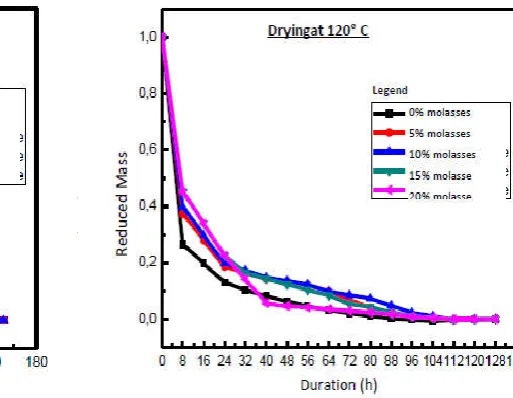
The following figures show this evolution of the reduced mass at different drying temperatures of 100°, 120° and 150°C in the oven (figures 8, 9 and 10).These curves make it possible to define the times at the end of which the briquettes will be dry according to the drying conditions. The curves corresponding to the drying of the briquettes show a time division into three stages during which the kinetics of the phenomenon varies. After the 3-day cure at room temperature, the drying process follows with the use of the oven where the drying speed is quite high because the water content of the briquettes is still high during this period.
The second stage lasts about eight to 16 hours. This step corresponds to a significant water loss in the briquettes, with a very high evaporation rate. This is due to the change in drying conditions as the briquettes are being studied. Another step is to slow down the drying speed. Because, as the surface water of the briquettes is evaporated, it then comes from the core of the briquettes and takes longer to reach the surface. The third step corresponds to the drying period at a constant rate and the last one to a state of hydric equilibrium of the briquettes. The drying of the samples can be considered complete after 104 hours at 150°C, 112 hours at 120°C and 144 hours at 100°C, after which the briquettes are considered dry. The results show that the loss of mass is high when the drying temperature increases. This loss of relative mass is inversely proportional to the molasses content.
Linear drying shrinkage: The water required to mould the
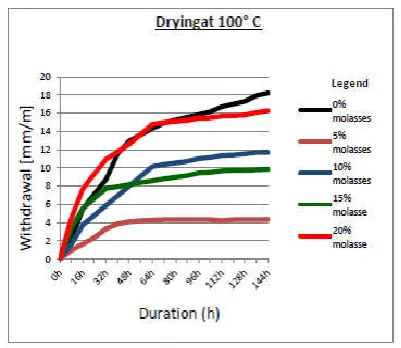
briquettes causes a shrinkage by desiccation during the drying of the material. Evaporation of water causes suction between soil particles and causes linear and volumetric shrinkage of the soil material. The following figures show the evolution of shrinkage as a function of time for oven drying at 100°C, 120°C, 150°C (figures 11, 12 and 13). From these figures, we can see that the rate of shrinkage is much higher during the first 48 hours of drying. It also shows that the addition of molasses at 10% reduces the linear drying shrinkage while at more than 15%, the linear drying shrinkage increases. Shrinkage is observed when the briquettes are dry. For briquettes with 20% molasses, the specimens dried at 150°C showed several microcracks. Drying induces by differential deformation of drying shrinkage between the core and the surface of the briquette a microcrack on the surface. The increase in shrinkage in briquettes stabilized with 15 and 20% molasses is a definite consequence of the chemical transformations that occur inside these briquettes. However, since the chemical components of molasses do not control all the contours of the reaction of the chemical components of molasses with those of the soil, the details of this phenomenon are not taken into account in this book. There is therefore an optimal amount of molasses beyond which there is an increase in shrinkage. Figures 14, 15 and 16 show the evolution of shrinkage as a function of time for oven drying at 120°C. From these figures, it appears that the addition of molasses increases the linear drying shrinkage. Linear shrinkage is higher for briquettes stabilized with 20% molasses. At this temperature. However, none of the bricks studied showed cracks. The shrinkages observed when the briquettes are dry are: At 100°C, shrinkage is greater for unstabilized briquettes depending on width and height. Depending on the length, briquettes stabilized at more than 15% have a higher shrinkage. The shrinkage observed when the briquettes are dry. The kinetics of the drying shrinkage is related to that of the water flow and depends on the drying conditions. It is possible to link the increase in drying shrinkage to the loss of mass of the briquettes. Due to planning constraints, drying campaigns at low temperatures could not be carried out (Figures 17, 18 and 19).
Analysis of experimental curves and numerical models: In
Fig. 8. Evolution of the reduced mass of bricks dried at 100°C according to the molasses content
Fig. 9 :Evolution of the reduced mass of bricks dried at 120°C according to the molasses content
Figure. 10. Evolution of the reduced mass of the dried bricks at 150°C according to the molasses conten
Figure 11: Linear shrinkage according to the length of the briquettes as a function of time (150°C)
Figure 12 : Linear shrinkage according to the width of the briquettes as a function of time (150°C)
Figure 14. Linear shrinkage according to the length of the briquettes as a function of time (120°C)
Figure 15. Linear shrinkage according to the width of the briquettes as a function of time (120°C)
Figure 16. Linear shrinkage according to the height of the briquettes as a function of time (120°C)
Figure 17. Linear shrinkage according to the length of the briquettes as a function of time (100°C)
Figure 18. Linear shrinkage according to the width of the briquettes as a function of time (100°C)
Dryingat 100°C
Figure 20. Modeling the reduced mass of unstabilized bricks dried at 100°C.
Figure 21. Modeling the reduced mass of stabilized bricks with 5% molasses dried at 100°C.
Figure 22. Modeling of the reduced mass of stabilized bricks with 10% molasses dried at 100°C.
Figure 23. Modeling of the reduced mass of stabilized bricks with 15% molasses dried at 100°C.
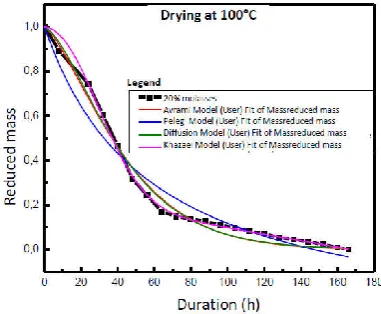
Figure 24. Modeling the reduced mass of stabilized bricks with 20% molasses dried at 100°C
Dryingat 120°C
Figure 25. Modeling of the reduced mass of unstabilized bricks dried at 120°C
Figure 27. Modeling of the reduced mass of stabilized bricks with 10% molasses dried at 120°C.
Figure 28. Modeling of the reduced mass of stabilized bricks with 15% molasses dried at 120°C.
Figure 29. Modeling of the reduced mass of stabilized bricks with 20% molasses dried at 120°C.
Dryingat 150°C
Figure 30. Modeling of the reduced mass of unstabilized bricks dried at 150°C.
Figure 31. Modeling of the reduced mass of stabilized bricks with 5% molasses dried at 150°C.
Figure 32. Modeling of the reduced mass of stabilized bricks with 20% molasses dried at 150°C.
Figure 34. Modeling of the reduced mass of stabilized bricks with 15% molasses dried at 150°C
The mathematical model with the highest value of R² and a low chi-square (X²) best approximates the drying curves.
For drying at 100°C (figures 20, 21, 22, 22, 23 and 24), the Khazaei model approaches the drying curves at 0% molasses. However, at 5% molasses, these are the Avrami and Khazaei models. At 10%, 15% and 20% molasses, these are the Khazaei and Avrami models respectively.
For drying at 120°C (figures 25, 26, 27, 27, 28 and 29), the Khazaei model is for the percentages of 0%, 5%, 10% and 15%. The Diffusion model is close to 20% molasses.
For drying at 150°C (Figures 30, 31, 32, 32, 33 and 34), except for the approximation to 0% molasses for the diffusion model, the Khazaei model better simulates the drying curves at 5%, 10%, 15% and 20%. All in all, the Khazaei model is the one that can be used as a benchmark in the simulation and analysis of the thermo mechanical behaviour of stabilized bricks based on sugar cane molasses (Annex 1, Annex 2).
DISCUSSION
Several experimental studies have been carried out in the drying of solid-liquid materials. Numerical models were also used to simulate the master curves of drying kinetics, thus characterizing the thermo mechanical parameters of the materials (Keita, 2014; Itaya, 2018; Aregba, 1990; Wyss, 2005; Philip, 1957; Samri, 2008; Nguyen, 2018; Moyne, 1982; Moyne, 1991; Chen, 1989; Nebhani, 2007; Taallah, 2014; Elenga et al., 2011; Elenga et al., 2013). These various studies not only laid the foundations for the drying kinetics of solid-liquid materials, but also made it possible to highlight different transfer methods corresponding to different research projects. These models are sometimes associated with Darcy's or Fick's laws, depending on the case (Chen, 1989). This study, on the drying kinetics of molasses-based stabilized earth bricks, integrates this diffusion water transfer process. In this regard, Aregba et al (1990) showed that under certain conditions (preponderance of the diffusive flow of steam over the convective flow, negligible effect of gravity on the transport of liquid water), a Fick type law can be applied to describe drying kinetics. This formalism requires an apparent diffusion coefficient that depends on the water content in order to take into account all transport phenomena (Ngoulou
et al., 2019; Aregba, 1990; Samri, 2008; Chen, 1989; Bazant,
1971).
In other words, water is assumed to migrate under the effect of a gradient in moisture content or concentration. On the other hand, Babbit (1950) suggests that the use of the moisture gradient as a driving force is only valid if it is a random movement characterizing the molecules involved in the diffusion process (Chemkhi, 2008; Babbit, 1950). On the other hand, drying kinetics highlights the existence of liquid water films flowing on the surface of the solid, which promote and contribute significantly to the transport of water during the deceleration phases. In our case, the higher the percentage of molasses in the material, the lower the loss of mass during drying. This is contrary to the results found with cement-stabilized blocks. Indeed, for these cement agglomerates, the faster the water/cement ratio is, the faster the drying kinetics (Baroghel-Bounyet al., 1999). In addition, the results obtained for the drying shrinkage show that above 15% molasses, the effect would be negative on briquettes dried at 150°C.
The shrinkage is in the order of 12 to 22 mm/m. The withdrawal is quite significant for a proportion of 20% of stabilizer. This could cause stress during drying and cause cracks. On the other hand, briquettes stabilized at 10% molasses have shrinkages of less than 8 mm/m. The components of molasses negatively influence shrinkage when they are present in large proportions. And according to Guillaud et al, (1995), the stabilization of most cement-based soils is satisfactory if the cement dosage is between 6 and 12%. This stabilization reduces dimensional variations (less shrinkage during drying and swelling during humidification. On the other hand, the organic matter content of the soil must be less than 2% in order not to slow down the setting of cement. But the effect is the modification of the dry density. The shrinkage cracks found are not foreign to the drying mechanism. The formation of shrinkage cracks is also observed on cement-stabilized bricks when the surface dries out too quickly (Guillaud, 1995). These results are similar to those obtained by Ngoulou et al (2019) in soil stabilization using cassava flour gel and amylopectin. Indeed, for a stabilizer content of 20%, we deduce that the parameter k (time function) of the Khazaei model is in correlation with the drying time (Ngoulou, 2019). In short, the experimental curves presented in reduced masses as a function of molasses and temperature contents are better approximated by Khazaei's mathematical model in view of the statistical results obtained, compared to the Avrami, Peleg and Diffusion models (Nebhani, 2007; Taallah, 2014; Samuel et al., 2017).
Conclusion
Then, several test campaigns were carried out on briquettes stabilized at 5%, 10%, 15% and 20% molasses and on unstabilized briquettes. The drying was done in an oven with temperatures of 100°C, 120°C and 150°C after three days of curing at room temperature. The results obtained on drying generally show that the loss of mass is inversely proportional to the molasses content.
In the dry state, the loss of mass is
At 100°C, by 22.62% for unstabilized briquettes and 20.96%, 20.83%, 18.70% and 16.66% for stabilized briquettes respectively at 5%, 10%, 15% and 20%.
At 120°C, 21.96% for unstabilized briquettes and 21.32%, 20.16%, 20.16%, 19.17% and 17.69% for stabilized briquettes respectively at 5%, 10%, 15% and 20%.
At 150°C, 23.25% for unstabilized briquettes and 24.95%, 22.18%, 21.50% and 20.86% for stabilized briquettes respectively at 5%, 10%, 15% and 20%.
However, the drying study shows that briquettes dry after 144 hours at 100°C, 112 hours at 120°C and 104 hours at 150°C. With regard to drying shrinkage, the results obtained show that up to 10% molasses shrinkage is lower than that observed on unstabilized briquettes. On the other hand, when the molasses rate is increased, i.e. 15% and 20%, the drying shrinkage increases. This increase in shrinkage when at least 15% molasses is added is due to the supposed chemical transformations that occur between molasses, which is very rich in sugar and clay. Also, briquettes stabilized with 20% molasses and dried at 150°C have several microcracks.The Khazaei model that showed the best agreement with the experimental data is correlated with the experimental data. A microstructural study is being considered to better understand the mechanics of internal bonds in the stabilized earth matrix considered as the porous medium.
Availability Declaration: The authors state that all data, models or calculation codes are available according to the articles cited. Malanda (2017). http://publication. lecames.org/. ISSN 2312-8712, Vol.2 (2), pp.1-9, 2017, Ngoulou et al (2019); https://doi.org/10.4236/ gm.2019. 91004, Elenga (2) (2013). https://doi.org/10.19026/ rjaset.6.3776 Origin Pro 8 software see Internet. No data were provided by a third party. These data and calculation codes are also available in the laboratory but are of an exclusive nature and can only be provided with restrictions for intellectual property purposes.
Acknowledgements
The authors would like to thank the staff of the laboratory of the "Bureau de Contrôle des Bâtimentset Travaux Publics (BCBTP)" for their contribution to geotechnical testing, and in particular Mr. KINSAMA Alexis-Matthieu for the computer part of this work.
REFERENCES
Aregba, W., Jomaa, W. et Puiggali, J. R. 1990. Une approche du séchage de matériaux fortement déformable. Revue physique Appliquée 25 (1990). 1161-1175.doi :1051/ephysap : 019900025011011.
Avrami, M. 1940. Kinetics of Phase Change. II Transformation-Time Relations for Random Distribution of Nuclei. The Journal of Chemical Physics, Vol. 8, 212-224 pp. https://doi.org/10.1063/1.1750631
Babbit, J. D. 1950. On the differential equation of diffusion. Can. J. Res. A. 28 :449-474.
Baroghel-Bouny, V., Mainguy, M., Lass-Abaterre, T. and Coussy, O. 1999. Characterisation and identification of equilibrium and transfer moisture properties for ordinary and high identification content mentation materials. Cement and concrete research, n¨29, p. 1225-1238. Bazant, Z. P. and Najjar, L. J. (1971). Drying of concrete as a
non-linear diffusion problem cement and concrete. Research 1971, vol. 1, page 461-473
Chemkhi, S. 2008. Séchage d’un milieu déformable non saturé. Modélisation du couplage hydromécanique. Thèse de Doctorat de l’École Nationale d’Ingénieur de Monastir et université de Bordeaux (2008.
Chen, P. and Pei, D.C.T. (1989). A. Mathematical model of drying processes. Int. J. Heat mass transfer, 32(2) : 297-310.
Crank, J. 1975. The Mathematics of Diffusion. Oxford University Press, Oxford.
Elenga, R. G., Ahouet, L., Kimbatsa-Tseto, F., Kinga-Moundzeo, Goma-Maniongui, J. 2018. Terres à briques du Congo : évaluation des propriétés géotechniques. Annales de l’université Marien Ngouabi, 2018 ; 18(2) : 13-20. Sciences et techniques. ISSN : 1815-4433,www.annales.umng.org
Elenga, R. G., Dirras, G. F., GomaManiongui, J. and Mabiala, B. 2011. Drying of raffia textiles fiber. BioRessources , vol. 6, N°4, 4135-4144 pp.
Elenga, R. G., Massamba, D., Niere, R. R., GomaManiongui, J. and Dirras, G. F. 2013. Convective and microwave dryings of raffia fruit: Modeling and effects on color and hardness. Research Journal of Applied Sciences, Engineering and Technology, Vol. 6, N°15, 2715-2723 pp. https://doi.org/10.19026/rjaset.6.3776
Fezzioui, N., Benyamine, M., TadjDraoui, N., Larbi B. S 2012. Performance énergétique d’une maison à patio dans le contexte maghrébin. Revue des Énergies Renouvelables 15(B) 399-405.
Guillaud, H. et Houben H. 1995. Traité de construction en terre. 2eédition. Marseille, editions Parenthèse.
IPCC Fourth Assessment report: Climate change 2007 (AR4). IPCC, Geneva, Switzerland, 2007.
Itaya, Y. 2018. Strain-stress formation and deformation of molded materials by drying – induced shrinkage. https://doi.org/10.1051/matecconf/20182401011.
Keita, E. 2014. Physique du séchage des sols et des matériaux de construction. Thèse de Doctorat université Paris Est, 2014.
Khazaei, J. and Daneshmandi, S. 2007. Modeling of Thin-Layer Drying Kinetics of Sesame Seeds: Mathematical and Neural Networks Modeling. International Agrophysics , 21, 335-348.
Mariem, B. S. et Mabrouk, S. B. 2017. Cinétique et séchage et courbe caractéristique de séchage d’une couche mince de tomate. 18e journées Internationales de thermique Meukam, P. 2004. Valorisation des briques de terre stabilisée
en vue de l’isolation thermique de bâtiment. Thèse de doctorat 3 cycle, université de Cergy – Pointoise de l’université de Yaoundé 1, 2004
Moyne, C. et Martin, M. 1982. Étude expérimentale du transfert simultané de chaleur et de masse au cours du séchage par contact sous vide d’un bois résineux. Int. J. Heat Mass Transfer, 25(12) : 1839-1848.
Moyne, C. et Perre, P. 1991. Processes related to drying. Part 1. Theoretical model. DryingTecnol., 9(5) : 1135-1152. Myriam, D. 1994. Le matériau terre : compactage,
comportement, application aux structures en bloc de terre. Thèse de Doctorat n° 94-ISAL-0004. Institut National des Sciences Appliquées.
Nebhani, M. 2007. Application d’un modèle de transfert de masse et de chaleur au séchage à haute température. Détermination expérimentale des paramètres du modèle et sa validation. Thèse de Doctorat, université aval, Québec. (Disponible). En ligne sur https://corpus.ulaval.ca/... NF P94-056 1996. Soil: Investigation and Testing—
Granulometric Analysis—Dry Sieving Method Washing. Association Francaise de Normalisation (AFNOR). http://www.afnor.fr
NF P94-057 1992. Analyse granulometrique des sols. Methode par sedimentation. Association Francaise de Normalisation (AFNOR). http://www.afnor.fr
Ngoulou, M., Elenga, R. G., Ahouet, L., Bouyila, S., Konda, S. 2019. Modeling the drying kinetics of earth bricks stabilized with Cassava flour gel and Amylopectin. Geomaterials, Vol. 9, 40-53 pp. https://doi.org/10.4236/gm.2019.91004.
Nguyen, H. T. 2018. Transfert hydrique dans le milieu poreux réactif. Application à l’étude du séchage d’une pâte pure ettringitique au jeune âge. Thèse d Doctorat de Lyon – INSA Lyon. (Disponible). En ligne sur http://www.researchgate.net/profile/nguyen-hai-trung2/… Peleg, M. 1988. An Empirical Model for Description of
Moisture Sorption Curves. Journal of Food Science, 53, 1216-1217. https://doi.org/10.1111/j.1365-2621.1988. tb13565.x
Philip, J., and De Vries, D. 1957. Moisure movement in porous materials under temperature gradiants. Eos, Transaction American Geophysical Union, 38 (2), 222-232.
Samba, G., and Nganga, D. 2011. "Rainfall variability in Congo-Brazzaville 1932-2007" Int. T. Climatol. Published online in Wiley, 2011.
Samri, D. 2008. Analyse physique et caractérisation hydro thermique des matériaux de construction : approche expérimentale et modélisation numérique. Thèse de Doctorat Institut National des Sciences Appliquées de Lyon. N° d’ordre 2008-ISAL-0067.
Samuel, D. G. L., Nageuda, D. K. and Maiya, M. P. 2017. Thermal comfort in traditional buildings composed of local and modern construction materials. International Journal of Sustainable Built Environment, 6, p. 463-475.Delgado M. C. J., Guerrero I.C. (2007). The selection of soils for unstabilised earth building. A. normative review. Construction and building materials, 2, p. 237-257.
Seid, M. A., Tchobo, F. P., Ayessou, N. C., Maoudou-Mbaye, T., Ndoutania, G., Akisse, N. et Dossou, J. 2016. Évaluation de la qualité physicochimique des résidus du complexe agro-industriel de Bauda/SAR (Tchad). Laryss Journal. ISSN 1112-3680, n°25, Mars 2016, pp. 203-218. Taallah, B. 2014. Étude du comportement physico-mécanique
du bloc de terre comprimée avec fibres. Thèse de doctorat. Université Mohamed Khider-Biskra.
UN-Habitat 2008. The state of African cities : a framework for addressing urban challenges in Africa. United Nations Human Settlements programme.
Wyss, U. 2005. la construction en matériaux locaux, état d’un secteur à potentiel multiple. Direction du Développement et de la Coopération. Ouagadougou, Burkina Faso, décembre, 2005