World Maritime University
The Maritime Commons: Digital Repository of the World
Maritime University
World Maritime University Dissertations
Dissertations
2016
The effects of the implementation of the Kenya
National Electronic Single Window System on
trade facilitation /
Mwanaulu Issa Mwajita
World Maritime UniversityFollow this and additional works at:
http://commons.wmu.se/all_dissertations
This Dissertation is brought to you courtesy of Maritime Commons. Open Access items may be downloaded for non-commercial, fair use academic purposes. No items may be hosted on another server or web site without express written permission from the World Maritime University. For more information, please [email protected].
Recommended Citation
Mwajita, Mwanaulu Issa, "The effects of the implementation of the Kenya National Electronic Single Window System on trade facilitation /" (2016).World Maritime University Dissertations. 515.
WORLD MARITIME UNIVERSITY
Malmö, Sweden
THE EFFECTS OF THE IMPLEMENTATION OF
THE KENYA NATIONAL ELECTRONIC SINGLE
WINDOW SYSTEM ON TRADE FACILITATION
By
MWANAULU ISSA MWAJITA
Kenya
A dissertation proposal submitted to the World Maritime University in partial
Fulfilment of the requirements for the award of the degree of
MASTER OF SCIENCE
In
MARITIME AFFAIRS
(SHIPPING MANAGEMENT AND LOGISTICS)
2016
ii
DECLARATION
I certify that all the material in this dissertation that is not my own work has been
identified, and that no material is included for which a degree has previously been
conferred on me.
The contents of this dissertation reflect my own personal views, and are not necessarily
endorsed by the University.
(Signature):
(Date)....19 Sep 2016
Supervised by: Dr Devinder Grewal
World Maritime University
Assessor: *
Institution/organization:
Co-assessor: *
iii
ACKNOWLEDGEMENT
This study is a product of the joint effort by World Maritime University’s (WMU)
Shipping Management & Logistics, and Port Management Department headed by
Professor Daniel Moon. I therefore extend my deep gratitude to all the WMU professors
for their expert guidance and support through the completion of this study. My sincere
gratitude goes to my supervisor, Dr Devinder Grewal for his expert guidance and
tremendous support in guiding me though this paper.
The pursuance of the Master’s program would not have been a possibility for me
without the support of my sponsor the TK Foundation who provided my full sponsorship
to pursue the WMU degree. My sincere appreciation also goes to my employer
KenTrade for providing me the support to pursue my studies away from the office. At this
juncture, I also extend my deep appreciation to Mr. Amos Wangora, KenTrade, and Mrs.
Edah Ngwatu, Kenya Ports Authority for their priceless input in opening the doors that
motivated me to apply for WMU’s master’s programme. I would also like to thank my family and friends for their unwavering support, love, encouragement and patience
throughout my studies.
Finally, to all those who participated in responding to my research questionnaire,
interviews, and others who gave their support namely; WMU’s Librarians Chris Hoebeke
and Anna Volkova for their invaluable support in acquiring and accessing research
materials, Erik Ponnert for his invaluable help with ICT research tools; WMU’s Henrik
Smith Residence’s staff Ursula Hoebeke and Kylie Campbell Lundqvist for ensuring that the residence is a conducive environment throughout my stay in Malmo, I say a very
iv
ABSTRACT
Title of Dissertation:
The Effects of the Implementation of the Kenya National
Electronic Single Window System on Trade Facilitation
Degree: MSc
This research analyses the impact in Kenya of the use of the Kenya National Electronic Single Window System by trade stakeholders. The study investigates the role that the establishment of the Single Window System (SWS) plays in improving the efficiency of the cargo clearance process. It also analyses the benefits and challenges that the trade stakeholders have experienced from the onset of the SWS roll-out.
This research highlights relevant issues related to trade facilitation and presents an overview on the SWS as one of the tools for trade facilitation. A review of the background of trade facilitation and the relevant international regulatory frameworks on the trade facilitation agreements is presented. A brief discussion on the types and models of SWS is presented along with their characteristics, benefits, challenges from all stakeholder perspectives.
The principal objective of the study is to identify and evaluate the underlying issues in the implementation of SWS. The study therefore focuses on the Critical Success Factors (CSF) for the implementation of SWS, the importance of concrete policy and regulatory frameworks backing the SWS operations and the effects of the implementation of SWS on stakeholder business processes and operations. The successful establishment of SWS is highly dependent on the alignment of business and ICT strategy with policy and regulatory frameworks in place relating to international trade and customs. The policy frameworks will determine the technical operations of the SWS and financial model needed to sustain the operating agency.
Keywords: Single Window System, Trade Facilitation, Business Process
v
TABLE OF CONTENTS
DECLARATION ... ii
ACKNOWLEDGEMENT ... iii
ABSTRACT ... iv
TABLE OF CONTENTS ... v
LIST OF TABLES ... viii
LIST OF FIGURES ... ix
LIST OF ABBREVIATIONS ... x
CHAPTER ONE ... 1
INTRODUCTION ... 1
1.1 Background ... 1
1.2 Research Objectives ... 2
1.3 Research Questions ... 2
1.4 Justification of the study ... 3
1.5 Kenya’s Strategic Location in the East Africa transport corridor ... 3
1.6 Scope of Research ... 4
1.7 Methodology ... 5
CHAPTER TWO ... 6
LITERATURE REVIEW AND IMPLEMENTATION PROCESS ... 6
Introduction ... 6
2.1 Trade facilitation ... 6
2.2 The Single Window Concept ... 10
2.3 Important Features of Single Window Systems ... 16
2.4 Benefits of Single Window Systems ... 18
2.5 International Single Window Implementations ... 20
vi
2.7 Steps in the Planning and Implementation of a Single Window System ... 23
2.8 Critical Factors in the Establishment of a Successful Single Window System ... 26
CHAPTER THREE ... 31
BACKGROUND OF THE KENYA SWS ... 31
Introduction ... 31
3.1 Implementation of the Single Window Concept in Kenya ... 36
3.2 Timeline of Kenya SWS Implementation ... 41
3.3 Using the Project Management Approach to manage the SWS Implementation 46 3.4 Identified Project Risks for the SWS Implementation ... 52
3.5 Single Window KPIs ... 53
3.6 Evolution of the Kenya Single Window System ... 55
3.7 Kenya’s International Legislative and Regulatory Policy Framework in relation to the Single Window System ... 58
CHAPTER FOUR ... 61
RESEARCH METHODOLOGY ... 61
Introduction ... 61
4.2 Research Design ... 61
4.3 Research Ethics ... 62
4.4 Research Limitations ... 62
4.5 Participant Selection ... 62
4.6 Use of Surveys ... 64
4.7 Access to Data ... 64
4.8 Sampling Frame and sampling technique... 64
4.9 Pilot testing ... 65
4.10 Research Instruments ... 66
4.11 Data collection Procedure- Questionnaire ... 67
vii
CHAPTER FIVE ... 68
DISCUSSION OF RESEARCH FINDINGS ... 68
Introduction ... 68
5.1 Questionnaire Findings ... 68
5.2 Demographic Data ... 68
5.3 Analysis of Questionnaire responses per question for each category ... 72
CHAPTER SIX ... 96
CONCLUSIONS AND RECOMMENDATIONS ... 96
Introduction ... 96
6.1 Observed Challenges on the Policy Framework for the KNESWS Operations .. 98
6.2 Research Limitations and Opportunities for Future Research ... 100
REFERENCES ... 101
viii
LIST OF TABLES
Table 1: Trade Facilitation Indicators and their corresponding TFA articles ... 9
Table 2: Countries with SWS implementations ... 21
Table 3: Maritime trade and logistics stakeholders in Kenya ... 41
Table 4: Key documents required for maritime trade clearance in Kenya... 43
Table 5: Summary of KNESWS module implementation status ... 44
Table 6 : Proposed Roles and Responsibilities of Kenya SWS Project Team ... 51
Table 7: Identified Quick Wins for the Phase I KNESWS Implementation ... 54
Table 8: Kenya National Single Window System Supporting Initiatives ... 55
Table 9: Kenya’s ratification status of international treaties and bilateral agreements related to maritime trade ... 60
Table 10: Sample size for KNESWS stakeholders’ survey ... 65
Table 11: Summary of respondents’ views per category for Question 1 ... 74
Table 12 : Summary of respondents’ views per category for NO responses for Question 2 ... 78
Table 13: Summary of positive respondent views on elimination of data duplication by the SWS ... 81
Table 14: Summary of contrasting respondent views on elimination of data duplication by the SWS ... 83
Table 15: Summary of views on if the SWS has resulted in improved business processes for its stakeholders ... 85
Table 16: Summary of divergent views on if the SWS has resulted in improved business processes for its stakeholders ... 86
Table 17: Summary of views on benefits experienced from SWS implementation ... 87
Table 18: Summary of views on benefits experienced per stakeholder from SWS implementation... 88
Table 19: Summary of views on sufficiency of change management initiative for SWS .. 90
Table 20: Summary of views from respondents on change management ... 92
Table 21: Summary of divergent views on linkage of the Kenya SWS to regional trade and logistics ... 94
ix
LIST OF FIGURES
Figure 1: Kenya's Strategic Location in the EAC trade network with road linkages to
hinterland ... 4
Figure 2 : Stakeholders in Trade Facilitation as defined by the World Customs Organization ... 10
Figure 3 : The main principles of a full-function SWS for trade processing ... 11
Figure 4: Trade documentation operations before and after SWS Implementation ... 12
Figure 5: Single Authority SWS ... 13
Figure 6: Single automated integrated SWS ... 14
Figure 7: Single automated information transaction SWS ... 15
Figure 8: Summary of the Benefits of SWS from Government and Traders Perspectives ... 20
Figure 9: Approvals and Goods release: Where the Single Window sits ... 23
Figure 10: Single Window Life Cycle ... 26
Figure 11: Interdependency of CSFs for SWS ... 30
Figure 12: Results of a Time Release Study on cargo dwell time at Kenya borders ... 33
Figure 13: Comparative ranking in Logistics Performance Survey 2015 vs. 2014 for EAC countries ... 34
Figure 14: Cost, Time and Documents Required for Import and Export ... 35
Figure 15: Comparison of Import and Export time for countries with and without SWS .. 36
Figure 16: A graphical representation of the Kenya National Electronic SWS operation 40 Figure 17: Sequence of activities using a Project Management Approach ... 47
Figure 18: Project Management Activities ... 48
Figure 19: Diagrammatic representation of Core Alignment of SWIF Principles ... 54
Figure 20: Evolution of Single Window Systems ... 57
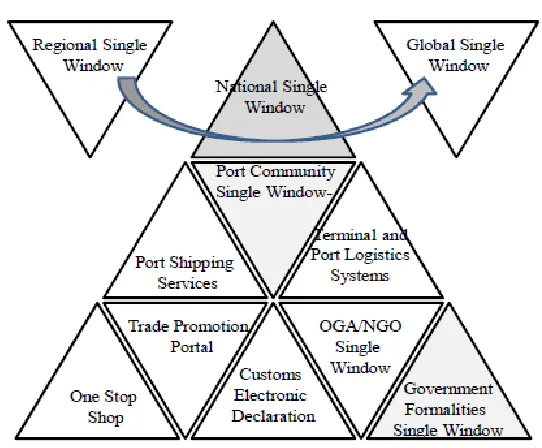
Figure 21: Conceptual overview of a national single window ecosystem ... 58
Figure 22: Overview of the key KNESWS stakeholders ... 63
Figure 23: Demographic representation of SWS stakeholder respondents ... 69
Figure 24: Need for implementing the Kenya SWS ... 73
Figure 25: Graphical representation of stakeholder views on whether the Kenya SWS has simplified the process of lodging pre-clearance trade documents. ... 77
Figure 26: Has the SWS has eliminated of data duplication ... 80
Figure 27: Has the SWS improved business processes for its stakeholders ... 84
Figure 28: Sufficiency of change management initiative for SWS ... 89
Figure 29: Impact of the SWS on regional trade and logistics ... 93
Figure 30: Enabling Legal Environment for SWS ... 99
x
LIST OF ABBREVIATIONS
CBS Community Based System
CSF Critical Success Factors
CTG Council for Trade in Goods
COMESA Common Market for East and Southern Africa
EAC East African Community
ECE Economic Commission for Europe
ESCWA United Nations Economic and Social Commission for Western Asia
GATT General Agreement on Tariffs and Trade
KESWS Kenya (National) Electronic Single Window System
KRA Kenya Revenue Authority
KPA Kenya Ports Authority
NGTF Negotiating Group on Trade Facilitation
OECD Organisation for Economic Co-operation and Development
PCBS Port Community Based System
SLA Service Level Agreements
SOP Standard Operating Procedures
SPS Sanitary and Phyto-sanitary (WTO/WHO)
SWS Single Window System
SQL Structured Query language
SWIF Single Window Implementation Framework
TA Technical assistance
TFA Trade Facilitation Agreement
TEU Twenty foot Equivalent Unit
TOR Terms of Reference
UNCTAD United Nations Commission on Trade and Development
xi
UN/CEFACT United Nations Centre for Administration Commerce and Transport
UN/EDIFACT United Nations EDI for Administration Commerce and Transport
UNCITRAL United Nations Commission on International Trade Law
UNCTAD United Nations Conference on Trade and Development
UNDP United Nations Development Programme
UNeDocs United Nations electronic documents
UNESCAP United Nations Economic and Social Commission for Asia and Pacific
UNLK United Nations Layout Key
UNTDED United Nations Trade Data Elements Directory
WCO World Customs Organization
WEF World Economic Forum
WHO World Health Organization
WTC World Trade Centre
WTO World Trade Organization
1
CHAPTER ONE
INTRODUCTION
This research analyses the implementation of the Kenya National Electronic Single
Window system and the role it plays as a tool for trade facilitation and its impact in the
regional trade integration via cross border trade.
This chapter covers a brief background of the research objectives, research questions,
and the importance of the strategic location of the port of Mombasa and Kenya as a
backbone for inter-regional maritime trade and logistics linkage.
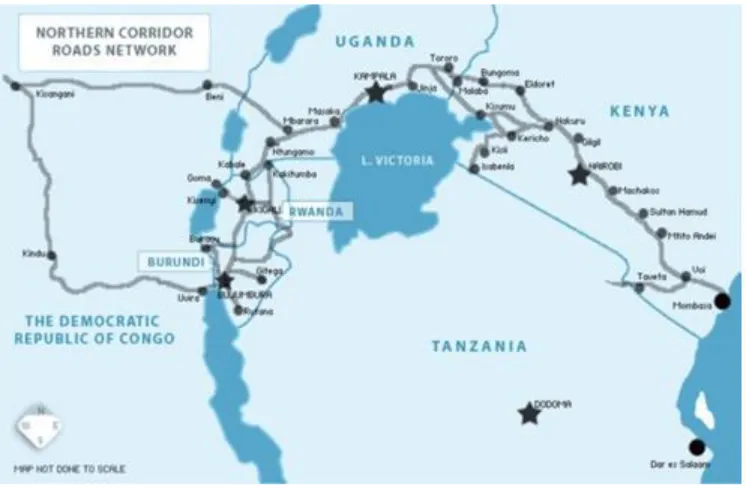
Kenya’s strategic location in East Africa serves a hinterland of Kenya, Uganda,
Rwanda, Eastern Congo, Burundi, South Sudan, Ethiopia and northern Tanzania.
The port of Mombasa is the biggest and busiest port on the east coast of Africa due to
its location midway between the Southern Africa Durban port and other main ports in
the Middle East and Red sea. It has a deep harbor with a multi-purpose comprising
several general cargo berths, container terminal, specialized berths, liquid oil terminals,
a dockyard and ship repair facilities.
1.1 Background
A major challenge identified by stakeholders in the shipping logistics chain in Kenya
was the bilateral procedures and lengthy approval process faced by the importers and
exporters who had to lodge multiple documents both electronically and manually with
multiple government agencies and other private entities involved international trade.
The Kenya National Electronic Single Window System (TradeNet) is an automated
system that is used for registering of pre-clearance documents for the shipping clients.
The TradeNet system is used to facilitate and enable the processing of permits,
exemptions, and import declarations forms and other documents electronically by
shipping, agents, freight forwarders, government agencies, importers, exporters and
2
1.2 Research Objectives
The purpose of the research is to analyze the impact of the implementation and
operationalization of the single window system as a tool for trade facilitation in Kenya.
The study seeks to explore the factors that contributed to the successful
implementation of the SWS and the effect of its operations to the import and export
documentation process for the trade stakeholders in Kenya.
The research will address the following key objectives:
1. Outline the key issues faced in implementation of the SWS and the
expected benefits of the implementation for trade facilitation
2. Provide a review of the challenges of SWS implementation in relation to the
establishment of a policy framework to address contemporary maritime
trade and logistics issues
1.3 Research Questions
In order to address the objectives outlined above, this research paper will focus on
answering the following questions:
1. Has the implementation of a single window system improved efficiency in the
shipping and logistics processesin Kenya?
2. Is trade facilitation a determinant factor in improving the efficiency of the
shipping logistics process in Kenya and the EAC region?
3. What role does change management play in the impact of the SWS
implementation and operationalization process?
4. What are the critical success factors vital to the successful implementation of
3
1.4 Justification of the study
The results from this research will provide useful information to stakeholders in the
trade facilitation and shipping and logistics field to further address challenges and build
up a knowledge base in relation to the implementation of maritime single window
systems in future.
1.5 Kenya’s Strategic Location in the East Africa transport corridor
Kenya is a gateway to East and Central Africa with the port of Mombasa acting as a
major transport hub serving the greater hinterland of the East Africa region’s landlocked economies of Uganda, Rwanda, Burundi, South Sudan and the Eastern
Democratic Republic of Congo.
The Kilindini harbor is a natural deep water port with a length of 7 nautical miles, a
width of 300 m and a maximum depth of 15 m while the inner harbor has a tidal range
of 3.5 m.
The port of Mombasa is the main operational port currently serving the Northern
transport corridor. Its container throughput accounts for about 40% of the total port
throughput while 30% of its throughput is transit cargo which is growing at a rate of
10% annually. In order to prevent over-reliance on the port of Mombasa and to
strengthen her position as a gateway and transport and logistics hub, Kenya embarked
on the construction of the Port of Lamu under the LAPSSET (Lamu Port South Sudan
Ethiopian Transport (LAPSSET) Corridor Project which is underway nearing
completion with a target date of 2018. Once complete, Lamu port will have 32 berths
interlinked with an oil pipeline, refinery, railways, airports and highways. The Lamu Port
with an estimated capacity of 24 million tons of cargo is consequently bound to impact
4
Figure 1: Kenya's Strategic Location in the EAC trade network with road linkages to hinterland
Source: (Kenya Ports Authority, 2013)
1.6 Scope of Research
The dissertation is structured into six main chapters as follows:
Chapter one provides a brief introduction covering the research objectives and
research questions. It also provides a background on the strategic location of Kenya
and the importance of the port of to the Mombasa to the shipping and logistics
stakeholders who use the SWS to lodge trade preclearance documents.
Chapter two covers the literature review whereby the first part introduces and
discusses the single window and trade facilitation concepts. A review of the type of
single windows and models is then described
Chapter three focusses on the case study of the Kenya National Electronic Single
5
This chapter concludes with an overview of the existing policy and regulatory
frameworks that Kenya has in place in relation to the trade facilitation agenda and the
operationalization of the SWS.
Chapter four focuses on the research methodology for the research work giving a
descriptive account of the method of data collection and how the research for the study
was conducted.
Chapter five presents the discussion of the results based on the data analysis from the
questionnaires.
Chapter six is the concluding chapter which outlines the summary of the findings of the
survey. The main outcomes of the research are discussed in relation to the case study
experiences. In this chapter the limitations of the research work are highlighted.
The scope for further research work in this dissertation is also mentioned here.
The dissertation is concluded by providing recommendations to be taken into account
by the governments and stakeholders of SWS in order to further develop the SWS
beyond national use.
1.7 Methodology
In order to achieve the research objectives, explorative research is used to analyze
primary and secondary sources of data on the subject matter of SWS. Sources used
include books, journal articles, sector reports and peer review materials obtained
through the WMU library via electronic and physical sources such as the Maritime
Commons, WTO and UNCTAD portals.
A further analysis of system reports from the Kenya National Electronic Single Window
System was performed as well as various policy instruments including international and
domestic trade agreements and policies.
The main method of a case study approach is used whereby a scrutiny of and project
implementation documents and the online survey results from participants in response
to the shipping and logistics stakeholder experience interacting with the Kenya SWS
6
CHAPTER TWO
LITERATURE REVIEW AND IMPLEMENTATION PROCESS
Introduction
This chapter explores published accounts on the topic of single windows systems. It
critically evaluates the existing research on the topic by thoroughly assessing previous
studies on single window systems and identifies any research gaps. This chapter will
focus on published works reviewing the Single window concept as a tool for trade
facilitation as per the World Trade Organization’s (WTO) Agreement on Trade
Facilitation (ATF).
2.1 Trade facilitation
WTO (2016) notes that there has been a significant increase in globalization and
liberalization of world economies resulting in growing complexity in cross border trade
due to the multiple state agencies involved in transnational logistics.
Due to its strategic location, Kenya has undertaken concerted efforts to upgrade its
infrastructure and technology platforms as well as setting up of policy frameworks to
facilitate cross border and international trade. Through the ratification of the World
Trade Agreement on trade facilitation, Kenya has implemented a number of programs,
one of which is the single window system.
Trade facilitation is concerned with the efficient application of trade rules and
regulations using various measures with an overall objective of reducing trade
transaction costs (TTCs) in cross border trade. Thus it can be conclusively defined as
the set of measures or policies which aim to simplify and harmonize international trade
procedures and practices so as to reduce or eliminate TTCs as well as encouraging
international trade. Trade facilitation measures would seek to streamline processes
and information flow across the relevant regulatory agencies and the international
supply chain using various tools such as the single window system.
In retrospect, the trade facilitation agenda has been at the core of WTO’s mission to
7
and Tariffs (GATT) 1947 which were later adopted into the GATT 1994 as part of WTO
e.g. Articles V, VIII and X that touch on freedom of transit goods, reduced TTCs, and
import and export formalities associated with international trade.
Trade facilitation was first introduced as a discussion topic in 1996 at the inaugural
WTO ministerial conference in Singapore which later formed the groundwork for further
work and forums by other international agencies mainly World Customs Organization
-WCO, The United Nations Conference on Trade and Development (UNCTAD),
International Monetary Fund (IMF) and UNECE at the WTO Trade Facilitation
symposium held in Geneva in March 1998. The WTO secretariat produced a checklist
of the main issues and solutions of the symposium into five broad areas namely:
documentation requirements; official procedures; automation and use of information
technology; transparency, predictability and consistency; and modernization of
border-crossing administration.
Thereafter, the fourth ministerial conference held in Doha, Qatar in 2001which brought
forth the trade facilitation agenda negotiations for CTG to review, clarify and improve
GATT 1994 articles V, VIII and X by identifying the trade facilitation needs and priorities
of members paying particular importance to the least developed countries by ensuring
the provision of technical assistance and capacity building.
The most significant contribution to the Trade Facilitation Agenda can be traced to the
Trade Negotiation Committee (TNC) in 2004 operating under the Negotiating Group on
Trade Facilitation (NGTF) whose work led to the adoption of the WTO’s ATF under the
“Bali” package in December 2013 marking nine years of extensive work and
negotiations whereby most opposition on the ATF provisions and SWS were from
developing countries due to the assumption that this would lead to benefits of trade
liberalization to their disadvantage.
International organizations have actively played a key role in the promotion of the trade
facilitation agenda by the establishment of various subsidiaries that promote the use of
ICT tools such as the SWS. Below are some key international organizations and the
8
1. United Nations Conference on Trade and Development
Trade Point Programme (TPP)
Automated Systems for Customs Data (ASYCUDA) 2. The United Nations Economic Commission for Europe UNECE
The Customs Convention on the International Transport of Goods under Cover of TIR Carnets (TIR Convention) 1975
The United Nations Centre for Trade Facilitation and Electronic Business (UN/CEFACT)
3. World Customs Organisation (WCO)
The International Convention on the Simplification and Harmonization of Customs Procedures (Revised Kyoto Convention)
WCO Framework of the Standards to Secure and Facilitate Global Trade (SAFE Framework)
The Harmonised Commodity Description and Coding System (HS Code)
4. World Trade Organization (WTO)
Agreement on Trade Facilitation (ATF) GATT Article IX (Marks of Origin)
Agreement on Implementation of article VII of GATT 1994 (Customs Valuation Agreement)
Agreement on Technical Barrier to Trade (TBT Agreement)
9
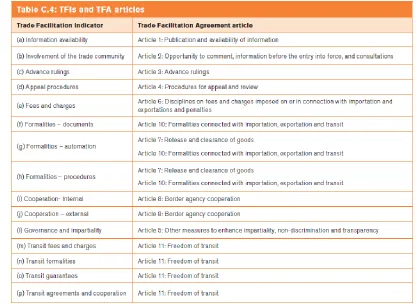
Table 1: Trade Facilitation Indicators and their corresponding TFA articles
10
Figure 2 : Stakeholders in Trade Facilitation as defined by the World Customs Organization
Source (World Trade Report, 2015)
2.2 The Single Window Concept
“SWS are essentially trade facilitation tools whose primary purpose is to simplify and
harmonize processes associated with cross border movement of goods.” (Ndonga, 2015)
UNECE (United Nations Economic Commission for Europe) defines the single window
as specified in UN/CEFACT recommendation number 33 as “a facility that allows parties involved in trade to lodge standardized information and documents with a single
entry point to fulfill all import, export and transit-related regulatory requirements. If
11
As a result of global trade liberalization, collaborative procurement, manufacturing,
assembly and distribution are increasingly handled through outsourcing whereby the
principles of comparative and competitive advantage influence the global supply chain
supply and demand factors. Information flow in order to meet import and export
compliance trade formalities comprising government approvals, customs clearance,
inspections, permit and license approvals are being processed electronically through
integrated ICT-facilitated systems commonly known as the electronic single window
systems (ESCWA, 2011)
Figure 3 : The main principles of a full-function SWS for trade processing
12
Figure 4: Trade documentation operations before and after SWS Implementation
Source (UNCTAD, n.d)
Single window systems may either be stand-alone functional systems or as is being
increasingly witnessed, integrated national or regional single window systems. In
general, SWS may not necessarily conform to a standard build model and can be
designed to meet country- specific border protocols. The UN/ CEFACT
Recommendation 33 broadly classify SWS process chains into three main models:
1. The single authority system
A central agency is tasked with setting up a SWS and coordinating the logistics
chain information by receiving electronic submissions and disseminating them
to other governmental and cross-border authorities. The central authority is
granted the authority to perform selected tasks on behalf of other cross-border
authorities guided by workflows and system integrations. In the case of Kenya,
KenTrade is the government agency in charge of setting up the KNESWS and
transmitting the trade documents to the Kenya Revenue Authority, Kenya Ports
13
countries, for example the case of the Swedish Single Window, Customs
perform selected tasks on behalf of other government bodies.
Figure 5: Single Authority SWS
Source (UN/CEFACT, 2005)
2. Single automated system
A key feature of single automated systems is that they provide an interface for the
collection, storage, use and dissemination of trade-related data (Ndonga, 2015).
An example of this is model is the U.S Custom’s and Border Protection Automated
Commercial System (ACS) where traders submit the data once and it is then
distributed to agencies that require the data. Finally it is transmitted to Automated
Targeting System (ATS) for risk management functions before being reverted back for
storage in the ACS. An inbuilt risk management system in a SW can significantly
reduce the proportion of physical goods inspections resulting in time savings and
14 There are various modes of transmission whereby:
i. Integrated SW system (Data is fully processed through system)
ii. Interfaced SW system (Decentralized whereby data is sent to the
responsible agency for processing)
iii. A combination of i and ii above
Figure 6: Single automated integrated SWS
Source (UN/CEFACT, 2005)
3. Automated information transaction system
These are self-regulating SWs that channel the information directly to the defined
agencies for processing and approvals based on a defined workflow using intelligent
routing agents. Transaction flows are based on a rules engine which determines the
flow of information and resultant approvals are sent back to the user with computed
15
Figure 7: Single automated information transaction SWS
Source (UN/CEFACT, 2005)
Based on the three models above, there are two main types of single window systems
1. Customs-centric SWs
These are SWS that provide a single electronic interface between customs and
operators. Their functions are limited to customs activities such as online
payment of customs duties, electronic declaration and risk assessment.
2. Port-centric SWs
These are SWS which collect and disseminate information in a port
environment. Port centric SWs may take the form of their Port Single Windows
(PSW) and Port Community Systems (PCS).
PSW are basically built to handle Business to Government (B2G) transactions
and handle port traffic information from vessels to a port authority. Examples
are Singapore’s and Finland’s PORTNET which are used by shipping agents
for electronic lodgement of vessel pre-arrival information, cargo declaration,
cargo report, and ship waste notification. This data is then used by the port
16
declarations, maritime administration for traffic monitoring, and traffic control for
coast guards.
PCS perform Business-to Business (B2B) message exchanges by acting as
central hubs of communication whereby user send data on seaborne trade
which are eventually shared to stakeholders through open access or
notifications. Examples of PCS are the U.K. Felixstowe Port Community
System, Indian Port Community System Data Community System (Dakosy) for
the Port of Hamburg, Germany, Portbase for Rotterdam and Netherlands and
PORT-MIS in the port of Busan, Korea.
In Europe, a lot of PCS can be traced back to the 1960s and whose functions
have been remodelled to offer cross- border services as a result of the
unification of trading measures under the European Union Import Control
System that links several EU customs organizations.
In 2010, the EU passed a directive that formed the basis of the creation of a
Maritime Single Window (MSW) in its member states that would allow for the
efficient exchange of ship pre-arrival and declaration information for all EU
ports.
Currently, the MSWs are now at an advanced stage of implementation after the
unification and harmonization of ship formality messages were agreed on by
the Member States.
In conclusion, it is quite clear that the challenge for most countries lies in the
transition of such basic port centric and custom centric single window systems
to comprehensive single window systems that can achieve the objective of
trade facilitation for all stakeholders in the global logistics supply chain.
2.3 Important Features of Single Window Systems
Taking into account all possible definitions and models of the Single Window system,
17 a. Single sign-on
SWS are built to accommodate a single user ID with each user assigned a
unique ID and password. The SWS is built to eliminate the need for users to log
on to different systems but rather use one single sign-on to access all
connected systems of the trading community. It is therefore crucial that ICT
policies relating to access, security, privacy and interoperability are built into the
SWS.
b. Single point of access
SWS must be able to provide users with a platform that uses a single point of
access to other community systems integrating the functions via technology.
c. Single submission of data
The main objective of SWS is to provide centralization of data hence it is
expected that once a user submits data into the SWS it will be made available
for all government agencies and other users that will require the data in the
preceding transactions related to the original submission as per data
authorization policies defined. For instance, a shipping agent inputting arrival
details for a ship should be able to use the details in the preparation of a cargo
manifest and consequently a freight forwarder with a consignment on the
particular manifest should be able to reuse the data to print out a delivery order
or cargo release order without having to duplicate the data. This ideally reduces
typing and transcription errors making the process fast and efficient.
d. A single point of decision making
This typically represents the single sign-on feature that enables the applicant to
apply for different permits, licenses and obtain approval for customs
declarations, obtain information on cargo consignment tracking information
based on cargo release status and estimate the time for arrival of goods so as
18 e. A single point of payment
With the centralization of all government agencies application for permits and
customs declaration into the SWS, the requisite payments by the importers and
exporters are made possible using an integration of the SWS to online banking
facilities via a payment gateway hence making it more convenient and efficient
to make payments virtually more transparent ultimately reducing corruption
instances.
Most SWS start out with the basic functionalities and have some of the above features
progressively built into the system to meet the needs of the stakeholders.
2.4 Benefits of Single Window Systems
There have been a number of benefits of single window systems that have been
documented in academic publications with jurisdictions that have established SWS
registering an increase in revenue collection as a result of reduced TTCs and
improvements in cross-border efficiencies. The benefits of SWs can be considered
from the views of logistics stakeholders participating in the logistics supply comprising
of:
a) Government agencies involved in international trade
b) Port, logistics and transport operators
c) Traders involved in international trade (importers , exporters, custom brokers,
shipping agents, freight forwarders)
Further benefits accrued from SWS, are discussed from the following perspectives:
1. Benefits to Policy makers
SWS provide an automated tool for trade facilitation by fostering regional
collaboration, integration and exchange of regional trade information. (ESCWA,
2011)
19
By centralizing the information collection and dissemination, SWS provide a
more efficient and productive use of human resources.
There is a noted increase in collection of fees, duties and penalties when SWS
are built with payment gateways to collect the requisite fees and duties for
trade.
SWS also provide an automated, comprehensive, streamlined portal for
compliance with government legislative, regulatory requirements and
international treaties.
SWS also enhanced controls for risk analysis and enhanced transparency and
accountability.
3. Benefits to the traders
The SWS implementation is expected to translate to faster goods clearance
procedures which are more predictable as a result of exception handling and
dispute resolution mechanisms ultimately reducing inventory costs.
Through increased centralization of information, there will be reduced clerical
efforts leading to cost reductions and shorter time taken to lodge trade
documents.
As a result of the enhanced goods release information provided by SWS, the
logistics supply chain can effectively predict the release of goods and efficiently
plan for warehousing and transportation needs.
4. Benefits to the logistics operators
For logistics operators, it is expected that SWS will lead to faster processing of
information, resulting in reliable information on goods movement which can be
used for supply chain planning and efficient resource allocation in operations
and warehousing and ultimately timely feedback to customers. It is also
expected that they will experience better end to end operation audits due to
20
Figure 8: Summary of the Benefits of SWS from Government and Traders Perspectives
Source: (UN, ESCAP, 2015)
2.5 International Single Window Implementations
A number of countries have implemented trade single window systems. A World Bank
survey (World Bank, 2013) of 181 countries noted that 71 countries had notable SWS
implementations as depicted by the table 2 below. Out of the 71, only 18 countries had
comprehensive SWS that that provide linkage to all government agencies while 53 had
partial linkage to the relevant government agencies.
It is important to note that certain digital divide barriers exist in developing nations
which may hinder the implementation of SWS hence these countries may take a
fragmented approach opting to pursue a phased implementation taking into account
their capacity for change. In this case, specific government organizations use their
procedural and data requirements as the basis of building the systems. These
fragmented systems can eventually be consolidated into comprehensive SWS
21
Table 2: Countries with SWS implementations
COUNTRY SWS
1 Singapore TradeNet
2 Sweden Virtual Customs Office (VCO)
3 Ghana GCNet system
4 Mauritius TradeNet
5 Britain UK International Trade Single Window
6 Hong Kong TradeLink
7 Japan Nippon Automated Cargo and Port Consolidated System (NACCS)
8 Republic of Korea uTradeHub
9 Indonesia Indonesia National Single Window
10 Malaysia Malaysia National Single Window
11 Saudi Arabia SaudiEDI
12 Mozambique MCNet
13 Nigeria Nigeria Integrated Customs Information System
14 Trinidad and Tobago Single Electronic Window
15 Qatar Qatar Customs Clearance Single Window
16 Senegal ORBUS
17 Kenya Kenya National Electronic Single Window System (TradeNet)
18 Madagascar TradeNet
19 Tunisia TradeNet
20 Ivory Coast TradeNet
21 Netherlands VIPPROG
22
2.6 Single Window Operation
Depending on the legal, political and organizational issues in place, the establishment
of an appropriate agency to lead the establishment and operation of a single window
may vary from country to country (UN/CEFACT 33).
The role of e-government cannot be underestimated in the successful implementation
of single window systems. “e-Government deals primarily with the government’s use of information technology to exchange information with and provide services to the
citizens, business and other sectors of a given government” (Cernuzzi, González, Ronchetti, Villafiorita, & Weldemariam, 2011).
E-government service delivery can be categorized into four main service relationship
categories namely:
i. Government-to-Citizens (G2C)
ii. Government-to- Business (G2B)
iii. Government-to-Government (G2G)
iv. Government-to-Employee (G2E)
SWS are essentially designed to provide an interface between national and
international trade data exchange and their establishment necessitate the
rationalization of existing trade administration approaches and requirements so as to
ensure data reuse to reduce duplication wherever possible making use of
e-Government applications and trade-related ministry and non-governmental
23
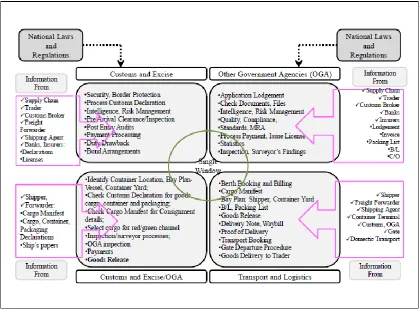
Figure 9: Approvals and Goods release: Where the Single Window sits
Source: (ESCWA, 2011)
2.7 Steps in the Planning and Implementation of a Single Window System
As highlighted previously, the implementation of SWS is a significant undertaking due
to the numerous stakeholders involved in the trade process which requires
commitment and goodwill from both government and business entities in local and
international trade. UN/CEFACT recommendation 33 outlines the key steps identified
in the setting up of SWS. It is important that the process involves a systematic
approach from the onset of the project implementation although it will be heavily
influenced by political, social, cultural aspects and traditions in a given country
(UN/CEFACT, 2005).
Due to the governance aspect of the SWS, traditional government structures are
24
2.7.1 Initial Concept development for the SWS
The work to establish a SWS starts with the concept preparation resulting from some
initial research undertaken by a government authority, agency or a private entity that is
likely to have a stake in the implementation process. The concept paper would
describe the objectives, expected benefits and a general overview of the
implementation process. The concept paper would provide a simple overview of
practical issues without giving much technical jargon and concepts. The objective of
the concept paper is to facilitate the initial discussion that leads to an in-depth study to
analyse the need for, and the feasibility and approach to be used in the establishment
of the SWS. The concept stage should be used to seek for the in principle approval of
the SWS implementation and acceptance by the government to progress with the
concept. After this is done, the next step is to get the buy-in from external stakeholders.
2.7.2 Decision to examine the feasibility of the SWS
After the concept paper preparation, a meeting would be set up between the high level
representatives of the SWS stakeholders from relevant trade organizations in order to
present the concept paper and define the launch of a feasibility study detailing the
objectives of the feasibility study incorporating a needs analysis and technology needs
readiness assessment. Prior to the meeting, it is important to lay the groundwork
through lobbying and project promotion for better understanding by the participants.
Political goodwill is a key pre-requisite for the successful implementation of the SWS.
In the case that a positive decision has been reached to proceed with the feasibility
study, the meeting will consequently set up a Project Management Group comprising
of senior representatives of the key agencies that will be directly involved in the
implementation and use of the SWS and have the authority to make decisions, commit
funds, allocate resources and commit to their full participation in the project. It is also
expected that the outcome of the meeting would be the adoption of a draft document
outlining the “objectives, responsibilities and terms of reference” for the Project
25
At this stage, the meeting participants also oversee the setting up of a task force that is
composed of the technical and management representatives of the key agencies that
will oversee the implementation and organizational tasks of the project guided by the
adopted Project Management group’s draft of objectives, responsibilities and terms of
reference.
2.7.3 Undertaking the Feasibility Study
The main objective for the feasibility study is to provide the decision makers with all
available options for each government body and their feasibility, mode (full or phased
implementation) of implementation, and the merits and demerits of each option for
each stakeholder. It is also critical to identify how the revenue collection (duties, fees
and taxes) aspect of the system will be managed at this stage.
Key areas for consideration during the feasibility study are the identification of the key
system deliverables, implementation and management strategy, and time schedule for
development and implementation.
2.7.4 Report on the Feasibility Study
It is expected that the outcomes of the feasibility study would be presented for
consideration and approval by the task force and thereafter submitted to the Project
Management Group.
It is essential that all stakeholders accord maximum input and reach a common
consensus before the finalisation of the report. Upon final agreement and adoption of
the feasibility report, the preferred SWS option and implementation approach chosen is
then presented to all the private and government stakeholders who make up the trade
community in a symposium or national stakeholder’s forum on the establishment of
SWS.
2.7.5 SWS Implementation
There are various modes of implementation that can be chosen for the SWS roll out
approach ranging from pilot, phased or full implementation from the defined project
management plan which essentially should have been agreed upon by the Project
26
to be a set of clearly defined tasks, responsibilities and milestones so as to plan,
execute, monitor, evaluate and regulate the implementation of the project.
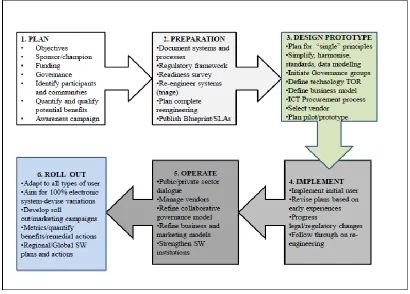
Figure 10: Single Window Life Cycle
Source (ESCWA, 2011)
2.8 Critical Factors in the Establishment of a Successful Single Window System
Apart from laying out the minimum standards, and best practice in the establishment of
SWS, the UN/CEFACT 33 also lists the following factors success factors. These are
based on a review of the operation and development of various SWS implementations
in various countries that were undertaken by the International Trade Procedures
27
2.8.1. Political Will
Most literature on SWS implementation success identifies the existence of a strong
political will on both government and business as one of the most important factors to
the successful introduction and operation. For this to be achieved, it is important that
from the onset of the project, there is proper dissemination of clear and impartial
information on the SWS objectives, implications, benefits, and possible challenges
from the initial stages of its establishment. The political goodwill of all stakeholders lays
the foundation for all other success factors (UN/CEFACT, 2005).
2.8.2. Strong Lead Agency
A strong, resourceful and empowered lead agency will be set up to oversee the launch
of the SWS and guide its implementation through the various stages as defined in the
project management plan and charter. For the organization to effectively carry it out its
mandate, it must have the appropriate political support, legal authority, adequately
skilled human resources, financial ability and links to the trading community. It is also
critical that the head of the lead agency who is the project champion be accorded the
necessary support from all the stakeholders.
2.8.3. Partnership between Government and Trade
The SW is essentially a model for cooperation between government agencies and
between the government and the trading (business) community hence it provides a
setup for a good opportunity for public private partnerships in the establishment and
operation of the SWS. Due to the fact that different stakeholders of SWS may have
different capacities and motivation for trade facilitation and varying gaps in the level of
business processes and system preparedness, it is critical that there are strong
partnerships and stakeholder engagement amongst all the stakeholders for an effective
SWS to be put in place in order to support the change process and the development of
28
2.8.4. Clear Project Definition and Objectives
As is the case with any project, it is very important to have clearly defined goals and
objectives from the onset of the SWS in order to guide the project through its
developments stages on the basis of the comprehensive stakeholder needs analysis,
resource allocation, existing infrastructure and the current submission approach of
trade-related information to the concerned government agencies. It is generally
recommended that the SWS should be incorporated in a country’s overall strategy to improve trade facilitation (UN/CEFACT, 2005).
2.8.5. Accessibility and user friendliness of the system
The accessibility and user friendliness of the SWS are key success factors for the
implementation project. Users should be trained adequately and operating instructions
and guidelines provided including the establishment of user support services through a
help (service) desk at the early phase of system implementation. Feedback from the
users on difficulties and experiences can be used to further develop and improve the
system as it develops. The SWS also needs to take into account the multi-lingual
requirements of its users in cases where this is a common scenario. The SWS design
should incorporate the ICT capacity of the system users operating it in the specific
country or region focusing on the future technological advancements and the user
threshold capacity to ensure system availability and uptime at all times.
2.8.6. Legal Framework
Both the WCO and UN/CEFACT emphasize the importance of a defined legislative and
legal framework structure providing guidance with some examples of structures in a
multi-stakeholder environment. It is important that the national legal frameworks
conform to the international trade treaties that support the legitimization of the national
single window. The UNICITRAL trade treaty can be used as a guide to many trade and
29
It may be necessary to put in place legislation guiding the exchange of electronic data
and the definition of data sharing protocols and data protection amongst users and
regulators in the SWS chain. The legal issues touching on the delegation and exercise
of power and authority by the lead agency will need to be defined clearly and
objectively (Chong, 2011).
2.8.7. Adherence to International Standard and Recommendations
A SWS implementation is highly reliant on the harmonization and alignment of requisite
trade documents and data sets hence it is vital that the system is built to ensure
compatibility with international systems and standards such as the UN/CEFACT 33 of
which the recommendations number 1 and 18 define in detail the standards for
SWS.(Koh, 2015)
2.8.8. Payment Gateway
It is a common practice for SWS to incorporate a payment gateway system for the
collection of government fees, duties, taxes and other relevant charges associated with
SWS operations by government agencies. This is critical for the smooth end-to-end
processes and can be an attractive feature for the government and trade community.
The incorporation of payment features into SWS will need to take into account
additional security mechanisms that will need to be built into the system to prevent
cyber security attacks and exposures to vulnerability. SWS payments can be used as a
means of revenue generation for the lead agency in charge of operating the SWS.
2.8.9. Financial Model of the SWS
It is important that a decision is made as early as possible during the onset of the
project regarding the financial model that will be used for the SWS. This can
significantly influence stakeholders and decision makers support for the system
implementation from the beginning. Financing options include financing from
government (e.g. Netherlands and Kenya) to a self-sustainable SWS model (e.g.
30
be explored taking into consideration such factors as the SWS service delivery model
in place i.e. G2B, G2G (Choi, 2011).
2.8.10. Communications Strategy
It is critical that all stakeholders are informed on the project goals, timelines objectives,
targets, progress, challenges and deliverables using a well-defined communication
strategy so as to foster trust amongst all the stakeholders of the SWS. It is also
essential that stakeholders’ expectations are managed to prevent overpromising and under delivering in order to generate significant goodwill to deliver the project
successfully. The frequency of communication can be defined in the project charter at
the onset of the SWS project and varied according to the various stages and
milestones as the SWS implementation progresses.
Summary
The above factors play an important role in the successful establishment and smooth
operation of SWS. The factors are interdependent on one another and therefore need
to be viewed in totality for the success of the SWS.
31
CHAPTER THREE
BACKGROUND OF THE KENYA SWS
Introduction
The liberalization of the Kenyan economy has resulted in the significant increase in
international trade. The favorable geographic location of Kenya in the East African
region of the Indian Ocean has consequently resulted in the increase in imports and
exports for its domestic use and for transit to the landlocked economies of Eastern
Africa that rely heavily on the port of Mombasa for their seaborne trade commodities.
The Port of Mombasa plays a crucial role in the maritime trade documentation
processes. It is in this context that the need for effective trade facilitation measures has
become a key factor in the creation of a favorable environment which can bring about
an improvement in the ease of doing business by reducing the bottlenecks experienced
and ensuring efficiency in the trade transaction processes resulting from maritime
seaborne trade.
Previously, before the introduction of the SWS, lengthy, repetitive and complex
procedures experienced during the lodging of trade documents at ports and airports
had an adverse impact on delays and created a negative impact on the supply chain
mainly in terms of costs and time. Documentation was characterized by excessive
paperwork and repetitive lodging of trade documents to national and international
government agencies and industry regulators. In an effort to improve the ease of doing
business in Kenya and the EAC region as a whole, the government of Kenya
formulated the Vision 2030 which focused on the economic, social and political pillars
that would have deliver aspects of the MDGs while improving the country’s GDP.
Various flagship projects were defined under each pillar to support the delivery of the
MDGs. The LAPSSET project that incorporates the creation of Lamu port and upgrade
and expansion of Mombasa port is nested under the infrastructure projects of the
economic pillar of Vision 2030. The Single Window System is one of the flagship
32
reforms to address the trade facilitation agenda forming part of the auxiliary projects
needed to support the infrastructure development projects. Also incorporated are the
construction and expansion of ports, national highways and railways expansion which
form part of the southern and northern corridors which serve the regional trans-border
trade among the EAC land-locked countries.
The development of the SWS in Kenya can be attributed to a Community Based
System initiative in 2005 that oversaw the commissioning of the port community at the
Port of Mombasa oversee a port-centric project which was spearheaded by the Kenya
Revenue Authority and the Kenya Ports Authority. The initial Community Based
System project concept was then developed into a national Single Window concept in
2007 which was to be finally overseen by a lead agency KenTrade in 2011.
The conceptual approach was developed to implement a national cross-cutting project
covering sea, air, road, rail and maritime systems encompassing all government
agencies involved in trans-border trade. At the helm of the project was the
inter-ministerial steering committee with members drawn from the Kenya Ports Authority,
Kenya Revenue Authority, National Treasury, Ministry of Trade and Ministry of
Transport.
The main objective of the Kenya SWS was to reduce cargo dwell time at the port of
Mombasa from the ten days (in 2011) to a maximum three days, and maximum dwell
time of one day at airport and one hour at the border points. This was to be achieved
through the elimination of inefficiencies identified such as space utilization at port as a
result of long cargo dwell time which resulted in port congestion.
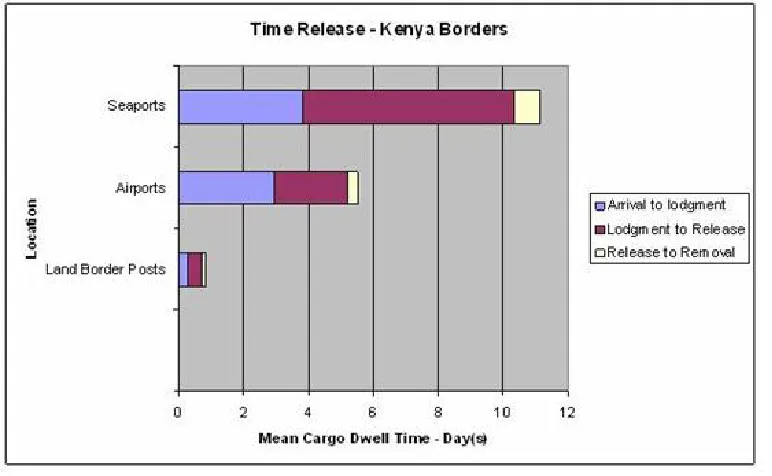
The diagram below represents the time release study results carried out in the
pre-implementation assessment survey indicating the average cargo dwell time taken at
33
Figure 12: Results of a Time Release Study on cargo dwell time at Kenya borders
Source: (Preliminary Assessment of a Community Based System in Kenya, 2005)
Also highlighted were the inefficiencies related to the cargo clearance process due to
manual paper handling procedures amongst trade stakeholders, high trade transaction
costs, and trade related corruption that served to ultimately reduce Kenya’s
competitiveness in the ease of doing business index, logistics performance index and
the trading across borders indices published by the World Bank annually. According to
the World Bank, some the aforementioned indices are some of the most common tools
used to quantify the effectiveness of trade facilitation measures. According to Orliac
(2012), there are more than twelve indicators used to measure trade facilitation using a
number of defined trade facilitation indicators. The trade facilitation indicators have
dependent relationships which may ultimately affect the efficiency of trade procedures
34
Figure 13: Comparative ranking in Logistics Performance Survey 2015 vs. 2014 for EAC countries
Source: (SCEA, 2015 East Africa Logistics Performance Survey)
Another important factor in the establishment of the Kenya SWS was to implement the
trade facilitation agenda. KenTrade’s mandate is to carry out trade facilitation initiatives
with the Kenya National Electronic Single Window being the pilot project for the
government agency. The establishment of the Kenya SWS as a tool for trade
facilitation played a key role in implementation of the WTO trade facilitation agenda. It
is important to understand Kenya’s role in the EAC economies share of the international trade and transport to facilitate the adoption of the 2030 SDGs by Kenya
and the landlocked economies that rely on its port for their trading needs.
“Cost-effective international trade and international transport of goods requires the alignment of ordering, payment, insurance, logistics, customs inspection and
clearance, and border controls.” (UN-OHRLLS, UNECE 2015)
High transport costs and inadequate transit infrastructure can eventually lead to high
cost of transportation and therefore as a result affect the trade and economic potential
of land locked developing countries.
A World Bank group survey carried out in 2012 sought to quantify the economic losses
35
through the application of trade facilitation measures. The survey predicted that the
present volume of import and export goods from USD 150-250 million in the first three
years and an increase to USD 300-450 million per annum thereafter. These savings
are attributed to reduced delays, reduced trade transaction costs, elimination of
inefficiencies and corruption, less paperwork, elimination of manual document handling
processes, reduction in the cost of capital as per the JIT (Just-In-Time) delivery
concept and lower demurrage costs, as well as the improvement in space utilization at
the ports resulting ultimately in increased capacity utilization. The table below
illustrates the effect of cross border processes on land locked developing economies.
Figure 14: Cost, Time and Documents Required for Import and Export
Source (World Bank, World Development Indicators)
Figure 13 below further illustrates the above point by showing the average time taken
to import and export and the number of documents needed between countries with
36
Figure 15: Comparison of Import and Export time for countries with and without SWS
Source (Doing Business Database, 2005)
3.1 Implementation of the Single Window Concept in Kenya
At the initial stages of the SWS implementation, a Project Management approach was
defined and the project charter, master plan and business process engineering were
identified as some of the key milestones of the Kenya SWS project. The feasibility
study assessed the existing situation through stakeholder consultations conducted via
seminars and workshops. The approach taken was laid out through the preliminary
assessment of the CBS in Kenya and had the following terms of reference:
i. Review of trade related procedures - The processing of documentation for
international trade and procedures associated with border clearance of cargo
was reviewed with the different stakeholders namely: ship agents, clearing
agent, KRA Customs, KEBS, KEPHIS, Port Health, KPA (port and inland
container depot), freight stations, KAA, Kenya Airways, shed operators, and rail
and road transporters.
The review was conducted in Nairobi and Mombasa over two missions in July
and August 2005. Review meetings were held with Government control
37
international trade. In addition, meetings were held with individual private sector
operators in order to obtain perspective of issues at enterprise level.
ii. Identification of existing ICT strategies - Identification of existing ICT strategies
(including on-going and planned initiatives) from trade participants: KPA, KRA,
KEBS, Transit Transport Co-ordination Authority, with specific attention to the
potential of the ORBUS system.
iii. Survey of e-readiness of stakeholders – Assessment of existing infrastructure and capacity building requirements, focusing on forwarders, banks,
transporters, exporters and importers and means for integrating them into the
network.
iv. Legal and regulatory requirements to support transaction and contractual
features of the new trade document