ISSN: 2149-214X
Education for Sustainable Development
in Primary School: Improvement of
Students’ Ecocriticism Skills
Ahmet Tekbiyik1, Mustafa Celik2 1
Recep Tayyip Erdogan University 2
9 Mart Primary School
To cite this article:
Tekbiyik, A. & Celik, M. (2019). Education for sustainable development in primary school:
Improvement of students‟ ecocriticism skills. Journal of Education in Science, Environment
and Health (JESEH), 5(2), 178-191.
DOI:10.21891/jeseh.568716
This article may be used for research, teaching, and private study purposes.
Any substantial or systematic reproduction, redistribution, reselling, loan, sub-licensing,
systematic supply, or distribution in any form to anyone is expressly forbidden.
Authors alone are responsible for the contents of their articles. The journal owns the
copyright of the articles.
DOI:10.21891/jeseh.568716
Education for Sustainable Development in Primary School: Improvement
of Students’ Ecocriticism Skills
Ahmet Tekbiyik, Mustafa Celik
Article Info
Abstract
Article History
Received: 19 January 2019
Ecocriticism analyzes the symbolic meanings attributed to nature and the mindsets created by these meanings through interpreting literature and cultural texts from an environmental perspective. The individuals who have gained ecocriticism skills are expected to create an awareness concerning possession of a distinctive value and to direct towards a non-anthropocentric understanding from an anthropocentric understanding. The purpose of this study is to develop ecocriticism skills of primary school students in the third grade. Action research design has been used in this study. A total of 15 students composed of 8 females and 7 males participated in the study. Data of the study were obtained with rhetorical discussion, analytical discussion, mind maps, and drawings. Following the implementations composed of discussions, mind maps and drawings, it has been determined that the implementations develop the ecocritical inquiry skills of students.
Accepted: 11 May 2019
Keywords
Ecocriticism,
Education for Sustainable Development-ESD, Primary school students
Introduction
The fact that the struggle to dominate nature has reached to an uncontrolled dimension has caused a disruption in the harmony of people with the environment they live (Özenoğlu Kiremit, 2013). The mismatch between the environment created by the human will and the natural environment has revealed environmental problems (Güngör, 2015). Just like other branches of science, the fields of art and literature couldn‟t keep silent for the destruction of nature; an awareness for nature was attempted to be created with such texts as poems, stories, and novels (Bayraktar, 2015). Addressing the relationship between the environment featured by ecological researches and humans being a part of it within the context of literature has created the concept of ecocriticism (Solak, 2012).
Ecocriticism analyzes the symbolic meanings attributed to nature and the mindsets created by these meanings through interpreting literature and cultural texts from an environmental perspective. It critically addresses the problems related to the environment and value judgements in the content of the text and creates an interdisciplinary field of study (Oppermann, 2012). While ecocriticism has focused on romantic period poems, wild narrative stories, and nature literature at first, it has tended towards the different dimensions of cultural field in recent years and analyzes such fields as scientific literature, film, television, art, architecture, zoos and shopping centers (Garrard, 2004). Ecocriticism, that has started to be accepted since 1990 as criticism theory and academic discipline analyzing nature in cultural works, brings literary criticism and ecology together (Güngör, 2013). According to ecocriticism perspective, literature has been shaped with the sociocultural, political and economic structure of the society and it should create its own discourse against today‟s environmental problems. As stated by ecocriticism understanding, literature which is highly effective in creating and changing the human‟s thought systems will contribute to the solution of environmental problems by undertaking a social responsibility role (Bulut Sarıkaya, 2012).
Ecocriticism analysis seeks answers for the following questions while addressing an ecological problem:
The ecocritical perspective shaped within the framework of these questions makes the inquiry activity directed to the content multidimensional from economic, ethical, philosophical and psychological aspects.
The publications and reports revealing the dimension of the damage given to ecosystem scientifically are observed to be not so effective in raising awareness for the ecological problems. The fact that literary narrative affects human beings by directly reaching their consciousness contributes people more to understand the inherent value of nature. This situation helps ecocriticism speak to a wider area and be more effective (Oppermann, 2009). Literary works allow children and young people to better organize their lives with their real or reality-like fictions and they provide the opportunity to see what is right or wrong in life (Arıcı, Ungan & Şimşek, 2014).
Education for Sustainable Development and Ecocriticism
Sustainability expresses a paradigm based on the understanding of improving the quality of life and ensuring development with a concern for the future in which economic, social and environmental dimensions are balanced. The sense of life prioritizing economic development only features the pragmatic outcomes of social and environmental developments. The sense of life adopting the sustainability paradigm accepts that not only the outcomes of human‟s welfare and economic development but also the serious threats directed to the environment should be addressed. Sustainability is a long-term target and many processes and methods to reach this target are explained with the concept of sustainable development (UNESCO, 2012). Sustainable development is defined as meeting the needs of today‟s individuals without hindering future generations from meeting their own demands (Brundtland Report, 1987).
Raising the awareness of sustainability and sustainable development with its economic, social and environmental dimensions falls into the fields of interests of many disciplines and sub-disciplines. In the last thirty years all around the world, global awareness has been attempted to be ensured with the meetings held by such global organizations as European Union (EU) and United Nations (UN) directed to sustainable development and the countries have been laid various burdens. In the UN General Assembly held in 2000, nearly 60 targets including such topics as peace, development, human rights, and environment were set. The subjects of increasing efficiency by changing the lifestyle in economic sense, being more careful about the use of energy and natural resources, using clean production technologies that will reduce the use of resources, improving the unbalanced distribution of income and health conditions and securing the justice in access to education and social services are some of these targets. European Council published a report in 2006 which included the renewed and improved sustainable development solutions for European Union countries. This report stipulates that long-term and effective strategies with which the European Union will ensure sustainable development can be improved through finding a unique and integrated solution. In this strategy with its main aim expressed as “Defining and improving the actions that will provide the increase in quality of life of both today‟s generation and future generations”, there are long-term targets, aims and concrete steps for seven basic priorities (Council of the European Union, 2006). These are stated as climate change and clean energy, sustainable transportation, sustainable production and consumption, a threat of public health, protection and management of natural resources, social integration, population, and immigration and struggle against global hunger (Tanrıverdi, 2009).
The solution of global problems is rendered with sustainable development practices and governments, society and individuals are assumed responsibility for sustainable development. Education is an important tool in order to improve the perceptions of public opinion about environmental science and policies, to protect natural resources, to define environmental problems and to create sustainable lifestyles. Education for Sustainable Development (ESD) aims to raise responsible and environmentally literate individuals regarding adoption of use of sustainable resources and solution of global environmental problems (Hungerford & Peyton, 1976; Roth, 1992). In this sense, individuals should receive education for an environmentally, socially and economically sustainable world. This education should adopt a multidimensional and dynamic approach composed of different tools, methods and various ideas based on problem-solving rather than uniform methods. This study is based on the assumption that ecocriticism being a criticism method which addresses environment and environmental problems over a general or special condition can be used within the context of ESD.
ecological elements can be developed. It is observed in literature that the studies conducted in the field of ecocriticism are at the corporate level or various works are analyzed in ecocritical dimensions (Balık, 2013; Bayraktar, 2015; Cengiz, 2013; Güngör,2015; Güngör, 2013; Islam, 2018; Parlak Temel, 2010; Solak, 2012; Toska, 2009; Wang, 2018). The studies addressing the activities of students regarding the possession of such skills by carrying the ecocriticism to the learning environments aren‟t observed. The criticism of children on the materials offered to them with an ecocritical perspective by relating them to the problems at a local or global scale is of great importance in terms of supporting sustainable development.
Thus, the purpose of this study is to develop ecocriticism skills of primary school students in the third grade. The concept of “ecocriticism skill” hasn‟t been used in the literature yet. Ecocriticism skill in the study denotes analysis, interpretation, and inference of linguistic and audiovisual stimuli from an ecocritical perspective. Responsibilities of individuals towards the natural world define in two views: Anthropocentrism and non-anthropocentrism. According to anthropocentric view, only human beings have moral values and dominate the natural world. Non-anthropocentric view loads moral meanings to such natural objects as animals, plants and landscapes (Jakobsen, 2017). The individuals who have gained ecocriticism skills are expected to create an awareness concerning possession of a distinctive value and to direct towards a non-anthropocentric understanding from an anthropocentricism understanding.
Method
Research Model
Action research design has been used in this study which aims to develop ecocriticism skills of primary school students. Action research aims to create practical solutions to problems in order to create change in learning environments (Esterberg, 2002; Melrose, 2001). It also provides a useful research approach in experimenting with new ideas. (Kemmis & McTaggart, 1988; Casey, 2007). The participative role of the researcher in the action research and her/his closeness to data ensure that the processes of participation-reflection and development in the research actualize effectively (Stringer, 2008; Yıldırım & Şimşek, 2011). The researcher teacher performed the implementations by participating in activities and discussions in person. Action research design was preferred due to the nature of a research problem and the role of researchers.
Participants of the Research
It is important to introduce ecocritical skills to children at early ages. The most proper grade level to relate ecocriticism with curriculum is third grade science course since the Turkish science curriculum starts in the 3rd grade. The research was performed with the 3rd-grade students of a primary school in Rize province located in the north-east of Turkey. A total of 15 students composed of 8 females and 7 males participated in the study. As per the nature of action research, it isn‟t always possible to obtain generalizable results since the sample selection from a wide population with a random sample method isn‟t obligatory (Fraenkel & Wallen, 2000). In this regard, the study was performed with the individuals who were directly related to the problem, i.e. with a designed group.
Data Sources and Analysis
Data of the study were obtained with rhetorical discussion, analytical discussion, mind maps and drawings. In rhetorical discussion considered to be a part of the culture in literature, an event is ensured to be seen from different perspectives multi-dimensionally and the assertion is attempted to be proven with the evidence as a way of defense and persuasion (Demirel, 2015). Rhetorical discussions also named as didactic discussions are defined as a series of expressions connected to each other in order to create a certain position; they ensure seeing an event from different angles multi-dimensionally (Boulter and Gilbert, 1995; Jimenez, Rodriguez and Duschl, 2000; Kuhn, 1992; cited by Aldağ, 2005).
through induction and analytical discussions were held. The researcher teacher recorded the comments of students with reminder notes in the discussion process. At this stage, video recording was performed and a discussion of data were obtained. Following the discussions, the students were given the tasks of mind maps or drawings. Without putting any limitations to students in both tasks, how the students were affected from the process and how they approached the problem were tried to be determined by complying with the topic and content of the discussion.
Concerning environment and sustainability, use of children‟s drawings and other visual tools (for instance mind maps) are gradually becoming popular as a systematic tool in order to evaluate the perceptions and attitudes of children towards the environment (Barraza, 1999; Walshe, 2008). Children‟s drawings can be used in determining their attitudes towards certain environmental problems as emotional indicators. In previous studies, the perceptions and expectations of children about sustainability (Barraza, 1999), change in their perceptions towards nuclear power stations (Brown, Henderson & Armstrong, 1987) and their mental models about the world (Çelik & Tekbıyık, 2016) were presented by using their drawings. Similarly, King (1995) tried to explore the children‟s concerns about the environmental crises through drawings. In this regard, it is observed that children‟s drawings are highly effective tools in reflecting their opinions, particularly about environmental topics. In this study, the students were expected to reflect their ecocriticism skills through drawings and mind maps following the above-mentioned discussion process.
Mind maps are the tools with which ideas and concepts about a subject are presented visually (Eppler, 2006). Two halves of the human brain perform different tasks. The left side of the brain is mostly responsible for such processes as logic, words, arithmetic, and ordering. The right side of the brain carries out the tasks related to multidimensionality, imagination, emotion, color, rhythm, and shapes. The combination of logic and imagination is represented in this technique which stipulates the use of both sides of the brain (Brinkman, 2003). Taking into account this attribute of mind maps and development characteristics of students, mind maps were utilized in the study with the purpose of reflecting their ecocriticism skills. Since the students have previous experience concerning the creation of a mind map, they don‟t have the difficulty.
Data obtained from the discussions and drawings in the study were analyzed with content analysis. Mind maps being the other data source of the study were descriptively analyzed. Discussions were recorded with the video camera. While the camera records are being written, the researcher who conducts the discussions is coded as RT and the students are coded as S1, S2, S3, etc. To ensure the reliability of the content analysis of the discussions, two researchers worked on the same data separately. The written data were analyzed in three stages. These stages are defining categories, identifying anchor samples and determining coding rules (Mayring, 2015). The analysis was conducted by two researchers. The reliability of the analysis was calculated by using the formula of Miles and Huberman (1994) by determining the researchers‟ same and different opinions. Consistency between independent encoders was found to be high (92%) and an agreement was reached on non-compliant encodings. In the content analysis of the drawings, two researchers determined the themes in which the drawings would be categorized. After the implementation of various materials, it was seen that students made drawings on different themes. In this respect, researchers came to an agreement and defined the themes of the drawings and named them.
It was tried to determine how often the students associated the central concept with other concepts in the mind maps that they produced by making one-stage relationships around the central concept. The concepts in their mind maps were represented descriptively and frequencies were formed (Weber, 1990). In this process, the themes and categories to which the associative concepts belong were determined by two researchers. In this way, the most frequently repeated concepts and the themes to which these concepts belong were presented.
Implementation Process
Table 1. The materials used during the implementation process
Material Sustainability Dimension Ecocritical Tool 1. Image: Keklik Ailesi (Partridge Family)
(Anonymous)
Climate change Discussion, Mind map
2. Comic: Global Warming (Anonymous) Climate change Discussion, Drawing 3. Image: Agricultural fields must be
protected… (TUCA, 2014) Sustainable consumption production and
Discussion
4. Tale: Sürüsü Azalan Çoban (Shepherd with Reduced Herd) (Gökduman, 2015)
Protection and management of natural resources
Discussion, Mind map
5. Song: Baltalar Elimizde (We Have Axes in our Hands)(Anonymous)
Protection and management of natural resources
Discussion, Mind map, Drawing
6. Tale: Ham Mısır ile Tam Mısır (Raw Corn and Whole Corn) (Yazgan, 2011)
Sustainable production and consumption
Discussion, Drawing
7. Animation: Bambi (Hand, 1942) Protection and management of natural resources
Discussion, Mind map, Drawing
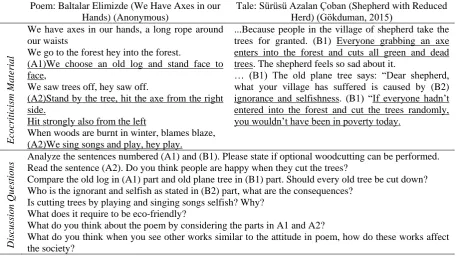
First, the implementations as a preparation of ecocriticism were conducted in the study. For this purpose, the students were attempted to be aware of the problems in nature and to offer their ideas concerning these problems through images and comics. The discussion was extended with the new questions in line with the opinions of students. In discussions, guiding questions were used to help students address the problems in nature from different aspects. The problems experienced in nature and close environment were analyzed within the context of living-nonliving beings. In order to raise awareness regarding the socio-economic reasons and outcomes of the problems, the students questioned whether it was necessary for humans – being the source of the problem – to undertake responsibility in solving this problem in the second part of the process. The purpose here is to ensure that children can be a critical reader/audience regarding how the nature is reflected in cultural works that appeal to them and they are aware of the fact that each of all elements in the nature carries a subject value. In the second part of this process, an analysis on how the nature and problems in nature were addressed in works was performed with analytical discussions. Within the scope of this condition, the proposition that each element of the unity of life and liveliness in nature possesses the value of subject was approached with rhetoric discussions.
Table 2. Sample ecocriticism materials and relevant discussion questions Poem: Baltalar Elimizde (We Have Axes in our
Hands) (Anonymous)
Tale: Sürüsü Azalan Çoban (Shepherd with Reduced Herd) (Gökduman, 2015)
Ecocrit
ic
ism M
aterial
We have axes in our hands, a long rope around our waists
We go to the forest hey into the forest.
(A1)We choose an old log and stand face to face,
We saw trees off, hey saw off.
(A2)Stand by the tree, hit the axe from the right side.
Hit strongly also from the left
When woods are burnt in winter, blames blaze, (A2)We sing songs and play, hey play.
...Because people in the village of shepherd take the trees for granted. (B1) Everyone grabbing an axe enters into the forest and cuts all green and dead trees. The shepherd feels so sad about it.
… (B1) The old plane tree says: “Dear shepherd, what your village has suffered is caused by (B2) ignorance and selfishness. (B1) “If everyone hadn‟t entered into the forest and cut the trees randomly, you wouldn‟t have been in poverty today.
Discussi on Q ue sti on
s Analyze the sentences numbered (A1) and (B1). Please state if optional woodcutting can be performed.
Read the sentence (A2). Do you think people are happy when they cut the trees?
Compare the old log in (A1) part and old plane tree in (B1) part. Should every old tree be cut down? Who is the ignorant and selfish as stated in (B2) part, what are the consequences?
Is cutting trees by playing and singing songs selfish? Why? What does it require to be eco-friendly?
What do you think about the poem by considering the parts in A1 and A2?
What do you think when you see other works similar to the attitude in poem, how do these works affect the society?
As is known, the language used in identity acquisition of individual plays a significant role. The cognitive structure of individual is created through the relations within the language as stated in the constructivist view (Best & Kellner, 2011). In the sample discussion presented in Table 2, the implementation method of ecocritical inquiry is observed. The situations described in the text are examined separately and the efforts are made to ensure realizing which messages can be created by different styles.
FINDINGS
Findings Obtained from the Discussions
In rhetorical and analytical discussions, students performed a critical analysis in terms of determining the reasons and significance of a problem experienced in nature, making an inference concerning the domain of problems in nature and life and observing the relational dimensions of unity of life in nature. Below is a cross-section of the discussion performed to explain the image which tells the life of the partridge family who had to migrate due to the negative impact of climate change (RT: Researcher Teacher; S3: Student 3):
RT: What would happen if partridges didn‟t exist?
S3: Their babies can‟t live. We can‟t eat egg. It is a sin to kill partridge, The God forbids it. RT: Have you heard about ticks?
S3: Yes, they adhere to your skin and make you sick.
RT: Poultries reduce ticks, so what will happen if partridges become extinct? S3: Ticks infest everywhere. Ticks adhere to people and people die.
RT: So, who has the highest responsibility? S3: People.
RT: It seems everything is connected; how can this be explained?
S3: When the number of partridges reduces, ticks increase and people‟s life endangers.
RT: How does the absence of partridges in the relation of Partridge-Tick-Human affect nature? S3: Nature‟s balance is impaired.
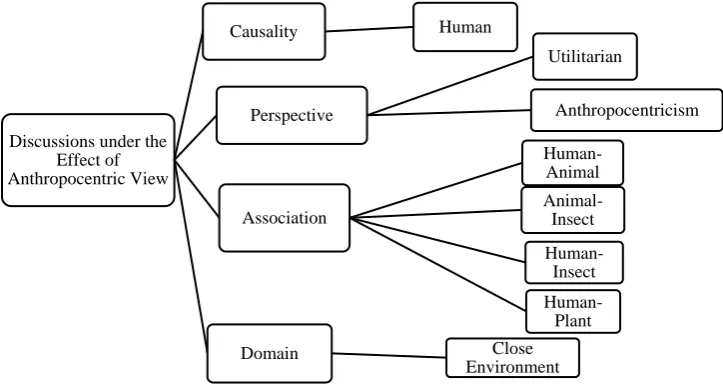
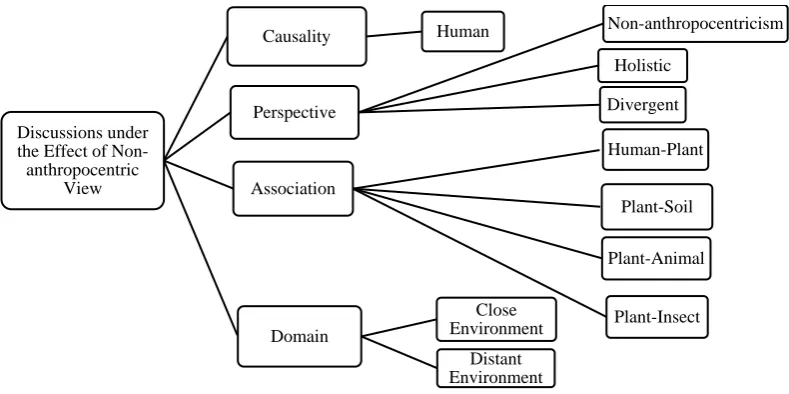
Looking at the flow, the analytical discussion that develops as answers given by the students to the questions asked by the teacher is observed to transform into a rhetoric structure towards the understanding of “unity of life” and “integrity in nature”. It is understood that the discussion process allows students to see the different dimensions of the problem. When all discussions are analyzed together, the discussions are observed to be conducted around two main themes as “Anthropocentricism” and “Non-anthropocentricism”. The schematic indication of the findings obtained with the analysis of these discussions is presented in Figure 1 and Figure 2.
Figure 1. Content analysis of the discussions under the effect of anthropocentric view
Figure 1 shows the findings obtained following the discussion of images and comic contents which have the characteristics of preparation study for development of ecocriticism skills of students. It has been determined
Discussions under the Effect of Anthropocentric View
Causality Human
Perspective
Utilitarian
Anthropocentricism
Association
Human-Animal
Animal-Insect
Human-Insect
Human-Plant
Domain Close
after the analysis of these discussions that students point out to humans as the main reason of the problems in nature. It is also stated in the discussions that students criticize with a more utilitarian and anthropocentricism perspective in addition to including association with living elements in nature. Regarding the statements of students during the discussion of visual content while addressing the effect of building houses on cultivated areas [„If tea doesn‟t grow; we will lose the money coming from tea; factory workers can‟t get paid and unemployment occurs‟. „If plants don‟t exist, oxygen and clean air decreases, people can‟t find food if natural balance is impaired‟.],it is observed that humans are emphasized as the most affected being from the problems in nature and future concern is explained with the expressions favoring the benefits of human.
Figure 2. Content analysis of the discussions under the effect of non-anthropocentric view
Figure 2 shows the content analysis of the findings obtained from the implementations performed following preparation study for development of ecocriticism skills of students. The students are observed to interpret a problem in nature with a holistic perspective through the discussion of the contents of stories, songs, tales and animations. Analyzing the statements of students [If you cut the forest, caterpillar can‟t be fed. Owls and moles can‟t build a nest. Humans don‟t have the energy. If forests are cut down, there is no oxygen and living things could disappear], it has been determined that a problem in nature is analyzed by students within the context of human-plant-animal relationship. It is understood that students criticize the problems by looking out the unity of life and integrity in nature. It has also been observed that students consider other living beings apart from humans as subjects and criticize the problems by showing an emotional sensitivity to non-human beings with such expressions as [Trees are also alive. When the trees are cut, there is no such thing as natural life, the natural balance is lost. The forest is the home for trees. There is brutality and insensitivity here…]. It has also been ascertained that the students analyze the problems by considering the distant environment [Without trees, snow melts due to global warming. Glaciers are melting, polar bears cannot find food] and interpret them with a divergent perspective.
Findings Obtained from Mind Maps
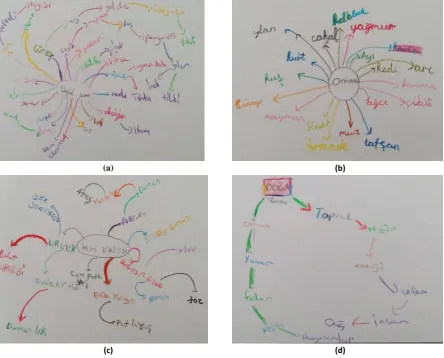
Following the discussion of images, animation, songs, and tale, the focal concepts directed to these activities were determined and mind maps were created around these concepts. „Air and water pollution‟ was selected as the focal concept after the ecocritical discussion of images, and relevant concepts and situations were ensured to be determined. Similarly, the concepts of „forest‟ after the song, „natural environment‟ after the animation activity and „nature‟ for the tale activity were established as key concepts; the effect of ecocritical discussions was attempted to be revealed within the relational context.
Figure 3 features the examples classified according to the characteristics of mind maps drawn by students. Looking at the mind maps, the students are observed to have substantial ecological concepts. In addition, specific drawings are included in which a holistic cross-section taken from nature (e.g. forest) is represented, which adopts a non-anthropocentrism approach that considers the living and non-living elements together in nature. Other mind maps analyzing the reasons of environmental problem (e.g. air pollution) from different dimensions and trying to represent the natural cycles were observed.
Discussions under the Effect of
Non-anthropocentric View
Causality Human
Perspective
Non-anthropocentricism
Holistic
Divergent
Association
Human-Plant
Plant-Soil
Plant-Animal
Plant-Insect Domain
Close Environment
(a) (b)
(c) (d)
Figure 3. Classification of mind maps by their characteristics [(a) holistic display adopting the non-anthropocentrism approach, (b) specific display adopting the non-non-anthropocentrism approach, (c) causal display adopting the non-anthropocentrism approach, (d) spiral display adopting the non-anthropocentrism approach]
Figure 4. Concepts associated with the concept of nature
Figure 5. Opinions of students about air and water pollution in their mind maps
Figure 5 contains the associated concepts of the students directed to the environmental problems caused by air and water pollution. It is observed in the figure that the students associate this concept with mostly factory and human concepts in terms of the factors that cause environmental pollution and the elements of vehicle, trash, diesel oil, and petroleum are used in this association. Concerning the outcomes caused by environmental pollution, students associated this concept with global warming, poisoning, disease, glacier melting, and thirst. It has been ascertained that the concepts of plant, animal, and soil are affected from air pollution within the scope of being affected from environmental pollution while the concepts of fish, penguin, whale, moss, octopus and polar bear are the living beings in the association affected from water pollution. Similarly, the concepts of ecosystem, natural life, harmony, and natural balance exist in this association.
Findings Obtained from Drawings
Following the ecocritical discussion of images, animation, tale, and songs, the students were given the task of drawing. The drawings were made to reveal what kind of impressions the discussed works and materials would arouse in the students. Drawing I was performed after the discussion and analysis of the comic and Drawing II was performed following the display and discussion of the animation movie Bambi. Drawing III was made after reading and discussing the tale Ham Mısır ile Tam Mısır (Raw Corn and Whole Corn) and Drawing IV was made after the activities of listening-discussing the song Baltalar Elimizde (We Have Axes in our Hands) and reading-discussing the tale Sürüsü Azalan Çoban (Shepherd with Reduced Herd). Regarding the findings obtained from the drawings, it is observed that the relation of affecting-affected directed to a situation in nature is addressed in drawings and what is told in these drawings is that all living and non-living elements are affected from a problem commonly.
Figure 6 contains the examples from drawing activity performed following the discussions. Looking at drawing (I), it is understood that the student points out to factory as the reason for global warming, the plant life is endangered as a result of global warming, flowers fade, air pollution increases due to these outcomes and the environment reaches to a grey and black appearance as this process continues. In the drawing (II) made by another student, the harmony in nature is described. When the drawing is examined, the harmonious association in wildlife expressed independently from humans stands out. This drawing was made after the discussion of animation movie Bambi and the damage given by irresponsible individuals to wildlife was addressed in discussion. It has been determined in the drawing that no negative condition is observed in natural life where human doesn‟t exist and a system is expressed in this harmonious association (crows are eating apples, the deer walks around the green grass, insects flying in a sunny weather).
production with natural methods; there exists an expression that this production method is acceptable with the drawings of vegetables and fruits.
(I) (II)
Ecocriticism of the comic reflecting the effect of global warming: The negative condition caused by air pollution in nature and the factors causing this are explained.
Ecocriticism of the animation movie telling the life of a deer: The harmony of living and non-living elements in nature is explained.
(III) (IV)
Ecocriticism of a tale telling the journey of a sweetcorn: The production by natural methods is compared with the production by unnatural methods.
Ecocriticism of the song telling the woodchopping in forest: The fact that cutting old trees will not always be true, the pollution after woodchopping and the factors causing this situation are explained here.
Figure 6. Holistic expressions in drawings
The drawing activity (IV) has an enthusiastic description in terms of rhythm and it was performed after the discussion of the content of song Baltalar Elimizde (We Have Axes in our Hands) and the tale Sürüsü Azalan Çoban (Shepherd with Reduced Herd) which introduce woodchopping like a part of daily life with a game-like expression. It is observed from the drawings that tree is defined as a subject, an empathetic bond is established with the tree by ascribing such humanistic attributes as feeling sorry and crying, humans cause the damage in nature and this damage will result in various problems especially air pollution.
Discussion and Conclusion
the content of these works by questioning how the bond created with nature should be has caused them to observe the situations in life with a critical, analytical and holistic approach. How the relationship between human and nature is described in the work is the main problem on which ecocriticism has focused and the ecocritic is on guard against the nature and environmental problem created in the work (Garrard, 2004). Among the implementations, the students interpreted not only the ready contents, but also the literature produced in free writing activities from the ecocritical perspective. During the free writing activity, a student described in her/his story that a jackal attacking chickens in a farm was killed by the farmer, which was criticized by the student‟s friends listening to this story and the students told their friend that the story should have ended with a less violent fiction with no guns and killing. It can be stated in this case that the implementations develop the ecocritical inquiry skills of students.
In the literature, there is no agreed upon method for the implementations of ecocriticism (Arıkan, 2011). Considering the based on ecocritical understanding of environmentally-friendly individuals, the discussion method that stirs the connection of asking- inquiring-interpreting was used in the study. The discussion method is observed to be effective in equipping with critical thinking skill (Seferoglu & Akbıyık, 2006). The fact that students convey their ideas easily in class and can see a problem from different perspectives has enabled them to analyze the relation of human-physical environment in cultural works with an interdisciplinary approach and to interpret the nature image in the work with a holistic approach.
Another striking dimension of the study is that students attribute subject value to the life of living beings in nature and wildlife. The fact that students reflect the emotional exposure of plants and animals against possible destruction of nature in their drawings and discussions and how humans jeopardize them constitutes a basis in creating an ecological self. The relationship and diversity in nature, ecological cycle, the functioning of the food chain, the integrity of different species and perception of holism in natural life are important in the development of ecological self (Çukur & Özgüner, 2008). The integrity in nature in ecocriticism and the emphasis on human‟s being aware of the position within the whole make a direct contribution to the development of ecological self. It could be said that the findings of the study comprehensively support this argument.
It has been understood from the discussions in the introduction part of the research that certain students show a tendency to the violent computer games among the situations observed by the researcher. One of these games is hunting games in which all wild animals in the forest are targeted, points are collected when animals are killed and violence is displayed with an entertaining view. In the later stages of the discussions, it was identified that students criticized computer games in terms of not only wildlife but also all contents that include violence. It was ascertained that the students who said to have deleted this game from their computers at home adopted a sensitive attitude towards living beings such as plants, insect, reptiles etc. in the school yard. The students were observed to make a warning or to inform school administration and teachers when a living being such as a sapling or lizard was damaged in the school yard.
Another point that needs to be emphasized in mind maps in the study is that the concept of nature has been associated with the notions of game, fun, excitement, time, picnic, energy and production. The fact that students consider the nature as a lively, active and joyful ambience to spend time can be interpreted as an opportunity for them to blend with nature. The ecocritics state in their analyzed works that alienation of nature is due to the distances put between human and nature (Oppermann, 2012). It is thought that implementation of ecocriticism may create awareness in the dimensions of nature and the meaning attributed to nature in children and a nature integrated sense of self can be developed through these implementations.
In the study which was performed to develop ecocriticism skills of the third-grade students in primary school, the students were ensured to analyze the representation method of nature in visual, audio and written works within the ecocritical scope. It has been determined through the implementations that students have created an awareness concerning the topics of considering non-human beings in nature as subjects, being aware of the integrated structure of nature and the necessity for people to undertake responsibility in protecting this structure. It has been established that the implementations are effective not only in uttering the protective precautions after determining the problems, but also in behavioral dimension, the students exhibit an eco-friendly approach in their own lives and environments.
Recommendations
Children's literature works, animation movies, computer games etc. and the content of audiovisual and literary materials for children can be examined within the ecocritical context.
A perspective can be created towards aligning the daily life practices with the nature by expanding the domain of the implementations of creative writing based on ecocriticism, environment education and critical reading.
The students can be enabled to see the socio-cultural environment from a critical perspective through the ecocritical implementations and to be sensitive towards nature and ecological life.
Discussion, mind maps and drawings could be used in the determination of the ecocritical views or similar critical ideas of primary school students. These tools have been shown to be effective for reflecting students' ideas.
References
Aldağ, H. (2005). Düşünme aracı olarak metinsel ve metinsel-grafiksel tartışma yazılımının tartışma becerilerinin geliştirilmesine etkisi [The effects of textual and graphical-textual argumentation software as cognitive tools on development of argumentation skills]. Unpublished PhD Thesis. Cukurova University. Institute of Social Sciences, Adana.
Arıcı, A. F., Ungan, S. & Şimşek, T. (2014). Çocuk edebiyatı türleri ve çocuk eğitimine katkıları [Types of children's literature and their contribution to child education]. T. Şimşek (Ed.) Kuramdan uygulamaya çocuk edebiyatı el kitabı (pp. 217- 328). Ankara: Grafiker Yayınları.
Arıkan, A. (2011). Edebi metin çözümlemesi ve ekoeleştiri [Literary analysis and ecocriticism]. Mediterranean Journal of Humanities, 1(1), 43-51.
Balık, M. (2013). Çevreci eleştiri ışığında Latife Tekin'in romanları [Latife Tekin's novels in the light of eco-critisism]. Online Thematic Journal of Turkic Studies, 5(1), 1-16.
Hand, D. (Director). (1942). Bambi [Movie]. USA: Walt Disney.
Barraza, L. (1999). Children's drawings about the environment. Environmental education research, 5(1), 49-66. Bayraktar, B., (2015). Birey-doğa ilişkisi temelinde kendisi ol(ama)ma: Mustafa Kutlu öykülerini ekoeleştirel
okumak [Being (Or not Being) oneself on the basis of individual-nature relationship: Ecocritically reading the stories of Mustafa Kutlu]. Turkish Studies -International Periodical for the Languages, Literature and History of Turkish or Turkic, 10(12), 137-154.
Best, S., & Kellner, D. (2011). Postmodern teori- Eleştirel soruşturmalar (Trans. M. Küçük). İstanbul: Ayrıntı Yayınları.
Boulter, C. J., & J. K. Gilbert (1995). Argument and science education, In P. J. M. Costello & S. M. Mitchell (Eds.), Competing and Consensual Voices: The Theory and Practice of Argument (pp. 84-98), Clevedon: Multilingual Matters Ltd.
Brown, J. M., Henderson, J., & Armstrong, M. P. (1987) Children's perceptions of nuclear power stations as revealed through their drawings, Environmental Psychology, 7(3), 189-199.
Brinkman, A. (2003). Mind mapping as a tool in mathematics education. The Mathematics Teacher,96(2), 96-101.
Bruntland, G. (ed.), (1987), Our common future: The World Commission on Environment and Development, Oxford, Oxford University Press.
Bulut Sarıkaya, D. (2012). Gılgamış Destanına Ekoeleştirel Bir Bakış [An Ecocritical Approach to Epic of Gilgamesh]. S. Oppermann (Edt.), Ekoeleştiri Çevre ve Edebiyat (pp. 93-127). Ankara: Phoenix Yayınevi.
Casey, D. (2007). Using action research to change health promoting practice. Nursing & Health Sciences, 9(1), 5-13.
Cengiz, Ç. (2013). Çevre-insan-doğa ilişkisinin Stefano Benni‟nin „Margherıta Dolcevita‟ ve Buket Uzuner‟in „Uyumsuz Defne Kaman‟ın Maceraları Su‟ adlı yapıtlarında ekoeleştirel bağlamda karşılaştırmalı olarak incelenmesi [Comparative study of relationship among environment-human-nature on ecocriticism context in Stefanno Benni's Margherita Dolcevita and Buket Uzuner's Uyumsuz Defne Kaman'ın Maceraları Su books]. Unpublished Master Thesis. Ankara University, Institute of Social Sciences, Ankara.
Council of the European Union. (2006). Commission Report Brussels. [Online] Retrieved from 17- July 2006, at URL: http://www.consilium.europa
Çukur, D. & Özgüner, H. (2008). Kentsel alanda çocuklara doğa bilinci kazandırmada oyun mekânı tasarımının rolü [Role of playground design to encourage nature awareness among children in urban areas]. Süleyman Demirel Üniversitesi Orman Fakültesi Dergisi, Seri: A, 2, 177-187
Demirel, R. (2015). The effect of scientific argumentation based on teaching single and with group student‟s academic achievement argumentation in force and motion subject. Journal of Theory and Practice in Education, 11(3), 916-948.
Eppler, M. J. (2006). A comparison between concept maps, mind maps, conceptual diagrams, and visual metaphors as complementary tools for knowledge construction and sharing. Information Visualization, 5(3), 202-210.
Esterberg, K. (2002). Qualitative Methods in Social Research. Boston: McGraw-Hill.
Fraenkel, J. R., & Wallen, N. E. 2000. How to Design and Evaluate Research in Education. New York: McGraw.
Garrard, G. 2004. Ecocriticism. Oxford: Routledge.
Glotfelty, C. (1996). Introduction. In C. Glotfelty & H. Fromm (Eds.), The Ecocriticism reader: Land-marksin literary ecology. London: University of Georgia Press.
Gökduman, N. A. (2015). Sürüsü Azalan Çoban [Shepherd with Reduced Herd]. Çikolatalı Masallar (pp. 21-22). İstanbul: Timaş Çocuk Yayınları.
Güngör, A.C. (2015). Animasyon sinemasına ekoeleştirel yaklaşım : Wall-e filminin incelenmesi [An ecocritical approach to animation movie; analyze of “Wall-e” movie]. The Turkish Online Journal of Design Art and Communication, 5(1), 1-16.
Güngör, T. Ö. (2013). Danıel Defoe‟nun Robinson Crusoe, Charles Dickens‟ın Hard Times (Zor Zamanlar), Graham Swift‟in Waterland adlı eserlerinin ekoeleştirel açıdan incelenmesi [Ecocritical study of Daniel Defoe's Robinson Crusoe, Charles Dickens's Hard Times and Graham Swift's Waterland]. Unpublished PhD Thesis. Atatürk University. Institute of Social Sciences, Erzurum.
Hayran, Z. (2010). Çok uyaranlı eğitim ortamlarının öğrencilerin kavram gelişimine etkisi [The impact of multi stimuli educational environment on concept development of students]. Education and Science, 35(158), 128-142.
Hungerford, H. R., & Peyton, R. B. (1976). Teaching environmental education. Portland, ME: J. Weston Walch. Islam, M. R. (2018). An ecocritical perspective of Ruskin Bond‟s “My Father‟s Trees in Dehra” and “The
Leopard”. The Achievers Journal: Journal of English Language, Literature and Culture, 4(3), 1-8. Jakobsen, T. G. (2017). Environmental ethics: Anthropocentrism and non-anthropocentrism revised in the light
of critical realism. Journal of Critical Realism, 16(2), 184-199.
Jimenez, M. P., Rodriguez, A. B. & Duschl, R. A. (2000). Doing the lesson or doing science: Arguments in high school genetics. Science Education, 84, 757792.
Kemmis, S., & Mc Taggart, R. (1988). The Action Research Planner, 3rd ed. Melbourne: Deakin University Press.
King, L. D. (1995). Doing their Share to Save the Planet. Children and Environmental Crisis, New Jersey: Rutgers University Press.
Kuhn, D. (1992). Thinking as argument. Harvard Educational Review, 62, 155-178.
Mayring, P. (2015). Qualitative content analysis: Theoretical background and procedures. In Approaches to qualitative research in mathematics education (pp. 365-380). Springer, Dordrecht.
Melrose. M. J. (2001). Maximizing the rigor of action research: why would you want to? How could you? Field Method; 13, 160–180.
Miles, M. B., & Huberman, A. M. (1994). Qualitative data analysis. Thousand Oaks, CA: Sage.
Operman, S. (2012). Ekoeleştiri: Çevre ve edebiyat çalışmalarının dünü ve bugünü [Ecocriticism: Past and present of environmental and literary studies]. S. Oppermann (Edt.), Ekoeleştiri çevre ve edebiyat (pp. 9-57). Ankara: Phoenix Yayınevi.
Oppermann, S. (2009). Ekoeleştiri [Ecocriticism] http://www.pen.org.tr/20Opperman.pdf Accessed date: 20 December 2015.
Özenoğlu Kiremit, H. (2013). Çevre Sorunları [Environmental problems]. Çocuk ve Çevre (pp. 98-131). Ankara: Vize Yayıncılık
Parlak Temel, Ö. (2010). Ekoeleştiri kuramı ışığında Stefano Benni‟nin “Margherita Dolcevita” ve “Terra!” adlı eserlerinde vurguladığı doğa öğesi ve yazarın çevreci düşünceleri [The nature element emphasized in Stefano Benni's 'Margherita Dolcevita' and 'Terra!' in the light of ecocriticism and the writer's environmental notions]. Unpublished Master Thesis. Ankara University Institute of Social Sciences, Ankara.
Roth C. E. (1992). Environmental literacy: Its roots, evolution, and directions in the 1990s. Columbus, OH: ERIC/SMEAC Information Reference Center.
Solak, C. (2012). Bir ekoeleştiri denemesi: Behiç Ak‟ın tek kişilik şehir oyununda birey, toplum ve çevre ilişkileri [An essay on ecocriticism: Interrelations among persons, society and environment in Behiç Ak‟s play, Tek Kişilik Şehir]. A. Ü. Türkiyat Araştırmaları Enstitüsü Dergisi, 47, 211-224.
Stringer, E. T. (2008). Action research in education. Upper Saddle River, NJ: Pearson Prentice Hall.
TUCA [Turkey Union of Chambers of Agriculture], (2014). Tarım alanları korunmalı… [Agricultural areas should be protected…]. http://www.tzob.org.tr/basin-odasi/haberler/tarim-alanlari-korunmali- Accessed date: 20 October 2015.
Tanrıverdi, B. (2009). Analyzing primary school curriculum in terms of sustainable environmental education. Education and Science, 34(151), 89-103.
Toska, S. (2009). Eugene O‟neill‟in İmparator Jones adlı yapıtına ekoeleştirel yaklaşım [Ecocritical approach to the Emperor Jones by Eugene O'neill]. Unpublished PhD Thesis. Atatürk University. Institute of Social Sciences, Erzurum.
UNESCO. (2012). Education for Sustainable Development Source Book, Learning & Training Tools No:4. Walshe, N. (2008). Understanding students‟ conceptions of sustainability. Environmental Education Research,
14(5), 537-558.
Wang, N. (2009). Toward a literary environmental ethics: A reflection on eco-criticism. Neohelicon, 36, 289– 298.
Wang, Y. (2018). Hemingway‟s reminiscence of nature: An eco-critical study of “Fathers and Sons”. Theory and Practice in Language Studies, 8(9), 1176-1180.
Weber, R. P. (1990). Basic content analysis, Beverly Hillls, CA: Sage.
Yazgan, B. (2011). Ham Mısır ile Tam Mısır [Raw Corn and Whole Corn]. Masal Zamanı Dizisi 2 - Masal Denizi (pp. 150-155). İstanbul: Erdem Çocuk Yayıncılık.
Yıldırım, A. & Şimşek, H. (2011). Sosyal bilimlerde nitel araştırma yöntemleri [Qualitative research methods in the social sciences]. Ankara: Seçkin Yayıncılık.
Author Information
Ahmet Tekbiyik
Recep Tayyip Erdogan University
Faculty of Education, 53200 Cayeli, Rize, Turkey
Contact e-mail: [email protected]
Mustafa Celik
Ministry of National Education