ISSN: 2149-214X
www.jeseh.net
The
Effect
of
Active-Participant
Experiments Upon The Skills of Nursery
Class Students to Recognize Measuring
Instruments
Ozkan Sapsaglam, Aykut Emre Bozdogan Gaziosmanpasa University
To cite this article:
Sapsaglam, O. & Bozdogan, A.E. (2017). The effect of active-participant experiments upon
the skills of nursery class students to recognize measuring instruments.
Journal of Education
in Science, Environment and Health (JESEH), 3
(1), 100-109.
This article may be used for research, teaching, and private study purposes.
Any substantial or systematic reproduction, redistribution, reselling, loan, sub-licensing,
systematic supply, or distribution in any form to anyone is expressly forbidden.
Authors alone are responsible for the contents of their articles. The journal owns the
copyright of the articles.
Journal of Education in Science, Environment and Health
Volume 3, Issue 1, 2017
ISSN: 2149-214X
The Effect of Active-Participant Experiments upon the Skills of Nursery
Class Students to Recognize Measuring Instruments
Ozkan Sapsaglam, Aykut Emre Bozdogan
Article Info
Abstract
Article History
Received:
01 September 2016
Preschool children learn through their senses. Children learn language, daily life skills, concepts and many other things through their senses. Thus, preschool educational environments and preschool educational activities should stimulate children’s senses. In this context, preschool science activities and experiments have positive effects upon children’s development and learning as they contain skills aimed at various senses like observation, relationship establishment, interpretation, inference and discussion. The objective of this study is to determine the effect of active-participant experiments upon the skills of preschool children to recognize and accurately select measuring instruments that are encountered in daily life and used in measuring various magnitudes. In the study, action research method was used. The study was conducted in the school year of 2015-2016 with totally 19 children (8 male and 11 female) aged 48-60 months. A total of 6 experiments (mass, weight, volume, length, temperature and time) were performed in 3 weeks to measure two magnitudes each week. In order to collect the study data, the researchers developed a measuring instrument of totally 6 questions, 3 of which were distracting. As a result of the study, it was determined that the experiments were effective upon the skills of children to recognize and accurately select measuring instruments that were used in measuring daily life magnitudes like mass, weight, volume, length, temperature and time.
Accepted: 30 December 2016
Keywords
Preschool period Science activities Experiments
Measuring instruments
Introduction
Preschool period is the second period where development is the fastest after prenatal period in human life. In periods where development is fast, learning is fast as well. In the preschool period, children mainly learn through their senses and acquire abundant knowledge and skills through their senses. In the first years of life, children seek and try to learn knowledge and skills to use in their future life. Jean Piaget defines children as little scientists that try to explore the world. The quest of children in the learning process can only be responded by an environment that is rich in stimulus. A quality preschool educational environment and quality preschool educational activities will provide the stimulus needed by children in the learning process. The development of young children is realized through their experiences in centers like school and home within micro systems (Bronfenbrenner and Morris, 2006). Children begin to investigate and explore their environment as from the first years of life (California Department of Education, 2013) and they have the skills of comprehending and learning knowledge in scientific fields like life science, location science and physical science at an early age (Erden and Sönmez, 2011; National Association for the Education of Young Children, 2014). However, the preschoolers sometimes overgeneralize (Kabadayı, 2006) the objects and sometimes over regularize (Kabadayı, 2012) them in their responses in different categories, while object labeling process in their environment. The study results show that preschool children can think about science and use scientific knowledge by making comparisons and estimations (Carey 2009; National Research Council, 2007; Schulz and Bonawitz, 2007).
Gelman, Brenneman, Macdonald, and Roman (2009) collect scientific applications aimed at preschool children under five titles as; 1) observation, prediction, control, 2) comparison, opposition, experiment, 3) word, discussion and language, 4) accounting, measuring and math’s and 5) record and documentation.
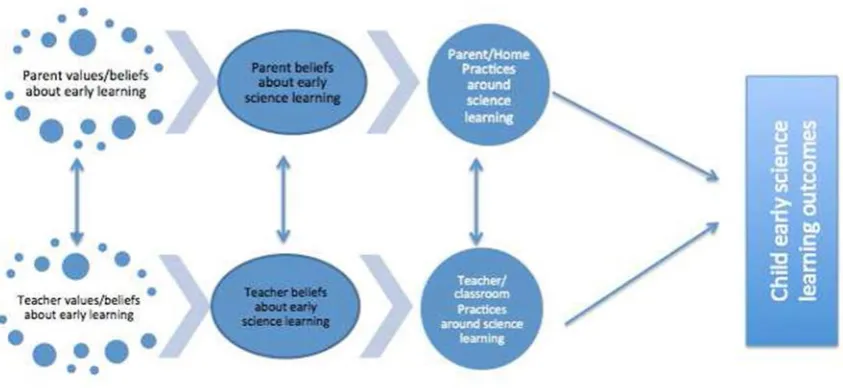
Rather than directly conveying scientific knowledge to children; preschool science education aims to allow them to learn these knowledge by experiencing and practicing (Aktaş-Arnas, 2002). Science education allows children to understand and learn their environment. With the help of science activities, children develop their learning skills, explore, obtain information about scientific methods like measuring, learn scientific language and special signs, conduct and explain experiments and participate in discussions (Curriculum For Excellence, 2004: 253; Dere and Ömeroğlu, 2001). Experiments play an important role in preschool science education activities. Experiments that are conducted in preschool education classes allow children to materialize abstract concepts and develop positive attitudes toward science (Alisinanoğlu, Özbey and Kahveci, 2011). Preschool children can learn more easily through concrete ways. Experiments are necessary for materializing abstract scientific concepts that children desire to investigate (Kandır et al., 2012). Children acquire not only scientific knowledge, but also scientific process skills with the help of experiments that are conducted in preschool science activities. From the middle of the 20th century, inclusion of all scientific process skills in science education programs has become important (Erten, Kiray and Sen-Gumus, 2013). Scientific process skills of preschool children include; observation, measuring, comparison, classification and communication (Alisinanoğlu, Özbey and Kahveci, 2007:14; Charlesworth and Lind, 2003; Kandır, Can Yaşar, İnal, et al., 2012:17; Keil, Haney and Zoffel, 2009). Choi (2016) explains the science learning of preschool children as in Figure 1.
Figure 1. Children’s development of early science learning (Source, Choi, 2016)
102
Sapsaglam & Bozdogan
children to recognize and select measuring instruments that are used in measuring various magnitudes via active-participant experiments. Thus, both the study and its potential results are considered important.
Study Objectıve
The objective of this study is to determine the effect of active-participant experiments upon the skills of preschool children (aged 48-60 months) to recognize and accurately select measuring instruments (meter, equal arm balance, dynamometer, graduated cylinder, thermometer and chronometer) that are encountered in daily life and used in measuring various magnitudes (length, mass, weight, volume, temperature, time).
Method
Action research, one of the qualitative research methods, was used in the study. Action research is suitable for the individuals who are directly related to the process to be developed and it can also be used to solve the professional problems a person meet in his field of expertise or to increase the quality of the work he does (Büyüköztürk, et. al., 2010). It was thought in the study conducted that the use of this method was suitable to determine the effect of active-participant experiments upon the skills of preschool children (aged 48-60 months) to recognize and accurately select measuring instruments that are encountered in daily life and used in measuring various magnitudes. Table 1 shows the study pattern.
Table 1. Study Pattern
Groups Pretest Procedure Posttest Permanence test
Experiment Informational questions
Experimental study (3 weeks)
Informational questions
Informational questions (5 weeks
later)
Procedure
1. Week: Visual measuring instrument of totally 6 questions, 3 of which were distracting, aimed at determining whether or not children were able to recognize appropriate measuring instruments used in measuring various magnitudes like mass, weight, volume, length, temperature and time in daily life was displayed for children by using a projector and a projection curtain and children were individually asked to answer the questions. Answers given by children to the questions were recorded by the researcher in writing. The process lasted for approximately 8 minutes for each child.
2. Week: In the experimental procedure stage, 2 different experiments were prepared for introducing equal arm balance, which is used measuring the mass, and dynamometer, which is used in measuring weight, and the experiments were applied with active participation of children. Each experiment lasted for approximately 35 minutes.
3. Week: The experimental procedure was sustained and 2 different experiments were prepared for introducing meter, which is used in measuring length, and chronometer, which is used in measuring time, and the experiments were applied with active participation of children. Each experiment lasted for approximately 30 minutes.
4. Week: In this final week of the experimental procedure, 2 different experiments were prepared for introducing thermometer, which is used in measuring temperature, and graduated cylinder, which is used in measuring volume, and the experiments were applied with active participation of children. Each experiment lasted for approximately 35 minutes.
5. Week: The measuring instrument that was applied in the 1st week after completing the experimental procedure was reapplied to children as a posttest in the computer environment. In that process, children individually answered the questions that were mirrored by computer and projection. Their answers were recorded by the researcher. The process lasted for approximately 7 minutes for each child.
mirrored by computer and projection. Their answers were recorded by the researcher. The process lasted for approximately 7 minutes for each child.
Working Group
Working group of the study was determined by using the technique of typical case sampling, which is among purposeful sampling methods. Typical case sampling is among the purposeful sampling methods used for determining the sample group in qualitative researches. In typical case sampling, it is aimed to have an opinion about a particular field by studying average conditions (Yıldırım and Şimşek, 2008). The study included totally 19 children (8 male and 11 female) aged 48-60 months, who were thought to show similar features to other children in this age group. All children in the working group showed a normal development.
Data Collection Tool
In order to collect the study data, the researchers developed a visual measuring instrument of totally 6 questions, 3 of which were distracting, aimed at determining whether or not children were able to recognize appropriate measuring instruments used in measuring various magnitudes like mass, weight, volume, length, temperature and time in daily life. The measuring instrument was developed based on the opinions of 2 preschool teachers and 3 academicians. In this context, the visual measuring instrument involved 6 questions aimed at using appropriate measuring instruments in measuring these concepts encountered in daily life and popular cartoon characters for children (Appendix 1). The visual measuring instrument was displayed for children using a projector and a projection curtain and children were individually asked to answer the questions. Answers given by children to the questions and their reasons were recorded by the researcher in writing.
Data Analysis
Statistical analyses of the data that were collected for sub-problems, which were tried to be answered within the frame of the general study objective, were conducted by using frequency. Numerical data were interpreted in graphics. Besides, opinions of children about measuring instruments were conveyed without making any changes.
Findings
Diagram 1 shows the data concerning the state of preschool children (aged 48-60 months) to recognize and select measuring instruments used in measuring various magnitudes that are encountered in daily life.
104
Sapsaglam & Bozdogan
Examining Diagram 1; 11 children responded ―right‖ and 8 children responded ―wrong‖ to the question, ―mass should be measured with equal-arm balance‖ in the pretest. However, at the end of the experimental study, it was observed that 16 children responded ―right‖ and 3 children responded ―wrong‖ to this question. In the permanence test, 15 children responded ―right‖ and 4 children responded ―wrong‖. Similarly, 9 children responded ―right‖ and 10 children responded ―wrong‖ to the question, ―weight should be measured with dynamometer‖ in the pretest. However, at the end of the experimental study, it was observed that 15 children responded ―right‖ and 4 children responded ―wrong‖ to this question. In the permanence test, 13 children responded ―right‖ and 6 children responded ―wrong‖. 14 children responded ―right‖ and 5 children responded ―wrong‖ to the question, ―length should be measured with meter‖ in the pretest. However, at the end of the experimental study, it was observed that 15 responded ―right‖ and 4 children responded ―wrong‖ to this question. In the permanence test, the posttest scores remained the same. 13 children responded ―right‖ and 6 children responded ―wrong‖ to the question, ―temperature should be measured with thermometer‖ in the pretest. However, at the end of the experimental study, it was observed that 15 children responded ―right‖ and 4 children responded ―wrong‖ to this question. In the permanence test, the posttest scores remained the same. 6 children responded ―right‖ and 13 children responded ―wrong‖ to the question, ―volume should be measured with graduated cylinder‖ in the pretest. However, at the end of the experimental study, it was observed that 9 children responded ―right‖ and 10 children responded ―wrong‖ to this question. In the permanence test, 8 children responded ―right‖ and 11 children responded ―wrong‖. Finally, 15 children responded ―right‖ and 4 children responded ―wrong‖ to the question, ―time should be measured with chronometer‖ in the pretest. However, at the end of the experimental study, it was observed that 18 children responded ―right‖ and only 1 child responded ―wrong‖ to this question. In the permanence test, the posttest scores remained the same.
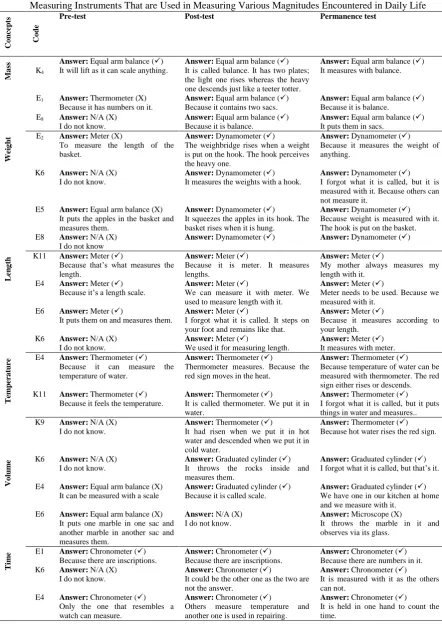
Examining Diagram 1; it was observed that children had preliminary information mainly about the necessity for measuring time with chronometer (f=15), which was followed by the necessity for measuring length with meter (f=14), temperature with thermometer (f=13), mass with equal-arm balance (f=11) and weight with dynamometer (f=9). On the other hand, children had minimum preliminary information about the necessity for measuring volume with graduated cylinder (f=6). However, as a result of the experimental study, an increase was observed in the rate of children to recognize and accurately select appropriate measuring instruments in measuring these concepts. In this context, 18 children stated, ―time should be measured with chronometer‖, 16 children stated, ―mass should be measured with equal-arm balance‖ and 15 children individually stated, ―weight should be measured with dynamometer, temperature with thermometer and length with meter‖ in the posttest. 9 children also stated, ―volume should be measured with graduated cylinder‖. As a result of the permanence test, there was a decrease at the least and it was determined that children continued to recognize and accurately select appropriate measuring instruments in measuring these concepts. In this context, 18 children stated, ―time should be measured with chronometer‖, 15 children individually stated, ―mass should be measured with equal-arm balance, temperature with thermometer and length with meter‖, 13 children stated, ―weight should be measured with dynamometer‖ and 8 children stated, ―volume should be measured with graduated cylinder‖ in the permanence test. Table 2 shows the opinions of preschool children (aged 48-60 months) about their state of recognizing and selecting measuring instruments that are used in measuring various magnitudes encountered in daily life.
Conclusion
The study results reveal that experiments being conducted are effective upon preschool children (aged 48-60 months) to recognize and accurately select measuring instruments used in measuring various magnitudes like mass, weight, length, temperature, volume and time that are encountered in daily life. In this context, it is seen that children’s active participation in experiments under the guidance of teachers provides an opportunity for permanent learning. Experiments are among basic learning methods in science education (Yıldız, Aydoğdu, Akpınar and Ergin, 2006:72). Experiments can be performed on many different topics in preschool education classes and these experiments will allow children to materialize abstract concepts (Alisinanoğlu et al., 2011; Kandır et al., 2012; Uyanık Balat and Önkol, 2010). Teachers have a tendency to show children scientific facts via experiments and science activities and they frequently apply to experiments in science activities (Merino et al., 2014; Özbek, 2009). Fleer (2013) suggests that teachers realize science education via counseling, material procurement, discussion or experiments. Preschool teachers primarily use scientific experiments and activities for the purpose of showing children the world (Choi, 2016).
have minimum preliminary information about the necessity for measuring volume with graduated cylinder and weight with dynamometer, which is associated with their inability to recognize these measuring instruments or perceive what they measure.
Table 2. Opinions of Preschool Children (Aged 48-60 Months) about Their State of Recognizing and Selecting Measuring Instruments That are Used in Measuring Various Magnitudes Encountered in Daily Life
C o n ce p ts C o d e
Pre-test Post-test Permanence test
M
a
ss K 4
Answer: Equal arm balance () It will lift as it can scale anything.
Answer: Equal arm balance () It is called balance. It has two plates; the light one rises whereas the heavy one descends just like a teeter totter.
Answer: Equal arm balance () It measures with balance.
E1 Answer: Thermometer (X)
Because it has numbers on it.
Answer: Equal arm balance () Because it contains two sacs.
Answer: Equal arm balance () Because it is balance.
E8 Answer: N/A (X)
I do not know.
Answer: Equal arm balance () Because it is balance.
Answer: Equal arm balance () It puts them in sacs.
We
ig
h
t E2 Answer: Meter (X)
To measure the length of the basket.
Answer: Dynamometer ()
The weighbridge rises when a weight is put on the hook. The hook perceives the heavy one.
Answer: Dynamometer () Because it measures the weight of anything.
K6 Answer: N/A (X) I do not know.
Answer: Dynamometer () It measures the weights with a hook.
Answer: Dynamometer () I forgot what it is called, but it is measured with it. Because others can not measure it.
E5 Answer: Equal arm balance (X) It puts the apples in the basket and measures them.
Answer: Dynamometer ()
It squeezes the apples in its hook. The basket rises when it is hung.
Answer: Dynamometer () Because weight is measured with it. The hook is put on the basket. E8 Answer: N/A (X)
I do not know
Answer: Dynamometer () Answer: Dynamometer ()
L
en
g
th
K11 Answer: Meter ()
Because that’s what measures the length.
Answer: Meter ()
Because it is meter. It measures lengths.
Answer: Meter ()
My mother always measures my length with it.
E4 Answer: Meter () Because it’s a length scale.
Answer: Meter ()
We can measure it with meter. We used to measure length with it.
Answer: Meter ()
Meter needs to be used. Because we measured with it.
E6 Answer: Meter ()
It puts them on and measures them.
Answer: Meter ()
I forgot what it is called. It steps on your foot and remains like that.
Answer: Meter ()
Because it measures according to your length.
K6 Answer: N/A (X) I do not know.
Answer: Meter ()
We used it for measuring length.
Answer: Meter () It measures with meter.
T emp er a tu re
E4 Answer: Thermometer () Because it can measure the temperature of water.
Answer: Thermometer ()
Thermometer measures. Because the red sign moves in the heat.
Answer: Thermometer () Because temperature of water can be measured with thermometer. The red sign either rises or descends. K11 Answer: Thermometer ()
Because it feels the temperature.
Answer: Thermometer ()
It is called thermometer. We put it in water.
Answer: Thermometer () I forgot what it is called, but it puts things in water and measures.. K9 Answer: N/A (X)
I do not know.
Answer: Thermometer ()
It had risen when we put it in hot water and descended when we put it in cold water.
Answer: Thermometer () Because hot water rises the red sign.
V
o
lu
m
e K6 Answer: N/A (X)
I do not know.
Answer: Graduated cylinder () It throws the rocks inside and measures them.
Answer: Graduated cylinder () I forgot what it is called, but that’s it.
E4 Answer: Equal arm balance (X) It can be measured with a scale
Answer: Graduated cylinder () Because it is called scale.
Answer: Graduated cylinder () We have one in our kitchen at home and we measure with it.
E6 Answer: Equal arm balance (X) It puts one marble in one sac and another marble in another sac and measures them.
Answer: N/A (X) I do not know.
Answer: Microscope (X)
It throws the marble in it and observes via its glass.
T
im
e
E1 Answer: Chronometer ()
Because there are inscriptions.
Answer: Chronometer () Because there are inscriptions.
Answer: Chronometer () Because there are numbers in it. K6 Answer: N/A (X)
I do not know.
Answer: Chronometer ()
It could be the other one as the two are not the answer.
Answer: Chronometer () It is measured with it as the others can not.
E4 Answer: Chronometer () Only the one that resembles a watch can measure.
Answer: Chronometer ()
Others measure temperature and another one is used in repairing.
106
Sapsaglam & Bozdogan
The study results show that children make information obtained from active-participant experiments meaningful by associating them with daily life. For instance, the child coded E4 responded ―equal arm balance‖ in the pretest and ―graduated cylinder‖ in the posttest and the permanence test to the question, ―What measuring instrument should measure volume‖. The child explained his reason for selecting the option in the permanence test as, ―We have one in our kitchen at home and we measure with it.‖ This answer proves that children make information obtained from experiments meaningful by associating them with daily life. Studies suggest that active-participant experiments conducted by children become more meaningful when they are associated with daily life. In their experiments, children may make generalizations on the basis of simple results (Şahin, 2000). Experiments help young children distinguish certain and uncertain information (Piekny and Maehler, 2013). Preschool teachers believe that activities like experiment, observation and estimation develop children’s scientific skills (Maier et al., 2013). Experimental activities at playschools allow children to comprehend oppositions and differences between various situations (Andersson and Gullberg, 2014).
The study results also reveal that the greatest increase in correct answers is observed in the necessity for measuring weight with dynamometer. While the number of children who gave correct answers in the pretest was 9; this number rose to 15 in the posttest. The minimum increase was observed in the necessity for measuring length with meter. In this context, while the number of children who gave correct answers to this question in the pretest was 14; this number rose to 15 in the posttest.
Recommendations
As a consequence, this study reveals that active-participant experiments conducted by preschool children are effective upon the skills of children to recognize measuring instruments and produce permanent results. In this context, the following recommendations are made.
Science activities play an important role for preschool children to explore their world. Thus, preschool educational environments should be supported by science materials.
Competence of preschool teachers concerning science education activities should be increased and vocational training opportunities should be given to teachers on this subject.
Science education activities should be involved more in preschool curriculums.
Parents should be supported for home-centered science education activities and for acquiring knowledge and skills on this subject.
Social awareness should be increased by organizing scientific activities like conference, congress and workshop aimed at preschool science activities.
Other scientific process skills of children should be investigated via active-participant experiments.
References
Akman, B., Üstün, E., & Güler, T. (2003). Altı yaş çocuklarının bilim süreçlerini kullanma yetenekleri. Hacettepe Üniversitesi Eğitim Fakültesi Dergisi, (24), s. 11-14.
Aktaş Arnas, Y. (2002). Okul öncesi dönemde fen eğitiminin amaçları. Çocuk Gelişimi ve Eğitim Dergisi, 6-7, 1–6.
Alisinanoğlu, F. Özbey, S. & Kahveci, G. (2011). Okul öncesinde fen eğitimi. Ankara: Maya Akademi.
Andersson, K. & Gullberg, A. (2014). What is science in preschool and what do teachers have to know to empower children? Cultural Study of Science Education, 9, 275–296.
Ayvacı, H. Ş., Devecioğlu, Y. & Yiğit, N. (2002). Okul öncesi öğretmenlerin fen ve doğa etkinliklerindeki yeterliliklerinin belirlenmesi. V. Ulusal Fen Bilimleri ve Matematik Eğitimi Kongresi Bildiri Kitabı, ODTÜ, Ankara.
Bronfenbrenner, U., & Morris, P. (2006). The bioecological model of human development. In W. Damon & R. Lerner (Eds.), Handbook of child psychology. NJ: Wiley.
Brunton, P. & Thornton, L. (2010). Science in the early years: building firm foundations from birth to five. UK: Sage Publications
Büyüköztürk, Ş., Çakmak E. K., Akgün Ö. E., Karadeniz, Ş. & Demirel, F. (2010). Bilimsel araştirma yöntemleri. Ankara: Pegema Yayıncılık.
Chang, N. (2012). The role of drawing in young children’s construction of science concepts. Early Childhood Education Journal, 40, 187–193.
Charlesworth, R.& Lind, K. (2003). Math and science for young children (Fourt Ed.) NY: Delmar.
Choi, B. (2016). Early science learning among low-income Latino preschool children: The role of parent and teacher values, beliefs, and practices. Doctoral Thesis, Unıversıty Of Calıfornıa, San Dıego: USA. Curriculum For Excellence. (2004). Education Scotland. 15 Kasım 2016 tarihinde
http://www.educationscotland.gov.uk/Images/all_experiences_outcomes_tcm4-539562.pdf sayfasından erişilmiştir.
Dere, H. & Ömeroğlu, E. (2001). Okul öncesi eğitimde fen, doğa, matematik çalışmaları. Ankara: Anı Yayıncılık.
Early, D., Iruka, I., Ritchie, S., Barbarin, O., Winn, D., Crawford, G. & Pianta, R. (2010). How do kindergarteners spend their time? Gender, ethnicity, and income as predictors of experiences in pre-kindergarten classrooms. Early Childhood Research Quarterly, 25(2), 177–193. doi:10.1016/j.ecresq.2009.10.003
Erden, F., & Sönmez, S. (2011). Study of Turkish preschool teachers’ attitudes toward science teaching. International Journal of Science Education, 33(8), 1149-1168.doi:10.1080/09500693.2010.511295. Erten, S., Kiray, S.A., & Sen-Gumus, B. (2013). Influence of scientific stories on students ideas about science
and scientists. International Journal of Education in Mathematics, Science and Technology, 1 (2), 122-137.
Fleer, M. (2013). Play in the early years. Port Melbourne: Cambridge University Press.
Gelman, R., Brenneman, K., MacDonald, G., & Román, M., (2010). Preschool pathways to science: ways of doing, thinking, communicating, and knowing about science. Baltimore: Brookes Publishing.
Güler, D. & Bıkmaz, F. (2002). Anasınıflarında fen etkinliklerinin gerçekleştirilmesine ilişkin öğretmen görüşleri. Eğitim Bilimleri ve Uygulamaları, 1(2), 249-267.
Kabadayı, A. (2006) Analyzing the preschoolers’ overgeneralizations of object labeling in the process of mother tongue acquisition in Turkey. Early Child Development and Care, 176 (7), 723-734.
Kabadayı, A. (2012). Okulöncesi çocuklarının türkçe ediniminde yaptıkları kurallaştırma hatalarının incelenmesi. Turkish Studies, 1561-73.
Kallery, M. (2004). Early years teachers’ late concerns and perceived needs in science: An Exploratory Study. European Journal of Teacher Educations, 27(2) 147-164.
Kandır, A., Can Yaşar, M., İnal, G., Yazıcı, E., Uyanık, Ö. & Yazıcı, Z. (2012). Etkinliklerle bilim eğitimi. Ankara: Efil Yayınevi.
Karaer, H. & Kösterelioğlu, M. (2005). Amasya ve Sinop illerinde çalışan okulöncesi öğretmenlerin fen kavramlarının öğretilmesinde kullandıkları yöntemlerin belirlenmesi. Kastamonu Eğitim Dergisi, 13 (2), 447-454.
Karamustafaoğlu, S. & Üstün, A. (2006). Okul öncesi öğretmen adaylarının fen ve doğa etkinliklerini uygulayabilme düzeylerinin belirlenmesi. Ondokuz Mayıs Üniversitesi Eğitim Fakültesi Dergisi, 21, 15-23.
Keil, C., Haney, J. & Zoffel, J. (2009). Improvements in student achievement and science process skills using environmental health science problem-based learning curricula. Electronic Journal of Science Education, 13 (1), 1-18.
Maier, M. F., Greenfield, D. B., & Bulotsky-Shearer, R. J. (2013). Development and validation of a preschool teachers' attitudes and beliefs toward science teaching questionnaire. Early Childhood Research Quarterly, 28 (2), 366-378. DOI: 10.1016/j.ecresq.2012.09.003
Martin, D. J., Jean-Sigur, R., & Schmidt, E. (2005). Process-oriented inquiry—a constructivist approach to early childhood science education: teaching teachers to do science. Journal of Elementary Science Education, 17(2), 13–26.
Martin, D. J. (2011). Elementary science methods: a constructivist approach. USA: Cengage Learning.
Merino, C., Olivares, C., Navarro, A., Ávalosb, K. & Quirogac, M. (2014). Characterization of the beliefs of preschool teachers about sciences. Procedia - Social and Behavioral Sciences 116 ( 2014 ) 4193 – 4198 NAEYC (2014). Early Childhood Program Standards and Accreditation Criteria & Guidance for Measuring.
10 Ekim 2016 tarihinde http://www.naeyc.org/files/academy/file/AllCriteriaDocument.pdf adresinden erişilmiştir.
National Research Council. (2007). Taking science to school. Washington, DC: National Academies Press. Özbek, S. (2009). Okul öncesi öğretmenlerinin fen eğitimine ilişkin görüşleri ve uygulamalarının incelenmesi.
Yüksek Lisans Tezi, Çukurova Üniversitesi Sosyal Bilimler Enstitüsü, Adana.
108
Sapsaglam & Bozdogan
Saçkes, M., Trundle, K. C., & Flevares, L. M. (2009). Using children’s literature to teach standard-based science concepts in early years. Early Childhood Education Journal, 36, 415–422.
Schulz, L. E., & Bonawitz, E. B. (2007). Serious fun: preschoolers engage in more exploratory play when evidence is confounded. Developmental Psychology, 43 (4), 1045-1050.
Sundberg, B., & Ottander, C. (2014). “Science in Preschool – A Foundation for Education for Sustainability? A View from Swedish Preschool Teacher Education.” In Research in Early Childhood Education for Sustainability. International Perspectives and Provocations, edited by S. Elliott and J. Davis, 280–293. Routledge.
Şahin, F. (2000). Okul öncesinde fen bilgisi öğretimi ve aktivite örnekleri. İstanbul: Ya-Pa Yayınları.
Taş, I. (2010). Etnografik bakış açısıyla kırsal kesimde okul öncesi fen eğitimine yönelik bir durum çalışması. Yüksek Lisans Tezi, Anadolu Üniversitesi, Eğitim Bilimleri Enstitüsü, Eskişehir.
TDK. (2016). Büyük Türkçe sözlüğü. Ankara: TDK Yayınları.
Uyanık Balat, G. & Önkol, F.L. (2010). Okul öncesi dönemde fen eğitimi öğretim yöntemleri. B.Akman, G. Uyanık Balat & T. Güler (Editörler), Okul öncesi dönemde fen eğitimi (s.89-126). Ankara: Pegem Akademi.
Ünal, M. & Akman, B. (2006). Okul öncesi öğretmenlerinin fen eğitimine karşı gösterdikleri tutumlar. Hacettepe Üniversitesi Eğitim Fakültesi Dergisi, 30, 251-257.
Yıldırım, A. & Şimşek, H. (2008). Sosyal bilimlerde nitel araştırma yöntemleri. Ankara: Seçkin Yayıncılık. Yıldız, E., Aydoğdu, B., Akpınar, E. & Ergin, Ö. (2006). Fen bilgisi öğretmenlerinin fen deneylerine yönelik
tutumları. Boğaziçi Üniversitesi Eğitim Dergisi, 24 (2), 71-86.
Author Information
Özkan Sapsağlam Gaziosmanpaşa University Faculty of Education
Contact e-mail: [email protected]
Appendix 1. Sample Questions about Measuring Instruments
Keloğlan wants to measure the weight of the apples he had bought from the market place. Which of the following measuring instruments should he use?
Tom burns the oven to boil water and the water starts boiling. Which of the following measuring instruments can measure the temperature of the boiling water?