IJSRST16257 | Received : 05 Sep 2016 | Accepted: 09 September 2016 | September-October-2016 [(2)5: 08-14]
© 2016 IJSRST | Volume 2 | Issue 5 | Print ISSN: 2395-6011 | Online ISSN: 2395-602X Themed Section: Science and Technology
08
Case Study of R&D Process Optimization of the Wall Tap
Chin-Chiuan Lin *
1, Huang-Pin Chan
2, Chang-Jiang Lee
3, Yi-Chang Chen
4 *1Professor of Department of Business Administration, Kun Shan University, Taiwan, R.O.C.2
Manager of R&D Department, I-S Limited Co., Taiwan, R.O.C. 3
Associate Professor of Department of Business Administration, Kun Shan University, Taiwan, R.O.C. 4
Assistant Professor of Department of Business Administration, Kun Shan University, Taiwan, R.O.C.
ABSTRACT
The R&D process of the new 3C products in addition to successful completed the customer demand for products and projects, but also must be fast and in timeliness. The present study employed focus group and Scrum methodology to optimize the process through improve the product design, manufacture plan, and patent avoidance within R&D activities. Results showed that the total development time of new product was reduced about 30% after introduced the optimize process.
Keywords: R&D process, Focus group, Scrum
I.
INTRODUCTION
With a wide range of new 3C (computer, consumer, and communication) products, the number of wall socket is far less than the needed of a house. Therefore, the wall tap become the preferred choice to expand the number of socket for users due to without any professional construction and able to immediately provide connection of all kinds of 3C products. Wall tap without power cord and direst plug-in the wall socket, therefore, is the most convenient product for expansion socket. Table 1 illustrates some type of wall tap produced by case company.
Moreover, due to the rapid developed of new electrical products, the new types of wall tap also need to develop corresponding, for example, added USB connector in the wall tap (eg. Type of R-63OL). However, the original design manufacture (ODM) of a new product in addition to successful satisfied the customer demand for products and projects, but also must be fast and in timeliness.
TABLEI
ILLUSTRATES SOME TYPE OF WALL TAP
PTR-016 PTR-013
R-63OL R-25BL
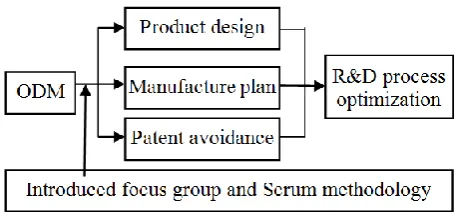
Therefore, the present study aims to optimize the research and develop (R&D) process of the wall tap to meet the customer demand on time. Figure 1 shows the research structure of the present study. The present study employed focus group and Scrum methodology to optimize the process through improve the product design, manufacture plan, and patent avoidance within R&D activities.
Figure 1:Research structure
II.
METHODS AND MATERIAL
1. Literature Review
A. Focus Group Methodology
There are many definitions of focus group in the literatures, features like organized discussion (Kitzinger, 1994), collective activity (Powell et al., 1996), social events (Goss & Leinbach, 1996) and interaction (Kitzinger, 1995) identify the contribution that focus group make to social research. Kitzinger (1994) introduced focus group methodology, explores ways of conducting such groups and examines what this technique of data collection can offer researchers in general and medical sociologists in particular. Powell et al. (1996) define a focus group as a group of individuals selected and assembled by researchers to discuss and comment on, from personal experience, the topic that is the subject of the research. Goss & Leinbach (1996) indicated that focus groups are receiving increasing attentions as a means to obtain qualitative data in an interactive context. Kitzinger (1995) indicated that focus group has advantages for researchers in the field of health and medicine.
Focus group is under-used in social research, although it has a long history in market research (Morgan, 1988), and more recently in medical research (Powell & Single, 1996). Morgan (1988) extensively revised edition of the best-selling focus group as qualitative research continues to provide an excellent guide for researchers across the disciplines. Powell & Single (1996) introduced focus group methodology and discussed its relevance to those researching health care provision.
Morgan (1996) indicated that over the past several decades, focus group and group interviews have reemerged as a popular technique for gathering
qualitative data, both among sociologists and across a wide range of academic and applied research areas. Focus group is currently used as both a self-contained method and in combination with surveys and other research methods, most notably individual, in-depth interviews. Morgan (1996) also pointed out that the advantages of focus group can be maximized through careful attention to research design issues at both the project and the group level. Important future directions include: the development of standards for reporting focus group research, more methodological research on focus groups, more attention to data analysis issues, and more engagement with the concerns of the research participants.
Morgan (1997) further indicated that focus group is a form of group interviewing but it is important to distinguish between the two. Group interviewing involves interviewing a number of people at the same time, the emphasis being on questions and responses between the researcher and participants. Focus group however rely on interaction within the group based on topics that supplied by the researcher. Focus groups can be used at the preliminary or exploratory stages of a study (Kreuger, 1988), during a study (Race et al., 1994), or after a program has been completed. Focus group also can help to explore or generate hypotheses (Powell & Single, 1996) and develop questions or concepts for questionnaires and interview guides (Hoppe et al., 1995; Lankshear, 1993).
Stewart & Shamdasani (2014) proposed the procedures of focus group: (1) Elaboration research problem; (2) Confirm sampling frame; (3) Determine
host and the focus group moderator; (4)
Development interview outline; (5) Recruiting focus group participants and designing the interview guides; (6) Conducting the focus group; (7) Analyzing focus group data; and (8) Writing reports.
Therefore, the present study employed focus group method to generate further avenues of R&D process.
B. Scrum
and feasibility technology of project management. Scrum is a rugby term for the scrum during the match of the ceremony. It emphasized the importance of teamwork in new product development, advocated an outstanding team needs to be given to the target rather than the task. Scrum is a product development approach, it included uncertainty and creativity in the
development cycle, promote information
transparency, team communication, and cooperation. Moreover, the demand changes of the customer also joined in the development cycle, with the constant evolution and adjustment cycle.
Scrum stressed the high degree of transparency and closed daily collaboration. This is the exactly key feature that the Scrum seemingly simple but in reality is not easy.
Scrum not only a new product development project management tool, but also a model of teamwork and philosophy. Nowadays, Scrum has been recognized as the most practical software development framework, moreover, the application fields had expanded into manufacturing, marketing, operations, and education.
1) Expand Scrum Project: There are four steps of the Scrum project. Table 2 shows the expand summary of Scrum project.
TABLEIII
EXPAND SUMMARY OF SCRUM PROJECT
Organize Envision
Pick a product owner: 1. Assemble your Scrum
team.
2. 3-9 people with right skills.
3. Selected a Scrum master.
Develop product backlog: 1. Create a roadmap. 2. Prioritize by value. 3. Refine and estimate the
entire project.
Develop Adapt
Run sprints: 1. Plan.
2. Work.
3. Demo or review. 4. Analyse and learn.
Let users try the product: 1. Get user feedback. 2. Incorporate those ideas
into product backlog. 3. Update and evolve.
To start and run a Scrum project, below shows how to go about it:
a) Organize: Pick a product owner: Every Scrum project needs a product owner. This will be the person who has the vision of what you want to do or accomplish. (i) Assemble your Scrum Team, 3-9 people with right skills: Scrum teams are the people who actually do the work involved. They need to be made up of people who have the skills needed to take the product owner's vision and make it a reality. (ii) Select a Scrum master: The Scrum master has a very specific role. He or she is not really a manager as such. The Scrum master is kind of a team captain, a coach and a facilitator. b) Envision: Develop product backlog: (i) Create a
roadmap: The product backlog is a high-level list of everything that needs to get done to make the vision a reality and is the roadmap which everyone understands and uses. (ii) Prioritize by value: The real aim of Scrum is to get a "minimum viable product" (MVP) into the hands of future customers as early as feasible and get their feedback. (iii) Refine and estimate the entire project: Note also having a dynamic and actively managed product backlog lowers risk. With Scrum, you don't have to guess what customers are thinking. Instead, show-and-tell and then find out what they think based on using what you do. It's a much smarter way to do product development.
c) Develop: Run sprints: (i) Plan: The Scrum master and the product owner meet together to plan sprints. (ii) Work: The team then selects the items from the product backlog they will complete in this sprint. (iii) Demo or review: The sprint ends with a demo where the team shows where they are at with the product. (iv) Analyse and learn: After the product demo, then get the team together for a retrospective.
d) Adapt: Let users try the product: (i) Get user feedback: Allowing customers to get hands-on experience with the product as it is being developed is one of the central and defining characteristics of Scrum. (ii) Incorporate those ideas into product backlog: The Scrum approach of getting early feedback is demonstrably better. (iii) Update and evolve: Scrum forces you to think in terms of priorities for the product specifications.
2) The Advantages of the Scum.
b) Sprints generate momentum: In traditional projects, you don't get any feedback on how things are going until completion and that might be many months in the future. Sometimes, that means you're heading in the wrong direction for weeks or even months without even realizing it. At other times, what seemed like a good idea at the start of the project is now irrelevant because the marketplace has changed. Having periodic sprints where you work intensively on getting something done and then stop to do a reality check avoids those problems.
c) You get immediate, ongoing feedback: When you do a project using Scrum, you break the work up into bite-sized chunks based around making stories come to life. You then measure how much work you get done in each sprint and at the end of each sprint, you figure out how to improve your velocity by removing barriers and working smarter. d) You can fail fast and fail often: Pretty much every
workplace study which has ever been conducted has concluded that happy people are more productive. Scrum makes employees happy, enthusiastic and engaged. Rather than having unrealistic plans forced on them from on high, Scrum teams plan their own agendas and motivate themselves. Employees have the chance to learn and grow. The end result is you get a motivated and engaged workforce.
e) Everyone gets to inspect and adapt: Transparency is part and parcel of Scrum. Everyone can see what's coming at all times. That means your sales team, for example, know what features your products will have so they can be developing marketing ideas even before the launch happens. Everyone will also have a fair idea when the product will be rolled out. That's a great way for the company to operate.
f) You plan reality, not fantasy: How can you get Scrum going where you work? The steps are: (i) Put together a product backlog and a team for something you're working on. (ii) As a team, articulate the vision you have for your product or service or whatever. (iii) Decide on a week's worth of backlog you will tackle together in the coming week. (iv) Recruit or appoint someone to be the product owner. (v) At the end of your first week, get the entire team together and ask: "What can we be doing differently in the future to produce more value?" (vi) Be totally transparent. (vii) Get demo versions of what you're working on in front of
future customers each week and see what they think. (viii) Remind everyone you will be evaluated on revenue and costs.
g) Scrum can be used anywhere: While admittedly Scrum emerged from the field of software development, it can be used anywhere.
h) Everyone acts autonomously: In Scrum, you have a product owner who is a leader but not the boss.
2. R&D Activities
C. Product Design
ODM is one of the main sources of products, wherein, most of the customers’ products only propose their demand without clear conception and design. Therefore, the R&D department need communicate with customers to define the features and functions of the product. After that, appearance design, type selection, design for manufacturability assessment, cost analysis, and preliminary offer can be preceded.
Generally, the design procedures of wall tap includes: (1) Industrial design: concept generation, exterior design, to review and change, 3D modeling, and mockup. (2) Mechanism design: safety reliability assessment, decomposition mechanism, systematic design, and prototype. (3) Electronic design: apply existing specifications, redesign, layout, proofing test, and test manufacturing. (4) Final test: clients’ interior regulatory standards and safety test. In addition to the cost, manufacturing, construction, and safety issues, appearance designs usually associated with great diversity of the market segmentation and the culture of different regions.
D. Manufacture Plan
Manufacture plan mainly on the number of manufacturing, quality control, manufacturing time, manufacturing process, capacity planning, and other issues. Planning object is integration the supply side and demand side with time in order to meet customer demand and manufacture plan. Manufacture plan can be reviewed by 5M1E analysis for the new products. The 5M1E analysis is described below:
1) Manpower: is the most active factor of production productivity, is the most difficulty in site management, and is the core to prevent accidents.
3) Material: including tools, materials, equipments, helmets, and gloves which auxiliary production.
4) Method: refers to the rules, regulations and other management levels which including rules and regulations, procedures and process standards.
5) Measurement: refers to the scene to examine the use of various instruments, meters, also includes a method of measurement procedures and standards.
6) Environment: includes work-site temperature, humidity, lighting, and cleaning conditions, also includes work atmosphere, the mood of the staff members, and relationships among staffs.
E. Patent Avoidance
1) The importance of avoidance: (a) Patent around is one way for enterprises to against competitors of the patent litigation and avoid falling into the accusation of malicious infringement. (b) Patent avoidance can shorten the product development cycle time and allowing quick access to commodity markets for the technology followers.
2) The use of patent information: (a) Patent search includes patent number, country, competitor, patent inventor and patentee distribution, patent citations, research, and development capabilities competitions. (b) Patent analysis includes management chart analysis, technical chart analysis, and patent citation analysis diagram. (c) Technical information includes avoid patent information, information technology research and development, licensing partnership information, litigation negotiation information. (d) Business decision includes patent applications, patent avoidance, expositions rival patent cross-licensing, authorization, and patent monitoring.
3. Outline of Wall Tap Industry
Wall tap market has many brands, such as: Belkin
(USA), SONMUSE (USA), DENKI (USA),
PHILIPS (Netherlands), Kharma (Netherlands),
Panasonic (Japan), audio-technica (Japan),
TRIPP.LITE (USA), ELPA (Japan), Matsushita (Japan), Simon (Spain), and Siemens (Germany).
The vertical integration of wall twp manufacturers need control from the raw materials, metal parts, plastic injection, application and testing of electronic parts, extension cords, product manufacturing and logistics. These broad ranges of business increase
loading of R&D department, these also test the enterprise management strategy at the same time.
III. RESULT AND DISCUSSION
F. Outline of the Case Company
Case company (I-S Limited Co.) is the leading company and setup at 1986 in Taiwan. There are more than 15 thousands employees in the world and the annual revenue was about NT$ 10 billion. The business philosophy and business scopes are the major contents for understand the case company.
1) Business philosophy: (a) Quality priority: case company pursuit of quality first, “outstanding talent- make the quality control become habits, and excellent product- make the customer always trust and satisfaction” is the quality policy of case company; (b) Positive innovation: continued modify and subversive innovation, improved quality of products and flexible the organizational strategy, and innovative marketing model become the driving force of growing. (c) Employee participation the operation: to build into a jointly owned by all colleagues and to share the business benefits; (d) International sales: carefully planned the coordinate of production and sales, and promoted the company’s first-class products to the world; and (e) Supreme of customer: establish a customer-centric concept that think the customers’ thinking, anxious the customers’ anxious, and meet the needs of customers.
2) Business scopes: (a) Cord set and connector of CRT and LCD monitor; (b) Cord set and connector of PC and notebook; (c) Cord set and connector of household appliances and consumer electronics; (d) Various specifications of the power transmission cable; (e) Cord set and connector of digital cameras and video camera; (f) L.A.N cable of UTP and STP; (g) Power strip; (h) Electronic signal and optic cables; and cable & connector used PVC pellets.
G. Current R&D Process
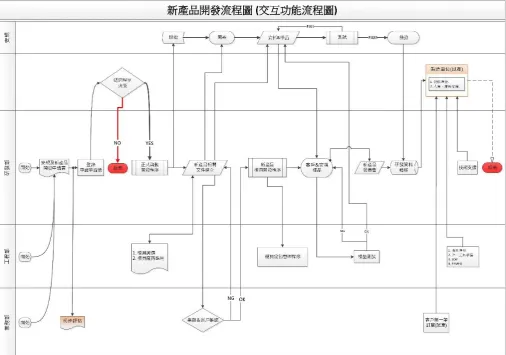
The preliminary assessment result then adjudicated by the general manager.
When a new product is determined to develop, the formal development process mainly includes: appearance design, mechanism design, mold design,
package and brand card design, prototype
manufacture, manufacture proofing, factory test, and obtain safety certification.
H. R&D Process Optimization
The total time of above product development process was about 221 days. Excludes 90 days of the obtain safety certification, there is still about 131 days for product development process. For the aimed to optimize R&D process of new product development. The present study introduced Scrum method to reduce the process and time of new product development.
1) Appearance design: Customer, marketing
department, and R&D department need to identify the appearance design of the new product. The identify day of appearance design usually less than 7 days, however, there is about 25 days of the case company.
2) Mechanism and mold design: Employed
concurrent engineering can reduce about 23 days of waiting time in mechanism and mold design process.
Package and brand card design: R&D department need construct the sold model and transfer into 2D drawing when customer provided the frame size. The operation time of package and brand card design was about 7-14 days in the industry. Employed concurrent engineering also can reduce about half operation time. Blister is one of the most frequently used packaging materials.
IV. CONCLUSION
The present study employed focus group and Scrum methodology to optimize the process. After perform the improvement process. Results showed that the total development time of new product was reduced about 30% after introduced the optimize process. This reduced time might greatly improve the competitiveness and customer satisfaction of the case company.tables in the conclusion—these should be referenced in the body of the paper.
V.
REFERENCES
[1] Burgess, J. (1996). Focusing on fear, Area, 28(2): 130-136.
[2] Hoppe, M. J., Wells E. A., Morrison D. M., Gilmore M. R. & Wilsdon A. (1995). Using focus groups to discuss sensitive topics with children. Evaluation Review, 19 (1): 102-114. [3] Gibbs, A. (1997). Focus groups. Social Research
Update, 19(8), 1-8.
[4] Goss, J. D. & Leinbach T. R. (1996). Focus groups as alternative research practice. Area, 28(2): 115-123.
[5] Kitzinger, J. (1994). The methodology of focus groups: the importance of interaction between research participants. Sociology of Health & Illness, 16(1), 103-121.
[6] Kitzinger, J. (1995). Qualitative research. Introducing focus groups. BMJ: British Medical Journal, 311(7000): 299.
[7] Kreuger R. A. (1988). Focus groups: a practical guide for applied research. London: Sage.
[8] Lankshear A. J. (1993). The use of focus groups in a study of attitudes to student nurse assessment. Journal of Advanced Nursing, 18: 1986-89.
[9] Merton R. K. & Kendall P. L. (1946). The Focused Interview. American Journal of Sociology, 51: 541-557.
[10] Morgan D. L. (1988). Focus groups as qualitative research. London: Sage.
[11] Morgan, D. L. (1996). Focus groups. Annual review of sociology, 129-152.
[12] Munodawafa D., Gwede C. & Mubayira C. (1995). Using focus groups to develop HIV education among adolescent females in Zimbabwe. Health Promotion, 10 (2): 85-92.
[13] Powell R. A. & Single H. M. (1996). Focus groups. International Journal of Quality in Health Care, 8(5): 499-504.
[14] Powell R. A., Single H. M. & Lloyd K. R. (1996). Focus groups in mental health research: enhancing the validity of user and provider questionnaires. International Journal of Social Psychology, 42(3): 193-206.
[15] Race K .E., Hotch D. F. & Parker T. (1994). Rehabilitation program evaluation: use of focus groups to empower clients. Evaluation Review, 18(6): 730-740.
[16] Stewart, D. W. & Shamdasani, P. N. (2014). Focus groups: Theory and practice, 3rd editions (Vol. 20). Sage Publications.
[17] Sutherland, J. (1993a). Scrum and Lean.
[20] Sutherland, J. (1993d). The Roots of Scrum: How the Japanese experience changed global.
[21] Sutherland, J. (1996). Scrum Web Home Page: A Guide to the SCRUM Development Process. Jeff Sutherland’s Object Technology Web Page.
[22] Schwaber, K. (1997). Scrum development process. In Business Object Design and Implementation (pp. 117-134). Springer London.
[23] Schwaber, K., & Sutherland, J. (2011). The Scrum guide. Scrum Alliance.
[24] White G. E. & Thomson A. N. (1995). Anonymized focus groups as a research tool for health professionals. Qualitative Health Research, 5(2): 256-261.
Appendix