www.orientjchem.org
An International Open Free Access, Peer Reviewed Research Journal CODEN: OJCHEG
2017, Vol. 33, No.(5): Pg. 2324-2328
Comparative Study of Radiation Shielding Parameters for
Binary Oxide Glasses
RAJINDER SINGH KAUNDAL*
Department of Physics, School of Physical Sciences, Lovely Professional University, Phagwara, Punjab-144411,India.
http://dx.doi.org/10.13005/ojc/330522
(Received: July 17, 2017; Accepted: August 20, 2017)
ABSTRACT
Melt and quench technique was used for the preparation of glassy samples of the composition
0.40 MO-0.60 B2O3 where MO contains oxides of lithium, sodium, potassium and bismuth. XCOM
computer program is used for the evaluation of gamma-ray shielding parameters of the prepared glass samples. Further the values of mass attenuation coefficients and effective atomic number at various photon energies is calculated. Values of half value layers have been compared with concretes. Density and molar volume studies have been carried out to get the idea regarding rigidity of glass network.
Keywords: Borate Glasses, Mass attenuation coefficient, Half value layer,
Effective atomic number.
INTRODUCTION
The study of interaction of nuclear radiations with matter is the important research area for the development of materials which can be used in high radiation environment.These radiation shielding materials have great importance for many scientific, engineering and medical applications. The data based on mass attenuation coefficient and half value layer is very useful for the purpose to identify the various radiation shielding materials. In the environment of high radiation exposure concrete is used as radiation shielding material because it is cheap and it can be molded easily into any desired design. In spite of all these advantages some limitation are also associated with the concretes like it is not transparent to visible light thus restricting one to see through it. Secondly when
it is exposed to the radiations for a longer period of time its mechanical strength is reduced. So it is desired to have materials which are transparent to visible light and have better shielding properties in terms of lesser volume requirement. Now a days heavy metal glasses are proving to be the promising candidates as an alternate to the conventional shielding material like concrete1-5. These have
considerable technological applications due to their density, high refractive index and low melting point6-7.
MATERIALS AND COMPUTATIONAL METHOD
Sample preparation, X-ray and density measurements
sample preparation were of analytical reagent (AR) grade having percentage purity of 99.9%. Appropriate amounts of Li2CO3, Na2CO3, K2CO3, Bi2O3, and H3BO3 were mixed thoroughly. Mixture was then taken in porcelain crucible and was melted and the melt was kept at the same temperature for 2 hours. Melt was quickly poured into preheated moulds in the temperature region of 200 to 250oC
followed by cooling down to room temperature.
Densities of the samples at room temperature were measured by using Archmede’s principle with Benzene as immersion liquid. Glass samples were weighed in air and when immersed in Benzene at 200C. The density was calculated by
using the formula.
Where ρ is the density of glass sample, a is weight of sample in air, b is weight of glass sample in Benzene and 0.787 is the density of Benzene at 200C. Chemical composition along
with density and molar volume of the prepared glass samples is given in table 1.
To confirm the amorphous nature glass samples XRD measurements were carried out on the prepared samples. Samples were crushed to fine powder form for X-ray diffraction studies. A Philips PW 1710 diffractrometer was used during the investigations. Radiation used was CuKa. The pattern was recorded at a scanning rate (2θ/s) of 0.030 with start angle (2θ) at 5.0100 and end angle
(2θ) at 60.00
. Absence of crystallization peak in XRD
data shows that prepared samples are amorphous.
Linear attenuation coefficients and effective atomic number
The mass attenuation coefficient of prepared samples is evaluated by using WIN XCOM3-4 developed by NIST. Several authors and
researchers have experimentally measured mass attenuation coefficients of different materials including silicate and borate glasses. Excellent agreement has been observed between the experimental and theoretical data obtained by XCOM software. In light of this it is possible to estimate mass attenuation coefficient for our glass system with reasonable accuracy by XCOM software8-10.
p= a/(a-b)x 0.787 (1)
HVL have been determined by mass attenuation coefficient by using the relation.
Effective atomic number can be calculated by using relation.
where the average atomic cross-section,
σt,a is evaluated by using equation.
HVL=0.693/μ (2)
Zeff = σt ,a/σt,el (3)
σt,m is the total molecular interaction
cross-section.
σt ,a = σt ,m/ Σjnj (4)
σt,m = (μ/p)M/NA,Where M=njAj is the mole
mass,NA is Avogadro's constant and nj and Aj are the number of formula units and atomic weight, respectively of constituent elements.
Average electronic cross-section, σt,el is given by
σt,el = 1/NA,ΣfjAj/Z(μ/p) (5)
where fi = ni/ Σnj is fractional abundance of element i with respect to number of atoms and Zi is atomic number of i element.
RESULTS AND DISCUSSIONS
Density and molar volume
Density and molar volume values of the prepared samples are shown in table1. The values of density increase from GS1 to GS4 showing the effect of changing a light metal atom with the heavier metal atom. The values of molar volume also show linear increase depicting that structure becomes more and more open as light metal atom is changed with heavier one.11 The value of molar volume is
maximum for the composition corresponding to Bi. It can be due to the fact that Bi ions play dual role in the glass structure. At higher mole fraction the role of Bi ions in the glass structure is of glass former.
Linear attenuation coefficients
attenuation coefficients as evident from table 2 shows rapid decrease attaining minimum value in the intermediate energy range. As one moves from intermediate energy range corresponding to Compton scattering region to high energy range corresponding to pair production the values of mass attenuation coefficient first show increase and
at very high values of the energy the values become almost constant.12-13
Effective atomic numbers and half value layer The scattering and absorption of gamma radiations are related to the effective atomic number of the materials. These values are calculated using equation 3 and variation for the prepared samples
Table. 1: Chemical compositions, density (r), molar volume (Vm).
Sample Name Li2O Na2O K2O Bi2O3 B2O3 r(gcm-3) V
m (cm 3 mol-1)
GS1 0.40 ….. ….. ….. 0.60 2.29 23.46026
GS2 ….. 0.40 ….. ….. 0.60 2.44 27.28033
GS3 ….. ….. 0.40 ….. 0.60 2.32 34.31552
GS4 ….. ….. 0.40 0.60 5.79 39.40794
Table. 2 : Mass attenuation coefficients for prepared glass samples at different energies.
Sample Mass Attenuation coefficient μμμμμ/p (cm2/g)
0.001 0.01 0.1 1 MeV 10 MeV 100 1000 10000 100000
MeV MeV MeV MeV MeV MeV MeV
GS1 3328 4.238 0.1486 0.06166 0.0195 0.01548 0.01817 0.01901 0.01916
GS2 2847 7.696 0.1529 0.06203 0.02049 0.01786 0.02116 0.0221 0.02227
GS3 3832 34.04 0.1838 0.06232 0.02277 0.02355 0.02839 0.02968 0.02989
GS4 5023 101 4.245 0.06962 0.04222 0.07349 0.09025 0.0938 0.09434
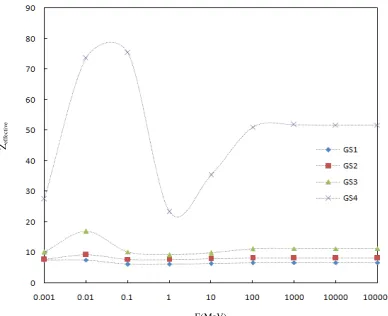
is shown in Fig. 1. It can be seen from the figure that for all the samples the Z eff steadily increases up to 10-2 MeV, then it steadily decreases up to 100 MeV
after which it increases up to 102 MeV after this
energy the values of Zeff almost remains constant. The variation of Zeff, value with energy for the samples materials may can be assigned due to the relative domination of different mechanisms mainly photoelectric effect, coherent scattering and incoherent scattering. At low energies, where photoelectric effect dominates, Zeff is more and at higher energies, where scattering dominates, Zeff is less14. Therefore, the Z
eff for total gamma ray
interaction varies from a higher value at lower energies to a lower value at higher energies depending on the relative domination of the partial gamma ray interaction processes. Effective atomic numbers increases linearly as we change the light metal atom with heavier metal atom. Value of effective number is maximum for the sample containing Bi atom. i.e. sample GS4 .Half value layer parameter is calculated from the linear
E(MeV)
Zef
fe
ct
iv
e
Fig. 1. Plot of Effective atomic number for the prepared glass samples as a function of photon
energy.
T a bl e . 3: HVL v alues f
or prepared glass samples at diff
erent ener gies Sample HVL( cm) 0.001 0.01 0 .1 1 M e V 1 0 M e V 1 0 0 1 0 0 0 10000 100000 MeV MeV MeV MeV MeV MeV MeV G S 1 9.1E-05 0.071427 2.037062 4.9093 15.52346 19.55474 16.65974 15.92359 15.79893 G S 2 9.98E-05 0.036915 1.858066 4.580015 13.86522 15.90696 13.4262 12.85513 12.757 GS3 7.8 E-05 0.008778 1.625643 4.794498 13.12223 12.68761 10.52459 10.06715 9.96424 G S 4 2.38E-05 0.001185 0.028203 1.719673 2.83571 1.629115 1.326578 1.276372 1.269066 T a b le . 4:
Chemical composition of concretes
HVL is not only composition dependent but it also dependent upon the density of material which is further related to the structural arrangements of constituents of composite material. This parameter is very important for the materials to be used as the radiation shield. For this purpose,
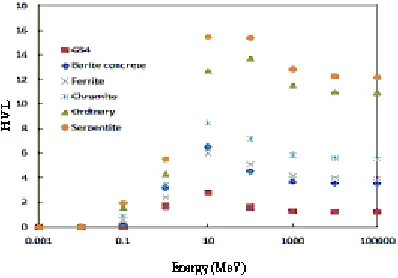
HVL values of the prepared glasses have been compared with some standard radiation shielding concretes (Table 4). For this glass sample GS4 is taken for the comparison purpose since its HVL value is minimum among all the prepared glass samples. Fig. 2 shows comparative plot of the HVL value for various concretes and GS4 sample. It can be clearly seen that for the prepared sample (GS4), value of HVL at all the energies is lesser than the concretes.
CONCLUSIONS
Bi containing grasses are found to have lowest HVL values in all the prepared samples. It is concluded that the Bi containing glasses can be used as an alternate to the radiation shielding materials. Further these are transparent to visible light and require lesser volume as compared to concretes which are opaque and require much larger volume.
REFERENCES
1. Singh, N.; Singh, K.J.; Singh, K.; Singh, H. Radiation Measurements, 2006, 41(1), 84-88.
2. Singh, K.J.; Singh, N.; Kaundal, R.S.; Singh, K. Nuclear Instruments and Methods in Physics Research Section B: Beam Interactions with Materials and Atoms. 2008, 266(6), 944-948.
3. Singh, N.; Singh, R.; Singh, K.J.; Singh, K. Glass Technology. 2005, 46(4), 311-314. 4. Stentz, D.; George, H. B.; Feller, S. E.;
Affatiogato, M. Phys. Chem. Glasses. 2000, 41, 406-408.
5. Watanabe, T.; Muratsubaki, K.; Benino, Y.; Saitoh, H.; Komatsu, T. J. Mater. Sci. 2001, 36, 2427-2433.
6. Singh, K.J.; Kaur, S. Annals of Nuclear Energy. 2014, 63, 350-354.
7 Bashter, I. Annals of Nuclear Energy. 1997, 24(17),1389-1401.
8. Yasaka, P.; Pattanaboonmee, N.; Kim,H.J.;
Limkitjaroenporn, P.; Kaewkhao, J. Annals of Nuclear energy, 2014, 68,4-9.
9. Singh,V.P.; Badiger, N.M. Glass Physics and Chemistry, 2015, 41(3), 276-283.
10. Singh, V.P.;Badiger, N.M. Intternational Journal Nuclear Energy Science, 2012, 7(1),75-99.
11. Singh, N.; Singh, R.; Singh, K.J. Glass Technol; 2005, 46 (4), 311-314.
12. Medhat, M.E. Annals of Nuclear Energy; 2009, 36(6), 849-852.
13. Lee CM;Lee YH; Lee KJ; Progress in Nuclear Energy. 2007,49(4),303-312.
14. Makarious, A.S.; Bashter, I.I.; Sayad, A. El.; Sameer, A.M; Kansouh, W.A; Annals of Nuclear Energy., 1996, 23,195.
15. Kirdsiri, K., Kaewkhao, J.; Pokaipisit, A.; Chewpraditkul, W.; Limsuwan, P. Annals of Nuclear Energy, 2009; 36(9); 1360-1363. 16. Reddy, D.V.K; Babu, S.K; Lingam S.Chandra;
Can. J. Physics, 1985,63;,945-948. Fig. 2. Plot of HVL(cm) for various concretes and