ISSN (e): 2250-3021, ISSN (p): 2278-8719
Vol. 08, Issue 7 (July. 2018), ||V (IV) || 20-27
Performance Analysis of Different Routing Protocols for Mobile
Ad-Hoc Network
Ardhendu Sekhar Chattopadhyay
1, Neetu Agarwal
21PhD scholar, Electronics & Communication Department Pacific University, Udaipur,Rajasthan ,India Asst.
Professor, Dr. B.C.Roy Engineering College,Durgapur,West Bengal,India
2Asstt.Professor, Pacific University, Udaipur,Rajasthan ,India E-mail:[email protected]
Corresponding Author: Ardhendu Sekhar Chattopadhyay
Abstract:
Mobile ad-hoc network (MANET) has a great importance in today’s research field as it is totally infrastructureless network which is demanded for urgent purpose in battle-field or devastated area during earth-quake etc. But there are some constraints which makes its implementation very difficult in practice. In this paper, we have concentrated different parameters which are considered for feasibility of MANET using different routing protocols. End to end delay, Average jitter are used to measure quality of service(QoS) of MANET in application layer and transmit power, receive power and ideal power are measured in physical layer . Results are analyzed choosing 36 nodes with traffic load of 10 using Qualnet simulator. Here, we have chosen ANODR, AODV, DSMO, FISHEY, LANMAR, LAR, OLSR, STAR and ZRP which are well-known routing protocols.Keywords:
ad-hoc network, Average jitter, End to end delay, routing protocols, Throughput.--- --- Date of Submission: 06-07-2018 Date of acceptance: 23-07-2018 --- ---
I.
INTRODUCTION
Mobile ad-hoc network (MANET)[1][20][6] is a wireless networking between different mobile nodes in a infrastructureless manner. In recent years, many research activities have been done in this interesting field. It is used in remote places or devastated places where there is no infrastructure based mobile networking.[2] War zones in ocean , battle fields, devastated areas due to earth quakes, cyclones, tsunami are some examples where MANET are used. There are some advantages of ad-hoc networking in comparison with infrastructure based mobile networking. Ad-hoc Mobile phones, Laptops are the devices used as nodes of MANET.[5] Each node behaves as a source node or router or destination in trans-receiver mode. There are obviously human operator who will carry these communicating nodes. Operators may be stationary or mobile in nature. There may be different types of mobility as operator may be stationary, pedestrian, cyclist or may be rider of two wheelers or cars.[6] Persons on ships as war crafts may be its user. Rescuer of devastated zones or military persons in battle fields may be users. This network can be configured as urgent basis without large investment or huge planning for creating infrastructure. No electricity power supply is not required for this system as mobile nodes are battery operated.[9]
But there some challenges that has made MANET under continuous research focus. These difficulties are battery life time, Quality of Service(QoS), security, Routing mechanism on which areas continuous research is going on.[2] MANET is multi-hop communication system. Here intermediate nodes are used as relay nodes. As the transmitted power as well as transmitting range of each node is small, hence source node cannot send the message to destination node in single hop.[4] Each node may be mobile in nature, hence positions of source node ,intermediate nodes and destination node may be changing with time. There are two types of transmission made in MANET : unicast or multicast. For unicast , source node sends the information to a particular destination node where in multicast, source node sends the information to a number of destination nodes.[10] There are different routing protocols are already exist which are briefly discussed in section-II. Parameters which are considered for designing a network and parameters by which we judge the efficiency of a routing protocol are discussed in section-III.. Simulation and result analysis are discussed in Section-IV. Conclusion is made in section-V.
II.
ROUTING PROTOCOLS
information from the routing table that is kept in its cache memory.[1] Updating of routing table in regular interval is required in this type of protocol. Hence, without any information exchange a lot of power is wasted in this type of protocol due to transmission and reception of node position and updating of routing table. But the advantage of proactive protocol is the delay which is less for information exchange as each source node is aware of the routing path of each destination node. Examples of proactive protocols are: Bellman-ford, DSDV, STAR, LANMAR, LAR, OLSR etc.[3]
In reactive protocols, source node has no current information about destination node. In some protocols of reactive, source node searches in its cache memory whether it has any previous communication with the destination node where it has played a role of relay node . If it gets any previous information about destination node, it searches that routing path. Reactive protocol is called as on-demand protocol as here source node starts searching about the routing path to the destination node when there is a demand of information exchange is required from source node to destination node. [7] In reactive protocol there are two mechanisms are used to establish connection between source node and destination node when required. These are route discovery and route maintenance. In reactive protocols, no energy is lost in periodic updating of routing table but delay for searching out the path between source node to destination node is much more than proactive protocol.[9]
In route discovery of reactive protocol, source node broadcasts the route request to its neighbouring nodes. This route request message contains initially the source node id , destination node id and number of hops made. After receiving the route request, neighbouring nodes checks whether destination id is matching with its id number or not. If neighbouring node itself is the destination node, it sends route reply to the source node following the reverse path of route request .[20]After receiving the route reply , source node choose shortest path i.e. path with minimum hops and starts communication with destination node by sending message. If neighbouring node is not the destination node then neighbouring node behaves as relay node . Relay nodes first checks whether it has any information about destination node in its cache memory.[11] If it has any information then it chooses that routing path otherwise it resend the route request message with inserting its id to its neighbouring nodes. This process goes on till the destination node is identified. Same relay node will not accept the same route request with more numbers of hopping to avoid searching with infinity loop problem. If source node gets many route reply with different paths, it chooses the shortest path. Example of reactive protocols are DSR,AODV etc.[15] During communication from source and destination node , if any link failure is detected by source and destination node for a specific time, then route maintenance is required where the process of route request and route reply cycle is again repeated .
Hybrid protocols is a combination of proactive and reactive protocols. Here total network area is divided into some zones. For intra-zone communication, proactive routing is used and for inter-zone communication, reactive routing is used. ZRP[17] is example of hybrid routing. The chart of different routing protocols are given below.
Fig.1: Different types of routing protocols.
Parameters of design and analysis for MANET
important impact on the performance of the networking. For designing a network , number of nodes to be placed should be decided first.
2. Area of networking: It is another parameter which must be considered for designing a mobile ad-hoc network. [15] Generally, in our simulation in Qualnet ,we consider an area of 1500meter X 1500 meter as a standard value. But depending on the requirement , we can change the network area as 300mX300m , 500mX500m , 1000mX1000m or 3000mX3000m as example. Obviously, node density is proportional with number of nodes used in network and inversely proportion with the area of networking . Hence, mathematically, we can express,
Nd α N where Nd is average node density and N is total number of nodes . --- (1)
And Nd α 1/A where A is the total area of the network. --- (2)
From (1) and (2), Nd = k(N/A) where k is a constant of proportionality. --- (3)
Node density plays, a vital role in controlling the behaviour of network. If node density is more, intermediate nodes are nearer, hence transmit power of each node can be reduced which in turn, increase the residual power of the node as well as network lifetime. But, due to availability of more nodes, number of intermediate node as well as number of hops may be increased which can reduce the residual energy and life time of the network. Hence, change in behaviour of network with varying node density is an interesting field of research.
3. Arrangement pattern of nodes: We can arrange nodes in different pattern. For simulation in Qualnet,[9] general options which are given for arrangement of nodes as Grid, Uniform, Random and user-specified. Arrangement of nodes gives important impact in result of simulation.
4. Mobility of nodes: There may be different types of mobility of nodes occurs which should be judged as important parameter in network design.[18] Nodes mobility speed can be varied as well as it is random or directional. We can specify the nodes mobility information from a file during simulation as different nodes may have different mobility depending on whether it is pedestrian, cyclist or in vehicle. Mobility pattern gives a change in result in MANET.
5. Traffic load: Traffic load is another important parameter of network design.[16] Number of traffic at a time may vary as 5,10, 15 as example. If number of traffic load increases, more power is required for nodes which decreases lifetime of network.
6. Protocols of routing: There are different routing protocols are used in manet.[17] Type of protocol used decides performance of network. Protocols of routing are discussed in section II.
7. Radio energy model: To get the measure of transmit power, receive power and idle power, we require to choose any battery model in physical layer. In qualnet, there are three energy model are available Generics, Mica-motes and Micaz[20].
The efficiency of different routing protocols are judged by some parameters which are discussed below:
1. Average Jitter: It is the variation in time to reach the receiving node.[10] In ideal situation, jitter should be zero. But , in practice , in different routing protocols, jitter arises. Each receiving node calculate the average jitter. In simulation ,we compare average jitter of all receiving nodes.
2. End to end delay: It is another parameter to measure the performance of MANET. [20] The time taken from source node to destination node is defined as end to end delay. The less the end to end delay is the better the routing protocol.
3. Packet delivery ratio: The ratio of number of packet received by destination node to number of packet transmitted by source node in unit time is defined as packet delivery ratio(PDR).[11] It is an important parameter to judge the quality of service of a network. For ideal network, value of PDR is unity but it is less than unity as some packets are dropped in receiver due to error.
5. Transmit Power Consumption: Power calculation is a vital issue in MANET as network lifetime solely depends on battery power. Amount of power consumption is maximum during transmit mode. Transmit power depends on two factor: distance to be covered and data rate. Transmit power consumption is proportion to d2 (for short distance) or d4(for long distance) where d is the distance between source and
destination node. Transmit power follows equation, y = mx +c where x is the source data rate and y is the required power, m and c being two constants.[1] Transmit circuit is made ON when any transmission is required. If a node is used as source node or intermediate relay node, transmit power is required.
6. Receive Power Consumption: Amount of power consumed by the receiver section of the node is measured when a node is used as destination node or intermediate relay node.[20] Receiver is kept ON , if a node receive some signal which is above the noise level. Hence, signal to noise ratio(SNR) plays an important in performance as well as effective utilisation of receiver power consumption.
7. Power consumption in Idle mode: If a node does not take part for transmission or reception, the amount of power consumed for its internal circuit is considered as power consumption in idle mode.[20] In idle mode, a node waits for any receive or transmit action.
8. Power consumption in Sleep mode: When a node stops all its work to save power is called as sleep mode.[15] Generally, after certain time, a node come back to idle mode from sleep mode. In sleep mode, power consumption of a node is zero.
III.
SIMULATION AND RESULTS ANALYSIS
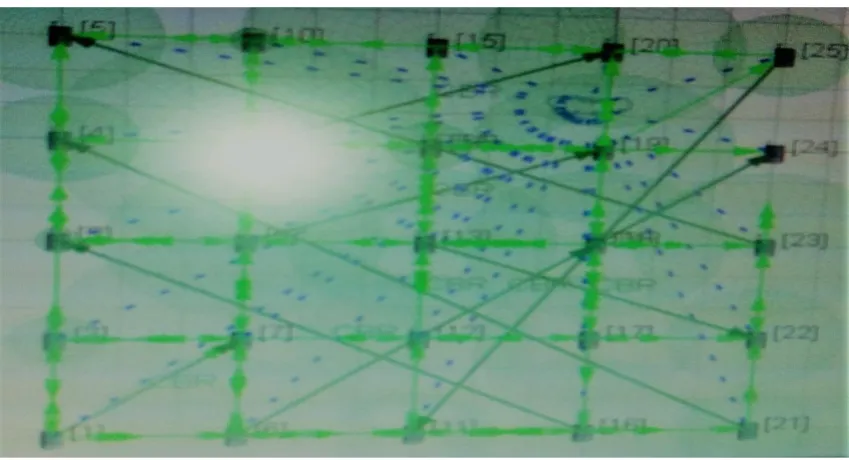
We have used Qualnet 5.0.2 for simulation of our work. [19]In our work, we have chosen 36 nodes arranged in grid pattern. Information of simulation is given in the Table below.
Table: Simulation Characteristics Serial
No.
Parameters Values
1 Simulator QualNet Version 5.0.2
2 Terrain Size 1500 x 1500 m2
3 Antenna model Omnidirectional
4 No of nodes 36
5 Radio Type 802.11b
6 Propagation Model Two Ray Ground
7 Channel Frequency 2.4 GHz
8 Traffic Source CBR
9 Pattern of arrangement Grid
10 Antenna Height(meters) 1.5
11 Data size 512 bytes
12 Data Rate 2Mbps
13 Antenna Gain(dB) 0.0
14 Performance Metrics in Application Layer Average Jitter, Average End to End Delay, Throughput
15 Performance Metrics in Physical Layer Energy consumed in Transmit mode, Energy consumed in Received mode, Energy Consumed in Idle mode
16 Battery Model Generic
17 Mobility Model Random Way Point
18 Routing Protocols Proactive : FISHEYE,
OLSR,LANMAR,LAR Reactive : ANODR,AODV, DSR, DYMO Hybrid : ZRP
19 Transmit circuitry power consumption(mW) 100.0 20 Receive circuitry power consumption(mW) 130.0 21 Idle circuitry power consumption(mW) 120.0
Fig. 2: Snap-shot of Node pattern of design for simulation
Source nodes are 1,6,8,9,13,16,18,21,23 and 25 and corresponding destination nodes are 7,18,19,20,22,3,24,,4,5 and 11. Snap shot of node pattern is shown in fig.2. Snap shot of simulation is shown in fig3.
Fig.3 : Snap-shot during simulation
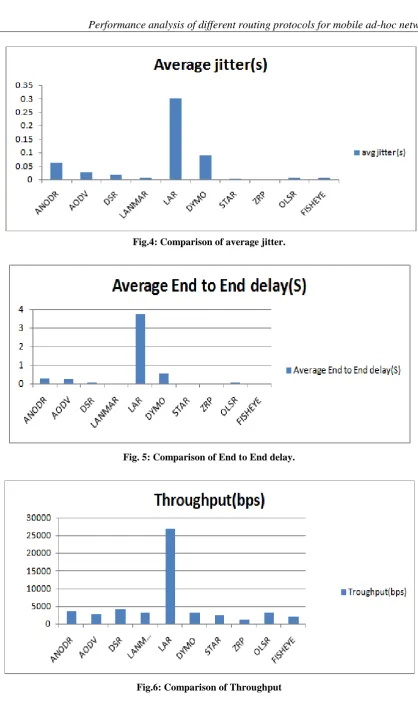
Fig.4: Comparison of average jitter.
Fig. 5: Comparison of End to End delay.
Fig.7: Comparison of TX power
Fig.8: Comparison of receive power.
IV.
CONCLUSION & FUTURE WORK
For average jitter, by observing fig.4, we see it is maximum for LAR and high for DYMO. It is gradually decreasing for ANODR,AODV , DSR and LANMAR. It is negligible for STAR, OLSR and FISHEYE. For, ZRP it is minimum with a value of nearly zero. For average end to end delay, by observing fig.5, we see again it is maximum for LAR. For DYMO it is high and negligible for DSR, ZRP,OLSR,FISHEYE and STAR. For ANODR and AODV, it is low. LAR has shown disadvantage in average jitter and end to end delay but from fig.6 we observe throughput is very high for LAR where it is low for other protocols. From fig.7, we see, transmitted power is maximum for DYMO , it is high for ANODR,DSR and LAR. TX power is moderate for AODV,LANMAR,OLSR and FISHEYE. It is low for STAR and minimum for ZRP. From, fig.8, we observe, receive power is maximum for LAR and DYMO. It is high for ANODR and DSR , moderate for AODV,LANMAR,OLSR and FISHEYE, and low for STAR and ZRP. In future work, we can observe , the change in characteristics with variation of number of nodes and number of traffic load with variation of battery model and mobility. We also propose to work, with different data speed with different channel frequency and propagation model. By changing area of networking and pattern of arrangement is another scope of observation.
REFERENCES
[1]. L. M. Feeney, An Energy Consumption Model for Performance Analysis of Routing Protocols for Mobile Ad Hoc Networks, Mobile Networks and Applications, 6(3), 2001, pages 239 - 249.
[2]. S. Giannoulis, C. Antonopoulos, E. Topalis, S. Koubias, ZRP versus DSR and TORA: A comprehensive survey on ZRP performance, 10th IEEE Conference Emerging Technologies and Factory Automation, Greece, 2005.
[4]. C. Yang, L. Tseng , Fisheye Zone Routing Protocol for Mobile Ad-Hoc Networks, Multimedia Communications Laboratory, Second IEEE Consumer Communications and Networking Conference, Taiwan, 2005.
[5]. T. Clausen and P. Jacquet, Optimized Link State Routing Protocol (OLSR), IETF RFC 3626, 2003. [6]. C. E. Perkins, E. M. Belding-Royer, and S. Das, Ad Hoc On Demand Distance Vector (AODV) Routing,
IETF Internet draft, 2002.
[7]. Garcia J.E., Cano J.C., P. Manzon, A Novel DSR based Energy Efficient Routing Algorithm for mobile Ad hoc Networks, In: the Proc of IEEE 58th Vehicular TechnologyConference, 5(3), 2003 849-854. [8]. I. Chakeres and C. Perkins, Dynamic MANET On-demand (DYMO) Routing, Internet Draft
(draft-ietf-manet-dymo-14), 2008.
[9]. QualNet documentation, QualNet 5.0.2 Model Library:Wireless, http://www.scalablenetworks.com. [10]. Dharam Vir,S.K.Agarwal,S.A.Imam, “ A simulation study on node energy constraints of routing
protocols of mobile adhoc networks use of Qualnet networks”,IJAREEIE,vol.1,issue 5,November2012.pp-401-410,ISSN:2278-8875.
[11]. Dinesh U.Rane,Lalit S.Addiwar,Usha Devi Gandhi, “Analysis of energy consumption in ad-hoc routing protocols” IJAER,vol. 7,issue V,May 2014.pp-38-48,ISSN:2231-5152.
[12]. Hanisha Goyal,Parveen Kakkar, “Performance Investigation of DYMO,DSR,AODV and LAR routing protocols using different mobility and energy models in MANETs”,IJECS,vol.3,issue3,march2014.pp-5017-5027,ISSN:2319-7242.
[13]. Shridhar Kabbur,G.F.Ali Ahammed, Rashma Banu, “Analysis of energy efficient routing protocol in MANET”,IJLTEMAS,vol.V,issue XI,November2016.pp-57-59,ISSN 2278-2540.
[14]. S. Mittal, P. Kaur, Performance Comparison of AODV, DSR and ZRP Routing Protocols in MANETs,, Intl. Conf. on Adv. in Comp., Control, and Telecom. Technologies, 2009, 28-29.
[15]. Paresh Acharekar,Saurabh Mehta,Shraddha Panbude, “comparative study for performance analysis of routing protocols in mobility and non-mobility scenarios”,EEIEJ,vol.3,No.1/2/3,August 2016.pp-1-18. DOI:10.5121/eeiej2016.33011
[16]. Nitin Arora,Suresh Kumar, “Simulation analysis of proactive,reactive and hybrid routing protocols in mobile adhoc network using Qualnet simulator 5.0.2” IJCER,vol.-3(4),pp.63-68,November,2012,ISSN 2141-6494.
[17]. Methaq jasam, salman bin yussof, “Evaluation of energy efficiency of MANET routing protocols” IJSTR,vol.2,issue 3,March 2013.pp-207-211,ISSN 2277.
[18]. M.Bheemalinggaiah,M.M.Naidu,D.Sreenivasa Rao,P.Sreenivasa Moorthy, “Survey of Routing Protocols,Simulation Tools and Mobility Models in Mobile Adhoc Networks” IJIACS, vol.6,issue. 11,November 2017,pp.-202-213,ISSN 2347-8616.
[19]. Giannni A.Di Caro, Analysis of simulation environments for mobile adhoc networks,Technical ReportNo.IDSIA-24-03,December2003,Dalle Molle Institute for Artificial Intelligence, Galleria 2,6928 Manno,Switzerland.
[20]. Dharam Vir,S.K.Agarwal,S.A.Imam, “Power control and performance improvement of reactive routing protocols using Qualnet simulator”IJAIEM,vol.2,issue4,April 2013,pp-175-184.ISSN 2319-4847.