Spectrum Allocation for Cellular User Based on
D2D Communication
N. L. Jebin Nesh N. Wiselin Raj
Post Graduate Scholar Assistant Professor
Department of Electronics and Communication Engineering Department of Electronics and Communication Engineering Christian College of Engineering & Technology
Oddanchatram, India
Christian College of Engineering & Technology Oddanchatram, India
Abstract
The amount of data traffic in cellular networks has been increasing dramatically in the past few decades. To cope with the traffic increase, heterogeneous cellular network has been introduced to improve network performance by offloading traffic to access points (APs) with better link quality. The increase of energy consumption directly increases the greenhouse gas emissions which threatens the environment. Radio frequency (RF) energy transfer and harvesting techniques have recently become alternative methods to power the next generation wireless networks. The D2D communication can enhance cell coverage and throughput, and also reduce transmit power. The study investigates cognitive and energy harvesting-based device-to- device (D2D) communication underlying cellular networks. Energy harvesting based Device to Device Communication for cellular network are proposed. In RSA, cellular user can select any of the available channel which includes the D2D channel. Where as in the case of PSA, cellular user can select D2D channel only when the remaining channels are occupied condition. The SINR outage probability requirements are estimated under both spectrum access policies, i.e. RSA and PSA. Among RSA and PSA policy, PSA policy provides better performance to the D2D users. For D2D users provides better performance when using an uplink channel compared with downlink channel.
Keywords:D2Dcommunication, energy harvesting spectrum allocation, fractional frequency reuse
________________________________________________________________________________________________________
I. INTRODUCTION
Geometry approaches have been applied to analyse RF energy harvesting performance in cellular network, relay network and cognitive radio network. Investigates trade-offs among transmit power and density of mobiles and wireless charging stations which are both modeled as a homogeneous Poisson Point Process (PPP). Studies the impact of cooperative density and relay selection in a large-scale network with transmitter-receiver pairs distributed as a PPP. The authors study a cognitive radio network where the primary and secondary networks are distributed as independent homogeneous PPPs. The secondary network is powered by the energy opportunistically harvested from nearby transmitters in the primary network. Under the outage probability requirements for both coexisting networks, the maximum throughput of the secondary network is analyzed. Prior literature mainly focuses on performance analysis on RF-powered wireless devices using a PPP. The study investigates cognitive and energy harvesting-based device-to- device (D2D) communication underlying cellular networks. The authors adopt independent PPPs to model the locations of BSs, cellular mobiles, and D2D devices. Specifically, two spectrum access policies designed for cellular BSs, namely, random spectrum access and prioritized spectrum access, are studied. In this paper, we generalize the conventional PPP analytical framework to an-determinantal point process (DPP). where in the PPP is a special case when approaches zero. We focus more specifically on the so-called Ginibre DPP which offers many advantages in terms of modeling capability and ease of simulation. This paper analyzes the point-to-point transmission between a RF-powered sensor node and a data sink. The sensor node needs to harvests RF energy from ambient RF sources (e.g., cellular mobiles). The ambient RF sources are modeled with a Ginibre -DPP. The sensor transmits to the data sink using instant harvested RF energy.
low-energy secondary transmitter harvests RF low-energy from transmissions by primary users in its vicinity. Statistical analysis is used to optimally choose network parameters such as power and density of secondary transmitters.
Mobile user equipment relay (UER) has been introduced by 3GPP to enhance communication reliability through device-to-device (D2D) communications. However, as UER needs to use its own power to forward other user’s data, D2D communication may be unreasonable to the UER. To overcome this issue, motivated by the recent progress in energy harvesting (EH) techniques, we propose a D2D communication provided EH heterogeneous cellular network (D2D-EHHN), where UERs harvest energy from an access point (AP) and use the harvested energy for D2D communication. We first derive the UER distribution according to the EH parameters, and then propose opportunistic D2D communication scheme to determine the transmission mode based on the best UER location. We then explore the effect of network parameters on the outage probability. Particularly, we show that having a high EH efficiency at user equipment’s (UEs) does not always improve the performance of D2D-EHHN, especially for dense network, and also how EH parameters affect the optimal offloading bias that minimizes the outage probability of D2D-EHHN. In the authors use dynamic programming to derive the optimal power control policy that minimizes the outage probability. The optimization problem is formulated and solved for block fading channels under energy harvesting constraints such that the transmit power is upper bounded by the amount of energy harvested. In for a point-to-point wireless link, the authors assume that the receiver can either harvest energy from ambient RF signals or decode information at any point of time. For such a scenario, the authors use optimization tools to obtain the optimal mode switching point that balances the tradeoff between the amount of harvested energy, data rate, and outage probability. In the authors use fractional programming and dual decomposition to propose a resource allocation algorithm that maximizes the energy efficiency of a downlink single-cell orthogonal frequency division multiple access (OFDMA) network. The context of multi-channel cognitive cellular networks, the authors provide a framework to model such a network in which macro BSs are under laid with cognitive femtocell BSs. On the other hand, in the context of D2D communication, the authors in use statistical analysis to investigate the effect of distance-based mode selection and power control on the outage performance in the uplink. Another statistical framework is presented in that takes the quality of the links between D2D users and BSs into consideration in the mode selection phase, furthermore, it accounts for the maximum transmit power of users.
For performance evaluation of D2D transmissions under lying a cellular network, the authors in consider different scenarios and optimization problems. In the authors propose a greedy algorithm to solve the resource allocation problem where the optimization problem is formulated as a mixed-integer non-linear program to maximize the sum-rate of both cellular and D2D under SINR constraints. The authors in consider a network scenario in which cellular and D2D users share the same resources. Using tools from stochastic geometry, we provide a tractable analytical framework for statistical analysis of cognitive D2D communication using energy harvested from the ambient interference. The probability that the channel to be used by D2D users is free, the SINR outage probability for both D2D and cellular users, and the overall outage probability for D2D users. We discuss the different trade-offs in the system and show the effect of varying network parameters such as spectrum sensing threshold, densities of BSs and cellular users, number of available channels, and sensitivity of the receivers on the system performance. While D2D users perform spectrum sensing-based transmission and a channel inversion power control. There are two different spectrum access policies are used for cellular communication, namely, random spectrum access (RSA) and prioritized spectrum access (PSA) policies. For each spectrum access policy, we analyze the performance of energy-harvesting D2D communication. We also show how cellular users are affected by the adopted spectrum access policy. It is considering both the cases when D2D transmissions take place in a channel assigned for downlink cellular transmissions or uplink cellular transmissions. We investigate the different scenarios to show when uplink channels are preferable to downlink channels and vice versa. More specifically, we obtain a closed-form expression for the value of the BS density after which uplink channels should be used to achieve a better perclosed-formance for D2D communication when compared to using downlink channels.
The provisioning of multiple channels can be used along with cognition by D2D users to protect the cellular transmissions. For the same network parameters and SINR outage requirements, we also show that the overall outage performance of D2D users is always superior with the PSA policy compared to the RSA policy. Based on the system model described above, we aim at quantifying the performance of both D2D and cellular communications in terms of transmission probability for D2D users (i.e., the probability that there is a channel available for transmission and the amount of harvested energy is sufficient for D2D transmission) and SINR outage probability of both D2D and cellular users.
II. PREVIOUS WORKS
capacity or a sufficient prediction horizon. Our theoretical results are supported by simulations using long-term measurements of solar energy in an outdoor environment. Furthermore, to demonstrate the practical relevance of our approaches, we measured the implementation overhead of our algorithms on real sensor nodes. For more than three decades, stochastic geometry has been used to model large-scale ad hoc wireless networks, and it has succeeded to develop tractable models to characterize and better understand the performance of these networks. Recently, stochastic geometry models have been shown to provide tractable yet accurate performance bounds for multi-tier and cognitive cellular wireless networks. Given the need for interference characterization in multi-tier cellular networks, stochastic geometry models provide high potential to simplify their modeling and provide insights into their design. Hence, a new research area dealing with the modeling and analysis of multi-tier and cognitive cellular wireless networks is increasingly attracting the attention of the research community. In this article, we present a comprehensive survey on the literature related to stochastic geometry models for single-tier as well as multi-tier and cognitive cellular wireless networks. A taxonomy based on the target network model, the point process used, and the performance evaluation technique is also presented. To conclude, we discuss the open research challenges and future research directions. Radio frequency (RF) energy harvesting is a promising technique to sustain operations of wireless networks. In a cognitive radio network, a secondary user can be equipped with RF energy harvesting capability. In this paper, we consider such a network where the secondary user can perform channel access to transmit a packet or to harvest RF energy when the selected channel is idle or occupied by the primary user, respectively. We present an optimization formulation to obtain the channel access policy for the secondary user to maximize its throughput. Both the case that the secondary user knows the current state of the channels and the case that the secondary users knows the idle channel probabilities of channels in advance are considered. However, the optimization requires model parameters (e.g., the probability of successful packet transmission, the probability of successful RF energy harvesting, and the probability of channel to be idle) to obtain the policy. To obviate such a requirement, we apply an online learning algorithm that can observe the environment and adapt the channel access action accordingly without any knowledge about the model parameters. We evaluate both the efficiency and convergence of the learning algorithm.
The numerical result shows that the policy obtained from the learning algorithm can achieve the performance in terms of throughput close to that obtained from the optimization. For more than three decades, stochastic geometry has been used to model large-scale ad hoc wireless networks, and it has succeeded to develop tractable models to characterize and better understand the performance of these networks. Recently, stochastic geometry models have been shown to provide tractable yet accurate performance bounds for multi-tier and cognitive cellular wireless networks. Given the need for interference characterization in multi-tier cellular networks, stochastic geometry models provide high potential to simplify their modeling and provide insights into their design. Hence, a new research area dealing with the modeling and analysis of multi-tier and cognitive cellular wireless networks is increasingly attracting the attention of the research community. In this article, we present a comprehensive survey on the literature related to stochastic geometry models for single-tier as well as multi-tier and cognitive cellular wireless networks. A taxonomy based on the target network model, the point process used, and the performance evaluation technique is also presented. To conclude, we discuss the open research challenges and future research directions.
III. PROPOSED METHOD
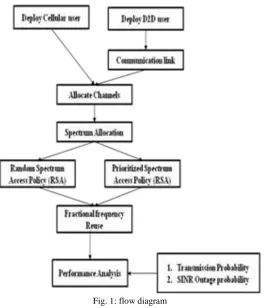
A network model is designed which consists of Base Station, D2D transmitters, D2D receivers and cellular users with specified radius and density.D2D communication link has been established between D2D transmitter and D2D receiver. Available bandwidth is divided into number of orthogonal channels. Those channels are sub divided into two categories for downlink and uplink transmission. Cellular user utilized any channels for uplink and downlink transmissions. But D2D users can use only the cd channel which allocated for D2D users communication.D2D transmitter harvested RF power from both downlink and uplink channels. In order to increase the probability to access the channel by increasing the sensing threshold. Energy D2D transmitter cannot use the D2D channel, because it depends on the allocation of that channel to the cellular transmitters. Spectrum access model has been achieved by both Random Spectrum Access (RSA) policy and Prioritized Spectrum Access (PSA) policy. Finally, the probability has been estimated for available channel for transmission and sufficient energy for harvesting D2D transmission. Analysis Performance of SINR outage probability of both D2D and Cellular users. It is considered cognitive D2D communication underlying a multi-channel cellular network where the D2D transmitters are able to use only the harvested RF energy from the ambient interference that results from the concurrent downlink and uplink transmissions by both the macro base stations (BSs) and cellular users.
integration of the overall system is done. Unit testing becomes verification efforts on the smallest unit of software design in the module. This is also known as ‘module testing’. The modules of the system are tested separately.
This testing is carried out during the programming itself. In this testing step, each model is found to be working satisfactorily as regard to the expected output from the module. There are some validation checks for the fields. For example, the validation check is done for verifying the data given by the user where both format and validity of the data entered is included. It is very easy to find error and debug the system. After the culmination of black box testing, software is completed assembly as a package, interfacing errors have been uncovered and corrected and final series of software validation tests begin validation testing can be defined as many, but a single definition is that validation succeeds when the software functions in a manner that can be reasonably expected by the customer. User acceptance of the system is the key factor for the success of the system. The system under consideration is tested for user acceptance by constantly keeping in touch with prospective system at the time of developing changes whenever required.
Flow Diagram of Proposed System
Fig. 1: flow diagram
IV. RESULT ANALYSIS
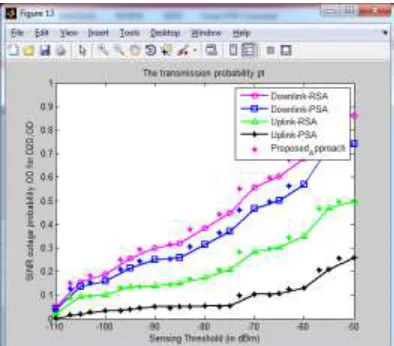
Fig. 3: The SINR outage probability for D2D users vs the transmission probability.
Fig. 4: overall outage probability of D2D users and the D2D transmit power.
Fig. 5: performance graph
V. CONCLUSION AND FUTURE WORK
We have presented a novel model for cognitive D2D communication using RF energy harvesting from the ambient interference in a multi-channel downlink-uplink cellular network. For coexistence of the under laying D2D transmissions in downlink and uplink channels, we have proposed two different spectrum access policies for the cellular network, namely, random and prioritized access policies. We have used stochastic geometry to provide a complete framework to model, analyze, and evaluate the performance of the proposed system in terms of transmission probability and SINR outage probabilities for D2D and cellular users. Under the same network setup, the prioritized spectrum access method output forms. The random spectrum access method for all considered
-90 -85 -80 -75 -70 -65 -60 -55 -50
0 0.1 0.2 0.3 0.4 0.5 0.6 0.7 0.8 0.9 1
D2D transmit power
o
v
e
ra
ll
o
u
ta
g
e
p
ro
b
a
b
il
it
y
o
f
D
2
D
u
s
e
rs
overall outage probability
the effect of the prioritized spectrum access policy adopted 12 by the BSs has been observed to be negligible compared to the random access policy.
In enhanced system, Implement Optimal Cooperation Protocol (OCP)for Energy Harvesting in Cognitive Radio System. In this system cellular user and D2D user is located where both are requested for accessing the channel. Cellular users licensed channel whereas D2D users unlicensed channel for transmitting the data. D2D user harvesting energy from ambient temperature while cellular users transmitted data via channel. D2D user starts to transmit the data when cellular users to silence. There are two approach proposed that is Non-Cooperation Mode and Cooperation Mode. Evaluate the performance by analyzing such as Optimal save ratio, optimal relay power and achievable throughput.D2D user’s energy harvester stop working and its transmitter is powered on for data transmission with energy in the storage device.
REFERENCES
[1] A. Harb, “Energy harvesting: State-of-the-art,” Renewable Energy, vol.36, no. 10, pp. 2641–2654, Oct. 2011.
[2] J. A. Paradiso and T. Starner, “Energy scavenging for mobile and wireless electronics,” IEEE Pervasive Computing, vol. 4, no. 1, pp. 18–27, Jan.-Mar. 2005. [3] D. Bouchouicha, F. Dupont, M. Latrach, and L. Ventura, “Ambient RF energy harvesting,” in Proc. of IEEE Int. Conf. Renewable Energies Power Quality
(ICREPQ’10), Mar. 2010, pp. 486–495.
[4] H. ElSawy and E. Hossain, “Two-tier HetNets with cognitive fem to cells: Downlink performance modeling and analysis in a multi-channel environment,” IEEE Trans. Mobile Comput., vol. 13, no. 3, pp. 649–663, Mar. 2014.
[5] K. Doppler, M. Rinne, C. Wijting, C. B. Ribeiro, and K. Hugl, “Device to device communication as an underlay to LTE-advanced networks,” IEEE Communication. Mag., vol. 47, no. 12, pp. 42–49, Dec. 2009.
[6] F. Baccelli and B. Blaszczyszyn, Stochastic Geometry and Wireless Networks: Volume I Theory, Now Publishers Inc, 2010.
[7] H. ElSawy, E. Hossain, and M. Haenggi, “Stochastic geometry for modeling, analysis, and design of multi-tier and cognitive cellular wireless networks: A survey,” IEEE Communication. Surveys Tuts., vol. 15,no. 3, pp. 996–1019, July 2013.
[8] K. Huang and V. K. N. Lau, “Enabling wireless power transfer in cellular networks: architecture, modeling and deployment,” IEEE Trans. Wireless Communication.,vol.13, no.2, pp.902–912,Feb.2014.
[9] S. Lee, R. Zhang and K. Huang, “Opportunistic wireless energy harvesting in cognitive radio networks,” IEEE Trans. Wireless Commun. vol. 12, no. 9, pp. 4788–4799, Sep. 2013.