ISSN (e): 2250-3021, ISSN (p): 2278-8719
Vol. 08, Issue 6 (June. 2018), ||V (III) || PP 35-40
The Impact of Project Resource Management on
Contractor Performance
Bagus Pratolo Aji Wijaya
1, AchfasZacoeb
2, Yulvi Zaika
2 1(M. Eng. Student, Departmentof CivilEngineering, BrawijayaUniversity, Indonesia) 2(M. Eng. Lecturer, Departmentof CivilEngineering, BrawijayaUniversity, Indonesia) 2(M. Eng. Lecturer, Departmentof CivilEngineering, BrawijayaUniversity, Indonesia)
Corresponding author: Bagus Pratolo Aji Wijaya
Abstract:
The resources within the construction project are one of the most vital things in the construction
process. This study aims to analyze the project resources management that simultaneously affect the
contractor’s performance. The problems raised in this research are how the management of construction
project resources such as human, material, equipment, and methods of implementation are reviewed on
the contractor's performance in the construction project of Al Azhar Campus II Tazkia IIBS Kab. Malang.
For this purpose, sampling data were collected on 30 people involved in the building process. The
analysis process uses correlation analysis to know how big the influence of variables and indicators of
project resource to contractor performance. Then proceed with regression analysis to determine the effect
of collectively and each variable so that it can conduct assessment of contractor performance with the
help of SPSS 25.0. From this research, the biggest variable that influenced is the absence of quality
management on the project. Then the result of the regression found that the project resources had an effect
of 30.7% on the contractor's performance and 69.03% contributed by the variable that was not in the
research. Material resources are the most influential variables on contractor performance.
Keywords:
resources, performance, contractors, regression analysis
--- --- Date of Submission: 01-06-2018 Date of acceptance: 16-06-2018 --- ---
I.
INTRODUCTION
The construction project resources represent potential capabilities and capacities that can be utilized for construction activities. The construction project resources consist of several types including cost, time, manpower, materials, and equipment used in project implementation, which in the operation of these resources needs to be done in a good management system, therefore it can be utilized optimally [1].The resource factor is one of the most important phases in a construction implementation. The resource factors in the construction process greatly affect the contractor's performance on the project. That is why all of the resources related to the implementation of construction must be planned and well-controlled. Resource factors relate to contractor performance.
II.
MATERIAL AND METHODS
A. Project Construction Resources
Resources are needed to carry out the works that is a component of the project. This is done in relation to the accuracy of the calculation of elements of cost, quality, and time. How to manage (in this case the effectiveness and efficiency) of the use of these resources will result in the cost and schedule of implementation of the work.
In managing resources there are two key aspects, namely ensuring the required resources are available when needed and the second is ensuring resources are used efficiently [2]. To achieve both of these aspects, sufficient and timely resources must be supplied so that the project can run well and be completed on time. Lack of resources will cause a delay.
Construction project resources consist of several types, including human resources, materials, equipment, and implementation methods used in project implementation, where in operationalizing these resources need to be done in a good management system, so that can be utilized optimally.
Human Resources
Human resource management is a typical approach to labor management that seeks to achieve competitive advantage through the development of a strategy of a highly capable and highly committed workforce using an integrated, structural, and personnel engineering culture [6].
The construction workforce is divided into two types, namely the provider or supervisor as well as the workers or the laborers (Craft labor). The number of providers is only 5-10% of the number of workers supervised. Besides, if seen from the form of working relationship between the parties concerned, the workforce of the construction project in particular is divided into two, namely [5]:
a. Direct hire, b. Wholesale labor,
The implementation of the project, human resources in the form of labor is a determinant of the success of a project. The type and intensity of the project activity changes rapidly throughout its cycle, so the provision of the amount of labor should include the approximate type and for when the labor is required. By knowing the estimated number and schedule of its needs, then the provision of human resources both quality and quantity to be better and efficient [4].
Material Resources
In every construction project, the use of materials is the most important part that has a substantial percentage of the total project cost. From several studies stating that material costs 50% -70% of project costs, this cost does not include the cost of material storage [1]. Therefore the use of excellent and appropriate management techniques to purchase, store, distribute and quantify construction materials becomes very important.
Material management is a system that coordinates activities to plan and supervise the volume and time of material procurement through acceptance / recovery, shifting and transfer of raw materials, materials in process and finished materials [8].
Equipment Resources
Implementing a construction project means combining resources to produce the desired end product. Construction equipment is one of the most important resources that can support the achievement of a desired goal, on a construction project the need for equipment is between 7 - 15% of project cost [2]. In the construction phase, one of the cost elements is the cost of heavy equipment. Looking at the scale of work and the technical requirements of implementation in building construction, the use of heavy equipment is a must, although it will require considerable funding in its implementation [7].
Method of Construction Implementation
The definition of work methods is a series of activities needed to process or change a set of input into a number of output which has added value. Changes that occur here can be physical or non-physical, where the change can occur to the shape, dimensions and properties. The added value in question is the value of the increased output in terms of functional value (usability) and / or economic value [8].
The construction work method is the sequence and timeline of building activities combined with contract requirements (drawings, specifications, schedules, completion etc.), availability of resources (such as labor, materials, equipment, funds) and environmental conditions of project implementation (such as weather, soil condition , social, economic and political conditions) [5].
B. Research Methods
This study uses statistical analysis of regression and correlation to know what matters that affect the project resources management to the contractor performance. In addition, the sampling data were collected using primary data in the form of questionnaires consisting of project stakeholders ie foundation, supervisory consultant, and main contractor.
III.
Result
3.1. Validity and Reliability Instruments TestValidity indicates the extent to which the measuring instrument to measure the validity of an instrument item can be known by comparing the correlation index of product moment pearson at 5% significance level with rtable value of 0.361 with the number of samples n-2 = 28 samples. If the value of rcount obtained at the sub-indicator value greater than the rtable of 0.361 then the item is declared valid and vice versa if lower than rtable declared invalid.
Tabel no 1:. Validity Instruments Test Result
Variables Points Result
X1 (Human Resources) 10 Valid
X2 (Materials) 4 Valid
X3 (Equipments) 2 Valid
X4 (Working Method) 3 Valid
X5 (External Variables) 7 Valid
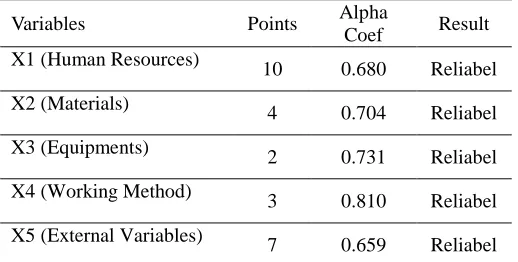
The results of valid variables are then tested its reliability by using SPSS 25.0 program that produces data reliability. Reliability test is done by looking at the value of Alfa Cronbach coefficient. An instrument can be said to be reliable in retrieving the desired data if the value of Alfa Cronbach coefficient derived from data greater than 0.6.
Tabel no 2: Reliability Instruments Test Result
Variables Points Alpha
Coef Result X1 (Human Resources)
10 0.680 Reliabel
X2 (Materials) 4 0.704 Reliabel
X3 (Equipments)
2 0.731 Reliabel
X4 (Working Method)
3 0.810 Reliabel
X5 (External Variables) 7 0.659 Reliabel
3.2. Correlation Analysis
X1.7 as an indicator of the ineffectiveness or the absence of quality management procedures has a value of -0.450 where this indicates the dominance of strong enough indicators that impact on the decline in value of contractor performance.
Table 3. Summary of Pearson correlation test results with dominant factors
No Code Indicator Coefficient Correlation
3 X1.7
the ineffectiveness or the absence of quality
3.3. Regression Analysis and Hypothesis Testing
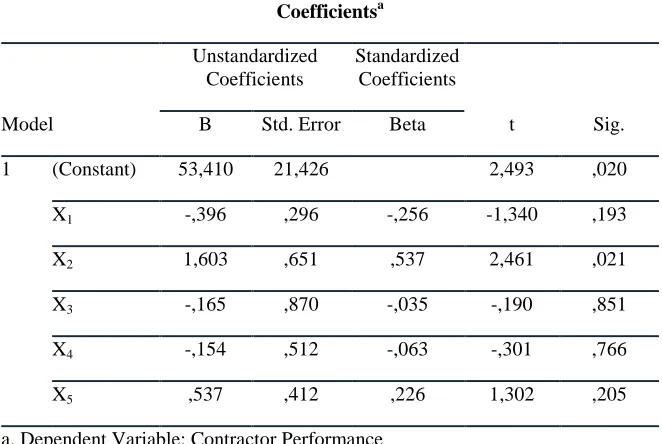
Furthermore, regression analysis is used to obtain the effect of independent variables X1 (Human Resources), X2 (Material), X3 (Equipment), X4 (Working Method), and X5 (External Variables) to variable Y (Contractor Performance) .
Tabel no 4: Summary of Regression Results
Coefficientsa
Model
Unstandardized Coefficients
Standardized Coefficients
t Sig. B Std. Error Beta
1 (Constant) 53,410 21,426 2,493 ,020
X1 -,396 ,296 -,256 -1,340 ,193
X2 1,603 ,651 ,537 2,461 ,021
X3 -,165 ,870 -,035 -,190 ,851
X4 -,154 ,512 -,063 -,301 ,766
X5 ,537 ,412 ,226 1,302 ,205
a. Dependent Variable: Contractor Performance
The effect of X1, X2, X3, X4, and X5 together on the Y variable can be expressed by the equation below:
Y = 53.410 - 0.396 X1 + 1.603 X2 - 0.165 X3 - 0.154 X4 + 0.537 X5
The meaning of the multiple regression equation can be interpreted as follows:
• Constant value = 53,383 is the value of the contractor's performance on the construction project if X1 = X2 = X3 = 0
• The value of b1 is -0.396; is the value of regression coefficient X1 which means every increase of human resource value by one point, it will decrease contractor performance value equal to 0396 points.
• The value of b2 is 1,603; is the value of the regression coefficient X2 which means any increase in the value of material resources by one point, it will raise the contractor's performance value by 1,603 points.
• The value of b3 is -0.650; is the value of X3 regression coefficient which means each increase of the value of equipment resources by one point, it will decrease the contractor's performance value by 0.650 points.
• The value of b4 is -0.154; is the value of the regression coefficient X4 which means any increase in value of the implementation method by one point, it will decrease the value of contractor performance by 0154 points. • The value of b5 is 0.537; is the value of the regression coefficient X5 which means any increase in value of the external variable by one point, it will raise the value of contractor's performance by 0241 points.
To prove whether the effect is significant or not, a significance test is done through F test, provided that if Fcount> Ftable, then H0 is rejected and H0 is accepted, and vice versa. Value of significance of 0.05%.
Tabel no 5: Summary of F Test Results
ANOVAa
Model
Sum of
Squares df Mean Square F Sig.
1 Regression 336,859 5 67,372 2,128 ,097b
Total 1096,667 29
a. Dependent Variable: Kinerja Kontraktor
b. Predictors: (Constant), X1, X2, X3, X4,X5
F Value Analysis :
Value ofFcount = 2.128
Denumerator (Sampel-variabel) = 30 -2
Numerator ( variabel-1) = 5 -1
Value ofFtabel = 2.60Ftable> Fcount = 2,128> 2,60 then H0 accepted means that simultaneously, independent variables are X1 (Human resources), X2 (Material), X3 (Tools), X4 (Working Method), and X5 (external variable) have an insignificant effect on variable Y (Contractor Performance).
Next, to test the effect of partial / each variable X to variable Y used t test, that is by comparing tcount with ttable, or significance value with α 5% or 0.05. with the number of samples 30, then the ttable of 2.063. Hypothesis that can be drawn is H0 rejected if sig value <0.05, or tcount> ttable then there is influence from variable X to variable Y (performance of contractor).
This test indicates that H0 is received on the variables X1, X3, X4, X5 which means that the variable has no significant effect because tcount<ttable. However, on X2 has a significant effect and positive effect on contractor performance. This is because tcount> ttable = 2,461> 2.063 or sig value. of 0.21 <0.05.
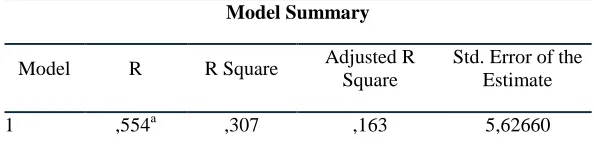
For determination value R square can be seen in table below: Tabel no 7: Value of R2 or Coefficient of Determination
Model Summary
Model R R Square Adjusted R Square
Std. Error of the Estimate
1 ,554a ,307 ,163 5,62660
Tabel no 6: Summary of T Test Result
Coefficientsa
Model t Sig.
,020
X1 -1,340 ,193
X2 2,461 ,021
X3 -,190 ,851
X4 -,301 ,766
X5 1,302 ,205
a. Predictors: (Constant) X1, X2, X3, X4,X5
The coefficient of determination (R Square) is 0.307. These results explain the contribution of the independent variables X1 (Human Resources), X2 (Material), X3 (Tools), X4 (Work Implementation Method), and X5 (External Variables) are included in the regression equation to variable Y (Contractor Performance) is 30.7%, while the other 69.03% is contributed by other variables not included in this research.
IV.
CONCLUSION
After performing analysis and statistical testing of the influence of project resources on contractor performance on Al Azhar Central Office Project II Campus II Tazkia IIBS, Kab. Malang, it is found that the most dominant factor is the ineffectiveness or the absence of quality management procedures that negatively affect. Where this preventive action must be considered by the contractor in order to increase the contractor's performance value in the project.Material resources that play an important role that significantly affect the performance of contractors with the value of tcount> ttable = 2.461> 2.063 with significance value of = 0.021 <0.05. While the construction project resources management in Al Azhar Campus II case study has an effect of 30.7% contractor performance. While 69.03% is another factor contributed by other problems that occur in the development project.
REFERENCES
[1]. Ervianto, Wulfram I.2004. Teori Aplikasi Manajemen Proyek Konstruksi. Yogyakarta: Salemba Empat. [2]. Fahan, Tengku. 2005. Analisis Efisiensi Penggunaan Alat Berat. Dalam Mawardi. (Penyunting). Pembuatan
Jadwal Pelaksanaan Untuk Simultan Dengan Memperhatikan Ketersediaan Sumber Daya Konstruksi. Jurnal Teknik Sipil. Polteknik Negeri Banjarmasin.
[3]. Muzayanah, Yannu. 2008. Pemodelan Proporsi Sumber Daya Proyek Konstruksi. Tesis. Tidak Dipublikasikan. Semarang: Universitas Diponegoro.
[4]. Soeharto, Imam. 1997. Manajemen Proyek. Jakarta: Erlangga
[5]. Soekirno, P. 1999. Pengantar Manajemen Proyek. Diktat Kuliah Magister Teknik Sipil. Yogyakarta: Universitas Islam Indonesia.
[6]. Storey, J. 1995. Human Resources Management: Still Marching On or Marching out, in J. Storey: A critical Text. London
[7]. Stukhart, G. 1995. Construction Materials Management. New York: Marcel Dekker
[8]. Wignjosoebroto, S. 1995. Ergonomi, Studi Gerak dan Waktu. Dalam Laksono, T.D. Produktivitas Pada Proyek Konstruksi. Tesis. Tidak Dipublikasikan. Purwakarta: Universitas Wijaya Kusuma.