International Journal of Pharmaceutical Research & Allied Sciences, 2019, 8(4):146-152
Research Article
CODEN(USA) : IJPRPM
ISSN : 2277-3657
Knowledge, Attitude and Practices of Saudi Pediatricians Regarding Newborn
Hearing Screening in Saudi Arabia
Ahmed Almutairi1, Muteb Alosaimi1*, Nadeer Zaki Albaik2, Saif Abdullah Abalkhail2, Norah Sulaiman Al Aqili2, Rayan Hasan Sabri2, Hussain Mohammed Alhiwaishil3, Ahmed Abdulrahman Baghdadi4, Abdullatef Ahmad Alenzi4, Talal Mohammed Althobaiti4, Saif Abdullah Alqahtani4, Maha Mukhlef Alanazi5, Khalid Saad M Albaqami6, Ghadeer Ibrahim
Sheteifi7, Saad Mohammed Al-Zahrani8, Riyadh Alabbas9
1Faculty of Medicine, Department of Pediatrics Medicine, Al Imam Muhammad ibn Saud Islamic University,
Riyadh, Saudi Arabia
2Faculty of Medicine, Department of Pediatrics Medicine, Imam Abdulrahman Bin Faisal University, Dammam,
Saudi Arabia
3Faculty of Medicine, Department of Pediatrics Medicine, King Faisal University, Hofuf, Saudi Arabia 4Faculty of Medicine, Department of Pediatrics Medicine, Jordan University of Science & Technology, Irbid,
Jordan
5Faculty of Medicine, Department of Pediatrics Medicine, Northern Border University, Arar, Saudi Arabia 6Faculty of Medicine, Department of Pediatrics Medicine, Ibn Sina College, Jeddah, Saudi Arabia 7Faculty of Medicine, Department of Pediatrics Medicine, king abdulaziz university, Jeddah, Saudi Arabia
8Faculty of Medicine, Department of Pediatrics Medicine, University of Gezira, Cairo, Egypt
9Department of Pediatrics Medicine, Ministry of Health, Riyadh, Saudi Arabia.
*Email: dr.mealosaimi @ gmail.com
ABSTRACT
Background: Late detection of permanent congenital and early and onset-hearing loss (PCEHL) severely affects
linguistic, cognitive, and educational development in children. Routine newborn hearing screening (NHS) has provided opportunities for children under the DHH category to be identified shortly after birth. Pediatricians have the biggest role in undertaking the assessment and physical interventions on hearing among newborns.
Methods: For this study, the participants who took part in the survey were Saudi pediatricians. The study design
was based on a cross-sectional approach where convenience sampling was adopted as a technique for data collection. Questionnaires were used as the only tool for data collection. Results: From the study, the majority of respondents were male, registering up to 57.9%. From the survey, documenting the state of the NHS program in Saudi Arabia, it turns out that it is important to have a typical screening protocol, regarding the working national policy. Up to 47.7% of the respondents replied that hearing screening instigates parental concern and anxiety, contradicting other studies that assert the opposite. The respondents, however, articulated concerns about requiring additional information on some of the particular details that are related to NHS. However, majority of them (44.4%) were confident in explaining the process to the parents of the newborns. Conclusion: The study can be seen to shed light on the attitudes, existing knowledge, and practice levels amongst pediatricians in Saudi Arabia. It shows that any NHS program is considered profitable if timely and appropriate referrals can be made to ensure follow-ups.
Late detection of permanent congenital and early and onset-hearing loss (PCEHL) severely affects linguistic, cognitive, and educational development in children. Routine newborn hearing screening (NHS) has provided opportunities for children under the DHH category to be identified shortly after birth. However, such programs have largely been implemented in developed countries, including the US, UK, and Canada. Since newborn hearing (NHS) allows for most PCEHL to be detected early for optimal interventions, its prospects for implementation are being considered in developing countries. The significance of hearing testing should not, however, be pegged on the prevalence rates of babies born with hearing problems. The key is to ensure that all babies born with hearing impairments are identified as soon as they are delivered. In language development, communication is central to effective progress as it determines how the baby perceives things in his/her environment [1, 2].
Hearing loss is defined as significant if it occurs to the degree that compromises normal language and speech development. Moderate bilateral permanent hearing loss (less than 40 dB) in children can affect speech acquisition, language explosion, and cognitive development [3]. The latter further compromises social, emotional development, and academics with consequential high costs to society [4-6]. Other studies indicate that even children with mild or unilateral permanent hearing loss face difficulties with speech, language, and psycho-social development [5-8]. For children, the years 0-5 is viewed as critical to language development.
The hearing screening process is a simple yet important process that has a huge implication in the development process of the child throughout his/her life [3]. The process is critical to establishing whether a newborn baby is deaf or faces difficulty with regard to hearing. Babies have unique forms of communicating with their environment, some of which are misleading and could lead to inaccurate conclusions [4]. For instance, response to noise among babies is usually observed in the form of head-turning. However, it is possible for babies that are face difficulty in hearing to respond to this basic form of hearing test equally. As such, it is only through a hearing screening test that an accurate assessment can be made on the level of hearing in a baby.
From a practice-based perspective, most children that are born in hospitals today are subjected to hearing screening tests [1, 9]. In leading globalized nations such as the United States of America, more than 98% of all newborn babies are subjected to hearing screening [10]. The usage of hearing screening across hospitals throughout the world could be subject to the level of technology deployed. Hearing screening is a common practice in Middle East countries such as Saudi Arabia [11]. The spread and practice of hearing screening in most hospitals are attributed to the relative ease of implementation of the screening technologies [5]. The two methods (Automated Auditory Brainstem Response (AABR) and Otoacoustic Emissions (OAE)) that are commonly used in the hearing screening are simple and easy to use. For both methods, the screening takes a shorter duration of time ranging between 5 to minutes. The process, however, requires the baby to be in a still position or sleeping in bed.
The purpose of this study is to assess the current levels of knowledge, attitude, and practices of Saudi pediatricians towards newborns hearing screening. The introductory section of the paper has emphasized the significance of hearing screening in all newborn babies. However, the process of hearing screening is largely a multidimensional area that requires the cooperation of healthcare professionals including nurses, pediatricians and mothers. Also, technological know-how should be fully executed by experienced personnel. Given these interactions, the parties must be fully equipped with the necessary knowledge and attitude towards newborn hearing screening. A combination of effective knowledge and attitudes towards newborn hearing provides positive interventions for addressing hearing concerns among children at an early age.
MATERIALS AND METHODS
Participants
For this study, the participants who took part in the survey were extracted from 13 regions, 17 cities, and 54 hospitals in the Kingdom of Saudi Arabia. All the participants were Saudi pediatricians working in hospitals that offer a residency training program. In total, 216 Saudi pediatricians were involved in the study. Given the wide scope of the area from which the participants were extracted, the study was presented with a significant pool of pediatricians from which data could be collected. The total number of participants involved in the study were thus adequate to conduct reliable scientific research. As opposed to many studies that collect data and information on such research studies from all medical staff, this study restricted its data collection to pediatricians only. This choice was informed by the need to collect qualitative and objective data from hospital staff that were mostly concerned with the diagnosis and hearing screening among newborn babies. The experience of the pediatricians that were involved in the study was not restricted to any duration of practice.
Study Design
The study design for this research work was based on a cross-sectional approach where convenience sampling was adopted as a technique for data collection. The overall structure of the research was simple, with questionnaires used as the only tool for data collection. Further, the questionnaires were printed in hard copy before being issued to the 216 pediatricians to respond to the survey questions. The timing for the survey questions was also designed with a view of the daily practical schedules of pediatricians. As such, the pediatricians were required to respond to the survey questions during morning periods after their daily morning meetings.
Materials
Questionnaires were used as the only tool for data collection. Despite using one means of collecting survey data, the survey questions were structured such that the responses of participants would be comprehensive and specific to the needs of the research work. In order to ensure that the research questionnaire is commensurate with all the expected outcomes for qualitative analysis, reference was made to a questionnaire that had been adopted for a previous study [3]. The purpose of that previous study was similar to the purpose of this study, except for the difference in the physical locations in which the surveys were undertaken. For that previous research work, the questionnaire had been resulted in qualitative outcomes in the Indian case study. With the modification of some survey questions to suit the context of the respondents, the questionnaire was expected to yield similar outcomes. An important aspect of the questionnaire was the content. The questionnaire was generally structured into four parts: demographic characteristics of the pediatricians, existing knowledge levels about UNHS among pediatricians, attitudes and practices about UNHS among pediatricians, and responses on the need for having information on different aspects related to permanent hearing loss in children.
Statistical Analysis
Statistical analysis was also carried out by the use of simple analytical tools in Microsoft Excel. Initially, the raw data collected on all the four parameters from across the 216 participants were needed in Microsoft Excel sheets. A comparison-based analysis was then carried out to establish the interrelationships between knowledge and attitude levels among pediatricians towards newborn hearing screening. For ease of illustrating, the existing interrelationships in the data and information collected from the participants, graphs and charts were used as analytical tools.
RESULTS
Table 1: Demographic characteristics of the pediatricians
Characteristics n (%)
Male 125 (57.9)
Gender Female 91 (42.1)
Non-teaching hospital 86 (39.8)
Consultant 56 (25.9)
Profession Resident 89 (41.2)
Specialist 71 (32.9)
Table 2: Existing knowledge levels about UNHS among pediatricians
Question Responses Percentage of
respondents (%)
Somewhat not familiar 20.8 How familiar are you with newborn & infant hearing
screening? Not familiar 17.6
Somewhat familiar 25.0
Familiar 19.4
Very familiar 17.1
No 23.1
Does your hospital have a universal newborn hearing
screening program? Unsure 38.9
Yes 38.0
1-8 weeks postnatal 17.1
In your opinion, what would be the ideal time to teach families about newborn screening and remind them about
the importance of follow-up?
Both pre and postnatal 45.8
Prenatal 37.0
No 18.5
Did your training prepare you adequately to meet the needs
of infants with permanent hearing loss? Unsure 35.6
Yes 45.8
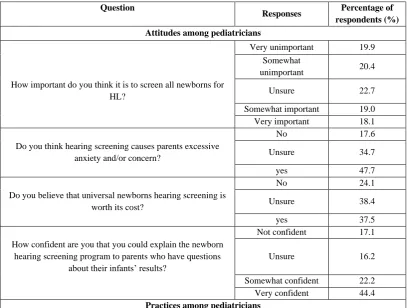
Table 3: Attitudes and practices about UNHS among pediatricians
Question
Responses Percentage of
respondents (%) Attitudes among pediatricians
Very unimportant 19.9
Somewhat
unimportant 20.4
How important do you think it is to screen all newborns for
HL? Unsure 22.7
Somewhat important 19.0
Very important 18.1
No 17.6
Do you think hearing screening causes parents excessive
anxiety and/or concern? Unsure 34.7
yes 47.7
No 24.1
Do you believe that universal newborns hearing screening is
worth its cost? Unsure 38.4
yes 37.5
Not confident 17.1
How confident are you that you could explain the newborn hearing screening program to parents who have questions
about their infants’ results?
Unsure 16.2
Somewhat confident 22.2
Very confident 44.4
program to parents who have questions about their infants’
results? No 36.1
Yes 63.9
Table 4: Cross Tabulation Between The Familiarity With Newborn & Infant Hearing Screening And Confidence In Explaining The Newborn Hearing Screening Process To Parents Who Have Questions
About Their Infants’ Results
Confidence in explaining the newborn hearing screening process to parents who have questions about their infants’ results
Not confident Unsure Somewhat confident Very confident
Count 4 12 10 19
Somewhat not familiar Expected Count 7.7 7.3 10.0 20.0
Count 10 7 5 16
Not familiar Expected Count 6.5 6.2 8.4 16.9
Count 10 10 10 24
Somewhat familiar Expected Count 9.3 8.8 12.0 24.0
Count 8 6 11 17
Familiar Expected Count 7.2 6.8 9.3 18.7
Count 5 0 12 20
Very familiar Expected Count 6.3 6.0 8.2 16.4
Table 5: Chi-Square Tests Results For The Association Between The Familiarity With Newborn Hearing Screening And Confidence In Explaining The Newborn Hearing Screening Process To
Parents With Questions About Their Infants’ Results
Value Degrees of freedom p-value
Pearson Chi-Square 18.300a 12 .107
Likelihood Ratio 23.908 12 .021
N of Valid Cases 216
a. 0 cells (0.0%) have expected count less than 5. The minimum expected count is 6.00.
Table 6: Symmetric Measures In The Association Between The Familiarity With Newborn Hearing Screening And Confidence In Explaining The Newborn Hearing Screening Process To Parents With
Questions About Their Infants’ Results
Value p-value
Phi .291 .107
Nominal by Nominal Cramer's V .168 .107
N of Valid Cases 216
a. Not assuming the null hypothesis.
b. Using the asymptotic standard error assuming the null hypothesis.
DISCUSSION
Although universal newborn hearing screening has been founded in various nations, Saudi Arabia still has a scattered and isolated form of implementation of the program. With pediatricians acting as primary healthcare givers, parents are obliged to visit them for any difficulty with the heath of their infants. As a result, pediatricians are always seen to play an important role in the program of hearing and screening, offering referrals, and ensuring applicable intervention as well as follow-up [10]. Without a national policy, the context of the implementation of the program in Saudi Arabia, it is appropriate to look at the attitudes and practices of pediatricians as well as the existing knowledge among the professionals.
hand, up to 41.2% of the respondents were resident professionals, with 32.9% being specialists, and the remaining 25.9% being consultants. The increased interest could drive the most probable reason for the majority of respondents to work in university hospitals among the group to take part in research pursuits as a part of the work outline [3].
Evaluating existing knowledge about NHS
From the survey to record the state of the NHS program in Saudi Arabia, it turns out that it is important to have a typical screening protocol, regarding the working national policy [1, 9, 10, 15]. From the results, it can be seen that up to 45.8% of the pediatricians considered counseling families with newborn screening and reminded them of the importance of follow-up at both pre and postnatal stages. According to the position statement of the Joint Committee of Infant Hearing, the rule of 1-3-6 is most applicable in the counseling process. The assessment provides that the screening should be done by one month, diagnosis by three months and intervention is made by six months of age [12]. In the present study, pediatricians seem to be aware of the rule, with the 45.8% responding that more testing should be conducted before three months, especially for newborns that fail the first screening [2].
Attitudes and practices regarding NHS
Despite the lack of particular knowledge and training about NHS, pediatricians in the study demonstrated an attitude that was overall negative towards screening [4, 5, 11]. Up to 47.7% of the respondents replied that hearing screening leads to parental concern and anxiety, contradicting other studies that assert the opposite. It also fails to support current literature amongst parents, which asserts that NHS does not result in anxiety. The respondents, however, expressed fears about requiring additional information on some of the particular details that are associated with NHS. However, majority of them (44.4%) were confident in explaining the process to the parents of the newborns.
Test of association
From the test of association between familiarity with newborn hearing screening and the confidence in explaining the newborn hearing screening process to parents with questions about their newborns’ results, it can be seen that the expected count is not similar to the observed value in all the cases. The chi-square test performed is, thereby, used to determine whether the observed values and the expected counts are different enough for the association to be significant. From Table 5, it can be seen that there are 0% of cells with expected counts of less than five, indicating that the chi-square test assumptions are not violated. The results further indicate a chi-square value of 18.3, with a p-value of 0.107. The p-value is greater than the alpha level of significance, given as 0.05. It therefore means that we fail to reject the null hypothesis that there is no significant association between familiarity with newborn hearing screening and the confidence in explaining the newborn hearing screening process to parents with questions about their newborns’ results. From the Crammer’s V value, it can be deduced that the familiarity with newborn hearing screening has a small to moderate effect on confidence in explaining the newborn hearing
screening process to parents with questions about their newborns’ results. However, the p-value which is
calculated to be greater than the alpha level of significance, indicates that the assertion is not significant.
CONCLUSION
REFERENCES
1. Jose DJ, Renjit RE, Manonmony S. Prevalence of hearing impairment among high risk neonates-A
hospital-based screening study. Inte J Biomed Adv Res. 2016;7(3):131-4.
2. Connolly JL, Carron JD, Roark SD. Universal newborn hearing screening: are we achieving the Joint
Committee on Infant Hearing (JCIH) objectives? The Laryngoscope. 2005 Feb;115(2):232-6.
3. Ravi R, Gunjawate DR, Yerraguntla K, Lewis LE, Rajashekhar B. A national survey of knowledge, attitude
and practices among pediatricians towards newborn hearing screening in India. International journal of pediatric otorhinolaryngology. 2017 Apr 1; 95:9-14.
4. Kim S, Lloyd-Puryear MA, Tonniges TF. Examination of the communication practices between state
newborn screening programs and the medical home. Pediatrics. 2003 Feb 1;111(2): e120-6.
5. Al-Sulaiman A, Kondkar AA, Saeedi MY, Saadallah A, Al-Odaib A, Abu-Amero KK. Assessment of the
knowledge and attitudes of Saudi mothers towards newborn screening. BioMed research international. 2015;2015.
6. Alsulaiman A, Abu‐Amero KK. Parent's attitude toward prenatal diagnosis and termination of pregnancy
could be influenced by other factors rather than by the severity of the condition. Prenatal diagnosis. 2013 Mar;33(3):257-61.
7. Alyami H, Soer M, Swanepoel A, Pottas L. Deaf or hard of hearing children in Saudi Arabia: Status of early
intervention services. International journal of pediatric otorhinolaryngology. 2016 Jul 1; 86:142-9.
8. Calcutt TL, Dornan D, Beswick R, Tudehope DI. Newborn hearing screening in Queensland 2009–2011:
Comparison of hearing screening and diagnostic audiological assessment between term and preterm infants. Journal of paediatrics and child health. 2016 Nov;52(11):995-1003.
9. Specker B, Fossen L. Early Hearing Detection Intervention (EHDI) Program: What is the Data Telling Us?
South Dakota Department of Health, Public Health Bulletin. 2018;30(1):1.
10. Gaffney M, Green DR, Gaffney C. Newborn hearing screening and follow-up: are children receiving
recommended services? Public Health Reports. 2010 Mar;125(2):199-207.
11. Al-Awamy BH. Saudi newborn screening: a national public health program: needs, costs, and challenges.
Saudi medical journal. 2008 Mar;29(3):470-author.
12. Therrell BL, Padilla CD, Loeber JG, Kneisser I, Saadallah A, Borrajo GJ, Adams J. Current status of
newborn screening worldwide: 2015. InSeminars in Perinatology 2015 Apr 1 (Vol. 39, No. 3, pp. 171-187). WB Saunders.
13. World Health Organization. Prevention of hearing impairment. Resolution of the 48th World Health
ssembly, WHA 48.9.
14. Vishwakarma C, Mathur R, Vishwakarma R, Jindal S, Sharma P, Sinha V. Universal hearing screening vs
targetted hearing screening: Make a choice. Indian Journal of Otology. 2015 Jul 1;21(3):179
15. Moeller MP, White KR, Shisler L. Primary care physicians' knowledge, attitudes, and practices related to