STABILITY INDICATING ANALYTICAL METHOD
DEVELOPMENT AND VALIDATION FOR THE
ESTIMATION OF AVANAFIL IN PHARMACEUTICAL
DOSAGE FORM
Bhatt Bhumik, Raval Kashyap, Sheetal Buddhadev
Noble Pharmacy College, Junagadh, India
Email: [email protected]
Date Received:
21-May-2015
Date of Accepted:
29-May-2015
Date Published:
03-Jun-2015
Abstract:
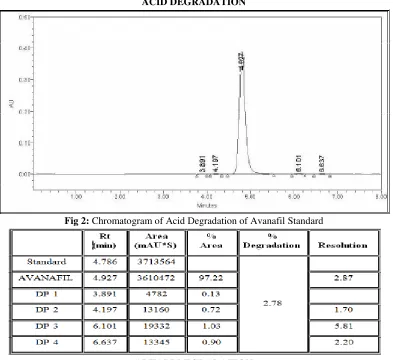
Analysis of pharmaceutical product is very important as it concerned with life. A stability-indicating assay accurately measures the active ingredients, without interference from degradation products, process impurities, excipients, or other potential impurities. Stability of the pharmaceutical product is most important, so that work is carried out to develop a new, simple, precise, accurate, validated stability indicating Analytical method for estimation of Avanafil in Pharmaceutical Dosage Form. In this method Acetonitrile: Water: Triethylamine: Acetic Acid in the ratio (65:35:0.1:0.1) was used as a mobile phase, so that developed method becomes ecofriendly. The detection was carried out at 254 nm and a flow rate of 1 mL/min and retention time 4.7 min. and C18 column was used for the separation of drug with other degraded product and process impurities. The linearity was observed in the range of 50–150 ppm. The developed method was meets all the acceptance criteria for the validation of analytical method as per the ICH guideline. The degradation of the drug in acid, alkali, oxidation, Thermal was found to be 2.78%, 4.00%, 2.06%, 1.48% respectively and it meets acceptance criteria for the stability of the pharmaceutical product as per ICH guideline. The assay of drug was found in acceptance range.
Keywords
: Avanafil, Acetonitrile, Water, Triethylamine, Acetic Acid.Introduction
Avanafil as (S) -4-[(3-Chloro-4 methoxybenzyl) amino] - 2- [2- ( hydroxymethyl )- 1 – pyrrolidinyl ] – N - (2pyrimidinylmethyl) – 5 -pyrimidinecarboxamide. It is a practically White crystalline powder. It is freely soluble in Methanol & in Acetonitrile, Practically insoluble in water, soluble in 0.1 mol/L hydrochloric acid. Its molecular formula C23H26ClN7O3 and calculated molecular weight of 483.95 gm/mol. The physiologic mechanism of erection of the penis involves release of nitric oxide (NO) in the corpus cavernosum during sexual stimulation. NO then activates the enzyme guanylate cyclase, which results
(greater than 100-fold for PDE6; greater than 1,000-fold for PDE4, PDE8 and PDE10; greater than 5,000-fold for PDE2 and PDE7; greater than 10,000-fold for PDE1, PDE3, PDE9, and PDE11). Avanafil is greater than 100-fold more potent for PDE5 than PDE6, which is found in the retina and is responsible for phototransduction.
In addition to human corpus cavernosum smooth muscle, PDE5 is also found in other tissues including platelets, vascular and visceral smooth muscle, and skeletal muscle, brain, heart, liver, kidney, lung, pancreas, prostate, bladder, testis, and seminal vesicle. Erectile dysfunction (ED) is sexual dysfunction characterized by the inability to develop or maintain an erection of the penis during sexual performance. A penile erection is the hydraulic effect of blood entering and being retained in sponge-like bodies within the penis. The process is often initiated as a result of sexual arousal, when signals are transmitted from the brain to nerves in the penis. Erectile dysfunction is indicated when an erection is difficult to produce. Avanafil is an effective treatment option for males suffering from ED. Its main advantage over the other available PDE5 inhibitors is its faster onset of action. 1-3 Till now only some methos published on Avanafil 4-7 but no stability indicating method published till now.
MATERIALS AND METHODS
Optimization of Chromatographic Parameters
Optimization in HPLC is the process of finding a set of conditions that adequately separate and enable the quantification of the analytes from the endogenous material with acceptable accuracy, precision, sensitivity, specificity, cost, ease and speed.
Optimization of Mobile Phase Strength
The mobile phase chosen after several trials with Water: MeOH in various proportions which is shown in table. Finally the mobile phase consisted mixture Acetonitrile: Water: Triethylamine: Acetic Acid (65:35:0.1:0.1).which resolved the tailing of peak. The flow rate of 1 ml/min was selected as it gave good result, system suitability parameters and reasonable retention time. The retention time of Avanafil was observed 4.7 min at 254 nm wavelength with run time of 6 min.
Selection of Detector and Detection Wavelength UV detector was selected, as it is reliable and wavelength was set to 254nm.
Preparation of solution
Preparation of Mobile Phase: Prepare a Mixture
Acetonitrile: Water: Triethylamine: Acetic Acid in the Ratio of (65:35:0.1:0.1) and sonicated for 20 min in ultra
Preparation of Diluent: Mobile phase is used as Diluent
Preparation of Standard Stock Solution (1000 ppm): Take 100 mg of Avanafil working standard into 100 ml volumetric flask, add 25 ml of diluent, dissolve it and make up volume with diluent.
Standard Solution (100 ppm):
Take 5 ml of Avanafil standard stock solution into 50 ml volumetric flask, make up volume with diluent and sonicated for 5 min in ultra-sonicator.
Sample Solution (100 ppm):
Twenty tablets were accurately weighed and break it .Then transferred into 1000 ml volumetric flask and 700 ml of diluent was added. The volumetric flask was sonicated to disperse tablets completely for 30 minutes with intermittent shaking. The solution was cooled to the room temperature and made up to volume with diluent. 10 ml of this solution was diluted to 100 ml with diluents. The solution was filtered through 0.45 µ Millipore PVDF filter; filtrate was collected after discarding first few ml.
Validation studies:
The following parameters were considered for the analytical method validation for the quantification of avanafil in tablet dosage form as per ICH guideline.
Specificity:
The analyte should have no interference from other extraneous components and be well resolved from them. Specificity is theprocedure to detect quantitatively the analyte in presence of componentthat may be expected to be present in the sample matrix.
System suitability:
System suitability test was carried out to verify that the analytical system is working properly to give accurate and precise results. Standard solution (100 ppm) was injected six times and thechromatograms were recorded.
Acceptance Criteria:
The % RSD for area response obtained from six replicate injections of Standard solution should be ≤ 2.0 %. Tailing factor for Avanafil peak should be ≤ 2.0 in standard solution.
Theoretical plates of Avanafil peak should ≥ 2000 in Standard solution.
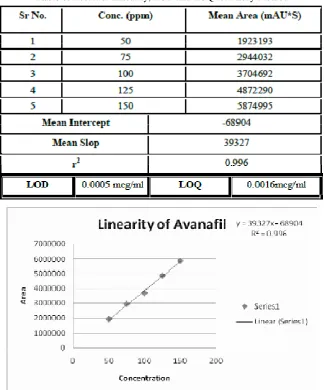
Linearity:
the regression were calculated.
Acceptance Criteria
The Regression coefficient (r2) should not be less than 0.999 for Avanafil.
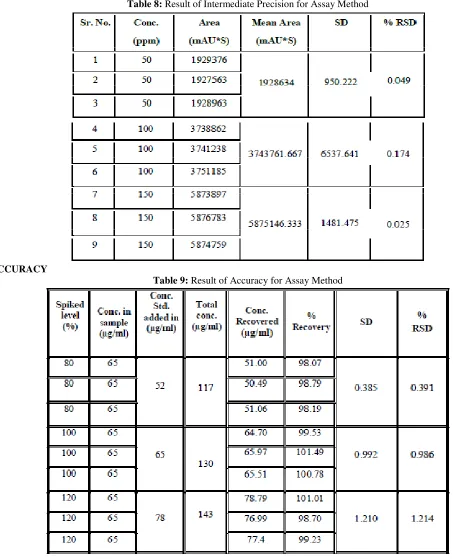
Accuracy (by recovery study):
Accuracy was determined over the range 80 % to 120 % of the sample concentration. Calculated amount of Avanafil API was added in placebo to attain 80 %, 100 % and 120 % of sample concentration
Amount as shown above was weighed and transferred into 50 ml volumetric flask and 25 ml of diluent was added. Dissolve it and make up the volume up to the mark with diluent. Sonicated for 5 min in ultra sonicator. Each sample was prepared in triplicate at each level and injected. The chromatograms were recorded and from the peak area of drug, % recovery was calculated.
Acceptance Criteria
Mean % recovery at each level should be between 98.0 % and 102.0 % for Avanafil.
Precision: System Precision:
The system precision was checked by using standard substance to ensure that the analytical system was working properly. Standard solution (100 ppm) was injected six times and chromatograms were recorded. The retention time and area of six determinations was measured and % RSD calculated.
Acceptance Criteria:
The % RSD of the peak area obtained from six replicate injections should be ≤ 2.0 %.
Method Precision (Repeatability):
The precision of analytical method is the degree of agreement among individual test results when the method is applied repeatedly to multiple samplings of homogeneous samples. It provides an indication of random error results and is expressed as coefficient of variation (CV). This was performed to indicate whether the method was giving consistent results for a single batch. Method precision was carried out by analyzing six replicate injections of assay concentration (100 ppm) of standard and sample solutions. Percentage assay of sample to that of label claim was calculated by comparing the sample solution response to that of standard solution response. % RSD was calculated.
Intermediate Precision (Ruggedness)
Intermediate precision was assessed by analyzing the standard solution and sample solution on different days. The % assay and % RSD were calculated.
Acceptance Criteria:
The % RSD calculated on 6 determinations for assay value of Avanafil should be ≤ 2.0 %.
ROBUSTNESS:
The robustness of an analytical method was carried out to confirm that the method remained unaffected by small but deliberate variations in method parameters and provides an indication of its reliability during normal usage. The standard solution was injected five times for each varied conditions of flow, column temperature, pH, and mobile phase ratio and chromatograms were recorded.
DEGRADATION STUDIES
Forced degradation study was carried out to confirm that during stability study or through its shelf life, any degradation product if found would not interfere with the peak of Avanafil Stress studies were carried out under the condition of acid, alkali, oxidation, thermal and light as mentioned in ICH guidelines.
Result of Acid Degradation:
Degradation of AVANAFIL was carried out in 1 N HCl at 40ºC in Water bath. Measurable degradation was obtained after 24 hrs. It showed multiple peaks of degraded products. Major degraded peak was found at 4.927 min. in drug substance. This study indicates that the drug is practically labile to acidic stress. The developed method could resolve all the peaks, so quantitation of drugs is possible with developed method in presence of acid degraded products.
Degradation of AVANAFIL was tried in 0.1N NaOH at RT. But no degradation was found. After that degradation was carried out in 1N NaOH at 40ºC in Water bath. Measurable degradation was obtained after 24 hr. Degradation peak was found at 4.82 min. in drug substance. This study indicates that the drug is practically labile to alkaline stress. The developed method could resolve all the peaks, so quantitation of the drugs is possible with developed method in presence of base degraded products.
Drug substances were treated with 30% solution of H2O2 and kept at RT. Measurable degradation was obtained after 24 hr. Degradation peak was found at 4.832 min. This study indicates that the drug is practically labile to oxidative stress. The developed method could resolve all the peaks, so quantitation of the drugs is possible with developed method in presence of peroxide degraded products.
Final Chromatographic Conditions for Assay Method
Preparation of Linearity Samples for Assay Method
Sample Preparations for Accuracy for Assay Method
Change in Flow rate (±0.2 ml/min)
Condition of Change in Flow Rate for Assay Method
Change in Column Temperature (± 2 oC)
Stability Indicating Assay Method Apparatus and Equipment
Apparatus and Equipments for SIAM
Final chromatographic condition
Final Chromatographic Conditions for Assay Method
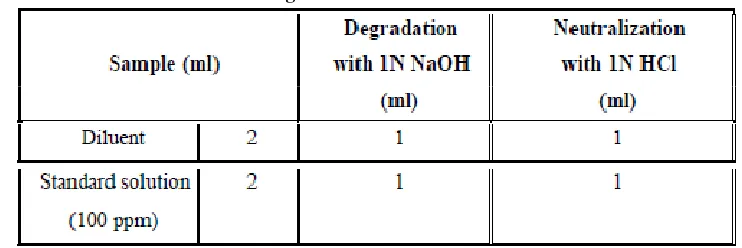
Acid Degradation
Acid Degradation Procedure for SIAM
Alkali Degradation
Alkali Degradation Procedure for SIAM
After degradation, make up the volume 5 ml with diluent and then go for the HPLC analysis. Peroxide Degradation
Peroxide Degradation Procedure for SIAM
After degradation, make up the volume 5 ml with diluent and then go for the HPLC analysis. Thermal Degradation
Thermal Degradation Procedure for SIAM
After degradation, make up the volume 5 ml with diluent and then go for the HPLC analysis. RESULT & DISCUSSION:
TRIAL FOR METHOD DEVELOPMENT OF AVANAFIL
Fig 1: Method Development Trial 3 Acetonitrile:Water:Triethylamine:Acetic Acid (65:35:0.1:0.1) RESULT & DISCUSSION OF STABILITY INDICATING ASSAY METHOD
FORCE DEGRADATION
ACID DEGRADATION
Fig 2: Chromatogram of Acid Degradation of Avanafil Standard
Fig 3: Chromatogram of Alkali Degradation of Avanafil Standard
Table 2: Result of Alkali Degradation
PEROXIDE DEGRADATION
Table 3: Result of Peroxide Degradation
THERMAL DEGRADATION
Fig 5: Chromatogram of Thermal Degradation of Avanafil Standard
Table 4: Result of Thermal Degradation
SPECIFICITY
Fig 6: Chromatogram of Diluent
Fig 7: Chromatogram of Sample
LINEARITY, LOD AND LOQ
Table 6: Result of Linearity, LOD and LOQ for Assay Method
Fig 8: Calibration Curve of Avanafil (50 – 150 ppm) for Assay Method PRECISION
Method Precision (Repeatability)
Intermediate Precision
Table 8: Result of Intermediate Precision for Assay Method
ACCURACY
ROBUSTNESS
Change in Flow rate (± 10%)
Table 10: Result of Change in Flow Rate for Assay Method
Change in Column Temperature (± 2 oC)
Table 11: Result of Change in Column Temperature for Assay Method
ASSAY OF AVANAFIL TABLET
developed method could resolve all the peaks, so quantitation of the drugs is possible with developed method in presence of peroxide degraded products
SYSTEM SUITABILITY
Chromatograph the standard solution preparation and record the peak responses. The column efficiency is NLT 2000 theoretical plates and the tailing factor is NMT 2.0 for Avanafil peak. The relative standard deviation for five replicate standard injections is not more than 2.0 %.
REFERENCE: 1. “Avanafil”, 2012
http://en.wikipedia.org/wiki/Avanafil
2. Drug Information online Drugs.com, 2012, Avanafil
http://www.drugs.com/search.php?searchterm=avanafil 3. Pharmacokinetics of Avanafil,
http://www.rxlist.com/stendra-drug.htm
4. Mangukiya MA, Patel GF et al. “Development and validation of spectroscopic methods for simultaneous estimation of avanafil and dapoxetine hydrochloride in combined dosage form.” Inventi Rapid: Pharm Analysis & Quality Assurance, 2012, 1-5.
5. Sharma N, Rajput P, “RP-HPLC Method Development for Estimation of Sildenafil Citrate in Tablets and in Seminal Fluid.” Journal of Applied Pharmaceutical Science, 2012, 172-178
6. Prasanna Reddy B, Amarnadh Reddy K. “Validation and Stability indicating RP- HPLC method for the determination of Tadalafil API in pharmaceutical formulations.” Research in Pharmaceutical Biotechnology, 2010, 2(1), 1-6.