Knowledge Based Course Planning System for EE Students
at UAE University
Mohammad Shakeel Laghari
Department of Electrical Engineering, UAE University, P. O. Box: 15551, Al Ain, United Arab Emirates.
* Corresponding author. Email: [email protected]
Manuscript submitted August 10, 2015; accepted December 20, 2015. doi: 10.17706/jcp.11.6.455-462
Abstract: Student course planning and advising at most at all universities is an important process to ensure students to fulfill the degree requirements of the university in a structured way and without encountering unnecessary and lengthy delays. United Arab Emirates University (UAEU) is one such institution where student register courses with one of the most advanced and adequate registration systems however; students have faced problems because of a need of a proper advising system as well as a need of seeking proper advising. A Knowledge Based Course Planning System (KBCPS) software package is devised to suit the course planning needs of the Electrical Engineering Department, UAEU. The software is developed by using the Java computer programming language. The system guide students in selecting the most suitable from five to seven courses to register in the next and subsequent semesters. The outcome of the course selections for the next and all the remaining semesters is stored in a file to help students with the registration system.
Key words: Course advising, course planning, software package, JAVA.
1.
Introduction
Course registration comprises of three main sections: what a student needs to know before registering, guidelines for registering courses, and what the next steps are after completing the registration. The process of registration and after steps is well established however, the knowledge of what courses to register in the next and subsequent semesters is an exceptional process.
Typical registration problems that are based on course planning and advising include: advised or chosen courses with time conflicts, missed out on courses specific for alternating semesters, preferred electives bypassing track requirements and restrictions, chosen too many or less courses in a specific semester, etc. Students in this category suffer with problems such as class expulsion after two or three weeks because of prerequisites, delay graduation because of unnecessary additional or missed out courses, drop a complete semester because of minimum number of courses requirement, etc.
includes prioritized course selection, restrictions, etc.
The system is on a trial phase in the EE Department and modifications are under process to suit the department needs in a more apposite manner.
2.
Background Information
In most of the academic institutions throughout the world, the early registration process used to involve student registering at a single point, where most of the registration related activities were to be performed after the requisite form has been filled and processed by the concerned department. This single point action used to generate many concerns that included rush at fee payments, query handling with too many forms, and other related issues. In mid nineties, most of the well-known academic institutions throughout the world started to address this perspective of registration from many angles including student advising, student course registration, class scheduling, administrative purposes, etc.
Late last century, institutions throughout the world saw a rapid expansion of tertiary education. As twenty first century approached, this trend increased near doubled. This rapid expansion has an indirect effect on the institution’s enrolment as the number of students has also increased. As the demand is stabilized so is, a need to streamline the registration process that maximizes the allocation of course places and increases the number of registered students.
Additionally, the institutions, in general, have progressed to offer programs that are specialized as well as multidisciplinary. The variety of programs has introduced time conflicts while choosing courses. The required registration system(s) are to be developed to provide on-line real time registration for students and enable students to maximize their opportunities in registering courses of their own interest as well as advising students in completing their degree requirements in a best possible way.
The concept of computerized registration system has been to tolerate machine and network failures. It was hoped that most human errors, such as incorrectly inputting data, would be detected by the system as they occurred, but it was expected that some "off-line" data manipulation would be necessary for errors that had not been foreseen.
Therefore, the success of any attempt to computerize this activity depends on the reliability, availability and integrity of the computer systems, both software and hardware, on which the registration programs are run. Because many of the departments at any University have most likely made significant investments in computer hardware, it is logical that no specialized hardware is to be purchased and software fault-tolerance is to be used instead.
3.
Alternate Planning and Advising Systems
The advising software at the Electrical Engineering Department, Texas Tech University featured a Graphical User Interface (GUI) that allowed students to choose only courses for which they have appropriate prerequisites and co-requisites requirements. The program also offered rule-based advice to students regarding special circumstances that it spots. The software is designed for straightforward modification, without programming, to accommodate addition or deletion of courses, prerequisites, co-requisites, and rules [1].
A Student Advising Software (SAS) package similar to the investigation of this presented research was developed by using JAVA computer programming language. It is a manual procedure, which helped and guided students in selecting appropriate courses suitable for online registration with the Banner University Registration System. However, the software was developed for an old and phased out curriculum [2].
A Student Auto Advising System (SAAS) software package was developed. It is an automated system based on old curriculum, with limited functionality and about a 20% error rate [4].
An Electrical Engineering Course Planning System (EECPS) was developed by the Author. It is a manual system developed for the new curriculum [5].
An automated course planning system to show a typical plan for the next registering semester is devised by using the Python programming language with improved functionality and lesser error rate [6].
Another automated course advising system to show a complete typical plan is developed that includes prioritized course selection. However, the system suffers with a reported higher error rate because of an inappropriate priority field [7].
The academics at the Florida Atlantic University developed a similar web-based advising system that supplemented the conventional advising process. The system's goals included minimization of repetitive tasks performed by advisors, encouragement of students to adopt a proactive attitude towards advising, make advising-related information available to remote students in a single place, and minimize inconsistencies in the advising process [8].
A Bayesian Network model by using a data mining technique is developed for planning course registration and advising that predicts a sequences of courses to be registered by undergraduate students whose majors are computer science or engineering. Evaluation of the model showed that the predictive power of this model is not 100% accurate but acceptable [9].
An expert system using JESS (a JAVA based rule engine and scripting environment) is developed that allowed students to seek quick responses to their queries regarding their plan of study and progress in the program. The rule-based expert system is customized to suit individual student’s course planning [10].
An expert system solution to the course-advising problem is developed. Within this project, an expert system shell (VP‐Expert) was used to develop the Academic Counseling Expert system. The project illustrated how powerful and extremely useful expert systems can be developed to perform routine tasks [11].
Another development was completed at the Wylie College IT for software architectural development of a course registration system using the specifications created for the college requirements. The Software Architecture Document provides an architectural overview of the C-Registration System. The C-Registration System was initiated by Wylie College IT to support online course registration [12].
4.
The KBCPS Software Package
The Electrical Engineering Department students take 147 credit hours to fulfill the B.Sc. degree requirements in Electrical Engineering. Typically, the students take from a minimum of 9 to a maximum of 12 semesters to complete their degree requirements with an average class load of 15 to 18 credits (from 5 to 6 courses) per semester.
A typical planning session starts with the student’s information query. The student enters an id that uploads a file into the software package. This file contains a list all passed and current semester taken courses. The system then downloads another file containing all (general education, college, compulsory, elective, etc.) courses offered in the next investigating semester (Spring 2015).
with a higher field-2 value are prioritized to be taken earlier to avoid any graduation delays. The Physics I course has two paths with maximum three levels in the path that include GENG 220, ELEC 320, and ELEC 411/ELEC 481 courses. Field-3: indicates the number of course openings in the next level. For Physics I, there are two courses in the next level: PHYS 1120 and GENG 220. Field-4: indicates the number of total courses in all hierarchal levels and paths. The example course opens seven courses in both of its two paths as shown in Fig. 2. Field-5: indicates the number of technical electives dependent on this course. No technical electives are opened by this course. Field-6: specifies the offering of the course in either first, second, or both semesters. Physics I course is offered in both semesters.
ELEC XXX (1, 2, 3, 4, 5, 6)
1: the course is needed / not needed for IT 2: how many hierarchical levels from this course 3: how many courses are opened in the next level 4: how many courses are opened overall 5: this course opens how many electives
6: the course is offered in 1stor 2ndor both semesters
(a)
Fig. 1. (a) Structure of the knowledge area; (b) Example of the knowledge area structure.
HSS 105 ISLM 1103 GCH&SS1 GCH&SS2 GCH&SS3 ESPU 107 ESPU 1452
MATH 1110 PHYS 1110
ELEC 330 GENG 250 GENG 200
PHYS 1120 GENG 220
GENG 215 GENG 315 MATH 2220 ECOM 360 ELEC 451 ELEC 462 ELEC 315 ELEC 325 ELEC 320 ELEC 360 MATH 2210 MATH 1120
EE Course Chart Hierarchy
STAT 220 ELEC 461 ELEC 472 ELEC 305 ELEC 310 ELEC 335 ELEC 345 ELEC 411 ELEC 481 ELEC 431 ELEC 433 ECOM 432 ECOM 442 ELEC 370 ELEC 375 ELEC 521 ELEC 522 ELEC 530 ELEC 512 ELEC 531 ELEC 533 ELEC 534 ELEC 551 ELEC 552 ELEC 561 ELEC 562 ELEC 570 ELEC 580 ELEC 582 ELEC 592 ECOM 451 CHEM 111 CHEM 2706 CHEM 175 ELEC 495 ELEC 585 ELEC 590
Fig. 2. Hierarchal course chart of the EE program.
Fig. 2 shows all program courses including the prerequisite/co-requisite requirements, course hierarchies, and lists of technical electives.
opens three courses in all levels, open two technical electives of ELEC 561 and ELEC 570, and finally it is offered in both semesters.
The six fields of the knowledge area are prioritized with field 1 having the highest priority. All courses with a ‘1’ in this field are considered before any other fields are investigated. After field-1, a higher value in field-2 is considered for course selection.
If there are too many courses in field-2 with a same field value in this field then field-3 is considered. Similarly, subsequent fields are examined if there are remaining courses to complete a typical semester plan.
5.
Test Cases
5.1.
Test Case 1
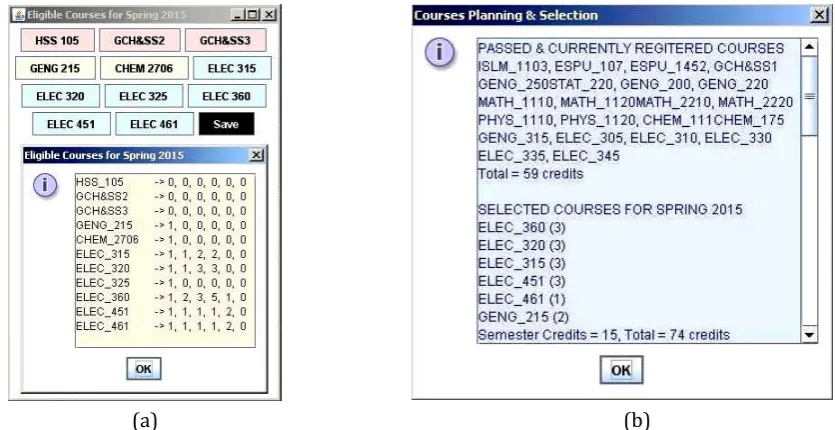
Fig. 3(a) shows a list of 11 eligible courses, which the student can take for the Spring semester of 2015. The reduced number of 11 courses (out of 44 offered) is based firstly on the number of courses that the student has already passed as shown in Fig. 3(b), and on all other courses that do not complete the prerequisite requirements are missing from the list. Selection choice is further reduced from 11 to 8 courses because of a ‘0’ in field-1.
Reviewing all remaining fields show that ELEC 360 as the first selection with a ‘2’ in the second field. Next, there are four courses with a field-2 value of ‘1’ and all are selected in the order of ELEC 320 (a ‘3’ in field-3), ELEC 315 (a ‘2’ in field-3), and ELEC 451/ELEC 461 with a ‘1’ in field-3. The last course selection is a choice between GENG 215, CHEM 2706, and ELEC 325. Choosing ELEC 325 may be considered a heavy semester load with all electrical core courses. Therefore, from the remaining two courses, GENG 215 is selected as it is at a higher hierarchal level as shown from Fig. 2. The 6 out of 11 courses are now selected by clicking the course buttons shown in the upper section of the Fig. 3(a).
(a) (b)
Fig. 3. (a) Spring semester (2015) course selection choice; (b) Selected courses of Spring 2015.
The course buttons are color coded to identify general education requirements (red), college requirements (green), compulsory specialization requirements (blue), and elective specialization requirements (yellow). The course selection with current semester credits and total completed credit hours is shown in Fig. 3(b).
(0,0,0,0,0,0), GCH&SS2 (0,0,0,0,0,0), GCH&SS3 (0,0,0,0,0,0), CHEM 2706 (1,0,0,0,0,0), ELEC 325 (1,0,0,0,0,0), ECOM 360 (1,1,2,2,1,0), ELEC 370 (1,0,0,0,5,0), ELEC 375 (1,0,0,0,5,0), ELEC 431 (0,0,0,0,3,1), ELEC 433 (0,0,0,0,3,1), ELEC 411 (0,0,0,0,0,1), ELEC 481 (0,0,0,0,0,1), & ELEC 561 (0,0,0,0,0,1). Again, this is a reduced list based on the completed prerequisites from the Fall 2015 semester (to be offered) courses.
The obvious choice for this semester is in the order: ECOM 360, ELEC 370/ELEC 375, ELEC 431/ELEC 433, ELEC 325. Course ELEC 431 and Lab ELEC 433 are preferred over CHEM 2706 because firstly, these are only offered in the first semester and secondly, both courses open three technical electives. Moreover, the student now becomes eligible for the industrial training in the next Fall (1st) semester and this may
leave the student to take these courses in the semester just before graduation, which restricts the three associated electives to be ever taken by this particular student. Similar course selection procedure is used for the remaining semesters until the graduating semester.
5.2.
Test Case 2
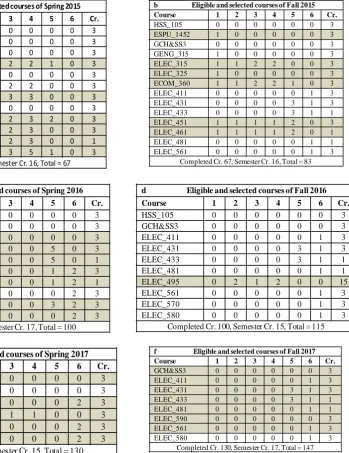
Table I. (a) Spring 2015 Selected Courses; (b) Fall 2015 Selected Courses; (c) Spring 2016 Selected Courses; (d) Fall 2016 Selected Courses; (e) Spring 2017 Selected Courses; (f) Fall 2017 Selected Courses
a Eligible and selected courses of Spring 2015
Course 1 2 3 4 5 6 Cr.
HSS_105 0 0 0 0 0 0 3
ESPU_1452 1 0 0 0 0 0 3
GCH&SS3 0 0 0 0 0 0 3
MATH_2220 1 1 2 2 1 0 3
GENG_315 1 0 0 0 0 0 3
ELEC_315 1 1 2 2 0 0 3
ELEC_320 1 1 3 3 0 0 3
ELEC_325 1 0 0 0 0 0 3
ELEC_330 1 2 2 3 2 0 3
ELEC_335 1 2 2 3 0 0 3
ELEC_345 1 2 2 3 0 0 1
ELEC_360 1 2 3 5 1 0 3
Completed Cr. 51, Semester Cr. 16, Total = 67
b Eligible and selected courses of Fall 2015
Course 1 2 3 4 5 6 Cr.
HSS_105 0 0 0 0 0 0 3
ESPU_1452 1 0 0 0 0 0 3
GCH&SS3 0 0 0 0 0 0 3
GENG_315 1 0 0 0 0 0 3
ELEC_315 1 1 2 2 0 0 3
ELEC_325 1 0 0 0 0 0 3
ECOM_360 1 1 2 2 1 0 3
ELEC_411 0 0 0 0 0 1 3
ELEC_431 0 0 0 0 3 1 3
ELEC_433 0 0 0 0 3 1 1
ELEC_451 1 1 1 1 2 0 3
ELEC_461 1 1 1 1 2 0 1
ELEC_481 0 0 0 0 0 1 1
ELEC_561 0 0 0 0 0 1 3
Completed Cr. 67, Semester Cr. 16, Total = 83
c Eligible and selected courses of Spring 2016
Course 1 2 3 4 5 6 Cr.
HSS_105 0 0 0 0 0 0 3
GCH&SS3 0 0 0 0 0 0 3
GENG_315 1 0 0 0 0 0 3
ELEC_370 1 0 0 0 5 0 3
ELEC_375 1 0 0 0 5 0 1
ECOM_432 0 0 0 0 1 2 3
ECOM_442 0 0 0 0 1 2 1
ELEC_462 0 0 0 0 0 2 3
ELEC_472 0 0 0 0 3 2 3
ELEC_562 0 0 0 0 0 2 3
Completed Cr. 83, Semester Cr. 17, Total = 100
d Eligible and selected courses of Fall 2016
Course 1 2 3 4 5 6 Cr.
HSS_105 0 0 0 0 0 0 3
GCH&SS3 0 0 0 0 0 0 3
ELEC_411 0 0 0 0 0 1 3
ELEC_431 0 0 0 0 3 1 3
ELEC_433 0 0 0 0 3 1 1
ELEC_481 0 0 0 0 0 1 1
ELEC_495 0 2 1 2 0 0 15
ELEC_561 0 0 0 0 0 1 3
ELEC_570 0 0 0 0 0 1 3
ELEC_580 0 0 0 0 0 1 3
Completed Cr. 100, Semester Cr. 15, Total = 115
e Eligible and selected courses of Spring 2017
Course 1 2 3 4 5 6 Cr.
HSS_105 0 0 0 0 0 0 3
GCH&SS3 0 0 0 0 0 0 3
ELEC_462 0 0 0 0 0 2 3
ELEC_585 0 1 1 1 0 0 3
ELEC_512 0 0 0 0 0 2 3
ELEC_592 0 0 0 0 0 2 3
Completed Cr. 115, Semester Cr. 15, Total = 130
f Eligible and selected courses of Fall 2017
Course 1 2 3 4 5 6 Cr.
GCH&SS3 0 0 0 0 0 0 3
ELEC_411 0 0 0 0 0 1 3
ELEC_431 0 0 0 0 3 1 3
ELEC_433 0 0 0 0 3 1 1
ELEC_481 0 0 0 0 0 1 1
ELEC_590 0 0 0 0 0 0 3
ELEC_561 0 0 0 0 0 1 3
ELEC_580 0 0 0 0 0 1 3
Another student example with completed 51 credit hours typically selects courses as shown in Table I (from (a) to (f). The course selection for all six semesters is in the following order. The selected courses are highlighted in the Table. Table I(d) shows only one course selection of Industrial Training.
Spring 2015 (Table I(a)) ELEC 360, ELEC 330, ELEC 335, ELEC 345, ELEC 320, & MATH 2220. Fall 2015 (Table I(b)) ECOM 360, ELEC 315, ELEC 451, ELEC 461, ELEC 325, & ESPU_1452. Spring 2016 (Table I(c)) ELEC 370, ELEC 375, ELEC 472, ELEC 432, ELEC 442, & ELEC 562. Fall 2016 (Table I(d)) ELEC 495.
Spring 2017 (Table I(e)) ELEC 585, ELEC 462, ELEC 512, ELEC 592, & HSS 105.
Fall 2017 (Table I(f)) ELEC 431, ELEC 433, ELEC 411, ELEC 481, ELEC 561, ELEC 590, & GCH&SS3.
6.
Conclusion
Student course advising is an important as well as a trifling process. The students may encounter unnecessary graduation delays because of a need of a proper advising and course registration system. A Knowledge Based Course Planning System based on six knowledge fields built around each course is devised to guide students in selecting from 15 to 17 credit hours or from five to seven appropriate courses suitable for online registration in the next and subsequent semesters. The outcome of the course selection is stored (semester wise) to show a complete typical plan.
References
[1] Hagler, M. (1995). Stand-alone PC-based advising aid for students. Proceedings of the Frontiers in Education Conference (pp. 18–21). Atlanta, Georgia.
[2] Laghari, M. S., Memon, Q. A., & Habib-ur-Rehman. (2005). Advising for course registration: A UAE university perspective. Proceedings of theInternational Conference on Engineering Education. Gliwice, Poland.
[3] Laghari, M. S., & Khuwaja, G. A. (2012). Electrical engineering department advising for course planning. Proceedingsof theIEEE Global Engineering Conference (pp. 861–866). Marrakech, Morocco.
[4] Laghari, M. S., & Khuwaja, G. A. (2012). Course advising & planning for electrical engineering department. WJEIS, 2(2), 172–181.
[5] Laghari, M. S. (2014). Electrical engineering course planning system. Proceedings of the 8th
International Conference on Engineering and Technology Research. Dubai, U.A.E.
[6] Laghari, M. S., Al Habsi, S. A., Maaz, N. A., & Al Naqbi, M. A. A. (2015). A one-semester course planner for EE students. Proceedings of the 2nd International Research Conference on Engineering, Science and Management. Dubai, U.A.E.
[7] Laghari, M. S. (2014). Automated course advising system. IJMLC,4(1), 47–51.
[8] Marques, O., Ding, X., & Hsu, S. (2001). Design and development of a web-based academic advising system. Proceedings of the31st ASEE/IEEE Frontiers in Education (pp. 6-10). Reno, Nevada.
[9] Pumpuang, P., Srivihok, A., Praneetpolgrang, P., & Numprasertchai, S. (2008). Using Bayesian network for planning course registration model for undergraduate students. Proceedings of the 2nd IEEE
International Conference on Digital Ecosystems and Technologies (pp. 492–496). Phitsanulok, Thailand. [10]Nambiar, A. N., & Dutta, A. K. (2010). Expert system for student advising using JESS. Proceedings of the
International Conference on Educational and Information Technology (pp. 312-315). San Francisco. [11]Patankar, M. (1998). A rule-based expert system approach to academic advising. Innovations in
Education and Training International, 35(1), 49–58.
Mohammad S. Laghari was born in Karachi, Pakistan. He received his B.E. degree in electronic engineering from Mehran University of Engineering and Technology, Jamshoro, Sind, Pakistan, M.S. degree in electrical engineering from Drexel University, Philadelphia, Pennsylvania, USA, and Ph.D. in computer engineering from the University of Wales, Swansea, UK in 1980, 1983, and 1993, respectively.
He has taught at the Kuwait University, King Saud University and is currently an Associate Professor in the Electrical Engineering Department, United Arab Emirates University, U.A.E. His research interests are in applied artificial intelligence, image processing, pattern recognition, and software systems. He has published more than 75 papers in these areas.