Numerical Modeling of Concrete Containing
Waste Tyre Rubber as Partial Replacement of
Fine Aggregate
Er. Kanwardeep Singh Dr. Jagbir Singh
P.G. Student Professor
Department of Civil Engineering Department of Civil Engineering Guru Nanak Dev Engineering College Ludhiana Guru Nanak Dev Engineering College Ludhiana
Er. Prem Gandhi Er. Varinder Singh
P.G. Student P.G. Student
Department of Civil Engineering Department of Civil Engineering Guru Nanak Dev Engineering College Ludhiana Guru Nanak Dev Engineering College Ludhiana
Abstract
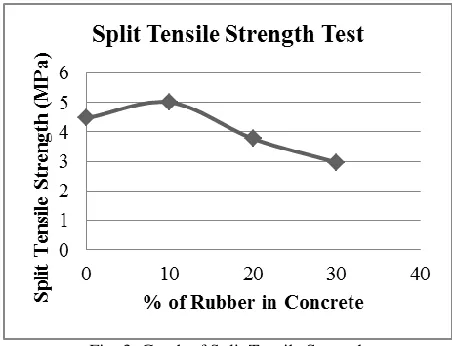
In this study, fine rubber was partially substituted with fine aggregates from 0% to 30% in multiples of 10%. The properties of concrete like compressive strength, flexural strength, split tensile strength and modelling in ANSYS was performed and the outcomes were investigated. The results showed that there was slight increase in the flexural and tensile strength of the specimens containing 10% fine rubber when compared to the control mix. Workability of concrete mix decreases with increase in the rubber content. The analytical result from ANSYS was obtained by the outcomes obtained from the experimental investigation and results were verified.
Keywords: Waste Tyre Rubber, Fine Aggregate, Rubber Added Concrete
________________________________________________________________________________________________________
I. INTRODUCTION
Recycling of tyres in nature is a major issue. In the present situation, these are tried to be utilized as a part of the concrete so that regular assets are spared and at the same time the earth is shielded from waste stores. Usage of waste tyre rubber in concrete as replacement of aggregate might be one of the better answers for the recycling of this waste. Rubber added concrete in this manner can contribute in maintainable development. Properties of concrete are influenced by incorporation of waste tyre. Workability of concrete with fine rubber decreases with the increase of rubber content. These studies have been done and it was seen that compressive strength declines as the measure of rubber particles increases.
Rubber added concrete has been seen for concrete containing rubber as substitution of aggregates.
Benefits of Adding Rubber in Concrete
Rubber added concrete is light in weight.
Rubber added concrete is environment friendly by using waste rubber instead of natural aggregates.
It has Low Linear Shrinkage Property.
Increases concrete Ductility.
Crack widths are reduced, thus improves durability.
Improved impact and abrasion resistance.
Importance of Numerical Modelling
Nowadays, with the help of advanced PC's and capable strategies for examination, such as the finite element method many efforts are developed analytical solutions which reduces the need for experiments which had to undertake by investigators. The numerical modelling technique has along these lines turned into an intense computational device, which permits complex investigations of the nonlinear reaction of RC structures to be done in a standard manner.
II. EXPERIMENTAL WORK
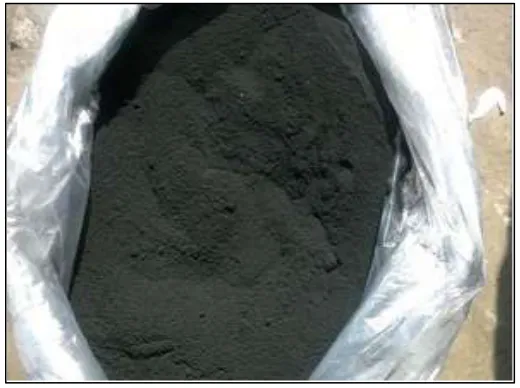
Fig. 1: Fine rubber used
Properties of Rubber used in study
The size of the fine rubber used in this research varies from 0.5 to 4.75 mm. Table - 1
Sieve analysis and specific gravity I.S. Sieve Size Percentage Passing
Fine Aggregate Coarse Aggregate Fine Rubber
40 mm - 100 -
20 mm - 100 100
10 mm 100 33 98
4.75 mm 97 4 82
2.36 mm 86 0 38
1.18 mm 74 - 6
600 Micron 42 - 0
300 Micron 23 - -
150 Micron 5 - -
Specific gravity 2.605 2.884 1.14
Numerical Modeling
Numerical Modelling is a numerical system for finding estimated answers to boundary value problems for differential equations. It utilizes various techniques (the calculus of varieties) to minimize a mistake and deliver a steady solution. FEM programming software like ANSYS is used for building arrangement sets in engineering simulation that helps the design process. Programming software puts a virtual item through a thorough testing technique, for example, smashing an auto into a block divider, or running for quite a while on a landing area street before it turns into a physical object. In this study Mechanical APDL (ANSYS) was used for analysis.
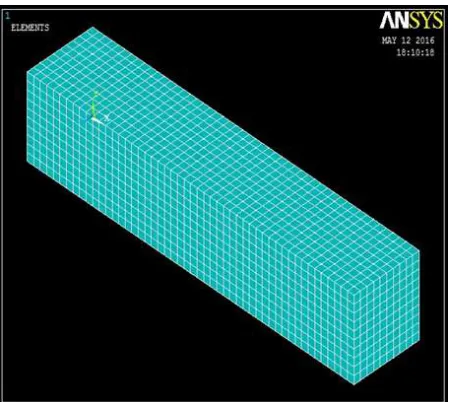
Meshing
Fig. 1: Meshed model of beam
Loads and Boundary Conditions
Boundary conditions were needed to constrain the model to get a one of a kind arrangement. In this research two supports were applied, one of which was constrained from all axis but other support was set free in x-axis. Two point loads were applied on the top surface of the model in y direction. Applies loads and boundary conditions are shown in Fig. 3.
Fig. 2: Isometric showing loads and boundary conditions
Parameters Required Defining Material Properties in ANSYS
Following are the parameters required to define material properties:
Compressive Strength
Split Tensile Strength
Modulus of Elasticity
Poisson's ratio ()
III. RESULTS AND DISCUSSION
The experimental testing results of Slump value in Table 2 and Compressive strength, Split tensile strength, Flexural strength, Modulus of elasticity, Poisson’s ration and density are listed in Table 3.
Table – 2
Mix proportions and slump value Type of
Concrete mix
Percentage of Rubber (%)
Cement (Kg/m3)
Fine Agg. (Kg/m3)
Fine Rubber (Kg/m3)
Coarse Agg. (kg/m3)
Water Content (litre)
Admixture (litre)
Slump (mm)
CC 0 330 749 0 1330 140 7.0 95
admixture (BASF 8341) was added in mix.
Fig. 4: Graph of Workability
Compressive Strength
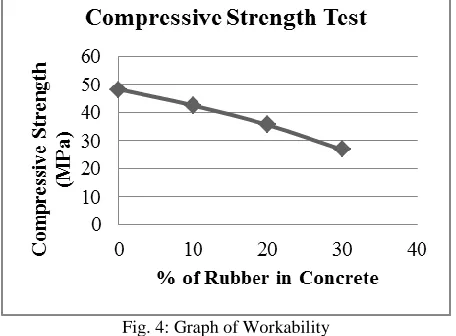
In the fig. compressive strength of different mix proportion demonstrated a decreasing tendency with increasing mixing ratio of the fine rubber content. The increase in fine rubber content from 0 to 30% resulted in a gradually decrease in the compressive strength from 48.2 MPa to 26.8 Mpa, which is equivalent to It can be seen that most reduction occurred when the replacement ratio was 30%.
Fig. 5: Graph of Compressive Strength Test
Split Tensile Strength
Fig. 3: Graph of Split Tensile Strength
Flexural Strength Test
The flexural strength of different mix proportion is presented in Figure 7. The flexural strength values between 5.54 and 3.18 MPa at 28 days were achieved, in which the RC10 had the highest strength value.
Fig. 4: Graph of Flexural Strength Test
Load-Deflection Values Obtained Experimentally and ANSYS
LOAD (N)
CC RC10 RC20 RC30
Deflection (ANSYS) (mm)
Deflection (EXP)(mm)
Deflection (ANSYS)(mm)
Deflection (EXP)(mm)
Deflection (ANSYS)(mm)
Deflection (EXP)(mm)
Deflection (ANSYS)(mm)
Deflection (EXP)(mm)
2000 .01 .009 .011 .009 .015 .013 .016 .014
4000 .02 .019 .021 .018 .028 .027 .033 .03
6000 .03 .027 .032 .030 .043 .041 .050 .046
8000 .041 .038 .043 .039 .058 .055 .064 .062
8500 - - - - - - .065 .063
9240 - - - - - .067 -
11000 .051 .049 .054 .050 .070 .069 - -
11800 - - - - .071 .070 - -
12800 - - - - .072 - - -
13000 - - .065 .061 - - - -
13500 .061 .060 - - - - - -
14080 .062 - - - - - - -
14800 - - .072 .062 - - - -
15400 - - .074 - - - - -
[1] Jing Lv, Tianhua Zhou, Qiang Du, Hanheng Wu. Effects of rubber particles on mechanical properties of lightweight aggregate concrete : Construction and Building Materials 91, 145–149, 2015.
[2] Mehmet Gesog˘lu, Erhan Guneyisi, Ganjeena Khoshnaw, Suleyman Ipek. Investigating properties of pervious concretes containing waste tyre Rubbers:
Construction and Building Materials 63, 206–213, 2014.
[3] Matthew R. Hall, Khalid Battal Najim. Structural behaviour and durability of steel-reinforced structural Plain/Self Compacting Rubberized Concrete
(PRC/SCRC) : Construction and Building Materials 73, 490–497, 2014.
[4] PankajPunase, S.R. Parekar, Rakesh Patel. Study on the behaviour of scrap tyre rubber and steel scrap reinforced concrete beams: UKIERI concrete congress concrete research driving profit and sustainability, 2015.
[5] Ranjodh Singh, Sudhir Arora, Rohin Kaushik. Enhancing the properties of roading aggregates by using waste plastic and rubber material: UKIERI concrete
congress concrete research driving profit and sustainability, 2015.
[6] Trilok Gupta, Sandeep Chaudhary, Ravi K. Sharma. Assessment of mechanical and durability properties of concrete containing waste rubber tyre as fine
aggregate: Construction and Building Materials 73, 562–574, 2014.
[7] Trilok Gupta, Ravi K. Sharma, Dr.Sandeep Chaudhary. Impact resistance of concrete containing waste rubber fiber and silica fume: International Journal of
Impact Engineering S0734-743X00080-9, 2015.
[8] Trilok Gupta, Dr.Sandeep Chaudhary, Ravi K. Sharma. Mechanical and durability properties of waste rubber fiber concrete with and without silica fume: