ISSN (Online): 2320-9364, ISSN (Print): 2320-9356
www.ijres.org Volume 2 Issue 11 ǁ November. 2014 ǁ PP.09-13
www.ijres.org 9 | Page
Implementation of the trinity of the control system based on OPC
Yang Lu
1), Lei Juyang
2)(College of Mechanical Engineering, Shanghai University of Engineering Science, Shanghai 201620,China)
A
bstract
:The WinCC+PLC control system is a typical real-time control system. Many Engineering colleges Introduce corresponding control experiments in relevant courses to enhance the students'understanding ofthis knowledge. But it needs bothvenues and funds and hasunsafety factors toequipped with varieties of experimental subjects for the laboratory. This paper gives a very good solution to thisproblem by introducing MATLAB virtual controlobject in theclassic WinCC+PLC controlsystem. What’s more,it realizes the seamless connection between the MATLAB and the WinCC+PLC control system after analysing how to make the PID controller in STEP7 .
Key words:OPC technology; MATLAB; WinCC; real-time control; simulation
I.
Introduction
It is essential to collectand monitor field data completely and effectivelyreal-time in industrial process.
WinCC isa man-machine interface (NMI)software to solve the visualizationand control tasksin the production process and process automationbywhichto coordinatevisualization,report,collection andarchiving
processdata andapplications forusers the freedom todefine theintegration provides asystem module.
Moreover,WinCC provides aspecialchannel which is used to ensure the communication with SIMATICS5,S7
and 505series of PLC be convenient andefficient.Therefore, so,the WinCC+PLC control systemhas gradually become theclassical control systemin kinds of industrial processes.MATLABis typically limited by the off-line simulation.[1] In order to combine with real-time controlobjects,we can under the help of the software WinCC by OPC technology(OLEforProcessControl,OLE used in theprocess of control) [2] to make the threecommunicateandconnect to the realization the seamless connection between MATLAB andthe control
system WinCC+PLC(STEP7),so as to establish thecontrol system three –in-one.
II.
OPC technology
Before the emergence of OPC, every application software developer has to write the special interface
function in order to access the data information of the equipment . what’s more,that the different kinds
of equipment and the equipments upgrade frequently has brought userand software developera hugeburden of work. The emerge of OPC maywell solve this problem.OPCtakes the Microsoft's OLE/COMand DCOM mechanismas the communicationmechanismof application and takes client / server model[3], so as to give themission of developing access interfaceto the hardwaremanufacturer or the third partymanufacturers and
present to the user inthe form ofOPCserver,solving the contradictionof
soft/hardwaremanufacturers,completing the systemintegration,improving the openness andinteroperability of
the system.The OPC server isresponsible asdata suppliers and provides necessary data to theOPC client;the
OPC clientisthe user of data,processingdata provided by OPC server.When using OPC,therealways includes
the OPC service andthe OPC client. OPC serveris usually designed by the user,as long as compliance withthe OPC datainterface protocolcan realize data acquisition fromthe OPC server.A OPC clientcan beconnected to
III.
Three-in-one
control
system
This control project selects water level in tank as the control objectas tank level is often usedas the object of studyin the related experiments because ithas the characteristics oflarge time delay and nonlinear.The principle of control systemis shown in figure 3-1:
Fig.3-1 The diagram of control Principle of virtual monitoring system
The objectrequestgoal settingvalue is SP,the working of the systemgoal isthrough the establishmentof
the simulation platform to makethe errorvalue E between set value SPandthe return value PVchange to be smallest and to monitor the key controlquantity at the same time. In the virtual monitoring system, the PLCsim isused to virtual as the controller S7-300PLC,the control algorithm adoptted PID controlis realized by
STEP7programming.The controller's output value the operating variablesU istransmitted over the MPI
channel in STEP7to WinCC.WinCC works as a OPC serverand passes the value to the OPCclient MATLAB.MATLAB client reads thenumericalU fromWinCC byOPC protocol and sent the value to
theactuator,which is the virtual object with time delay, then get the control variable Y of the system.In this system,time delay object is founded through the MATLAB simulation.The MATLAB will also return the value of Y at every time to thecomparator,which makes the whole systemto form aclosed loop control.
IV. The Design and
verification of the system
4.1The design of the controller
In thecontinuous system,the signalis analog signal,the output of the controller of PID controller is
maked up by proportion item,integral item,differentialitem and the item outputinitial[4], this can be expressed byformula type 4-1:
mv t = kc ev t +
1
TI ev t dt + TD
dev(t)
dt + M (4-1) In the formula,ev(t)is the inputof the controller,the mv(t) isthe output of the controller,M is theinitial
loopoutput value,kc is thePIDloopgain,TIand TD are respectively theintegral time and differential time.
Take the rectangular integral on the integralpart toapproximate theexactpart, use the method of difference on differentialpartto approximationcalculation,thentype4-1 changed into:
Mn= Kc (sp n − pv(n) + KC TS T I
sp n − pv(n) + MX
+ KC TD sp n − pv(n) TS
(4-2)
After Completing the digital of PIDcontroller, PIDcontrollercan beprogrammedto work. What Needs to be pointed out[5] is that the scanningcycleof general PLCroughly onlyseveral ms to tens of ms,for the system which requireslongsampling period, the frequency of PID calculation is too fast so unnecessaryburden showed to the CPU which will make the scancycle of PLCincreased easyly then slow the response.For this
kind of physical value as levelwhich changes slowly, the difference betweenbefore and after the twocalculationerror is very smalland even may be less than theerrorof the fluctuations in the value, this may
PV
Y
E U
SP Controller
(PID)
Actuator
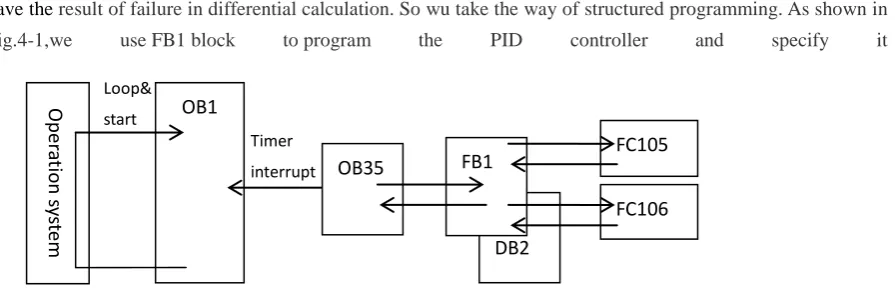
have the result offailure in differentialcalculation.So wu take the way of structured programming.As shown in
Fig.4-1,we useFB1block toprogram the PID controller and specify it
Fig. 4-1 The hierarchical structure of block call
abackgrounddata block when it is called.During process of the PLC operation,the blockOB1 works as theinterface between the operating systemand the user program and immediately keep scanning and operation as the PLC startted. The block OB35 is acircularterminaltissue block ofeachtime interval which will work for a time default100ms, the block FB1 is called in the block OB35,then the cycle time of OB35execution is
theoperation time of thePIDcontroller.The block FB1calls the block FC105 and the block FC106.Confined to
the length,the programis not listed.The complete programfileis shown in fig.4-2.
Fig. 4-2 The figure of edited program blocks
4.2The implementation of Virtual control object
After studying onwater levelstructure,object controlfunctionis obtained by demonstration, just as: Gp(s) =
e−4τs
Tps + 1 (4-1) Among them,τ = 20,Tp= 60, addingthe zero order holder and useZ transform into the type to discrete the object, then type4-1 changes into:
Y(z)
U(z)= 1 − Z−1 Z−4 1 1 − Z−1−
1
1 − e3 Z−1 =
0.284Z−5
1 − 0.716Z−1 (4-2) Converte it to discreteequation, then type 4-2can be expressed as:
Y∗ t = 0.716Y∗ t − T + 0.284U∗(t − 5T) (4-3) It is
Y∗ nT = 0.716Y∗ n − 1 T + 0.284U∗ (n − 5)T (4-4) From the typecan be clearly seen:the current output value Y is relevented to theprevious
momentoutputvalue Yand the the control value U at 5 moments before.
In MATLAB according to theOPC communicationprocessprogramming,inorder to realize theMATLAB
as the OPC client to communicate with OPCserver,it is need to createa clientobject in MATLABand establish a connection with theserver and add objects,groups and items and set the Property of groups and items. The
program is divided into 3 parts: the MATLAB to read OPC data server data program (shown
below), MATLABwrites data to the OPC server and display subroutine call back function. The key procedures Timer
interrupt Loop&
start OB1
O
per
at
io
n s
ys
tem
DB2 FB1 OB35
are as follows:
Server=opcda('localhost','opcserver.wincc');
connect(Server);
group=addgroup(Server);
Item1=additem(group,'cyd');
set(group,'updaterate',20);
set(group,'RecordsAcquiredfcncount',2);
set(group,'Recordstoacquire',60);
set(group,'datachangeFcn',@mydisplay);
start(group);
wait(group);
4.3 The configuration design of WinCC
WinCC configurationdesign mainlyincludes three aspects that are the interfacesettings, the variable design and the control screen design.The interfacesetting realizes the communication between WinCCand STEP7,the variable design makesdata transmissionin the communication between WinCCand STEP7 in the
control system, the control screen design can show thereal timechange of the value. in the control system . Finally,the run of the systemintegrationis completed,the result of running the systemis showned in fig.4-3.
Fig.4-3 the running result of the system
V. The Conclusion
After the birth of OPC technology, it has beensupported by many automation hardware and
softwareenterprises[6].This paper establishesa complete control system based onOPC technologywith WinCC,MATLABand STEP7three-in-one and use this system to monitorthe control ofvirtualcontrolled
object.With thepromotion and popularization of thecontrol modulebased on OPC standard, it not only makes thecontrolbecomes simple,alsomakes the access to the processdata easier. The use of MATLAB
forsimulation of the virtualobject solves the problem that a lot ofschool laboratory are short of equipments.
With the use of MATLAB,as long asthe transfer function is known, the controlobject can beapplied to
simulate. By this way,virtual the damage controlobjectorexpensive controlobject can not only save money
References
[1] QINGBAO H,SHAOJIAN S.Real-time control system based on MATLAB and PCAuto via OPC technology[A].In:2009 IEEE Internatioal Conference on Intelligent Computing and Intelligent Systems (ICIS 2009)[C].2009:671-674.
[2] The OPC Foundation, “OPC XML DA 1.01 specification”, http://www. opcfoundation.org/,accessed December 2004. [3] Member List. http://www.opcfoundation.org
[4] Samarth Singh,R.Mitra.Comparative Analysis of Robustness of Optimally offline Tuned PID Controller and Fuaay Supervised PID controller[C].Proceedings of 2014 RAECS UIET Panjab University Chandigarh,06-08 March,2014.
[5] Deshourough L,Miller R.Increasing Customer Value of Industrial Control Performance Monitoring-Honeywell’s Experience[C],
Proceeding of the 6th International Conference on Chemical Process Control,2002:172-192.