~ 101 ~ WWJMRD 2018; 4(4): 101-105
www.wwjmrd.com International Journal Peer Reviewed Journal Refereed Journal Indexed Journal UGC Approved Journal Impact Factor MJIF: 4.25 E-ISSN: 2454-6615
Mr.J.Prabhakaran Assistant Professor, Sree Narayana Guru Institute of Management Studies Coimbatore, Tamil Nadu, India
Dr.E.Muthu Kumar
Professor, Nehru College of Management, Coimbatore,
Tamil Nadu, India
Correspondence: Mr.J.Prabhakaran
Assistant Professor, Sree Narayana Guru Institute of Management Studies Coimbatore, Tamil Nadu, India
A study on Functional Problems of Self Help Groups
in Coimbatore District
Mr.J.Prabhakaran, Dr.E.Muthu Kumar
Abstract
A self-help group (SHG) is a village-based financial intermediary committee usually composed of 10–20 local women or men. A mixed group is generally not preferred. Most self-help groups are located in India, though SHGs can be found in other countries, especially in South Asia and Southeast Asia. Members also make small regular savings contributions over a few months until there is enough money in the group to begin lending. Funds may then be lent back to the members or to others in the village for any purpose. In India, many SHGs are 'linked' to banks for the delivery of micro-credit.
Keywords: Functional Problems, self-help groups, Chisquare, Anova.
Introduction
A SHG may be registered or unregistered. It typically comprises a group of micro entrepreneurs having homogeneous social and economic backgrounds; all voluntarily coming together to save regular small sums of money, mutually agreeing to contribute to a common fund and to meet their emergency needs on the basis of mutual help. They pool their resources to become financially stable, taking loans from the money collected by that group and by making everybody in that group self-employed. The group members use collective wisdom and peer pressure to ensure proper end-use of credit and timely repayment. This system eliminates the need for collateral and is closely related to that ohjf solidarity lending, widely used by micro finance institutions. To make the bookkeeping simple, flat interest rates are used for most loan calculations.Self-help groups are started by -governmental organizations (GO) that generally have broad anti-poverty agendas. Self-help groups are seen as instruments for goals including empowering women, developing leadership abilities among poor and the needy people, increasing school enrollments, and improving nutrition and the use of birth control. In countries like India, SHGs bridge the gap between high-caste & low-caste members. Financial intermediation is generally seen more as an entry point to these other goals, rather than as a primary objective. This can hinder their development as sources of village capital, as well as their efforts to aggregate locally controlled pools of capital through federation, as was historically accomplished by credit unions.
accounts, borrowers as a line of a SHG cut doctor expenses on jaunt (to and from the result and otherwise places) for completing material run and on the departure of workdays in persuasion for loans.
Review of Literature
Reji (2013) he stated out that the Ministry of rural Utilisation has specific components for women in its programmes and finances are "women factor" to assure line of enough resources for the comparable. The aim of the existing examination was assessing the effectualness consciousness ply groups in the economic state of women. This think is analytical and descriptive in nature. Both particular and unessential collection were utilised for the study 100 Self-help groups are haphazardly designated and from each SHG 2 members interviewed. Thusly a complete determine of 200 SHG members.The search aggregation were analyzed and interpreted by using various statistical tools self-help groups are portion for the economic conditions of its members. It can be end that the ego aid groups are amend glutted for the socio-economic position of women. Sajeev and Thangavel (2012) person evaluated the socioeconomic developments of SHG in different districts in Kerala nation using cluster psychotherapy. The aim of the papers countenance the symmetricalness of the members in attending meetings and preparation, party and scheme benefits gained by the members in ain place. In this paper introducing aggregation excavation method for gentle and rapid analysis based on clustering reasoning using K-Means and Hirsute C-K-Means, This meditate happen that peak product of Coolies is from Malapuram, Trivandrum and Calicut Districts many than half the meet is coolies in all districts. Most of the SHG member’s person seized loans for educational purposes. It is a fact one of the prima concluded that that Governing should swear indispensable steps to turn educational status of SHG members.
Pavithra and Narayana (2013) acuminate out that the self-help group is a littler volunteer relationship of rural/urban people, rather womenfolk from the same socio-economic punctuate. The represent musing was to examine the socio-economic state of agrestic women has splashed the intact Yalagiri (Vellore) Territory in Tamilnadu. A take of 350 respondents was selected on the assumption of Cordate Haphazard Method from the universe and Crombach's Alpha triad aspects of utilisation of women through consciousness supply group in Yalagiri (Vellore)
Dominion. The ending tools were misused for proportion reasoning, pinnated reasoning, and Pear's examine. This ponder concluded that signifies the economic connectedness that is associated with the self-help group and rustic processing.
Objectives of the Study
To assess the functional problems of self-help groups based on demographic profile.
To determine the levels of functional problems of the Self-help groups in Coimbatore.
To examine about the planning funtions based on education level.
Hypothesis
Ho:There is no significant difference between functional problem of self-help group and age group of self-help group members.
Ho: There is no significant difference between functional problem of self-help group and region of self-help group members.
Ho: There is no association between planning function of self-help group and education of self-help group members.
Methodology
The document is analytical supported on both primary and secondary sources. First assemblage were composed from with the better of fine structured questionnaire; Thirdhand information is obtained from varied publicised and unpublished records, books, journals and message donated by the Mahalir thittam staff Coimbatore territory. Multi stage purposive and random sampling has been adoptive for the represent thoughtfulness. At the primary open up all the 10 women consciousness helpfulness and confiscate at small one give somebody been haphazardly designated from each radical. This papers percent simple percentage analysis, Anova, chi-square test and percentage method is used as statistical tools for analyzing the collection and investigating the hypothesis.
Analytical Framework
The present study is concerned with the functional problems of the sample of self-help group members in Coimbatore district
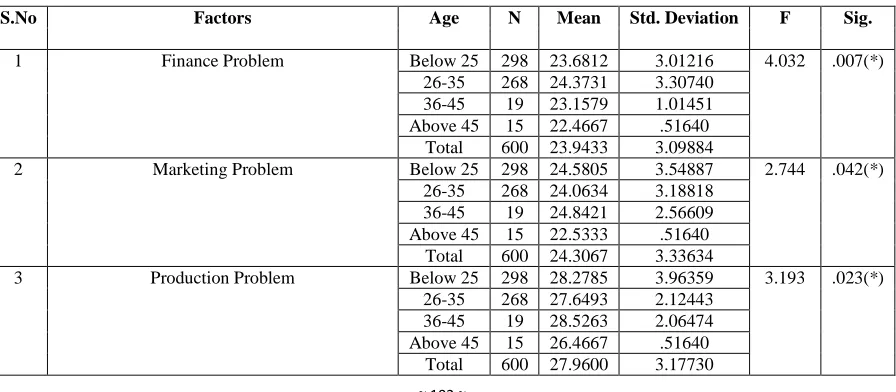
Table 1: Opinion towards the functional problems of self-help groups based on age
S.No Factors Age N Mean Std. Deviation F Sig.
1 Finance Problem Below 25 298 23.6812 3.01216 4.032 .007(*)
26-35 268 24.3731 3.30740
36-45 19 23.1579 1.01451
Above 45 15 22.4667 .51640
Total 600 23.9433 3.09884
2 Marketing Problem Below 25 298 24.5805 3.54887 2.744 .042(*)
26-35 268 24.0634 3.18818
36-45 19 24.8421 2.56609
Above 45 15 22.5333 .51640
Total 600 24.3067 3.33634
3 Production Problem Below 25 298 28.2785 3.96359 3.193 .023(*)
26-35 268 27.6493 2.12443
36-45 19 28.5263 2.06474
Above 45 15 26.4667 .51640
~ 103 ~
4 Human Resource Problem Below 25 298 23.8188 2.75376 4.066 .007(*)
26-35 268 24.6493 3.09466
36-45 19 24.6842 2.72952
Above 45 15 24.4000 1.54919
Total 600 24.2317 2.91184
5 Communication & Decision Making Problem Below 25 298 22.1577 4.21541 12.651 .000(*)
26-35 268 20.4851 2.72246
36-45 19 22.7368 3.66427
Above 45 15 23.3333 2.58199
Total 600 21.4583 3.67161
Source: Primary data computed *-significant at 5% NS-not significant
From the above table it can be interpreted that the P values of various functional problems namely Financial, Marketing, Production, Human Resource, Communication & Decision Making is less than 0.05, thereby indicating
that the null hypothesis is rejected.The test result shows that there is significant difference in the mean scores of functional problems of the respondents based on the age group.
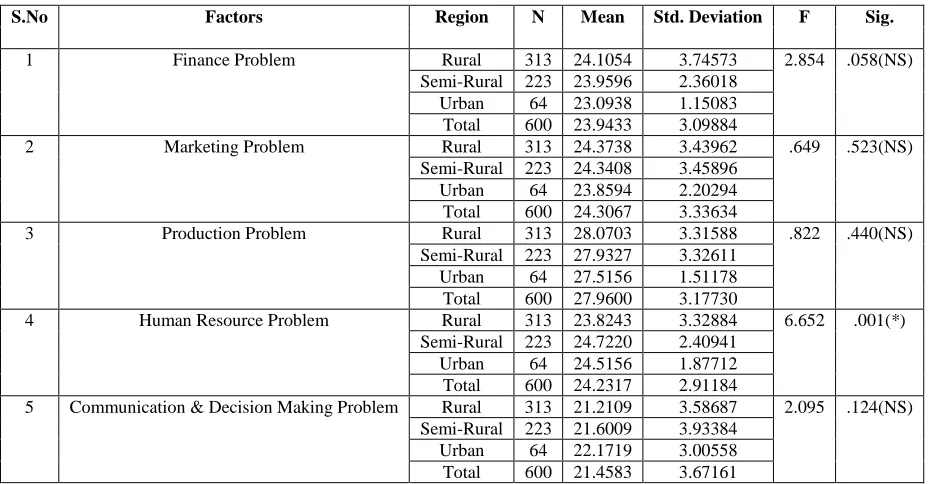
Table 2: Opinion towards the functional problems of self-help groups based on region
S.No Factors Region N Mean Std. Deviation F Sig.
1 Finance Problem Rural 313 24.1054 3.74573 2.854 .058(NS)
Semi-Rural 223 23.9596 2.36018
Urban 64 23.0938 1.15083
Total 600 23.9433 3.09884
2 Marketing Problem Rural 313 24.3738 3.43962 .649 .523(NS)
Semi-Rural 223 24.3408 3.45896
Urban 64 23.8594 2.20294
Total 600 24.3067 3.33634
3 Production Problem Rural 313 28.0703 3.31588 .822 .440(NS)
Semi-Rural 223 27.9327 3.32611
Urban 64 27.5156 1.51178
Total 600 27.9600 3.17730
4 Human Resource Problem Rural 313 23.8243 3.32884 6.652 .001(*)
Semi-Rural 223 24.7220 2.40941
Urban 64 24.5156 1.87712
Total 600 24.2317 2.91184
5 Communication & Decision Making Problem Rural 313 21.2109 3.58687 2.095 .124(NS)
Semi-Rural 223 21.6009 3.93384
Urban 64 22.1719 3.00558
Total 600 21.4583 3.67161
Source: Primary data computed*-significant at 5% NS-not significant
From the above table it can be interpreted that the P values of various functional problems namely Financial, Marketing, Production, Communication & Decision Making is greater than 0.05, thereby indicating that the null hypothesis is accepted. The test result shows that there is no significant difference in the mean scores of above
factors in the above study in relation to regional difference of the respondents. However it can be noted that with regard to human resource problems the P value is less than 0.05. This shows that the null hypothesis is rejected and there is a significant difference in the opinion towards the human resources problems based on region.
Table 3: Showing the levels of functional problems of self-help groups
Functional Problems Levels Frequency Percent
Level of Finance Problem Low 265 44.2
High 335 55.8
Level of Marketing Problem Low 225 37.5
High 375 62.5
Level of Production Problem Low 298 49.7
High 302 50.3
Level of HR Problem Low 236 39.3
High 364 60.7
Level of COD Problem Low 251 41.8
High 349 58.2
Source: Primary data computed
The above table shows that all the functional problem namely finance, marketing, production, human resource,
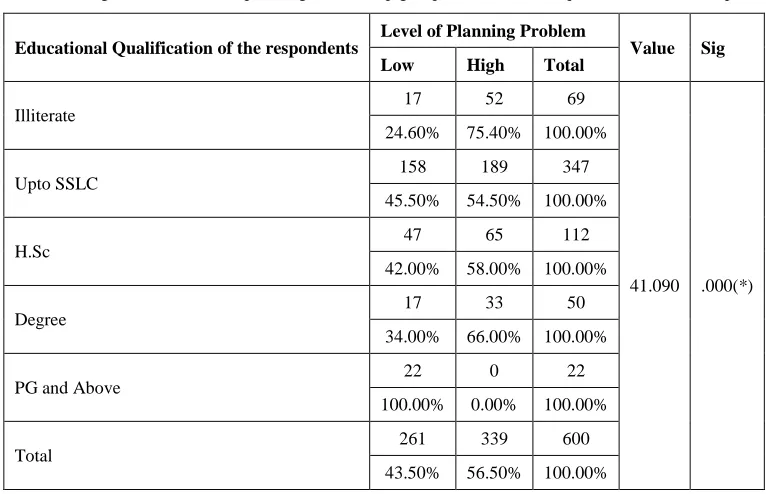
Table 4: Showing the association of planning of self-help groups on educational qualification of the respondents
Educational Qualification of the respondents Level of Planning Problem Value Sig
Low High Total
Illiterate
17 52 69
41.090 .000(*)
24.60% 75.40% 100.00%
Upto SSLC
158 189 347
45.50% 54.50% 100.00%
H.Sc
47 65 112
42.00% 58.00% 100.00%
Degree
17 33 50
34.00% 66.00% 100.00%
PG and Above
22 0 22
100.00% 0.00% 100.00%
Total
261 339 600
43.50% 56.50% 100.00%
Source: Primary data computed*-significant at 5% NS-not significant
From the above table it can be interpreted that the P value of planning function towards the educational qualification is lesser greater than 0.05, thereby indicating that the null hypothesis is rejected. The test result shows that there is association between the mean scores of above factors in the above study in relation to educational qualification of the respondents.
Findings
The P values of various functional problems namely Financial, Marketing, Production, Human Resource; Communication & Decision Making is less than 0.05, thereby indicating that the null hypothesis is rejected. The test result shows that there is significant difference in the mean scores of functional problems of the respondents based on the age group.
The P values of various functional problems namely Financial, Marketing, Production; Communication & Decision Making is greater than 0.05, thereby indicating that the null hypothesis is accepted. The test result shows that there is no significant difference,
However it can be noted that with regard to human resource problems the P value is less than 0.05. This shows that the null hypothesis is rejected and there is a significant difference in the opinion towards the human resources problems based on region
The functional problem namely finances, marketing, production, human resource, communication and decision making are having high level of problems among the self-help group members.
The P value of planning function towards the educational qualification is lesser greater than 0.05, thereby indicating that the null hypothesis is rejected. The test result shows that there is association between the mean scores of above factors in the above study in relation to educational qualification of the respondents.
Suggesstion
In this study the women self-help groups are doing diverse kinds of undersized business for earning money to get a
better social status. Hence the government provides a choice of financial schemes to progress their earning capability as well as their social status.
The self-help group are also facing a lot of problems in the society, in the aspects of to accomplish their individual needs, family financial commitment and low personal confidence, To overcome the respective problems in women self-help group the government need to assist motivational training programmes with new innovations for motivating them and getting good status in the society. Micro finance institutions can additionally provide insurance and other such conveniences to the successful self-help group retail outlet services for the products, which can give a big, heighten to the actions of self-help groups. Even the NGO can insist upon regular change in leadership to get better functioning of self-help groups
Conclusion
The self-help group mechanism is hypothetically a very sound idea and can definitely lead to development in choice, opportunity, and sovereignty. Since the study is fretful with self-help groups suffers from lack of time, mobility, skills, income, literacy, education, health services, employment opportunities, Labour market and right to use to productive resources. The significant issues that were researched in the area and ways to which the self-help groups have progress of women who are members. The Self-help groups have helped in raising the income and the levels of their living to facilitate them to cross the scarcity line were by self-help groups can direct to financial and social intermediation, employment generation, poverty alleviation human development and rural development.
Reference
1. Lakshmi R and vadivalagan G(2011) Impact of self-help groups on empowerment of women: A study in Dharmapuri District, tamilnadu, Journal of management and sciences, volume No.1, Issue- 2, pp. 43-54.
~ 105 ~
Empowerment in Nakuru county, Interdisciplinary journal of contemporary Research in Business, vol-5, No- 4, August 2013.
3. Shobhana Gupta1 and Sanjeev Kumar Singh (2012) Economic Security among Rural Women through Self Help Groups: An Analytical Study, Indian Res. J. Ext. Edu. 12 (2), May, 2012.
4. Reji (2013) Economic empowerment of women through self-help groups in Kerala, International Journal of Marketing, Financial Services & Management Research, Vol.2, No. 3, March (2013), pp- 97-113.
5. Sajeev and Thangavel (2012) Evaluation of socio-economic patterns of SHG members in Kerala using clustering analysis, IJCSI International Journal of Computer Science Issues, Vol. 9, Issue 2, No 2, March 2012,p.p -386-397.
6. Umamaheswari Gurusamy and Jayakumar(2013) A study on social impact of women self-help groups in Mettur Taluk, Salem District, Tamilnadu, International Journal of Social Science & Interdisciplinary Research, Vol. 2, Issue-3 March 2013.