Automatic Surveillance System for Border
Security
Shubham Deb Dashrath Purohit
Department of Computer Engineering Department of Electronics Engineering Padmabhushan Vasantdada Patil Pratishthan’s College of
Engineering, Sion - Chunabatti, Near Everard Nagar, Mumbai, Maharashtra 400022, India
Padmabhushan Vasantdada Patil Pratishthan’s College of Engineering, Sion - Chunabatti, Near Everard Nagar,
Mumbai, Maharashtra 400022, India
Vinod Pendam Kshitij Dolas
Department of Electronics Engineeringg Department of Electronics Engineering Padmabhushan Vasantdada Patil Pratishthan’s College of
Engineering, Sion - Chunabatti, Near Everard Nagar, Mumbai, Maharashtra 400022, India
Padmabhushan Vasantdada Patil Pratishthan’s College of Engineering, Sion - Chunabatti, Near Everard Nagar,
Mumbai, Maharashtra 400022, India
Mrs. Asha Rawat
Head of Department
Department of Computer Engineering
Padmabhushan Vasantdada Patil Pratishthan’s College of Engineering, Sion - Chunabatti, Near Everard Nagar, Mumbai, Maharashtra 400022, India
Abstract
India shares 15,106-km-long border and 7,515 km on the coastline with its neighboring countries. In addition to the large physical fences built for stopping illegal immigrants, drug dealers, and terrorists from crossing the border, smart fencing has been proposed to extend the eyes and ears of the Border Patrol. This is because it reduces human efforts and it also reduces risk and threat to human life, thus saving the lives of our civilians as well as our soldiers. The idea is to use Image Processing (which is cheaper when compared to other security systems such as RADAR under use), wireless communication and a robotic arm to locate and shoot intruders while providing continuous security monitoring along the borders. The Objective of our project is to increase the Internal Security and provide long term support to it by making use of machines. Thereby reducing human efforts and working effortlessly in any of the weather conditions like summer or winter whilst providing greater efficiency. Systems can be installed in the places which are out of human reach and can work in areas harmful to human health such as radiation or bad weather. Keywords: Background Subtraction, Dilation, Erosion, Gaussian matrix of mixtures, Morphological filtering, RGB, Thresholding
________________________________________________________________________________________________________
I. INTRODUCTION
Despite continued growth and investment, border and maritime security continues to present challenges to governments around the world. Owing to the vastness and the extreme climatic conditions which may be prevalent in these regions, it becomes practically impossible to deploy personnel throughout the borders, let alone the armed equipment required by them to guard it. According to a media report, India’s defense budget increased from $36.1-billion (U.S.) in 2011 to $45.2-billion due to increased import of foreign firearms. Also according to independent media reports, the total number of conflict-related deaths at the borders range from 47,000 to 100,000 which include civilians, soldiers, journalists etc. since 1988, which is quite high. Hence border security has become a high-priority issue in India. Our system relies on background subtraction to detect intruders. It runs on two modes: In Manual mode once the intruder is detected, the system alerts the control room about the intruder. If the control room gives the permission to shoot it will shoot the intruder, otherwise it will not. In Automatic mode, the system would shoot any moving object on sight. This mode could be used when the country is under attack from the neighboring country.
Origin of the Research Problem
civilians trying to cross the border, our system would notify the control room to take appropriate action of either shooting it down or instructing the BSF personnel to go to that location and settle the matter with the civilian.
Interdisciplinary Relevance
India’s land borders exceed 15,000kms and it shares these with seven countries. The length of India’s land borders with its neighbors varies considerably: Bangladesh - 4,339kms; Bhutan 605kms; China - 3,439kms; Myanmar - 1,425kms; Nepal - 1,690kms & Pakistan - 3,325kms. Due to the proclivity of India’s neighbours to exploit India’s nation-building difficulties, the country’s internal security challenges are inextricably linked with border management. The border security scenario is marked by: increased cross-border terrorism; infiltration and ex-filtration of armed militants; illegal migration; left-wing extremism and separatist movements aided and abetted by external powers.
II. TECHNOLOGY AND METHODOLOGY
Image Processing Unit
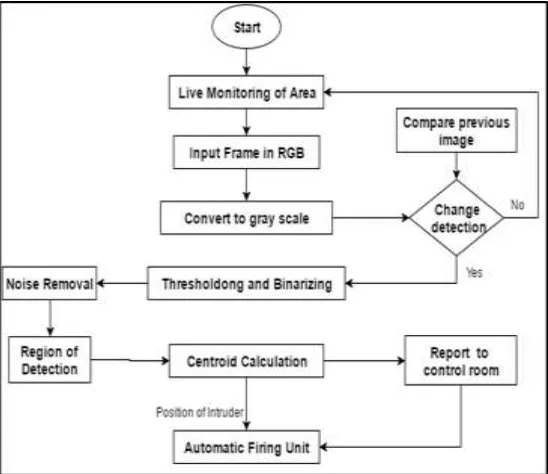
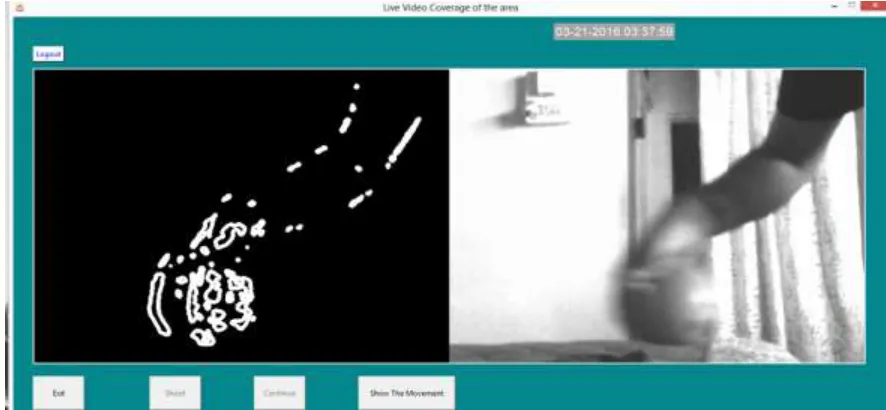
The Image processing is performed by using Python, opencv and numpy. Continuous live video feed is captured by camera and it is processed. A predefined frame rate is set, so that continuous frames are displayed and checked for any suspicious movement. We then store the static image of the background as the reference image. Then if any intruder tries to enter inside our border, then the motion of the intruder could then be detected by using background subtraction algorithm. This algorithm displays any moving object in the environment and makes the RGB value of the image as white (255,255,255) so that we could identify him in the background which is initially black (0,0,0). It uses Gaussian matrix of mixtures to detect any moving objects in the background. External noise in the image is reduced by using the noise removal techniques specified in opencv such as dilation and erosion to remove any impurities in the image so that there is less processing in the background for the detection of the intruder.
Morphological filtering is used to set a given threshold on the moving object being detected by the camera. Thresholding is required to ignore any small changes in the background. So only some significant changes in the background could be detected and then sent to the control room. We made two modes to counter the problem of having an issue when civilians approach the border. So in Manual mode, a request for the permission to shoot would be sent to the control room And in Automatic mode, it will shoot directly without any acknowledgment from command center. This mode could be used during emergency situation around the borders when the country is being attacked by other country.
A flowchart of our system is indicated in the diagram below:
III. IMPLEMENTATION AND RESULTS
Following images are the evidence of the results. Some of them are captured by computer screenshot and mobile camera.
Icon of our Application.
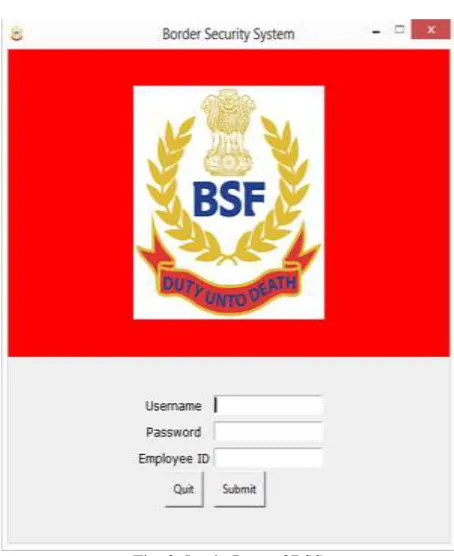
Fig. 2: Icon of BSS Login page of our Application
Splash Screen of our Application
Fig. 4: Splash screen of BSS Live Video Coverage Tab of our Application
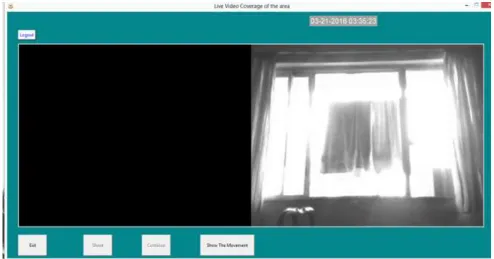
Live Video Coverage Tab in Static Mode
Fig. 5: Live Video Coverage Tab in Static Mode IV. CONCLUSION
A working model of the proposed system has been devised. The performance of the system is found to be satisfactory. Its response is found to be dependent on ambient light, and therefore, it requires calibration for a given environment. It is clear that, this system, if deployed in the borders, can simplify the task of safeguarding them and also reduce the overall personnel-count. In future, RADAR can be integrated into this device, by means of which the system can be made more versatile. It not only increases the range, but also provides scope for determining size, speed and direction of motion of the intruder and is absolutely fail-proof. Also by introducing a dedicated DSP Processor with real time code instead of Opencv for the image processing tasks, the system can be made more efficient and reliable.
REFERENCES
[1] Press Information Bureau, Government of India, Ministry of Home Affairs, http://pib.nic.in/newsite/PrintRelease.aspx?relid=112348
[2] A low-complexity algorithm for intrusion detection in a PIR-based Wireless Sensor Network Published in: Intelligent Sensors, Sensor Networks and
Information Processing (ISSNIP), IISC Bangalore, India. Conference Paper, Jan 2010.