IOT Based Automatic Watering of Plants using
Raspberry Pi And Android
Jigyasa Kamthan Ketan Goyal
UG Student UG Student
Department of Computer Engineering Department of Computer Engineering Bharati Vidhyapeeth College of Engineering, PUNE Bharati Vidhyapeeth College of Engineering, PUNE
Kratika Gupta Mr. Sagar Mohite
UG Student Associate Professor
Department of Computer Engineering Department of Computer Engineering Bharati Vidhyapeeth College of Engineering, PUNE Bharati Vidhyapeeth College of Engineering, PUNE
Abstract
With the raging water needs and the scarcity of water, there is a dire need for a smart system that can save the pristine water. This paradigm targets at saving time and avoiding the adversities like constant surveillance. It also facilitates in reducing water wastage by automatically providing water depending on the water need of plants, hence using the amount which is required.. It can provide us with sustainable approach for water conservation. Due to digitalization, there is always a way of reducing risks and making work simpler. This application specifically and particularly controls water system for gardens by using the efficiency of Raspberry Pi. It is attained by installing sensors in the field to monitor the soil temperature and soil moisture which extends the data to the Raspberry Pi for estimation of water demands of plants and also we provide the user with the extreme ease of managing all the information using the android application.
Keywords: Arduino Uno, Automation, Internet of Things, Raspberry Pi, Sensors
________________________________________________________________________________________________________
I. INTRODUCTION
The IoT is grounded on the rising developments in RFID (radio frequency identification), sensors, communication technologies, and IP. The root idea is to have smart sensors directly, without any conundrum of human involvement to deliver supreme strata of applications. Revolutionization of Internet, mobile and machine-to-machine technologies can be seen as the stepping phase of IoT. In the befalling generation of technology, it is foretold that IoT has the capability to summon the diverse technologies to enable new apps by agglomerating physical objects together in support of igenious decision making. This is a plant environmental monitor system. It records the soil moisture, air temperature and air humidity of plants and will alert via a twitter notification on the mobile application when plants need water. The system is battery operated, wireless, Arduino and Raspberry Pi based and comes with an Android application. The app aggrandises the user’s ability to know at the current data and historical data like temperature, humidity on app.
II. NEED
III. CIRCUIT DIAGRAM
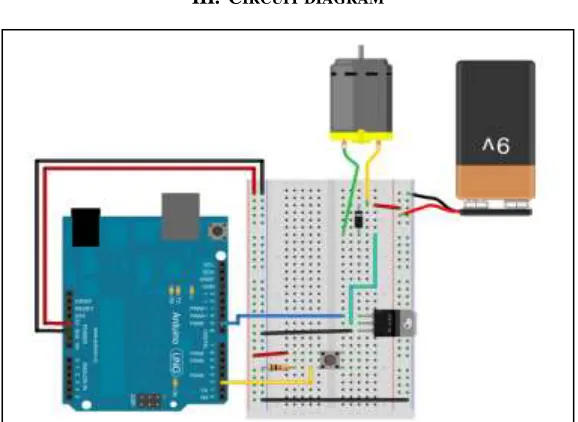
Fig. 1: Circuit Diagram of pump controlled by Arduino.
There are two major components in this project which are moisture sensors and a motor or water pump. The purpose of the moisture sensor is to sense the level of moisture in the plant. The motor or water pump provides water to the plants. The moisture sensor indicates the level of moisture in the plant and sends the signal if water is needed. The motor/water pump exhilarates water to the plants until the optimum moisture level is met.
IV. HARDWARE DESCRIPTION
Raspberry pi
“Pi is a single-board computer”. Pi is small in size but little bigger than a credit card, it packs enough power to run games, word processor, image editor and any program of similar magnitude. I was introduced as an educational gadget to be used for protoyping by hobbyists and for those who want to learn more about programming concepts.
Fig 2: Raspberry Pi 3 model B
Arduino
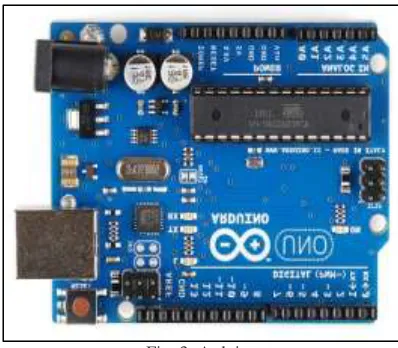
Fig. 3: Arduino
Soil Moisture Sensor
Inexpensive sensors consisting of two electrodes and probes for measuring the soil resistance are often used for residential purposes. A higher average dielectric constant for the soil is caused by a higher water concentration. The soil moisture sensors measure the propagation speed in a buried transmission line to measure the average dielectric constant. These sensors provide data at the current time and improve the efficiency. The sensors are easy to install and require less protection.
Fig. 4: Soil Moisture Sensor
Soil Temperature Sensor
A Resistance Temperature Detector (RTD) is used to measure temperature of soil.this sensor values is used to control the motor.[1]
V. SOFTWARE DESCRIPTION
Raspbian Operating System
The Raspberry Pi primarily uses Raspbian, a Debian-based Linux operating system. Ubuntu MATE, Snappy Ubuntu Core, Windows 10 IoT Core, RISC OS and specialised distributions for the Kodi media centre and classroom management. Operating systems available via the official website of other third party.
Android application
The android app is controlling raspberry pi and through the mobile application we can monitor all the actions happening with Raspberry pi
VI. WORKING
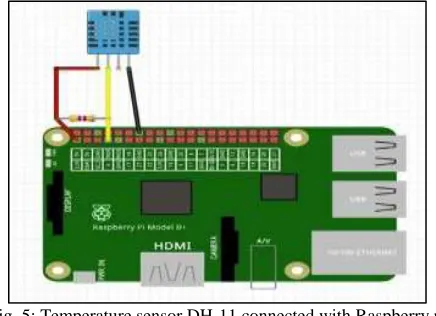
Fig. 5: Temperature sensor DH-11 connected with Raspberry pi
We set up DH-11 with the Raspberry pi, and sending values to internet. Setting a Channel at ThingSpeak.com
Sending an Tweet Message
A simple solution to send message, is t send a Tweet directly from the webpage. In this case the”React” module of ThingSpeak.com is used.
Connecting the RPi and the Arduino Using Serial Communication:
Once the Arduino is connected with RPi, extra values interpreted by Arduino can also sent to the Thinkspeak.com webpage, other data interpreted by the sensor. We code in such a way that it send data to website and also collect values from Arduino. When the temperature sensor sense an increase in temperature and sends tweet automatically “Its too Humid”.
Fig. 6: Raspberry pi connected with Arduino
VII.ADVANTAGES
This technology is nominated for efficient smart irrigation systems and it may provide a valuable tool for preserving water. Maximum sucking up of water by the plant is ensured by sprinkling water evenly using motor. So there is less wastage of water. This system also automated as we can control the amount of water we want deliver to the plants when it is needed based on types of plants by keeping an eye on soil moisture and temperature. This project can be used to irrigate agricultural land where manpower needs to be minimise. Many aspects of the system can be changed according to the need and controlled through android application.
VIII. FUTURE SCOPE
The proposed approach is to add security in the notification area of the project. Since notification is sent through twitter it is mandatory to add additional security in the system. By applying multiple encryption algorithm we can add security to the architecture. This algorithm may be Blowfish, SÁ, two fish, advance encryption standard (AES). As the twitter notification is triggered in the thinks peek software the data will be encrypted using any of the encryption algorithms so that the data is secured. There are multiple policies which are applied to make internet secure. But its studied that less number of policies are applied. Twitter architecture is based on networking domain and cloud sub domain which is keen to network security.
Our project scope can be improved by adding feature which can tell the climate condition and water the plants/crops according to the need. If rain is predicted more, less water is supplied to plant. The total cost of providing enough water to the plants throughout a year long can be calculated. By storing the values constantly we can study about the nature call such as Drought
IX. CONCLUSION
Through Internet Of Things we can access remotely existing network framework, new openings are created for more direct integration of country into digital infrastructure and resulting in improved efficiency benefits. In India, farmers use ancient irrigation techniques through manual control which include more manpower. This result in more wastage of water .Hence we require an efficient, precise monitor and water control system which can automate the water need of plants. It saves manpower, money and the most important money and ensures judicious use of water.
REFERENCES
[1] Joaquín Gutiérrez, Juan Francisco Villa-Medina, Alejandra Nieto-Garibay, and Miguel Ángel Porta- Gándara “Automated Irrigation System Using a Wireless Sensor Network and GPRS Module ” IEEE 2013
[2] G. Nisha , J.Megala, Velammal institute a/technology,Chennai,India, “WIRELESS SENSOR NETWORK BASED AUTOMATED IRRIGATION AND CROP FIELD MONITORING SYSTEM, 2014 Sixth International Conference on Advanced Computing (ICoAC) 978-1-4 799-8159- 5114/$31.00©20 14 IEEEE 2004
[3] Nikhil Agrawal, Smita Singhal, “Smart Drip Irrigation System using Raspberry pi and Arduino” International Conference on Computing, IEEE 2010 [4] Jadhav,S., & Hambarde, S.(2016). Android based Automated Irrigation System using Raspberry Pi, International Journal of Science and Research,