Study on Learner Modeling in Adaptive
Learning System
Bing Jia
Jilin University, Changchun, 130012, China Email: [email protected]
Yongjian Yang and Jun Zhang Jilin University, Changchun, 130012, China
Email: {yyj, zhangjun10}@jlu.edu.cn
Abstract—In light of the present situation researches on
learner model in Adaptive Learning System at home and abroad, analyze the design principles and characteristics of Adaptive Learning System. Based on these, this paper summarizes the main problems of learner model from dimension of attention, representation method and acquisition path. It puts forward a new learner model called Advanced Learner Model (ALM for short), which includes three characteristic items such as knowledge level, cognitive ability and preferences. We respectively give the representation of them based on set and tuple. And give the acquisition of characteristic value for prior information and dynamic information. After that, propose a new Adaptive Learning System based on ALM as a case to show the application of this model.
Index Terms—Adaptive Learning System, Advanced
Learner Model, characteristic, representation, acquisition
I. INTRODUCTION
Students are the service object of Adaptive Learning System. The design of learner model should take the advantage of the advanced educational concepts and network technology, and have respect for the students' different learning needs and learning characteristics, to provide students with the multi-style, multi-level, high efficient knowledge acquisition program. Each student should be able to get a series of personalized learning resources, as well as personalized guidance and real-time tracking service. Achieve autonomic learning under teacher guidance or peer collaboration access to all aspects of the personalized development.
There are three classic models in the current researches at home and abroad. The first is Characteristics of Adults as Learners model proposed by Cross[1], which has two dimensions (personal and environmental characteristics). The second one is the characteristic dimensions of distance learners by Kaye and Rumble[2], which includes education, life style, infrastructure and demographic. The third one is a theoretical analysis system for distance education students established by Ding Xingfu[3], which includes seven dimensions, such as historical status, physiological and psychological and so on.
We analyze and summarize these models from different prospects, such as dimension of attention, representation and acquiring path[4] in Table I. We discover three common problems existing in the learner model. They all concern about the learners’ interests and psychological characteristics, but indeed ignore learner’s original knowledge level and cognitive ability which are relevant to the learning resources recommending. They generally use the qualitative description method which is inconvenient in calculating and reasoning. Also use the single subjective methods such as questionnaire and statistics, which made the acquisitive characteristics inaccurate.
In this article, in order to provide effective support to adaptive learning, we mainly put our focus on the research of the three above problems, aiming at the basic components and the relevant representation and acquiring method of the learner model. We propose a new learner model called ALM by knowledge level module, cognitive ability module and preferences module. Analyze the theoretical basis of learner model and Adaptive Learning System in section 2. Introduce the representation method of ALM in section 3. Give the acquisition of characteristic value in section 4. Propose a new Adaptive Learning System called NalsALM as a case to explore the related technologies to achieve the model and the application in section 5 and summarize the study in section 6. Parts of the work had been published separately in the 2009 International Conference on Computer Technology and Development and Edutainment 2010. This paper is mainly for improving the model, such as the acquisition of characteristic value for prior information and dynamic information, the correction of the formal description and the design of database of NalsALM. Also gives some integration methods and particular descriptions of ALM.
TABLE I.
COMPARISON OF THE CLASSICAL MODEL
Model
View Cross’s Kaye’s Ding Xingfu’s
II. THE RELATED THEORETICAL BASIS
Learner model refers to produce one reliable way of expression to demonstrate what the student understood and could do, what he does not understand and could not do, what he wants to do as well as he should do[5]. The study of learner model is based on Adaptive Learning System, also is the key link in Adaptive Learning System.
A. The Adaptive Learning System
The basic idea of Adaptive Learning System is a student-centered and a targeted study guide according to the student mastery and acceptance of knowledge. It has the following characteristics.
Adaptability: The system automatically provide learner with the most suitable knowledge to learn through interact with learner based on recognizing the knowledge level and characteristics of learner.
Autonomy: Learner have the right to choose whether to participate in the system provided learning activities or not. And also can choose the way or strategy to participate in the learning process.
Constructive Resources: System constructs the appropriate learning resources and makes it adapt to learner’s all kinds of needs, which is based on the learners’ acquired knowledge.
From the pedagogical point of view, adaptive learning system should meet the following requirements at the same time, such as learner’s prior knowledge, cognitive ability, learning preferences, interests, personal circumstances and motivation.
B. Theory Basis of Learner Model
ALM can build a more diverse and rich characteristics system starting from the point of view of the multi-agent[6][7]. Gagne[8] believes that any kind of learning new knowledge and skills are based on the knowledge already learned and subordinated to. And learner’s cognitive capacity reflects his study ability (Speed, the way to accept knowledge, etc). Clearly, the premise of effective learning activities is to understand learner's knowledge level and cognitive ability. In addition, the learner's learning is driven by motivation. We should pay attention to understand the learner's interests and preferences information to promote the learning activities of learner. In this paper, we construct ALM from three characteristics of learner, such as knowledge level, cognitive ability and preferences. ALM can gain learner’s learning behavior clearly only through man-machine interface to interact with the learner. Using appropriate reasoning mechanisms extrapolate and amendments to form an abstract or formal representation for learner feature items.
III. REPRESENTATION OF ALM
In order to provide adaptive learning services for learner in Adaptive Learning System, learner model must have functions as follows:
First, estimates learner's knowledge level and cognitive ability through test, then uses them as the basis of pushing learning content.
Second, provides personalized guidance for learner in accordance with learner’s needs, interests and habits to stimulate learner’s interests in learning[9].
Finally, renewals learner model by mining and extraction to the information in learner’s learning process and test process.
So, ALM is consisted of knowledge level module, cognitive ability module and preferences module. We respectively give the representation methods of the three modules in detail in the following sections.
A. Knowledge Level
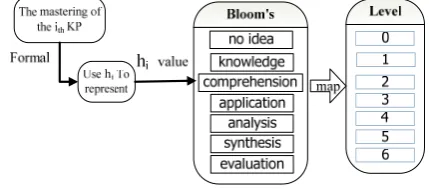
Knowledge level refers to a set of learner's existing knowledge under a certain goal. It has two parameters, one is knowledge point (KP), the other is mastering of KP. We use ki to represent the ith (KP), and we use hi to
represent learner’s mastering of the ith KP. For the
mastering, when learner has no idea of the KP, we use “0” to represent the situation. For others, we divide the mastering into six levels based on Bloom's taxonomy of cognitive objectives[10], such as knowledge, comprehension, application, analysis, synthesis and evaluation, mapping with 1~6, as shown in Fig.1.
To sum up, we use “Knowledge-how” to represent the set.
Definition 1: Knowledge-how={(k1,h1),…,(ki,
hi),…,(kn,hn)}, where ki represents the ith knowledge
point(KP), n represents the total of KPs, hi
represents learner’s mastering of the ith KP, hi∈H,
H={0, 1, 2, 3, 4, 5, 6}, where “0” represents the situation that the learner have no idea of the KP, 1~6 respectively represents the educational objectives, Which are knowledge, comprehension, application, analysis, synthesis and evaluation in turn.
B. Cognitive Ability
Cognitive ability is the brain-based skills. We need to carry out any task from the simplest to the most complex. They have more to do with the mechanisms of how we learn, remember, problem-solve, and pay attention rather than with any actual knowledge. Any task can be broken down into the different cognitive skills or functions needed to complete that task successfully[11]. We can describe the level of learners’ ability by depicting the cognitive status of learners. It also has two parameters. One is the type of cognitive ability. The other is the level value of cognitive ability. The type of cognitive ability should be divided into eight capabilities based on Gardner's multiple intelligences theory of cognitive abilities such as inductive capacity, memory, observation,
abstraction ability, analytical ability, calculation ability, imagination, and logical reasoning ability. And be expressed with a1 to a8 in turn, as Fig.2 shows. The level value can be represented by li. As the ability to
change is continuous, li is defined as the value greater
than 0 and less than 1.
We use “Ability-level” to represent the set of learner’s cognitive ability.
Definition 2: Ability-level= {(a1, l1),…, (ai, li) ,…, (a8,
l8)}, where ai is the ith cognitive ability, li is the level of
the ith cognitive ability.
C. Preferences
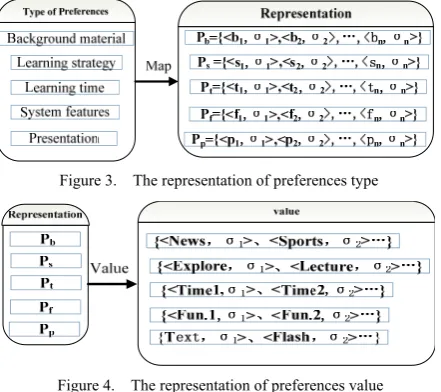
Preferences are defined as demonstrated interest, hobby and other information in learning. Through the analysis, we preferred preferences information into the background material preferences, learning strategy preferences, learning time preference, system features preferences and presentation preferences. In turn is expressed as Pb,Ps,Pt, Pf,Pp. They are five concept
sets, A concept is a pair of (c, σ), where c is a concept, and σ is a coefficient denotes the preference degree of the concept, as Fig.3 shows. For the value, take the presentation of resources for example, it can be taken the value of a set of <text、σ1>, <flash、σ2>, as Fig.4 shows.
Use a five-tuple “Preferences-set” to represent it. Definition 3: Preferences-set=<Pb , Pp, Ps, Pt, Pf >,
where Pb represents background material preferences
(sport, entertainment, education, etc.), Pp represents
resource presentation preferences (text, audio, animation,
video), Ps represents learning strategies preferences
(teaching type, inquisition type, cooperation type), Pt
represents study time preferences (time period), Pf
represents system function preferences (using the system frequency-related features). Pb, Pp, Ps, Pt, Pf are five
concept sets, A concept is a pair of (c, σ), where c is a concept, and σ is a coefficient denotes the preference degree of the concept.
IV. ACQUISITION OF CHARACTERISTIC VALUE OF ALM We acquire the characteristic values of learner model through analyzing learners’ characteristics. In traditional teaching process, through observation, survey and communication, teachers would obtain learners’ characteristics which are required in the teaching process. However, under the network environment, learners and system are invisible to each other, which made the face to face communication impossible. So it could only be done through the analysis and process of the captured information by computers. Thus, the conception of learners’ characteristic analysis is with the proper use of computer technology to acquire the learner model’s characteristic values, under the guidance of some reasoning methods[12].
A. Acquisition Method of Prior Information
In the initial state, we need to get the following three aspects. First, achieve the knowledge readiness of learner in the learning objectives based on the learner selected target, namely to understand the learner’s knowledge level for the specific subject content. Then understand the maturity of certain cognitive abilities of the learner. Finally understand the learner’s attitude, psychological, physiological and social characteristics, including age, gender, life experiences, cultural backgrounds, learning motivation, personal expectations, hobbies and other factors when engaged in the learning. The first two can be collectively referred to as the “learning state of readiness”. The third aspect can be called “the general characteristics of learner”.
The collection of the three aspects information can use the following three channels. The first one is to obtain registration information. For a new user, the system want to know his related information as much as possible, the only effective access way is through user registration. The second one is the questionnaire to obtain the general characteristics and certain personality characteristics information through the analysis of learner’s answers for the questions by questionnaire in the system. The third one is test. The test is divided into system pre-test and system test. In this section mainly discusses the initial acquisition of characteristic values, so the concern is system pre-test. After learner selects the learning objectives, system provides the pre-test in order under this goal. System uses fuzzy logic theory according to learner's answers to adjust the selected strategy, namely considering whether the level rising or not. These questions are also associated with learner’s some cognitive ability. So the system can obtain the knowledge Figure 4. The representation of preferences value
level and the estimate value of the corresponding cognitive ability.
B. Acquisition Method of Dynamic Information
ALM is established through data extraction method. And performs the static storage or dynamic extraction in real time to the needed data. Then conclude and associate the stored data through the model rules to construct basic learner model. In the learning process, extract dynamic information constantly to correct and renew learner model to describe key characteristics of learner personality learning in the maximum extent. The object of dynamic extraction is learner’s learning process and testing process behavior in the use of this system (referred to the learner behavior information, etc).
However, after obtaining the various of feature information and data about the behavior of learner through a variety of ways, rules database will be needed a lot of query operations to match the personality traits of each learner, which will lead to overloading of the system to cause the system blocked and the operating efficiency reduced. So it is necessary to use data mining techniques to preprocess these information and data. These data of user include access records of network, proxy server logging, logging of the user browser profiles, registration information, user dialogue or test information, user records, user questions, the user selection and search keywords, etc. We can use these raw data to build data mining model consisted of pretreatment process, the mining process, pattern analysis. We introduce the estimation methods of the three modules in detail respectively in the following sections.
1) Estimation method of knowledge level
For the set of KPs, the basic idea is to find its precursor according to the set of goal KPs. And estimate whether the value of learner’s master degree of these precursors is “0”, if not, end the process and record this knowledge point. If so, carry on finding this KP’s precursor.
There are two effective methods in estimating the degree of learner's mastering of a certain KP, such as Bayes theorem and fuzzy logic[13]. We had introduced some related algorithms in previous published research paper[14], but there is some mistakes and ambiguity about the formula and the data example. So we correct them in this paper. Fuzzy logic is a logic based on the concept of fuzzy set, in which membership is expressed in varying probabilities or degrees of truth-that is, as a continuum of values ranging from 0 (does not occur) to 1 (definitely occurs). In the process of this study, the first step to determine the representation of the mastery by fuzzy set, the second step gives changes rules of the membership in fuzzy set, and finally gives the expression of the parameter q in the rules. So you can reverse the process to achieve the mastery of KP.
According to Definition 1, we use these seven ranks (0~6) to express the degree of learner's mastering of a certain KP. The membership of each rank is expressed as μk(i),i=0~6. Express the degree of learner's mastering of
a certain KP by fuzzy set K. K={i∣(i, μk(i)), i∈H },
where, 0≤μk(i) ≤1, ∑μk(i) ≤1 . To a KP, the highest
level of membership is the level that the learner has achieved currently about this KP.
For example, assume that the membership of the six ranks are{0, 0.1, 0.2, 0.4, 0.2, 0.1, 0}, therefore, the degree of learner's mastering of a certain KP are expressed as K=={(0, 0), (1, 0.1), (2, 0.2), (3, 0.4), (4, 0.2), (5, 0.1), (6, 0)}. We can see that the level of membership for the rank 3 is the highest. Then we can estimate the degree of learner's mastering of a certain KP is rank 3.
We define the changing rules of membership of fuzzy set “K” as Table II, assume “m” is the rank of test questions, i=0~6, “k” is the turn of the current calculation.
The basic principle of changing rule: when learner does a certain rank of test question correctly, adopt “up rule” to the rank and the following rank. And adopt “down rule” to the above rank. When learner does test question wrongly, the membership does not change. Take table III for example, here supposes parameter q = 0.5, fuzzy set “μ” is the set of the degree of learner's mastering of a certain KP. We can infer that the degree of mastering about the KP is level 1 from table III. The learner does the second question in rank 2 correctly, but he does the third question in same rank wrongly. We may surmise that he possibly guesses the third question right or this question is possibly neglectful. When does the fourth question in the same rank, he is also wrong. It seems more likely that he may not reach rank 2. The fifth test declines the rank of the question from rank 2 to rank 1. As a result, this algorithm can exclude some interference information, such as guess right and negligence. It can classify the knowledge level of learner better.
From the “down rule” in Table III, using “Δ” to represent the variation of μk(i), Δ=(μk-1(i+1) - μk-1(i))q, so
parameter “q” decides the scope of membership changing. It decides the declining speed of learner’s mastering of KP. The determination of parameter “q” should consider the following two aspects, the difficulty of the question and the degree of learner’s familiarity with the question. The difficulty of the question is expressed as “d”, where 0<d<1. The degree of learner’s familiarity with the question will be obtained by the speed of learner to answer the question correctly. We stipulate two time sections, normal time and longest time.
TABLE II.
CHANGING RULES OF MEMBERSHIP
If Rule Type
i<m μk(i)= μk-1(i) - μk-1(i)q + μk-1(i-1)q up rule
i=m μk(i)= μk-1(i) + μk-1(i-1)q + μk-1(i+1)q up rule
i>m μk(i)= μk-1(i) - μk-1(i)q + μk-1(i+1)q down rule
TABLE III.
THE EXAMPLE OF CHANGING RULES OF MEMBERSHIP
If learner answers the question correctly in normal time range, indicate that he is familiar with the knowledge. If he answers the question correctly between the normal time and the longest time, indicate that he is not very familiar with it. If beyond the longest time, indicate that he is not familiar with it. Then, use the function to express the familiar degrees with the questions, we can obtain Definition 4.
Definition 4: assume that α is the normal time, γ is the longest time, β=(α+γ)/2. The function of the degree of learner’s familiarity with the question F(t) is defined as follow, where “α”, “ γ “of each question can be different. “y” is an adjustment coefficient to be used to adjust the the impact degree of overtime.
⎪ ⎪ ⎪ ⎪ ⎩ ⎪⎪ ⎪ ⎪ ⎨ ⎧ ≥ ≤ ≤ ⎟⎟ ⎠ ⎞ ⎜⎜ ⎝ ⎛ − − ≤ ≤ ⎟⎟ ⎠ ⎞ ⎜⎜ ⎝ ⎛ − − − ≤ = β γ β α γ α β α α γ α α t t t y t t y t t F 0 1 1 ) ( 2 2
So that q = cd * F (t), c is a constant larger than 1,
0<d<1. When learner does the question correctly in the normal time range, F(t)=1, q becomes large. When learner does the question correctly exceed the normal range, F(t) becomes small, q becomes small too. It proves that learner’s mastering degree of KP is changing slower. When exceeds the longest time, F(t)=0, q=0. Similarly, q increases with increasing d. When learner does a more difficult question correctly, it proves that he learns this content well, also proves his mastering degree of KP is rising faster.
So, the steps to determine “Knowledge-how” a) Obtains a set of learner’s goal knowledge: Target-knowledge={t1,t2,…,tm}.
b) Discovers the pre-KPs corresponding with the m KPs in the “Target-knowledge” set according to domain model. Get the set of pre-KPs as Pre-knowledge={p1,
p2, …, pn}.
c) Judges the learner’s mastering of pre-KPs one by one (maked with 0~6). so the set of learner’s pre-KPs level, Pre-Knowledge-how={(p1, h1), …, ( pi, hi),…, (pn,
hn)}, hi∈H.
d) Records KPs whose mastering degree between 1 and 6 in “Knowledge-how”. Set pj as target-KPs and turn
to step b when hj=0.
e) Achieves the disorder set “Knowledge-how”. 2) Estimation method of cognitive ability
We can obtain the learner’s cognitive ability by testing[15]. We design a form of every test is : Test(i) = (A(i),T(i),η,λ, Φ:Q), A series of test questions constituted a test paper. TEST= {t1= (A1,T1,η1, λ1,
Φ1:Q1),…,tn=(An,Tn,ηn,λn, Φn:Qn)}. For example, in
order to obtain the level of induction ability and memory ability. The series of test questions are as follows:
Test(1)= (A(1),T1,η1,λ1,Φ1:Q1).
Test(2)= (A(1),T2,η2,λ2,Φ2:Q2).
Test(3)= (A(2),T3,η3,λ3,Φ3:Q3).
Test(4)= (A(2),T4,η4,λ4,Φ4:Q4).
Then obtain the answers of the test questions. The set of answers as Answer, Answer ={answer (t1,φ’1), …,
answer (ti,φ’i), … ,answer (tn,φ’n)}. So, we can
definite the level of the ith cognitive ability as follow:
Ability-how (Ai)=
(
')
(
)
1 1 / j j j n nj j j j
j j φ φ φ η λ η λ = = ⎡ × × ⎤ × ⎢ ⎥ ⎣ ⎦
∑
I∑
Where (φ’j∩φj)/φj is the accuracy rate of learner’s
answers to the jth question, using Rj to express the
accuracy rate, so 0≤ Rj≤ 1. n is the total of the questions
which the student replied to test the ith kind of ability. Let
li=Ability-how (Ai), and we can obtain the set of learner’s
cognitive ability as “Ability-level”. 3) Estimation method of preferences
For the estimation of preferences, it divided into two steps which are initial estimation and dynamic estimation. We have to pretest the learners’ interests before them using the system for learning and also initialize learner’s interests. With the proceed of learner’s learning activities, we can discover learner’s interests. Then correct and maintain those values through data mining about the data of learners’ searching concepts, browsing websites’ types and topics of discussions. For the initializing values, we can gather user’s interests information through user’s registration forms or scale, and use direct or indirect matching methods to process those original data to acquire the initial values. For dynamic values, it concerns about learner’s learning procedure information and historical testing information. Then processes the acquired values through data mining model to obtain the needed data.
In addition, when using the characteristic value, we can build the vectors about the feature item of learning objective and the relevant weight to present the learning resources according to the 5D vector space consisted of five factor group n of learner’s interests. Based on the angle of the feature vectors in the vector space, determine the similarity between learner’s interests information and the learning resource, and return the most similar learning resource to the learner.
V. A CASE STUDY BASED ON ALM
In order to verify the performance of ALM, this paper presents a new adaptive learning system based on ALM (short for NalsALM), to complete the case study for ALM.
A. The Framework Design of NalsALM
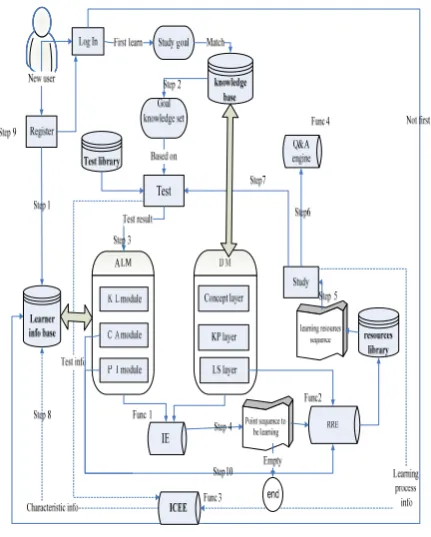
time. Based on the learner’s goal, ALM chooses knowledge points as goal knowledge points set in the knowledge base, using “Target-knowledge” to represent the set, then designs tests according to “Target-knowledge”. ALM will deduce learner’s knowledge level and cognitive ability from test data. After that, IE achieves the “Knowledge-sequence” set that the learner will learn according to the deducing result of ALM, domain model and Target-knowledge. RRE recommends learning resources to meet learning needs of the learner best based on “Knowledge-sequence”. ICEE collects and arranges the information of learning process and testing process to reappear for learner’s characteristic information. System’s main flow is shown in Fig.5.
The descriptions of main flow as follows:
Step 1: Register for a new learner. Get the prior information of the learner. The learner’s personal information, academic information and other information are recorded in the learner info base.
Step 2: User need to choose learning goals if it is the first time the learner use the system. The learning objectives can be a chapter, a section or a knowledge point. Relations between them are included. That is, a chapter formed by a number of sections, and a section also formed by a number of knowledge points. Based on the learner’s goal, choose KPs as goal KPs set in the knowledge base under the goal, Express this set with “Target-knowledge”.
Step 3: Design the test questions according to this set with target-knowledge, and feed back the test data and result to ALM.
Step 4: Educe the sequence of the KPs to supply to learner for learning based on the relevant data between ALM and domain model.
Step 5: Show the selected learning resources to user sequentially.
Step 6: Learners can get the answers from the Q&A engine when they are in trouble.
Step 7: Learners can test actively at any time during learning.
Step 8: Record learners' learning process information in learner information base
Step 9: If learner has used the system, it directly shows the resources that the learner should learn according to his learning record.
Step10: If the sequence is empty, then end. Learner need to choose a further target.
B. The Major Works of NalsALM
1) The design of database for NalsALM NalsALM has four databases, such as knowledge base, test base, resources base and learner information base. We give the relationship between the main tables in the databases in Fig. 6.
Below descriptions are given to the design of part of the four database tables.
a) Knowledge base
Courses table (course number, course name, course descriptions, course grades, course objectives , reference information , whether compulsory).
Knowledge table (knowledge point number, knowledge point name, concept type, course number, parent knowledge number, precursor knowledge points, target level, background concept number).
Background table (background number, background content).
Chapter table (chapter number, name, course number, school, the parent node, the learning page number, elective / compulsory, before node).
Knowledge_lesson table (knowledge point number, chapter number, relationship degree, Bloom’s learning goals, order in lesson).
Knowledge structure table (knowledge point number, Number of precursor knowledge point, associated degree, discipline, term).
b) Test base
Question stem table (question number, type of cognitive ability, problem type, hardness, rank,
Figure. 6 Relationship between the main tables
description of problem stem, guess coefficient, whether to activate tips, whether random, answer number, normal time, longest time, etc). It was used to save the stem of the test questions.
Question branch table (answer number, question number, answer, whether it is the answer, explanations). It was used to store the information of the answers to your questions.
Test_knowledge points table (question number, degree of association, knowledge point number). It used to indicate the degree of association of the test questions and knowledge.
c) Resources base
Learning resources table (resource number, name, subject, keywords, format, author, language, description, content, upload person, upload time, media type, application objects, evaluation)
Resource_knowledge point table (knowledge point number, resource number, degree of association, rank of resources, resources difficulty, background concept number , type of cognitive ability needed, ability value, type of cognitive ability improved, learning strategy types)
Student resource evaluation table (student number, resource number evaluation)
d) Learner information base
Basic information of student table (student ID, name, username, password, gender, school, schooling year, Email, term, photo, preference information).
Knowledge level table (student ID, knowledge point number, master degree, whether to achieve).
Cognitive ability table (student ID, type, the ability value).
Preference information table (student ID, background material preferences, media type, learning strategy preferences, learning time preference, system function preferences).
Learn history table (student ID, start time, chapter number, knowledge point number, resource number had been studied, end time, knowledge point breakpoint, evaluation).
Test history table (student ID, knowledge point number, start time, test number, over time, evaluation)
Error information table (knowledge point number of error question, error causes, error number).
Learning sequence table (student ID, knowledge ("," across the sequence, selection of target and does not meet the requirements of pre-KP)).
2) Learning resources push mechanism
we can obtain “Knowledge-how”, “Ability-level”, and “Preference” by estimation methods in section 4. Here, we will introduce how to achieve to push the learning resources effectively and personalized based on these three information[16][17].
a) Access to “Knowledge-sequence”
IE Arranges the disorder KP in learner’s knowledge level set “Knowledge-how” educed by ALM according to the relations of KP in domain model. Knowledge base has stored the requirements of mastering degree of KPs. It judges KP one by one, and deletes the KP which meets
the requirement from the set. Finally obtains a set of pre-KPs as “Pre-sequence” to be learning.
Pre-sequence={(ki,ri),…, (kj,rj),…, (km,rm)}, 1≤
i<j< …<m ≤ n, where kj represents the jth KP, rj
represents the rank of the jth KP, and rj=hj+x where hj is
the learner’s mastering of the jth KP in “Knowledge-how”,
x is given by the system in accordance with the teaching objectives. Then obtains a set of target KPs sequence as “Target-sequence” according to “Target-knowledge”.
Target-sequence={(t1,1), (t2,1),…,(ti,1), (tn,1)}, the
target KPs need to learn from rank 1, step-by-step . So the set of KPs to be learning “Knowledge-sequence”= Pre-sequence∪Target-sequence.
b) Recommendation of learning resources
RRE selects learning resources which meet the rank needs of each KP of “Knowledge-sequence” in resources base as a collection “R” of learning resources, Then match the “Ability-level” of the learner to the related cognitive ability attribute of each resource, Obtain a collection “R1” of learning resources whose similarity are
within a certain range(Ideally, it is necessary to make the recommended learning resources can not exceed any level of cognitive ability of the learners, but also help to improve certain cognitive ability of learners). Finally, according to learner's “preferences-set” selects the learning resources that best meet the learning needs of learners in R1.
Appropriate for a certain knowledge point learning resources, learners need to be tested after learning that the resource.
If pass, add the mastery of knowledge with 1 pace. Next, determine whether the rank meet the Level requirements of the KP. If it meets, delete the KP. If not, improve the level of KP and continue to learn until meet the demand.
If not pass, re-select other resources in this level to learn for learner until he pass the test.
For example, student A has reached the rank 2 (comprehension) to Ki in the current by test, but the
knowledge base required level is 4 (analysis). So for KP Ki, the system should give the learning resource in rank
3(application) to A. If A pass the test, we can infer that A has reached the rank 3, but still not reach rank 4. Next, the system will provide the learning resource to A in rank 4 (synthesis). If A don’t pass the test, the system will still provide other learning resource to A in rank 3 (application).
VI. CONCLUSION
method to estimate the learner’s cognitive ability. Use vector space theory to represent preferences. After that, we propose a new Adaptive Learning System based on this learner model as a case. And give the framework design and the database design of NalsALM.
ACKNOWLEDGMENT
We would like to thank professor Yongjian Yang and Shaochun Zhong for their insightful comments in reviewing drafts of this paper. We also would like to thank foundation of Jilin Province key scientific and technological projects (No.20120303) and Changchun scientific and technological projects (No. 11KZ03) for the sponsor to our study.
REFERENCES
[1] Cross, K. Patricia. “Adults as Learners. Increasing Participation and Facilitating Learning”. Jossey-Bass, 1981. [2] A. Kaye, G. Rumble. “Distance Teaching for Higher and
Adult Education”. London, Croom Helm, 1981.
[3] X.F. Ding. “Distance Education”. Beijing Normal University Press. Beijing, 2001.
[4] B. Jia,S. C. Zhong,et al. The Construction and Evolution of Learner Model in Adaptive Learning System. In:Hj. Kamaruzaman Jusoff, eds.Proc. of the 2009 International Conference on Computer Technology and Development (ICCTD 2009), USA: IEEE, pp.148-152, November 2009. [5] X. P. Lai, Y. P. Wu and W. D. Cheng, “The Design and
Implementation of Multimedia Intelligent CAI in Mining Science,” Beijing: Computer Systems Applications, No. 2, pp.34–35, February 1997.
[6] P. D. Chen and K. D. Li, “Design of student model centered web based adaptive learning system,” Proceedings of SITE 2002, Nashville, Tennessee, pp. 136-137, March 2002.
[7] B. Jia,S.C. Zhong, et al. “The Study and Design of Adaptive Learning System Based on Fuzzy Set Theory”, Edutainment 2010, Changchun, pp.1-11, August 2010. [8] R. M. Gagne, “Educational technology, as technique,”
Educational Technology, pp. 5–13, August 1968.
[9] H. Feng, L. Wang and H. Yang, “The Research of Multi-purposes Based Learner Model”, Beijing: Computer Engineering and Applications, vol. 39, No. 36, pp.98–100, December 2003.
[10]B. S. Bloom, M. D. Engelhart, E. J. Furst, W. H. Hill and D. R. Krathwohl, “Taxonomy of Educational Objectives,” handbookⅠ,Cognitive domain, London, Longman, 1989. [11]What is a Cognitive Ability?
http://www.sharpbrains.com/blog/2006/12/18/what-are-cognitive-abilities/. December. 2006.
[12]Z.H.Jiang, Z.J.Wu. Network environment, multi-dimensional characteristics of the learner model to build. E-education Research, April 2005, pp.71–73.
[13]Z. Zhuang, “Estimation method of student’s cognitive level in self-adaptive distance tutoring system,” Beijing: Computer Engineering and Applications, vol. 43, No. 3, pp.220–223, January 2007.
[14]B. Jia, Y. J. Yang, J. Zhang. “Representation and acquisition of feature value of learner model in adaptive learning system”. Proc. of the 2011 International Conference on Intelligent Systems and Knowledge Engineering, Shanghai, pp. 371-377, December, 2011. [15]S. Q. Tang and Z. Zhong, “Evaluation of Cognition of
Students,” Nanning: Journal of Academy of Sciences, Vol.18, No. 4, pp.281–284, April 2002.
[16]B. Jia, Representation and acquisition of characteristic value of learner model in adaptive learning system, Northeast Normal University, 2010.