Time and Movement Analysis in shell
Molding Process
Matheus Cathoud de Barros Chagas1, Tiago Bittencourt Nazaré2, Antônio Elízio Oliveira3
1
Student of Industrial Engineering, Faculdades integradas de Cataguases-FIC/UNIS
2
Master in Engeneering Sustems Management, Iniversidade católica de Petropolis-UCP
3
Specialist in strategic business management, Universidade de São Paulo-USP
RESUMO
The present work aims to perform a study of time and motion in the process of production of shell molding in the shell molding sector, through the efficiency of computer simulation using the Arena software. To conduct the study, technical visits were made over a period of time, with the intention of mapping the current process using timing of activities. By simulating the data obtained in the collection and comparison of results, it was possible to identify losses in the production process due to the excessive time allocated to the employee displacement to another sector. After the simulation, it was possible to propose a change in the existing layout, seeking to increase production capacity, making the most of available resources.
Keywords: Time and motion, Layout, Software Arena, Shell Molding.
I. INTRODUCTION
It is noted that with the increase of competitiveness and in order to achieve organizational excellence and stay actively in the market, companies have constantly sought to improve their processes. Once these processes are mapped and analyzed, it is possible to identify improvements, thereby increasing productivity and reducing production costs.
It is essential to analyze the process of an organization so that it is possible to identify possible losses within the process, thereby making changes, seeking to increase production capacity, making the most of available resources.
Krajewski, Ritzman and Malhotra (2009) discuss that process analysis begins when a new opportunity to improve processes is identified and ends when the process is improved and thus a continuous cycle of improvement is created.
The study of times and movements becomes viable, since with the timed execution of activities, facilitates the identification of possible losses and improvement of production processes.
The objective of the present article is to analyze the production process, using the chronoanalysis methodology where the data will be applied in the Arena software, where the current and
the proposed process will be simulated, analyzing the time spent by the employee to perform the displacement of the number of data. Males produced / batch within the shell mash production process, up to the molding process. Subsequently, to propose an improvement in the production process, through a proposal to change the layout, using Auto CAD software, where such changes, ensure a smaller displacement from the masking sector to the molding sector.
II. LITERATURE REVIEW
A. Time and motion
According to Figueiredo (2011), the use of the time and movement study tool aims to avoid any unnecessary effort or movement at the moment of execution in a production process, thus seeking to enable the employee for a single function and together establish new productive parameters in search of process improvement.
Martins and Laugeni (2006), affirm that through the study of times can be established standards for the productive systems in order to facilitate the process planning, since the available resources are used effectively, paying attention to the necessary time for the production. Performing each task, taking into account that the employee is qualified and properly trained to perform the activity, working to perform a specific task or operation.
B. Layout
According to Chiavenato (2005) the physical arrangement, or layout, of a department or a company in general, is nothing more than the physical distribution of machines and equipment within the organization where, through calculations and definitions established according to with a certain product that will be manufactured, the work environment is organized to achieve the best possible form and with the shortest execution time, avoiding waste.
factors. Due to the constraints encountered most of the time, finding the best physical arrangement can take some time and depends on the variables and elements used. Based on this scenario, the use of computer simulation is a more usual and economical alternative to create, test, evaluate and decide whether or not to implement the proposed layout model.
C. Computational Simulation using Arena software According to Harrel et al. (2000), in a computer simulation model can be tested different values and variables that can be controlled and modified by who is designing. The control of the variables allows a comparison between the desirable models, among them, the process input and output.
Bosoli et al. (2009) states that the growth of studies in the area of computer modeling and simulation is due to the low cost of performing tests and process changes to achieve an ideal work model.
For Prado (2014), Arena is an integrated graphic simulation environment, which contains all process modeling resources, as well as presenting process design and animation, statistical analysis and results analysis. Arena software is one of the most recognized and innovative in the computer simulation methodology, combining user-friendly language resources in an integrated graphical environment.
III. METHODOLOGY
Bibliographic searches were conducted through books and the internet, scientific articles were also consulted in accordance with the proposed theme. Studies were conducted on the casting process, shell molding process, time and motion and layout.
From this, timings were performed for realizations of time calculation between the processes, in order to obtain an average between the values found. The simulation and construction of the process was done using the Arena 15 student software, and the layouts were built using the Auto CAD 2017 student software and the shell mash production process flow was elaborated using the Microsoft Office Visio 2016 software.
A. Company object of study
The analysis was performed in a metallurgy company, in the city of Cataguases, southeastern region of the state of Minas Gerais, divided between administrative and production sectors, following the manufacturing of nodular cast iron, gray and cast steel parts.
Visits were made to the company under study from January 7 to January 23, during its opening hours in order to collect the necessary data to prepare the research.
The working hours are from 07 to 17 hours, with a meal break of 01 hours and in the afternoon, from 14 to 14:15 hours, there is a new stop, for
breakfast. The objective of the work was the shell molding process, which is composed by a warehouse that has about 40x10 meters, totaling 400m² of area, this sector is composed of six machines, which are divided as follows: two machines (blowers), This is process, the raw material used to manufacture the items is the shell sand with a grain size of 70 to 90 AFS, the sand is 100% new.
Analyzing the current process, through the Arena software, it was found that, within the process of manufacturing shell sand males, due to data sampling, a change in layout will be necessary to be in agreement with the synthetic analysis.
Similar to contextualization, it shows the importance of this change in the context of the company overview, productivity gains and process optimization.
According to Bosoli et al. (2009), choosing a suitable layout model is a difficult task that depends on several factors. Because of the constraints encountered most of the time, finding the best physical arrangement can take some time and depends on variables and the elements used. Based on this scenario using computational simulation is an alternative to create, test, evaluate and decide whether or not to implement the proposed layout model.
B. Shell Molding Process
The molding process originating in Germany under the name "Croning Process or Process C"; in the USA, under the name of "Shell Molding", was developed during World War II and introduced around 1940. It consists of the use of hot-polymerized synthetic resin agglomerated sand mixture, with which the molds are made in the form of of thin shells, 10 to 15mm thick.
The components of this process are:
The machine (home-made): Composed by a set of horizontally positioned torches in the shape of torches, responsible for heating the plate and the model stuck in it, sandbox (silo) to store the raw material used and a pneumatic press. Responsible for bonding the two parts of the mold being: bottom and lid, thus forming the mold.
The machine (blower): Composed of a set of torches vertically positioned gas nozzles, a manual gas nozzle responsible for heating the internal cavity in the male produced, sandbox (Sand reservoir).
Model: Required to be metallic (steel, cast iron) the model must have exit angles, small rounding radii, can be used indefinitely and must be designed to withstand high temperatures and friction in peel removal.
The Sandbox: Sand reservoir that is attached to the molding machine (shell) has a slot for the plate and performs a rotating movement causing the sand to be deposited on the model / plate to form the molds: lid and bottom.
Application of process machinery
The used shell sand mixture with a grain size of 70 to 90 AFS, the sand is 100% new. It is deposited on the preheated model at temperatures of 280º to 350º C, in contact with which it forms a shell, due to the beginning of resin polymerization, depending on its thickness, contact time, pre-temperature. Heating and the nature of the mixture.
The desired thickness in turn depends on the size and weight of the part to be cast, its complexity and the metal to be employed. The bark thus formed, partially cured, goes to the greenhouse to complete the cure at temperatures of 280º to 350º C, and the cure can be done after extraction of the bark or on the model itself, as shown in figure 1.
Figure 1: Process of contact of the sand with the preheated model, forming the mold.
Source: http://www.fremar.com.br/fundicao-shell-molding.html - adapted by the author.
The mold, consisting of two parts, which are lid and bottom, is assembled with any males, closed with staples or glued through the pneumatic presses, to be poured with liquid metal after this process. Removing the cast from the mold will break it and cannot be reused.
a) Shell masking process
The process mapping and data chronanalysis was performed following the flow of the shell mash production process.
When an order request arrives, it is reviewed by the production planning and control department to verify the quantity of parts to be produced and the availability of the machine to be used to meet the manufacturing quantity. Subsequently, the machine operator is informed which item will be produced and if there is a
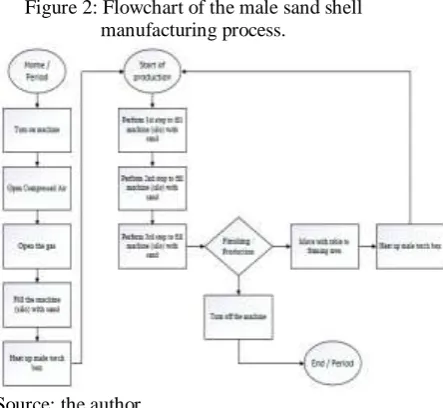
need to change the male box that is attached to the machine. The flowchart allows a visualization of the activities performed during the male shell sand manufacturing process, elaborated through the Microsoft Office Visio 2016 software, as shown in figure 2.
Figure 2: Flowchart of the male sand shell manufacturing process.
Source: the author
Then the production of the shell sand males begins, for each beginning of the period it is necessary to perform a standard setup procedure before starting the production, which are: start the machine, open the gas and compressed air piping, supply the machine (Sand reservoir) with the specified shell sand and heat the male box with torch.
This process start is necessary at each long-term stop, such as: morning with the start of activities and after lunchtime return. The performance of these procedures is to ensure that the metal surface of the core box can adhere to the sand forming a thin shell that will respect the internal dimensions, giving rise to core production.
IV. RESULTS AND DISCUSSIONS
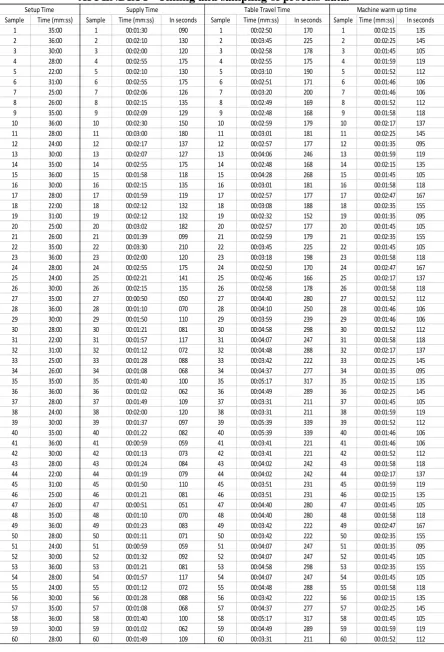
In order to map the current process, as well as to perform a chronanalysis of the activity times, visits were made to the company under study from January 7 to January 23, during its opening hours with the purpose of collecting the necessary data for the preparation of the activity,research as (Appendix 1).
A. Simulation of the current layout.
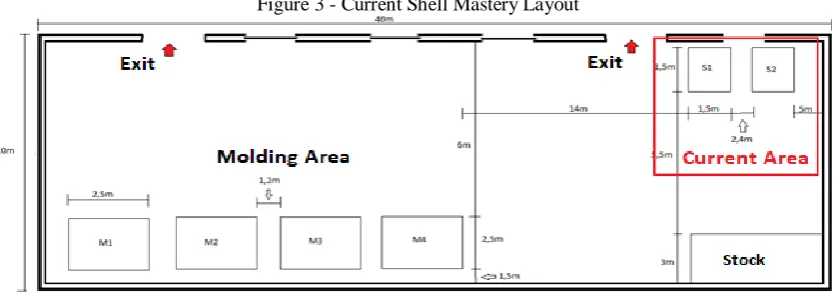
By simulating the current process with Arena Software. It was possible to verify and analyze the process, noting that, within the process of manufacturing of shell sand males, a problem related to loss in the production process was diagnosed, due to the excessive time destined to the employee's displacement to another sector, which affected the process. Productive, being ineffective, as shown in Figure 3.
Figure 3 - Current Shell Mastery Layout
Source: the author
After checking the current process of shell mashria, as shown in figure 3, it is noticed a high time attributed to the displacement of the employee of the maschry sector to the molding area, to supply another machine and finally continue the production process.
According to the simulation of the data of the new layout, the value of the number of males produced / batch, according to the simulation, considering such factors: setup time o standard in the two production periods, it can be noticed from the sample mean that time spent to move the table to another sector, thus interrupting production and affecting the number of males produced / batch, as shown in table 1.
Table 1 - Current Process Sampling Data.
Source: the author
In the table above it is possible to verify the amount of samples analyzed in each process, which are: setup; supply; displacement and heating. The sample mean time was considered in the simulation to assemble the process simulation, as shown in figure 4.
Figure 4 - Simulation of the current process (Arena software).
Source: the author
The current process simulated by the Arena software. The configuration time will not be accounted for in the simulation, it will be considered o standard time for each work period, and in the morning and afternoon, the other processes to perform the simulation were considered, the average of the samples. Of each process, namely: supply; displacement and heating. After simulating the current process, the number of males produced / batch is obtained, as shown in figure 5.
Figure 5 - Number of males produced / batch in the current process (Software Arena).
Source: the author
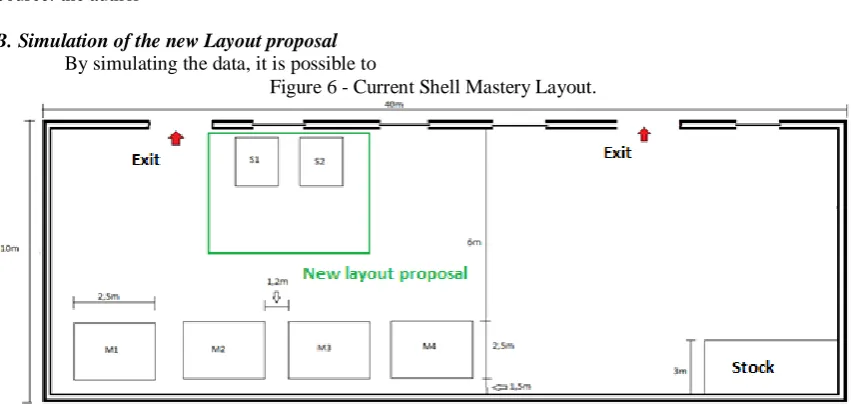
B. Simulation of the new Layout proposal By simulating the data, it is possible to
verify that, changing the current layout to a new layout, the displacement time is neglected, as shown in figure 6.
Figure 6 - Current Shell Mastery Layout.
Source: the author
Within the new layout, it will be possible to take advantage of the time spent on the shift to gain production, thus obtaining a gain in the number of males produced / batch.
A layout change will be required to conform to the synthetic analysis. Similar to contextualization, it shows the importance of this change in the context of the company overview,
productivity gains and process optimization. With the proposed new layout, it is possible to disregard the time destined to perform the displacement of the produced males / batch, from one process to the other, according to table 2.
Table 2 - Sampling data of the proposed process.
Source: the author
After changing the proposed layout, the following sample averages were considered in the new process simulation, namely: supply and heating. To assemble the process simulation considering a new layout, as shown in figure 7.
Figure 7 - Process simulation considering new proposed layout. (Software Arena).
Source: the author
The new process, considering the proposed new layout, simulated by the Arena software. The setup time will not be accounted for in the simulation because it is being
considered as the standard time for each working period, being, in the morning and afternoon, the other processes, were taken into consideration, only the sample averages, being they: supply and heating. After the simulation of the new process, considering the proposed new layout, the number of males produced / batch, as shown in figure 8.
Figure 8 - Number of males produced / batch (Software Arena) - without commuting time.
Source: the author
C. Analysis of Results
According to the proposed change of layout, a new process simulation was performed
Setup Time(Min) Supply Time(S) Displacement Time(S) Heating Time(S)
Sample Quantity 60 Sample Quantity 60 Sample Quantity 0 Sample Quantity 60
Minimum value 22 Minimum value 50 Minimum value 0 Minimum value 95
Maximum value 36 Maximum value 210 Maximum value 0 Maximum value 167
Sample Average 29.3 Sample Average 109 Sample Average 0 Sample Average 123
and with it, it can be seen that in relation to the process average the productive capacity of the mash sector, in reference to the displacement time being neglected, following the proposed new layout of production, a gain of 92.25% was obtained in the number of males produced / batch, according to table 3.
Table 3 - Comparison of results and production gain with new layout.
Comparison of Results
Number of males in the current process 54
Number of males with new layout 104
Productivity gain with new layout 92,25%
Source: the author
It is noticeable the variations of time and can still be standardized, increasing the productive capacity of the maschry sector.
V. CONCLUSION
Based on the cronoanalysis, the productive process was analyzed using the cronoanalysis tool where the data were applied in the Arena software. By simulating the current and the proposed process, it was possible to identify that the time it takes for the employee to displace the number of males produced / batch within the shell mash production process, until the molding process could be neglected, taking into Considering a proposal to change the current layout, it was done through Auto CAD software.
After dealing with the data and comparing the results, it was found that making a proposal to change the layout, the travel time performed by the employee himself will be nonexistent obtaining a gain of 92.25% in the number of males produced / batch.Of course, this time spent wrongly will be allocated to the sequence of the other processes.
REFERENCES
[1] BÓLOSI, GUSTAVO S; FALLEIROS, JOÃO PAULO B.; FORNARI, VÍTOR Y VIEIRA, JOSÉ G VIDAL.
Simulação computacional como ferramenta para reorganização do arranjo físico de uma empresa de produtos químicos. XXIX Encontro Nacional de Engenharia de Produção, 2009. Available in: <http://www.abepro.org.br/biblioteca/enegep2009_TN_STP _091_620_12819.pdf> Access in 01/04/2019 às 14:40h. [2] HARREL, C. R.; MOTT, J. A. R.; BATEMAN, R. E.;
BOWDEN, R. G.; GOGG, T. J.Simulação: otimizando os sistemas. 5ªed. Promodel Corporation. 1997.
[3] FIGUEIREDO, Francisca Jeanne Sidrim de; OLIVEIRA Teresa Rachel Costa de; SANTOS Ana Paula Bezerra Machado. Estudo de tempos em uma indústria e comércio de calçados e injetados LTDA. - XXXI Encontro Nacional de Engenharia de Produção. Belo Horizonte, MG, Brasil,2011
[4] MARTINS, Petrônio G.; LAUGENI, Fernando P.
Administração da Produção. São Paulo: Saraiva, 2006. [5] CHIAVENATO, Idalberto. Gestão de pessoas: segunda
edição. Rio de Janeiro, RJ, 2005.
[6] PRADO, D. S. do. Teoria das Filas e da Simulação. Belo Horizonte: Editora de Desenvolvimento Gerencial, 1999, 124 p. Série Pesquisa Operacional, v. 2.
[7] METALÚRGICA FREMAR LTDA – Fundição e
APPENDIX I - Timing and sampling of process data.
Sample Time (mm:ss) Sample Time (mm:ss) In seconds Sample Time (mm:ss) In seconds Sample Time (mm:ss) In seconds
1 35:00 1 00:01:30 090 1 00:02:50 170 1 00:02:15 135
2 36:00 2 00:02:10 130 2 00:03:45 225 2 00:02:25 145
3 30:00 3 00:02:00 120 3 00:02:58 178 3 00:01:45 105
4 28:00 4 00:02:55 175 4 00:02:55 175 4 00:01:59 119
5 22:00 5 00:02:10 130 5 00:03:10 190 5 00:01:52 112
6 31:00 6 00:02:55 175 6 00:02:51 171 6 00:01:46 106
7 25:00 7 00:02:06 126 7 00:03:20 200 7 00:01:46 106
8 26:00 8 00:02:15 135 8 00:02:49 169 8 00:01:52 112
9 35:00 9 00:02:09 129 9 00:02:48 168 9 00:01:58 118
10 36:00 10 00:02:30 150 10 00:02:59 179 10 00:02:17 137
11 28:00 11 00:03:00 180 11 00:03:01 181 11 00:02:25 145
12 24:00 12 00:02:17 137 12 00:02:57 177 12 00:01:35 095
13 30:00 13 00:02:07 127 13 00:04:06 246 13 00:01:59 119
14 35:00 14 00:02:55 175 14 00:02:48 168 14 00:02:15 135
15 36:00 15 00:01:58 118 15 00:04:28 268 15 00:01:45 105
16 30:00 16 00:02:15 135 16 00:03:01 181 16 00:01:58 118
17 28:00 17 00:01:59 119 17 00:02:57 177 17 00:02:47 167
18 22:00 18 00:02:12 132 18 00:03:08 188 18 00:02:35 155
19 31:00 19 00:02:12 132 19 00:02:32 152 19 00:01:35 095
20 25:00 20 00:03:02 182 20 00:02:57 177 20 00:01:45 105
21 26:00 21 00:01:39 099 21 00:02:59 179 21 00:02:35 155
22 35:00 22 00:03:30 210 22 00:03:45 225 22 00:01:45 105
23 36:00 23 00:02:00 120 23 00:03:18 198 23 00:01:58 118
24 28:00 24 00:02:55 175 24 00:02:50 170 24 00:02:47 167
25 24:00 25 00:02:21 141 25 00:02:46 166 25 00:02:17 137
26 30:00 26 00:02:15 135 26 00:02:58 178 26 00:01:58 118
27 35:00 27 00:00:50 050 27 00:04:40 280 27 00:01:52 112
28 36:00 28 00:01:10 070 28 00:04:10 250 28 00:01:46 106
29 30:00 29 00:01:50 110 29 00:03:59 239 29 00:01:46 106
30 28:00 30 00:01:21 081 30 00:04:58 298 30 00:01:52 112
31 22:00 31 00:01:57 117 31 00:04:07 247 31 00:01:58 118
32 31:00 32 00:01:12 072 32 00:04:48 288 32 00:02:17 137
33 25:00 33 00:01:28 088 33 00:03:42 222 33 00:02:25 145
34 26:00 34 00:01:08 068 34 00:04:37 277 34 00:01:35 095
35 35:00 35 00:01:40 100 35 00:05:17 317 35 00:02:15 135
36 36:00 36 00:01:02 062 36 00:04:49 289 36 00:02:25 145
37 28:00 37 00:01:49 109 37 00:03:31 211 37 00:01:45 105
38 24:00 38 00:02:00 120 38 00:03:31 211 38 00:01:59 119
39 30:00 39 00:01:37 097 39 00:05:39 339 39 00:01:52 112
40 35:00 40 00:01:22 082 40 00:05:39 339 40 00:01:46 106
41 36:00 41 00:00:59 059 41 00:03:41 221 41 00:01:46 106
42 30:00 42 00:01:13 073 42 00:03:41 221 42 00:01:52 112
43 28:00 43 00:01:24 084 43 00:04:02 242 43 00:01:58 118
44 22:00 44 00:01:19 079 44 00:04:02 242 44 00:02:17 137
45 31:00 45 00:01:50 110 45 00:03:51 231 45 00:01:59 119
46 25:00 46 00:01:21 081 46 00:03:51 231 46 00:02:15 135
47 26:00 47 00:00:51 051 47 00:04:40 280 47 00:01:45 105
48 35:00 48 00:01:10 070 48 00:04:40 280 48 00:01:58 118
49 36:00 49 00:01:23 083 49 00:03:42 222 49 00:02:47 167
50 28:00 50 00:01:11 071 50 00:03:42 222 50 00:02:35 155
51 24:00 51 00:00:59 059 51 00:04:07 247 51 00:01:35 095
52 30:00 52 00:01:32 092 52 00:04:07 247 52 00:01:45 105
53 36:00 53 00:01:21 081 53 00:04:58 298 53 00:02:35 155
54 28:00 54 00:01:57 117 54 00:04:07 247 54 00:01:45 105
55 24:00 55 00:01:12 072 55 00:04:48 288 55 00:01:58 118
56 30:00 56 00:01:28 088 56 00:03:42 222 56 00:02:15 135
57 35:00 57 00:01:08 068 57 00:04:37 277 57 00:02:25 145
58 36:00 58 00:01:40 100 58 00:05:17 317 58 00:01:45 105
59 30:00 59 00:01:02 062 59 00:04:49 289 59 00:01:59 119
60 28:00 60 00:01:49 109 60 00:03:31 211 60 00:01:52 112
Supply Time Table Travel Time