Volume 5, Issue 1, 135 - 150.
ISSN: 2469-9632 http://www.ijem.com/Effect of Layered Curriculum in Problem Solving Skills of Students in
Science and Technology Course
*Sevda Koc Akran**
Siirt University, TURKEY Inonu University, TURKEY Oguz Gurbuzturk
Received: January 31, 2019 ▪ Revised: February 6, 2019 ▪ Accepted: February 11, 2019
Abstract: This study mainly aims to determine the effect of layered curriculum on problem solving skills of students in science and
technology course. The study group of the research is the 6th grade students of an elementary school in the center of Malatya. The mixed method, which includes quantitative and qualitative research patterns, was used. In the quantitative dimension of the study; in order to find the answers for the1st, 2nd and 3th sub problems, the study group consists of 60 students, 30 in the experimental group and 30 in the control group. In the quantitative dimension, “The Problem Solving Skills Test” which is developed by the researcher has been used. In the study, the qualitative data have been collected during the application by quoting from the students’ diaries and researchers’ diaries and after the application by using semi structured interview forms and examining documents. To analyze the quantitative data t-test was used and to analyze the qualitative data, descriptive analysis and content analysis were used. The study, while significant differentiation has not been observed between point average of control group students in pre-test problem solving skills and post-test point average; there has been a significant differentiation in favor of the post-test between point average of experimental students pre-test and post-test problem solving skills. Experimental group students encountered problems particularly in B and A layers during the period they performed Layered Curriculum activities. Also, there has been a significant differentiation in favor of the experimental group between experimental group students who were subjected to the Layered Curriculum activities and control group students who continued the existing curriculum. It was concluded that, experimental group students took responsibility in Layered Curriculum activities both individually and within a group, and used their problem solving skills when they face a problem.
Keywords: Layered, layered curriculum, education, problem, problem solving skills.
To cite this article: Koc -Akran, S., & Gurbuzturk, O. (2019). Effect of layered curriculum in problem solving skills of students in
science and technology course. International Journal of Educational Methodology, 5(1), 135-150. https://doi.org/10.12973/ijem.5.1.147
Introduction
Layered curriculum was developed by Nunley in 1980. When explaining the layered curriculum, Nunley (2004) resembled the figure of layers to a diamond in the first years. She divided this diamond into three layers. These are called C, B, A layers.
* This study was derived from the doctoral thesis of Sevda Koc Akran under the supervision of Oguz Gurbuzturk ** Corresponding author:
Sevda Koc Akran, Siirt University, Faculty of Education, Department of Educational Science, Siirt - Turkey. [email protected]
A Layer: Critical thinking
B Layer: Application
Figure 1. Layered curriculum (Nunley, 2004).
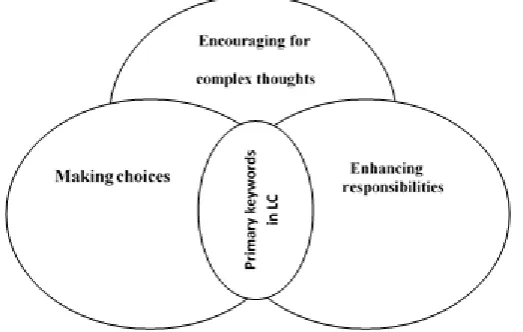
According to Nunley (2004), phases and features of layered curriculum are: First, units divide into C, B and A layers. In the layer C of Layered Curriculum, it is expected from children to correlate their given new and old information and to define and comprehend them for making an activity; in layer B, to apply this knowledge, use it in order to solve encountered problems; in layer A to think critically about an issue. Each layer aims students to make choices, take responsibility and express various opinions. Each goal constitutes a keyword of Layered Curriculum (see Figure 2).
Figure 2. Primary Keywords in layered curriculum (adapted from Nunley, 2004, p.51).
During the practical use of Layered Curriculum students were asked to choose among activities C, B and A layers considering their own learning style and make an oral defense upon choosing particular activities. In other words, Layer C includes comprehension and recalling. Students review and construct their basic skills in this level, which includes explanations, listing, identifying, classifying, memorizing, repetition, gap filling, summarizing, and discussing, and reviewing, interpreting skills. It is expected at this level that students score 65-70 points by choosing desired tasks, students have to accomplish those tasks in order to go on to the next level. Then, students who take these scores pass to B and A. (There are applying and analyzing for level B; evaluating and creating for level A) (Gencel & Saracoglu, 2018, Uzum & Pesen, 2019).Purpose of oral defense is to understand in which layer the student had difficulty or in which layer activities s/he participated more. Nunley (2004), considered these specified issues when she used this teaching method in a science lesson. According to LaSovage (2006), Neo (2008) and Maurer (2009), considering these points provides students to be active on the process with Layered Curriculum and learn in line with their own learning styles. These learning styles encourage students to make research from different sources, question them and create new ideas instead of obtaining knowledge directly. Every step of this process indicates that the students use their problem solving skills.
Problem solving skills are what the Layered Curriculum aims to gain for an individual since children always encounter problems when they perform activities. The most significant point is to determine how these skills are used by children and how it can contribute to boost other skills. In this research, Science and Technology curriculum is handled and the contribution of Layered Curriculum approach to students’ mental process and problem solving skills were presented. The reason of handling Science and Technology curriculum in this research is ineffectiveness of auxiliary books for helping students to gain problem solving skills used in the curriculum and teachers related to activity, method and strategy to ensure students gain problem solving skills (Aktas, 2006; Aktepe & Aktepe, 2009, Derya Dasci & Onel, 2018). Thus, it can be said that, current curriculum is not effective in developing students’ problem solving skills. Even if this curriculum actually intends students to gain these skills. In other word, information society education understanding aims to raise individuals that; comprehend the importance of problems and problem related areas, where to access information, which information to use during the solving process, and settle on the most effective way of solving a problem (Kalayci, 2001). However, researches (Koc Akran & Uzum, 2018; Derya Dasci & Onel, 2018; Koc Akran, 2018; Gomleksiz & Bicer, 2012; LaSovage, 2006) emphasize that Science and Technology Curriculum has inadequacies to raise such individuals. Thus, this study aims to specify; how the practical usage of Layered Curriculum in a Science and Technology curriculum helps to improve students’ problem solving skills, and as a contemporary approach, how the practical usage of Layered Curriculum will contribute learning-teaching process during curriculum improvement period. In order to achieve this aim, the questions below were examined:
1. Is there a significant difference between the points related to problem-solving skills of pre-test and post-test of control group?
3. Is there a significant difference between the points related to problem-solving skills of post-test of experimental and control group?
4. What are the experimental group students' opinions on the effectiveness of the layered curriculum?
Methodology Research model
In this research, dominant-less dominant mixed method design is adopted. If qualitative or quantitative research method is selected as a baseline in dominant-less dominant mixed method design, another research design is applied to a small part of the research (Tashakkori & Teddlie, 1998). In order to determine the effects of Layered Curriculum approach on students’ problem solving skills, one of the quasi-experimental designs, pre-test-post-test paired control group design is used in the quantitative aspects of the research. According to Fraenkel and Wallen (1993) quasi-experimental designs contain the following main attributes: One or more control group and quasi-experimental group; Random assignment of subjects in both control and experimental groups; Pre-test of groups to check the equality; Post-test of groups to identify the impacts on dependent variables; One or more treatment on the experimental group/s; Isolation, control, and manipulation over independent variables; ‘Non-contamination’ between experimental and control group.
In the qualitative aspect, benefitted from case study, answers of 4th sub problems were searched and obtained data analyzed thoroughly.
This research lasted five weeks. Certain activities were performed by the experimental group and control group students in line with ‘Human Body Systems’ unit. During these activities, experimental group is assigned with Layered Curriculum approach related activities, while control group is assigned with current curriculum activities. Task lists including C, B, A layers of Layered Curriculum and different assignments in each layer, handed to the students of experimental group in advance. Students were provided with freedom to choose which activities to perform.
Study group
The study group of the research is the 6th grade students of an elementary school in Malatya province in Turkey. In the quantitative dimension of the study; in order to find the answers for the1st, 2nd and 3th sub problems, the study group consists of 30 in the experiment group and 30 in the control group, total 60 students.
Table 1. Distribution of experimental and control group students
Group Number of students Girl Gender Male
f % f %
Experimental 30 12 40 18 60
Control 30 18 60 12 40
TOTAL 60 30 50 30 50
At the sixth grade of the mentioned school, there are four classes. In the study, in forming the experiment and the control groups, of the purposive sample types, “random sampling method” has been used. According to Buyukozturk et al. (2012: 85), in this sampling method, sampling units' probability of being selected as sampling is equal and independent. In the quantitative dimension of the study, in order to find answers for the 4th sub problems, from the 30 participants that are in the experiment group, 10 participants have been chosen according to “voluntary basis”.
Data collection instruments
Data of the research was collected through quantitative and qualitative data collection instruments. In the quantitative aspect, when seeking for answers to 1st, 2nd, 3rd sub problems, “Problem Solving Skills Test” which is developed by the researcher (2013) was used in pre-application and post-application process.
point Likert scale was used with the expressions, “Suitable” “Unsuitable” “Must Be Corrected”. Then, the expert opinions of three academic members who worked on “Layered Curriculum” were taken with regard to the questions in the interview form. In accordance with these experts’ remarks, necessary improvements were made. Interviews with 10 participants were realized in the school’s reading room by using this form. Interviews with the participants took approximately 15-20 minutes.
Data analysis
To analyze quantitative data, SPSS 17.00 statistics program was used. In the study, in order to test the scoring reliability of the problem solving skill tests, intraclass correlation coefficient-r1 has been calculated. As Alpar (2003:379) stated
while intraclass term represents “analyzing repetitive measurement of the same variable (testing same people repeatedly, same people are measured by the same measurer in different times, same test is performed by two measurers etc.)”, interclass is a suitable term for “a bivariate analysis (such as correlation coefficient)”. When r1 is used
to calculate interrater reliability; 0.95 to 1.00 is described as “perfect”; 0.85 to 0.94 as “high”; 0.70 to 0.84 as “moderate”; and 0.0 to 0.69 as “unacceptable”. Since raters were not assigned by randomness rule, two-way mixed model was used and as conformity between averages were taken into consideration, perfect match was regarded. In consequence of the analysis, average conformity coefficients between total scores that obtained from assessments of 22 tested students by three raters are, .94 in the test called “Aunt Semra” (Form A); .92 in the test called “Importance of Heart Health”; .98 in the test called “A Drop of Hope”; .98 in the test called “Little Enemies of Our Body”; .97 in the test called “Little Snowman’s Sore Throat”. With reference to this data, it can be said that two out of five tests’ interscorer reliability is “high”, for three of them it is “perfect”. Besides, to determine whether test scores fit the normal distribution, Shapiro-Wilks value checked and only greater than 0.05 value was accepted. As Buyukozturk (2007) stated, if the number of groups is more than 50, Kolmogorov-Smirnov normality test is used; but if the number is less than 50, Shapiro-Wilks normality test is used. As a result of these analyses, t-test was used during the “problem solving skills test” data analysis concerning pre-test-post-test.
In the qualitative data analysis of the research, data obtained from researcher diaries was subjected to descriptive analysis and content analysis and described in accordance with the acquired data. Themes were created after descriptions and consulted to an expert opinion on reliability of the themes. Information about descriptions were tabulated with frequency and percentage distribution. Also, data obtained from researcher diaries and documents of student assignment photographs were examined together.
Within the scope of content analysis, sub-themes were tried to be achieved comprehensively by deepening these descriptions. Thus, in order to establish detailed themes related to efficiency of Layered Curriculum, concepts in the data were determined in compliance with the problem of research and coded accordingly. Information about detailed sub-themes that obtained from content analysis were given within the text as subheadings. Also, direct quotations from interviews with participants and student diaries along with students’ assignment photographs were added and interpreted in the results section. While quoting directly, each quotation was enumerated and attributions to quotations were given in square brackets with a view to facilitate readers to forge a link between the quotations and attributions within the text. In these quotations, instead of students’ names D1, D2, D3, D4, D5… code was used; while
exemplifying experimental group students’ daily, C1, C2, C3, C4, C5… and researcher in diary A code was used.
Findings / Results Results on control pre-test and post-test problem solving skills test points
Point average of the control group students’ pre-test and post-test “Problem Solving Skills Test” is shown in Table 2. Table 2. t-test results point average of the control group students' pre-test and post-test problem solving skills test
Measurement N
S sd t p
Pre test 30 74,90 3,09 29 1,424 0,16
Post-test 30 75,88 3,19
When we look at the data on Table 2, we can see that pre-test problem solving skills point average of the control group is = 74,90 out of 100 points, and post-test problem solving skills is = 75,88; but significant differentiation was not observed between pre-test and post-test point averages [t(29)= 1,424; p>0.05]. This finding can be interpreted as
existing Science and Technology Curriculum teaching methods are not efficient in improving problem solving skills of students in the control group.
Results on experimental group pre-test and post-test problem solving skills test points
Table 3. t-test results point average of the experimental group students' pre-test and post-test ‘problem solving skills test’
Measurement N
S sd t p
Pre test 30 75,00 4,49 29 23,276 0,00*
Post test 30 85,28 4,91
*p<0.05
When we look at the data on table 3, we can infer that pre-test problem solving skills point average of experimental group which was subjected to Layered Curriculum activities is =75,00 out of 100, and post-test point average after being subjected to Layered Curriculum activities is =85,28, between pre-test and post-test results there is a significant differentiation in favor of the post-test [t(29)= 23,276; p<0.05]. This finding can be interpreted as Layered
Curriculum approach is effective on improving problem solving skills of students.
Student diaries also support the finding that students’ problem solving skills have been improved with Layered Curriculum approach. C2 coded student wrote about a problem s/he encountered while performing an activity then
described how s/he solved it in his/her diary as follows:
…It was hard for me to write a poem on B layer. I asked my teacher. I didn’t know how to write a poem. My teacher told me about it. I searched the similar topics right away. Then asked my Turkish language teacher. I pieced all the information together. I wrote the poem and read it in the class. My friends and teacher asked me some questions about it. I followed the same steps while writing a story on A layer. It was really easy…(C2, 19.03.2013).
As seen in C2 coded student’s diary, the student realized the problem while working on an activity on B layer and
collected information from different sources. Performed the activity by piecing information that seemed substantial, together and presented in front of the class. Likewise, this student also encountered a problem in A layer which includes high level behaviors. However, as the student learnt how to deal with a problem in B layer, s/he didn’t have trouble solving a problem in A layer.
Results on experimental group and control group post-test problem solving skills test points
Point average of experimental group and control group students post-test, “Problem Solving Skills Test” is shown in Table 4.
Table 4. t-test results point average of the experimental group students' and control group students post-test problem solving skills test
Groups N
S sd t p
Experimental 30 85,28 4,91
58 8,787 0,00*
Control 30 75,88 3,11
*p<0.05
When the data in Table 4 is analyzed, we can see that there is a significant differentiation between post-test problem solving skills point average of experimental group students who were subjected to Layered Curriculum activities and that of control group students who were not subjected to Layered Curriculum activities [t(58)= 8,787; p<0.05]. When
arithmetic average of the groups was analyzed, it was observed that experimental group students’ post-test problem solving skills point average is =85,28 out of 100, while control group students’ post-test problem solving skills point average is =75,88. This finding can be interpreted as Layered Curriculum approach has been effective on improving problem solving skills of students in experimental group.
...Another student had difficulty in making a concept map. This student told me s/he taped several cartons to each other but they were not strong enough to hold it and finally carton pieces that he cut fell off. I asked what kind of a solution he found. The student said s/he cut holes on the cardboards, asked for a thread from his mother, used threads to tie cartons up (A, 26.03.2013).
As seen in the researcher diary, with the help of Layered Curriculum Approach, when students encounter a problem, it is observed that start with spotting the problem, then try to identify the problem, do a research from various sources, know where to find the necessary information, ask for help from acquaintances, try to find multiple solutions and determine which one is the most efficient.
Results on student reviews concerning the efficiency of Layered Curriculum
Table 5. Descriptional analysis results of student reviews regarding the difference between activities performed in line with Layered Curriculum and previous Science and Technology lesson
Category Source Coding density
f % f %
What is the difference between activities you performed in line with Layered Curriculum and previous Science and Technology lesson?
Student-centered activities 10 50 30 75 Teacher-centered activities 10 50 10 25
Sum 20 100 40 100
* As each student can code more than one category/theme, total source might be more than the number of participants
Description analysis of interviews with 10 students shows that, Layered Curriculum activities are “student-centered” [activities have three layers from easy to difficult (f=8), activities make lessons more entertaining (f=8), learning by practicing (f=6), enjoyable lessons (f=2), voluntary participation to lessons (f=2), activities are performed even outside the class (f=1), positive attitude towards lessons through activities (f=1), activities improve self-assessment skills (f=1) and psychomotor skills (f=1) ]. On the basis of this finding, it can be said that students divide Layered Curriculum as C, B, A layers and arrange activities in the layers from easy to difficult [e.g.1-2-3-4-5-6-7-8], and activities make lessons more entertaining [e.g.9-10-11-12-13-14-15-16].
[1] “Layered Curriculum consists of C, B and A layers. C layer is a little bit easier. We performed 6 activities. And we did 2 from B. We were laying the basis step by step to finally reach the A layer.” [D7]
[2] “We learn a topic fast from low-level to high-level by means of Layered Curriculum activities.” [D1]
[3] “It is a teaching method with activities from easy to difficult. C layer is the easiest layer in Layered Curriculum. .. We pass to B layer after finishing those activities. We accomplish 2 activities in the B layer. … then we pass to A layer which includes the most difficult activities.” [D2]
[4] “Layered Curriculum helps people to participate lessons more willingly, and it goes from easy to difficult. …[D3]
[5] “It is something we make activities from easy to difficult. I started with the easy one. C layer. C layer was very easy. B layer was a little bit difficult. But it was easy at the same time. A layer was too difficult. I had difficulty on that one little bit. But then I accomplished that too.’’[D4]
[6] “It is kind of a layer that goes from easy to difficult. We performed an easy activity about a topic we learned. Then, a little bit more difficult. And then we passed to a more difficult one until we understand the topic wholly’’ [D5]
[7] “Layered Curriculum begins to teach us from easy to difficult. That means, we make simple things at first, then more difficult ones, it has three layers, in the C layer there are simple activities, B has medium and A has the hardest ones.” [D9]
[8] “We learn the topics from easy to difficult with Layered Curriculum activities.” [D10]
[9] “In this enjoyable activity, we cut cartons and tried to make something with your help.” [D2]
[10] “We enjoy activities more with the Layered Curriculum” [D3]
[11] “These activities were so much fun, and amusing.” [D4]
[12] “We became well informed and it was more enjoyable. We have never done such enjoyable activities in a science and technology lesson before.” [D5]
[13] “In the Layered Curriculum we write the names of activities in flower petals. It feels enjoyable. It is very enjoyable. You go home and say “mom, I really like this style. I will study for science lesson from now on.”….. with the help of Layered Curriculum we’ve started to perform activities in a more fun way.”[D6]
[14] “We participate our lessons more eagerly and willingly.” [D7]
[15] “This lesson became more fun when you came. We learned better. We made presentations afterwards. We told however we wanted. We drew pictures. We drew our heart and vein. Then we explain over the picture.” [D8]
[16] “ ….we make enjoyable things with the activities.” [D9]
Interviewed students stated that C layer activities were easy, B layer activities were medium, A layer activities were difficult. Also, it can be deduced that, activities helped science and technology lesson to be more enjoyable, and provided students to participate lessons more eagerly and willingly. These findings are also supported by student diaries.
According to C7 coded student Layered Curriculum consists of three layers, C, B and A layers, there are different
Views of C9 coded student are also similar to C7 coded student. C9 coded student expressed his/her similar opinions as
follows: Dear Diary,
……Layered Curriculum is separated to three layers and there are different activities….. Teacher showed us A, B, C layers but the most difficult layer is A and the easiest is C……(C9, 18.03.2013).
According to C9 coded student’s diary, Layered Curriculum consists of three layers and there are various activities in
each layer. Also, according to this student, the most difficult activities among the Layered Curriculum activities are in layer A. the easiest activities are in layer C. C3 and C5 coded students stated similar opinions as C9 coded student in their
diaries, as follows: Dear Diary,
…….We chose activities in the Layered Curriculum. The first activity was easy. I mean C layer was easy…… Then, I realized that activities are getting more and more difficult when we approach to A layer. ….At first these activities were easy but next ones were hard as climbing a mountain. Like you climb and climb to the mountain, just like that…….(C3, 26.03.2013). Dear Diary,
…….there are A, B, C layers in the Layered Curriculum. C layer was the easiest and A layer was the hardest….. (C5, 25.03.2013).
According to C3 coded student and C5 coded student Layered Curriculum consists of C, B, A layers and while C layer
contains easy activities, A layer has difficult ones. C3 coded student even resembled the activities in B and A layers to
climbing a mountain.
Students are able to recognize which activities are easy and which ones are difficult with Layered Curriculum. For instance, C10 coded student expressed opinions about Layered Curriculum in his/her diary, as follows:
My Dear Diary,
There were different activities in C, B and A layers of Layered Curriculum. I haven’t seen so many activities before. We chose 6 activities in C layer, 2 in B layer, and 1 in A layer. As C layer was easy, B layer was medium and A layer was hard, I chose the ones that I could do. (C10, 19.03.2013).
“ C” LAYER (60-70 POINTS)
ACTIVITIES POINT
Read newspaper articles about blood donation and summarize these articles
written and orally 10
Search several sources about heart health and share them in the class 10
Write a 300 words essay on blood donation 10
“ B” LAYER (15 POINTS)
Write lyrics about the importance of the heart for human life 15 Write a poem about the importance of the heart for human life 15
Make interview with doctors and nurses in community health centers to create an
‘Immunization schedule’ 15
“ A” LAYER (15 POINTS)
Write a genuine story about blood donation and act out in the class 15 Design an original model displaying blood transfusion 15
Write a genuine poem about blood donation. 15
Write a genuine article about the importance of blood donation in terms of human
body and society 15
According to C10 coded student, in the C, B, A layers of Layered Curriculum there are different number of activities, they
Besides these students, C1, C2, C4, C8 coded students specially stated in their diaries that Layered Curriculum activities
were enjoyable. Some quotations from these students’ diaries are given below respectively. Dear Diary,
……We watched an activity on microorganisms today. We reviewed the topic while doing this activity. We repeat what we learn through activities. Activities are so much fun, I enjoy them. So my Dear Diary, I enjoy a lot while watching my friends’ activities and also performing my own.……(C1, 16.04. 2013).
According to C1 coded student’s diary, Layered Curriculum activities are enjoyable. In other words, this student enjoy a
lot while performing activities as well as watching other friends’ activities. Same emotions were expressed in C2 coded
student’s diary, as follows:
…..I gave 3 of my assignments to the teacher. The best one was the poster. Today the lesson was very fun. Therefore I was very happy. I wrote down the summaries of important topics. I wrote the things I learnt to my diary as well. It was really good. I’ve never been this happy. I wish we could use Layered Curriculum in other lessons too, it would be so fun that way…(C2, 8. 04.2013).
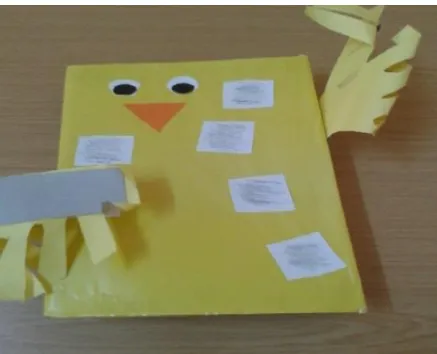
Picture 1. Poster prepared by students
According to C2 coded student diary, it can be said that, the student enjoys Layered Curriculum activities very much and
wants to use Layered Curriculum in other lessons as well, that way s/he believes those lessons would be more enjoyable. C4 coded student on the other hand, expressed opinions about how Layered Curriculum activities make
lessons more fun, as follows: My Dear Diary,
Our teacher gives us lessons. We perform activities after topics’ finish. Sevda teacher reminded the topics of our first lesson. Then, friends performed their activities. I also performed my activities and I decorated it with colorful beads, ornaments and threads, it looked wonderful, I had so much fun. Our lesson was very amusing…(C4, 9.04.2013).
According to C4 coded student diary, the student had a great time while performing activities and s/he enjoyed them,
and s/he could decorate it with anything s/he desired. In other words, it can be said that, with the Layered Curriculum activities, students use their imagination and diversify activities by adding visual dimension with any kind of material they can reach and enjoy this process.
Just as C4 coded student, C8 coded student enjoys while performing and watching Layered Curriculum activities and
expressed his/her? opinion, as follows: Dear Diary,
Picture 2. One of the Puppets prepared by students
While Layered Curriculum activities continued, the students are given continuous feedback. With the help of these feedback students either pass to another activity or question themselves on why they couldn’t do a certain activity/ activities and try to make up their deficiencies. C8 coded student was pleased to receive feedbacks then pass to another
activity and strive to get a similar feedback. Thus, Layered Curriculum activities are enjoyable for students.
Table 6. Descriptional analysis results of student reviews regarding the attention while choosing the activities in the Layered Curriculum task list
Category Source Coding density
f % f %
What did you pay attention while choosing the activities in the Layered Curriculum task list? Why?
Sympathy 8 53,33 8 53,33
Perception of self-sufficiency 7 46,67 7 46,67
Sum 15 100 15 100
* As each student can code more than one category/theme, total source might be more than the number of participants
As it is seen in Table 6, descriptional analysis of interviews with 10 students, shows that previous science and technology activities were teacher-centered [in these activities teacher only conducts the lesson (f=8) and summarizes them (f=1), activities were not from easy to difficult (f=1)]. Based on this finding, we can deduce that narrative method is commonly used in the lessons with teacher-centered activities [e.g.17-18-19-20-21-22-23-24].
[17] “Our teacher finished the units. He was teaching all by himself.” [D2]
[18] “Our teacher wasn’t asking us to perform activities. He was just teaching the lesson. Sometimes he was asking us questions.” [D4]
[19] “In the science and technology lesson teacher was teaching us. When the teacher asked whether we understood we used to say we did and it was going on like that.” [D5]
[20] “Our teacher was telling us the topic. If 1 or 2 of us doesn’t understand, he used to tell one more time. And summarize accordingly. He was checking our notebooks in the last day. He was also checking our workbooks. If there is any unanswered question, he wanted us to complete them. There were no activities.” [D6]
[21] “Our teacher used to come to the class and teach all the lesson on the board. I don’t remember performing any activities at all.” [D7]
[22] “Before you came, our previous teacher used to give the lesson by himself. He didn’t give us this kind of tasks.” [D8]
[23] “Before you, the teacher used to teach and we were writing down.” [D9]
[24] “Teacher was speaking and I was listening.’’[D10]
Student reviews and opinions in their diaries support each other. One of these students, C6 coded student expressed
opinions in his/her diary about difference between Layered Curriculum activities and existing science and technology activities as follows:
My Lovely Diary,
According to C6 coded student diary, student stated that s/he used to summarize the topics of lessons, and teachers
only give homework, teach the lesson and do not assign any activities. However, the student also stated that s/he enjoys Layered Curriculum activities, and they submitted a different activity every day.
Table 7. Descriptional analysis results of student reviews regarding favorite activity
Category Source Coding density
f % f %
What was your favorite activity? Why?
Visual learning 9 56,25 12 54,54
Audio-visual learning 7 43,75 10 45,46
Sum 16 100 22 100
* As each student can code more than one category/theme, total source might be more than the number of participants
As it is seen in Table 7, descriptional analysis of interviews with 10 students shows that, 8 students were “interested” in enjoyable Layered Curriculum activities (f=8). On the other hand, 7 students stated that they chose Layered Curriculum activities in accordance with the “perception of self-sufficiency” [activities that they can succeed (f=5), believe in themselves (f=1), and are determined (f=1)] Based on this finding, we can deduce that, while students choose from Layered Curriculum activities, they attach importance it to be enjoyable [e.g.25-26-27-28-29-30-31-32] and they choose the ones they can do [e.g.33-34-35-36-37], about “why did they choose these activities” it is seen that “because they learn better with these activities” [e.g.25-26-28- 30-37].
[25] “I thought if I do these, I will have more fun with activities and I will learn the lesson at the same time.” [D1]
[26] “I picked the enjoyable ones. Enjoyable activities makes learning easier.” [D2]
[27] “I paid attention to the activity I like the most. I mean I tried to choose whichever one is more enjoyable for me.” [D3]
[28] “I chose the enjoyable ones. When I perform an entertaining activity, I learn better.“ [D4]
[29] “There were researches, verbal narrations. But instead of those, I chose enjoyable ones so that my friends don’t get bored while I present. I tried to choose enjoyable things so that both me and my friends would learn.” [D6]
[30] “ …I especially tried to perform in a fun way. Because having fun means learning. I learn better when it is fun.” [D8]
[31] “I’ve never seen so many activities before. As I was choosing activities I chose the enjoyable ones.” [D9]
[32] “I picked the activities that don’t contain enacting a story or puppets, so I chose the activities that I will perform on my own not with a group, and also enjoyable ones.” [D10]
[33] “The ones that I could do, I mean the ones that I can do. When it’s too difficult you don’t get bored.” [D2]
[34] “I can do so I picked the activities that I can do by myself.” [D3]
[35] “While I was choosing those activities I said to myself if I could do that. So I chose activities that I could do.” [D4]
[36] “At first, I thought if I could do it or not. I picked activities that I could do. I don’t pick anything I cannot do.“ [D5]
[37] “I chose the activities I could do. If you can do something that means you are learning. With these activities I learnt the topics better.” [D7]
It can be said that findings on the difference between the Layered Curriculum activities and existing science and technology activities [see e.g.9-10-11-12-13-14-15-16] are supported by the finding, while students choose Layered Curriculum activities they choose especially the ones that are enjoyable and the ones that they believe they can do. About the difference between Layered Curriculum activities and existing science and technology activities, students stated both during their interviews and in their diaries that Layered Curriculum activities are more enjoyable. Similarly, student diaries support the findings obtained from the question regarding what is the first thing students observe while choosing from Layered Curriculum activities. One of these students, C1 coded student expressed opinions in his/her
diary about what they observe while choosing Layered Curriculum activities as follows: Dear Diary,
When the teacher gave me the task list, I picked activities that are fun and I will enjoy with my friends (C1, 19.03.2013). According to C1 coded student diary, among the activities prepared in line with C, B, A layers this student chose
enjoyable ones. It is also seen that s/he even wants his/her friends to enjoy the activities.
…Then I handed the task list. 4-5 student wrote their favorite activities to the task list…In the break time, students were asking each other about the activities they chose… In the second lesson, I asked students which activities did they choose and why they chose them. Most of the students chose enjoyable activities, the ones that they are interested in, makes learning easier and they believe they can do. As far as I can see, students learn the topics better and realize their potentials if they enjoy the lesson… They choose activities knowing of their potentials and learn the activity with the help of this potential. (A, 11.03.2013).
Table 8. Descriptional analysis results of student reviews regarding encountered problems while performing activities on C, B, A layers
Category Source Coding density
f % f %
What kind of problems have you encountered while performing activities on C, B, and A layers?
Preparing material 8 72,73 8 66,67 Accessing material 3 27,27 4 33,33
Sum 11 100 12 100
* As each student can code more than one category/theme, total source might be more than the number of participants
As it is seen in Table 8, descriptional analysis of interviews with 10 students shows that, 9 students enjoy “visual material” [preparing presentation (f=3), making diagrams (f=2), preparing newspaper advertisement (f=2), making a literature survey (f=2), preparing an immunization schedule (f=1), writing composition (f=1), preparing crossword puzzles (f=1)] preparing activities. On the other hand, 7 students stated that they enjoy “audiovisual materials” [writing a poem and reading in the class (f=3), writing a story and enacting afterwards (f=2), writing lyrics and singing (f=2), making a model television and reporting news (f=2), making a puppet show (f=1)] preparing activities among all Layered Curriculum activities. Based on this finding, we can say that, students’ favorite Layered Curriculum activities are preparing a presentation as a visual material [e.g.38-39-40], writing a poem and reading in the class as an audiovisual material [e.g.41-42-43] and as a reason for “enjoying these activities”, they stated that they “express their feelings and opinions better” [e.g.40- 42-43].
[38] “Preparing a presentation (slide show) in the A layer.“ [D1]
[39] “There was presentation (slideshow) preparing in the A layer. I did that. I collected pictures and information. “ [D3]
[40] “ …. Making presentation (slideshow)……I like that most. I can easily share the information in my head with my friends while delivering presentation.“ [D8].
[41] “…. There were poems related to milk in B layer. “ [D4]
[42] “I got it at first glance. B layer was really cool. …. there was poem writing. I take my pen and started writing. Then I understood that it was amazing. I said “I will do that first” because I can express my feelings in a better way with poetry. [D7]
[43] “I guess B layer included writing a poem. I wrote them. I really liked it. I can express my thoughts better when I write poems.” [D8]
Student reviews regarding their favorite activities of Layered Curriculum and their opinions written in their diaries support each other. C8 coded student stated in his/her diary on his/her favorite activities as follows:
Dear Diary,
……..My teacher handed us a task list in the first weeks. I picked activities from that list. Actually, activities that I picked were my favorite ones…. I performed my favorite activities today. I made a presentation (C8, 18.03.2013).
According to D8 coded student diary, this student picks many activities from the task list, but his/her favorite activities
are preparing presentation and writing poem. As it is seen, Layered Curriculum enables students the "right of choice". Thus, students choose the activities they like, interested, enjoy and contribute to their learning in line with their own learning styles.
Table 9. Descriptional analysis results of student reviews regarding problem solving
Category f Source % Coding density f %
How did you solve these problems? Collecting information Identifying the problem 10 6 62,5 37,5 11 6 64,71 35,29
Sum 16 100 17 100
As it is seen in Table 9, descriptional analysis of interviews with 10 students shows that, 8 students encountered a problem while preparing material for Layered Curriculum activities [organizing information’s to be used (f=8)]. On the other hand, students stated that they also encountered problems while accessing the materials [does not know where to find information about the material (f=3) and how to classify information (f=1)]. Based on this finding, it can be said that students don’t know how to organize information in the Layered Curriculum activities [e.g.44-45-46-47-48-49-50-51] and where to find information about materials [e.g.52-53-54].
[44] “There was television in the last layer I know what a television is but collecting all the information in one place was the actual problem….. I make the television with papers and books. Those papers helped me a lot. I had trouble making this television but I succeeded at last. “ [D2]
[45] “When I was writing a story in A layer, I chose different names than my classmates’ as they may get upset with me. Because they say don’t write our names. And I had difficulty preparing a presentation. I didn’t know how to prepare a presentation at first…. I handled it but it was a bit hard because my friends didn’t help me. “ [D3]
[46] “Not in C but I encountered a problem in B. While writing a poem I tried to write different stuff. It was hard to do.” [D4]
[47] “I encountered a problem in a newspaper advertisement in the A layer. At first, I couldn’t think of anything about taking blood or blood donation. I didn’t know how to gather this information… Then I searched it from my science and technology book and internet. Writing lyrics was a little bit difficult. I paid utmost attention to write it relevant to heart. I tried to write in a way to describe heart and the importance of heart in terms of human health.” [D5]
[48] “I guess there was an immunization schedule in the B layer. I know what a vaccination schedule is. But the hardest part was to collect all the information together. It was so problematic. “Maybe I should just leave it” I told myself. I wanted to enact a story from A layer, I brought it to school but no one helped me.” [D7]
[49] “I had difficulty finding the rhythms while writing lyrics in the B layer. What I had difficulty in the A layer was drawing a picture. I can’t draw very much so I pushed myself to draw better. I drew with lids and stuff.” [D8]
[50] “There was composition writing in the A layer. I had trouble finding information, I mean finding a title, it was really hard. ” [D9]
[51] “ …..I had difficulty making booklets in B layer. Because it was hard to bring all the information together.” [D10]
[52] “In order to look for an immunization schedule, I walked to community health center for total 100 meters. I didn’t know where to find at first.. I had difficulty making booklets too.” [D1]
[53] “Just finding serum hose was a bit hard. I took it from our neighbor. I had difficulty in B layer as I didn’t know how to make slideshows.” [D3]
[54] “I searched from books and internet. I had a really hard time.’’[D6]
Student reviews regarding in which layer of Layered Curriculum they encountered problems and opinions written in their diaries support each other. C6 coded student stated reviews on which layer s/he encountered a problem in his/her
diary as follows: My Lovely Diary,
Today teacher made the ones who didn’t prepared activities stand up and I was one of them. But I made an effort. I wrote a composition right away and prepared a quiz of ten questions. But I need to finish my activities in the C layer but there is no internet connection at my home… I wish internet would work today… Or I wish my sister helps me so that maybe I could perform my activity in the C layer. (C6, 01.04.2013)
According to C6 coded student diary, it can be said that the student doesn’t know where to find the information about
materials. This situation can also be interpreted as, the student does not know s/he can find information from different sources.
As can be seen in the student reviews and diaries, students encountered problems in organizing information in Layered Curriculum activities as well as not knowing where to find material related information.
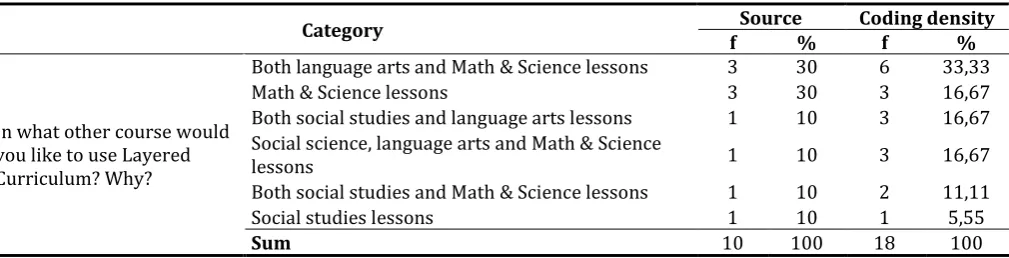
Table 10. Descriptional analysis results of student reviews regarding usage of Layered Curriculum in other courses.
Category f Source % Coding density f %
In what other course would you like to use Layered Curriculum? Why?
Both language arts and Math & Science lessons 3 30 6 33,33
Math & Science lessons 3 30 3 16,67
Both social studies and language arts lessons 1 10 3 16,67 Social science, language arts and Math & Science
lessons 1 10 3 16,67
Both social studies and Math & Science lessons 1 10 2 11,11
Social studies lessons 1 10 1 5,55
Sum 10 100 18 100
* As each student can code more than one category/theme, total source might be more than the number of participants
As it is seen in Table 10, descriptional analysis of interviews with 10 students shows that, 9 students tried to solve encountered problems through “collecting information” [research from different sources (f=7) and getting help from acquaintances (f=4)]. On the other hand, 6 students tried to solve encountered problems through “identifying the problem” [introduce the problem (f=5) and discuss if there was any solution to a similar problem (f=1)]. Based on this finding, it can be said that, students solve problems by researching from different sources [e.g.55-56-57-58-59-60-61] and introducing the problem [e.g.62-63-64-65-66].
[55] “I looked for blood types from books.” [D2]
[56] “I got help from books….” [D3]
[57] “I’ve done research from other sources.” [D4]
[58] “Then I did research about that. “ [D5]
[59] “I researched it, collected information first.” [D6]
[60] “I completed it with the help of books. I stuck some stickers and stuff.” [D8]
[61] “I search in books.“ [D9]
[62] “When I encounter a problem, I start all over again. Like I’ve never faced this a problem.” [D1]
[63] “I prepared solution layers myself. First, I analyzed what might be the source of the problem.” [D3]
[64] “I make a plan. Then I follow the steps to achieve it. What should I do first and after that I follow all these.” [D4]
[65] “Firstly, I specified the problem about the heart topic.” [D5]
[66] “Generally I ask myself what the problem is.” [D9]
Student reviews on how they solved the problems they encountered in C, B, A layers and opinions written in their diaries support each other. D1 and D9 coded students stated in their diaries on how they solved the problems they
encountered in C, B, A layers as follows: Dear Diary,
I picked activities from the task list, all fine, but I had trouble performing some of them, but the rest was easy for me. For example I couldn’t do the activity about A layer. So I started my activity all over again. (C1, 02.04.2013).
According to C1 coded student diary, the student couldn’t manage to do an activity from A layer at first. Nonetheless,
s/he didn’t give up trying to perform the activity and reconsider the learning process. This student also repeated what is written in his/her diary during the interview. In the interview it was observed that D1 coded student started over
when s/he encountered a problem [see e.g.62]. In other words, there is a clear consistency between the statements in student’s diary and his/her answers to questions during the interview.
In the interview it was observed that, C9 coded student tried to collect information about the problem and used it to
solve the problem by means of the information s/he collected from different sources [see e.g.61]. This student’s answers during the interview and statements on his/her diary supports each other.
Findings on how students solve problems they encountered while performing Layered Curriculum activities are supported by student diaries as well as researcher diaries. The researcher stated in her diary about how students solved problems they encountered while performing activities as follows:
instance, one of the students told me s/he didn’t know how to prepare a booklet, so s/he searched it from internet at first, then found a booklet sample with the help of his/her father and made a booklet about blood then presented it in the classroom (A, 26.03.2013).
In student interviews, as seen in researcher and student diaries, students tried to solve their problems by researching and introducing them.
In the sixth session, students were asked in which lessons Layered Curriculum can be used. According to findings, Layered Curriculum can be used in science &math; social studies; both language arts and science &math; both social studies and language arts; both social studies and science &math; social studies, language arts and science &math. In the description analysis of interviews with 10 students, they expressed opinions on applying Layered Curriculum to various lessons as follows: 3 students said it might be applied to science &math lessons [Mathematics (f=3) ]; 1 student said social studies [Social Studies (f=1)]; 3 students said both Language Arts and science &math [Mathematics (f=3), Turkish (f=2) and English (f=1)]; 1 student said both social studies and language arts [Social Studies (f=3), Turkish (f=1) and English (f=1)]; 1 student said both social studies and science &math [Social Studies (f=1), Mathematics (f=1)]. On the other hand, 1 student expressed his her? opinion on applying Layered Curriculum to social studies, language arts and math &science lessons [Social Studies (f=1), Turkish (f=1) and Mathematics (f=1)]. In addition to this finding, according to students’ opinion, Layered Curriculum activities can be applied to both language arts and math &science lessons [e.g.67-68-69-70-71-72] and math &science lessons [e.g.73-74-75], and also about the issue “why it should be applied to these certain lessons” they stated that “because these lessons are hard to learn” [e.g. 67-68-69-70-71-73-74-75 ].
[67] “If I were a teacher I would use Layered Curriculum in Turkish lesson. Because I cannot learn some topics. [D2]
[68] “Mathematics…. There are different signs of sets in C layer and I had difficulty memorizing them so I memorized them first.” [D2]
[69] “It would be great if it was applied in mathematics lesson. Because there are some topics that I may not learn in math class. For example, I have trouble in sets. We could do some activities about sets. …I could make newspaper or poem with them. Same friends write stories, we could write stories about sets…. [D4]
[70] “Learning English is very hard. We could write poems in English lesson likewise.” [D4]
[71] “I would say mathematics. Because math lesson is difficult for both myself and my friends. Then you came, we look through Layered Curriculum and got good grades…” [D7]
[72] “We could figure out any question. It would be great if we wrote a poem about period, comma and all the others.” [D7]
[73] “ …. I have a little bit trouble understanding decimal fractions in math. [D5]
[74] “I have great difficulty learning Math lesson. Our teacher could teach the topics by using more equipment, showing pictures.” [D9]
[75] “But when I think about the activities you introduce, I can also say mathematics. Topics are very hard. The teacher could teach us starting from easy. Like, if he showed pictures, made a story from problems that would be really good. I would say Math subject.” [D10]
It was observed that students can use Layered Curriculum in both language arts and math &science, or math &science subjects. According to the findings acquired from interviews, it can be said that, students prefer applying Layered Curriculum not to all the subjects, but the ones they have difficulty learning.
Discussion and Conclusion
curriculum activities can hardly be adapted by the students and teacher’s lack of knowledge on how to teach students according to their individual differences, learning preferences and intelligences would bring about unsuccessful results (Koc Akran & Uzum, 2018). In this research, it was observed that, contrary to the existing curriculum, Layered Curriculum activities considered of students’ individual differences and thus students participated in activities in C, B and A layers eagerly and willingly. According to Gomleksiz and Bicer (2012), Layered Curriculum activities are arranged from easy to difficult in accordance with students’ individual differences. Students perform easy activities at first and this situation increases their motivation. Also, gradual arrangement of activities enables students to create different solutions to each problem that they encounter.
There has been a significant differentiation in favor of the experimental group between experimental group students who were subjected to the Layered Curriculum activities and control group students who continued the existing curriculum. It was concluded that, experimental group students took responsibility in Layered Curriculum activities both individually and within a group, and used their problem solving skills when they face a problem. According to Johnson (2007), Koc Akran (2018) Layered Curriculum approach makes major contributions to students’ problem solving and responsibility taking skills. With this sense of responsibility, they choose Layered Curriculum activities willingly and they know why they choose them. In this research for instance, when students choose Layered Curriculum activities, it was observed that enjoyable activities and the ones they were able to do and about “why did they choose certain activities” it is seen that the reason is “because they learn better with these activities”. Nunley (2004), Yildirim Yakar and Albayrak (2018) indicates that, when teachers give students the right to choose the activities, students will be pleased by this circumstance, enjoy and make the right choices suitable for their learning style. Bicer (2011) also emphasized that, students choose enjoyable Layered Curriculum activities as well as the ones they can do and that these activities facilitate students’ learning process. Similarly, Yilmaz (2010) and Aydogus (2009) also highlighted that students choose enjoyable and easier Layered Curriculum activities and the ones they can deliver their performance comfortably at the same time. The fact that students choose enjoyable activities shows that “Layered Curriculum based education is a successful motivation tool for students” (LaSovage, 2006; Aydogus & Ocak 2011, p.362). Highly motivated students, thus, will want to apply Layered Curriculum activities to different or difficult subjects that they have serious trouble. Results from student interviews also support this notion. In the student reviews, it was observed that Layered Curriculum can be applied to both verbal subjects and math &science subjects and the reason of “why it should be applied to these subjects” is “because those subjects are hard to learn. According to Aydogus and Ocak (2011, p.363), students want Layered Curriculum to be applied in comprehensive subjects such as language arts and math &science, however indicates that it would be difficult and boring to apply it to other subjects. Similarly, Gun (2013), Uzum and Pesen (2019) inferred from the research she conducted that, with the Layered Curriculum, students participate more to social science subject and their motivation for lessons has increased.
Suggestions
Layered Curriculum can be implemented in other courses and new researches may be conducted.
The contribution of the different lessons of the layered curriculum to the teaching-learning process can be studied.
The effect of the application of the layered curriculum classrooms at different class levels on the achievement of the student can be studied.
References
Aktepe, V., & Aktepe, L. (2009). Teaching method using science and technology education on students’ aspects: The example of Kirsehir Bilsem. Journal of Kirsehir Education Faculty (KEFAD), 10(1), 69-80.
Aydogus, R. (2009). The effect of the layered curriculum in Science & Technology subject to the academic achievement for 6th and 7th grade students in primary education. (Unpublished master’s thesis). Afyon Kocatepe University, Afyonkarahisar, Turkey.
Aydogus, R., & Ocak, G. (2011). The effect of the layered curriculum in Science & Technology subject to the academic achievement for 6th and 7th grade students in primary education. The Journal Turkish Educational Sciences, 9(2), 343-368.
Bicer, S. (2011). Effects of the layered curriculum teaching method on student’s success, permanence and attitudes in science and technology course (Unpublished master’s thesis). Firat University, Elazig, Turkey.
Buyukozturk, S. (2007). Guidebook of data analysis for social sciences. Ankara: Pegem Publishing.
Buyukozturk, S., Cakmak, E. K, Akgun, O. E., Karadeniz, S., & Demirel, F. (2012). Scientific research methods (11th ed). Ankara: Pegem Publishing.
Fraenkel, J. R., & Wallen, N. E. (1993). How to design and evaluate research in education. Boston: McGraw Hill. Galliers, R. (ed.) (1992 ). Information systems research: issues, methods and practical guidelines. Oxfordshire: Alfred Waller Ltd.
Gomleksiz, M. N., & Bicer, S. (2012). Effects of the layered curriculum teaching method on student’s success, permanence and attitudes in science and technology course. International Journal of Human Sciences, 2(9), 1657-1683.
Gun, E. S. (2013). The reflections of layered curriculum to learning-teaching process in social studies course. International Journal of Instruction, 6(2), 87-98.
Ilkel, E. G., & Saracoglu, S. (2018). The effect of layered curriculum on reflective thinking and on self-directed learning readiness of prospective teachers. International Journal of Progressive Education, 14(1), 8-20.
Johnson, K. J. (2007). Layered curriculum for the construction trades: A mathematics curriculum to teach trade students basic math skills to be successful apprentices. Carbondale: Southern Illinois University Press.
Kalayci, N. (2001). Problem solving and applications in social studies. Ankara: Gazi Bookstore.
Koc Akran, S. (2018). The effect of the application of the layered curriculum on the metacognitive awareness of students in the 6th class science and technology lesson. Anatolian Journal of Educational Leadership and Instruction, 6(1), 1-25.
Koc Akran, S., & Uzum, B. (2018). The effect of the layered curriculum on the 6th grade students' learning styles in science lesson. International Journal of Educational Methodology, 4(3), 141 - 152. doi: 10.12973/ijem.4.3.141
LaSovage, A. J. (2006). Effects of using a layered curriculum format of instruction in a high school environmental science energy unit. (Unpublished master’s thesis). University of Michigan State, Michigan, USA.
Maurer, L.A. (2009). Evaluating the use of layered curriculum and technology to increase comprehension and motivation in a middle school classroom (Unpublished master’s thesis). University of Michigan State, USA.
Noe, B. (2008). The effects of a layered curriculum versus traditional teaching methods on academic achievement of fourth graders in the science content are (Unpublished master’s thesis), Columbia College, USA.
Nunley, K. F. (2004). Layered curriculum. Amherst: Brain.org Publication.
Nunley, K. F. (2011). Enhancing your layered curriculum classroom: tips, tune-ups and technology. Amherst: Brain.org Publication.
Tashakkori, A., & Teddlie, C. (1998). Mixed methodology: combining qualitative and quantitative approaches. London: Sage Publications.
Uzum, B., & Pesen, A. (2019). Do the Learner-centered Approaches Increase Academic Performance? Effect of the Layered Curriculum on Students' Academic Achievement in English Lesson. International Journal of Instruction, 12(1), 1585-1608.
Yildirim Yakar, Z., & Albayrak, M. (2018). The effect of the layered curriculum method on the students’ achievement in “area measurement”. Hacettepe University Journal of Education. Advance online publication. doi: 10.16986/HUJE.2018044393.