INTERNATIONAL JOURNAL OF PHARMACEUTICAL, CHEMICAL AND BIOLOGICAL SCIENCES
Available online at
www.ijpcbs.com
ONCE-DAILY SUSTAINED RELEASE MATRIX TABLETS OF
GLIMEPIRIDE - FORMULATION AND
IN VITRO
EVALUATION
S. Bhagat*, D. Nayak and R. Keny
Goa College of Pharmacy, 18
thJune Road, Panaji–Goa, India.
INTRODUCTION
In the last few years, diabetes mellitus has reached epidemic proportion and is now becoming cause of premature mortality and morbidity. Novel drug delivery systems (NDDS) are techniques capable of controlling the rate of drug release, sustaining the duration of therapeutic activity and/or targeting the delivery of drug to tissue1. Increased complication and expense involved in marketing new drug products has focused greater attention on the development of sustained release drug delivery. Basic rational selection of drug for oral NDDS is to optimize physicochemical and biological properties of drug. Sustained release systems include any drug delivery system which achieves slow release of drug over an extended period of time2. Sustained release technology through oral route of administration has received maximum attention with respect to research on physiological and drug constraints as well as design and testing products. For many orally administered active agents, it is preferred that the molecules are released at a constant speed in a determined lapse of time, to allow safety
and to provide a prolonged action of therapeutic effect. Nowadays, the SR systems are designed to provide a more reliable absorption profile and improve the bioavailability and efficiency of the active agent3. Glimepiride is an oral antidiabetic agent that belongs to the sulphonylurea drug class. Pharmacokinetics and dosage schedule support once daily controlled release formulation for Glimepiride for better control of blood glucose levels to prevent hypoglycemia, enhance clinical efficacy and patient compliance. For any controlled release dosage form it is very important to use minimum number of excipients with minimum processing steps in order to reduce tablet-to-tablet and batch-to-batch variations, hence direct compression is most suitable and easily up scalable technique4.
MATERIALS AND METHODS MATERIALS
The materials used include Glimepiride (gift sample from Zydus Cadila, Kundaim-Goa), HPMC K4M (gift sample from Colorcon Asia Pvt. ltd., Verna-Goa), HPMC K100 LV (gift sample from Colorcon Asia Pvt. ltd., Verna-Goa), Sodium
Research Article
ABSTRACT
The present investigation aims to formulate Sustained Release matrix tablets of Glimepiride in a matrix design utilizing different percentages of hydrophilic polymers. Based on the preformulation studies, 10 optimized formulations were prepared by direct compression using different controlled release polymers such as HPMC K4M, HPMC K100 LV and Sodium Alginate alone and in combination. Comparative evaluation of the drug release from the various formulations was conducted and the performance evaluated. The data obtained from dissolution studies was fitted in 5 models i.e. Zero Order, First Order, Higuchi Matrix, Korsmeyer Peppas and Erosion plot. Mathematical analysis of release kinetics indicated that nature of drug release from matrix tablets was dependent on drug diffusion and polymer relaxation, hence followed non-fickian or anomalous release approaching Zero Order Kinetics. The cumulative percentage drug release data revealed that formulations F5, F8 and F9 were highly effective in retarding drug release up to 24 hours with 97.47 %. 99.38 % and 98.76 % respectively. Stability studies performed at 40 degrees/75 % RH for a month exhibited absolutely no significant variations.
Alginate (gift sample from Snap Natural and Alginate Products ltd., Mumbai). Microcrystalline cellulose was gift sample from Glenmark Pharmaceuticals, Colvale-Goa. Colloidal Silicon Dioxide was gift sample from Wallace Pharmaceuticals, Bethora-Goa. All the other chemicals used of analytical grade were procured from Loba Cheme Pvt. Ltd Mumbai.
METHODS
Preformulation Studies
Identification of drug was carried out by FTIR-88A (Perkin Elmer). Standardization of the drug was carried out using UV spectrophotometry [Lambda 25 UV/VIS Spectrometer (Perkin Elmer)]. Pre-Compression Parameters i.e Angle of Repose and Compressibility Index on pure drug powder was evaluated. IR spectral analysis of the formulations was performed to assess drug excipient compatibility. Preliminary studies were carried out on the granules of drug using different hydrophilic polymers and their combinations. Based on this preformulation data, the optimized formulations for further course were decided.
Formulation
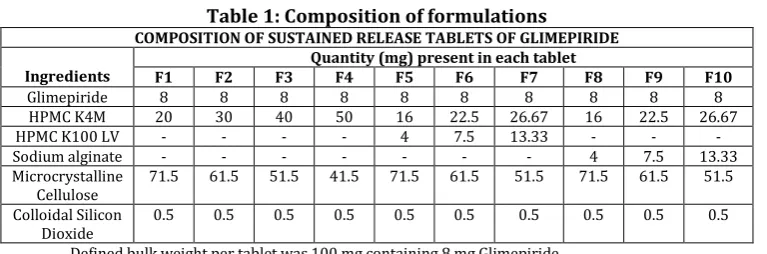
Sustained Release Matrix tablets each containing 8 mg of Glimepiride were prepared using HPMC K4M, HPMC K100 LV and Sodium Alginate alone and in combination by direct compression technique (Table 1). All the ingredients except Aerosil were uniformly blended. After sufficient mixing of the drug and other components, Aerosil was further mixed for additional 2-3 minutes. The tablet mixture was then compressed using Cadmach single stroke tablet punching machine with flat round punches using 7 mm punch. Formulated tablets of Glimepiride are as shown in figure 1.
EVALUATION5- 7
The calibration curve was obtained by preparing aliquots of working standard solution of Glimepiride in simulated gastric fluid (pH 1.2) and simulated intestinal fluid (pH 7.2) using methanol as a co solvent and the absorbance at 228 nm was measured after suitable dilution using Perkin Elmer UV/VIS Spectrophotometer.
Visual examination
Tablets were evaluated for physical appearance by visual assessment and uniformity of thickness using vernier calipers.
Weight variation test
Twenty tablets were selected randomly from each of the ten formulations, weighed
individually and average weight was calculated.
Hardness test
Five tablets were randomly picked from each of the ten formulations and the hardness expressed as kg/cm2 was determined using Monsanto Hardness Tester.
Friability test
The friability of tablets was determined using Roche friabilator. It is expressed in percentage (%). Ten tablets were initially weighed (Initial weight) and transferred into the Friabilator. The friabilator was operated at 25 rpm for 4 min (100 rotations). The tablets were then reweighed (Final weight). The percentage friability of tablets was calculated by:
% Friability=
Initial weight – Final weight x 100 Initial weight
Drug Content uniformity
To find Drug content, spectrophotometric method was followed. Powdered tablets corresponding to weight of the tablet was extracted in minimum volume of methanol in 100 ml volumetric flask. Final volume was made upto 100 ml with phosphate buffer pH 7.2. The solution was then filtered and 0.5 ml of filtrate was pipetted into 25 ml volumetric flask and diluted upto the mark with phosphate buffer pH 7.2 and analysed at 228 nm using suitable blank. Concentration of Glimepiride in mg/ml was determined by using standard calibration curve of drug. Drug content studies were carried out in triplicate for each formulation.
Swelling Studies
Swelling behavior of tablet was measured by placing the tablet matrices in dissolution test apparatus, in 900 ml of simulated intestinal fluid at 37±0.5oC. Tablets were removed periodically for every 2 hours from dissolution medium after draining free water. These were measured for weight gain and diameter. Swollen weights of tablets were determined at predefined time intervals. Swelling Index was calculated by:
Swelling Index =
[Final weight at time t(Wt) - Initial weight(Wo)] Initial weight (Wo)
In vitro dissolution studies
0.1) from 2-24 hours at rotation speed of 50 rpm and temperature of 37oC ± 0.5oC. 8 ml of the dissolution fluid was withdrawn after every hour and replaced with fresh quantity of dissolution fluid. The samples were filtered and analyzed using UV spectrophotometer at 228 nm.
Accelerated Stability studies7
Accelerated Stability testing on formulations was carried at 40 ± 2oC / 75 ± 5% RH for period of one month. The quality parameters namely hardness and drug content were evaluated.
RESULTS AND DISCUSSION Visual examination
Visual assessment revealed that all the formulations were concave, round in shape, having smooth texture, off white in colour with absence of odour and physical flaws. Size of the tablet was around 7 mm. Tablet thickness was almost uniform in all the prepared tablets falling within 2.79±0.004 to 2.83±0.008 mm (Table 2). Tablet Diameter was in range 7.0±0.04 to 7.09±0.08 mm (Table 2).
Weight variation test
None of the tablets deviated from average weight by more than ± 10 % (Table 2).
Hardness test
Hardness of the tablets was maintained in the range of 5.32±0.16 to 6.03±0.15 kg/cm2 (Table 2).
Friability test
The percentage weight loss in the friability test was less than 1% in all the batches. The tablets were able to withstand the mechanical shocks of the friabilator. Thus it can be concluded that the tablets possess good mechanical strength (Table 2).
Drug Content uniformity
The uniformity of drug content was found to be between 98.01±0.15 to 99.57±0.24 % of Glimepiride. (Table 2).
Swelling Studies
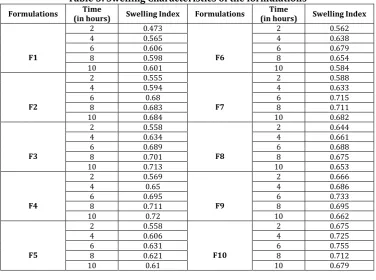
Swelling index was calculated with respect to time (Figure 2). Formulation 10 showed maximum swelling as depicted in table 3. As the time increased the Swelling Index was also increased, because weight gain by tablet was increased proportionally with the rate of hydration up to 6 hours. Later on, it decreases gradually due to dissolution of outermost gelled layer of tablet into dissolution medium. A direct relationship was observed between swelling index and polymer concentration. As the
polymer concentration increased, swelling index was increased. In present study, higher swelling index was found for formulation 10 containing a combination of HPMC K4M and Sodium Alginate, due to higher concentration of Sodium Alginate which has higher water intake capacity.
In vitro dissolution studies
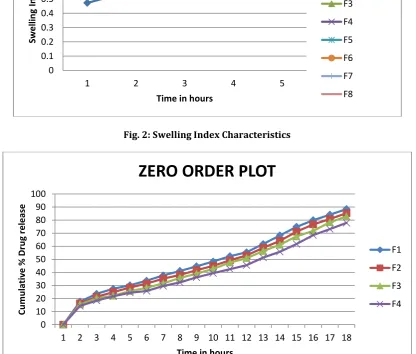
In vitro dissolution data of Glimepiride from formulated tablets is as in table 4. Tablets containing 20%, 30%, 40% and 50% w/w of matrix containing only one polymer HPMC K4M and its combination in three different ratios viz. 4:1 (20%), 3:1 (30%), 2:1 (40%) (HPMC K4M: HPMC 100 LV matrices) and 4:1 (20%), 3:1 (30%), 2:1 (40%) (HPMC K4M: Sodium Alginate matrices) were used to prepare matrix tablets. Results of dissolution studies of formulations F1, F2, F3 and F4 are shown in figure 3. Tablets F1, F2, F3 and F4 released 17.6%, 16.25%, 15.5% and 14.3% at the end of 2 hours and 88.45%, 85.29% 82.74%, 77.81% of drug at the end of 24 hours respectively.
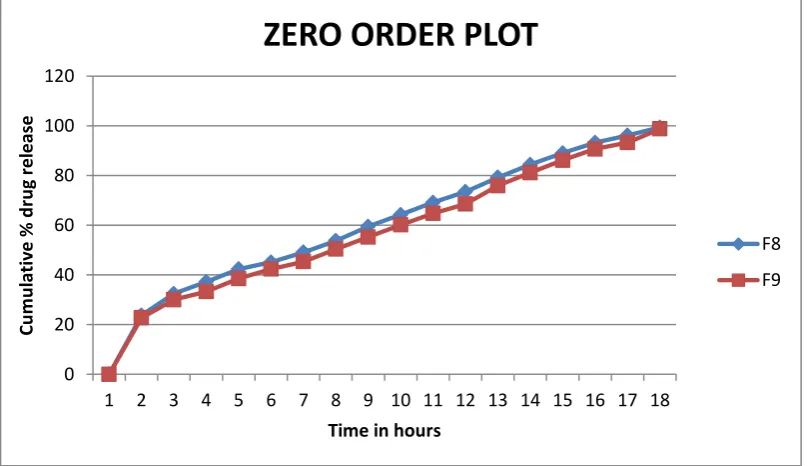
Formulations F1, F2 and F3 were further modified by incorporating different low viscosity polymers such as HPMC K100 LV and Sodium Alginate. Results of dissolution studies (Figure 4) of tablets containing HPMC K4M and HPMC K100 LV in combination indicate that F5, F6 and F7 released 21.25%, 20.84% and 20.28% at the end of two hours and 97.47%, 96.12% and 94.65% at the end of 24 hours respectively. Tablets containing HPMC K4M and Sodium Alginate in combination indicate that F8, F9 and F10 released 23.78%, 22.75% and 22% at the end of two hours and 99.38%, 98.76% and 97.53% at the end of 24 hours respectively. In vitro release results are as shown in figure 5. Incorporation of Sodium Alginate along with HPMC K4M [1:4 (20%w/w)] hastens release rate of Glimepiride giving a release of 99.38% at the end of 24 hours.
The drug release rate and burst effect decreased with the increase in tablet content of HPMC K4M. It was also noted that the drug released was incomplete with increase in concentration of HPMC K4M.
high dissolution rate observed with sodium alginate could be due to its low swelling ability, indicated by lower viscosity values compared to other two polymers.
Accelerated Stability studies
Not much variation or changes were observed in the formulations; hence formulations were able to retain its stability. The results are tabulated in table 5.
CONCLUSION
The study discusses the preparation of SR tablets of Glimepiride, using gel forming polymers methocel and sodium alginate individually and in combination to sustain the release of Glimepiride. These tablets would prolong duration of drug release and help to maintain the drug plasma concentration. Investigation focused on studying the effect of different polymers and their combination on drug release. When the kinetics was fitted into 5 different mathematical models and then subjected to regression analysis, values indicated a zero order release profile. The mechanism of drug release is studied to be by diffusion and erosion. From all the results of investigations, we conclude that a
combination of HPMC K4M with HPMC K100LV and Sodium alginate as seen in formulation F5 and F9 is highly effective to retard the release of drug upto period of 24 hours and F8 is considered to be an ideal and optimized batch. Morever the release controlling materials are cheap, readily available, safe, and easy to handle and require simple technologies for the preparation of SR tablets. The investigation hopefully marks a successful endeavour.
ACKNOWLEDGEMENT
The authors are grateful to Micro Labs ltd. (Verna Goa) and Cadila Healthcare ltd. (Kundai-Goa) for providing gift sample of Glimepiride, Colorcon Asia (Verna Goa) for gifting Polymers, Glenmark Pharmaceuticals (Colvale-Goa) for gifting Microcrystalline Cellulose and Wallace Pharmaceuticals Pvt. Ltd. (Ponda-Goa) for providing gift sample of other excipients. Authors are also thankful to Wallace Pharmaceuticals Pvt. Ltd. (Ponda-Goa) for providing tablet compression facility and to Unichem Laboratories (Pilerne-Goa) for granting permission to use their Quality Control instruments.
Table 1: Composition of formulations
COMPOSITION OF SUSTAINED RELEASE TABLETS OF GLIMEPIRIDE
Ingredients F1 F2 F3 Quantity (mg) present in each tablet F4 F5 F6 F7 F8 F9 F10
Glimepiride 8 8 8 8 8 8 8 8 8 8 HPMC K4M 20 30 40 50 16 22.5 26.67 16 22.5 26.67 HPMC K100 LV - - - - 4 7.5 13.33 - - - Sodium alginate - - - 4 7.5 13.33 Microcrystalline
Cellulose 71.5 61.5 51.5 41.5 71.5 61.5 51.5 71.5 61.5 51.5 Colloidal Silicon
Dioxide 0.5 0.5 0.5 0.5 0.5 0.5 0.5 0.5 0.5 0.5 Defined bulk weight per tablet was 100 mg containing 8 mg Glimepiride.
F1 to F10 represents various tablet formulations of Glimepiride.
Table 2: Evaluation of Tablet parameters
Code Variation* Weight
(mg)
Thickness*
(mm) Hardness* (kg/cm2)
Diameter*
(mm) Drug Content## Friability*
F1 100.4±0.51 2.79±0.009 6.03±0.15 7.08±0.06 99.33±0.05 0.58±0.09
F2 100±0.66 2.83±0.008 5.67±0.17 7.09±0.08 98.50±0.66 0.60±0.09
F3 99.9±0.56 2.80±0.010 5.79±0.17 7.0±0.09 98.10±1.15 0.60±0.10
F4 100.4±0.51 2.72±0.009 5.89±0.19 7.03±0.06 98.43±0.75 0.70±0.11
F5 100.1±0.56 2.81±0.006 5.77±0.21 7.01±0.08 98.40±0.52 0.70±0.12
F6 100.3±0.67 2.79±0.01 5.97±0.17 7.0±0.08 99.20±0.42 0.72±0.10
F7 100.3±0.48 2.79±0.005 5.69±0.20 7.01±0.05 98.19±0.17 0.71±0.11
F8 100.2±0.63 2.75±0.004 5.57±0.15 7.0±0.04 98.16±0.14 0.72±0.12
F9 99.3±0.67 2.76±0.003 5.32±0.16 7.02±0.07 98.40±0.52 0.60±0.09
F10 100.1±0.73 2.78±0.003 5.27±0.19 7.01±0.09 98.66±0.57 0.71±0.12 F1 to F10 represents the various tablet formulations of Glimepiride.
Table 3: Swelling Characteristics of the formulations
Formulations (in hours) Time Swelling Index Formulations (in hours) Time Swelling Index
F1
2 0.473
F6
2 0.562
4 0.565 4 0.638
6 0.606 6 0.679
8 0.598 8 0.654
10 0.601 10 0.584
F2
2 0.555
F7
2 0.588
4 0.594 4 0.633
6 0.68 6 0.715
8 0.683 8 0.711
10 0.684 10 0.682
F3
2 0.558
F8
2 0.644
4 0.634 4 0.661
6 0.689 6 0.688
8 0.701 8 0.675
10 0.713 10 0.653
F4
2 0.569
F9
2 0.666
4 0.65 4 0.686
6 0.695 6 0.733
8 0.711 8 0.695
10 0.72 10 0.662
F5
2 0.558
F10
2 0.675
4 0.606 4 0.725
6 0.631 6 0.755
8 0.621 8 0.712
10 0.61 10 0.679
Table 4: In vitro dissolution
release profiles of SR Tablets
Formulation Code
Time (At the end of 2 hours)
Time (At the end of
24 hours)
F1 17.6 88.45
F2 16.25 85.29
F3 15.5 82.74
F4 14.3 77.81
F5 21.25 97.47 F6 20.84 96.12 F7 20.28 94.65 F8 23.78 99.38 F9 22.75 98.76 F10 22.0 97.53
Table 5: Stability Studies
Formulation code
##Content
uniformity (%)
**Hardness
(kg/cm2)
Fig. 1: Sustained Release Matrix Tablets of Glimepiride
Fig. 2: Swelling Index Characteristics
Fig. 3: Zero order plot of F1, F2, F3 and F4 0
0.1 0.2 0.3 0.4 0.5 0.6 0.7 0.8
1 2 3 4 5
Swe
lli
n
g
In
d
e
x
Time in hours
SWELLING INDEX CHARACTERISTICS
F1
F2
F3
F4
F5
F6
F7
F8
0 10 20 30 40 50 60 70 80 90 100
1 2 3 4 5 6 7 8 9 10 11 12 13 14 15 16 17 18
Cu
m
u
lativ
e
%
Dr
u
g r
e
le
ase
Time in hours
ZERO ORDER PLOT
F1
F2
F3
Fig. 3: Zero order plot of F5, F6 and F7
Fig. 3: Zero order plot of F8 and F9 0
20 40 60 80 100 120
1 2 3 4 5 6 7 8 9 10 11 12 13 14 15 16 17 18
Cu
m
u
lativ
e
%
d
ru
g
re
le
ase
Time in hours
ZERO ORDER PLOT
F5
F6
F7
0 20 40 60 80 100 120
1 2 3 4 5 6 7 8 9 10 11 12 13 14 15 16 17 18
Cu
m
u
lativ
e
%
d
ru
g
re
le
ase
Time in hours
ZERO ORDER PLOT
F8
REFERENCES
1. Bhonsle AV, Takwale RV and Sawant SD.
The Eastern Pharmacist.
2002;18(41):1573.
2. Wells TI and Anlton ME. Pharmaceutics-The Science of Dosage form design, English Language Book Society, London. 223-253.
3. Li VHK, Robinson JR and Lee VHL. Influence of drug properties and routes of drug administration of the design of sustained and controlled release system. Controlled Drug Delivery-Fundamentals and applications, drugs and pharmaceutical sciences, Marcel Dekker Inc, New York, 1987, 2nd Edition. Volume 29:4-94.
4. Chikhalikar K and Moorkath S. Carbopol Polymers: A versatile range of polymers for pharmaceutical application. Pharmabiz. 2002.
5. United States Pharmacopoeia 24- National Formulary 19. United state Pharmacopeial convention, Inc. 2000 Edition 24
6. Remington JP. The Science and Practice of Pharmacy. 20th Edition. 2000;2:904-908.