| |235
© ARCHIVES OF BUDO | SCIENCE OF MARTIAL ARTS
Interests in mobile activity forms of persons
practicing judo
Marcin Ściślak
ABCDE, Andrzej Rokita
CDE, Wiesław Błach
BCEUniversity School of Physical Education in Wroclaw, Poland
Source of support:
Departmental sources
Received:
14 July 2014;
Accepted:
09 June 2015;
Published online:
22 July 2015
ICID:
1164299
Abstract
Background & Study Aim:
One of the most important and conscious human activities taken up in order to satisfy needs to play or com-pete is a sport. It is expressed by, inter alia, exercises and games carried out according to certain rules. For per-sons who practice specific sports not only competition itself is significant. In martial arts, particularly in judo we can observe profound humanistic concepts and a way of perfecting one’s personality by constant studies, which results from training obligations. Taking into consideration the increasing trends of interests in mar-tial arts during the recent years, we decided to diagnose these interests in a group of persons practicing judo. A practical aim was the usage of the research results in planning and organising judo classes. We verified the hypothesis that interests in mobile activity forms of persons practicing judo depend upon their sex and age.Material & methods:
Subjects of our research were persons practicing judo (from juniors to seniors). We diagnosed interests inmo-bile activity forms of 72 persons (15 women and 57 men). The basic research method was a diagnostic opin-ion poll and the technique was a survey. For the purpose of determining interests in mobile activity forms we used a standardized survey questionnaire: ‘Interests in the scope of physical mobile activity’.
Results:
Women were mostly interested in martial arts and aerobic. Men preferred martial arts in the first place. There were other forms that enjoyed popularity such as athletics, tourism as well as other forms of mobile activity.Conclusions:
If physical education classes satisfy the students’ interests in mobile activity, it seems that it is highlyproba-ble that some positive attitudes towards physical culture and sport shall be formed in students in the course of the process.
Key words: combat sport • martial arts • physical culture
Author’s address: Marcin Ściślak, Team Sports Games Department, University School of Physical Education, Mickiewicza 58, 51-617 Wrocław, Poland; e-mail: [email protected]
Authors’ Contribution: A Study Design B Data Collection C Statistical Analysis D Manuscript Preparation E Funds Collection
ORIGINAL ARTICLE
Original Article
I
ntroductIonOne of the most significant tasks of a teacher and sport instructor in the process of formation and edu-cation is to arouse students’ curiosity and strengthen it thus leading to establishment of certain interests in a student. It is equally important to develop stu-dents’ passions, particularly in the process educating to the physical culture, in particularly to the sport. As it is commonly known, passions are a mental property which is characteristic of a positive attitude towards the specific activities that a given individual performs [1].
Contents, scope and maturity of interests depend on a number of general developmental factors. In the psychology of interests, among the factors whose role is emphasised and discussed at the same time, we can distinguish two groups: biogenetic factors and social and cultural factors [1].
Biogenetic factors comprise dependencies of inter-ests upon age, sex and talents. Social and cultural fac-tors include dependencies of interests upon a social environment and programmes and methods of school education [1].
One of the most important and conscious human activities taken up in order to satisfy needs to play or compete is a sport. It is expressed by, inter alia, exercises and games carried out according to cer-tain rules. For persons who practice specific sports not only competition itself is significant. In mar-tial arts, particularly in judo we can observe pro-found humanistic concepts and a way of perfecting one’s personality by constant studies, which results from training obligations [2]. This process of per-fection is usually conducted in sport sections on school premises or in sports clubs. It is interest-ing to notice that there are increasinterest-ing trends in young persons’ interests in martial arts [3]. It would be interesting to learn as well whether the young people practicing martial arts (for example, judo) are interested in martial arts only or perhaps they are also interested in some other forms of mobile activity.
History of judo dates back to the mid-19th century. This new hand-to-hand fighting method made into a sport was given a name in Japanese which is trans-lated as ‘gentle way’ of winning. A sportsman who mastered this fighting method can beat a physically stronger opponent (which often happens in the open category at least). An experienced Judoka is charac-terised by agility, the ability to use a wide range of
technical means of fighting, efficient defensive meth-ods as well as the ability to use force and opponent’s inertia against himself [4].
The main objective of martial arts is self-perfection. The way of spiritual development, way of life and auto-creation are more important here than a tech-nique itself, which of course does not mean that the practice itself is not meant to aspire to mastery [5].
It seems that a particular possible internal experience of each sportsman is ‘winning over oneself ’. This cate-gory of winning is synonymous to ‘crossing one’s own limits’, the philosophy of which seems to be the clos-est to combat practices [6].
The research on interests in mobile activity forms con-ducted so far concentrated on secondary school stu-dents in Poland [7-21] and abroad [22-28]. None of the researchers was involved in diagnosing interests in mobile activity forms of persons practicing vari-ous sports.
Taking into consideration the increasing trends of interests in martial arts during the recent years, we decided to diagnose the persons practicing judo.
A cognitive aim was knowledge about interests in mobile activity forms of persons practicing judo. A practical aim was the usage of the research results in planning and organising judo classes.
We verified the hypothesis that interests in mobile activity forms of persons practicing judo depend upon their sex and age [7,8,11-13,18,21,22,27]. In order to verify this hypothesis, we decided to answer the fol-lowing research questions:
1. Which mobile activity forms are the subject of interest of persons practicing judo?
2. Which mobile activity forms are the subject of interest of women and which of men practicing judo?
3. Do interests in mobile activity forms depend upon the sex and age of persons practicing judo?
M
aterIalandMethodsSubjects of our research were persons practicing judo (from juniors to seniors). We diagnosed interests in mobile activity forms of 72 persons (15 women and 57 men) (Table 1).
Cognitive activity – is any activity aimed at individuals for better orientation in the surrounding reality.
Interests – the interest is relatively stable observable tendency to explore the world around them taking the form of targeted cognitive activity a specific intensity manifested in relation to surrounding selective phenomena.
Mobile activity – is an expression of a particular attitude towards one’s own body, conscious and active concern for their development, fitness and health, the ability to organize and spend time with the greatest benefit of physical and mental health.
Ściślak M et al. – Interests in mobile activity...
Table 1. Number of subjects
Judo section
Sex
AZS AWF, Juvenia Wrocław, Gwardia Wrocław
Total Younger
Juniors 15-16 years of
age
Juniors 17-19 years old
Youths 20-22 years old
Seniors 20 years old and more
Women 4 3 4 4 15
Men 18 20 8 11 57
Total 22 23 12 15 72
Our research was conducted in January 2012 dur-ing judo classes in sports clubs AZS AWF Wrocław, Juvenia Wrocław and Gwardia Wrocław.
The basic research method was a diagnostic opinion poll and the technique was a survey. For the purpose of determining interests in mobile activity forms we used a standardized survey questionnaire: ‘Interests in the scope of physical mobile activity’ [23].
Taking into account the subject matter of our research, we used the results of group 4 (1 subgroup – types of sports) of our opinion poll for the purpose of a statistical analysis.
Before starting our research, we familiarized the sub-jects with the survey questionnaire. The questionnaire was filled in by choosing sex, age, class and indicating according to the ranking 5 out of 17 favourite mobile activity forms (from the most favourite ones: 1, to the least favourite ones: 5).
By means of a Pearson chi-square test on the level of significance p < 0.05 we verified the hypothesis that interests in forms of mobile activity of persons prac-ticing judo do not depend on their sex and age.
r
esultsInterests in forms of mobile activity of persons practicing judo
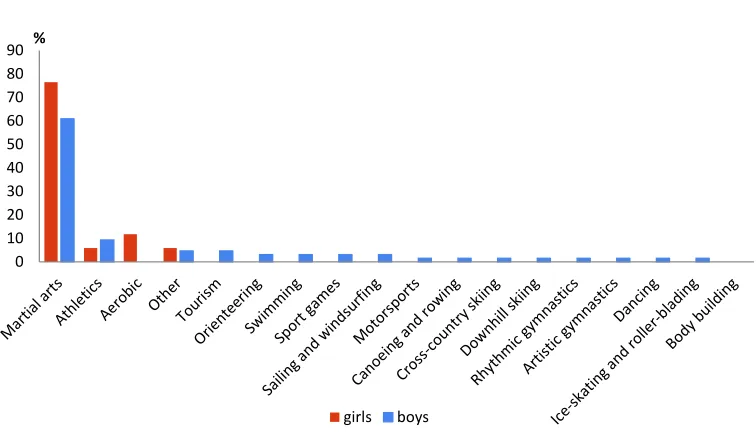
The most popular among persons practicing judo were definitely martial arts (64.19%). Further sports indi-cated by the subjects were athletics (8.64%) and tour-ism (3.7%). None of the subjects chose body building or dancing.
Sports such as motorsports, canoeing and rowing, cross-country skiing and downhill skiing, rhythmic
and artistic gymnastics, dancing and roller-blad-ing (1.23% each) were almost of no interest for the subjects.
With the use of a Pearson chi-square test we verified the hypothesis that interests in forms of mobile activ-ity of persons practicing judo do not depend on their sex and age. As it turned out on the level of signifi-cance p < 0.05, the sex of the subjects influenced the choice of two forms of mobile activities (martial arts and aerobic). Therefore, a further analysis was carried out with regard to the sex of the subjects.
A Pearson chi-square test also showed that on the level of significance p < 0.05, the age of the subjects influenced the choice of nine forms of mobile activi-ties (athletics, motorsports, swimming, orienteering, aerobic, sports games, tourism, downhill skiing, sail-ing and windsurfsail-ing). Therefore, a further analysis was carried out with regard to the age of the subjects.
Interests in forms of mobile activity of women practicing judo
The most popular among women practicing judo were martial arts (76.47%). Apart from this, aerobic (11.76%) and athletics (5.88%) were also quite pop-ular. None of the women was interested in motors-ports, canoeing and rowing, cross-country skiing and downhill skiing, body building, rhythmic and artistic gymnastics, orienteering, sports games, dancing, tour-ism, sailing and windsurfing, ice-skating and roller-blading (Figure 1).
Interests in forms of mobile activity of men practicing judo
The most popular among men practicing judo were martial arts (60.93%). Next, forms such as athletics (9.37%), tourism (4.68%) and other mobile activity forms (4.68%) were chosen. None of the men was interested in body building and aerobic (Figure 1).
Interests in mobile activity forms of juniors and younger juniors (15-16 years old)
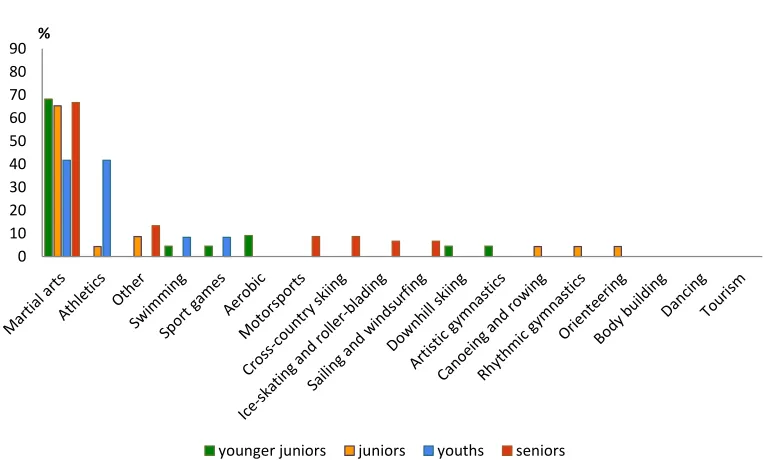
The most popular among juniors and younger juniors practicing judo were martial arts (68.18%). Also pop-ular were such forms as aerobic (9.09%), artistic gym-nastics (4.54%), swimming (4.54%), sports games (4.54%), ice-skating and roller-blading (4.54%) and downhill skiing (4.54%). None of the subjects was interested in canoeing and rowing, cross-country ski-ing, body buildski-ing, rhythmic gymnastics, orienteer-ing, aerobic, dancorienteer-ing, tourism, sailing and windsurfing (Figure 2).
Original Article
Interests in mobile activity forms of male and female juniors (17 - 19 years old)
Male and female juniors were mostly interested in martial arts (65.21%). Quite popular were such forms as tourism and other mobile activity forms (8.69% each), athletics, canoeing and rowing, rhythmic gym-nastics, orienteering (4.34% each). None of the sub-jects was interested in the remaining twelve mobile activity forms (Figure 2).
Interests in forms of mobile activity of youths (20 – 22 years old)
Among youths the most popular mobile activity forms were martial arts and athletics 41.66% each). Also popular were such forms as swimming and sports games (8.33% each). None of the subjects was interested in the remaining fourteen mobile activity forms (Figure 2).
Interests in forms of mobile activity of male and female seniors (20 years of age and more)
Male and female seniors were mostly interested in martial arts (66.66%). Apart from this, also popular forms were other mobile activity forms (13.33%), motorsports and cross-country skiing (8.66%) and ice-skating and roller-blading, sailing and windsurf-ing (6.66% each). None of the subjects was inter-ested in the remaining thirteen mobile activity forms (Figure 2).
Summarising, independently of the age of the sub-jects, the most popular mobile activity form among
persons practicing judo is martial arts. None of the subjects was interested in the remaining twelve mobile activity forms (Figure 2).
d
IscussIonPhysical culture and sport are particularly important for human development and protection of our health and psycho-physical ability, which are endangered by the contemporary civilization that drastically elimi-nates all physical effort from our daily life and favours a sedentary lifestyle (sedentariness). This results in civilization diseases and lowering vitality and qual-ity of life, which can be remedied by movement and sport in their broad meaning [29].
In the years 2007-2010 the Supreme Chamber of Control [30] carried out inspections of student par-ticipation in physical education classes in the case of 18 661 students. In the inspected schools it could be observed that along with the subsequent stages of edu-cation critical perception of participation in physical education classes is on the increase. In the conducted survey, almost one fifth of final grade primary school students, one fourth of lower secondary school students and one third of secondary school students expressed opinions that these classes were not interesting.
In the years 1985-1986 Strzyżewski and Górna [31] conducted research on students’ opinions about phys-ical education and sport classes in several towns of southern Poland. They examined 3696 male and female students of primary and secondary schools.
Interests in mobile activity forms of persons practicing judo
Figure 1. Interests in forms of mobile activity of persons practicing judo.
Figure 2.
Interests in forms of mobile activity of persons practicing judo (younger juniors,
juniors, youths, seniors).
0 10 20 30 40 50 60 70 80 90 %
girls boys
0 10 20 30 40 50 60 70 80 90 %
younger juniors juniors youths seniors
Figure 1. Interests in forms of mobile activity of persons practicing judo.
Ściślak M et al. – Interests in mobile activity...
The research material was collected on the basis of an anonymous survey containing 36 questions concerned with various aspects of school physical education classes (students’ attitudes towards physical educa-tion classes, sport and physical educaeduca-tion teachers).
In this way, students’ attitudes towards physical edu-cation during the years 1985-1986 were described. The following conclusions can be drawn from these observations:
• young people’s attitudes towards physical education deteriorate along with their age (starting from grade 5 of primary school until their final year at second-ary school),
• relatively high percentage of students do not under-stand the basic meaning of physical exercises and their significance in human life [31].
These findings were further confirmed by the studies carried out in 1999 by Dobosz and Trzcińska [32]. They proved the students’ increas-ing tendency not to participate in physical educa-tion classes due to long term doctor’s excuses (on average 10,6% of girls and 8,4% of boys within each grade had such excuses).
Taking into consideration the result of the inspection by the Supreme Chamber of Control [30] as well as of other researchers [29,32-34], the authors decided to diagnose interests in forms of mobile activity of per-sons practicing judo.
The studies that we have carried out showed signifi-cant differences in interests of persons practicing judo. These differences referred to their sex and age.
Women were mostly interested in martial arts and aerobic. Men preferred martial arts in the first place. Apart from this, athletics, tourism and other mobile activity forms enjoyed some popularity.
It seems that popularity of martial arts among youths practicing judo is influenced by their interests result-ing from the fact of practicresult-ing this sport.
None of the women was interested in motorsports, canoeing and rowing, cross-country skiing and downhill skiing, body building, rhythmic and artis-tic gymnasartis-tics, orienteering, sports games, dancing, tourism, sailing and windsurfing, ice-skating and roller-blading.
Quite opposite results were obtained by Bartoszewicz and Frömel [27] in 2002 and 2003. The most pop-ular among the girls were such forms as swimming, dancing and sports games, whereas the most popular forms with the boys were sports games, swimming and motorsports.
Similar results were achieved by Frömel, Ludva, Formankova [22]. In their studies carried out in 1995, the girls were mostly interested in sports games, swimming and ice-skating, whereas boys preferred body building, swimming and downhill skiing.
Interests in mobile activity forms of persons practicing judo
Figure 1. Interests in forms of mobile activity of persons practicing judo.
Figure 2.
Interests in forms of mobile activity of persons practicing judo (younger juniors,
juniors, youths, seniors).
0 10 20 30 40 50 60 70 80 90 %
girls boys
0 10 20 30 40 50 60 70 80 90 %
younger juniors juniors youths seniors
Figure 2. Interests in forms of mobile activity of persons practicing judo (younger juniors, juniors, youths, seniors).
Original Article
According to Górna [9], gymnastic is highly placed as the third most popular mobile activity form. None of the men was interested in body building and aerobics.
Similar results were achieved by Bartoszewicz and Frömel [27] by indicating that the least popular forms with the girls were body building and cross-country skiing whereas the least preferred forms for the boys were cross-country skiing, rhythmic gymnastics and aerobic.
According to Frömel, Ludva, Formankova [22] the least preferred forms with the girls were motorsports, canoeing and rowing as well as orienteering. The least popular forms with the boys were aerobic and rhyth-mic and artistic gymnastics.
The existing differences between the results of Bartoszewicz and Frömel [27], Frömel, Ludva, Formankova [22] or Górna [9] and our results may have resulted from the given research environment and the course of conducting research.
According to Rokita [16], who analysed students’ interests in forms of mobile activity, the forms of mobile activity that enjoy the greatest popularity ought to be realized in secondary schools as part of school physical education in classes and the best thing to do is to create out-of-class groups of com-mon interests for the students.
c
onclusIonsIf physical education classes satisfy the students’ inter-ests in mobile activity, it seems that it is highly prob-able that some positive attitudes towards physical culture and sport shall be formed in students in the course of the process.
Taking into consideration the actual interests in mobile activity forms of persons practicing a partic-ular sport, we can make a monotonous training pro-cess more attractive by satisfying sportsmen’s needs and expectations.
a
cknowledgeMentsWe would like to thank the coaches of judo section of the clubs KS AZS AWF Wrocław, Juvenia Wrocław and Gwardia Wrocław for enabling us to conduct our research.
c
oMpetIngInterestThe authors declare that they have no competing interests.
r
eferences1. Gurycka A. Rozwój i kształtowanie zainteresowań. Warszawa: PWN; 1989 [in Polish]
2. Gospodarek T, Maśliński J, Cieplicki M. Judo. Od kadeta do mistrza. Wrocław: MCM multimedia; 2000 [in Polish]
3. Uczestnictwo Polaków w sporcie i rekreacji ruchowej w 2008 roku. Warszawa: GUS; 2009 [in Polish] 4. Sterkowicz S, Kiejda I, Błach W. Charakterystyka
sposobów walki judo w igrzyskach olimpijskich 1988-1996. Trening 1997; 1: 27-33 [in Polish] 5. Cynarski WJ. Budo – funkcje sportowe,
wychowaw-cze, kulturowe. Sport Wyczynowy 2000; 1-2: 89-93 [in Polish]
6. Kalina RM. Rozwój – realna perspektywa tre-nowania sportowca. Trening 1997; 4: 101- 109 [in Polish]
7. Rokita A. Zainteresowanie uczniów liceów ogólnokształcących zespołowymi grami sportowymi. In: Naglak Z, Panfil R, editors. Team sports games in physical education and sport. Wrocław: AWF; 1995: 31-36 [in Polish]
8. Rokita A. Zainteresowania aktywnością ruchową uczniów szkoły średniej a planowanie i realizacja zajęć dydaktycznych z wychowania fizycznego. In: Ślężyński J, editor. Effects of education in physical
9. Górna K. Zainteresowania młodzieży licealnej for-mami aktywności sportowo-rekreacyjnej. Kultura i Edukacja 1997; 3-4: 151-159 [in Polish] 10. Pławińska L. Zainteresowania młodzieży
szkol-nej wychowaniem fizycznym i sportem. Zeszyty Naukowe. Prace Instytutu Kultury Fizycznej Uniwersytetu Szczecińskiego 1997, 12: 71-79 [in Polish]
11. Rokita A. Zainteresowania formami aktywności ruchowej a postawa wobec kultury fizycznej uczniów szkół ponadpodstawowych. Dissertation. Wrocław: AWF; 1997 [in Polish]
12. Rokita A. Planowanie budżetu godzin z wychowania fizycznego a zaspokajanie zainteresowań uczniów aktywnością ruchową. In: Ślężyński J, editor. Effects of education in physical culture. Katowice: PTNKF: 1998: 47-50 [in Polish]
13. Rokita A. The timetable of physical education (PE) activities as an example of providing interest in mobile activity for students. In: Parisi P et al., editors. Proceedings of the 4th Annual Congress of the European College of Sport Science. Roma: University Institute of Motor Science; 1999: 397 14. Rokita A. Zainteresowania aktywnością ruchową
z piłką uczniów klas I liceum ogólnokształcącego w latach 1995-2001. Hum Mov 2001; 1 (3): 93-96
15. Mynarski W, Tomik R. Formy i zakres aktywności ruchowej w czasie wolnym uczennic i uczniów gim-nazjów. Ann Univ Mariae Curie-Skłodowska 2005; 60, (16): 28-31 [in Polish]
16. Rokita A. Interest in sport activity among first year secondary school students in the years 1995-2001. Kinesiology 2005; 37 (1): 99-105
17. Bartoszewicz R. Transfer między zainteresowaniami sportowymi a aktywnością ruchową uczniów gim-nazjalnych w wybranych krajach europejskich. Ann Univ Mariae Curie-Skłodowska 2007; 1: 137-142 [in Polish]
18. Bartoszewicz R. Aktywność ruchowa młodzieży gimnazjalnej z południowo-zachodniej Polski na tle wybranych ośrodków europejskich. Studia i Monografie. Wrocław AWF; 2011 [in Polish] 19. Pankowska-Koc K. Zainteresowanie kulturą fizyczną
– czy wzrasta z wiekiem. Wych Fiz Zdrow 2012; 7: 20-22 [in Polish]
20. Ściślak M, Rokita A, Popowczak M, Kołodziej M, Kałużny K. Zainteresowania grami sportowymi uczniów liceów ogólnokształcących Wrocławia. Rozprawy Naukowe AWF we Wrocławiu 2012; 39:149-158 [in Polish]
Ściślak M et al. – Interests in mobile activity...
22. Frömel K, Ludva P, Formankova S. Structure of sporting interests and motor activities of young peo-ple. Telesna Kultura 1995, 96: 5-47
23. Frömel K, Bartoszewicz R. Aspect of organiza-tion in the structure of sporting interests and motor activity in children in the regions of Olomouc and Wroclaw. In: Pavlović M, editor. Sport Mladih. III Mednarodni Simpozij. Zbornik. Fakulteta za sport. Ljubljana; 1998: 94-99
24. Frömel K, Novosad J. Motor activity in a week’s routine of secondary school pupils. In: Pavlović M, editor. Sport Mladih. III Mednarodni Simpozij. Zbornik. Fakulteta za sport. Ljubljana; 1998: 100-106
25. Frömel K, Skalik K, Sigmund E, Vasendova J, Neuls F, Wirdheim E. Analysis of physical activity in 16
and 18 year-old grammar school students within international context. J Hum Kinet 2000, 3: 103-113 26. Greenwood M, Stillwell J, Byars A. Activity prefer-ences of middle school physical education students. Educator 2001; 2: 26-29
27. Bartoszewicz R, Frömel K. Motor activity of junior high school students in the period of socio-economic transformations in Poland and the Czech Republic. Hum Mov 2006; 7 (1): 14-24
28. Kurkova P. Telesna vychova a preference volnocaso-vych aktivit u zaku se sluchovym postizenim. Telesna Kultura 2010; 33 (1): 7-25
29. Harasymowicz J. Humanistyczne wartości – wychowania fizycznego i sportu. Wych Fiz Zdrow 2009; 56, (3): 45-46 [in Polish]
30. Supreme Chamber of Control. NIK o wychowaniu fizycznym w szkole. Warsaw: NIK; 2013 [accessed 2014 May 9]. Available from: URL:http://www.nik. gov.pl. Accessible 09.05.2014 [in Polish] 31. Strzyżewski S, Górna K. Lekcje wychowania
fizycz-nego i sport w opinii uczniów i uczennic. Katowice: AWF; 1989: 22-24 [in Polish]
32. Dobosz J, Trzcińska D. Kto i dlaczego nie ćwiczy na lekcjach WF? Wychowanie Fizyczne i Zdrowotne 2000; 2/3: 81-83 [in Polish]
33. Litwiniuk A, Daniluk A, Cynarski W. Structure of personality of persons training ju-jitsu and wrestling. Arch Budo 2010; 6 (3): 129-136
34. Mountjoy M. Sports: keeping young people healthy. Brit J Sport Med 2011; 45 (11): 837-942
Cite this article as: Ściślak M, Rokita A, Błach W. Interests in mobile activity forms of persons practicing judo. Arch Budo 2015; 11: 235-241